Flu Test and Tamiflu in Korea: Rapid Test Cost, Who Gets Antivirals on NHIS, Clinic or ER
Haesul Health desk (AI-assisted). As of 19 November 2026 (KST). Based on the Korea Disease Control and Prevention Agency (KDCA) press release declaring the 2026–2027 flu advisory (11 September 2026) and its attached Ministry of Health and Welfare (MOHW) antiviral coverage rules (notice 2017-193), KDCA’s sentinel surveillance bulletin for week 45 (published 12 November 2026), the 2026 national fee schedule and MOHW’s selective-benefit notice 2026-200, the National Health Insurance Service (NHIS) conversion factors, the 2026 non-covered fee disclosure by MOHW and the Health Insurance Review and Assessment Service (HIRA), and HIRA’s drug price list. Independent cross-checks: the Korean Hospital Association, the Korea Pharmaceutical Information Center, Mediprice, Yakcheck, the Korean Pharmaceutical Association’s newspaper, Maeil Shinmun and the UK’s NHS. General information, not medical advice.
Quick answer: If you have a sudden fever with a cough or sore throat this winter, go to a neighbourhood clinic (의원, uiwon) rather than an ER. A rapid flu test there is not covered by NHIS: the 2026 median price at clinics is ₩30,000. The flu antiviral oseltamivir (Tamiflu and generics) is prescription-only and is covered by NHIS in two cases: you test positive, or a flu advisory is in force and you are in a high-risk group (children 9 and under, pregnant women, people 65 and over, people with chronic illness and some others). In both cases it must start within 48 hours of the first symptoms. Korea’s 2026–2027 advisory has been in force since 11 September 2026. For a healthy adult on NHIS, a clinic visit, a positive test and a covered five-day course come to about ₩42,900 (our calculation). Call 119 for severe breathing difficulty, chest pain or coughing up blood.
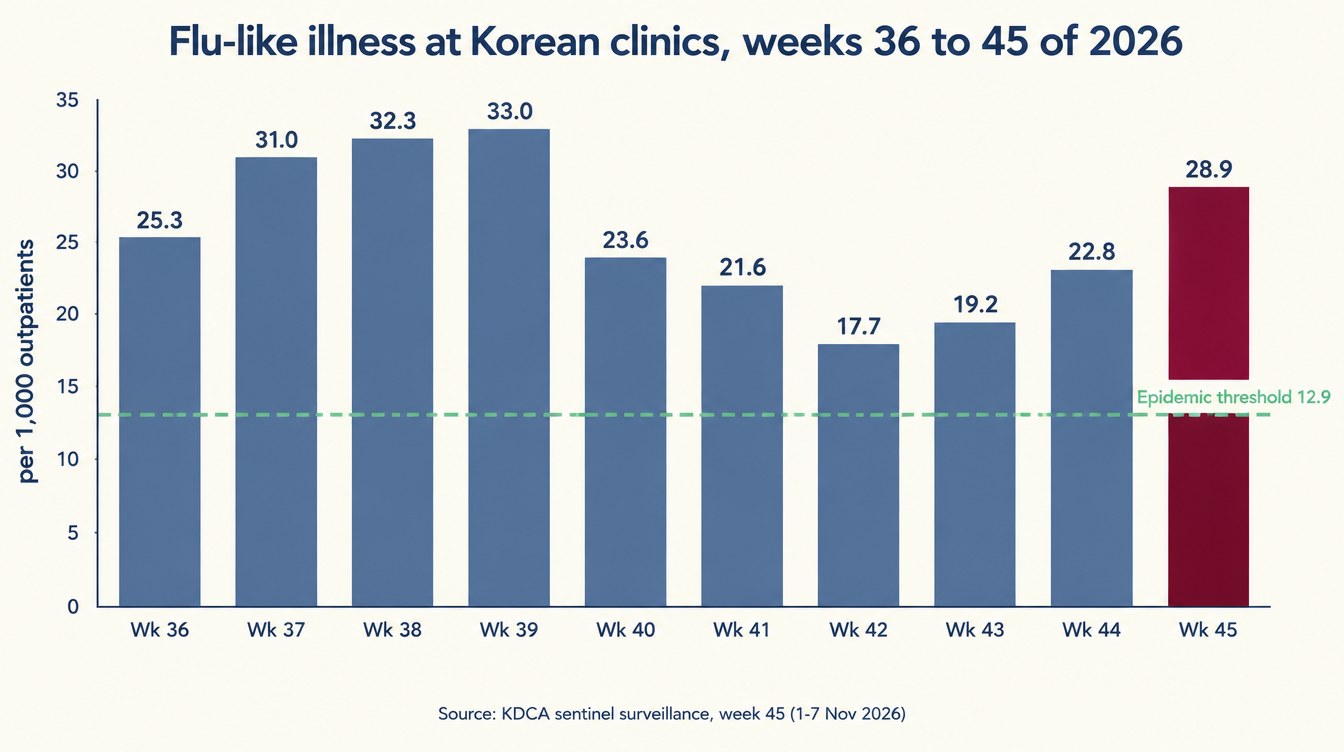
Why now: flu is climbing again. In KDCA’s week-45 bulletin (1 to 7 November 2026), clinics in the national sentinel network saw 28.9 people with flu-like illness per 1,000 outpatients, up from 17.7 in week 42, 19.2 in week 43 and 22.8 in week 44. That is more than twice this season’s epidemic threshold of 12.9. Hospital flu admissions at sentinel hospitals rose to 639 from 461 the week before. The rate is still below the same week last year (50.7), but this season started unusually early: KDCA declared the advisory on 11 September, when the week-36 rate had already reached 25.3. Last season’s advisory came on 17 October 2025. KDCA had not posted its week-46 bulletin when we checked on the morning of 19 November.
Who this applies to
- Foreign residents enrolled in NHIS. You pay the same as Korean patients: 30 percent of covered fees at a clinic, and the same antiviral rules. Most foreign residents are enrolled through work or, as regional members, after six months in Korea; our NHIS guide for foreigners explains who pays what.
- Tourists and anyone not yet on NHIS. None of the coverage below applies to you. You pay the full price for the visit, the test and the medicine, and claim it from travel insurance if you have it. The rules on testing, the 48-hour window and when to go to an ER still matter.
- Parents. Children aged 9 and under count as high-risk under the coverage rules, so during the advisory a doctor can prescribe a covered antiviral without a test. At night or at weekends, see our guide to Moonlight Children’s Hospitals and late-night pharmacies.
Clinic or ER? Where to go with flu symptoms
| Your situation | Where to go | Why |
|---|---|---|
| Fever, aches, sore throat or cough; you can eat, drink and breathe normally | A neighbourhood clinic: internal medicine (내과), family medicine (가정의학과), ENT (이비인후과) or a paediatric clinic (소아청소년과) for children | Cheapest place for a test and a prescription; most take walk-ins |
| Same symptoms, and you are 65 or over, pregnant, or have a heart, lung, kidney, liver or immune condition | A clinic, early, the same day if you can | KDCA asks high-risk people to see a doctor early; covered antivirals without a test apply to you during the advisory |
| Symptoms not getting better after about a week, or getting worse again | A clinic; tell the doctor how long you’ve been ill | The NHS lists symptoms that don’t improve after 7 days as a reason for an urgent appointment |
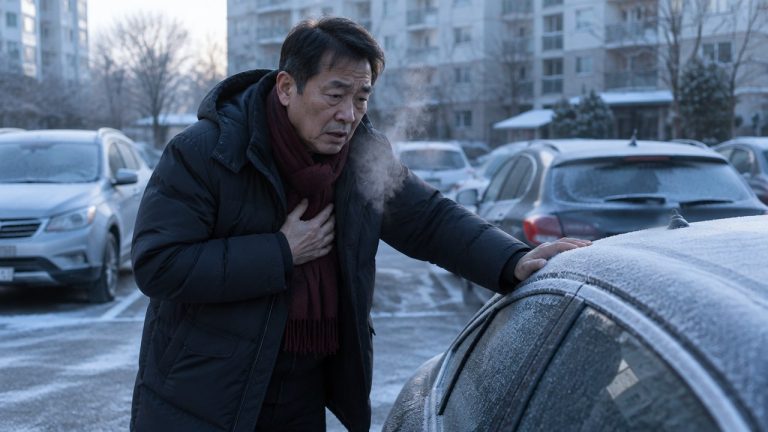
| Sudden chest pain, severe difficulty breathing (gasping, can’t finish a sentence), coughing up blood | Call 119 or go to an ER | The NHS’s emergency signs for flu; 119 is free and can connect an interpreter |
| A child who is floppy, hard to wake, struggling to breathe or not drinking | Call 119 | Don’t wait for a clinic to open |
A Korean ER is the expensive option for ordinary flu. Since 13 September 2024, NHIS patients whose visit is triaged as minor or non-urgent (KTAS 4–5) at a regional emergency medical centre pay 90 percent of the ER bill, and KTAS 5 patients pay 90 percent at local centres too. MOHW’s own estimate was an average of about ₩220,000 for such a visit at a regional centre and about ₩100,000 at a local one. Our ER guide for foreigners explains triage and the full rules.
The rapid flu test: what it is and what it costs
At a clinic, the doctor takes a swab from your nose and a rapid antigen test for influenza A and B gives a result during the same visit. Outside emergency departments it is a non-covered (비급여) item, so each clinic sets its own price and you pay all of it, NHIS or not.
| Where the test is done | How it is charged | 2026 price |
|---|---|---|
| Neighbourhood clinic (의원) | Non-covered, clinic sets the price | Median ₩30,000; average ₩27,300; highest ₩35,000 |
| All hospital types together | Non-covered | Average ₩27,400, unchanged from 2025 |
| Tertiary (university) hospital | Non-covered | Highest reported ₩65,000 |
| ER of a designated emergency institution, or an intensive care unit, when flu is suspected | Selective benefit (선별급여), patient pays 50 percent | 184.07 points × ₩83.8 = ₩15,420; you pay about ₩7,700 (our calculation) |
Sources for the table: the MOHW and HIRA 2026 non-covered fee disclosure (3 September 2026; 74,449 institutions; its example pair was a clinic at the ₩30,000 median and another at the ₩35,000 maximum), Mediprice’s breakdown of the same data by hospital type, and, for the ER row, the 2026 fee schedule (code 누-661, D6611: covered “only in emergency medical institutions and qualifying ICUs”) read together with MOHW notice 2026-200, which sets the patient share at 50 percent.
Two practical points. First, prices are published: HIRA’s non-covered fee search (also in the 건강e음 app) lists each clinic’s price for “인플루엔자 A·B 바이러스항원검사[현장검사]”, so you can ask or check before the swab. Second, a cheap ER test does not make the ER cheap: the 90 percent rule above applies to the rest of the bill.
The test is not compulsory. Whether you need one is the doctor’s decision, but because it decides whether a healthy adult’s antiviral is covered, it is worth understanding the rules in the next section before you say yes or no.
When NHIS covers Tamiflu: the rules in plain English
Oseltamivir (오셀타미비르) is the only flu tablet or capsule on Korea’s NHIS drug list: Tamiflu is the original brand, and there are 17 covered generics. MOHW’s coverage rule (notice 2017-193, item 629, reprinted in full in KDCA’s 11 September 2026 release) covers it when both of the following are true. Outside these rules, “the patient pays the full drug cost”.
- Timing: it is started within 48 hours of the first flu symptoms (at least two of cough, headache, sore throat and similar, plus a high fever). Hospital inpatients are the only exception: for them a doctor can start it later.
- Who: either influenza is confirmed by a rapid antigen test or a PCR test, or a flu advisory (인플루엔자주의보) is in force and the patient is in one of these groups:
| High-risk group in the coverage rule | Notes |
|---|---|
| Aged 9 or under | Including babies from 2 weeks old |
| Pregnant, or within 2 weeks of giving birth | |
| Aged 65 or over | |
| Weakened immune system | |
| Metabolic disorders (such as diabetes), heart disease, lung disease, kidney problems, liver disease, blood disorders | Chronic conditions named in the notice |
| Neurological and neurodevelopmental disorders | |
| Under 19 and on long-term aspirin treatment | The list ends with “and others” |
So, during this season’s advisory, a 70-year-old or a 5-year-old with flu symptoms can get a covered prescription on the doctor’s judgement alone. A healthy 30-year-old needs a positive test for the same prescription to be covered. Without one, the doctor can still prescribe it, but you pay the full price of the medicine.
The second covered antiviral, inhaled zanamivir (리렌자로타디스크), follows the same structure with a slightly different list (age 7 and over; during an advisory, children 7 to 12, pregnant women from the third month, 65 and over, and chronic illness). Two other flu medicines are not covered: the single-dose IV drip peramivir (페라미플루), which press reports citing HIRA’s data put at ₩70,000 to ₩150,000 per dose including the drip fee, and the single-dose tablet baloxavir (조플루자), which is not on the NHIS drug list, so the pharmacy sets the price and you pay all of it.
What an antiviral course costs at the pharmacy
HIRA’s drug price list sets the 2026 ceiling price of Tamiflu 75 mg at ₩1,659 a capsule (applied from 1 January 2026); the 17 covered generics range from ₩1,063 to ₩1,731 a capsule. The approved adult treatment course on the Korean label is 10 capsules over 5 days; your doctor sets the actual dose, which differs for children by weight. A Korean pharmacy also charges a dispensing fee: for a 5-day prescription in 2026 that is ₩7,800 in total.
| Five-day course, adult, weekday daytime | Medicine | Dispensing fee | Total | You pay with NHIS (30 percent) |
|---|---|---|---|---|
| Tamiflu, covered | ₩16,590 | ₩7,800 | ₩24,390 | about ₩7,300 |
| Cheapest covered generic | ₩10,630 | ₩7,800 | ₩18,430 | about ₩5,500 |
| Highest-priced covered generic | ₩17,310 | ₩7,800 | ₩25,110 | about ₩7,500 |
| Tamiflu, not covered (no positive test, not high-risk) | ₩16,590 in full | share of ₩7,800 | roughly ₩17,000 to ₩19,000 (our estimate) |
Our calculation: capsule price × 10 + the 2026 five-day dispensing fee, × 30 percent, rounded down to the nearest ₩100 as pharmacies do. The last row assumes the pharmacy charges the medicine at its listed price and your usual share of the dispensing fee; pharmacies may bill uncovered prescriptions slightly differently, so ask at the counter. Patients 65 and over and children under 6 pay lower shares at pharmacies, so their bills will be lower than these.
Worked examples: a whole flu visit
These assume an NHIS-insured patient at a neighbourhood clinic on a weekday, a first visit, and the clinic-level consultation fee in the 2026 fee schedule (code AA154, 197.12 points × ₩95.6 = ₩18,840, of which you pay 30 percent, about ₩5,600). The test price is the 2026 clinic median.
| Scenario | Visit | Test | Medicine at pharmacy | Total you pay |
|---|---|---|---|---|
| Healthy adult, test positive, covered Tamiflu | ₩5,600 | ₩30,000 | ₩7,300 | about ₩42,900 |
| Healthy adult, test negative, no antiviral | ₩5,600 | ₩30,000 | none | about ₩35,600 + any other prescription |
| Healthy adult, no test, doctor prescribes anyway (not covered) | ₩5,600 | none | about ₩17,000–19,000 | about ₩22,600–24,600 |
| High-risk patient during the advisory, no test, covered Tamiflu | ₩5,600 | none | ₩7,300 (less for 65+ and under 6) | about ₩12,900 or less |
| Tourist without NHIS, test positive | ₩18,840 or more | ₩30,000 | ₩16,590 + ₩7,800 | at least about ₩73,200 |
All figures are our calculations from the official prices above and are for illustration only. Clinics may charge uninsured patients more than the fee-schedule rate, so tourists should treat the last row as a floor. Evening, night, Saturday-afternoon and holiday surcharges apply to the consultation and dispensing fees.
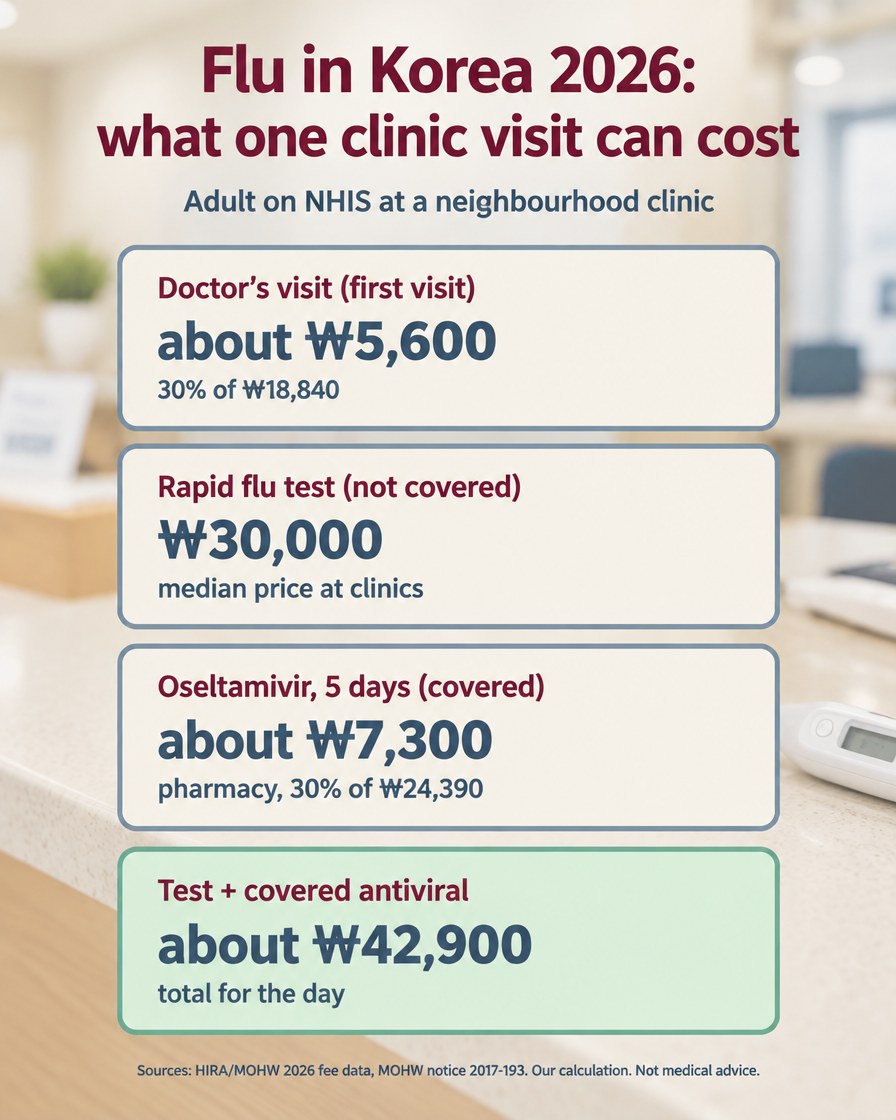
The table shows why the test question matters for a healthy adult. A positive test makes the medicine cheap, but the test itself costs more than the uncovered medicine. Whether you need a test, an antiviral or neither is a medical decision: many healthy adults recover from flu with rest and fluids, and the coverage rules exist because high-risk groups gain the most from early treatment. Tell the doctor honestly when your symptoms started, and whether anyone at home is high-risk (a baby, a pregnant partner, an older parent).
Your clinic visit, step by step
- Note the time your fever started. The 48-hour window runs from the first symptoms, not from when you reach the clinic. Write down the time and your first temperature.
- Bring ID. Your residence card, or your passport if you don’t have one, so the clinic can check NHIS. Our guide to seeing a doctor in English has phrases and tips on finding English-speaking clinics.
- Wear a mask in the waiting room. KDCA asks anyone with respiratory symptoms to wear one and cover coughs.
- Say what you need. Useful phrases: “독감 검사 비용이 얼마예요?” (How much is the flu test?) and “보험 적용돼요?” (Is it covered by insurance?).
- Get the prescription filled at any pharmacy. Korean pharmacies dispense only Korean prescriptions. For fever and aches, our guide to cold and flu medicine at a Korean pharmacy explains what you can buy without a prescription and the daily limits on acetaminophen.
- Keep your receipts. The clinic receipt separates covered (급여) and non-covered (비급여) items; travel insurers and Korean private medical insurance (실손보험) both ask for them.

Staying home: school, nursery and work
Korea’s joint flu management guideline for nurseries, kindergartens and schools (Ministry of Education, MOHW and KDCA) sets the stay-at-home period as until 24 hours after your temperature is back to normal without fever-reducing medicine, or 48 hours after the last dose if you took one. Doctors can set a longer period for people with severe illness or weak immune systems. Schools can bar a pupil with an infectious disease under the School Health Act (Article 8). The guideline uses the same period for staff at those facilities; for other workplaces, check your employer’s sick-leave rules. The NHS adds that people with flu are most infectious in the first 5 days.
Antibiotics do not treat flu. The NHS says doctors do not recommend them for flu because they don’t relieve symptoms or speed recovery. If flu turns into pneumonia, a doctor may prescribe them for that.
Common problems
- “The pharmacist won’t sell me Tamiflu.” It is a prescription medicine in Korea. See a clinic first.
- “My test was negative but I still feel awful.” Flu is not the only virus going round (in week 45, rhinovirus was found in 26.9 percent of respiratory samples at sentinel clinics, close behind flu at 27.7 percent). Go back if you get worse.
- “It has been more than 48 hours.” The coverage rule and the label both target the first 48 hours. Whether treatment still makes sense later is for the doctor to decide, particularly for high-risk patients and anyone admitted to hospital.
- “The clinic offered me an IV drip for flu.” That is usually peramivir, which is not covered by NHIS. Ask the price first. Maeil Shinmun reports that MFDS, in its 2020 approval review, judged peramivir and oral oseltamivir to work the same way with equivalent treatment effect.
- “Is it norovirus, not flu?” Vomiting and diarrhoea without much cough point elsewhere; our guide to norovirus in Korea’s winter covers that.
- “I wanted to prevent this.” It’s not too late for a flu shot this season; see our guide to the flu shot for adults under 65, and for people 65 and over, the free COVID and flu vaccines.
Frequently asked questions
Q. How much is a flu test in Korea?
At a neighbourhood clinic, the rapid influenza A and B antigen test is not covered by NHIS, so the clinic sets the price. In the 2026 government disclosure the clinic median was ₩30,000 and the clinic maximum ₩35,000. In a designated ER or intensive care unit it is half-covered, about ₩7,700 for the patient (our calculation), but the rest of an ER bill is much higher.
Q. Is Tamiflu covered by national health insurance in Korea?
Yes, but only within MOHW’s rules: it must start within 48 hours of symptoms, and either a rapid or PCR test confirms flu, or a flu advisory is in force and you are high-risk (9 or under, pregnant or just given birth, 65 or over, immunocompromised, or with certain chronic illnesses). Otherwise you pay the full drug price. A covered five-day adult course costs about ₩7,300 at the pharmacy (our calculation).
Q. Is the flu advisory in force now?
Yes. KDCA declared the 2026–2027 influenza advisory from 00:00 on 11 September 2026, and had not announced an end when we checked on 19 November. In week 45 (1 to 7 November), the flu-like illness rate was 28.9 per 1,000 clinic outpatients, more than twice the 12.9 threshold.
Q. Can I buy Tamiflu without a prescription?
No. Oseltamivir is a prescription-only medicine in Korea, so you need to see a doctor first and take the prescription to any pharmacy. Over-the-counter cold medicines can ease fever and aches but do not treat the flu virus.
Q. Should I go to the ER for the flu in Korea?
Not for ordinary symptoms. Insured patients triaged as minor or non-urgent at a regional emergency medical centre pay 90 percent of the ER bill, and MOHW estimated about ₩220,000 on average for such visits. Go to a clinic instead, and call 119 for severe breathing difficulty, chest pain, coughing up blood or a child who is hard to wake.
Q. How long should I stay home with the flu?
Korea’s flu guideline for nurseries and schools says until 24 hours after your temperature returns to normal without fever-reducing medicine, or 48 hours after the last dose if you took one. A doctor can set a longer period for severe illness or a weak immune system. Check your employer’s sick-leave rules for work.
Sources
- KDCA press release, 2026–2027 influenza advisory declared from 11 September 2026, with Attachment 3 (MOHW notice 2017-193, item 629: oseltamivir and zanamivir coverage) and the advisory history table (2025–26 advisory from 17 October 2025): https://www.kdca.go.kr/bbs/kdca/42/309662/download.do
- Korea Policy Briefing, KDCA advisory notice (15 September 2026): https://www.korea.kr/news/policyNewsView.do?newsId=148971832
- Korean Hospital Association, advisory notice citing KDCA 감염병관리과-2227 (high-risk table, routine test-positive rule): https://www.kha.or.kr/kha_home/notice_list.do?articleNo=47520&mode=view
- KDCA sentinel surveillance weekly bulletin, week 45 (1–7 November 2026, posted 12 November; ILI 28.9, threshold 12.9, 10-week series, admissions 639, detection rates): https://dportal.kdca.go.kr/pot/bbs/BD_selectBbs.do?q_bbsDocNo=20261112163809554&q_bbsSn=1010&q_clsfNo=2
- MOHW notice 2026-200, Standards for selective benefits, Annex 2 (누661 influenza A·B antigen test, 50 percent): https://www.law.go.kr/LSW/flDownload.do?flSeq=169848547
- 2026 fee schedule via Docple Check, specimen tests (누-661 D6611 184.07 points; ER/ICU-only note) and consultation (AA154 197.12): https://check-app.docple-plus.com/sugabook/node/25 and https://check-app.docple-plus.com/sugabook/node/10
- NHIS, conversion factors by year (2026 clinic ₩95.6, hospital ₩83.8): https://www.nhis.or.kr/announce/wbhaec11413m01.do
- KET News, MOHW/HIRA 2026 non-covered fee disclosure (3 September 2026; flu antigen test average ₩27,400): https://www.ket.kr/news/article.html?no=40518
- Health Chosun, same disclosure (clinic median ₩30,000 vs maximum ₩35,000): https://health.chosun.com/site/data/html_dir/2026/09/03/2026090303038.html
- Mediprice, Flu test cost 2026 (clinic average ₩27,300, tertiary maximum ₩65,000, ER selective-benefit calculation): https://mymedprice.co.kr/flu-test-cost-2026/
- Korea Pharmaceutical Information Center, Tamiflu 75 mg (₩1,659 per capsule from 1 January 2026; label; prescription-only): https://www.health.kr/drug/A11AGGGGA5141
- Yakcheck, oseltamivir 75 mg covered products (18 products, ₩1,063–₩1,731; HIRA list of 11 November 2026): https://www.yakcheck.co.kr/ingredient/358901ACH
- Korean Pharmaceutical Association newspaper (KPA News), 2026 pharmacy fees (five-day dispensing fee ₩7,800): https://www.kpanews.co.kr/news/articleView.html?idxno=266995
- Maeil Shinmun, Tamiflu vs peramivir costs (October 2026): https://www.imaeil.com/page/view/2026101113003563765
- Lifecatch, Peramivir and private insurance (peramivir not on the NHIS drug list as of April 2026): https://health.lifecatch.co.kr/lounge/insight/131/
- Ministry of Education, Q&A on flu exclusion periods (joint guideline with MOHW and KDCA), via the National Law Information Center: https://www.law.go.kr/LSW/cgmExpcInfoP.do?cgmExpcDatSeq=411586&ofiClsCd=350109
- NHS, Flu (reviewed 3 February 2026): https://www.nhs.uk/conditions/flu/
- Our ER guide (MOHW 90 percent rule and averages): https://en.haesul.com/korea-emergency-room-foreigners/
How we checked: On 19 November 2026 (KST) we read KDCA’s advisory release and the coverage notice it reprints, the week-45 bulletin PDF (and confirmed week 46 was not yet posted), MOHW’s selective-benefit notice PDF and the fee-schedule entries for the test and the consultation, then calculated each cost from points × NHIS conversion factor and the published drug and dispensing prices. Test prices come from the 2026 government disclosure as reported by two outlets and broken down by Mediprice.
This guide is general information, not medical advice. Whether you need a flu test, an antiviral or emergency care is for a doctor to decide; we give no doses. For severe breathing difficulty, chest pain or coughing up blood, call 119. For infectious-disease questions, KDCA’s 1339 call centre runs 24/7.
Researched and drafted with AI assistance; checked against the sources listed.


One Comment