Checking Blood Pressure at Home in Korea’s Winter: Free Monitors, Cuffs, NHIS Cover
Haesul Health desk (AI-assisted). As of 19 November 2026 (KST). Based on the Korea Disease Control and Prevention Agency (KDCA) hypertension page (updated 21 October 2026), its winter heart-and-brain health advice and cold-weather release, KDCA’s World Hypertension Day release (15 May 2026), the Korean Society of Hypertension (KSH) home blood pressure position statement and 2022 guideline update, the Ministry of Food and Drug Safety (MFDS) advice on blood pressure monitors, the Korea Consumer Agency’s monitor test, district health centre notices (Guro, Gangbuk, Dongducheon, Taebaek) and the Ministry of Health and Welfare (MOHW) chronic disease programme. Independent cross-checks: the UK’s NHS and the American Heart Association. General information, not medical advice.
Quick answer: In Korea you can check your blood pressure for free at your district public health centre (보건소, bogeonso) and, in many districts, at the community service centre (주민센터, jumin-senteo), where self-service automatic monitors sit in the lobby. Some health centres also lend a home monitor free for 1 to 3 months. To measure at home, use an upper-arm automatic monitor with a cuff that fits your arm, take two readings 1 to 2 minutes apart every morning and every bedtime for 7 days, and average them. Korea’s guideline treats a home average of 135/85 mmHg or higher as high blood pressure, so book a clinic visit and bring the log. If a reading is very high and you also have chest pain, one-sided weakness, slurred speech or sudden vision loss, call 119.
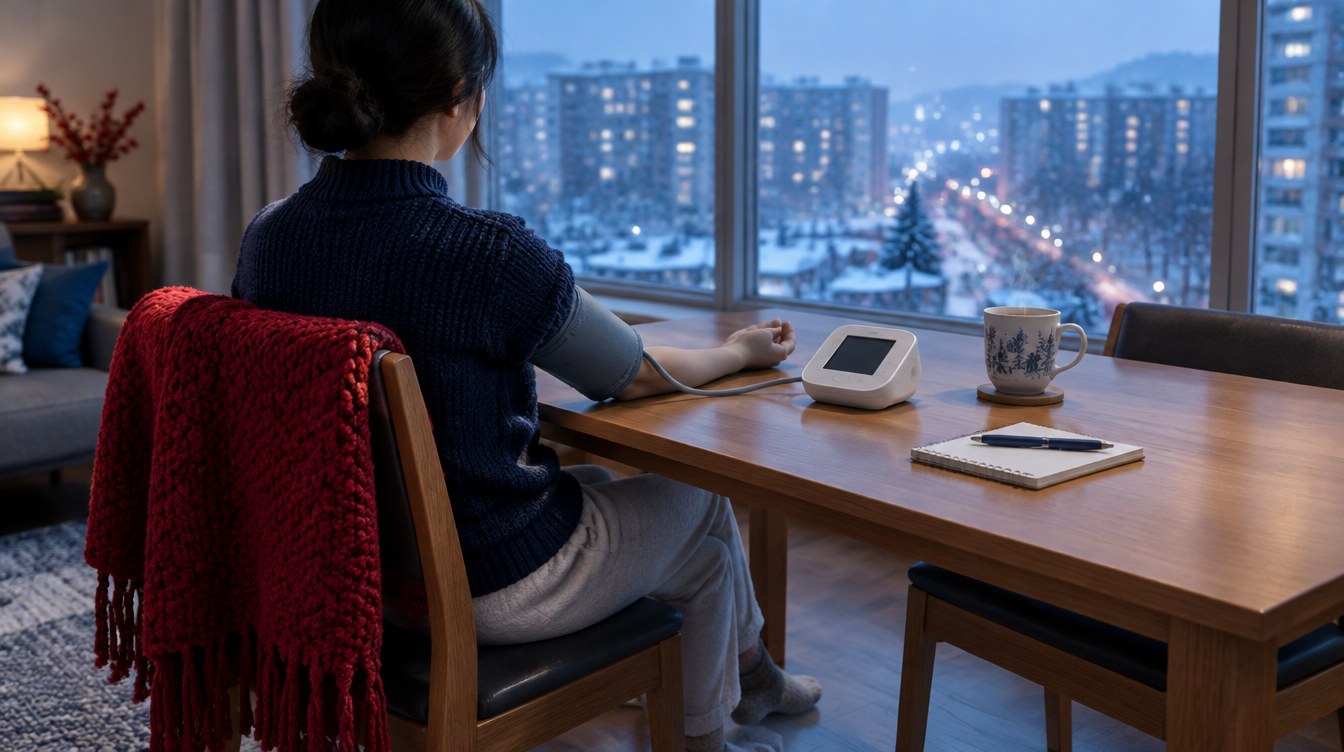
Why now: cold air tightens blood vessels and pushes blood pressure up. KDCA says that in winter the sympathetic nervous system makes peripheral arteries contract, blood pressure and heart rate rise, and lower body temperature makes blood clot more easily, and that deaths from heart and brain disease in Korea peak between December and February. MOHW’s 2026–27 winter protection period runs from 15 November 2026 to 15 March 2027. If you already take blood pressure medicine, or a checkup told you your numbers were borderline, the next three months are the time when a home log is most useful.
Who this applies to
- Foreign residents in Korea who have high blood pressure, were flagged on a checkup, or have a family history. Hypertension is common here: KDCA’s 2024 national survey found it in 26.3 percent of men and 17.7 percent of women aged 19 and over, and only about half of people with hypertension had it under control.
- Visitors and newcomers who brought their own medicine and want to keep an eye on their numbers during a cold trip.
- Anyone told by a doctor to keep a home log. The free district services below are open to residents of that district; a few are open to anyone who walks in.
KDCA’s hypertension rules say adults aged 20 and over should have their blood pressure measured at least once every two years, and every year if you are 40 or older, have a family history of hypertension, are living with obesity, or are already in the “pre-hypertension” range (systolic 130 to 139 or diastolic 80 to 89 mmHg).
Where to check your blood pressure for free
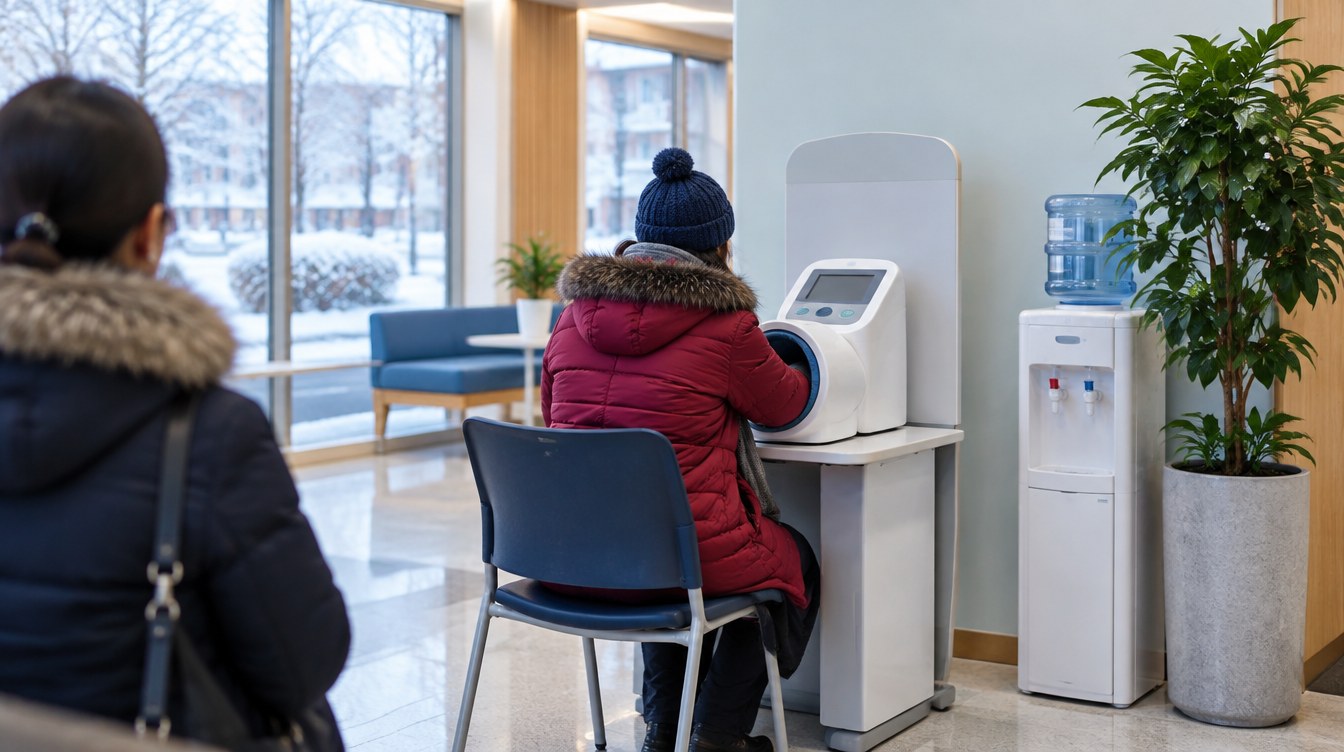
You don’t need an appointment, an NHIS card or Korean to use a lobby monitor. You sit, put your arm into the cuff tunnel or wrap the cuff, press the start button and read the printout or screen. Here is what official notices show, district by district. Every district runs its own scheme, so check your own health centre’s website or call before you travel across town.
| Where | What is offered | Who can use it | Source |
|---|---|---|---|
| Guro-gu, Seoul | Self-service automatic monitors in every neighbourhood community service centre, the district office lobby, the health centre and several sports centres | Anyone in the building | Guro-gu office, “Blood pressure monitors near you” page |
| Gangbuk-gu, Seoul | Self-service monitors at 16 sites (community centres, health branches, the health centre); free home monitor loan for 12 weeks, extendable once to 24 weeks, with a log book and a how-to booklet | Gangbuk residents with hypertension or who need blood pressure control; phone first | Gangbuk-gu notice (April 2025) |
| Dongducheon, Gyeonggi | Free home monitor loan for 8 weeks, once a year, from March 2026 | Any Dongducheon resident; phone, then visit | Newsro report, 13 February 2026 |
| Taebaek, Gangwon | Free loan of a blood pressure monitor and a glucose meter, 1 month plus a 2-month extension (3 months a year) | People diagnosed with hypertension or diabetes, and others who ask; bring ID | Taebaek health centre notice |
| Health centres in many districts | Blood pressure checks and counselling; the May–July 2026 KSH and KDCA “measurement month” ran free checks at health centres from Seoul to Jeju | Local residents | KDCA release, 15 May 2026 |
Pharmacies. Some neighbourhood pharmacies (약국, yakguk) keep a self-service monitor for customers, but this is a courtesy, not a public service, and we found no official list of which ones do. Ask at the counter; the pharmacist can also tell you how to read the result. In the UK many pharmacies offer free checks to people over 40 (NHS), but Korea has no equivalent national pharmacy scheme that we could find.
How good are lobby machines? A single reading on a public machine, taken after a brisk walk in the cold, is a snapshot. KDCA notes that readings change with cold or noisy rooms, poor posture and arm position, caffeine and stress, and that the right way to judge your blood pressure is to measure several times at the same time of day in a calm setting and use the average. Use the lobby machine to spot a problem, then confirm it with a home log or at a clinic.
Buying a home monitor in Korea
Blood pressure monitors are regulated medical devices in Korea. MFDS’s buying advice comes down to four points: check that the label says the product is licensed, notified or certified as a medical device; choose a cuff that fits your arm; analogue (stethoscope) types need training; and price has nothing to do with accuracy. The Korea Consumer Agency tested 10 popular upper-arm models in 2018 and found that all met the accuracy standard, including the cheapest; the models it bought online in September 2017 cost from ₩42,240 to ₩115,310 (prices then, not now). Pharmacies, medical-supply shops, large marts and online shops all sell them.
| What to look for | Why | Source |
|---|---|---|
| Upper-arm (팔뚝형 or 위팔형) automatic monitor | KSH says wrist devices are generally not used because they are inaccurate if the wrist is not at heart level; finger devices are not used. A validated wrist device is the fallback only for very large arms | KSH 2022 guideline update |
| The right cuff size | A cuff that is too small reads high. Measure round the thickest part of your upper arm and check it falls inside the range printed on the cuff | Korea Consumer Agency; MFDS |
| Medical device marking on the box | Shows the model went through Korean approval | MFDS |
| Averaging and memory, or an app | Makes a 7-day log easier; KCA found functions such as cuff-fit and movement detection vary by model | Korea Consumer Agency |
| Spare cuff | Cuffs stretch with use and should be replaced when worn | Korea Consumer Agency |
Smartwatches and phone apps are not a substitute. A cuffless watch reading needs regular calibration against a cuff monitor, and phone-camera apps are less accurate; bring cuff readings to your doctor (Korean Pharmaceutical Association’s journal, 2022).
How to measure at home: the 7-day log
These steps follow the Korean Society of Hypertension’s home blood pressure position statement, with the Korea Consumer Agency’s summary as a cross-check.
- No caffeine, exercise, smoking, bathing or alcohol for 30 minutes before you measure.
- Morning: within 1 hour of waking, after using the toilet, before breakfast and before any morning blood pressure medicine.
- Evening: within 1 hour before going to bed.
- Sit on a chair with your back supported, feet flat, legs uncrossed, and rest 1 to 2 minutes. Don’t talk.
- Wrap the cuff on your bare upper arm (thin clothing is acceptable), with the arm resting on a table so the cuff is at heart level. MFDS says the lower edge of the cuff should sit about 2.5 cm above the elbow crease.
- Take two readings 1 to 2 minutes apart each time and write both down.
- Do this for at least 7 days when blood pressure is first being checked, and for 5 to 7 days before a clinic appointment after that.
Winter tip: measure in a warm room, not straight after coming in from the cold, and keep the room at a steady temperature. KDCA lists a cold room as one of the things that change a reading, and its cold-weather advice is to keep indoor temperature at 18 to 20°C.
Worked example: averaging a log (our calculation)
The readings below are an invented example to show the arithmetic, not real patient data. Each line is the average of that session’s two readings.
| Day | Morning (mmHg) | Evening (mmHg) |
|---|---|---|
| 1 | 142/88 | 134/82 |
| 2 | 138/86 | 132/80 |
| 3 | 144/90 | 136/84 |
| 4 | 140/87 | 130/80 |
| 5 | 139/85 | 133/81 |
| 6 | 143/89 | 135/83 |
| 7 | 141/88 | 131/79 |
Morning systolic: (142 + 138 + 144 + 140 + 139 + 143 + 141) ÷ 7 = 987 ÷ 7 = 141. Evening systolic: (134 + 132 + 136 + 130 + 133 + 135 + 131) ÷ 7 = 931 ÷ 7 = 133. Overall systolic average: (987 + 931) ÷ 14 = 137. Diastolic works the same way: morning 613 ÷ 7 = 87.6, evening 569 ÷ 7 = 81.3, overall 1,182 ÷ 14 = 84.4.
So this person’s home average is about 137/84: the systolic number is above the 135 home line. The morning average of 141/88 is also above 135/85 while the evening is below it. KSH calls this pattern morning hypertension and notes it carries a higher risk of heart and brain events, which is why the guideline asks for morning readings before medicine. This log is exactly what a clinic doctor wants to see. Whether it means treatment is for the doctor to decide.
What the numbers mean, and when to see a doctor
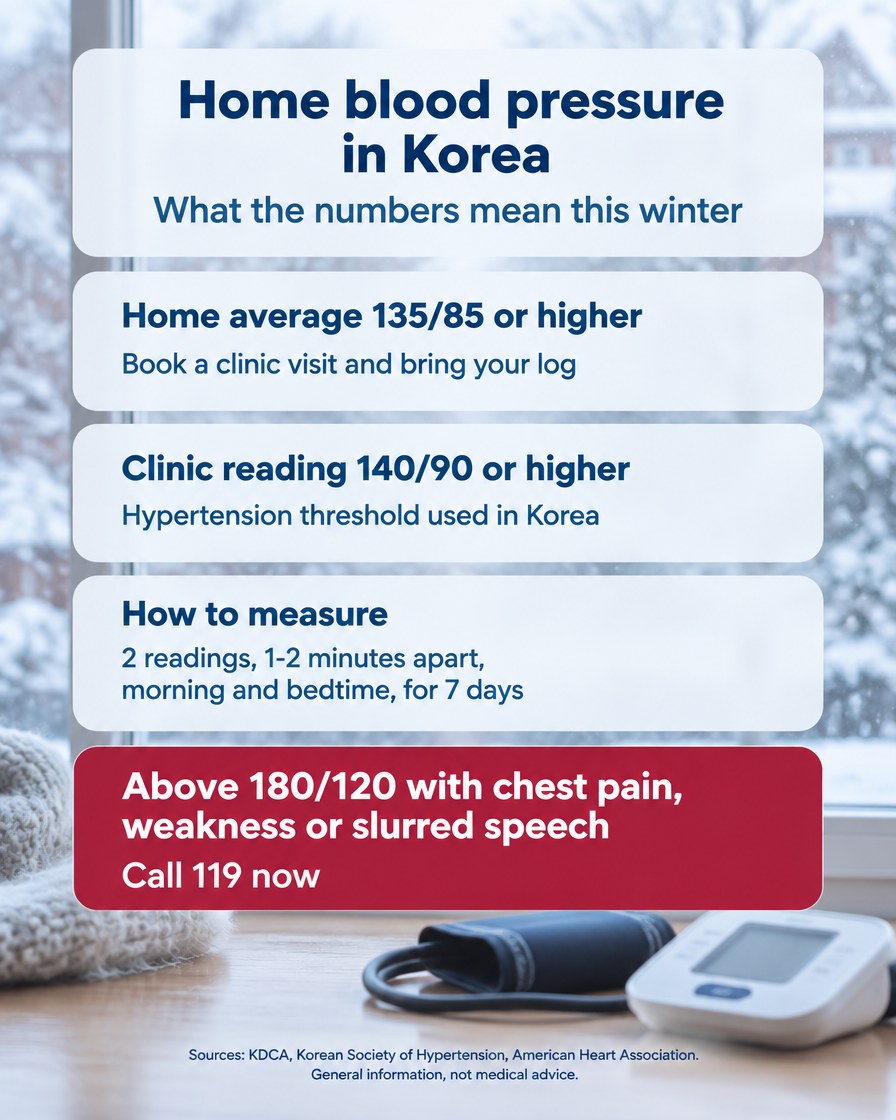
Home readings run lower than clinic readings, so Korea uses different cut-offs for each. The table below is general information from KDCA, KSH and the NHS, not a diagnosis.
| Situation | What it means | What to do |
|---|---|---|
| Home average below 135/85 and no diagnosis | Below the home hypertension line | Keep up yearly checks if you are 40+ or have risk factors (KDCA) |
| Clinic reading 130–139 / 80–89 | “Pre-hypertension” in Korea’s classification | Lifestyle changes and a home log (KDCA) |
| Home average 135/85 or higher | High blood pressure on home readings (KSH; NHS uses the same home line) | Book a clinic visit and bring the 7-day log |
| Clinic reading 140/90 or higher | Hypertension threshold used in Korea (KDCA) | See a doctor; ask about a home log or 24-hour monitoring |
| Already on treatment and home average 135/85 or higher | KSH calls this uncontrolled hypertension | Tell your doctor; don’t change or stop medicine on your own (KDCA) |
| Above 180/120 on two readings a minute apart, no symptoms | Severe hypertension (US guidance, American Heart Association) | Contact a doctor the same day |
| Above 180/120 with chest pain, shortness of breath, back pain, numbness, weakness, vision change or trouble speaking | Possible emergency (American Heart Association) | Call 119 now; don’t drive yourself |
In Korea, 119 is the number for ambulances. KDCA’s emergency advice for heart attack and stroke signs is the same: call 119 at once rather than waiting to see if it passes. Our guides to heart attack warning signs in Korea’s winter and to stroke signs and the BE FAST check explain what to look for.
If your national health checkup printed a blood pressure flag, our guide to blood pressure on Korea’s checkup and the 140/90 line explains the confirmatory visit, and blood pressure ranges by agency compares the Korean, US, UK and WHO categories.
What a clinic visit and NHIS cover cost
For a blood pressure check-up you can go to any neighbourhood internal medicine (내과) or family medicine (가정의학과) clinic without a referral. Foreign residents enrolled in National Health Insurance (NHIS) pay the same 30 percent clinic copay as Korean members; our guide to NHIS for foreigners in 2026 explains enrolment.
| Clinic visit (2026, under 65, weekday) | Full fee (NHIS price) | You pay with NHIS (30 percent) |
|---|---|---|
| First visit consultation | ₩18,840 | about ₩5,600 |
| Follow-up consultation | ₩13,360 | about ₩4,000 |
| Follow-up under the chronic disease programme (20 percent) | ₩13,360 | about ₩2,600 |
Our calculation: 2026 fee-book points for a clinic first visit (197.12) and follow-up (139.85) times NHIS’s 2026 clinic conversion factor of ₩95.6, rounded down to ₩10, with the copay rounded down to ₩100. Tests such as blood work or an ECG and any medicine are extra. Visitors without NHIS pay the full fee, and clinics may charge uninsured patients more, so ask first.
NHIS hypertension programme. If a clinic diagnoses hypertension, ask whether it takes part in the Primary Care Chronic Disease Management programme (일차의료 만성질환관리). MOHW says joining cuts your copay on the programme fee, the listed hypertension tests and follow-up consultations from 30 to 20 percent, and you can earn up to ₩80,000 a year in health points. Participating clinics also check your home readings remotely between visits. Our explainer on whether NHIS foreigners can join the chronic disease programme covers eligibility, fees and how to sign up.
KDCA’s registration programme. In 19 local areas (including Seongdong-gu in Seoul, Gwangsan-gu in Gwangju, Sejong, Gwangmyeong, Namyangju, Ansan, Bucheon and Hanam in Gyeonggi, Mokpo, Pohang and Jeju City), KDCA’s hypertension and diabetes registration programme (고혈압·당뇨병 등록관리사업) offers free education and counselling at a registration and education centre, appointment reminders by text, and, for patients aged 65 and over, a monthly discount of ₩1,500 on the clinic fee and ₩2,000 per condition on medicine. KDCA’s page says it is for people aged 30 and over living in those areas according to the resident register, so ask your health centre whether your foreign resident registration qualifies.
Your winter checklist
- Find your nearest free monitor: search your district office’s website for “자동혈압계 설치장소” (automatic monitor locations) or “혈압계 대여” (monitor loan), or ask at the 주민센터.
- Buy or borrow an upper-arm monitor with the right cuff size.
- Keep a 7-day log (morning and bedtime, two readings each) and repeat it 5 to 7 days before each clinic visit.
- Warm up before going out on cold mornings: dress in layers with a hat, gloves and scarf, and avoid sudden cold and heavy exertion such as shovelling snow. KDCA says people with hypertension or heart and brain disease should avoid snow-clearing and should ask their doctor first if they must.
- Keep taking prescribed medicine; KDCA says patients must not change or stop it on their own.
- Cut salt: KDCA’s hypertension rules recommend no more than 6 g of salt a day (about a teaspoon). Korean soups and stews are often salty, so leave some of the broth.
- Know the 119 signs for heart attack and stroke, and keep your log and medicine list on your phone for the paramedics.
Common problems
- “My numbers are different every time.” Normal. KDCA says blood pressure changes with stress, exercise, meals, caffeine and sleep. That’s why you average two readings per session over 7 days.
- “The left and right arms differ.” The Korea Consumer Agency’s summary says to manage by the arm that reads higher. Mention the difference to your doctor.
- “My cuff won’t close / is loose.” Wrong size. Check the arm range printed on the cuff; many brands sell larger or smaller cuffs separately.
- “It’s high at the clinic but fine at home.” That can be white-coat hypertension; the opposite, normal in clinic but high at home, is masked hypertension. KDCA says both are why home readings matter. Bring your log.
- “I can’t explain it in Korean.” Show the written log. For interpretation, call 1330 (Korea Travel Hotline, 24 hours, several languages).
Frequently asked questions
Q. Where can I check my blood pressure for free in Korea?
At your district public health centre (보건소) and, in many districts, at community service centres (주민센터), which keep self-service automatic monitors in the lobby. Guro-gu in Seoul, for example, lists monitors in every neighbourhood centre. Some health centres, such as Gangbuk-gu, Dongducheon and Taebaek, also lend home monitors free for 1 to 3 months to residents.
Q. What is a normal home blood pressure reading in Korea?
The Korean Society of Hypertension treats a home average of 135/85 mmHg or higher as high blood pressure, measured twice each morning and evening over at least 7 days. The clinic threshold is 140/90 mmHg. A normal clinic reading is below 120/80 mmHg, according to KDCA.
Q. Should I buy an upper-arm or a wrist blood pressure monitor?
Upper-arm. The Korean Society of Hypertension says wrist devices are generally not used because readings are inaccurate if the wrist is not at heart level; a validated wrist device is a fallback only for very large arms. MFDS adds that price has nothing to do with accuracy, so check the medical device marking and the cuff size instead.
Q. Does cold weather raise blood pressure?
Yes. KDCA says cold air makes peripheral arteries contract and raises blood pressure and heart rate, and that deaths from heart and brain disease in Korea are highest from December to February. Measure in a warm room and avoid sudden cold and heavy exertion.
Q. Does NHIS cover hypertension treatment for foreigners?
Foreign residents enrolled in NHIS pay the same 30 percent clinic copay as Korean members. If you join the Primary Care Chronic Disease Management programme at a participating clinic, MOHW says the copay on programme fees, listed tests and follow-up visits falls to 20 percent. We found no NHIS benefit for buying a home monitor, but some health centres lend one free.
Q. When is high blood pressure an emergency?
If a reading is above 180/120 mmHg on a repeat check and you also have chest pain, shortness of breath, back pain, numbness, weakness, vision changes or trouble speaking, call 119 at once. Without symptoms, contact a doctor the same day. These cut-offs are from the American Heart Association; KDCA’s advice for heart attack and stroke signs is likewise to call 119 straight away.
Sources
- KDCA National Health Information Portal, Hypertension (registered 1 August 2025, updated 21 October 2026; 140/90 definition, white-coat and masked hypertension, yearly checks, FAQ on why readings vary incl. cold rooms, do not stop medicine): https://health.kdca.go.kr/healthinfo/biz/health/gnrlzHealthInfo/gnrlzHealthInfo/gnrlzHealthInfoView.do?cntnts_sn=6765
- KDCA press release, World Hypertension Day: six hypertension rules (15 May 2026; 2024 prevalence men 26.3, women 17.7; measure every 2 years from 20, yearly from 40 or with risk factors; salt 6 g; K-MMM26 health-centre measurement campaign): https://www.kdca.go.kr/bbs/kdca/42/307093/download.do
- KDCA National Health Information Portal, monthly health information, heart and brain disease in summer and winter (August 2024; winter mechanism, deaths highest December to February, check blood pressure regularly): https://health.kdca.go.kr/healthinfo/biz/health/ntcnInfo/healthSourc/thtimtCntnts/thtimtCntntsView.do?thtimt_cntnts_sn=74
- KDCA National Health Information Portal, Winter cold-wave health rules (updated 2 June 2026; indoor 18 to 20°C; people with hypertension should avoid snow-clearing): https://health.kdca.go.kr/healthinfo/biz/health/gnrlzHealthInfo/gnrlzHealthInfo/gnrlzHealthInfoView.do?cntnts_sn=2048
- KDCA press release, Cold-related illness emergency room surveillance (2025–26 season; blood vessels contract and blood pressure rises in winter; chronic patients avoid sudden cold): https://www.kdca.go.kr/kdca/2847/subview.do?enc=Zm5jdDF8QEB8JTJGYmJzJTJGa2RjYSUyRjQxJTJGMjE1NDk2JTJGYXJ0Y2xWaWV3LmRvJTNG
- KDCA, Hypertension and diabetes registration programme (last reviewed 6 January 2026; 19 areas, age 30+, ₩1,500 / ₩2,000 discounts for 65+): https://www.kdca.go.kr/kdca/3361/subview.do ; Seongdong-gu health centre, same programme: https://bogunso.sd.go.kr/health/contents.do?key=2284
- Korean Society of Hypertension Home Blood Pressure Forum, Home blood pressure monitoring: a position statement (Clinical Hypertension, 2022; 30-minute rule, morning and bedtime timing, two readings 1 to 2 minutes apart, 7 days, 135/85, morning hypertension): https://link.springer.com/article/10.1186/s40885-022-00218-1
- The 2022 focused update of the 2018 KSH hypertension guidelines (home threshold 135/85; wrist and finger devices): https://pmc.ncbi.nlm.nih.gov/articles/PMC9930285/ ; KSH home blood pressure education materials: https://www.koreanhypertension.org/sense/family
- MFDS, Medical device safe-use information: blood pressure monitors (buying and use advice; cuff 2.5 cm above elbow crease; price unrelated to accuracy): https://www.mfds.go.kr/brd/m_464/view.do?seq=28287
- Korea Consumer Agency via Consumer24, Comparative test of home blood pressure monitors (17 April 2018; 10 upper-arm models, all accurate, ₩42,240 to ₩115,310 in September 2017; cuff size; morning and evening two readings): https://www.consumer.go.kr/user/ftc/consumer/cnsmrBBS/80/selectInfoCmprDetail.do?infoId=A1077573
- Guro-gu office, Blood pressure monitors near you (updated 2 July 2024): https://www.guro.go.kr/www/contents.do?key=4390
- Gangbuk-gu notice on monitor sites and the 12-week loan (April 2025), as republished by Welfarehello: https://www.welfarehello.com/community/hometownNews/55a82ec0-ff3a-4a12-be96-69222847dd10
- Newsro, Dongducheon health centre lends blood pressure monitors free (13 February 2026): https://www.newsro.kr/articles/1617430
- Taebaek health centre notice, Free loan of blood pressure and glucose meters: https://www.taebaek.go.kr/health/selectBbsNttView.do?bbsNo=65&key=624&nttNo=165129
- MOHW press release, Primary care chronic disease management moves to the full programme (30 September 2024; copay 30 to 20 percent, health points): https://www.mohw.go.kr/board.es?act=view&bid=0027&list_no=1483237&mid=a10503000000
- 2026 national fee schedule via Docple Check (clinic consultations AA154 197.12, AA254 139.85): https://check-app.docple-plus.com/sugabook/node/10 ; NHIS, Conversion factors by year (2026 clinic ₩95.6): https://www.nhis.or.kr/announce/wbhaec11413m01.do
- Money Today on MOHW’s 2026–27 winter protection plan (10 November 2026; 15 November 2026 to 15 March 2027): https://www.mt.co.kr/policy/2026/11/10/2026111009432892249
- Yakup Gongron (Korean Pharmaceutical Association journal), How to counsel patients on blood pressure (26 December 2022; watch readings need cuff calibration every 4 weeks, phone apps less accurate): https://www.kpanews.co.kr/news/articleView.html?idxno=301273
- NHS, Blood pressure test (reviewed 25 November 2025; 140/90 clinic, 135/85 home; free pharmacy checks for over-40s in England): https://www.nhs.uk/conditions/blood-pressure-test/
- American Heart Association, When to call 911 about high blood pressure (reviewed 14 August 2025; 180/120): https://www.heart.org/en/health-topics/high-blood-pressure/understanding-blood-pressure-readings/hypertensive-crisis-when-you-should-call-911-for-high-blood-pressure
How we checked: On 19 November 2026 (KST) we read KDCA’s hypertension page and winter advice, its May 2026 hypertension release, the KSH home blood pressure statement and guideline update, MFDS’s and the Korea Consumer Agency’s monitor advice, four district health centre notices and MOHW’s chronic disease programme release, then calculated clinic fees from the 2026 fee book and NHIS conversion factor. The 7-day log is an invented example to show the arithmetic.
This guide is general information, not medical advice. Whether you have hypertension, need medicine or should change a dose is for a doctor to decide. For chest pain, one-sided weakness, slurred speech or sudden vision loss, call 119. For health questions, KDCA’s 1339 call centre runs 24/7 (mainly infectious disease); for interpretation, call 1330.
Researched and drafted with AI assistance; checked against the sources listed.