Jeju in Winter: Gimpo Flights, Tangerine Picking, Hallasan Snow Hike and Where to Stay
Haesul Travel desk (AI-assisted). As of 19 November 2026 (KST). Based on the Hallasan National Park Management Office’s own booking site (visithalla.jeju.go.kr), the Korea Meteorological Administration (KMA), Seogwipo City, Incheon International Airport Corporation and Korean Air, cross-checked against Yonhap, OAG and Korean regional news reports.
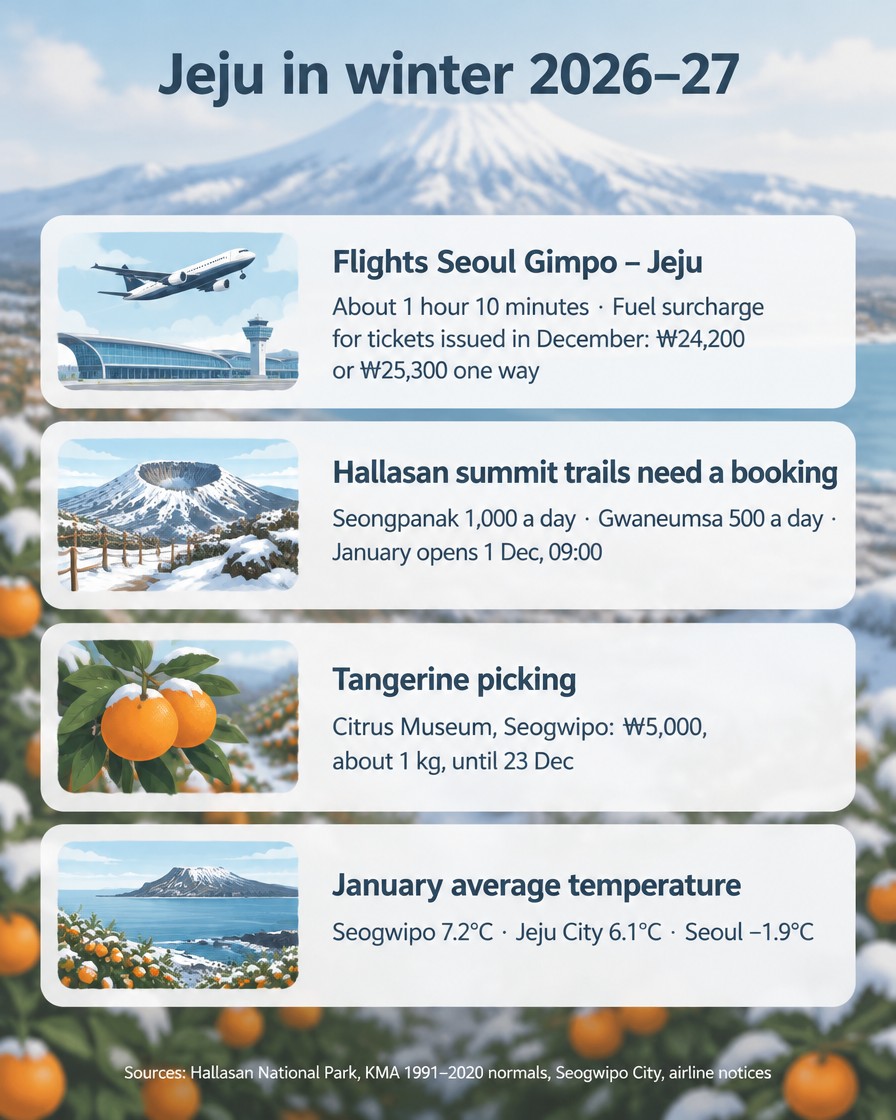
Quick answer: Fly from Seoul Gimpo to Jeju (about 1 hour 10–15 minutes on the timetable; OAG counted 14.4 million scheduled seats on the route in 2025, the busiest in the world). For tickets issued in December, airlines add a domestic fuel surcharge of ₩24,200 or ₩25,300 one way, depending on the carrier. To reach the Hallasan summit (1,950 m) you must book in advance on the park’s official site: Seongpanak takes 1,000 hikers a day and Gwaneumsa 500, and January 2027 places open on Tuesday 1 December 2026 at 09:00. The Citrus Museum in Seogwipo runs tangerine picking for ₩5,000 (about 1 kg to take home) until 23 December. For winter sun, stay on the south side: KMA normals give Seogwipo 153.5 hours of January sunshine against 70.2 hours in Jeju City.
This guide is for visitors and foreign residents planning a Jeju trip between December and February, including the Christmas and New Year breaks: 25 December is a Friday, 36 days from 19 November. It covers flights and airport ID rules, how the Hallasan booking system works (with the official cut-off times), what a snow hike needs, where and how to pick tangerines, which part of the island to stay in, and a worked transport budget. It is general travel information. Trail rules, fares and timetables change, and the mountain closes in bad weather, so check the official pages listed at the end before you go.
Why Jeju in winter?
Jeju is the mildest place most visitors can reach in an hour from Seoul. KMA’s 1991–2020 climate normals put January at 6.1°C in Jeju City and 7.2°C in Seogwipo, against −1.9°C in Seoul. Daytime highs in January average 8.6°C in Jeju City and 10.8°C in Seogwipo, so a coat and layers are enough on the coast even when Seoul is freezing.
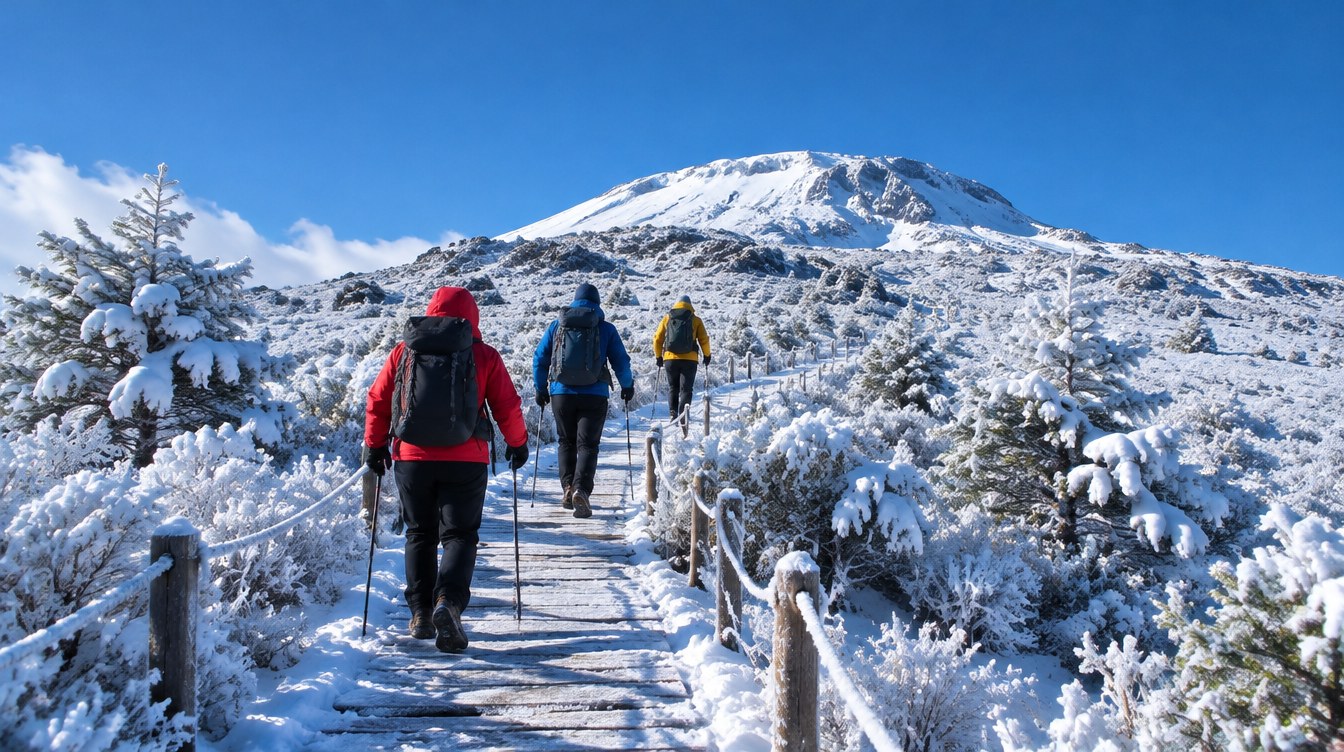
Two things surprise first-time winter visitors. First, the north coast (Jeju City and the airport) is grey and windy in winter, while the south coast (Seogwipo, Jungmun) is much sunnier: Seogwipo gets more than twice Jeju City’s January sunshine. Second, the mountain in the middle has a different climate. Hallasan is 1,950 m high, and its upper trails are snow and ice country from December to March, which is exactly why the snow hike is popular.
Winter weather: Jeju City and Seogwipo vs Seoul
| Month (1991–2020 normals) | Jeju City avg / high / low | Seogwipo avg / high / low | Seoul avg / high / low |
|---|---|---|---|
| December | 8.3 / 11.0 / 5.6°C | 9.4 / 13.1 / 6.2°C | 0.2 / 4.2 / −3.4°C |
| January | 6.1 / 8.6 / 3.7°C | 7.2 / 10.8 / 4.1°C | −1.9 / 2.1 / −5.5°C |
| February | 6.8 / 9.9 / 4.0°C | 8.2 / 11.8 / 4.8°C | 0.7 / 5.1 / −3.2°C |
| January sunshine | 70.2 h | 153.5 h | 169.6 h |
| January avg wind | 4.1 m/s | 2.4 m/s | 2.3 m/s |
| January precipitation | 67.5 mm | 60.7 mm | 16.8 mm |
Source: KMA climate normals 1991–2020 (stations 184 Jeju, 189 Seogwipo, 108 Seoul), read from data.kma.go.kr on 19 November 2026.
In practice: expect 4–11°C on the coast, frequent wind and showers in Jeju City, and below-freezing conditions with snow on Hallasan’s upper slopes. Pack a windproof, waterproof layer, gloves and a hat.
Getting there: flights from Seoul Gimpo
The route
Almost every visitor from Seoul flies from Gimpo (GMP), the domestic airport on subway lines 5 and 9 and the airport railroad. According to OAG’s annual ranking (22 December 2025), Jeju–Seoul Gimpo was the world’s busiest airline route in 2025 with 14.4 million scheduled seats, about 39,000 a day, served by seven carriers. Korean Air’s own timetable listing shows its first morning flight leaving Gimpo at 07:05 and landing at 08:20, which is typical: plan on roughly 1 hour 10–15 minutes gate to gate.
If you land at Incheon on an international flight, you normally transfer across Seoul to Gimpo first; our Incheon Airport to Seoul guide covers the AREX train that also stops at Gimpo.
What a ticket costs in winter
Domestic fares change daily, so treat these as a guide, not a quote:
- Korean Air’s own fare page (checked 19 November 2026) showed Gimpo–Jeju one-way economy from ₩48,300 for many November, December and January dates, and from ₩70,300 for February, including taxes and fuel surcharge. Fridays and holiday weekends were much higher (₩94,300–₩111,300 on several dates).
- Fuel surcharge for tickets issued in December 2026: ₩24,200 one way on Korean Air, Asiana (for tickets issued 1–16 December), Trinity Airways and Air Busan, and ₩25,300 on Jin Air, Jeju Air, Eastar Jet and Air Seoul, according to each airline’s notice as compiled by Topstar News (10 November 2026). The surcharge follows the date you buy the ticket, not the date you fly, so a ticket for 20 December bought on 25 November carries November’s ₩25,300.
Worked example: return fuel surcharge
| Ticket bought | Carrier group | One way | Return |
|---|---|---|---|
| In November 2026 | All 8 domestic airlines | ₩25,300 | ₩50,600 |
| 1–31 December 2026 | Korean Air, Trinity, Air Busan (Asiana 1–16 Dec) | ₩24,200 | ₩48,400 |
| 1–31 December 2026 | Jin Air, Jeju Air, Eastar Jet, Air Seoul | ₩25,300 | ₩50,600 |
Our calculation from the airline notices; the saving from buying in December is ₩2,200 per return ticket on the airlines that cut the surcharge. It is small next to the base fare, so buy when the fare itself is low.
ID at the airport (foreigners included)
Under the Aviation Security Act, domestic passengers must show a valid, original ID at boarding. Incheon International Airport Corporation’s domestic boarding page lists, for passengers aged 19 and over including foreigners, a passport, a residence card (외국인등록증), a driver’s licence and several other documents; photocopies, photos and screenshots are not accepted, and expired IDs are refused. Visitors should simply carry their passport; residents can use their residence card. Make sure the name on your booking matches your ID.
Hallasan in winter: booking rules from the official site
Hallasan National Park is run by Jeju Special Self-Governing Province, not the Korea National Park Service, and it has its own booking site at visithalla.jeju.go.kr (with an English page). Everything in this section is read from that site on 19 November 2026.
Which trails need a booking
Only the two trails that reach the summit crater (Baengnokdam) need a reservation: Seongpanak (성판악) and Gwaneumsa (관음사). The other trails, Eorimok (어리목) and Yeongsil (영실) to Witse-oreum (about 1,700 m), Donnaeko (돈내코) to the south wall junction, and the short Eoseungsaengak and Seokguram walks, need no booking but do have entry cut-off times.
| Trail | Length (one way) | Typical time | Booking? | Daily places |
|---|---|---|---|---|
| Seongpanak → summit | 9.6 km | about 4 h 30 min up | Yes | 1,000 (800 for 05:00–08:00, 200 for 08:01–11:30) |
| Gwaneumsa → summit | 8.7 km | about 5 h up | Yes | 500 (400 for 05:00–08:00, 100 for 08:01–11:30) |
| Yeongsil → Witse-oreum | 3.7 km (5.8 km to south wall) | about 1 h 30 min to Witse-oreum | No | – |
| Donnaeko → south wall junction | 7 km | about 3 h 30 min | No | – |
Source: Hallasan National Park booking site, trail pages and the notice of 24 October 2025 that set the two booking time bands from 1 December 2025. The Gwaneumsa summit section was closed for rockfall work from 1 August to 30 September 2026 and reopened on 24 September 2026, according to the park’s notice of 18 September 2026.
When bookings open
- Bookings for each month open on the first working day of the previous month at 09:00 and run to the end of that next month. December 2026 places opened on Monday 2 November; January 2027 places open on Tuesday 1 December 2026 at 09:00, and February places on the first working day of January.
- On opening days there is a queue, the booking-status page is temporarily hidden, and the site is down for maintenance between 20:00 and 22:00 on the opening day and the day before.
- A booking covers up to 4 people, and each hiker’s details must be completed; an unfinished booking is cancelled automatically after one day. There is no waiting list.
- Your entry QR code is sent to the phone number (or email) you enter, so use a number that can receive texts or KakaoTalk. Booking is done through a verified sign-in, so foreign visitors without a Korean phone number should look at the English page’s sign-in options before opening day.
- Bring ID. Under a park notice of 5 June 2026, rangers check ID against the QR code at the entrance. A mismatch, or a resold QR code, means no entry and a one-year booking ban.
- No-shows are penalised: if you neither hike nor cancel before your time band ends, you cannot book for 3 months (first time) or 1 year (second time). If you start up Seongpanak and come down Gwaneumsa, book Seongpanak.
Winter cut-off times
Hallasan is a day hike only, and the park closes each section early in winter so that everyone is down before dark. The official three-season table (winter = November to February) gives:
| Checkpoint (winter) | Last entry / turn-back |
|---|---|
| Hiking day starts | 06:00 |
| Seongpanak trailhead and Jindallaebat shelter | 12:00 |
| Gwaneumsa trailhead and Samgakbong shelter | 12:00 |
| Summit (Dongneung peak): start descending by | 13:30 |
| Eorimok and Yeongsil trailheads | 12:00 |
| Witse-oreum: last entry towards the south wall / leave by | 13:00 / 15:00 |
| Donnaeko information centre | 10:00 |
Source: visithalla.jeju.go.kr “등산허용 안내” (reservation guide), read 19 November 2026. The same page and the Seongpanak trail page still also show an older two-season table with an 11:30 cut-off at Jindallaebat; to be safe, plan to pass Jindallaebat shelter by 11:30.
In practice that means starting Seongpanak by about 07:00 if you are a normal-paced hiker, because the shelter is 7.3 km and roughly three hours from the trailhead.
What a snow hike needs
The park’s cautions page asks winter hikers to carry winter clothing, crampons (아이젠), gloves and warm water, plus emergency snacks and spare clothes. On 18 November 2026 Jeju Province announced that from 1 December 2026 to 31 March 2027 rangers will check crampons at the trailheads and strongly urge hikers to wear them when the trail is snowy or icy, and that booked hikers will get a phone message about the gear (Yonhap, 18 November 2026). Hiking is partly or fully closed under heavy-snow, heavy-rain or typhoon warnings; booked hikers are messaged, and you should cancel before your time band ends to avoid a no-show penalty.
Other practical points from the park:
- Getting there by bus: Seongpanak is on route 281 (Jeju Bus Terminal ↔ Seogwipo, first bus 06:00, about 45 minutes from Jeju City) and the airport express 181 (first 06:10, about 35 minutes from the airport). Gwaneumsa needs a change to bus 475 at Sancheondan.
- Parking at Seongpanak has only 156 spaces and fills very early; the park recommends public transport. Parking costs ₩1,000 for the first hour plus ₩500 per 20 minutes, up to ₩13,000 a day for a car. The official fee page lists no trail admission amounts.
- Summit certificate: if you reach the top, you can apply for a certificate the same day on the booking site (a free web version since 1 September 2026), via the JEJU IoT app, or as a paid paper copy at the trailhead kiosk.
- The park recommends the easier Eorimok or Yeongsil trails for anyone without recent hiking experience or with heart conditions. Yeongsil is a popular shorter snow walk: apart from the steep ridge section above Yeongsil rest area the trail is mostly gentle, it passes the Yeongsil rock formations, and it gives snow scenery without Seongpanak’s 19.2 km round trip.
If you slip or twist an ankle on ice, our guide to what to do after a fall on ice in Korea covers clinics, ER and X-ray costs; for emergencies on the mountain, call 119 and give the number on the nearest trail location sign.
Tangerine picking
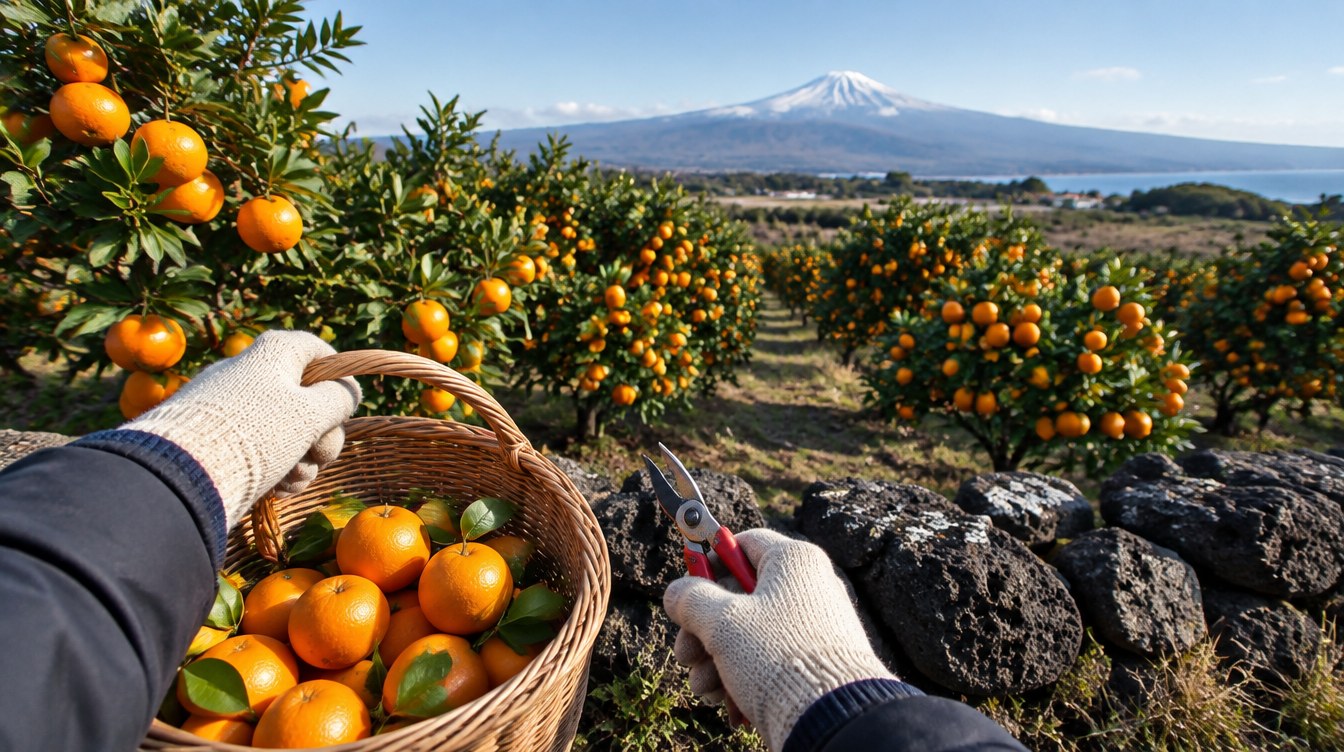
Jeju’s open-field tangerines (gamgyul, 감귤) are harvested from late autumn into winter, and picking your own is the classic winter activity.
The easy official option: Seogwipo Citrus Museum (감귤박물관). Seogwipo City’s tourist-site office runs “2026 tangerine picking” in two orchards inside the museum from Tuesday 27 October to Wednesday 23 December 2026. It costs ₩5,000 per person; after a short safety briefing you pick and taste, then take home about 1 kg in the bag provided. Entry times are 09:30–11:30 and 13:00–16:30, and picking stops in rain or strong wind (Seogwipo City release, reported by Yonhap and Jeju Sotong Today, 25 October 2026).
Private farms run their own picking sessions across the island in November and December. Independent 2026 round-ups list typical prices of about ₩7,000–₩10,000 per kg, often with tasting included; prices and kilo allowances vary by farm, so check the farm’s own page and call the day before about rain closures. The Citrus Museum’s season ends on 23 December, so for a picking trip over Christmas or New Year, look at private farms.
A few tips: wear clothes you don’t mind getting sticky, use the clippers rather than pulling fruit off branches, and eat on site only what the farm allows.
Where to stay
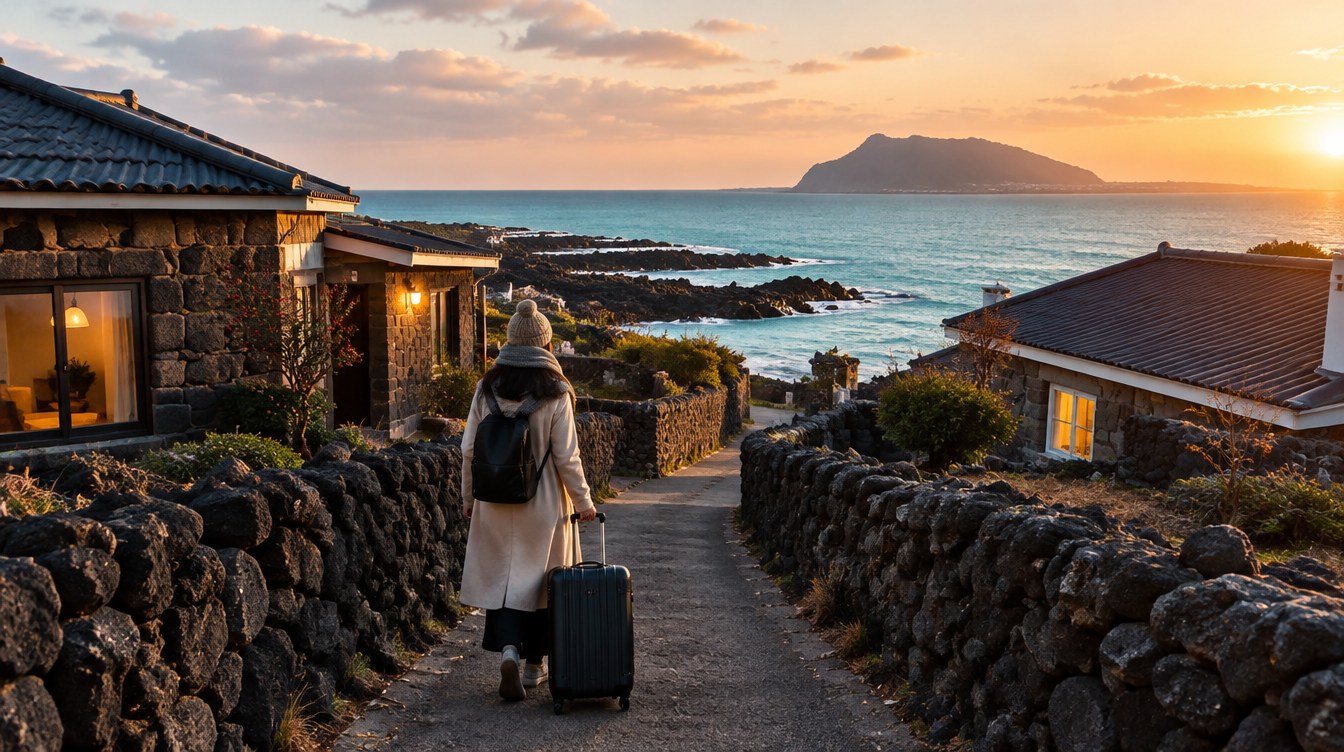
Jeju is bigger than it looks (driving round the coast takes most of a day), so pick a base that suits your plan. Without a car, choose a base with good bus links.
| Base | Good for | Winter notes | Bus links |
|---|---|---|---|
| Jeju City (north) | Short trips, late arrivals, Hallasan from Seongpanak or Gwaneumsa | Greyest and windiest part of the island in winter (January sunshine 70.2 h) | Airport next door; 281 to Seongpanak; express buses everywhere |
| Seogwipo (south) | Winter sun, waterfalls and coastal walks, tangerine farms, Citrus Museum | Sunniest and mildest base (153.5 h, 7.2°C in January) | 281 back over the mountain past Seongpanak (about 50 minutes to the trailhead); 181/182 express to the airport |
| Jungmun (south-west resort area) | Resort hotels, a relaxed stay | Same mild south-coast weather; quieter evenings | Express buses via Seogwipo World Cup Stadium |
| East or west coast villages (Seongsan, Aewol, Hallim) | Guesthouses, sea views, sunrise or sunset | Beautiful but spread out | Best with a rental car |
Climate figures: KMA normals above. Bus routes: Hallasan National Park trail and parking pages (281, 181, 182, 475).
A practical plan for most visitors is two nights in Seogwipo (sun, tangerines) plus, if you want the summit, one night in Jeju City before the hike so you can catch an early 281 or 181 bus to Seongpanak.
Buses and fares. Jeju’s trunk and local buses charge a flat ₩1,150 by transport card (₩1,200 cash) for adults; express buses (route numbers in the 100s, such as 181) start at ₩2,000 for the first 20 km and add a distance charge when you tap off, up to a ₩3,000 maximum. Transfers are discounted. (Jeju bus information system fare table as reported by Jeju Gyotong Bokji Sinmun, 23 October 2026, and independent 2026 fare guides.)
Worked budget: a 3-day Jeju winter trip from Seoul (transport and activities)
| Item | Cost |
|---|---|
| Return flight Gimpo–Jeju, low-fare day (Korean Air “from” fare, incl. taxes and fuel surcharge) | ₩96,600 (2 × ₩48,300) |
| Airport → Jeju City and back (2 express rides at the ₩2,000 base) | ₩4,000 |
| Jeju City → Seongpanak and back (2 rides, worst case at the ₩3,000 express cap) | ₩6,000 |
| Jeju City → Seogwipo and back to the airport (2 express rides at the cap) | ₩6,000 |
| 4 local bus rides in Seogwipo | ₩4,600 (4 × ₩1,150) |
| Hallasan trail booking | ₩0 (no fee listed) |
| Citrus Museum tangerine picking | ₩5,000 |
| Total (per person, before accommodation and food) | ₩122,200 |
Our calculation from the fares above; express fares depend on distance, so the real bus total is usually a little lower. A Friday departure or holiday weekend can add ₩50,000–₩60,000 to each flight based on the dates shown on Korean Air’s page. Accommodation and food are not included.
Before you go: a short checklist
- Decide whether you want the summit. If yes, book Seongpanak or Gwaneumsa on visithalla.jeju.go.kr as soon as your month opens (1 December at 09:00 for January).
- Book flights for the dates you want; compare carriers, and remember the fuel surcharge follows the purchase date.
- Pack your passport or residence card (original), crampons for Hallasan, a windproof layer and gloves.
- For tangerine picking before 23 December, the Citrus Museum is the cheapest official option; after that, use a private farm.
- Check the park homepage on the morning of your hike for closures, and cancel in time if you can’t go.
Going somewhere else this winter? See our two-day Busan winter plan by KTX and Gangneung and Sokcho in winter. Shopping on the trip? Our tourist tax refund guide explains instant and airport refunds.
Frequently asked questions
Q. Do I need a reservation to hike Hallasan in winter?
Only for the two summit trails. Seongpanak (1,000 hikers a day) and Gwaneumsa (500 a day) must be booked on visithalla.jeju.go.kr; Eorimok, Yeongsil and Donnaeko need no booking but close to new hikers at fixed winter cut-off times.
Q. When can I book Hallasan for January 2027?
Bookings open on the first working day of the previous month at 09:00, so January 2027 places open on Tuesday 1 December 2026 at 09:00. Expect a queue, and note the site is down for maintenance from 20:00 to 22:00 that evening and the evening before.
Q. Are crampons required on Hallasan?
The park lists crampons as winter gear to carry, and from 1 December 2026 to 31 March 2027 rangers will check for them at the trailheads and strongly urge hikers to wear them on snow or ice. Bring a pair: icy upper trails are dangerous without them.
Q. How much is tangerine picking in Jeju?
At the Seogwipo Citrus Museum it costs ₩5,000 per person for about 1 kg, from 27 October to 23 December 2026, with entry 09:30–11:30 and 13:00–16:30. Private farms typically charge about ₩7,000–₩10,000 per kg.
Q. What ID do foreigners need for a domestic flight to Jeju?
An original, valid passport or residence card. Photocopies, photos and screenshots are not accepted, and the name on the booking should match the ID.
Q. Is Jeju City or Seogwipo better in winter?
Seogwipo is sunnier and milder: KMA normals give it 153.5 hours of January sunshine and an average of 7.2°C, against 70.2 hours and 6.1°C in Jeju City. Jeju City is better for a night before an early Hallasan start or a late flight.
Sources
- Hallasan National Park Management Office (Jeju Special Self-Governing Province), booking site: reservation guide and cut-off times https://visithalla.jeju.go.kr/contents/contents.do?id=49 (English: &language=en_US); fees and parking https://visithalla.jeju.go.kr/contents/contents.do?id=50 ; Seongpanak and Gwaneumsa trail pages (id=61, 62), Yeongsil (id=60), Donnaeko (id=63); notices: booking time bands (24 Oct 2025), QR/ID checks and Seongpanak parking (5 Jun 2026), opening-day restrictions (5 Jun 2026), Gwaneumsa closure (19 Jun 2026) and reopening (18 Sep 2026), web summit certificate (27 Aug 2026), FAQ — all read 19 Nov 2026
- Jeju Province winter Hallasan safety measures, 1 Dec 2026–31 Mar 2027: Yonhap, 18 Nov 2026 https://www.yna.co.kr/view/AKR20261118086400056
- Korea Meteorological Administration, climate normals 1991–2020 (stations 184, 189, 108): https://data.kma.go.kr/normals/table.do
- Seogwipo City Citrus Museum, 2026 tangerine picking (27 Oct–23 Dec): city release as reported by Yonhap https://www.yna.co.kr/view/AKR20261023113800056 and Jeju Sotong Today (25 Oct 2026); private-farm prices from independent 2026 round-ups (jeju.com, daytrevel)
- OAG, “Busiest airline routes 2025” (22 Dec 2025): https://www.oag.com/pressroom/south-koreas-jeju-cju-seoul-gimpo-gmp-worlds-busiest-airline-route-in-2025
- Korean Air, Seoul–Jeju fares page (checked 19 Nov 2026): https://www.koreanair.com/flights/en/flights-from-seoul-to-jeju ; KE1017 timetable via flight-schedule listings (mustarddata, flightmapper)
- December 2026 domestic fuel surcharges, compiled from the eight airlines’ notices: Topstar News, 10 Nov 2026
- Domestic boarding ID rules (Aviation Security Act): Incheon International Airport Corporation https://www.airport.kr/ap_ko/6693/subview.do ; Korea Airports Corporation guidance
- Jeju bus fares: Jeju bus information system (bus.jeju.go.kr) fare table as reported by Jeju Gyotong Bokji Sinmun (23 Oct 2026); cross-checked with independent 2026 fare guides
How we checked: We read the Hallasan booking site’s guide, trail, fee and notice pages directly on 19 November 2026, pulled KMA’s normals from its own data service, and matched the flight, tangerine and bus figures with at least two sources (official page or release plus an independent report). Where the official site shows two different cut-off tables, we give the newer one and the safer time.
Researched and drafted with AI assistance; checked against the sources listed.
One Comment