Korea IRP and Pension Savings Tax Credit 2026: What to Fund Before 31 December
Haesul Economy desk (AI-assisted). Last checked: 2026-11-10 (KST); countdown updated 2026-11-13; first published 7 November 2026. Tax-year 2026 pension deposits close in 48 days (December 31, 2026). Limits and rates re-read on the NTS pension-account credit table on Nov 10. Based on the National Tax Service (NTS) special tax-credit page for pension accounts, Income Tax Act Article 59-3 on law.go.kr, NTS call-centre Q&A on pension-account credits, and Korea.kr year-end settlement guidance. This is general information, not tax, financial or legal advice. Confirm your own numbers with payroll, your financial institution or a licensed tax adviser before you deposit or file.
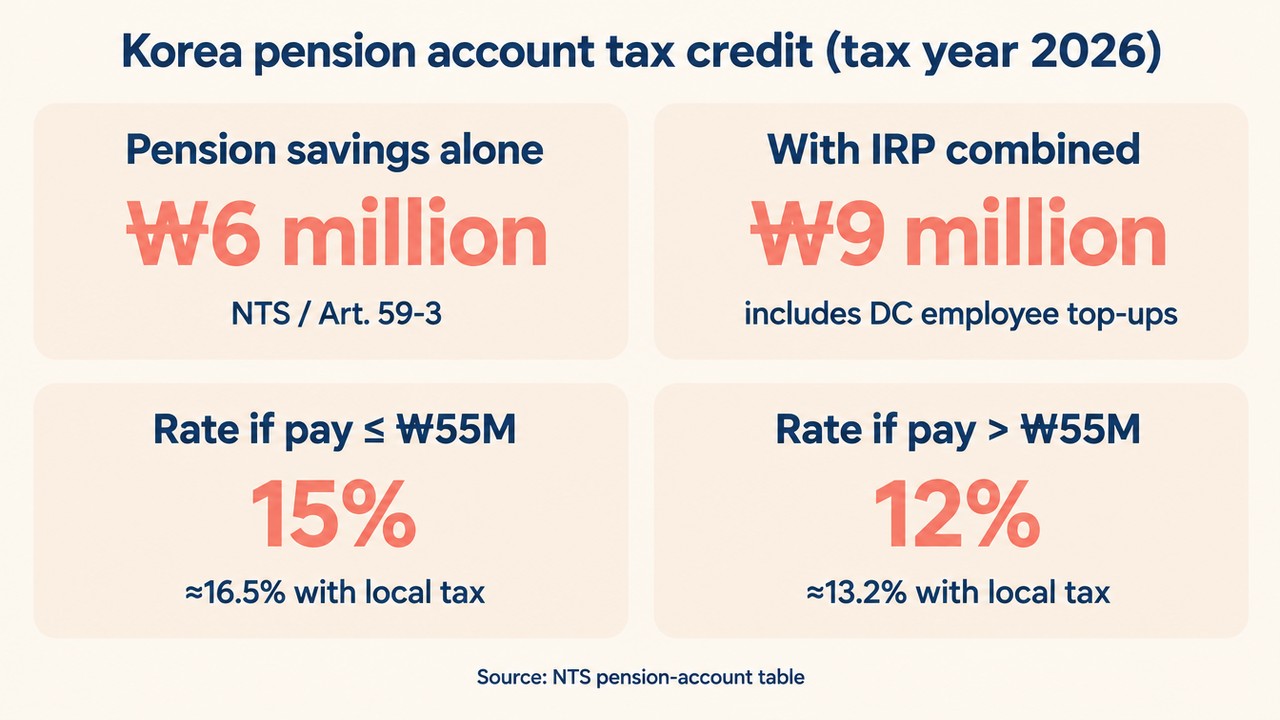
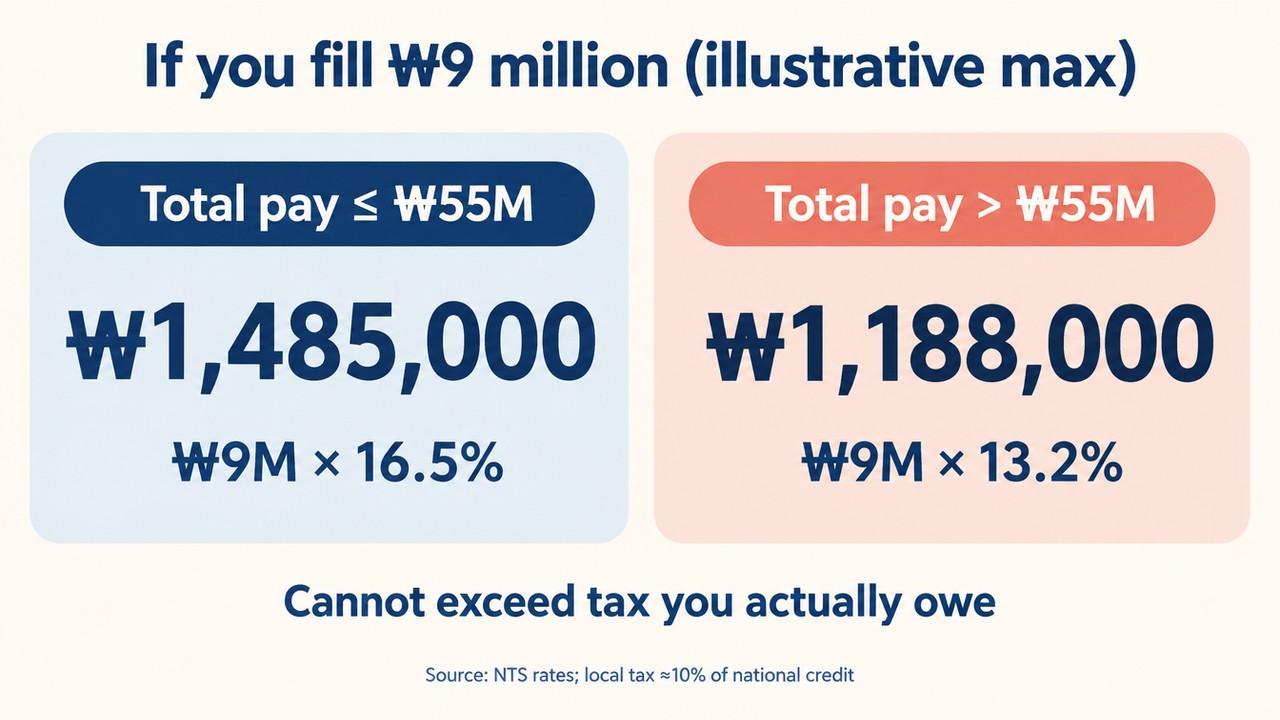
Quick answer: To count for 2026, the money must reach your pension savings or IRP account by December 31, 2026 — 48 days left from November 13 (NTS). Korea’s pension-account tax credit (연금계좌 세액공제) covers deposits into a pension savings account (연금저축) and a personal IRP (개인형 퇴직연금, Individual Retirement Pension) — plus qualifying employee top-ups to a DC retirement plan. Pension savings alone are credited up to ₩6 million a year. Pension savings (within that ₩6 million) plus IRP/DC employee deposits together are credited up to ₩9 million. The national credit rate is 15% if total pay is ₩55 million or less (or comprehensive income ₩45 million or less); otherwise 12%. Local income tax (usually 10% of the national credit) lifts the combined rates to about 16.5% and 13.2%. Filling the full ₩9 million therefore yields a calculated maximum of about ₩1,485,000 or ₩1,188,000. For tax year 2026, only amounts credited to the account by 31 December 2026 count — and bank cut-off times can be earlier on the last business day.
Year-end tax settlement (연말정산) turns a year of payroll withholding into your real income tax. The pension-account credit is a special tax credit: it reduces calculated tax, not taxable income. This guide is for tax year 2026 deposits (1 January–31 December 2026), settled with employers in early 2027. For the wider timeline, Hometax login steps and the 19% flat-tax choice, see our year-end tax settlement guide for foreigners. The credit sits next to the social-insurance lines on your payslip; those four deductions are explained in our payslip guide. Medical spending is a separate special credit — see our medical expense tax credit guide.

Pension savings vs IRP — terms in plain English
Pension savings (연금저축) is a retail retirement account you open at a bank, broker or insurer under the name “연금저축”. Common forms are pension savings funds (증권사 연금저축펀드) that hold funds and ETFs, and pension savings insurance. Anyone who meets the product rules can open one; it is not tied to an employer.
IRP (개인형 퇴직연금) is a personal retirement-pension account under the Employee Retirement Benefit Security Act. It is the account that often receives a lump-sum retirement payout, and employed or self-employed people with earned income can also make voluntary deposits. Risk assets inside an IRP are generally capped (commonly discussed as 70%), and partial withdrawals outside statutory hardship reasons are tightly restricted — early exit is usually an all-or-nothing termination.
DC employee top-ups (확정기여형 퇴직연금 근로자 추가납입) count toward the same combined credit as IRP deposits. Employer DC contributions do not — the NTS call centre states company burden amounts are not the worker’s deposits and are excluded from this credit.
Both pension savings and IRP share one person-level credit ceiling. Opening three accounts does not multiply the ₩9 million limit.
Limits and rates for tax year 2026
The NTS table on the special tax-credit page (연금계좌 세액공제) and Article 59-3 of the Income Tax Act currently in force (checked 7 November 2026) line up as follows:
| Income band | Credit base limit | National rate | With local tax (≈10% of national) |
|---|---|---|---|
| Total pay ≤ ₩55M (or comprehensive income ≤ ₩45M) | Pension savings ₩6M; with IRP/DC employee deposits ₩9M combined | 15% | ≈16.5% |
| Above that band | Same ₩6M / ₩9M structure | 12% | ≈13.2% |
How the two ceilings stack:
| Deposit mix | Amount that enters the credit |
|---|---|
| Pension savings only ₩9M | ₩6M (₩3M excess ignored for this credit) |
| IRP only ₩9M | ₩9M |
| Pension savings ₩6M + IRP ₩3M | ₩9M |
| Pension savings ₩5M + IRP ₩4M | ₩9M |
| Pension savings ₩2M + IRP ₩7M | ₩9M |
Sources: NTS cntntsId=7875 pension-account table; Income Tax Act Art. 59-3 (law.go.kr); NTS call-centre CTG11905 worked mix table. Local-tax uplift is the usual 10% of the national income-tax credit, not a second statutory rate printed on the NTS summary table.
ISA maturity money rolled into a pension account can expand the credit base by 10% of the rolled amount, capped at ₩300,000 for the year of the roll — only in that maturity year, per the same NTS page and Art. 59-3(3)–(4).
Worked examples (illustrative deposits)
Example A — lower band, fill the gap before New Year.
Total pay ₩48,000,000. You already put ₩4,000,000 into pension savings in 2026.
Extra deposit by 31 December: ₩2,000,000 more to pension savings + ₩3,000,000 to IRP → credit base ₩9,000,000.
Calculated credit with local tax: ₩9,000,000 × 16.5% = ₩1,485,000.
Example B — higher band, IRP only so far.
Total pay ₩72,000,000. IRP deposits so far: ₩3,000,000.
Current calculated credit: ₩3,000,000 × 13.2% = ₩396,000.
Add ₩6,000,000 of pension savings → base ₩9,000,000 → ₩1,188,000.
Example C — dual-income household, one ₩9M pot.
Spouse A total pay ₩80,000,000 (12% / 13.2% band). Spouse B total pay ₩45,000,000 (15% / 16.5% band).
If only ₩9,000,000 of spare cash exists, parking it in Spouse B’s accounts yields about ₩1,485,000 versus about ₩1,188,000 in Spouse A’s — a ₩297,000 gap — only if Spouse B still has enough calculated tax left to absorb the credit. Credits cannot create a cash refund beyond tax owed.
| Credit base | ≤₩55M pay (16.5%) | >₩55M pay (13.2%) |
|---|---|---|
| ₩3,000,000 | ₩495,000 | ₩396,000 |
| ₩6,000,000 | ₩990,000 | ₩792,000 |
| ₩9,000,000 | ₩1,485,000 | ₩1,188,000 |
Sources: rates and limits from NTS / Art. 59-3; table amounts = base × 16.5% or 13.2%. Actual refund cannot exceed your decided tax (결정세액) after other credits.

Why 31 December matters — and why “same day” is not enough
Korea.kr’s year-end settlement briefing tells workers that deposits into pension accounts through 31 December of the tax year qualify for that year’s income or tax credits. The statute credits amounts paid into the pension account in the tax year; it does not invent a later grace period for New Year’s Day transfers.
Practical traps expats hit every December:
- Bank / broker cut-off times on 31 December (or the last business day) can be mid-afternoon for IRP wires even when the calendar still shows the 31st.
- Pension savings funds often key off trade settlement / purchase execution, not the moment you pressed transfer in the app — confirm with your broker.
- Weekend or holiday 31 December (not the case in 2026: Thursday) means the last processing day is earlier; a late Friday attempt can post in January and become next year’s credit.
- January 2027 deposits help tax year 2027, not 2026.
Aim to finish transfers by mid-December. In January, check Hometax’s simplified year-end file for pension-savings and retirement-pension deposit lines; if a line is missing, ask the financial firm for a pension-deposit confirmation certificate for payroll.
Rechecked on November 10, 2026 (NTS): the NTS table still lists a ₩6 million pension-savings ceiling (₩9 million including retirement-pension accounts) at 15% for total pay of ₩55 million or less (comprehensive income ₩45 million or less) and 12% above that. Two extras on the same page: when a matured ISA balance is moved into a pension account, 10% of the amount moved (up to ₩3 million) is added to the limit — only in the year of the transfer; and a one-home older household (one spouse 60+) that moves to a cheaper home may pay the price difference into an IRP as an extra deposit, up to ₩100 million. (NTS special tax-credit page, read 10 November 2026.)
Who can claim — and who usually cannot
Typically eligible: a resident with comprehensive income who deposited into a qualifying pension savings or retirement-pension account in the tax year. Foreign residents with an alien registration number who are on the normal progressive income-tax track can use the same credit when the account is in their own name.
Usually excluded or limited:
- People who chose the 19% flat tax for foreign workers — that path generally forgoes ordinary special tax credits such as this one (compare both paths in our settlement and flat-tax guides before you lock in).
- Non-residents for Korean income-tax purposes.
- Deposits that are tax-deferred retirement payouts rolled into an IRP, or transfers between pension accounts — Art. 59-3 excludes those from the fresh-deposit base.
- Employer DC contributions.
- Deposits into a spouse’s or parent’s account — the credit follows the account holder’s settlement, not the person who wired the money.
Early withdrawal: the credit can reverse
This product is tax deferred, not tax free. If you terminate early outside statutory hardship reasons, the NTS call centre explains that amounts previously credited (plus investment gains treated as other income) are generally hit with other-income tax at 16.5% including local tax, collected at source as separate taxation. Hardship cases (death, overseas relocation, lengthy medical care, disaster, bankruptcy, provider shutdown, and similar statutory reasons) can instead be taxed as pension income at the lower pension withholding rates.
That is why filling ₩9 million with money you may need for a house deposit or tuition within a few years is often a bad trade even when the year-end credit looks large. Keep an emergency buffer outside the locked accounts.
December checklist for tax year 2026
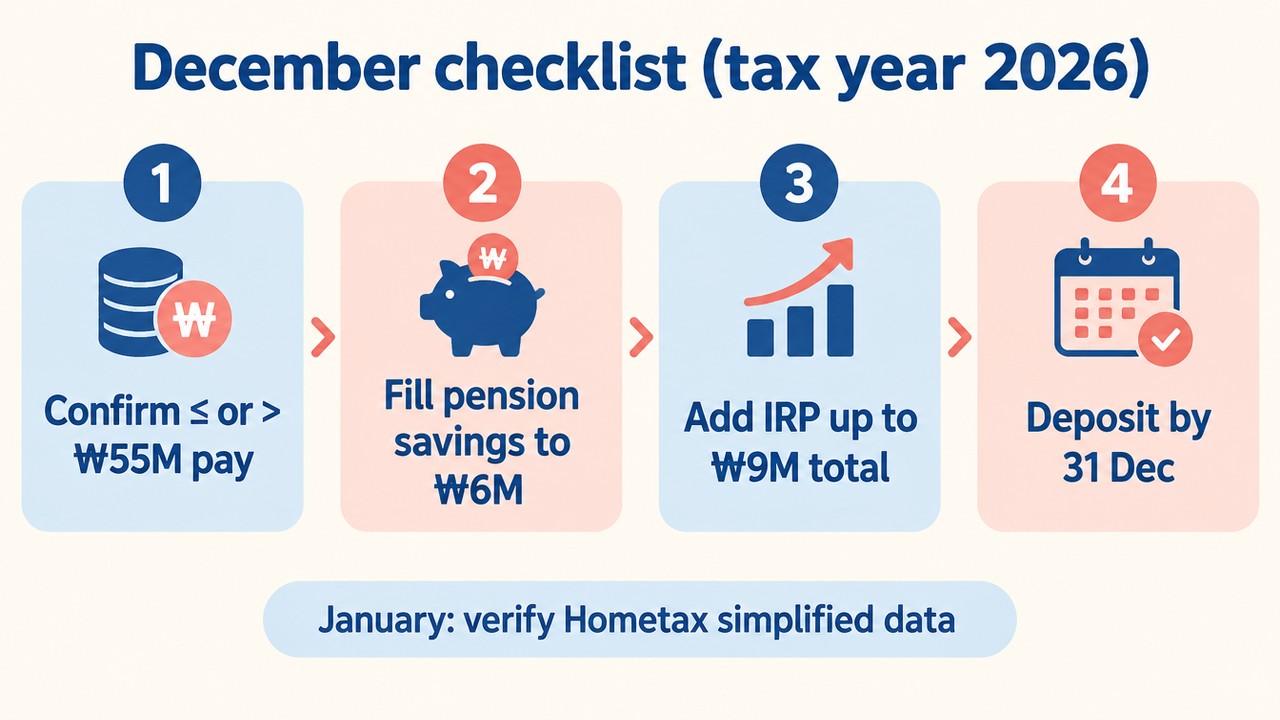
- Open Hometax year-end preview (when available in November/December) and estimate remaining decided tax.
- Read your app’s year-to-date pension savings and IRP deposit totals.
- Confirm whether total pay will sit at or under ₩55 million — that single line changes 15% vs 12%.
- Fill pension savings up to ₩6 million first if you want the more flexible retail account, then use IRP (or DC employee top-ups) for the rest up to ₩9 million.
- Complete wires by mid-December; treat 31 December as a hard calendar limit, not a leisurely same-day window.
- In mid-January 2027, re-check simplified data; bring a deposit certificate to payroll if a line is wrong.
- Excess over the credit base does not auto-roll — ask the firm about a carry-forward / conversion application if you overshot and want next year’s credit treatment (NTS call-centre “전환특례”).

Frequently asked questions
Q. How many days are left to fund my pension account for the 2026 credit?
Until December 31, 2026 (a Thursday) — 48 days left from November 13. The NTS credits amounts paid into a pension savings or IRP account during the tax year: up to ₩6 million for pension savings and ₩9 million combined with IRP/DC deposits, at 15% if total pay is ₩55 million or less and 12% above (NTS pension-account table, checked Nov 10). Money that lands in January 2027 counts for tax year 2027, so allow for bank and broker cut-off times.
Q. What is the Korea IRP pension savings tax credit limit for 2026?
Pension savings alone are credited up to ₩6 million. Pension savings (within that ₩6 million) plus IRP or DC employee deposits share a combined ₩9 million ceiling. Putting ₩9 million into pension savings alone still only credits ₩6 million for this benefit.
Q. How much can I get back if I deposit ₩9 million?
At the 16.5% combined rate (total pay ≤ ₩55 million), the calculated maximum is about ₩1,485,000. At 13.2%, it is about ₩1,188,000. You never receive more than the income tax you actually owe after other credits.
Q. Does a 31 December deposit still count for tax year 2026?
Yes — if the amount is actually credited (and, for fund products, executed) as a 2026 deposit under your provider’s cut-off rules. Korea.kr and the annual settlement guides treat 31 December as the calendar end of the tax-year deposit window. Late wires that post in January become 2027 deposits.
Q. Can a foreign employee claim this credit?
Resident foreign employees on the progressive tax track can claim deposits in their own qualifying accounts, reported through Hometax and payroll like any other special credit. Flat-tax choosers generally cannot stack it. Account ownership must be yours; wiring into a family member’s IRP does not move the credit to your settlement.
Q. What happens if I cash out early?
Outside statutory hardship reasons, previously credited principal and relevant gains are typically taxed as other income at 16.5% including local tax. Hardship withdrawals can instead use lower pension-income withholding. Check the NTS call-centre early-termination Q&A and your contract before you terminate.
Related reading
- Korea credit card and cash receipt deduction 2026
- Korea medical expense tax credit 2026
- Korea ISA account 2026: limits and tax-free maturity
Sources
- National Tax Service, Special tax credits — pension account table (연금계좌 세액공제) (checked 7 November 2026; re-checked 10 November 2026)
- National Law Information Center, Income Tax Act Article 59-3 (연금계좌세액공제) (checked 7 November 2026)
- NTS call centre, Pension account tax credit Q&A (CTG11905) (checked 7 November 2026)
- Korea.kr, Year-end settlement points — deposit through 12.31 for pension accounts (checked 7 November 2026)
- Haesul, Korea year-end tax settlement for foreigners 2026
- Haesul, Korea payslip: four social insurance deductions 2026
- Haesul, Korea medical expense tax credit 2026
General information only, not tax, investment or financial advice. Written with AI assistance and checked against the sources above. Rules and Hometax calendars can change; verify against the NTS notice for the January 2027 settlement season before you deposit or file.





7 Comments