Korea Retirement Pay Tax: Lump Sum or Pension From an IRP, and Why the Pension Route Cuts the Tax by 30 to 50 Percent
Haesul Economy desk (AI-assisted). As of 13 November 2026 (KST). Based on the current text of the Income Tax Act article 129(1)5-3 and Enforcement Decree articles 40-2 and 187-3 on the National Law Information Center (law.go.kr), the official reason for the December 2025 amendment, the National Tax Service (NTS) pages on deferred retirement income and pension income, the Financial Supervisory Service (FSS) integrated pension portal, the Ministry of Employment and Labor (MOEL) answers on the Employee Retirement Benefit Security Act, and the Government Employees Pension Service (GEPS) guide to tax deferral. Independent cross-checks: a national economic daily and a broadcaster’s report on the 2026 change. This is general information, not tax or financial advice.
Quick answer: In Korea, retirement pay (퇴직금 or a DB/DC retirement pension payout) is taxed as retirement income. Take it as a lump sum and you pay the full retirement income tax (퇴직소득세) at once. Leave it in an IRP or another pension account and draw it as a pension from age 55, and the tax on each pension payment is only 70% of that tax in the first 10 years of actual receipt, 60% in years 11 to 20, and 50% after year 20 (the 50% tier applies from 2026). If your employer already withheld the tax, moving the money into a pension account within 60 days of receiving it gets that tax refunded into the account. Workers who retire before 55 usually have their retirement pay sent to an IRP anyway, because that has been the law since 14 April 2022. The only catch is the annual pension limit: anything you take above it is taxed like a lump sum.

If you are in your fifties and a retirement date, an early-retirement offer or the end of a contract is coming up, the biggest tax decision is usually not your salary. It is what happens to your retirement pay. Many people in Korea still picture the old routine, where the company deducts the tax and the rest lands in a salary account. That route still exists for some people, but the law now nudges almost everyone towards an individual retirement pension account (IRP, 개인형퇴직연금), and the tax code rewards anyone who leaves the money there and takes it as a pension.
This guide covers the decision itself: what the lump-sum route costs, what the pension route saves and under which conditions, the 60-day window if the money has already reached your bank account, and the annual limit that trips people up. It does not cover the separate tax on money you paid into an IRP or pension savings account yourself and claimed a tax credit for. That has its own rules (3.3% to 5.5% and the ₩15 million threshold), and we explain them in a separate guide. For the year-end credit on those contributions, see our IRP and pension savings tax credit guide.
Step one: where your retirement pay goes when you leave
Since 14 April 2022, the Employee Retirement Benefit Security Act (article 9(2)) says an employer must pay statutory retirement pay by transferring it into an IRP account the worker names, not into an ordinary bank account. MOEL’s published answers list the exceptions:
| Situation (MOEL; Act art. 9(2), Decree art. 3-2) | Must the money go to an IRP? |
|---|---|
| You retire before age 55 | Yes, as a rule |
| You retire at 55 or older | No. You can take it into a normal account |
| Retirement pay of ₩3 million or less | No |
| Retirement because of death, or a foreign worker leaving Korea | No |
| Another law lets part of it be deducted (for example a student-loan repayment) | The deducted part no; the rest yes |
MOEL also says that when the money goes into an IRP, the employer pays the pre-tax amount and does not withhold retirement income tax. The tax is not cancelled. It is deferred (과세이연) and settled later, when the money leaves the account. So for most people under 55 the question is not “lump sum or IRP?” at the moment they leave. It is how they take the money out of the IRP later.
For people aged 55 or older, or anyone whose money already went into a salary account, the choice comes earlier, and that is where the 60-day rule matters.
The 60-day rule if the tax has already been withheld
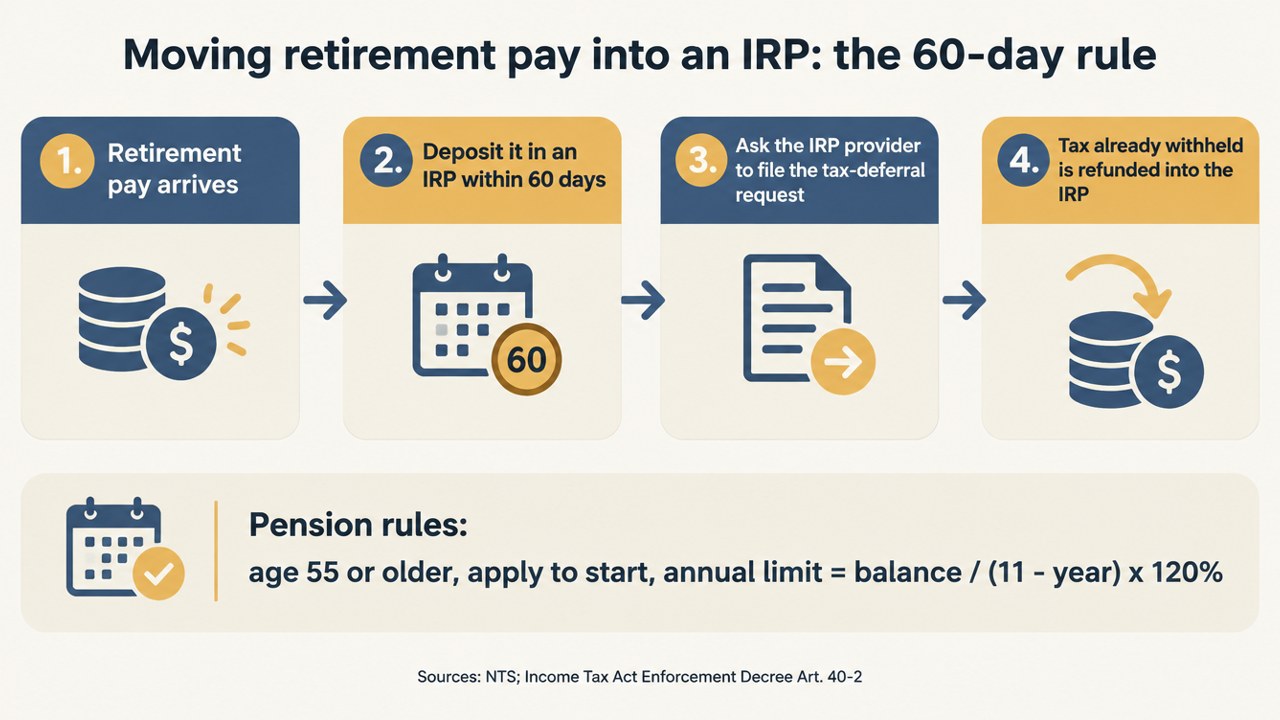
Under Income Tax Act article 146(2), as the NTS explains it, retirement income tax is not withheld if the retirement pay is in a pension account on the day you retire, is paid straight into one, or is deposited into a pension account within 60 days of the day you received it. If the employer already withheld the tax, you can ask for it back.
The NTS lays out the refund route like this:
- You leave and the employer pays you, withholding retirement income tax.
- Within 60 days you deposit the money into an IRP (or another pension account) and file a tax-deferral account report (과세이연계좌신고서) with the bank or broker that runs it.
- The account provider sends the report to the former employer.
- The employer asks its tax office for the refund, and the refund is paid into the pension account, not to you in cash.
GEPS, which pays public servants’ retirement benefits and uses the same deferral system, says the refund usually reaches the account in about one to two weeks once the paperwork is in. It also points out one practical limit: account providers accept only the taxable part of a retirement payment for deferral, so if part of your payout was tax-free, only the taxable part can go in.
How much less tax the pension route costs
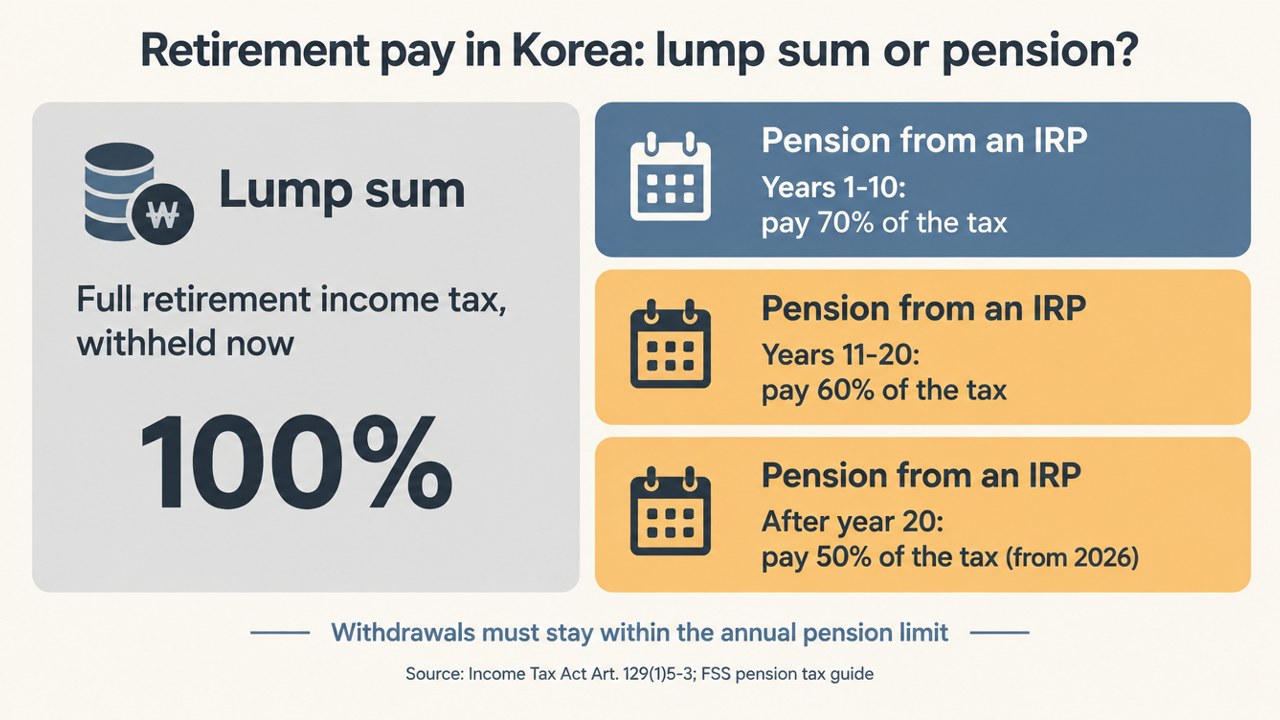
Here is the core of the decision. Income Tax Act article 129(1)5-3 sets the withholding rate on pension payments that come from deferred retirement income as a share of the tax you would have paid on a lump sum:
| Year of actual pension receipt | Tax on each pension payment | Saving against a lump sum |
|---|---|---|
| Years 1 to 10 | 70% of the retirement income tax rate | 30% |
| Years 11 to 20 | 60% | 40% |
| After year 20 | 50% (new from 2026) | 50% |
The third tier is new. Until 2025 the law had only two tiers, 70% for up to 10 years and 60% after that, which is still what some older bank and FSS pages show. The December 2025 amendment, whose official reason on law.go.kr is “to support a stable retirement”, cut the rate for receipt beyond 20 years from 60% to 50%, and the version in force from 1 January 2026 has the three tiers. A national economic daily described the same change in October 2025, and banks rewrote their pension terms early in 2026 to match.
Two details matter for planning:
- “Year of actual receipt” counts the years you actually took money. Enforcement Decree article 187-3 counts from the tax year of your first pension payment and adds each later tax year in which you receive one. Years in which you leave the money untouched do not move you towards the 60% and 50% tiers.
- Pension payments from retirement money are taxed separately. On the FSS pension portal, pension income that comes from deferred retirement income is taxed through separate withholding (분리과세) at the reduced share of retirement income tax, so it is not added to your other income at the year-end return.
A worked example (illustrative)
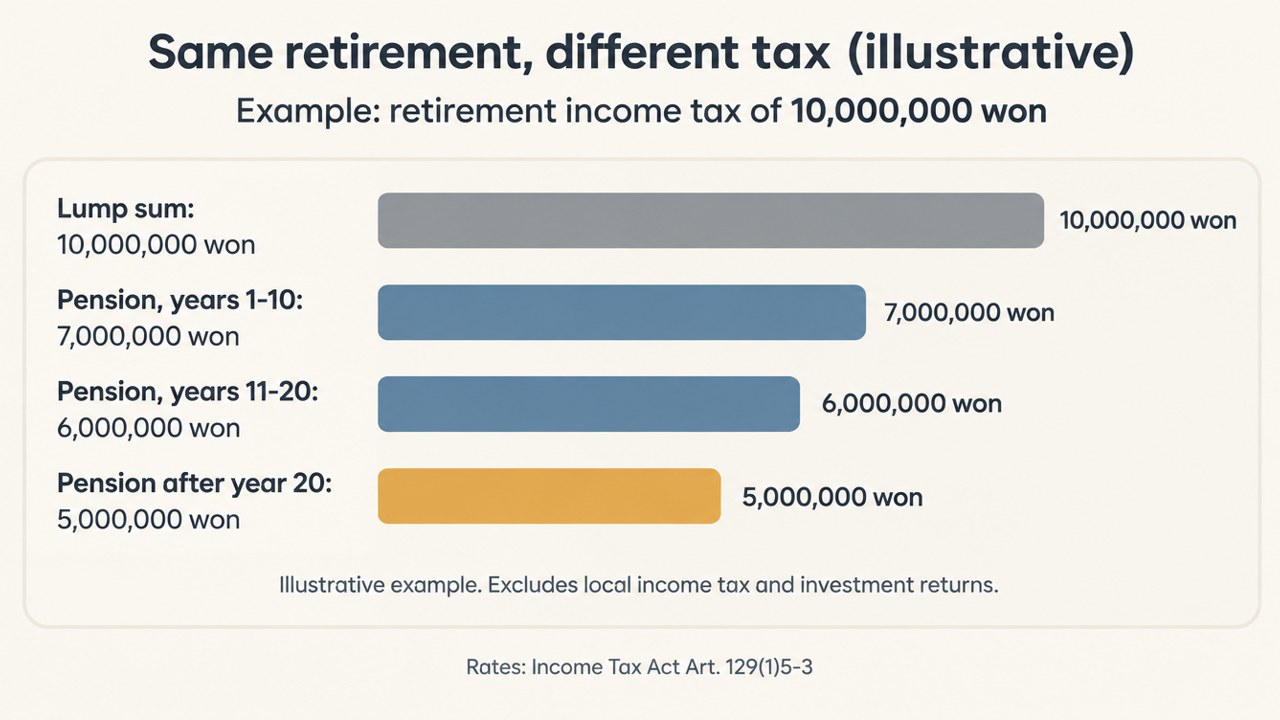
Suppose your retirement income tax, as shown on the withholding receipt your employer issues, comes to ₩10,000,000 (an illustrative figure; the real number depends on your pay and years of service). Ignoring local income tax and investment returns, and assuming every won is drawn within the annual limit, the tax on the same money would be:
| How the money comes out | Tax on that money (our calculation) |
|---|---|
| All as a lump sum | ₩10,000,000 |
| All as pension within years 1 to 10 | ₩7,000,000 |
| All as pension within years 11 to 20 | ₩6,000,000 |
| All as pension after year 20 | ₩5,000,000 |
In real life the money comes out over many years, so your total falls somewhere between those lines depending on how much you draw in each period. The more you spread it, the more of it falls into the cheaper tiers. The difference between ₩10 million and ₩7 million is real money for most households, and that is before any return the account earns while it waits. The reverse is also true: if you need the whole sum next year to clear a mortgage, the pension route may not fit, and paying the full tax can still be the right call.
The conditions: age 55, a start request and the annual limit
The reduced rates apply only to withdrawals that count as pension receipt (연금수령). Under Enforcement Decree article 40-2(3), and as both the NTS and the FSS repeat, a withdrawal counts only if:
- you are 55 or older and have asked the account provider to start pension payments;
- the account has been open for five years. This condition does not apply when the account holds deferred retirement income, so a new IRP that holds your retirement pay can pay a pension straight away once you are 55;
- the amount stays within the annual pension limit, worked out at the start of each tax year (or on the day you apply, in your first year):
Annual pension limit = account balance ÷ (11 − pension year) × 120%
Anything above the limit is treated as a non-pension withdrawal (연금외수령) and the retirement money in it is taxed at the full retirement income tax, exactly like a lump sum. The NTS adds that the limit no longer applies from the 11th pension year. In the formula, “pension year” counts from the first tax year in which you could start receiving, which is not quite the same as the “actual receipt” years used for the 70/60/50 rates.
One more NTS rule helps people who joined early: for an account opened before 1 March 2013 (including a defined-benefit plan joined before that date whose full payout moves into a new account), the count of pension years for the limit starts at year 6, not year 1.
How the limit plays out (illustrative)
With a balance of ₩200,000,000 at the start of pension year 1, the limit is ₩200,000,000 ÷ 10 × 120% = ₩24,000,000 for that year (our calculation). In pension year 5 with a balance of ₩150,000,000, it is ₩150,000,000 ÷ 6 × 120% = ₩30,000,000. Taking ₩40,000,000 in year 1 would mean the ₩16,000,000 above the limit is taxed like a lump sum.

Why 31 December matters this year
Two of the rules above run on the calendar year. The annual limit is set at the start of each tax year, and the “actual receipt” count adds one year for each tax year in which you receive a pension payment. Our reading of Enforcement Decree article 187-3 is that if you are already 55 and holding retirement money in an IRP, a pension payment received by 31 December 2026, 48 days from 13 November, makes 2026 your first year of actual receipt, so year 11 (and the 60% tier) arrives one year sooner than if you start in January. A national economic daily made the same point when the 2026 change was announced: start drawing at least a small amount once you reach 55, because the cheaper tiers depend on how many years you have actually received. Ask your provider about its minimum payment and processing time before the year-end rush.
Lump sum or pension: a quick way to decide
| If this sounds like you | The lump sum may suit | The pension route may suit |
|---|---|---|
| You need most of the money within a year or two (debt, a child’s wedding, a home) | ✓ | |
| You have other income to live on for now and want the money to last | ✓ | |
| You are under 55 | (Usually not an option: the money goes to an IRP) | ✓ |
| Your retirement income tax is small or zero | Little difference | Little difference |
| You want to spread the money over 10 to 20 years or more | ✓ (60% then 50% tiers) |
Two cautions. First, GEPS notes that if your retirement income tax is zero, there is nothing to refund, so a deferral account brings no tax saving on its own. Second, once money leaves the IRP outside the pension rules, the retirement part is taxed in full. If you think you may need a large sum later, keep part of your savings outside the IRP.

A checklist for your retirement month
- Ask payroll for your retirement income withholding receipt (퇴직소득원천징수영수증). It shows the retirement income tax figure the 70/60/50 rates are based on.
- If you are under 55, open an IRP with a bank or broker and give payroll the account number, so the pre-tax amount goes straight in.
- If you are 55 or older and receive the money in cash, decide within 60 days whether any of it should go into a pension account, and file the deferral report with the provider.
- Ask the provider to calculate your annual pension limit and its minimum monthly or annual payment.
- If you are already 55 and have retirement money sitting in an IRP, consider whether to start payments before 31 December 2026.
- Check the rest of your retirement money map: health insurance after retirement and National Pension catch-up payments after 60.
Related reading
- Korea IRP and Pension Savings Tax Credit 2026: the credit for money you pay in yourself, and what happens if you withdraw it early
- Korea Health Insurance After Retirement: how voluntary continuation keeps your employee premium for up to 36 months
- Korea National Pension Catch-Up and Voluntary Continuation After 60: filling gaps in your public pension record
Frequently asked questions
Q. How much less tax do I pay if I take my retirement pay as a pension in Korea?
Under Income Tax Act article 129(1)5-3, each pension payment from deferred retirement income is taxed at 70% of the retirement income tax rate in years 1 to 10 of actual receipt, 60% in years 11 to 20 and 50% after year 20. That is a saving of 30%, 40% or 50% against taking the same money as a lump sum. The 50% tier applies from 2026.
Q. My company already paid my retirement pay into my salary account. Is it too late?
Not if you act within 60 days of receiving it. According to the NTS, depositing the money into an IRP or another pension account within 60 days defers the retirement income tax, and tax already withheld can be refunded into that account through the provider and your former employer. GEPS says the refund usually takes about one to two weeks once the paperwork is in.
Q. Do I have to put my retirement pay into an IRP?
If you retire before 55, usually yes. Since 14 April 2022 the Employee Retirement Benefit Security Act has required employers to pay retirement pay into an IRP the worker names. MOEL lists the exceptions: retiring at 55 or older, retirement pay of ₩3 million or less, death, a foreign worker leaving Korea, or a deduction required by another law.
Q. Can I start the pension straight away, or do I have to wait five years?
You need to be 55 or older and ask the provider to start payments. The five-year account rule in Enforcement Decree article 40-2(3) does not apply when the account holds deferred retirement income, so a new IRP holding retirement pay can pay a pension from age 55. You must stay within the annual limit: balance ÷ (11 − pension year) × 120%.
Q. What happens if I take more than the annual pension limit?
The amount above the limit counts as a non-pension withdrawal, and the retirement money in it is taxed at the full retirement income tax, as if you had taken a lump sum. The NTS says the limit no longer applies from the 11th pension year.
Sources
- National Law Information Center, Income Tax Act (소득세법) article 129(1)5-3, version in force from 1 January 2026 (Act no. 21221, 23 December 2025): 70% for up to 10 years of actual receipt, 60% for over 10 and up to 20 years, 50% for over 20 years — https://www.law.go.kr/lsLawLinkInfo.do?chrClsCd=010202&lsJoLnkSeq=1000226048 (checked 13 November 2026)
- National Law Information Center, amendment reason for Act no. 21221 (rate for receipt beyond 20 years cut from 60% to 50% of the non-pension rate, “to support a stable retirement”) — https://www.law.go.kr/LSW/lsRvsDocInfoR.do?lsiSeq=280405 (checked 13 November 2026)
- National Law Information Center, Income Tax Act Enforcement Decree article 40-2(3) (pension receipt conditions: age 55 and start request, five years except deferred retirement income, annual limit) — https://www.law.go.kr/LSW/lsLinkCommonInfo.do?lsJoLnkSeq=1032953507 (checked 13 November 2026)
- National Law Information Center, Income Tax Act Enforcement Decree article 187-3 (counting years of actual receipt) — https://www.law.go.kr/LSW/lsLinkCommonInfo.do?lspttninfSeq=126754 (checked 13 November 2026)
- National Tax Service, 퇴직소득세의 이연 (deferred retirement income, Income Tax Act art. 146(2); 60-day deposit; refund procedure) — https://www.nts.go.kr/nts/cm/cntnts/cntntsView.do?cntntsId=7882 (checked 13 November 2026)
- National Tax Service, 연금소득 (pension receipt conditions; annual limit not applied from the 11th year; pre-March-2013 accounts start at year 6) — https://www.nts.go.kr/nts/cm/cntnts/cntntsView.do?cntntsId=7885&mi=6605 (checked 13 November 2026)
- Financial Supervisory Service integrated pension portal, 중도인출/연금수령 안내 (pension receipt conditions; limit formula; taxation by source of money) — https://www.fss.or.kr/fss/main/contents.do?menuNo=201003 (checked 13 November 2026)
- Financial Supervisory Service integrated pension portal, 퇴직연금 세제 – 연금수령 (separate taxation of pension income from deferred retirement income; pre-2026 two-tier wording) — https://www.fss.or.kr/fss/main/contents.do?menuNo=201012 (checked 13 November 2026, search extract)
- Ministry of Employment and Labor, online counselling answer on IRP transfer of retirement pay (from 14 April 2022; pre-tax payment; exceptions) — https://www.moel.go.kr/minwon/fastcounsel/fastcounselView.do?inetDcssMngId=202207071414544981000 (checked 13 November 2026)
- National Law Information Center, Employee Retirement Benefit Security Act article 9(2) — https://law.go.kr/lsLinkCommonInfo.do?chrClsCd=010202&lsJoLnkSeq=1023689761 (checked 13 November 2026)
- Government Employees Pension Service, 퇴직소득 과세이연제도 card news (60-day IRP transfer; refund in about one to two weeks; zero-tax case; taxable part only) — https://www.geps.or.kr/cusEngagement_pensionTong_brainy_cardnews_irp (checked 13 November 2026)
- Independent: The Korea Economic Daily, “퇴직연금 수령기간 20년 넘으면 50% 稅감면” (3 October 2025; 30%/40% to a new 50% tier; start small at 55) — https://www.hankyung.com/article/2025100349901 (checked 13 November 2026)
- Independent: broadcast report carried on Daum, “연금수령 20년 넘으면 세액 50%감면…은행들 약관 줄줄이 손본다” (4 February 2026; applied from 2026 receipts) — https://v.daum.net/v/20260204115216731 (checked 13 November 2026, search extract)
This article is general information, not tax, legal or financial advice. The worked examples are illustrations, not a forecast of your tax. Your retirement income tax depends on your pay and years of service, and your provider’s rules on minimum payments and processing times vary. Confirm with your employer’s payroll team, your IRP provider or the NTS helpline (126) before you decide.





One Comment