
Korea Payslip Deductions 2026: What the 4 Social Insurances Take From Your Salary
Haesul Economy desk (AI-assisted). Last checked: 2026-11-06 (KST). 4insure.or.kr English returned HTTP 400 on this refresh; existing 2026 rates kept from the prior verified read (4 Social Insurance Information Center / NHIS 2026 rate notices). NHIS English site reachable.
Quick answer: In 2026 a Korean employee pays about 9.7% of gross pay in social insurance: 4.75% pension, 3.595% health, about 0.47% long-term care and 0.9% employment insurance. On 3,000,000 won a month that is about 291,520 won. Before December 31: if you plan pension savings or IRP contributions for a year-end tax credit, check NTS guidance and your plan rules so the money is recorded for tax year 2026 — do not rely on a generic deadline number without confirming your product.
The four deductions on a Korean payslip
Most salaried workers in Korea, including foreign employees on most work visas, see four social-insurance lines on their payslip: National Pension (국민연금), National Health Insurance (건강보험), Long-Term Care Insurance (장기요양보험) and Employment Insurance (고용보험). A fifth scheme, industrial accident insurance (산재보험), is paid entirely by the employer, so it never appears as a deduction. Income tax and local income tax are separate and not covered here.
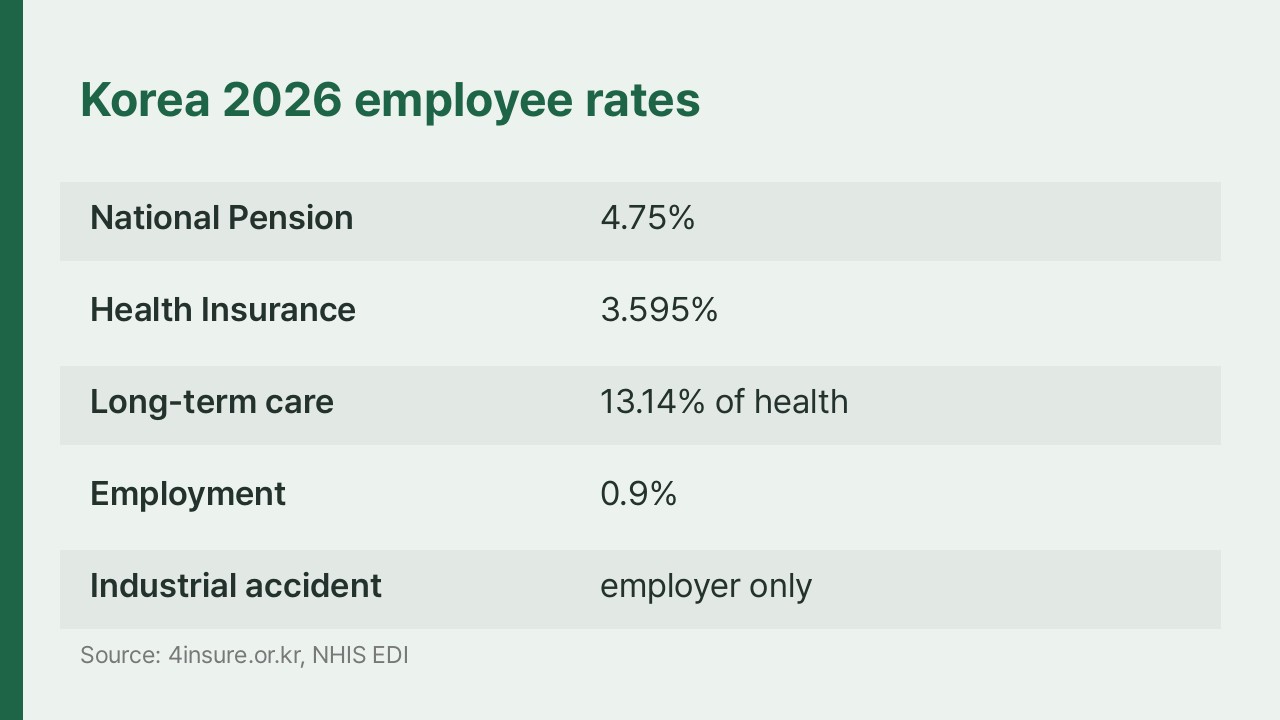
2026 rates at a glance
| Insurance | Total rate | Employee share | Employer share |
|---|---|---|---|
| National Pension | 9.5% | 4.75% | 4.75% |
| Health Insurance | 7.19% | 3.595% | 3.595% |
| Long-Term Care | health premium x 0.9448/7.19 | half | half |
| Employment (unemployment benefit) | 1.8% | 0.9% | 0.9% |
| Industrial accident | varies by industry | none | all |
(Source: 4 Social Insurance Information Center, 2026 rates; NHIS EDI 2026 rate notice — rates unchanged on 6 November 2026 re-check attempt; 4insure English HTTP 400)
Before December 31 (tax-credit window): Pension savings and IRP contributions that you want counted toward tax year 2026 generally need to be completed under your plan’s rules before year-end. Confirm the exact cutoff with NTS year-end settlement guidance and your bank or insurer — this page does not invent a hard filing date.
The pension rate rose from 9% to 9.5% in 2026 after the April 2025 National Pension Act reform, and it will keep rising by 0.25 percentage points per side each year until it reaches 13% in 2033. The health insurance rate rose to 7.19%. Employers also pay an extra 0.25-0.85% for job-stability programmes under employment insurance, which does not come out of your pay.
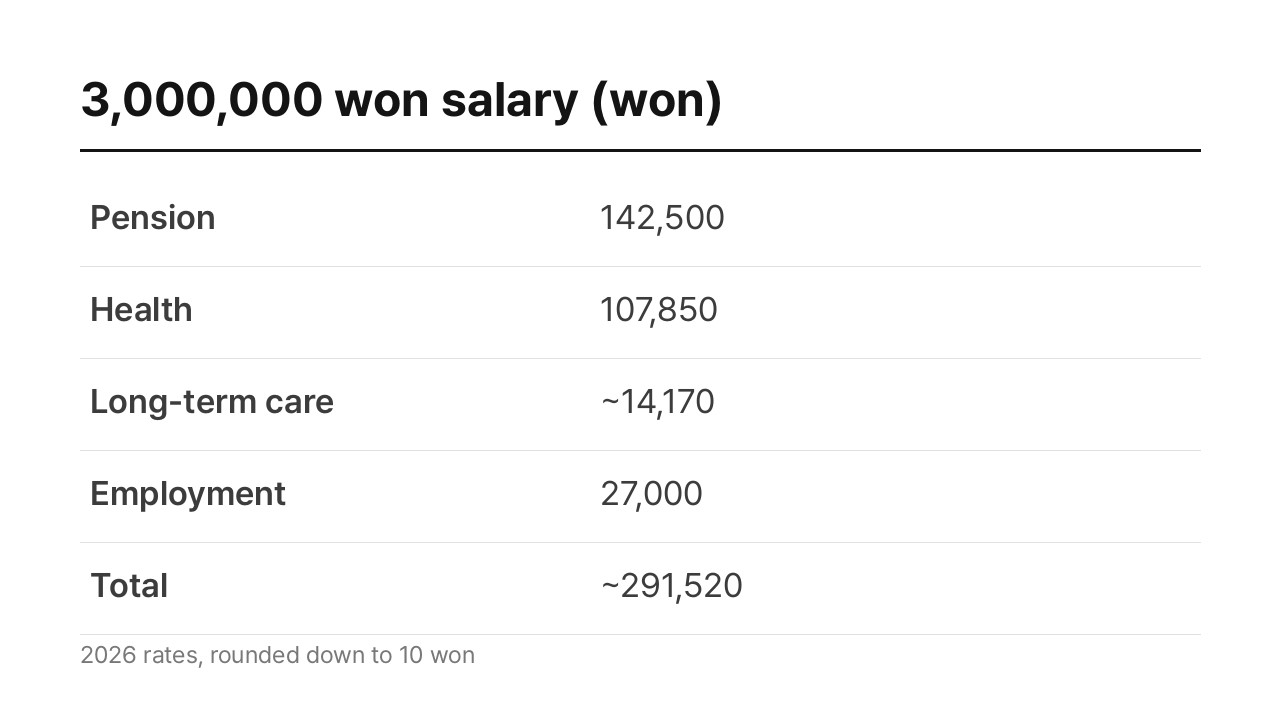
Worked example: 3 million won a month
- National Pension: 3,000,000 x 4.75% = 142,500 won
- Health Insurance: 3,000,000 x 3.595% = 107,850 won
- Long-Term Care: total health premium 215,700 x 0.9448/7.19, halved = about 14,170 won
- Employment Insurance: 3,000,000 x 0.9% = 27,000 won
- Total: about 291,520 won, roughly 9.7% of gross pay
Figures are rounded down to the nearest 10 won. Your payslip can differ by a few won to a few thousand won, because pension uses a “standard monthly income” set once a year and health insurance uses your declared monthly pay.
Comparison at 2.5, 3 and 4 million won
| Gross monthly pay | Pension | Health | Long-term care | Employment | Total |
|---|---|---|---|---|---|
| 2,500,000 | 118,750 | 89,870 | 11,800 | 22,500 | 242,920 |
| 3,000,000 | 142,500 | 107,850 | 14,170 | 27,000 | 291,520 |
| 4,000,000 | 190,000 | 143,800 | 18,890 | 36,000 | 388,690 |
(won per month, employee share, 2026 rates, calculated by Haesul)

Notes for foreign workers
- Pension refunds: some nationalities can claim a lump-sum refund of pension contributions when leaving Korea, depending on their country’s agreement with Korea. See our guide linked below.
- Health insurance: foreign employees enrolled through the workplace pay the same rate as Korean employees. The NHIS 2026 notice lists the average premium for foreign regional (self-employed or non-employed) subscribers as 158,630 won a month.
- Year-end settlement: health insurance is settled against actual pay each April, so you may pay a little more or get a little back.

How to check your own payslip
- Compare the pension and health lines with the rates above.
- Check that long-term care appears as its own line.
- Check that employment insurance is 0.9%.
- If the gap is large, ask HR what monthly pay was reported to the insurers.
FAQ
Q. Do pension savings or IRP contributions need to land before December 31?
For a year-end tax credit on tax year 2026 income, contributions generally need to be recorded under your plan’s rules before year-end. Confirm the exact cutoff with NTS guidance and your bank or insurer rather than assuming a single published clock time.
Q. How much is deducted for social insurance in Korea in 2026?
The employee pays about 9.7% of gross pay: 4.75% pension, 3.595% health, about 0.47% long-term care and 0.9% employment insurance.
Q. Did the Korean pension rate change in 2026?
Yes. The total rate rose from 9% to 9.5% (4.75% each for employee and employer) and will rise 0.5 points a year to 13% in 2033.
Q. Is long-term care insurance a percentage of salary?
No. It is the health insurance premium multiplied by 0.9448/7.19, about 13.14% of the health premium.
Q. Do foreigners pay the same social insurance rates?
Workplace-enrolled foreign employees pay the same rates. Pension refunds on leaving depend on your nationality.
Q. Does industrial accident insurance come out of my pay?
No. The employer pays all of it.
Related guides
- Korea year-end tax settlement for foreigners 2026
- Korea year-end medical expense tax credit 2026
- Korea basic pension 2026: amount and eligibility
- Korea National Pension lump-sum refund for foreigners
- Korea 19% flat tax for foreign workers
Sources
- 4 Social Insurance Information Center, insurance overview (4insure.or.kr) (checked 1 November 2026; English main.do returned HTTP 400 on 6 November 2026 — prior rates kept)
- National Health Insurance Service EDI, 2026 premium rate notice (edi.nhis.or.kr) (checked 1 November 2026)
- NHIS English site (reachable 6 November 2026) https://www.nhis.or.kr/english/wbheaa02300m01.do
This article was written with AI assistance and fact-checked against official sources. It is general information, not tax or legal advice.





11 Comments