Hangover IV Drip Clinics in Korea: What’s in the Drip, What It Costs, and Safer Options
Haesul Health desk (AI-assisted). As of 18 November 2026 (KST). Based on product labels in the Ministry of Food and Drug Safety (MFDS) drug database (nedrug), MFDS rules on “hangover” claims for food products, the National Health Insurance non-covered list (annex 2 of the NHI benefit rules, amended 15 April 2026), the Health Insurance Review and Assessment Service (HIRA) 2026 non-covered fee release, the Ministry of Health and Welfare (MOHW) list of convenience-store medicines, the Korea Disease Control and Prevention Agency (KDCA) drinking statistics of 27 July 2026, the Road Traffic Act, the UK’s NHS and the US National Institute on Alcohol Abuse and Alcoholism (NIAAA). Independent cross-checks: Yonhap, Maeil Business, Financial News, Edaily, Today Shinmun, and the price surveys of my-doctor.io and Modoodoc. General information, not medical advice.
Quick answer: A “hangover drip” (숙취 수액, sukchwi suaek) at a Korean clinic is usually a bag of basic IV fluid with vitamins or other add-ons, and it is non-covered: National Health Insurance (NHIS) pays nothing and you pay the clinic’s own price. In a November 2026 price survey of 267 clinics the average listed price was ₩60,330, against ₩50,420 for IV drips in general. None of the common add-on ingredients is approved in Korea as a hangover treatment, and the US NIAAA says there is no cure for a hangover other than time. Skip the drip and call 119 if someone is confused, cannot be woken, breathes slowly or keeps vomiting while drowsy: that can be alcohol poisoning.
Why now: Korea’s year-end party season (송년회, songnyeonhoe, and work dinners called 회식, hoesik) runs through December; 31 December 2026 is 43 days from 18 November. KDCA’s analysis of the 2025 Community Health Survey, published on 27 July 2026, found that 57.1 percent of adults drank at least once a month, 33.7 percent binge-drank at least once a month (for men, seven or more glasses, or five cans of beer, in one sitting; for women, five or more glasses or three cans) and 12.0 percent drank that much at least twice a week, which KDCA calls high-risk drinking. Yonhap’s report of the same release adds that Korea’s monthly binge-drinking rate was the fifth highest of 27 OECD countries in the OECD’s Health at a Glance 2025 (2023 data). If a night out ends with a clinic drip, it helps to know what you are paying for.
What is actually in a hangover drip
There is no standard recipe. “Hangover drip” is a menu name, not a drug. The price-survey site my-doctor.io describes it as fluid and electrolyte replacement as the base, with vitamins or ingredients for stomach symptoms added at the clinic’s discretion, and says the name alone does not tell you the contents. In practice a Korean clinic drip has two parts:
- The base fluid: a bag of saline, dextrose or a balanced electrolyte solution that replaces water and salts. This is the same kind of fluid hospitals use for dehydration.
- Add-ons: vials injected into the bag. The most common ones have nicknames, which the government is now trying to replace with ingredient names. Edaily reported on 8 April 2026 that the NHIS has commissioned research on standardising non-covered item names, so that, for example, the “Cinderella shot” would be listed as thioctic acid and the “white jade shot” (백옥주사, baegok jusa) as glutathione.
Here is what the MFDS-approved labels for the three best-known add-ons actually say. We looked up one injection product for each ingredient on nedrug.mfds.go.kr on 18 November 2026 (product names left out on purpose; other products with the same ingredient can carry different wording).
| Nickname | Ingredient | What the MFDS label approves it for | Label warnings (summary) |
|---|---|---|---|
| Garlic shot (마늘주사, maneul jusa) | Fursultiamine, a vitamin B1 derivative | Preventing and treating vitamin B1 deficiency; extra supply when needs rise and diet is not enough (for example wasting illness, an overactive thyroid, pregnancy, breastfeeding, heavy physical labour); Wernicke encephalopathy; and some nerve, muscle and joint pain where B1 deficiency is presumed. The label says it should not be used aimlessly for about a month if it has no effect | Rarely, shock: stop at once if blood pressure falls or chest pain or breathing difficulty appears. Inject slowly, as it can cause pain along the vein |
| White jade shot (백옥주사) | Glutathione | On the 600 mg injection label we checked: preventing nerve damage caused by cisplatin-type chemotherapy | Rarely, anaphylaxis-like reactions (pale face, low blood pressure, abnormal pulse) and rash |
| Cinderella shot (신데렐라주사, sinderella jusa) | Thioctic acid (alpha-lipoic acid) | Extra supply when needs rise (heavy physical labour), Leigh syndrome, and certain drug-induced or noise-induced hearing loss; not to be continued if there is no effect after about a month | Loss of appetite, nausea, diarrhoea, rash, headache, dizziness, palpitations |
What the table shows: none of these labels lists hangover as an approved use. A doctor may still choose them, but you are paying for a vitamin or supplement given by vein, not for a licensed hangover treatment. Some clinics also add an anti-nausea or stomach medicine, which is a doctor’s decision for your symptoms; ask what it is.
Does the fluid itself help? It can make a dehydrated person feel better, but the evidence for hangovers is thin. The NIAAA’s hangover fact sheet (updated December 2025) says alcohol causes mild dehydration by suppressing the hormone vasopressin, and that some people turn to sports drinks or IV treatments to correct electrolytes. It then says research has not found a link between the size of electrolyte changes and how bad a hangover is, or that added electrolytes reduce hangover severity, and that in most people the body restores electrolyte balance quickly once the alcohol wears off. Its bottom line: “There is no cure for a hangover other than time.” Symptoms peak as blood alcohol returns to about zero and can last 24 hours or longer.
Why NHIS pays nothing for it
Korea’s National Health Insurance does not cover treatment for “simple fatigue or lethargy” (단순한 피로 또는 권태) when it does not get in the way of work or daily life. That wording sits at the top of annex 2 of the NHI benefit rules, the list of non-covered (비급여, bigeupyeo) care, in the version amended on 15 April 2026. Hangover is not named in that list, but clinics bill hangover and “energy” drips as non-covered nutrient injections: one Seoul health-screening foundation’s posted price list, for instance, files a “drinking” (음주) basic drip under nutrient injections at a flat ₩40,000.
The difference matters if you are actually ill. Two independent price guides (my-doctor.io and the IVNT price site casseur-de-prix.com) both say that fluids a doctor gives to treat a real problem, such as dehydration from repeated vomiting, can fall under normal NHIS rules, while a drip because you feel rough generally does not. If you are on NHIS (most registered foreign residents are; see our NHIS guide for foreigners), tell the doctor your symptoms rather than ordering a menu drip, and check the receipt for which items were covered.
Visitors without NHIS pay the full price either way. Check your travel-insurance wording before you assume a drip is covered, and keep the itemised receipt (진료비 세부내역서, jillyobi sebu naeyeokseo) if you plan to claim.
What a hangover drip costs in 2026
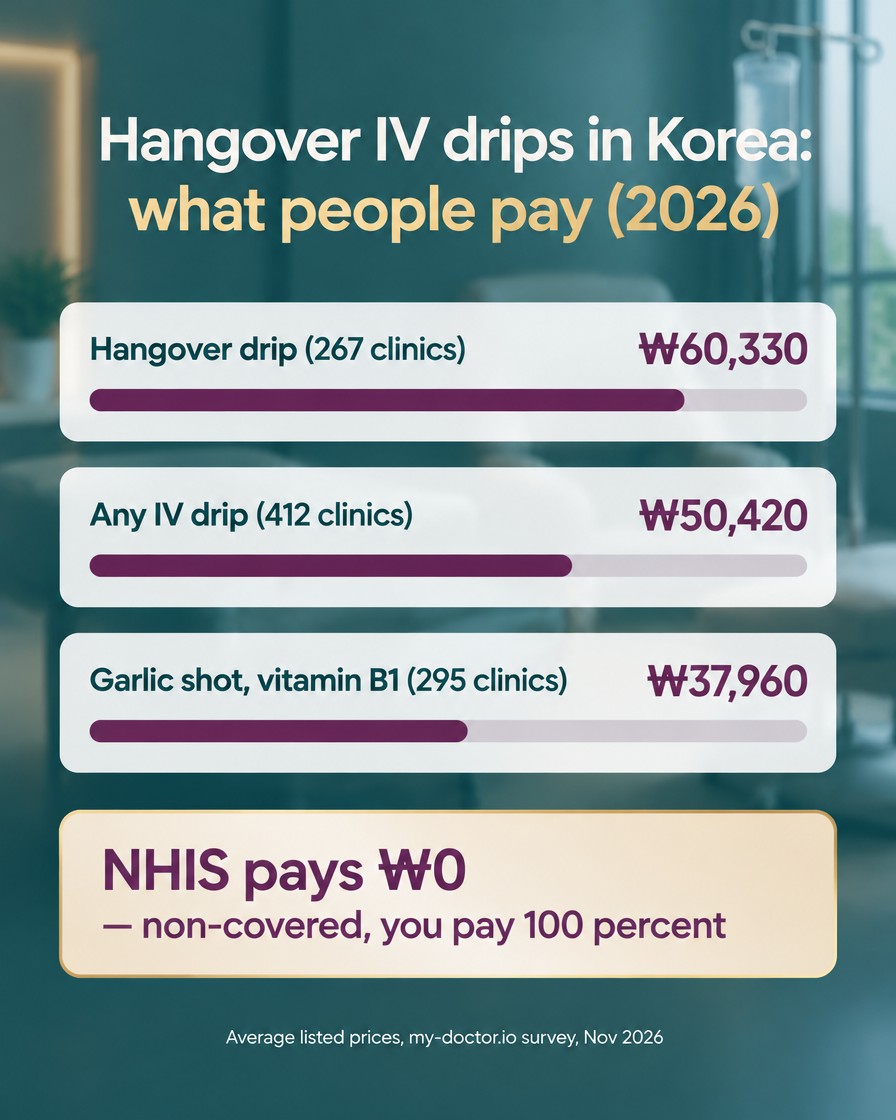
Because these drips are non-covered, each clinic sets its own price; clinics must tell patients non-covered prices in advance under the Medical Service Act rules (as the IVNT price guide summarises). HIRA collects these prices: its 2026 release of 3 September covered 753 non-covered items at 74,449 medical institutions, searchable on hira.or.kr and in the 건강e음 (Geongang e-eum) app, and HIRA’s 2026 reporting guidance says nutrient injections are reportable. We could not extract item-level medians for nutrient drips from HIRA’s interactive lookup on 18 November, so the figures below come from two independent price surveys, labelled as such. They agree on the range: a basic drip around ₩46,000 to ₩50,000 on average, a “hangover” drip around ₩60,000.
| Item (survey) | Clinics in survey | Average listed price | Lowest listed |
|---|---|---|---|
| “Hangover drip” 숙취 수액 (my-doctor.io, November 2026) | 267 | ₩60,330 | ₩10,000 |
| Any IV drip 수액 (my-doctor.io, November 2026) | 412 | ₩50,420 | ₩1,000 |
| IV drip treatment 수액치료 at family-medicine clinics (Modoodoc, November 2026, from patient reviews; highest ₩103,000) | 3,919 surveyed | ₩46,448 | ₩1,500 |
| “Garlic shot” 마늘주사 (my-doctor.io, 7 November 2026) | 295 | ₩37,960 | ₩1,000 |
| NHIS share for any of the above when given for fatigue or hangover | ₩0 |
Very low “lowest” prices may reflect app promotions or a single add-on rather than a full drip, so treat the averages as the useful number. Prices vary with the ingredients, the dose, whether a consultation fee is added and whether you buy a multi-session package.
Worked calculation (ours, from the survey averages above):
| Scenario | Calculation | Total |
|---|---|---|
| Premium for the “hangover” label over an average drip | ₩60,330 − ₩50,420 | ₩9,910 per drip (about 20 percent more) |
| A hangover drip instead of a garlic shot | ₩60,330 − ₩37,960 | ₩22,370 more |
| One hangover drip after every Friday party from 20 November to 25 December 2026 (6 Fridays) | 6 × ₩60,330 | ₩361,980 |
| The same six Fridays with an average drip | 6 × ₩50,420 | ₩302,520 |
| NHIS refund on any of these | 0 | ₩0 |
How to check one clinic’s price: before you sit down, ask for the total (총액, chong-aek) including any consultation fee, and the ingredient names (성분, seongbun) rather than the nickname. Then compare the clinic on HIRA’s non-covered price lookup. Our guide to seeing a doctor in English in Korea explains how clinic visits and receipts work.
When a hangover drip is a bad idea
A drip is a medical procedure, not a spa treatment. Skip it, or at least tell the doctor first, in these situations:
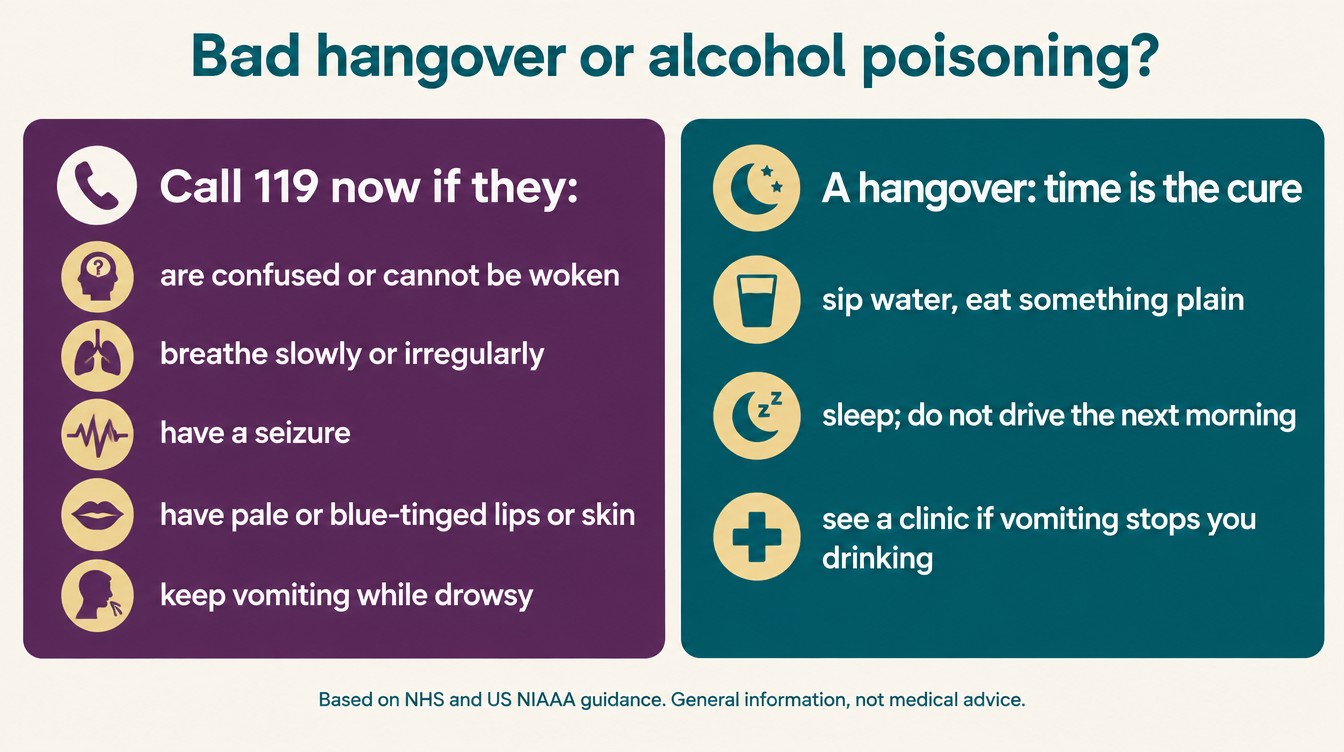
- Signs of alcohol poisoning. The NHS lists confusion, slurred speech or being unable to speak, being unable to stand or walk, vomiting, wetting or soiling oneself, pale or blue-tinged skin, slow or irregular breathing, seizures and loss of consciousness, and says to call an ambulance. In Korea that is 119. Do not leave the person alone, sit them up if awake or put them in the recovery position if not, and do not give coffee, put them in a cold shower or try to make them sick (NHS, reviewed 4 June 2026). Hospitals may give fluids by drip for alcohol poisoning, but under monitoring, not in a clinic recliner.
- You are still drunk. NIAAA says hangover symptoms peak as blood alcohol returns to about zero; a drip does not speed up how fast your liver clears alcohol. my-doctor.io’s own FAQ says a hangover drip does not sober you up and does not make it safe to drive.
- Heart, kidney or liver disease, diabetes or pregnancy. Extra fluid, sugar or vitamins are not automatically safe; tell the doctor about every condition and medicine.
- You have reacted to an injection before. The fursultiamine label warns of rare shock and the glutathione label of rare anaphylaxis-like reactions. Speak up at once if you feel chest tightness, dizziness or itching during the drip.
- It has become a habit. If you need a drip after most nights out, the drinking is the problem to look at. Korea’s national checkup includes a drinking questionnaire for adults; our guide to the lifestyle assessment on the national checkup explains how it scores alcohol use, and our explainer on high ALT and AST liver results covers a related number on checkup reports.
Convenience-store and pharmacy hangover products
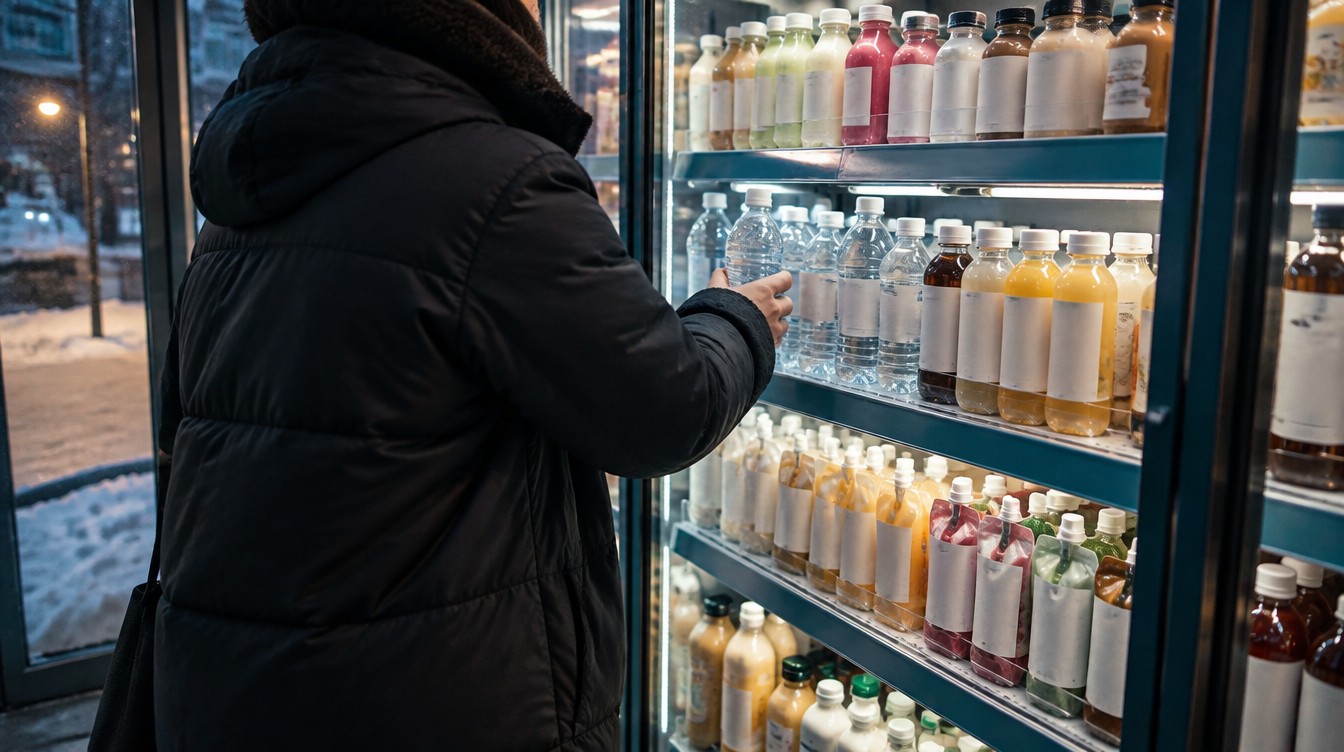
Korean convenience stores sell a wall of hangover drinks, pills and jellies. Two rules help you read them.
Hangover drinks are food, and their claims are now regulated. Since 1 January 2025, any food sold with hangover wording, such as “sobers you up” (술 깨는) or “the day after drinking” (술 먹은 다음 날), must have human-study evidence behind the claim and must pass a pre-review by the Korea Food Industry Association, the MFDS-registered self-regulatory body (MFDS; Yonhap, 30 December 2024). Products already on sale had a grace period until 30 June 2025. A product that keeps the claim without evidence can face a 15-day to one-month business suspension or a 15-day product-manufacturing suspension. So a hangover claim on a Korean label now means the company holds a study; the product is still a food, not a medicine approved by the MFDS.
Only 13 medicines may be sold outside pharmacies. MOHW’s list (page updated 31 March 2026) allows 24-hour shops registered with the local health centre to sell five fever and pain medicines (adult and children’s acetaminophen and a children’s ibuprofen syrup), four digestive aids, two cold medicines and two pain patches. Shops may sell only one pack per item per purchase and none to children under 12. Financial News reported on 26 September 2026 that two of the children’s acetaminophen products have stopped production, so only 11 are actually on shelves, and that nothing has been added since the scheme began in 2012 (MOHW is discussing expanding it to up to 20 items; antacids and anti-diarrhoeals have been floated). Our cold and flu medicine guide lists the 13 by ingredient.
Painkillers and alcohol: read the warning. The MFDS label on Korean acetaminophen tablets carries this warning first: people who regularly drink three or more drinks a day must talk to a doctor or pharmacist before taking it or any other fever or pain medicine, because it can cause liver damage. NIAAA says the same about acetaminophen and alcohol, and adds that aspirin and ibuprofen can irritate the stomach lining. Ask a pharmacist (약사, yaksa) before taking anything for a hangover headache; this guide does not give doses.
At night or on a holiday, public late-night pharmacies and some clinics stay open; our guide to late-night pharmacies, moonlight clinics and 119 shows how to find them.
The morning after: drink-driving rules
The most expensive hangover mistake in Korea is driving. Under Article 148-2 of the Road Traffic Act (version in force from 13 October 2026), driving with a blood alcohol concentration (BAC) of 0.03 percent or more is a crime. The bands below apply to a first offence; a repeat within 10 years falls under a heavier clause (Art. 148-2(1)):
| BAC | Criminal penalty (Road Traffic Act, Art. 148-2(3)) | Licence |
|---|---|---|
| 0.03 to under 0.08 percent | Up to 1 year in prison or a fine of up to ₩5 million | Suspended |
| 0.08 to under 0.2 percent | 1 to 2 years in prison or a fine of ₩5 million to ₩10 million | Revoked |
| 0.2 percent or more | 2 to 5 years in prison or a fine of ₩10 million to ₩20 million | Revoked |
The licence column follows Maeil Business’s summary of the police release (revocation at 0.08 percent and above) and a law firm’s summary of the licence-points rules (suspension below that). Last winter the National Police Agency ran a year-end crackdown from 1 December 2025 to 31 January 2026, with nationwide checks every Friday, at least two sweeps a week per provincial police agency, and morning-commute and lunchtime checks for hangover and lunchtime drinking (Maeil Business, 27 November 2025). The same release counted 8,107 drink-driving crashes from January to October 2025, with 76 deaths and 16,639 injuries. We found no 2026–27 crackdown announcement when we checked on 18 November. A drip does not lower your BAC; only time does.
A simple plan for a year-end party
- Before: eat a proper meal, plan your ride home (taxi, subway or a designated-driver service, 대리운전, daeri unjeon) and keep the car at home.
- During: alternate alcohol with water, and pace yourself; you do not have to finish every glass that is poured.
- That night: water and sleep. If a friend shows the danger signs above, call 119 and stay with them.
- Next morning: water, a plain meal, rest. Do not drive until you are sure the alcohol has cleared. If you still want a drip, ask for the ingredient list and the total price first, and say if you have any health conditions.
- If vomiting stops you keeping fluids down, or symptoms last beyond a day: see a doctor and describe the symptoms; treatment of real dehydration is a medical matter, not a menu choice.
Common problems
- “The clinic only gives me a nickname.” Ask “성분이 뭐예요?” (seongbuni mwoyeyo, what are the ingredients?) and “총 얼마예요?” (chong eolmayeyo, how much in total?).
- “The price doubled at the counter.” A package price may have been quoted per session, or a consultation fee added. Ask for the itemised receipt; you can ask HIRA to review charges for covered items through its 진료비 확인 (fee check) service.
- “Will my insurer pay?” Read the policy wording: many policies treat a drip for fatigue differently from treatment of a diagnosed illness, such as gastroenteritis with dehydration, so ask the doctor to note the diagnosis on the receipt if there is one.
- “I feel worse during the drip.” Tell the nurse at once. Chest tightness, itching, dizziness or pain along the vein are reasons to stop.
Frequently asked questions
Q. How much is a hangover IV drip in Korea?
Prices are set by each clinic. In my-doctor.io’s November 2026 survey of 267 clinics the average listed price for a hangover drip was ₩60,330, against ₩50,420 for IV drips in general (412 clinics). Modoodoc’s review-based survey put IV drip treatment at family-medicine clinics at ₩46,448 on average. NHIS pays nothing for drips given for fatigue or a hangover.
Q. Does a hangover drip work?
It can relieve thirst and dehydration, but the US NIAAA says research has not shown that added electrolytes reduce hangover severity and that there is no cure for a hangover other than time. None of the common add-ons (fursultiamine, glutathione, thioctic acid) is approved in Korea as a hangover treatment on the labels we checked.
Q. Is a hangover drip covered by Korean health insurance?
No. The NHI benefit rules list care for simple fatigue or lethargy that does not affect work or daily life as non-covered, and clinics bill hangover drips as non-covered nutrient injections. Fluids a doctor gives to treat real dehydration, for example from repeated vomiting, can fall under normal NHIS rules.
Q. Will a drip sober me up so I can drive?
No. A drip does not speed up how fast your body clears alcohol. Korea’s limit is a blood alcohol concentration of 0.03 percent, and police have run morning-commute checks for hangover driving during the year-end crackdown.
Q. Can I take a painkiller for a hangover headache?
Ask a pharmacist first. The MFDS label on acetaminophen warns that people who regularly have three or more drinks a day must consult a doctor or pharmacist before taking it or any other fever or pain medicine, because of the risk of liver damage. NIAAA adds that aspirin and ibuprofen can irritate the stomach.
Q. When should I call 119 instead?
Call 119 if someone is confused or cannot be woken, breathes slowly or irregularly, has a seizure, has pale or blue-tinged lips or skin, or keeps vomiting while drowsy. These are signs of alcohol poisoning listed by the NHS. Stay with the person and do not try to make them sick.
Sources
- MFDS drug database (nedrug), fursultiamine injection label (efficacy, warnings), checked 18 November 2026: https://nedrug.mfds.go.kr/pbp/CCBBB01/getItemDetail?itemSeq=200807341
- MFDS nedrug, glutathione 600 mg injection label: https://nedrug.mfds.go.kr/pbp/CCBBB01/getItemDetail?itemSeq=201400511
- MFDS nedrug, thioctic acid injection label: https://nedrug.mfds.go.kr/pbp/CCBBB01/getItemDetail?itemSeq=201502444
- MFDS nedrug, acetaminophen 500 mg tablet label (alcohol warning): https://nedrug.mfds.go.kr/pbp/CCBBB01/getItemDetail?itemSeq=199601312
- MFDS Seoul regional office, notice on hangover claims from 1 January 2025 (28 May 2024): https://www.mfds.go.kr/brd/m_824/view.do?seq=45346
- Korea.kr, Food-safety changes in 2025 (MFDS): https://www.korea.kr/news/policyNewsView.do?newsId=148938505
- Fisheries Safety Information Service, reprint of the MFDS release of 30 December 2024 (penalties, grace period): https://fsis.go.kr/front/contents/cmsView.do?cate_id=0401&cnts_id=36217&select_list_no=6
- Yonhap, Hangover claims need human-study evidence from 2025 (30 December 2024): https://www.yna.co.kr/view/AKR20241230032700017
- Today Shinmun, Hangover-product human trials now mandatory (January 2025): https://www.ntoday.co.kr/news/articleView.html?idxno=112257
- Annex 2 of the NHI benefit rules, non-covered care (amended 15 April 2026), via law.go.kr: https://www.law.go.kr/LSW/flDownload.do?flSeq=163452831
- HIRA and MOHW, 2026 non-covered fee disclosure (3 September 2026): https://www.hira.or.kr/bbsDummy.do?brdBltNo=11896&brdScnBltNo=4&pgmid=HIRAA020041000100
- HIRA non-covered price lookup: https://www.hira.or.kr/npay/index.do?pgmid=HIRAA030009000000
- 2026 non-covered reporting notice (nutrient injections reportable), as republished: https://kimyakuk.tistory.com/15629029
- Edaily, Standardising nicknamed non-covered items (8 April 2026): https://www.edaily.co.kr/News/Read?mediaCodeNo=257&newsId=02453446645414152
- my-doctor.io, Hangover drip prices, 267 clinics (November 2026): https://my-doctor.io/medical-cost/수액/숙취수액
- my-doctor.io, IV drip prices, 412 clinics (November 2026): https://my-doctor.io/medical-cost/수액
- my-doctor.io, Garlic shot prices, 295 clinics (7 November 2026): https://my-doctor.io/medical-cost/수액/마늘주사
- Modoodoc, IV drip treatment prices (November 2026): https://www.modoodoc.com/blog/post/169/
- IVNT price guide, Nutrient drip costs and insurance (30 September 2026): https://casseur-de-prix.com/weight-loss-20260930-ivnt/
- Example posted non-covered price list of a health-screening foundation: https://www.hanaromf.com/helpdesk/insurance/index.jsp?shospital_fk=3
- MOHW, Convenience-store (safe household) medicines, updated 31 March 2026: https://www.mohw.go.kr/menu.es?mid=a10702040200
- Financial News, Convenience-store medicines still at 13 items (26 September 2026): https://www.fnnews.com/news/202609231125118781
- KDCA, Drinking indicators from the 2025 Community Health Survey (press release, 27 July 2026): https://www.kdca.go.kr/bbs/kdca/42/308588/download.do
- Yonhap, High-risk drinking among men down in 10 years (27 July 2026): https://www.yna.co.kr/view/AKR20260727065500530
- Road Traffic Act, Article 148-2 (in force 13 October 2026), via law.go.kr: https://www.law.go.kr/lsLinkCommonInfo.do?chrClsCd=010202&lsJoLnkSeq=1032387695
- Maeil Business, Police year-end drink-driving crackdown (27 November 2025): https://www.mk.co.kr/news/society/11478367
- Kwon Jinho Law, Drink-driving penalties by BAC band, first offence (licence suspension and revocation): https://kwonjinholaw.com/criminal/dui/dui-first-offense/
- HIRA, Fee check service (진료비 확인): https://www.hira.or.kr/rb/npay/index.do?pgmid=HIRAA030009100000
- NIAAA, Hangovers fact sheet (updated December 2025): https://www.niaaa.nih.gov/publications/brochures-and-fact-sheets/hangovers
- NHS, Alcohol poisoning (reviewed 4 June 2026): https://www.nhs.uk/conditions/alcohol-poisoning/
How we checked: On 18 November 2026 we read the MFDS labels for one fursultiamine, one glutathione, one thioctic acid and one acetaminophen product, the MFDS hangover-claim notice, annex 2 of the NHI benefit rules, HIRA’s 2026 release, MOHW’s convenience-store medicine page, KDCA’s drinking release, the Road Traffic Act article, and the NIAAA and NHS pages. Prices are survey averages from my-doctor.io and Modoodoc, not HIRA medians; the worked totals are our own arithmetic from those averages.
This guide is general information, not medical advice. Whether you need IV fluids, and which, is for a doctor to decide. In an emergency call 119.
Researched and drafted with AI assistance; checked against the sources listed.