Lifestyle Assessment on Korea’s National Checkup at 40, 50, 60 and 70: The Smoking, Drinking, Exercise, Diet and Weight Questions, and What Your Result Sheet Means
Haesul Health desk (AI-assisted). As of 11 November 2026 (KST), based on the National Health Insurance Service (NHIS) general checkup guide, the Ministry of Health and Welfare (MOHW) Health Checkup Implementation Standards (notice no. 2026-6, in force 7 January 2026, with its lifestyle questionnaires, prescription forms and result forms on law.go.kr), the MOHW e-Health Portal, and the Korea Disease Control and Prevention Agency (KDCA) National Health Information Portal. Independent cross-checks: Cheongju St. Mary’s Hospital checkup centre, the US CDC and the US NIAAA. This is general information, not medical advice. Only your doctor can interpret your own answers and results.
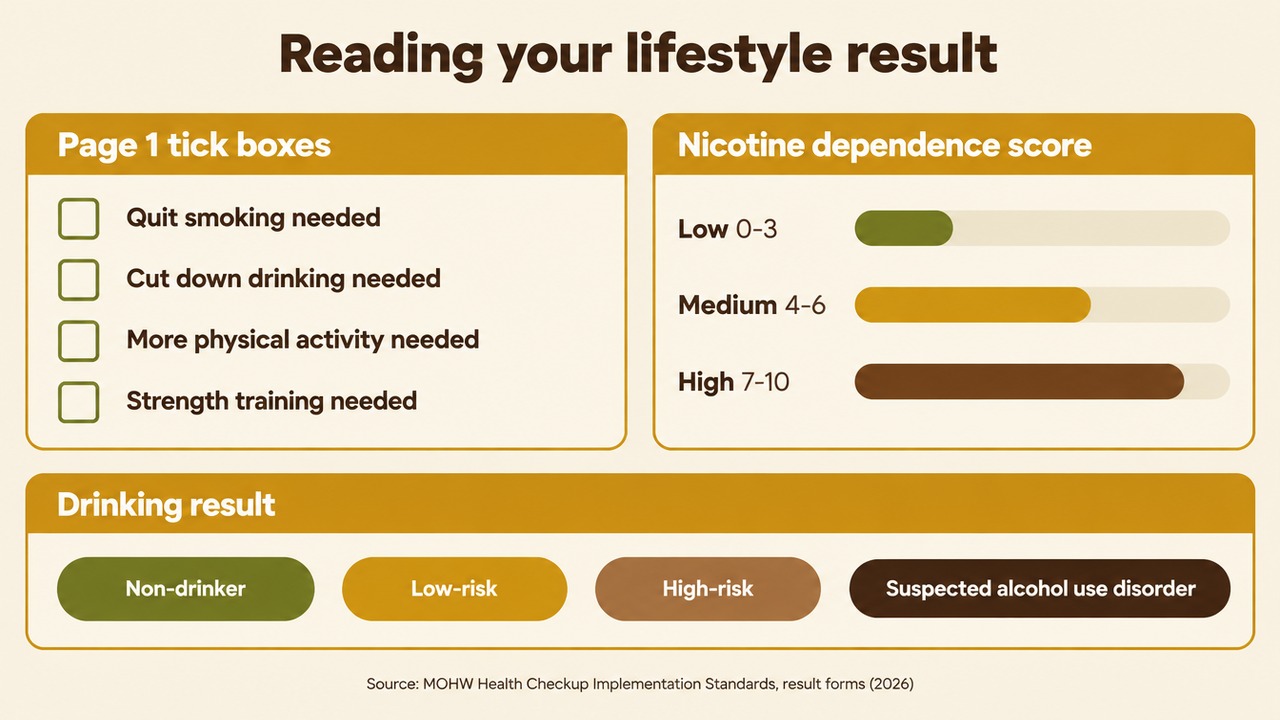
Quick answer: The lifestyle assessment (생활습관평가) is a part of Korea’s national general checkup that you get only at ages 40, 50, 60 and 70. It is not a blood test. It is a set of questionnaires and a short doctor counselling on five areas: tobacco use, drinking, exercise, nutrition and obesity. The result comes as a separate lifestyle result sheet with up to five “prescriptions”, plus four tick boxes on page 1 of your normal result sheet: quit smoking needed, cut down drinking needed, more physical activity needed, strength training needed. The 2026 checkup window closes on Thursday 31 December 2026, 48 days from 13 November. The prescriptions are lifestyle guidance and cannot be used to buy medicine. If you are one of those ages this year, the next one is ten years away, counting from the list of ages.
Most people in their 40s to 70s know the checkup for its blood pressure, glucose and cholesterol numbers. In the year you turn 40, 50, 60 or 70 (as NHIS counts your age), the same visit also asks how much you smoke, drink and move, how you eat, and how your weight has changed, and then hands you a written plan. Because it only comes four times in a lifetime, it is easy to walk past. This guide explains who gets it, what each questionnaire actually asks, how the scores work where the official forms print them, and how to read the two documents you receive.

Who gets the lifestyle assessment, and when
The NHIS general checkup guide lists the lifestyle assessment among the “sex- and age-specific items” with one rule: age 40, 50, 60 and 70. The MOHW e-Health Portal’s 2026 programme page repeats the same four ages for general-checkup recipients. Cheongju St. Mary’s Hospital’s checkup centre says the same in its patient notes: smoking, drinking, exercise, nutrition and obesity at 40, 50, 60 and 70.
The checkup itself follows the usual rules:
- Who is invited: heads of regional households, employees, and household members and dependants aged 20 and over. NHIS says the checkup is once every 2 years, every year for non-office workers. The e-Health Portal adds that the two-year cycle follows odd or even birth years, while the age-specific items are done at the matching age.
- Which birth years? If you count your age as 2026 minus your birth year, the four ages are birth years 1986, 1976, 1966 and 1956. That is our own calculation, not an NHIS statement, and all four are even years. NHIS sends your notice and its website lets you look up whether you are a target, so use that rather than doing the sum yourself.
- The window: 1 January to 31 December each year. NHIS says that if you missed last year’s checkup you can apply to be added as a target this year.
- The cost: under Article 12 of the Implementation Standards, NHIS bears the whole cost of the general checkup for insured people and dependants, and the state and local government bear it for Medical Aid recipients. NHIS warns that tests outside the standard items are charged.
- Medical Aid recipients aged 66 and over are not in the general checkup. They get the Life-Transition Checkup, where the lifestyle assessment is done at age 70 only (e-Health Portal).
The Standards also say, in Article 6, that if you want, you can do the lifestyle assessment once on a different day from the rest of the checkup. If you do that separate-day assessment at a different clinic, bring your general checkup result sheet (Article 13).
Cheongju St. Mary’s adds that being notified as a target does not settle it. Time abroad, military service or a job change can alter your status, and going for items you are not eligible for can mean the cost is recovered from you, so confirm before you go.
What the assessment is, in the official wording
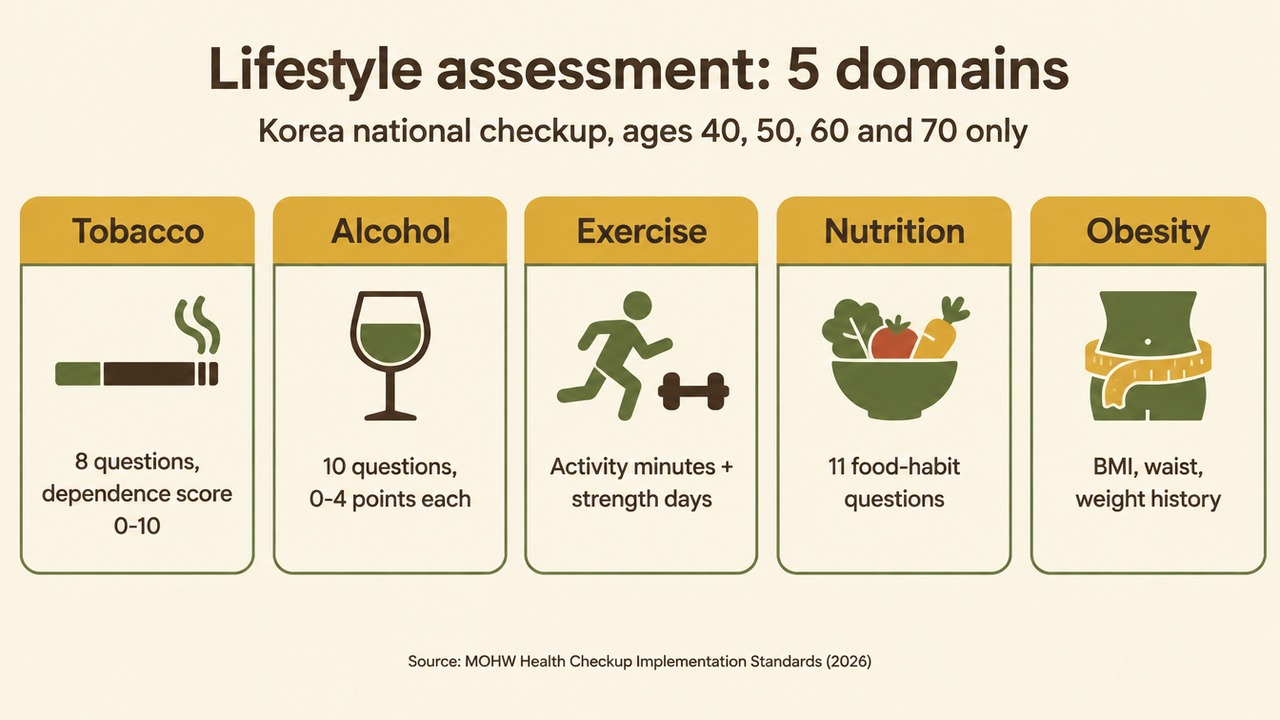
Article 5 of the Implementation Standards defines it as assessing the health-risk factors of tobacco use, drinking, exercise, nutrition and obesity, and, depending on the result, giving counselling and prescriptions for improving lifestyle. The clinic gives you the lifestyle result sheet and the prescription forms. If you take the lifestyle assessment on a separate day, Article 10 says the clinic must hand the result to you directly, except for unavoidable cases such as a system failure, when it can be sent by post, email or mobile. General checkup results are sent within 15 days (NHIS).
Before the visit you fill in the general questionnaire (문진표). Items 4 to 10 on one 2026 hospital copy of the national questionnaire (Soonchunhyang University Bucheon Hospital) are the lifestyle questions:
- Smoking: whether you have ever smoked at least 5 packs (100 cigarettes) in your life, whether you smoke now, how many years and how many a day; the same for heated tobacco; and whether you have used liquid e-cigarettes in the past month (never, 1–2 days, 3–9, 10–29 or every day).
- Drinking (past year): how often you drink (per week, month or year), how much you usually drink on a drinking day, and the most you drank in one day, entered as glasses, bottles, cans or cc for soju, beer, spirits, makgeolli and wine.
- Activity: days per week and hours per day of vigorous activity, days and hours of moderate activity, and the number of days in the past week you did strength training.
Then the doctor ticks a lifestyle line on the result sheet: good or needs improvement for smoking, drinking, physical activity and strength. For ages 40, 50, 60 and 70, the fuller assessment tools in the Standards are used.
Domain by domain: what each tool asks and how it is scored
| Domain | Official tool | What it asks | Scoring on the form |
|---|---|---|---|
| Tobacco | Form 15 (revised 1 Jan 2025) | 8 questions, for current smokers only | Questions 3 to 8 are scored, giving 0–10; questions 1–2 (quit plans, confidence) are not |
| Alcohol | Form 15-3 | 10 questions on the past year | 0–4 points per question; the prescription form calls it AUDIT-KR |
| Exercise | Form 15-5 | Work, travel and leisure activity; sitting time; strength days; 7 safety questions | Minutes and days of moderate and vigorous activity |
| Nutrition | Form 15-7 | 11 food-habit questions (2021 copy) | 1, 3 or 5 points each (2021 copy) |
| Obesity | Form 15-9 | Height, weight, waist, BMI plus 3 weight-history questions (2021 copy) | BMI and waist lines on the result sheet |
Sources: MOHW Health Checkup Implementation Standards forms 15, 15-3, 15-5 (law.go.kr); nutrition and obesity tools from a 2021 copy of the forms from a checkup provider (hanilmed.net), because the current law.go.kr versions of forms 15-7 and 15-9 are images I could not read. The current wording may differ.
Tobacco: an 8-question form and a score from 0 to 10
Only current smokers fill it in. The current form says lifelong non-smokers and former smokers skip it, and the 2021 copy also let e-cigarette-only users skip it. The form counts one regular cigarette = one heated-tobacco stick = 15 puffs or 10 minutes of a liquid e-cigarette. The scored questions are:
| Question | Answer and points |
|---|---|
| 3. Time to the first cigarette after waking | Within 5 min 3; 6–30 min 2; 31–60 min 1; after 60 min 0 |
| 4. Hard to refrain in no-smoking places? | Yes 1; no 0 |
| 5. Which cigarette is hardest to give up? | The first of the morning 1; any other 0 |
| 6. Cigarettes per day | 10 or fewer 0; 11–20 1; 21–30 2; 31 or more 3 |
| 7. More in the first hours after waking? | Yes 1; no 0 |
| 8. Would you smoke if ill in bed most of the day? | Yes 1; no 0 |
The maximum is 3 + 1 + 1 + 3 + 1 + 1 = 10, matching the result sheet’s three bands: low 0–3, medium 4–6, high 7–10. The result sheet also records whether you are a non-smoker, former smoker, current smoker or e-cigarette-only user. The quit-smoking prescription form lists the menu the doctor can tick: counselling and education, drug treatment (nicotine replacement, bupropion, varenicline), and referral to quit-smoking groups, clinics or the national cessation support services. Whether any applies to you is the doctor’s decision.
Alcohol: 10 questions, up to 40 points
The alcohol tool is a 10-question, 0–4 point scale. Questions 1–8 ask how often you drink, how much on a usual day, how often you drink a lot in one sitting, and in the past year how often you could not stop once you started, drinking got in the way of daily life, you needed a morning drink, you felt regret, or you could not remember the night before. Questions 9 and 10 ask whether your drinking has led to injury, or whether family or a doctor told you to cut down, scored 0 (never), 2 (before the past year) or 4 (in the past year). The maximum is 40.
The form turns your drinks into units like this: soju by the bottle (half a bottle or less = 0 points on the amount question, up to 2.5 bottles or more = 4), and other drinks by the glass, with a can of beer or a small bottle counting as one glass, a bowl of makgeolli as one glass, and 500 cc of draught beer as 1.3 glasses. Question 3 sets the heavy-drinking line at more than one bottle of soju or 5 cans of beer (2,000 cc of draught) in one sitting, which the form says equals 60 g of alcohol.
For scale, KDCA and the US NIAAA both define a standard drink as about 14 g of pure alcohol: about a 12-ounce (350 ml) can of 5% beer, or one quarter of a 17% soju bottle (about 90 ml). KDCA also notes that the World Health Organization says there is no safe level of alcohol for health.
The result sheet then labels you non-drinker, low-risk, high-risk or suspected alcohol use disorder. I could not open the national cut-off scores for those labels in an official text. Different local tools use different lines. KDCA describes 8 or more on AUDIT-K as risky drinking. Tongyeong Public Health Center, using its own version, labels 10–19 for men and 6–9 for women as risky drinking and 20 or more (men) or 10 or more (women) as abuse or dependence. Its question 3 is worded differently from the national form. Use these only as rough reference points, and let your clinic tell you which label applies.
The alcohol prescription form tells the story of each label: for low-risk, take care not to become high-risk; for high-risk, change drinking habits to within low-risk limits, and abstain for the time being if there are physical complications such as reduced liver function; at the suspected-disorder level, stop drinking completely and see a hospital about treatment. A screening label is not a diagnosis. KDCA says a diagnosis uses the DSM-5 list of 11 criteria (2–3 met is moderate, 4 or more is severe).
Exercise: minutes by intensity, plus strength days
The exercise tool asks about work (for example carrying more than about 20 kg is high intensity; brisk walking at work or cleaning is moderate), travel (walking or cycling at least 10 minutes at a time), and sport and leisure (running, hiking, swimming and badminton are listed as high; brisk walking, light jogging, golf and Pilates as moderate). Only stretches of at least 10 minutes count. It also asks how many hours a day you sit or lie awake, and how many of the past 7 days you did push-ups, sit-ups, weights or similar (none, 1, 2, 3, 4 or 5 or more). Questions 6 to 12 are safety checks: whether a doctor has limited your exercise because of your heart, chest pain during or without exercise, loss of balance from dizziness, bone or joint problems, current prescription for blood pressure or heart, or any other reason not to exercise.
The result sheet has two lines: insufficient physical activity / basic physical activity / health-enhancing physical activity, and insufficient strength training / adequate strength training. The exercise prescription then rates your level as not enough to maintain health, enough to maintain but not to improve health, or enough to improve health, and suggests a type (brisk walking, hiking, swimming, cycling, dance, yoga, strength training and so on), a time (10 minutes, 15–30 minutes or 30+ minutes) and a frequency (1–2, 3–4 or 5+ times a week).
I could not open the checkup’s own minute thresholds for each rating. As a reference, KDCA’s physical activity guidance for ages 19–64 is 150–300 minutes of moderate or 75–150 minutes of vigorous aerobic activity a week, with one minute of vigorous counting as two of moderate, plus strength training on at least 2 days a week. For those 65 and over KDCA lists 150–300 minutes moderate or 75–100 vigorous, and strength training on at least 2 days. The US CDC’s adult guideline has the same 150 / 75 / 2-days structure. KDCA also suggests keeping inactive leisure sitting to about 2 hours a day, and says that if you answer “yes” to any question on a readiness questionnaire such as PAR-Q, you should talk to a doctor before starting intense activity.
Nutrition: 11 food-habit questions
The 2021 copy of the nutrition tool asks about: a cup (200 ml) of milk or dairy daily; meat, fish, egg, bean or tofu dishes 3 times a day; non-kimchi vegetables at every meal; a piece of fruit daily; fried or stir-fried food; cholesterol-rich foods such as pork belly, egg yolk or squid; a daily sweet snack or sweet drink (ice cream, cake, biscuits, mixed coffee, cola, sikhye); salted or pickled side dishes daily; fixed meal times; how many of five food groups you eat in a day; and how often you eat out. Each answer scores 1, 3 or 5 (reversed for the “less is better” items), so the total runs from 11 to 55 by our arithmetic. The result sheet’s old format rated nutrition as good, fair or poor. I could not confirm the score cut-offs for those ratings.
The nutrition prescription offers: eat more (dairy, protein foods, vegetables; the 2021 copy adds fruit), eat less (fat, simple sugars, salt), build good habits (do not skip breakfast, eat a variety), or a referral to a nutrition class.
Obesity: BMI, waist and weight history
The obesity part starts from the numbers your clinic already measures. Page 1 of the result sheet marks BMI as underweight under 18.5, normal 18.5–24.9, overweight 25–29.9, obese 30 or over, and waist as abdominal obesity at 90 cm or more for men and 85 cm or more for women. In the 2021 copy, people picked for the obesity lifestyle assessment answer three more questions: whether you have gained 10 kg or more since your late teens or early twenties, how many times you have tried to lose weight (never, 1–3, 4 or more, always trying), and how interested you are in keeping a normal weight. The obesity prescription offers: eat smaller portions, cut snacks and late-night eating, cut drinking amount and frequency, cut eating out and fast food, follow the exercise prescription, or a referral to an obesity clinic.

Your two result documents
| Where | What it shows |
|---|---|
| Page 1 of the general checkup result sheet | A note to see the lifestyle result sheet and prescriptions, and four boxes under lifestyle: quit smoking needed, cut down drinking needed, more physical activity needed, strength training needed, with the line “consult your doctor” |
| Lifestyle result sheet (생활습관평가 결과지) | Smoker status; nicotine dependence band (low 0–3 / medium 4–6 / high 7–10); drinking level; activity level; nutrition and weight status |
| Prescription forms | One each for quitting smoking, drinking, exercise, nutrition and obesity, each marked “yes” or “no” |
Every prescription form carries the same footer: it is a prescription to guide lifestyle, not for dispensing or taking medicine. Cheongju St. Mary’s says the same. In practice, you take the page to the doctor or to a support service named on it; you do not take it to a pharmacy.
Page 1 also carries your overall checkup verdict (normal A, normal B (borderline), disease suspected, and so on) and, for blood pressure, diabetes and lipid flags, the free confirmatory visit described at the end of this guide. Those verdicts do not depend on your lifestyle answers. They come from your measured numbers.
Worked readings: four example answer sets
These are illustrative answers scored with the official forms where the scores are printed. They are not real patients.
Example 1: a 52-year-old man who smokes. First cigarette within 5 minutes of waking (3), finds it hard to refrain in no-smoking places (1), the first cigarette of the day is the hardest to give up (1), 12 cigarettes a day (1), does not smoke more in the morning (0), would smoke if ill in bed (1).
- Total 3 + 1 + 1 + 1 + 0 + 1 = 7, which is the high band (7–10).
- The page 1 “quit smoking needed” box is likely to be ticked, and the quit-smoking prescription lists counselling, drug treatment or referral for the doctor to choose.
Example 2: a 58-year-old man who drinks beer. Drinks 2–3 times a week (3), usually 3–4 cans (1), 5 or more cans in one sitting about once a month (2), loss of control never (0), problems with daily life never (0), no morning drink (0), regret less than monthly (1), no memory loss (0), no injury (0), family told him to cut down in the past year (4).
- Total 3 + 1 + 2 + 0 + 0 + 0 + 1 + 0 + 0 + 4 = 11 out of 40.
- 11 is above KDCA’s 8-or-more AUDIT-K line and inside the Tongyeong centre’s male “risky” band of 10–19. The national label (low-risk or high-risk) is the doctor’s call. If it is high-risk, the prescription form says to bring drinking within low-risk limits, and to stop for now if liver function is affected.
Example 3: a 60-year-old woman who walks. Brisk walking for 30 minutes on 4 days a week (120 minutes moderate), light jogging for 15 minutes on 2 days (30 minutes vigorous), no push-ups or weights this week.
- Counting 1 vigorous minute as 2 moderate: 120 + 30 × 2 = 180 moderate-equivalent minutes, inside KDCA’s 150–300 range for adults.
- Strength days: 0 against KDCA’s 2 or more. This is the gap the “strength training needed” box points at, even when the walking is enough.
Example 4: a 70-year-old man. 168 cm, 71 kg, waist 92 cm.
- BMI = 71 ÷ (1.68 × 1.68) = 71 ÷ 2.8224 = 25.2, which the result sheet marks as overweight (25–29.9).
- Waist 92 cm is above the men’s 90 cm line, so abdominal obesity is flagged. The obesity prescription then offers items such as smaller portions, fewer snacks and late meals, and the exercise prescription.

What to do with the result
- Read both documents. Page 1 tells you the broad verdict and ticks. The lifestyle result sheet tells you the detail. If a prescription says “yes”, it was written for you.
- Use the counselling. The point of the assessment is the conversation and the plan, so ask what the doctor would change first, and ask about any support service the form lists.
- Find free support where it exists. KDCA says regional addiction management support centres (50 across the country) and mental health welfare centres provide national support services for drinking problems. The smoking prescription refers to national cessation support services.
- Check safety before you raise exercise. If you answered “yes” to any of the heart, chest-pain, dizziness or joint questions, raise it with your doctor before you step up intensity.
- Do not expect a diagnosis. A lifestyle label such as “high-risk” or “suspected alcohol use disorder” is a screening result. Only your doctor can diagnose.
- Keep the sheet for next time. By the list of ages, the next lifestyle assessment is at the next of 50, 60 or 70, and there is none after 70 (our reading of the list).
A 50-day plan to 31 December 2026
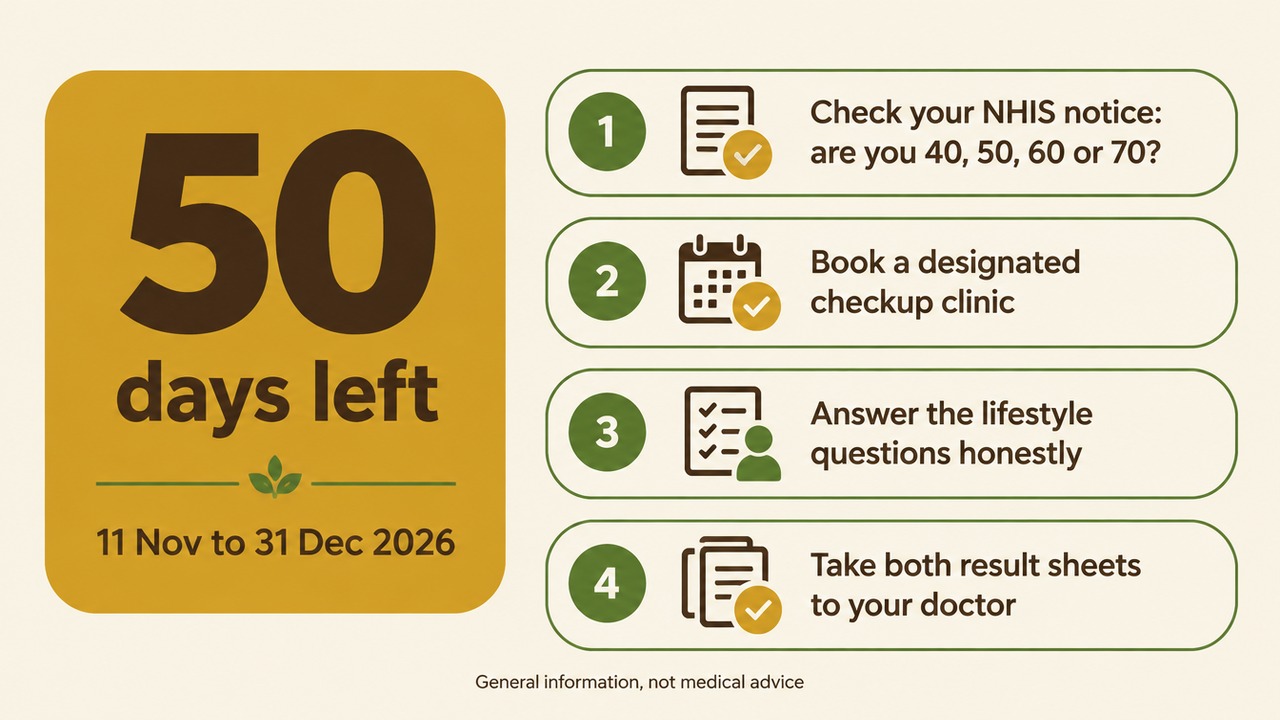
- This week: check on the NHIS website or app that you are listed as a 2026 target, and find a designated checkup clinic. NHIS says you must bring photo ID (resident card, driving licence or passport), and if you lost your notice you can print a target confirmation on the NHIS site.
- Before the visit: NHIS asks you to fast from 9 pm the night before and to avoid all food, water, coffee, milk, cigarettes, juice and gum on the morning of the checkup. If you go in the afternoon, fast at least 8 hours.
- At the visit: ask for the lifestyle assessment, and ask whether it will be done the same day. You may choose a different day once.
- After the visit: collect both result documents and the prescription forms. If page 1 shows a blood pressure, diabetes, lipid, TB, depression, early psychosis or hepatitis C “disease suspected” flag, NHIS covers a first confirmatory visit until 31 March 2027. That deadline is for those flags, not for the lifestyle assessment.
- If you miss it: the window closes on 31 December. Because the lifestyle assessment is tied to the ages 40, 50, 60 and 70, ask NHIS how it treats a missed year before you assume you can catch up.
Related reading
- Korea’s National Health Checkup by Age: What Expats and Foreign Residents Need to Know: every extra test by age, and who is covered
- Depression Screening on Korea’s National Checkup: PHQ-9 Score Bands: the other questionnaire done at 40, 50, 60 and 70
- Metabolic Syndrome on Korea’s National Checkup: The 5 Criteria: how waist, blood pressure, glucose and lipids add up
Frequently asked questions
Q. Who gets the lifestyle assessment on Korea’s national checkup?
People who have the general checkup at ages 40, 50, 60 and 70. It covers tobacco use, drinking, exercise, nutrition and obesity. The 2026 checkup window runs to 31 December 2026. Medical Aid recipients aged 66 and over get it at 70 only, through the Life-Transition Checkup.
Q. Do I have to pay for the lifestyle assessment?
It is part of the general checkup, whose cost NHIS covers in full for insured people and dependants. NHIS says tests outside the standard items are charged. The lifestyle prescriptions are for guidance only and cannot be used to dispense medicine.
Q. What do the four lifestyle boxes on my result sheet mean?
Page 1 of the general result sheet has four boxes under lifestyle: quit smoking needed, cut down drinking needed, more physical activity needed and strength training needed. A ticked box means the doctor judged that area to need improvement. The lifestyle result sheet and prescriptions give the detail.
Q. Is “suspected alcohol use disorder” a diagnosis?
No. It is a screening label from a 10-question tool. KDCA says diagnosis uses a list of 11 DSM-5 criteria and is made by a doctor. The checkup’s own score cut-offs for the labels were not available in an official text I could open, so talk to your doctor about your result.
Q. Can I do the lifestyle assessment on a different day from the checkup?
Yes, once, if you ask. The Health Checkup Implementation Standards allow the lifestyle assessment to be done on a different date. If you go to a different clinic, bring your general checkup result sheet.
Sources
All sources below were checked on 11 November 2026 unless noted.
- National Health Insurance Service, 일반건강검진 (general checkup guide): lifestyle assessment at ages 40, 50, 60, 70; checkup period 1 Jan–31 Dec; every 2 years, every year for non-office workers; add-on for last year’s non-attenders; fasting rules; results within 15 days; confirmatory visits to 31 March of the next year — https://www.nhis.or.kr/nhis/healthin/wbhaca04500m01.do (checked 11 November 2026)
- MOHW, 건강검진 실시기준 (Health Checkup Implementation Standards, notice no. 2026-6, in force 7 January 2026): Article 5 (definition of the lifestyle assessment), Article 6 (separate day), Article 10 (results handed directly), Article 12 (cost), Article 13 (result sheet when changing clinic) — https://www.law.go.kr/LSW/admRulLsInfoR.do?admRulSeq=2100000272270&chrClsCd=010201 (checked 11 November 2026)
- MOHW, Annex form 6-3 생활습관평가 결과통보서 — https://www.law.go.kr/LSW/flDownload.do?flSeq=160922685 (checked 11 November 2026)
- MOHW, Annex form 6 일반건강검진 결과통보서 (page 1 lifestyle boxes; lifestyle result sheet; BMI and waist lines) — https://www.law.go.kr/LSW/flDownload.do?flSeq=160922671 (checked 11 November 2026)
- MOHW, Annex form 15 담배사용 생활습관 평가 도구 (8 questions, scoring) — https://www.law.go.kr/LSW/flDownload.do?flSeq=160922831 (checked 11 November 2026)
- MOHW, Annex form 15-3 음주 생활습관 평가 도구 (10 questions, scoring) — https://www.law.go.kr/LSW/flDownload.do?flSeq=160922843 (checked 11 November 2026)
- MOHW, Annex form 15-4 금주/절주 처방전 (AUDIT-KR; prescription wording; not for dispensing) — https://www.law.go.kr/LSW/flDownload.do?flSeq=160922849 (checked 11 November 2026)
- MOHW, Annex form 15-5 운동 생활습관 평가 도구 and form 15-6 운동 처방전 — https://www.law.go.kr/LSW/flDownload.do?flSeq=160922861 and https://www.law.go.kr/LSW/flDownload.do?flSeq=160922867 (checked 11 November 2026)
- Checkup provider hanilmed.net, 2021 copy of the lifestyle forms (nutrition form 15-7 and obesity form 15-9 text; older version, current wording may differ) — https://epower.hanilmed.net/upload/2021_%EC%83%9D%ED%99%9C%EC%8A%B5%EA%B4%80%ED%8F%AC%ED%95%A8%EC%84%9C%EC%8B%9D.pdf (checked 11 November 2026)
- Soonchunhyang University Bucheon Hospital, 2026 general checkup questionnaire (lifestyle items 4–10) — https://giccs.schmc.ac.kr/attach/DATA/bucheonHealth/2026_schmc_M40_l.pdf (checked 11 November 2026)
- MOHW e-Health Portal, 일반건강검진 사업 (2026): lifestyle assessment at 40, 50, 60, 70; odd/even birth-year cycle; Medical Aid Life-Transition Checkup at 70 — https://www.e-health.go.kr/gh/heSrvc/selectBbsDtlViewInfo.do?bbsId=U00322&bbsNo=381805&bbsSeCd=Z1&menuId=200035&pageIndex=1 (checked 11 November 2026)
- KDCA National Health Information Portal, 음주 (updated 15 June 2026): standard drink, NIAAA risk definitions, AUDIT-K 8 or more, DSM-5, support centres — https://health.kdca.go.kr/healthinfo/biz/health/gnrlzHealthInfo/gnrlzHealthInfo/gnrlzHealthInfoView.do?cntnts_sn=5297 (checked 11 November 2026)
- KDCA National Health Information Portal, 신체활동 (physical activity guidance for ages 19–64 and 65+; readiness questionnaire; sitting) — https://health.kdca.go.kr/healthinfo/biz/health/gnrlzHealthInfo/gnrlzHealthInfo/gnrlzHealthInfoView.do?cntnts_sn=6251 (checked 11 November 2026)
- Independent: Cheongju St. Mary’s Hospital health promotion centre, notes for checkup takers (ages, five domains, prescriptions not for dispensing, cost) — https://www.ccmc.or.kr/reserve/reserve_03_05_04.php (checked 11 November 2026)
- Independent: US CDC, Adult Activity: An Overview (150 / 75 minutes, 2 days of strength) — https://www.cdc.gov/physical-activity-basics/guidelines/adults.html (checked 11 November 2026)
- Independent: US NIAAA, What Is A Standard Drink? (14 g) — https://www.niaaa.nih.gov/alcohols-effects-health/what-standard-drink (checked 11 November 2026)
- Independent: Tongyeong Public Health Center, 알코올 사용장애 선별검사 (local AUDIT-K bands, used only as a reference point) — https://www.tongyeong.go.kr/health/01635/01898/01899.web (checked 11 November 2026)
This article is general health information, not medical advice. It does not diagnose any disease or substance-use disorder. Talk to your doctor about your own results, medicines and targets, especially before changing diet or exercise if you have heart, kidney or other conditions.