Korea Driver’s Licence Renewal in 2026: The 31 December Deadline, the New Birthday Window, Fees and Fines
Haesul Living desk (AI-assisted). As of 9 November 2026 (KST), based on the Road Traffic Act article 87 (Korean Law Information Center), the Korea Road Traffic Authority (KoROAD) Safe Driving civil-service pages on aptitude tests, renewals and the senior driver course, the National Health Insurance Service (NHIS) general checkup page, and the Ministry of Government Legislation’s Easylaw guide. Independent cross-checks: Yonhap News (12 January 2026), a Korean National Police Agency answer published on the Korean Law Information Center (April 2026) and an independent Korean motoring explainer (November 2026). General information, not legal advice; your own dates are on KoROAD’s website.
Quick answer: If the renewal period printed on your Korean driving licence reads 1 January – 31 December 2026, you can still renew until 31 December 2026 — 48 days from 13 November. A law change in force since 1 January 2026 moves future windows to six months either side of your birthday, and people who were already due in 2026 may use either window, so if your birthday falls in the second half of the year your real last day may be in 2027. Class 2 licences need only a renewal (₩10,000); Class 1 licences need an aptitude test with an eyesight check (₩16,000, plus ₩7,000 for the physical unless you use an NHIS checkup from the last two years). Miss it and you face a ₩20,000 (Class 2) or ₩30,000 (Class 1) fine — and a Class 1 licence is cancelled one year after the deadline.
Korea used to send everyone due in a given year to the licence office in the same 12 months, so test centres were packed every December. From 2026 the system is changing, but the old calendar-year window still applies to people who were already scheduled. The Act applies to every Korean licence holder, so this guide is for Koreans and for foreign residents who converted an overseas licence, and for adult children helping a parent aged 65 or 75 and over through the stricter senior rules.
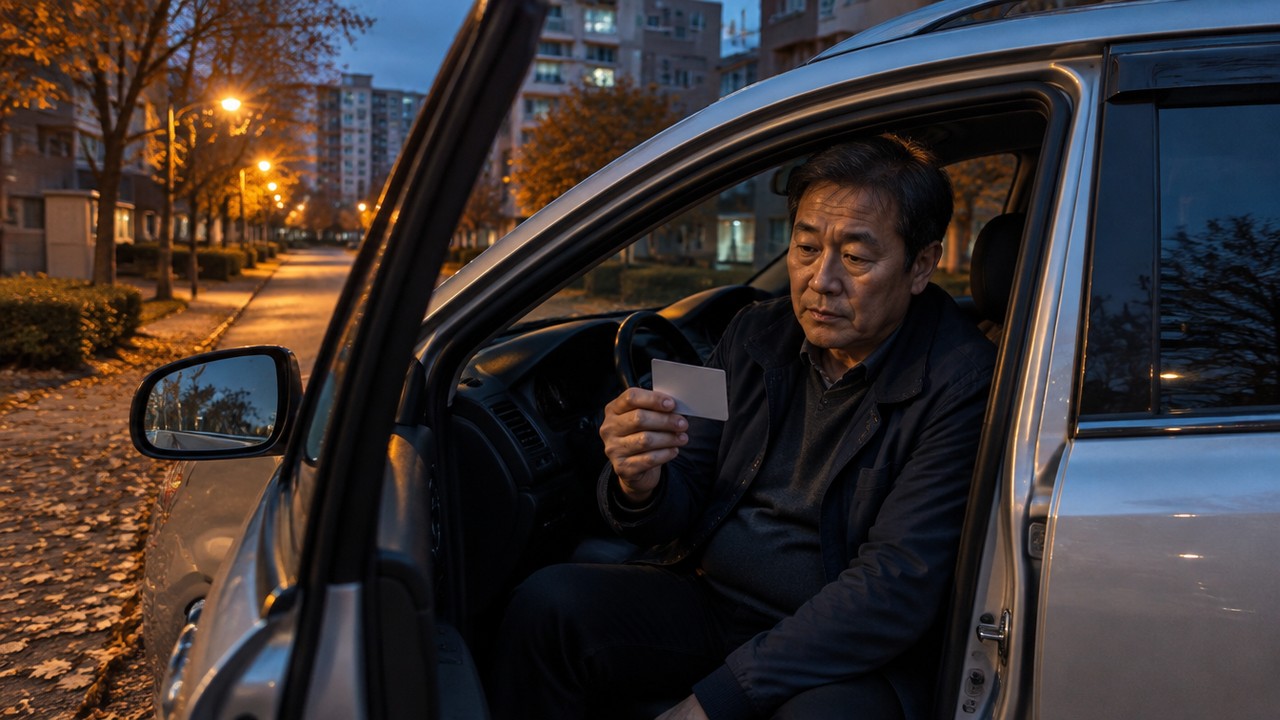
How often you renew
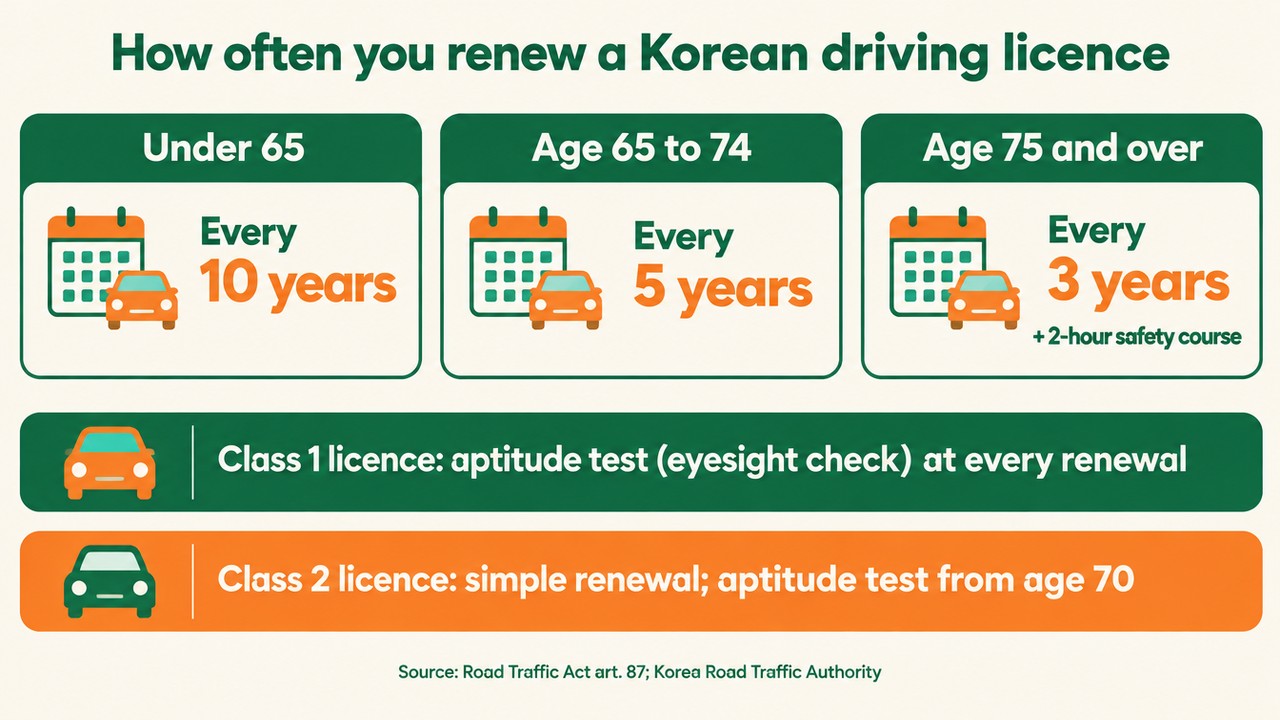
Article 87 of the Road Traffic Act sets the cycle. The first renewal falls 10 years after you passed the licence test; after that, every 10 years from your previous renewal. The cycle shortens with age, judged on the day you passed or last renewed:
| Your age on the test or last renewal day | Cycle | Extra requirement |
|---|---|---|
| Under 65 | Every 10 years | — |
| 65 to 74 | Every 5 years | — |
| 75 and over | Every 3 years | 2-hour senior driver safety course before renewal (art. 87(3), art. 73(5)) |
| One eye only, Class 1 ordinary licence | Every 3 years | Eye-doctor certificate |
Source: Road Traffic Act art. 87(1)–(3); KoROAD aptitude test and renewal page.
Class 1 vs Class 2. Holders of a Class 1 licence must take the regular aptitude test (정기 적성검사) at each renewal: essentially a physical with an eyesight check, run by KoROAD. Holders of a Class 2 licence just renew the card, unless they are 70 or over during the renewal period, when they take the aptitude test too (art. 87(2)). Licences issued or last renewed before 9 December 2011 run on older 7-year (Class 1) or 9-year (Class 2) cycles with a six-month window printed on the card, according to KoROAD.
The 2026 change: birthday plus or minus six months
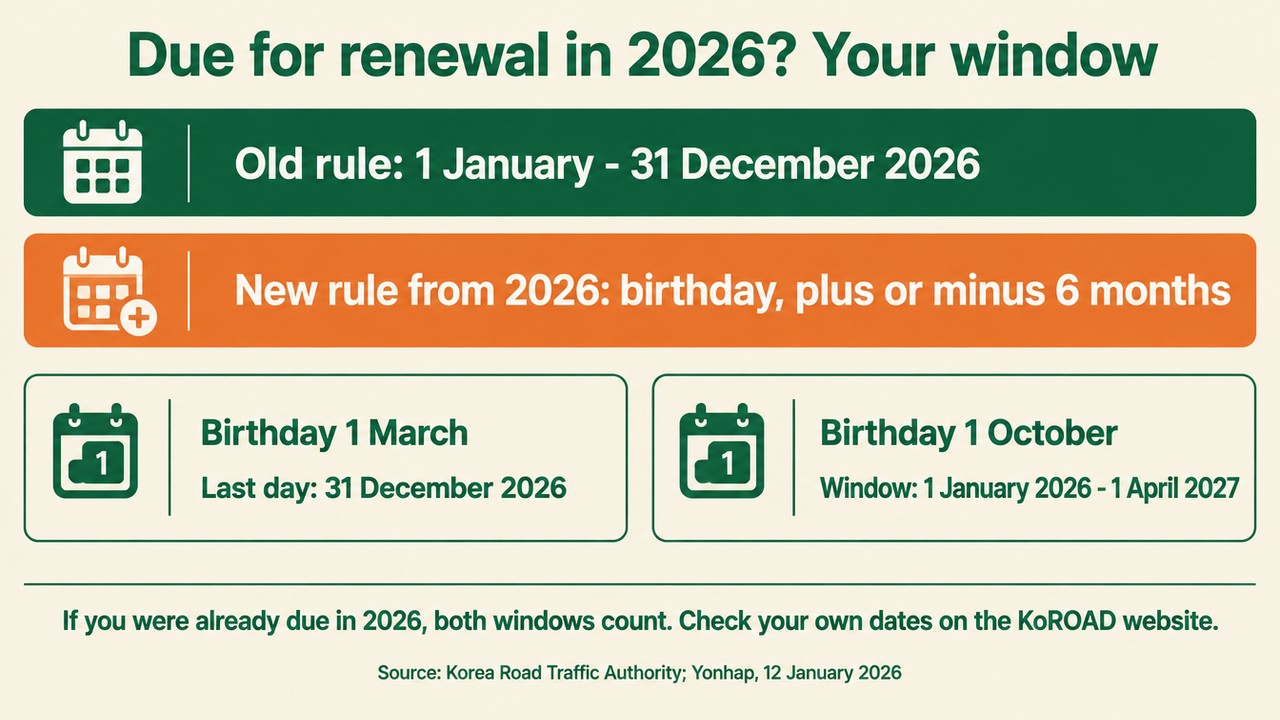
KoROAD says that from 1 January 2026 the renewal and aptitude-test period is “within six months either side of the birthday” in the year your cycle ends, instead of the whole calendar year. The current text of article 87(1) says the same. Licences issued before 2026 still print the old calendar-year window, so the card may not match the legal period.
To avoid confusion, a transitional rule lets people who were given their window under the old system — that is, everyone already due in 2026 — use the old window (1 January – 31 December) as well as the new one. Yonhap’s example from KoROAD: someone due in 2026 with a birthday on 1 October has a new window of 2 April 2026 – 1 April 2027, and with the old window added, can renew any time from 1 January 2026 to 1 April 2027.
Worked example: when is your real last day?
Calculated by us from KoROAD’s rule and its 1 October example (new window = the day after “birthday minus 6 months” to “birthday plus 6 months”; the later of the two end dates counts):
| Due in 2026, birthday | New window ends | Old window ends | Your last day |
|---|---|---|---|
| 1 March | 1 September 2026 | 31 December 2026 | 31 December 2026 |
| 30 June | 30 December 2026 | 31 December 2026 | 31 December 2026 |
| 1 October (KoROAD example) | 1 April 2027 | 31 December 2026 | 1 April 2027 |
| 15 November | 15 May 2027 | 31 December 2026 | 15 May 2027 (calculated) |
So for birthdays in roughly the first half of the year, 31 December 2026 is the real deadline. For birthdays from July onwards, the new window runs into 2027 — but KoROAD itself tells people to confirm their exact period on its website (Safe Driving, My Page) or the police’s traffic site (efine.go.kr) rather than relying on the card. Checking takes a minute and avoids a fine.
Who is due in 2026?
Count back from your last renewal or test date. You are in the 2026 group if, for example, you passed or last renewed in 2016 (10-year cycle), renewed in 2021 when you were 65–74 (5-year cycle), or renewed in 2023 when you were 75 or over (3-year cycle). The renewal period on your licence card, or KoROAD’s website, will confirm it.
What to bring, where to go, what it costs
You can apply at any licence test centre nationwide or the traffic civil-affairs desk of a police station (KoROAD notes Gangnam Police Station does not do renewals; use the nearby Gangnam test centre). Fees and documents, from KoROAD:
| Item | Class 2 renewal | Class 1 (and 70+ Class 2) aptitude test |
|---|---|---|
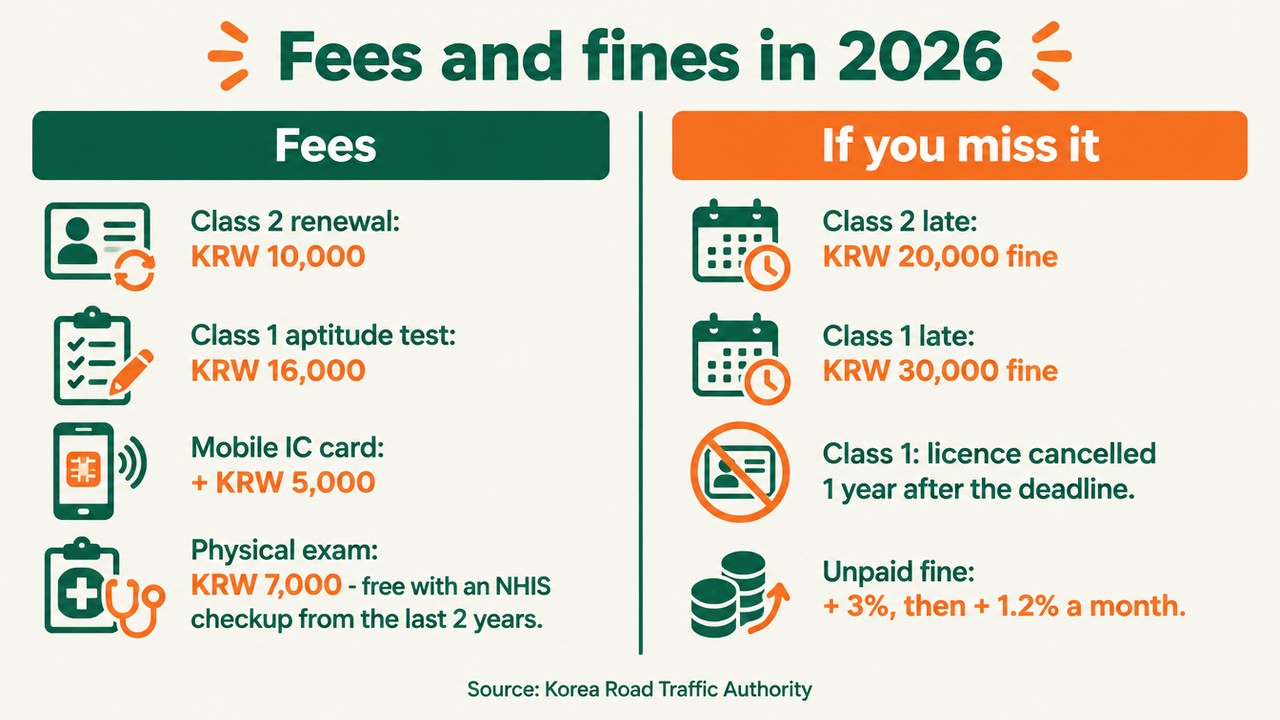
| Fee — standard card | ₩10,000 | ₩16,000 |
| Fee — mobile IC card | ₩15,000 | ₩21,000 |
| Physical exam | Not needed | ₩7,000 at a test-centre booth (₩8,000 for large/special licences), or free with an NHIS checkup result |
| Photos (3.5 × 4.5 cm, taken within 6 months) | 1 | 2 (1 if you use a checkup result) |
| Online application | Yes | Class 1 ordinary only, if NHIS checkup data exist |
| Someone else can hand it in | Yes, with a power of attorney | Yes for Class 1 ordinary/70+ Class 2 using a checkup result or medical certificate |
| Pick-up | In person only | In person only |
The checkup shortcut. Both KoROAD and NHIS say a national health checkup taken within two years of your application can replace the physical (vision and hearing), as long as your eyesight meets the standard. You agree to administrative data sharing at the counter; the data are usually available about 15 days after the checkup. This works for Class 1 ordinary and Class 2 licences, not Class 1 large or special ones. Eyesight standards (glasses allowed): Class 1 — 0.8 or better with both eyes open and at least 0.5 in each eye; Class 2 — 0.5 or better with both eyes open (0.6 in the seeing eye if one eye is blind). If you are booking your own 2026 checkup anyway, see our Dec 31 checkup deadline guide and the checkup by age guide.

Worked cost examples
Calculated from the KoROAD fees above:
| Person | Licence | What they need | Cost |
|---|---|---|---|
| Ms Park, 54 | Class 2 | Renewal only, online | ₩10,000 (₩15,000 for mobile IC) |
| Mr Kim, 58 | Class 1 ordinary | Aptitude test, using his 2025 NHIS checkup | ₩16,000 + ₩0 = ₩16,000 |
| Mr Lee, 71 | Class 2 | Aptitude test (70+), physical at the test centre | ₩16,000 + ₩7,000 = ₩23,000 |
| Mrs Choi, 77 | Class 1 ordinary | Free 2-hour course + cognitive screening + aptitude test with checkup | ₩16,000 (course free; screening free at a dementia relief centre) |
If your parent is 75 or over
From 75, the cycle is three years for both classes, everyone takes the aptitude test, and the licence cannot be renewed without the senior driver safety course (art. 87(3)). KoROAD’s senior course page sets out the order:
- Book the course: a free two-hour course, online through KoROAD’s Traffic Safety Education Centre or in person at a test-centre classroom. It covers ageing and safe driving, medicines and driving, a cognitive self-check, traffic law and senior crash data.
- Cognitive screening: choose one — a hospital or clinic, the local dementia relief centre (free screening, call 1899-9988 to book), or the test centre’s line-connection test. If the result shows dementia or mild cognitive impairment, a doctor’s certificate is needed.
- Aptitude test and renewal at a test centre or police station, with the licence, two photos, the fee and (for police stations) the screening result sheet from within the last year.
KoROAD adds that some car insurers give a discount after the course; ask your insurer. If you are helping a parent who is also due for the free checkup’s memory questionnaire (age 66 and over), our guide to Korea’s checkup cognitive test from 66 explains the KDSQ-C score and the dementia relief centre.

Missed the deadline: fines and cancellation
KoROAD lists the penalties:
| Situation | Penalty |
|---|---|
| Class 2, renewal period passed | ₩20,000 fine; no suspension or cancellation (abolished in December 2011) |
| Class 2 aged 70+ (aptitude test due) | ₩30,000 fine; cancelled one year after the end of the test period (if the card says “aptitude test period”) |
| Class 1, aptitude test period passed | ₩30,000 fine |
| Class 1, one year after the test period ended | Licence cancelled |
| Fine unpaid by its due date | +3%, then +1.2% a month, up to 75% in total |
What an unpaid fine grows to (calculated from KoROAD’s rates on a ₩30,000 fine): +3% = ₩900, so ₩30,900; each further month adds 1.2% (₩360); the 75% cap means the most it can reach is ₩52,500.
If a Class 1 licence was cancelled for a missed aptitude test, KoROAD says that within five years you only re-sit the physical and the written test (the skills and road tests are waived); after five years you take everything again.
Abroad or in hospital? Article 87(4) lets you renew early or postpone for reasons such as overseas travel or military service. KoROAD says a postponed renewal must be done within three months after the reason ends — for example, three months after you return to Korea or leave hospital. KoROAD also lists the Overseas Koreans Agency service centre in Seoul as an application point for overseas Koreans staying in Korea.
A quick checklist
- Look at the renewal period on your card; if it says 2026, check your exact last day on KoROAD’s website.
- Class 1 or 70+? Use your NHIS checkup from the last two years to skip the ₩7,000 physical.
- Have a passport-style photo (3.5 × 4.5 cm, last six months).
- Parent 75+? Book the free course and the cognitive screening first; they must be done before renewal.
- Living abroad? Apply to renew early or postpone before the window closes. New to Korea? Our guide to living in Korea as a foreigner covers the other first-year admin.
Frequently asked questions
Q. What is the deadline to renew a Korean driving licence in 2026?
If your licence shows a renewal period of 1 January – 31 December 2026, you can renew until 31 December 2026. Because the new birthday ±6-month window also applies to you, people with birthdays in the second half of the year may have until a date in 2027; check your exact period on KoROAD’s Safe Driving website.
Q. How much does it cost to renew a Korean driving licence?
A Class 2 renewal costs ₩10,000 (₩15,000 for a mobile IC card). A Class 1 aptitude test costs ₩16,000 (₩21,000 mobile IC), plus ₩7,000 for the physical at a test-centre booth unless you use a national health checkup from the last two years.
Q. What happens if I miss my licence renewal in Korea?
Class 2 holders pay a ₩20,000 fine but keep the licence. Class 1 holders pay ₩30,000, and the licence is cancelled if the aptitude test is still not done one year after the period ends. Unpaid fines grow by 3% and then 1.2% a month, up to 75%.
Q. Can I use my national health checkup instead of the licence physical?
Yes, for Class 1 ordinary and Class 2 licences. A national health checkup taken within two years of your application can replace the vision and hearing exam if your eyesight meets the standard; agree to administrative data sharing at the counter.
Q. What extra steps do drivers aged 75 and over have?
They renew every three years, must take the aptitude test, and must complete a free two-hour senior driver safety course with a cognitive self-check before renewal. They also need a cognitive screening result from a hospital, a dementia relief centre or the test centre.
Sources
- Road Traffic Act, article 87 (renewal periods, birthday ±6 months, aptitude test for Class 1 and 70+ Class 2, no renewal without the 75+ course or aptitude test, early renewal/postponement), Korean Law Information Center — https://www.law.go.kr/LSW/lsLawLinkInfo.do?chrClsCd=010202&lsId=001638&lsJoLnkSeq=1000188870&print=print (confirmed 9 November 2026)
- Korea Road Traffic Authority (KoROAD) Safe Driving, 정기적성검사/면허갱신 (2026 change and transitional rule, cycles, fees, photos, checkup substitution, eyesight standards, fines, cancellation, re-sit, postponement) — https://www.safedriving.or.kr/diGuide/selectDiGuide01.do (confirmed 9 November 2026)
- KoROAD Safe Driving, 고령운전자 교통안전교육 (75+ mandatory course, cognitive screening options, steps, insurance discount) — https://www.safedriving.or.kr/oldTraSafeEdu/selectOldTraSafeEduGuide.do (confirmed 9 November 2026, via search extract)
- KoROAD Safe Driving, 고령운전자 교통안전교육 course content (five subjects, free) — https://www.safedriving.or.kr/geGuide/selectGeGuide12.do (confirmed 9 November 2026, via search extract)
- National Health Insurance Service, 일반건강검진 (licence aptitude-test simplification: checkup within 2 years replaces the physical) — https://www.nhis.or.kr/nhis/healthin/wbhaca04500m01.do (confirmed 9 November 2026)
- Ministry of Government Legislation, Easylaw: 운전면허를 갱신해야 합니다 (renewal periods; aptitude test rule) — https://easylaw.go.kr/CSP/CnpClsMain.laf?ccfNo=3&cciNo=2&cnpClsNo=2&csmSeq=668 (confirmed 9 November 2026, via search extract)
- Yonhap News, 12 January 2026, “운전면허 갱신 기간 ‘연 단위’→’생일 전후 6개월’로 변경” (1 October example; old window also applies for the first renewal) — https://www.yna.co.kr/view/AKR20260112056000062 (confirmed 9 November 2026)
- Korean National Police Agency answer, 16 April 2026, “운전면허 적성검사와 갱신” (Class 1 ₩16,000 / Class 2 ₩10,000; ₩30,000 / ₩20,000 fines; 65+ 5 years, 75+ 3 years), Korean Law Information Center — https://www.law.go.kr/LSW/cgmExpcInfoP.do?cgmExpcDatSeq=2503797&ofiClsCd=350128 (confirmed 9 November 2026, via search extract)
- CarMoneyNote, 6 November 2026, “75세 이상 운전자, 면허 갱신 3년·교통안전교육·자진반납 정리” (independent explainer: art. 73(5), 2-hour course, ₩20,000/₩30,000 fines, cancellation) — https://carmoneynote.com/posts/elderly-driver-education/ (confirmed 9 November 2026, via search extract)
General information, not legal advice. Rules and fees can change; confirm your own renewal period and requirements with KoROAD (1577-1120) before you go.






2 Comments