Korea Child Allowance 2026: Age Cut-Off, Monthly Amount by Region, and How to Apply
Haesul Travel & Living desk (AI-assisted). Last checked: 2026-11-15 (KST) — added the 2027 changes (under-10 cut-off written into law; the proposed new child basic allowance for babies born from 1 July 2027; automatic payment without an application). First published 6 November 2026 (KST), based on the Ministry of Health and Welfare (MOHW) child-allowance policy page, the Korea.kr policy briefing of 27 April 2026, and Government24 / Bokjiro application notes. This is general information, not legal, tax or financial advice. Confirm your child’s case with your local community centre (행정복지센터) or the MOHW helpline 129 before you rely on a figure.
Quick answer: Korea’s child allowance (아동수당) pays a monthly cash benefit for every child under age 9 (만 9세 미만) who holds Korean nationality and a valid resident registration number. From April 2026, the amount depends on where the child lives: ₩100,000 in the capital region, ₩105,000 outside it, ₩110,000 in population-decline preferential areas, and ₩120,000 in special population-decline areas — with ₩10,000 more when a local government pays via local gift card under its ordinance (up to about ₩130,000). Apply on Bokjiro (bokjiro.go.kr) or at the community centre; parents can apply online. Payment is usually on the 25th of each month. Apply within 60 days of birth (including the birth day) to get the benefit backdated to the birth month. In 2027 the cut-off rises to under 10 (already in the Child Allowance Act), and the government has proposed a larger child basic allowance of ₩200,000 a month for babies born on or after 1 July 2027 — still a budget proposal as of 15 November 2026.
If you already follow Korea’s wider cash-support stack — basic pension for older adults, winter energy vouchers, employment-insurance job-seeker allowance — child allowance is the early-childhood piece of the same family. Our basic pension 2026 guide covers the older-adult side; energy voucher winter heating support covers seasonal help. For the broader settling-in picture, see living in Korea as a foreigner.
What child allowance is (and is not)
Child allowance is a universal, age-based cash payment under the Child Allowance Act. MOHW’s purpose line is plain: ease the economic burden of raising children and support a healthy growth environment. It is not means-tested. Household income and assets do not decide eligibility once the age, nationality and registration tests are met.
It is also separate from childcare-fee support (보육료), home childcare allowance (양육수당), the first-meeting voucher (첫 만남 이용권) and parental leave pay. Government24’s benefit note states that receiving those other benefits does not block child allowance if the age, nationality and resident-registration conditions hold.
Who qualifies in 2026
Age: under 9, with a path toward under 13
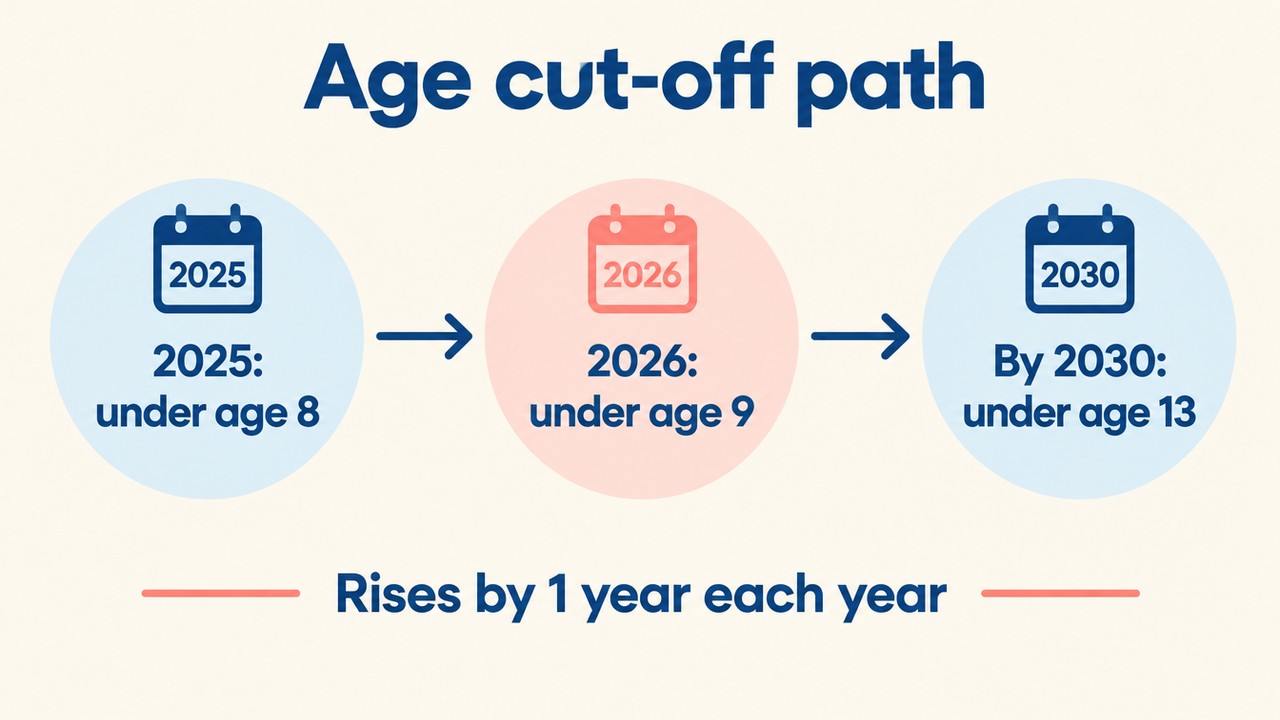
MOHW’s live policy page (last updated 31 March 2026) lists the support target as all children under age 9 (만 9세 미만). The Korea.kr policy briefing of 27 April 2026 explains the 2026 change: the cut-off moved from under 8 (2025) to under 9 (2026), and the age ceiling is scheduled to rise by one year each year through 2030, reaching under 13.
Eligibility tracks the child’s birth date, not school grade. Two children in the same elementary class can have different outcomes if one has already turned nine and the other has not.
Note on stale pages: Government24’s subsidy detail page (last modified 20 February 2026 in the footer we opened) still shows the older “under age 8” wording and a flat ₩100,000 line. Treat MOHW + the April 2026 Korea.kr briefing as controlling for age and regional amounts in late 2026, and verify any local gift-card top-up with your city or county.
Nationality and registration
Government24’s eligibility block (still useful for the nationality rules even where the age line lags) requires:
- Korean nationality for the child — including dual nationals under the Nationality Act, refugee-recognised children under the Refugee Act, and special contributors under the Framework Act on Treatment of Foreigners Residing in the Republic of Korea.
- A normally issued resident registration number (주민등록번호), or an equivalent social-welfare / medical-aid computer management number where that substitute applies.
Parents may be foreign nationals. What matters is the child’s Korean nationality and registration. If the child does not hold Korean nationality, this particular cash benefit does not apply — check other local or foreign-resident programmes separately.
Overseas stay pause
Government24 notes that payment pauses if a recipient child stays abroad for 90 days or more (counting the departure day). Returning and re-confirming residence with the local office typically restarts the benefit; ask the community centre how they want the return reported.
How much you get in 2026: regional table
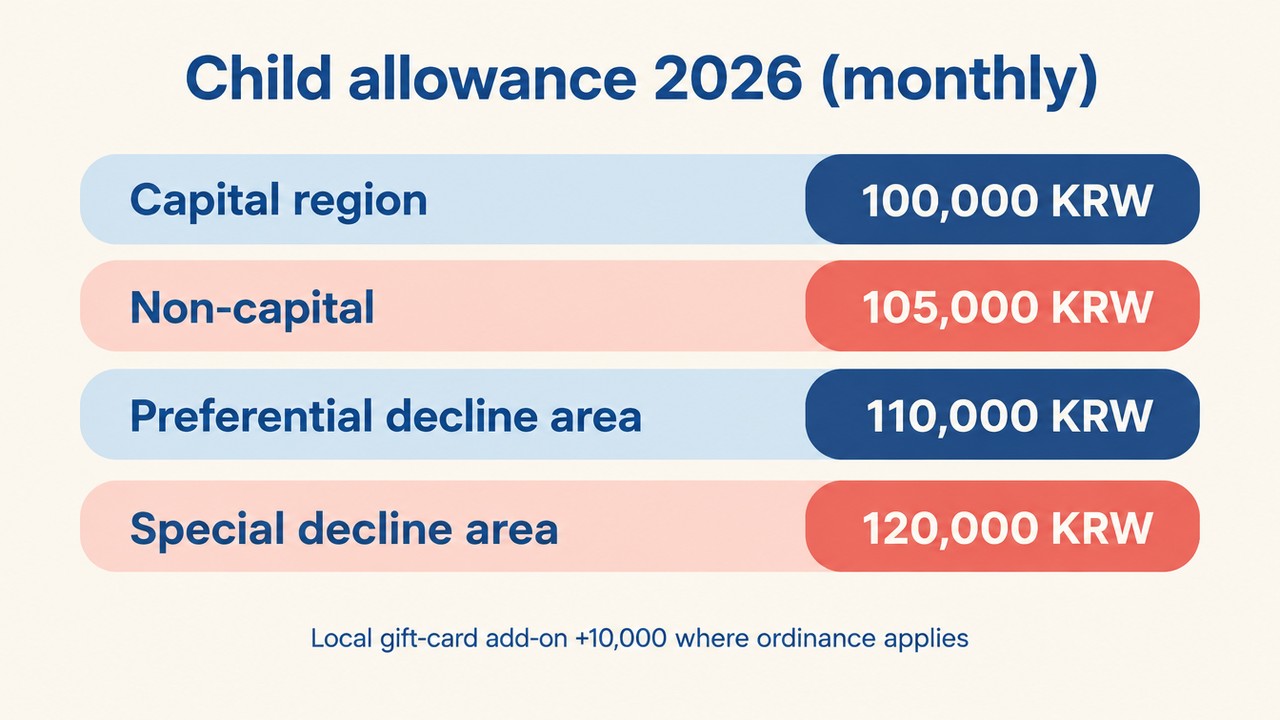
MOHW states the monthly range as ₩100,000–₩130,000 per child. The Korea.kr briefing and MOHW’s bullet list break it down by residence:
| Residence category (2026) | Monthly amount per child | Notes |
|---|---|---|
| Capital region (수도권) | ₩100,000 | Seoul, Incheon, Gyeonggi (standard capital-region definition used in the briefing) |
| Non-capital region (비수도권) | ₩105,000 | Everywhere else that is not a special decline category |
| Population-decline preferential area (우대) | ₩110,000 | Designated decline localities with preferential treatment |
| Population-decline special area (특별) | ₩120,000 | Higher special designation |
| Local gift-card add-on | +₩10,000 | Only where the local government pays via regional gift card under ordinance; MOHW notes this can bring the top line to about ₩130,000 |
Sources: MOHW child-allowance policy page (지원금액 10–13만 원; capital / non-capital / preferential / special bullets); Korea.kr policy news 27 April 2026 (same four base amounts + ₩10,000 gift-card note). Confirm your address against the current population-decline designation list at your community centre — designations can change.
Worked annual sketch from official monthly figures
| Scenario | Monthly | × 12 months |
|---|---|---|
| One child, capital region | ₩100,000 | ₩1,200,000 |
| One child, non-capital | ₩105,000 | ₩1,260,000 |
| Two children, capital region | ₩200,000 | ₩2,400,000 |
| One child, special decline + gift-card add-on | ₩130,000 | ₩1,560,000 |
Our multiplication from the official monthly amounts above. Actual deposits follow the 25th-of-month calendar (or the prior business day when the 25th falls on a weekend or holiday), and a child’s final month is the month before the birthday month that ends eligibility.

What changes in 2027
Three separate changes are coming. Only the first is already fixed in law; the others depend on the National Assembly.
| Change | Who it affects | Status (15 Nov 2026) |
|---|---|---|
| Age cut-off rises from under 9 to under 10 | Every child born up to 30 June 2027; children born in 2017 are paid for all 12 months of each year from 2026 to 2029, whatever their birthday | In law: Child Allowance Act No. 21489 (20 March 2026), transition clause: 2026 under 9, 2027 under 10, 2028 under 11, 2029 under 12, then under 13 |
| New child basic allowance (아동기본수당): ₩200,000 a month, ₩300,000 in preferential regions, paid half in cash and half in local gift cards; ₩300,000 more a month for a child aged 0–1 cared for at home | Babies born on or after 1 July 2027 | Government 2027 budget proposal (MOHW, 4 September 2026); the Assembly’s legal deadline for the budget is 2 December |
| Payment without an application: the local office gives parents the information and decides payment itself; parents can opt out | Children born after the amendment takes effect, three months after its 20 October 2026 promulgation (late January 2027) | In law: Child Allowance Act amendment No. 22101 (20 October 2026) |
What this means in practice:
- Your child was born in 2017 or later and is already paid: nothing to do. Under the 2027 cut-off a child keeps receiving the allowance until the month before turning 10, and the 2017 cohort is covered all year.
- Born before 1 July 2027: the existing amounts in the table above (₩100,000–₩130,000) continue; the ₩200,000 basic allowance is not a raise for every child.
- Expecting a baby in 2027: watch the December budget vote. If the proposal passes, a July-or-later birth falls under the new allowance; MOHW has not published how preferential regions will be listed or how to apply.
Our reading of the official texts listed in Sources; amounts for July 2027 births are a proposal and can change before the budget passes.
How to apply
Online (parents)
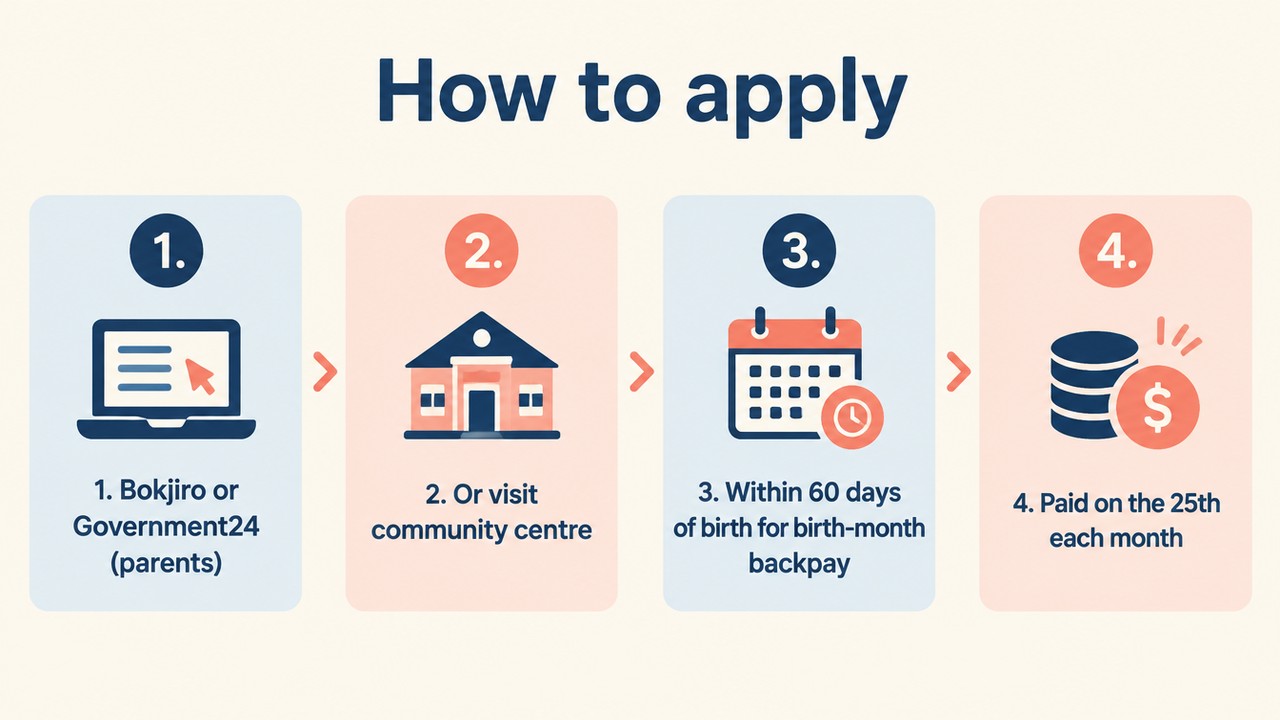
- Sign in to Bokjiro at bokjiro.go.kr (PC or the Bokjiro mobile app), or use Government24 (gov.kr) under the one-stop / happiness-birth path when you are bundling newborn benefits.
- Open the welfare-service application menu and select 아동수당 (child allowance).
- Confirm household members, bank account for deposit, and any requested attachments.
- Submit. Processing is generally within about 14 days (extendable in some cases); the first deposit then follows the next regular 25th cycle after approval.
Online filing is limited to cases where the child’s guardian is a parent. Grandparents, foster parents and other guardians need an in-person visit.
In person
Visit any eup / myeon / dong community centre (행정복지센터 / 주민센터) nationwide — address of registration or actual residence. Bring ID. For a proxy application, bring the power-of-attorney form, the proxy’s ID, and a copy of the guardian’s ID (Government24 document list).
Newborns: the 60-day rule
You can apply any time after birth registration. If you apply within 60 days of birth (including the birth day), payment is backdated to the birth month. Apply later and payment usually starts from the application month only. Many parents file child allowance together with birth registration through the happiness birth one-stop package (first-meeting voucher + parental benefit + child allowance).
Children who already aged out under the old under-8 rule
The April 2026 Korea.kr briefing says children born roughly January 2017 through March 2018 who had stopped receiving the benefit because they passed the old cut-off were brought back in by authority, without a new application, with January–March 2026 arrears paid in the April cycle. If you are in that cohort and still see nothing, call the community centre with the child’s resident registration details before re-filing blindly.
Payment calendar and bank account
- Regular pay day: the 25th of each month.
- If the 25th is a Saturday, Sunday or public holiday, payment moves to the previous business day.
- Money goes to the registered account (guardian’s account in the usual case).
- Once approved, you do not re-apply every year while the child remains under the age cut-off and still meets nationality / residence tests.
Keep the account details current. A closed account or a name mismatch is a common reason a “should have been automatic” payment never appears.
Foreign-resident families: what usually matters
| Situation | Typical child-allowance outcome |
|---|---|
| Child has Korean nationality + resident registration; parent(s) foreign | Eligible on the child’s status |
| Child is a dual national with a Korean resident registration number | Eligible (Nationality Act dual nationals are listed) |
| Child is a foreign national only (no Korean nationality) | Not this benefit — ask about other local programmes |
| Family lives abroad 90+ days with the child | Payment pauses until residence is re-confirmed |
For broader foreigner admin — registration, health insurance enrolment, everyday systems — start with our living in Korea as a foreigner guide. Health-insurance premium rules for foreign residents are in a separate post on this site.
Common mistakes to avoid
- Waiting past 60 days after birth and losing birth-month back pay.
- Trusting an outdated “under 8 / flat ₩100,000” page without checking MOHW’s 2026 age and regional table.
- Assuming a foreign-national child qualifies because the parents pay Korean taxes — nationality of the child is the gate.
- Ignoring a 90-day overseas stay and wondering why deposits stopped.
- Not updating the deposit account after a bank change or divorce / custody change.
- Skipping the community-centre check when you live in a population-decline area and want to confirm preferential vs special amounts and any gift-card ordinance.
Frequently asked questions
Q. What is the Korea child allowance age cut-off in 2026?
Under age 9 (만 9세 미만) on MOHW’s live policy page. The Korea.kr April 2026 briefing says the cut-off rose from under 8 in 2025 and is scheduled to keep rising by one year each year through under 13 in 2030.
Q. How much is child allowance per month in 2026?
₩100,000 in the capital region, ₩105,000 outside it, ₩110,000 in population-decline preferential areas, and ₩120,000 in special decline areas, with up to ₩10,000 more where local gift-card payment applies — MOHW’s ₩100,000–₩130,000 range.
Q. Where do I apply for 아동수당?
Online on Bokjiro (or Government24 for some newborn packages) if a parent is the guardian, or in person at any community centre. Non-parent guardians must visit in person.
Q. Can a child of foreign parents get the allowance?
Yes if the child holds Korean nationality and a valid resident registration number. The parents’ foreign nationality alone does not block the child’s claim.
Q. When is the money paid, and what if I apply late after birth?
Usually on the 25th (or the prior business day). Apply within 60 days of birth to backdate to the birth month; later applications generally start from the application month.
Q. Does child allowance change in 2027?
Yes. The age cut-off rises to under 10 in 2027 under the Child Allowance Act, and children born in 2017 are paid all year. The government has also proposed a new child basic allowance of ₩200,000 a month (₩300,000 in preferential regions) for babies born on or after 1 July 2027; as of 15 November 2026 that is still a budget proposal.
Sources
- Ministry of Health and Welfare — Child allowance payment policy page (지원대상 만 9세 미만; 월 10–13만 원 regional bullets; Bokjiro / community-centre apply) — https://www.mohw.go.kr/menu.es?mid=a10711030100 (checked 2026-11-06; page footer 최종수정일 2026-03-31)
- Korea.kr policy news — “2026년 4월부터 아동수당 더 넓게, 더 많이!” (age under 9; regional amounts; arrears / authority re-enrolment) — https://www.korea.kr/news/policyNewsView.do?newsId=148963446 (27 Apr 2026; checked 2026-11-06)
- Government24 subsidy detail — child allowance apply paths, 60-day birth rule, 25th pay day, nationality / registration, 90-day overseas pause (age/amount lines may lag) — https://www.gov.kr/portal/rcvfvrSvc/dtlEx/135200000120 (checked 2026-11-06)
- Bokjiro — online welfare application portal — https://www.bokjiro.go.kr (checked 2026-11-06)
- National Law Information Center — 아동수당법 (Child Allowance Act), Act No. 21489 of 20 March 2026 (age 13 ceiling; transition: 2026 under 9, 2027 under 10, 2028 under 11, 2029 under 12; 2017-born paid January–December 2026–2029) and Act No. 22101 of 20 October 2026 (payment decided without an application, in force three months after promulgation) — https://law.go.kr/LSW/lsRvsDocListP.do?chrClsCd=010202&lsId=013103&lsRvsGubun=all (checked 2026-11-15)
- Yonhap News — MOHW 2027 budget proposal: child basic allowance ₩200,000 / ₩300,000, half cash and half local gift card, +₩300,000 for home care at age 0–1, applies to births from 1 July 2027 — https://www.yna.co.kr/view/AKR20260903175700530 (3 Sep 2026; checked 2026-11-15)
Disclaimer
This article is for general information only. It is not legal, tax or financial advice and is not a substitute for a decision by your local community centre or MOHW. Amounts, age cut-offs, population-decline designations and gift-card ordinances can change. Always verify with Bokjiro, Government24, your community centre, or helpline 129 before you plan a household budget around a payment.
Related on en.haesul.com: Korea basic pension 2026 · Living in Korea as a foreigner · Korea energy voucher 2026 · Claiming parents as dependants (2026) · Year-end tax settlement for foreigners





2 Comments