Bone Density Test in Korea: Free at 54, 60 and 66, and How to Read Your T-Score
By the Haesul Global health desk (AI-assisted). Last checked: 2026-11-10 (KST); countdown updated 2026-11-13. The 2026 general checkup window that includes the bone density test closes in 48 days (December 31, 2026). Rechecked on the NHIS general checkup guide (read on Nov 9: 골밀도 검사 for women at 54, 60 and 66; period 1.1–12.31). General health information, not medical advice; your doctor interprets your own results.
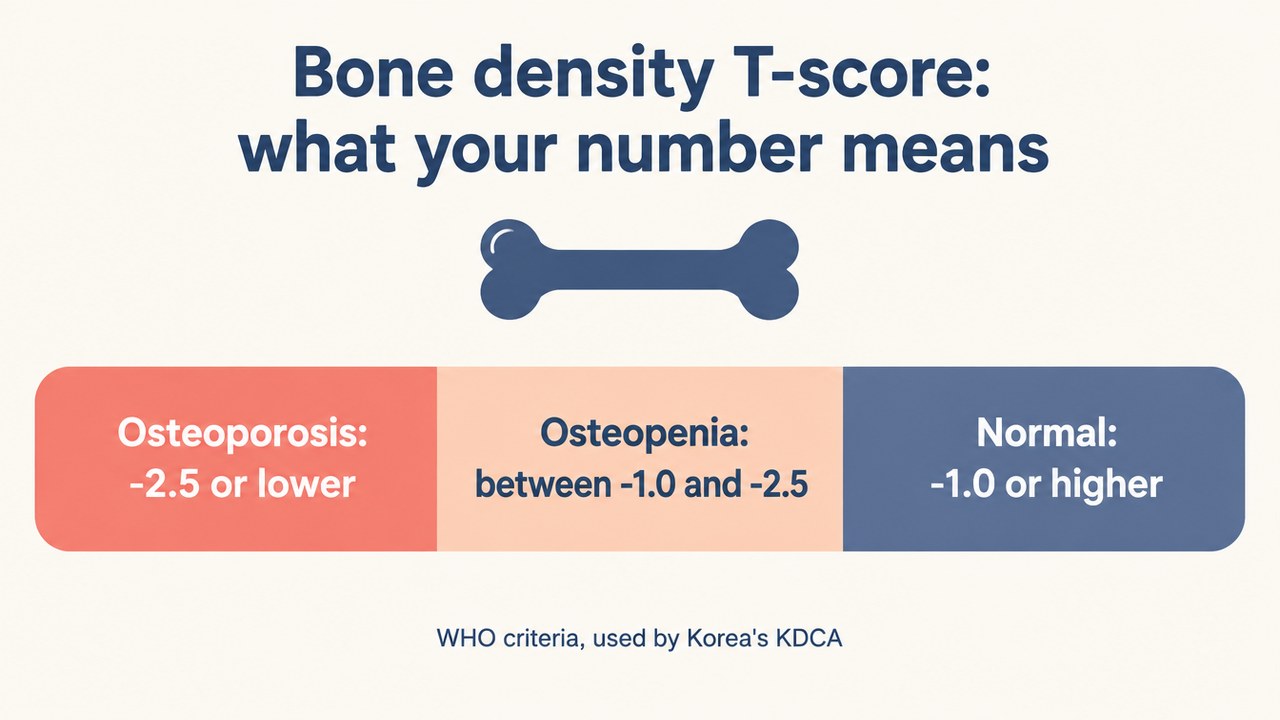
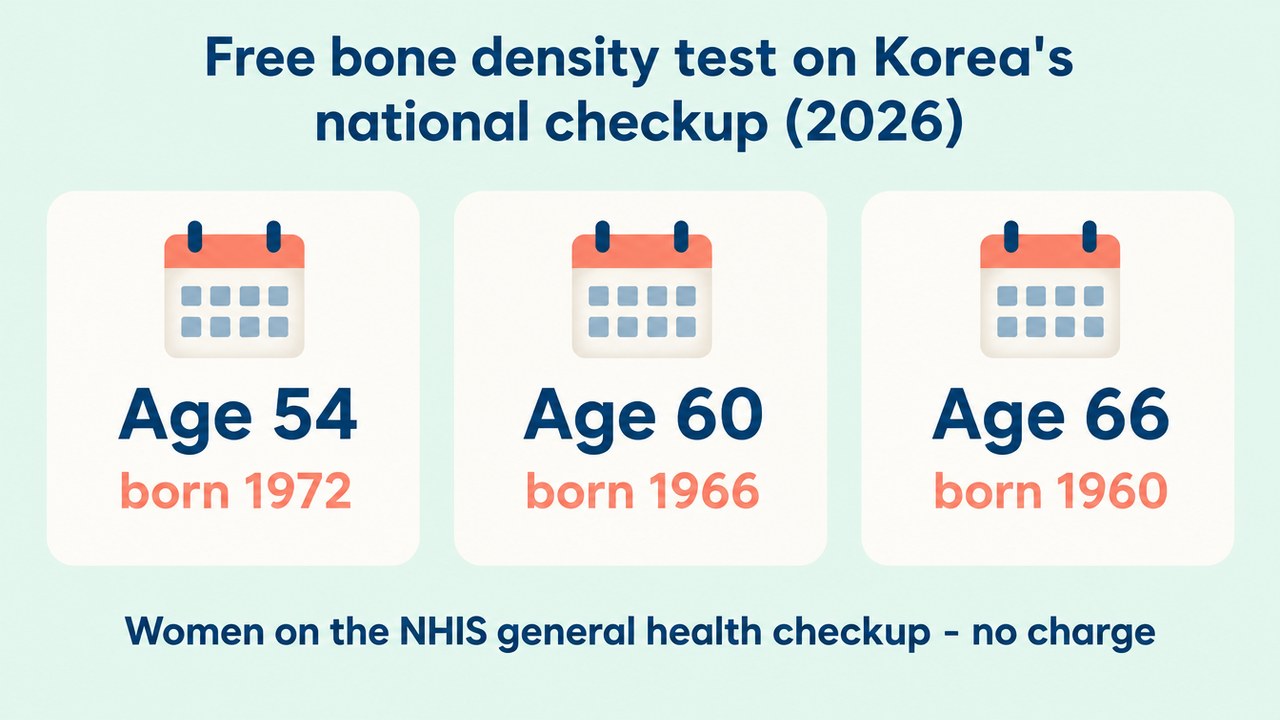
Quick answer: If you are a woman born in 1972, 1966 or 1960, get the free scan by December 31, 2026 — 48 days left from November 13 (NHIS). Women in Korea’s National Health Insurance general health checkup get a free bone density (DXA) scan at ages 54, 60 and 66. Age 60 was added in January 2025, so the older “54 and 66” rule you may have read is out of date. In 2026 that means women born in 1972, 1966 or 1960. Your result shows a T-score: −1.0 or higher is normal, between −1.0 and −2.5 is osteopenia (low bone mass), and −2.5 or lower is osteoporosis. A low score doesn’t mean you need medicine straight away. Doctors also look at your fracture history and 10-year fracture risk.
Who gets the free test, and when
Korea’s National Health Insurance Service (NHIS) adds a bone density test (골밀도 검사) to the regular general health checkup for women at certain “life-transition” ages. Since January 2025 those ages are 54, 60 and 66. Age 54 has been in the programme the longest, 66 was added later, and the Ministry of Health and Welfare added 60 through a checkup notice in January 2025. The government announced that change in July 2024, and both NHIS and the National Health Insurance Ilsan Hospital list all three ages for 2026.
Eligibility goes by birth year, not your birthday. In 2026 you qualify if you are a woman born in:
| Age in 2026 | Born in | Test included? |
|---|---|---|
| 54 | 1972 | Yes, DXA bone density |
| 60 | 1966 | Yes (added from 2025) |
| 66 | 1960 | Yes |
| Other ages, or men | — | Not part of the standard checkup |
The NHIS English guide lists general health checkup costs as free of charge, and the bone density test is part of that checkup, so there’s nothing extra to pay. Medical Aid (의료급여) recipients follow a separate life-transition schedule, which offers the test at 66, so check with your local public health centre.
The checkup runs on a calendar-year basis. If you’re in one of these birth years and haven’t had your 2026 checkup yet, our guide to catching up on Korea’s health checkup before the 31 December deadline covers booking and what to bring. For what each age gets more generally, see Korea’s national health checkup by age.
What happens during the scan
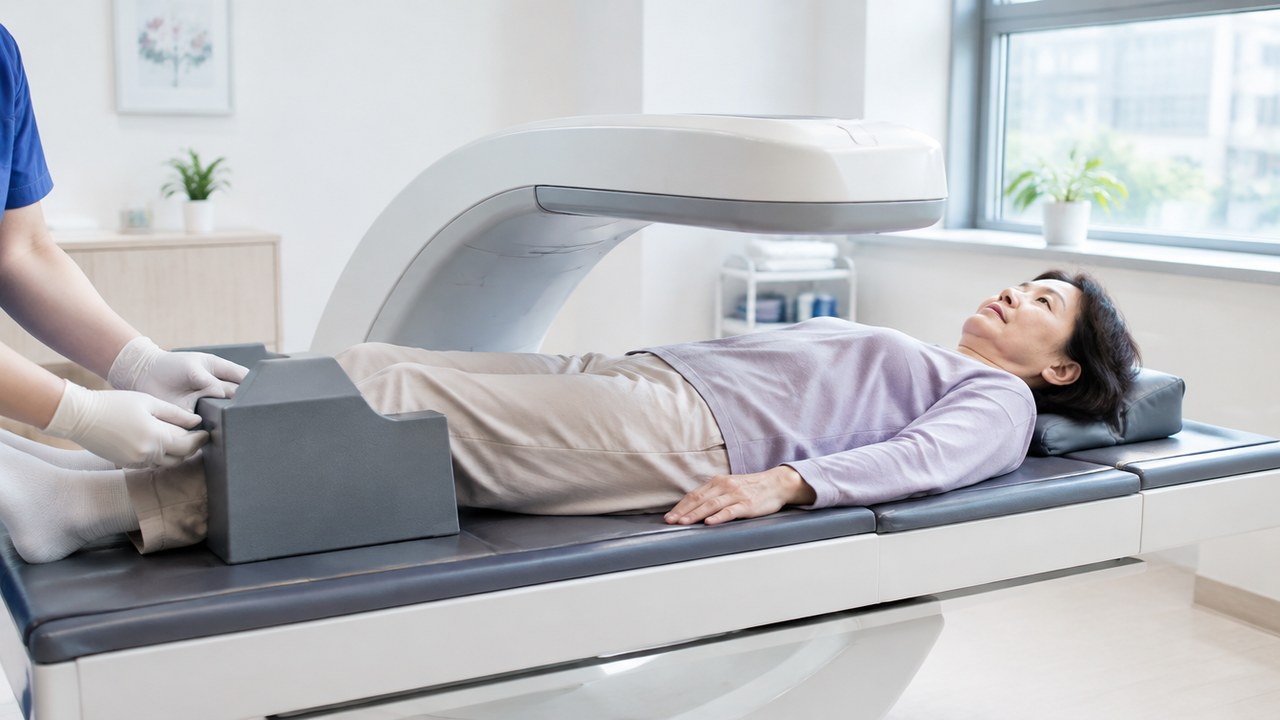
The checkup uses dual-energy X-ray absorptiometry (DXA). The Korea Disease Control and Prevention Agency (KDCA) calls it the most widely used method. You lie on a padded table while a scanner arm passes over you. It takes a few minutes and doesn’t hurt. Under the checkup rules, the lumbar spine is measured in principle, and the hip (femur) is used if the spine can’t be measured. KDCA adds that the wrist can be used when neither works. MedlinePlus (US National Library of Medicine) notes the radiation dose is very low.
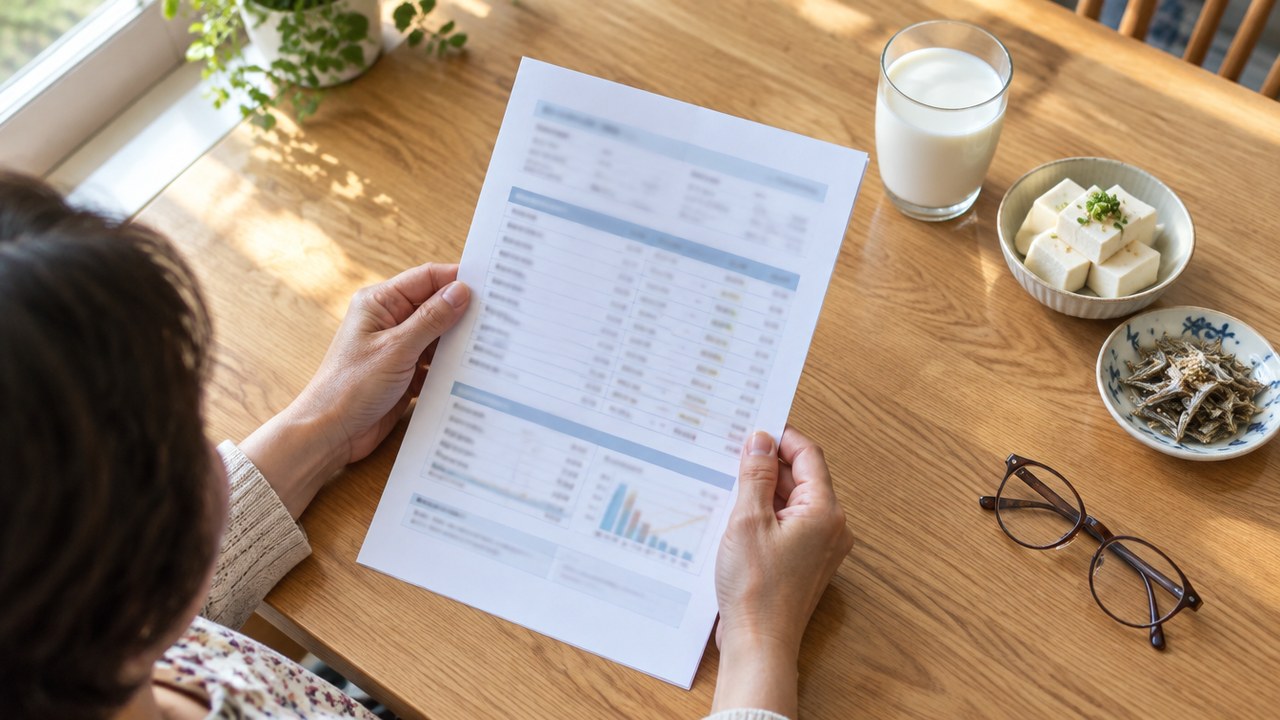
Since January 2023, Korean checkup result sheets show which site was measured and its T-score, so you can read the number yourself.
T-score vs Z-score: which one applies to you
A T-score compares your bone density with that of a healthy young adult at peak bone mass. It’s measured in standard deviations, so −1.0 means one step below that young-adult average. KDCA says T-scores are used for postmenopausal women and men aged 50 and over, the people who usually get this test at 54, 60 or 66.
A Z-score compares you with people your own age and sex. KDCA uses it for premenopausal women, men under 50 and children. A Z-score of −2.0 or lower is read as “below the expected range for age” and usually prompts a search for another cause.
| T-score | Category (WHO criteria used by KDCA) | Plain meaning |
|---|---|---|
| −1.0 or higher | Normal | Bone density in the healthy range |
| Between −1.0 and −2.5 | Osteopenia (low bone mass) | Lower than ideal, not osteoporosis |
| −2.5 or lower | Osteoporosis | Higher risk of fracture |
MedlinePlus uses the same cut-offs (−1.1 to −2.4 for bone loss, −2.5 or lower for likely osteoporosis).
Why women in their 50s and 60s are screened
KDCA says bone mass starts falling from about age 35, and bone loss is fastest in the three to five years after menopause. That’s why the checkup targets women at 54, 60 and 66. Citing the Korea National Health and Nutrition Examination Survey (2008–2011), KDCA reports osteoporosis in 37.3% of women aged 50 and over compared with 7.5% of men, plus osteopenia in about half of both groups (48.9% of women, 46.8% of men). Osteoporosis usually has no symptoms until a bone breaks, so a scan is often the only early warning.
Worked examples: four results, read step by step
These examples show how the categories work. Your doctor will look at your full picture.
| Result on the sheet | Category | What usually happens next |
|---|---|---|
| Spine T-score −0.6, age 54 | Normal | Keep up calcium, vitamin D and exercise; the next free test comes at 60 |
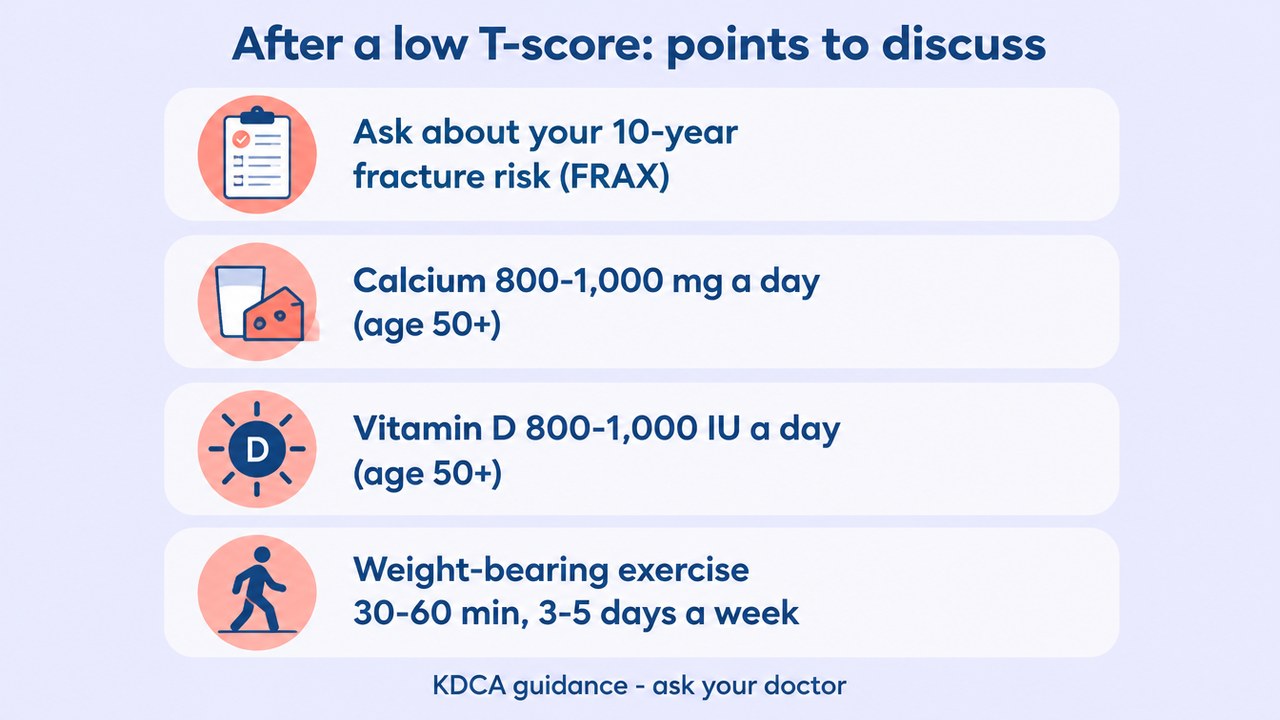
| Spine T-score −1.8, age 60, no fractures | Osteopenia | Ask about your 10-year fracture risk (FRAX); lifestyle steps first |
| Hip T-score −1.9, age 66, broke a wrist in a minor fall | Osteopenia with a past fracture | KDCA lists this as a case where treatment may be considered |
| Spine T-score −2.7, age 66 | Osteoporosis | KDCA lists osteoporosis as a treatment candidate; see a doctor to discuss options |
KDCA lists people who may be considered for treatment as those with osteoporosis, a hip or spine fracture, osteopenia plus a past fragility fracture or a secondary cause, or a FRAX 10-year risk of 3% or more for a hip fracture or 20% or more for a major osteoporotic fracture. FRAX is a calculator that combines your bone density with factors such as age, weight, smoking and family history. MedlinePlus also notes that doctors use it.
Bone-friendly habits KDCA recommends

- Calcium: 800–1,000 mg a day for adults 50 and over, ideally from food first (dairy, tofu, small fish eaten with the bones, such as dried anchovies).
- Vitamin D: 800–1,000 IU a day for adults 50 and over. About 15 minutes of sunlight a day also helps.
- Exercise: weight-bearing exercise such as brisk walking, 30–60 minutes, three to five days a week.
- Avoid smoking and heavy drinking.
If you’re prescribed osteoporosis medicine such as a bisphosphonate or denosumab, KDCA advises telling your dentist before dental work such as extractions or implants.
Checklist for your result sheet
| Check | Why it matters |
|---|---|
| Which site was measured (spine or hip)? | Readings differ by site; compare like with like next time |
| T-score or Z-score? | T-scores apply after menopause; Z-scores apply to younger people |
| Any past fractures from a minor fall? | Can change the treatment decision even with osteopenia |
| Medicines such as long-term steroids? | Possible secondary cause to mention to your doctor |
| Menopause timing and family history | Feeds into the FRAX risk estimate |
If your checkup also flagged other numbers, our guides on creatinine and eGFR kidney results and menopause symptoms may help you prepare questions.
Frequently asked questions
Q. What is the deadline for the free 2026 bone density test?
December 31, 2026 — 48 days left from November 13. NHIS says the general checkup period runs January 1–December 31 each year and lists the bone density test for women at 54, 60 and 66 (NHIS guide, checked Nov 9). If you missed last year’s checkup, NHIS can add you to this year’s list on request.
Q. Is the bone density test on Korea’s national checkup really free?
Yes. For eligible women at 54, 60 and 66, the DXA scan is part of the NHIS general health checkup, which NHIS lists as free of charge. Tests you add yourself at the hospital are billed separately.
Q. I read that it’s only at 54 and 66. Is that wrong?
It’s out of date. Age 60 was added from January 2025, so in 2026 women born in 1972, 1966 and 1960 are eligible.
Q. My T-score is −2.0. Do I have osteoporosis?
No. −2.0 falls in the osteopenia (low bone mass) range, between −1.0 and −2.5. Osteoporosis starts at −2.5 or lower. Your doctor may still estimate your fracture risk with FRAX.
Q. Can men get a free bone density test?
Not through the standard general checkup, which offers it to women at 54, 60 and 66. Men aged 50 and over can ask a doctor about a scan if they have risk factors such as long-term steroid use or a past fracture.
Q. Do I need medication for osteopenia?
Not usually by itself. KDCA lists osteopenia as a treatment candidate only alongside a past fragility fracture, a secondary cause, or a high FRAX 10-year risk. Otherwise, calcium, vitamin D and exercise come first.
Related reading
- Korea breast cancer mammography screening (women 40+)
- Hepatitis C test at 56 on Korea’s checkup
- Lung function test at 56 and 66 on Korea’s checkup
Sources
- National Health Insurance Service, General health checkup: items by age (checked 4 November 2026; re-checked 9 November 2026)
- National Health Insurance Service (English), Health screening (checked 4 November 2026)
- Korea Disease Control and Prevention Agency, National Health Information Portal, Osteoporosis (checked 4 November 2026)
- Korea.kr (Government of Korea), Checkup changes including bone density at 60 (checked 4 November 2026)
- MedlinePlus (US National Library of Medicine), Bone mineral density test (checked 4 November 2026)
- Doctors News, Checkup result sheets to show bone density site and T-score (checked 4 November 2026)
This article is general health information, not medical advice. It was written with AI assistance and fact-checked against official sources. Only your doctor can interpret your results and decide on treatment.



5 Comments