Menopause Symptoms Checklist: What the NHS, the US NIH and Korea’s KDCA Say
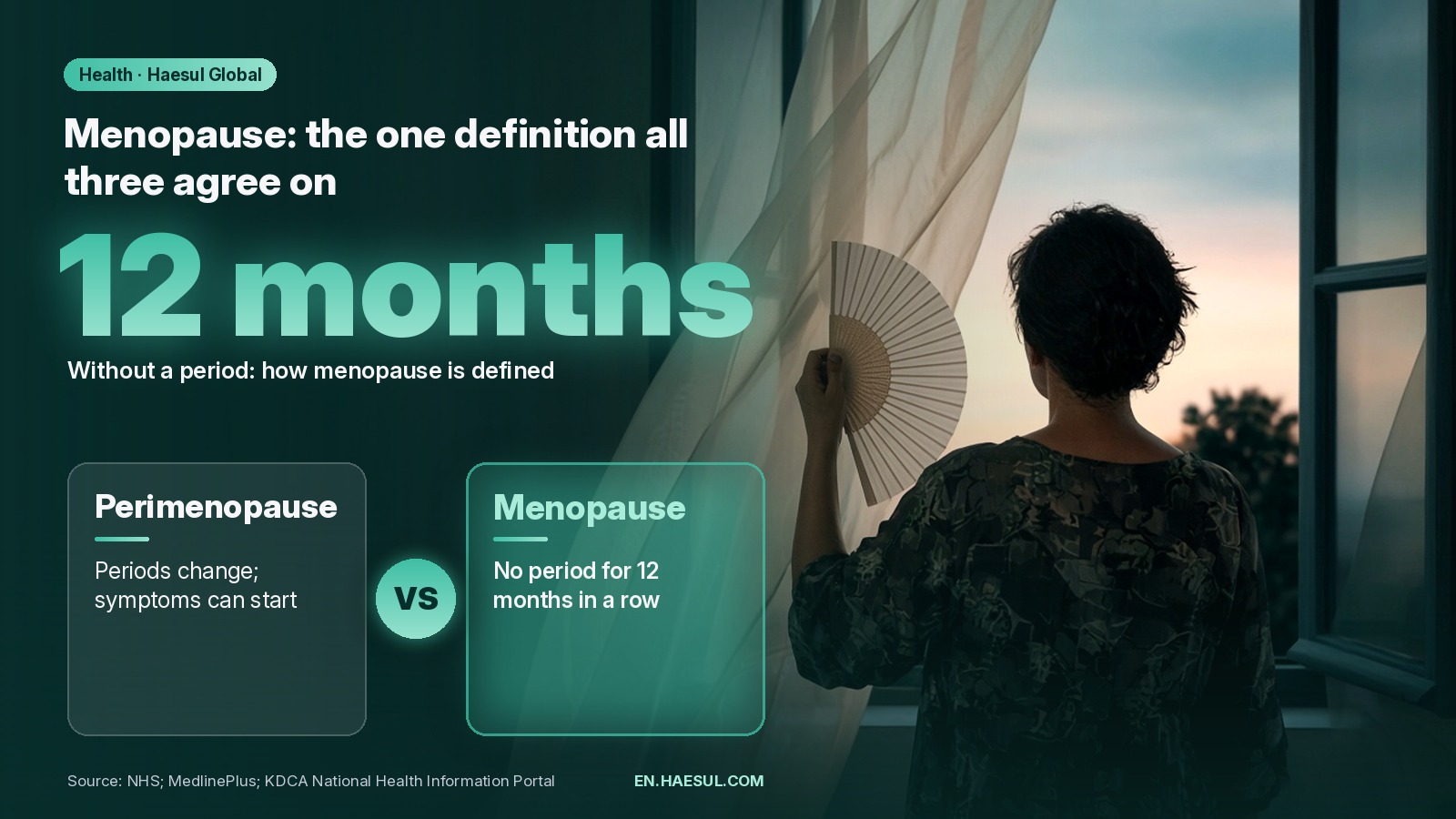
As of October 16, 2026 (KST), ahead of World Menopause Day on October 18. Three official health sources agree on the basic definition: you have reached menopause when you have not had a period for 12 months. They are the UK’s NHS, US MedlinePlus from the National Institutes of Health (NIH), and Korea’s Disease Control and Prevention Agency (KDCA). They also describe a similar set of symptoms, led by hot flushes, night sweats, sleep problems and mood changes. Their figures on age and duration are worded slightly differently, so this guide shows each source’s numbers separately.
Perimenopause and menopause
- Perimenopause (the menopausal transition) is the time leading up to menopause, when periods change. MedlinePlus says it usually begins in your 40s and can last several years (MedlinePlus). KDCA says it starts at an average age of 46 (range 39–51) and lasts 2–8 years, about 5 on average (KDCA).
- Menopause is reached after 12 months without a period. After that comes postmenopause (NHS).
- KDCA notes that about 10% of women stop menstruating suddenly, with no change in their cycle first.
Age and timing, source by source
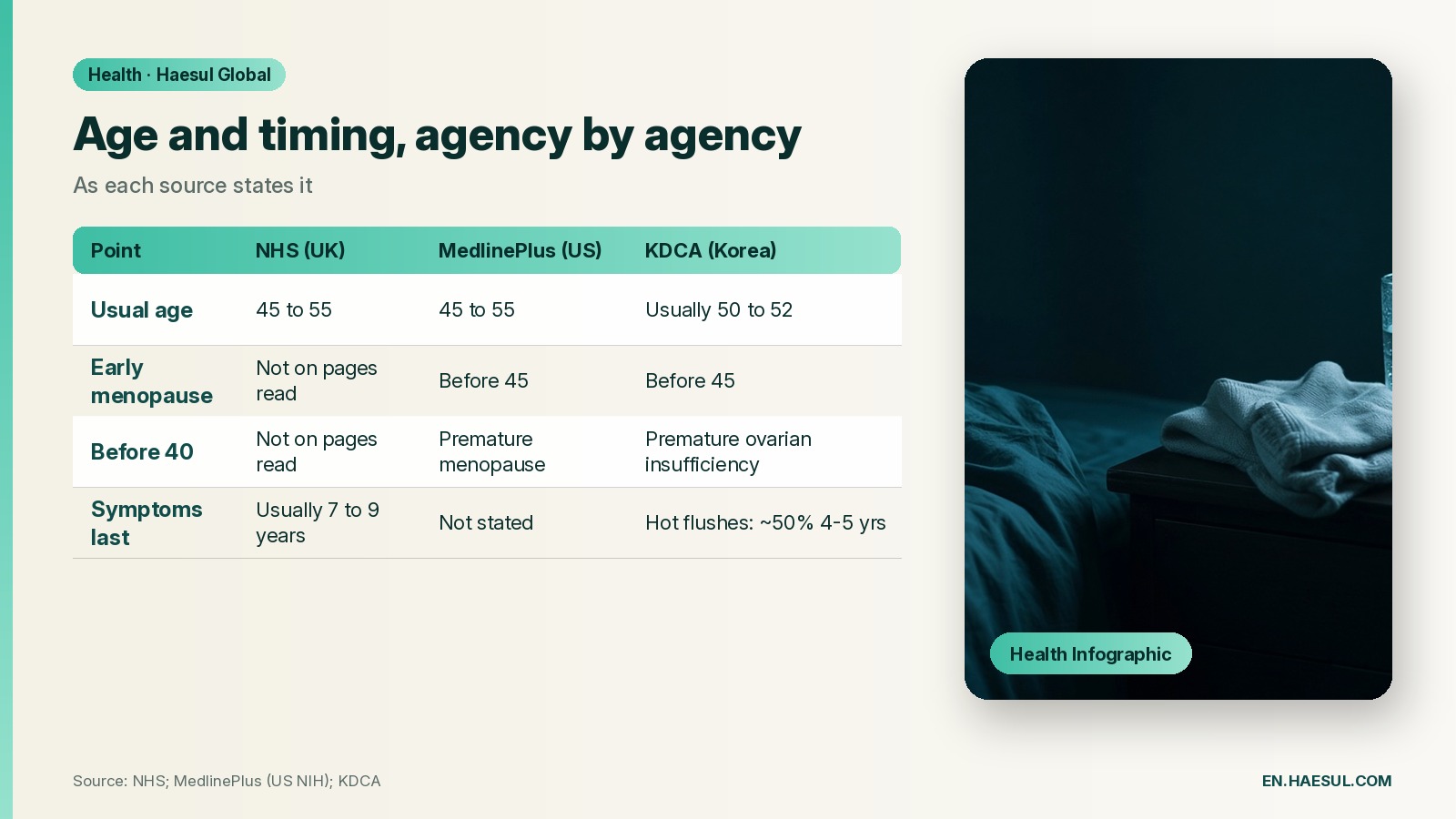
| Point | NHS (UK) | MedlinePlus (US NIH) | KDCA (Korea) |
|---|---|---|---|
| Usual age | Usually between 45 and 55 | Most commonly 45 to 55 | Generally 50 to 52 |
| Early menopause | — | Before 45 | Before 45 |
| Before 40 | — | “Premature menopause” (POI is described as a separate condition) | “Premature ovarian insufficiency” |
| How long symptoms last | Usually 7 to 9 years, sometimes longer | Not stated | Hot flushes: about 50% for 4–5 years, 10% up to 15 years |
Sources: NHS – Menopause and perimenopause, NHS – Symptoms, MedlinePlus – Menopause, KDCA – 폐경기 (Menopause). “—” means the pages we read don’t give the figure.
Why the numbers differ: NHS and MedlinePlus give a broad age range, while KDCA gives a narrower “usual” band. The duration figures also measure different things. The NHS figure covers symptoms in general, while KDCA’s figures cover hot flushes and sweats specifically. KDCA adds that these “vasomotor” symptoms affect about 60–70% of women in the transition and are most common in the first year after menopause.
Symptom checklist
All three sources list these. Wording varies, so the descriptions follow the NHS unless noted.
- Changes to periods. They may come more or less often and be heavier or lighter, then stop.
- Hot flushes and night sweats. A sudden feeling of heat in the face, neck and chest, sometimes with sweating, palpitations or dizziness, lasting several minutes. At night they are called night sweats. MedlinePlus says “hot flashes”.
- Sleep problems. These can be worse with night sweats. MedlinePlus says a lack of sleep over time can lead to fatigue and memory problems.
- Mood changes, poor memory and “brain fog”. The NHS lists low mood and anxiety. KDCA also lists irritability, poor concentration and insomnia.
- Vaginal dryness and discomfort, which can make sex painful.
- Urinary symptoms. More UTIs, needing to pee more often, and incontinence.
- Other changes the NHS lists: weight gain, palpitations, headaches, joint and muscle pain, hair thinning, dry skin, lower libido and mouth problems.
- Longer-term risks. Bone loss can lead to osteoporosis, and cholesterol can rise along with heart disease risk (MedlinePlus; KDCA).
The NHS notes that symptoms vary widely. Some people hardly have any, and symptoms can change over time.
When to contact a doctor
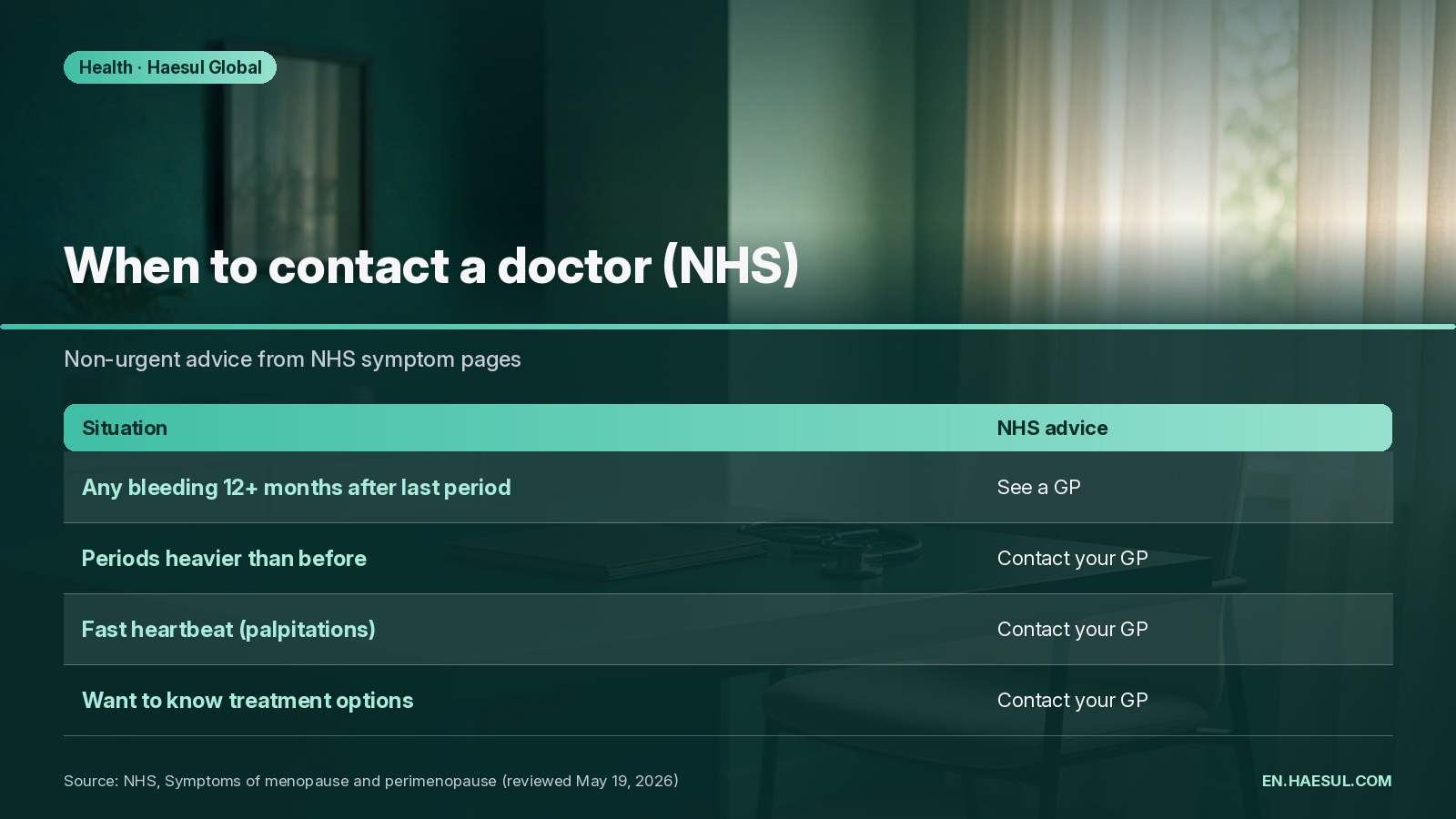
The NHS advises contacting a GP if:
– you think you have symptoms and want to know your options;
– you have symptoms such as a fast heartbeat (palpitations);
– you still have periods but are now bleeding more, not less, than before;
– you have any vaginal bleeding after 12 months or more without a period. The NHS says this postmenopausal bleeding is usually not serious but can be a sign of cancer, so it should be checked even if it happened only once.
KDCA says women considering hormone therapy should first have a check-up, including blood pressure, a breast exam and a pelvic exam (KDCA).
Treatment options the agencies describe
- Hormone replacement therapy (HRT). All three describe it. The NHS says oestrogen is the main type, and people who still have a womb also need progestogen to protect it (NHS – Treatment). KDCA says hormone therapy can be considered for healthy women aged 60 or under, or within 10 years of menopause, after weighing benefits and risks. MedlinePlus says HRT has benefits and risks and suggests discussing it with a provider.
- Non-hormonal options. The NHS lists CBT, clonidine and some antidepressants for hot flushes. MedlinePlus lists several non-hormone medicines and CBT for sleep.
- Herbal remedies. The NHS says there is very little evidence on how well products such as black cohosh and red clover work or how safe they are. KDCA says black cohosh’s effect is unclear and red clover doesn’t effectively reduce hot flushes.
- Lifestyle. MedlinePlus suggests layered clothing, avoiding alcohol, spicy food and caffeine, keeping a healthy weight and good sleep habits. KDCA is more cautious: it says evidence that lifestyle changes improve hot flushes is not clear, though weight loss can be considered.
Korean-language version: 여성 갱년기 증상 체크리스트 (haesul.com).
FAQ
At what age does menopause usually happen? Between 45 and 55 according to the NHS and MedlinePlus. KDCA says generally 50 to 52.
Can you still get pregnant during perimenopause? Yes. The NHS says you still need contraception for 1 year after your last period if you’re 50 or over, and for 2 years if you’re 40 to 49.
Is there a test for menopause? KDCA says menopause is diagnosed by 12 months without a period, not by a specific test, though blood tests can help after a hysterectomy.
Not medical advice. This article summarises public information from the NHS, MedlinePlus (US NIH) and KDCA. It isn’t a diagnosis or a treatment recommendation. Talk to a doctor about your symptoms and about whether any treatment, including HRT, is right for you.
Sources
- NHS, “Menopause and perimenopause”, accessed Oct 16, 2026: https://www.nhs.uk/conditions/menopause/
- NHS, “Symptoms of menopause and perimenopause”, last reviewed May 19, 2026, accessed Oct 16, 2026: https://www.nhs.uk/conditions/menopause/symptoms/
- NHS, “Treatment for menopause and perimenopause”, last reviewed May 19, 2026, accessed Oct 16, 2026: https://www.nhs.uk/conditions/menopause/treatment/
- MedlinePlus (US National Library of Medicine, NIH), “Menopause”, last updated Aug 3, 2026, accessed Oct 16, 2026: https://medlineplus.gov/menopause.html
- KDCA National Health Information Portal, “폐경기 (Menopause)”, updated May 11, 2026, accessed Oct 16, 2026: https://health.kdca.go.kr/healthinfo/biz/health/gnrlzHealthInfo/gnrlzHealthInfo/gnrlzHealthInfoView.do?cntnts_sn=6687