Melatonin in Korea: Prescription-Only Rules, Sleep Clinics and What You Can Bring In
Haesul Health desk (AI-assisted). As of 19 November 2026 (KST). Based on the Ministry of Food and Drug Safety (MFDS) drug database (의약품안전나라) entries for melatonin, the MFDS and Korea Customs Service (KCS) announcement of 11–12 November 2026 on carrying medicine into Korea, MFDS’s July 2026 release on sleep-aid foods bought from overseas websites, MFDS’s published answers on why melatonin is a blocked ingredient, the Korea Consumer Agency’s August 2026 survey of “plant melatonin” foods, the Health Insurance Review and Assessment Service (HIRA) rules for sleep studies and the Ministry of Health and Welfare (MOHW) release that brought sleep studies under national health insurance. Independent cross-checks: Yonhap, Medipana News, Yonhap News TV and two sleep clinics’ published price pages. General information, not medical advice.
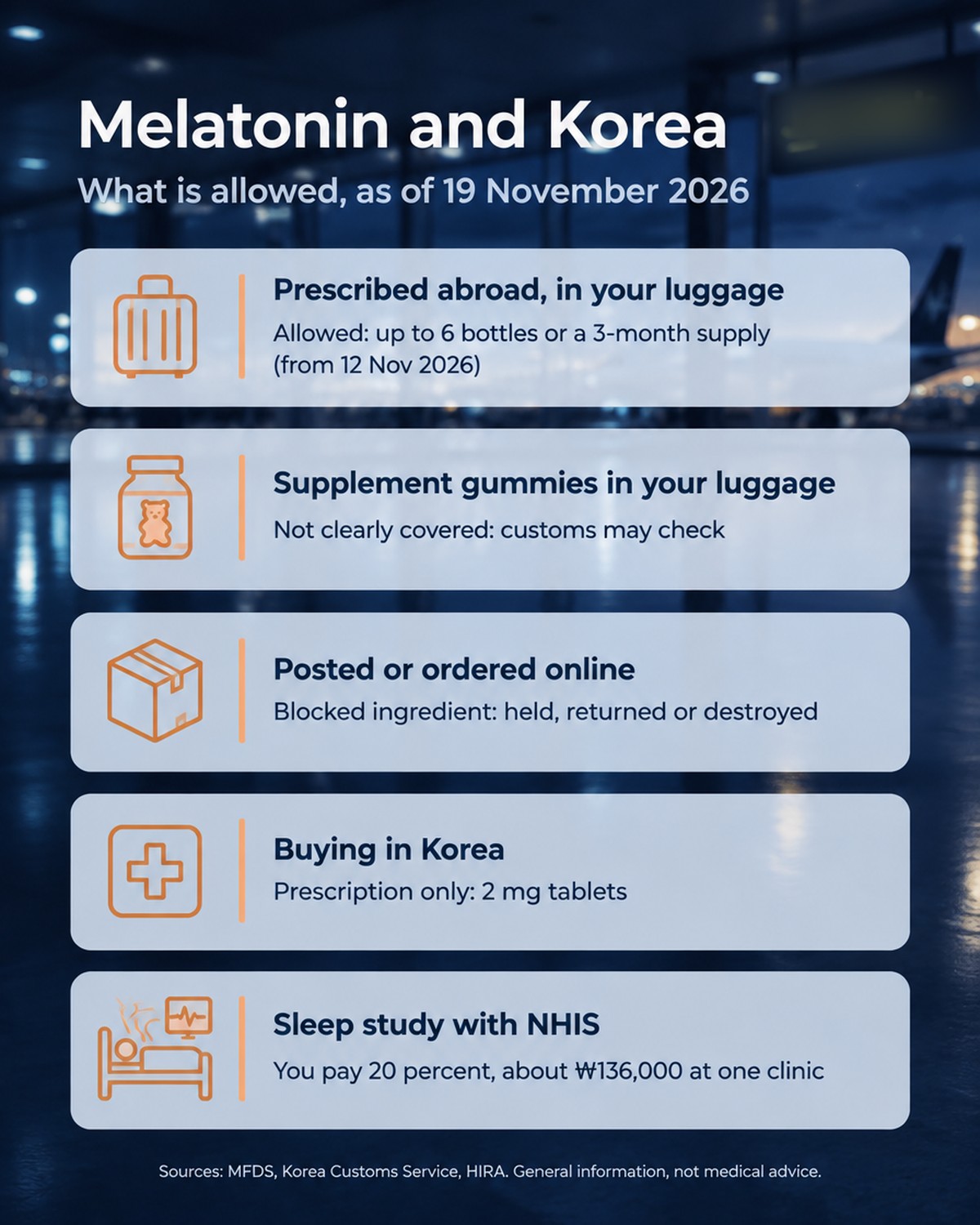
Quick answer: In Korea, melatonin is a prescription-only medicine (전문의약품, jeonmun-uiyakpum). Pharmacies will not sell it over the counter, and the only adult products MFDS lists are 2 mg prolonged-release tablets approved for short-term treatment of insomnia in people aged 55 and over. Since 12 November 2026, MFDS and Korean customs allow travellers to carry in medicine that was properly prescribed or bought abroad, up to 6 bottles or a 3-month supply. Melatonin posted to Korea or ordered from an overseas website is a different story: MFDS lists it as a blocked ingredient, so customs holds it. For sleep problems that last, a Korean clinic can see you, and an overnight sleep study (수면다원검사) is covered by national health insurance (NHIS) when you meet HIRA’s criteria. You then pay 20 percent, about ₩136,000 at one clinic in 2026.
Why now: the customs rule changed a week ago, and the winter holiday flights mean many people are landing with jet lag and a bottle of gummies from home. The rules for sleeping pills that are controlled drugs in Korea (zolpidem, benzodiazepines and similar) are in our separate guide, Bringing medicine into Korea: the 6-bottle rule and the MFDS permit. Here we cover melatonin itself, what you can buy in Korea, and how to get your sleep looked at.
Who this applies to
- Visitors with jet lag who take melatonin at home and want to know whether to pack it.
- Foreign residents who used melatonin for years in the US, Canada or elsewhere and have found that Korean pharmacies don’t stock it.
- Anyone sleeping badly in Korea for weeks: insomnia, loud snoring, gasping at night or falling asleep at work.
Cost figures assume you are enrolled in NHIS (our guide to health insurance for foreigners explains who must join). Tourists and anyone not yet enrolled pay the full price.
Is melatonin prescription-only in Korea?
Yes. When we searched MFDS’s drug database on 19 November 2026, every melatonin product approved for sale in Korea was listed as a prescription medicine. A search by ingredient returns 33 entries, counting withdrawn products and export-only items. What is left on the domestic market falls into two groups:
| Product type (MFDS database) | Approved use in Korea | Prescription? |
|---|---|---|
| 2 mg prolonged-release tablets (Circadin and about 20 other brands) | Short-term treatment of insomnia with poor sleep quality in patients aged 55 and over; the label allows use for up to 13 weeks | Yes |
| 1 mg and 5 mg prolonged-release mini tablets for children (approved 15 November 2023) | Insomnia in children and teenagers aged 2–18 with autism spectrum disorder or certain genetic conditions, and (label section changed 28 July 2026) children aged 6–17 with ADHD, when better sleep habits have not helped | Yes |
Source: MFDS 의약품안전나라 product entries (searched 19 November 2026). The original Circadin was imported from Switzerland; its import licence was withdrawn on 15 July 2026, and the same company was licensed to make it in Korea on the same day.
Three things follow from this:
- No over-the-counter melatonin. The 3 mg, 5 mg and 10 mg gummies sold in US supermarkets have no Korean equivalent you can buy without a prescription.
- The approved adult use is narrow. The label says 55 and over, short-term. A doctor decides whether to prescribe outside that. Don’t assume a clinic will write a prescription just because you took melatonin at home.
- It is usually not covered by NHIS. The database shows no insurance price for these tablets, so you pay the full price. One Korean hospital’s published price list puts a 2 mg tablet at ₩1,729 (updated February 2026), and other pharmacies and hospitals set their own prices.
MFDS keeps repeating the reason in its consumer warnings. In its July 2026 release, it called melatonin an ingredient that needs a prescription and said that taking high doses for a long time can cause dependence, headaches, dizziness and low mood. Its advice was to take it only with a doctor’s prescription and a pharmacist’s guidance.
What about “plant melatonin” sold in Korea?
You will still see melatonin in Korean online shops, sold as “plant melatonin” (식물성 멜라토닌) foods: tablets, jellies and drinks made from plant extracts. These are ordinary foods, not medicines or approved health supplements. The Korea Consumer Agency tested 30 of these products between February and June 2026 and published the results on 6 August 2026:
- All 30 contained melatonin. It was chemically identical to the prescription medicine.
- The amount per daily serving ranged from 0.7 mg to 12.0 mg, and 27 of the 30 exceeded the 2 mg prescription dose. That is up to 6 times the prescription dose.
- Two products held only 33 percent and 50 percent of the melatonin on their labels.
- Of 100 online ads it checked, 58 were misleading. Some called the products “sleep aids”, claimed they were “MFDS certified” or presented them as supplements with proven benefits. All 58 ads had been changed or taken down by 27 July 2026.
The agency told consumers not to take large amounts or take these products for long, and said children, teenagers and pregnant women should ask a professional first. So “plant” does not mean milder. If you are looking for melatonin in Korea, the honest route is a doctor.
Can I bring melatonin into Korea?
It depends on how the melatonin travels and on what it is classed as where you bought it. Here is what the official sources say, route by route:
| How it arrives | What the rules say (as of 19 November 2026) | Source |
|---|---|---|
| In your luggage, prescribed or sold as a medicine abroad (for example melatonin a doctor prescribed in the UK, EU or Australia) | Allowed since 12 November 2026: medicine properly prescribed or bought under another country’s regulated system, up to 6 bottles, or above that up to a 3-month supply. You don’t have to file papers, but customs checks that it is genuine, so bring the prescription or receipt. | MFDS/KCS, 12 Nov 2026; Yonhap, Medipana |
| In your luggage, sold as a dietary supplement (typical US gummies and tablets) | Not clearly covered. The new rule is about medicines approved by a regulator. US melatonin is sold as a supplement. Supplements fall under a separate 6-bottle personal-use limit, but customs can check items MFDS has flagged as harmful even within that limit, and MFDS treats melatonin in food as a blocked ingredient. | Ministry of Government Legislation (easylaw), KCS table; MFDS answers |
| Posted, couriered or ordered from an overseas website | Blocked. MFDS has listed melatonin as a banned ingredient for foods bought directly from abroad, whatever the dose, source or form. Customs holds the parcel, and it can be returned or destroyed. The 12 November change says buying medicine directly from abroad is still not allowed. | MFDS answers (2024, 2025); MFDS 2 Jul 2026; Yonhap 11 Nov 2026 |
| Sleeping pills that are controlled drugs in Korea (zolpidem, alprazolam, lorazepam and others) | Need an MFDS permit before you fly. The 12 November change does not cover narcotics or psychotropic medicines. | MFDS/KCS; see our medicine guide |
What changed on 12 November 2026. Before the change, customs did not separate a traveller’s own medicine from an online order. Both were judged against the same list of products to hold, so medicine that was properly prescribed abroad was sometimes held at the airport. Under the new arrangement, a medicine that was formally approved in the country where you got it and was prescribed or bought through its normal medical system can come in for your own treatment, even if it is not approved in Korea (MFDS, quoted by Medipana on 18 November). The limits are a total of 6 bottles or, above that, a 3-month supply by the directions for use. MFDS added that bringing in 6 bottles or a 3-month supply again and again does not count as personal treatment. Customs will look at travel history and recent checks, and selling or giving the medicine to others can break the Pharmaceutical Affairs Act.
The grey zone, in plain terms. Neither MFDS nor customs has said in so many words whether a jar of US supplement gummies in your suitcase counts as “medicine” under the new rule. We read the official texts as follows: a prescription label or pharmacy receipt clearly helps, and a supplement jar may be checked. If you pack melatonin, keep the amount to what you will use on the trip, in its original labelled container, together with any prescription. Customs decides at the airport. If something is held, ask the officer what documents would release it. MFDS says it has asked customs to consider releasing blocked supplements when a doctor’s note says the product is safe for you, but the final decision is customs’.
Jet lag: what helps, according to health services
Korea is on UTC+9 all year, with no daylight saving time. For most flights from Europe or the Americas that means a big shift. The UK’s NHS gives practical steps that need no medicine:
- Before you fly: move your bedtime and wake-up time a little towards Korean time.
- On the plane: drink water, avoid much caffeine or alcohol, and sleep if it is night in Seoul. An eye mask and earplugs can help.
- After you land: switch to Korean time at once, set an alarm so you don’t oversleep, get outside in daylight, and avoid daytime naps.
- Short trips (2–3 days): you could stay on your home schedule.
The NHS also says medicines are not usually needed for jet lag, and it does not recommend melatonin tablets for jet lag because there is not enough evidence that they work. Other countries’ health services take different views. Ask your own doctor before the trip. We give no dosing advice here.
Sleep problems that last: where to go in Korea
A few bad nights after a flight or a stressful week is normal. Trouble sleeping for weeks, loud snoring with pauses in breathing, or falling asleep at work is worth a doctor’s visit. In Korea you can walk into a clinic without a referral (see how to see a doctor in English).
| Your main problem | Where to start (Korean name) | What usually happens |
|---|---|---|
| Can’t fall asleep or stay asleep (insomnia), worry, low mood | Psychiatry clinic (정신건강의학과, jeongsin-geongang-uihakgwa) or neurology (신경과) | Talk-based assessment, sleep habits, possibly a prescription; a sleep study is not covered for insomnia alone |
| Loud snoring, gasping, pauses in breathing, daytime sleepiness | Ear, nose and throat clinic (이비인후과) or a hospital sleep centre (수면센터 / 수면클리닉) | Airway check, then an overnight sleep study if you meet the criteria |
| Falling asleep suddenly in the day, sudden muscle weakness with emotion | Neurology or a hospital sleep centre | Sleep study and daytime tests |
| Restless legs at night, feeling exhausted with weight change or a racing heart | Internal medicine or neurology | Blood tests (iron, thyroid). Thyroid problems can disturb sleep; our TSH and free T4 guide explains the report |
For insomnia, start with a clinic visit. In Korea a psychiatry clinic visit is billed like any other clinic visit, and the copay for psychotherapy is lower. Our mental health guide for foreigners has the HIRA copay rates and how the diagnosis code is recorded. If sleeplessness comes with thoughts of self-harm, call 109 (suicide prevention, 24 hours) or the mental health crisis line 1577-0199.
Sleep studies on NHIS: who qualifies and what it costs
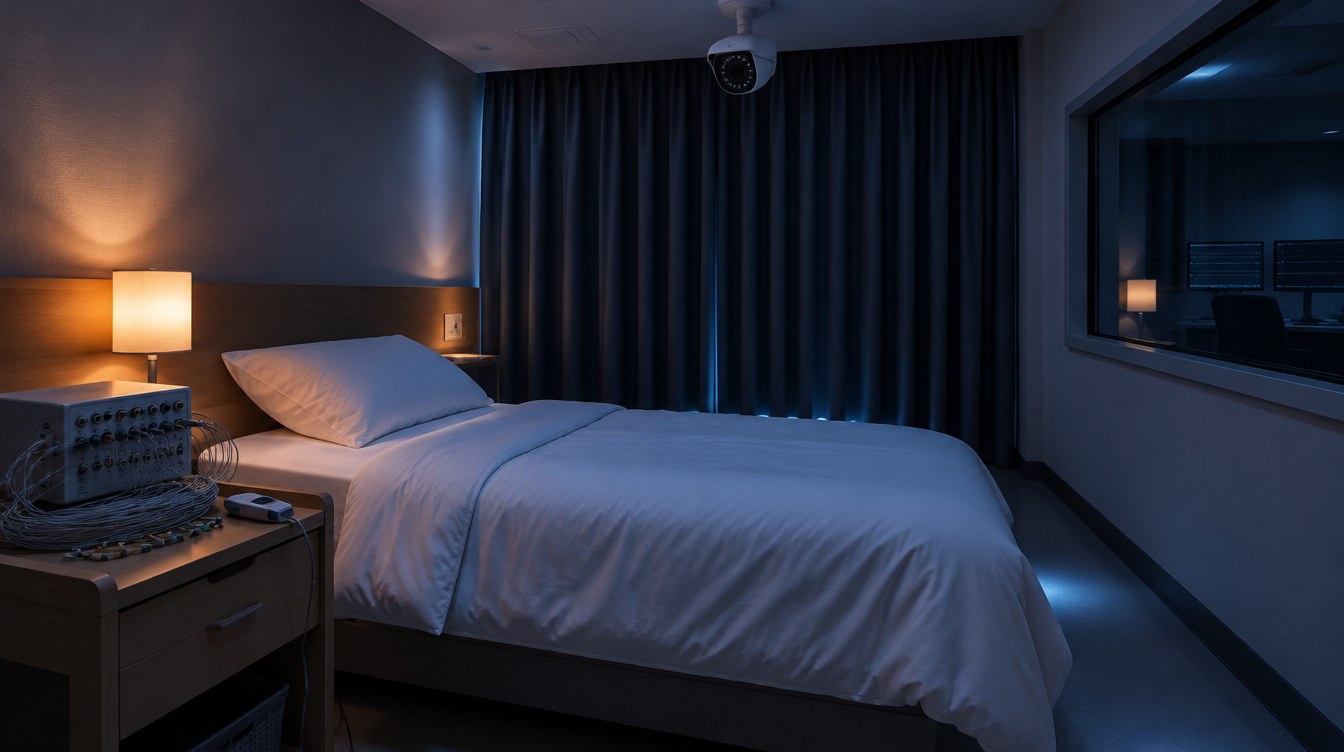
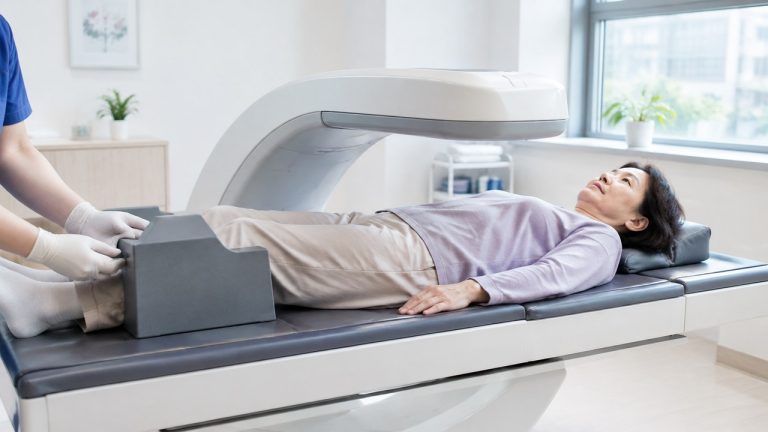
An overnight polysomnography (수면다원검사) records your brain waves, eye movements, muscle tone, heart rhythm, breathing and blood oxygen while you sleep. You come in the evening, sleep alone in a monitored room, and leave in the morning. National health insurance has covered it since 2018. MOHW approved the change in March 2018 and set the copay at 20 percent, and the clinics we checked date the start to July 2018.
HIRA’s coverage criteria for suspected sleep apnoea (FAQ updated 15 September 2026; HIRA notice 2023-293, in force 1 January 2024). You need (a) at least one symptom: daytime sleepiness, frequent snoring, observed pauses in breathing, fatigue, choking during sleep, tossing and turning, or waking often. You also need either (b) an examination finding of a narrow airway (Mallampati grade 3 or above, tonsil size grade 2 or above from age 13, or airway collapse on endoscopy) or (c) a history of high blood pressure, heart disease, stroke or diabetes, or a BMI of 30 or more. Narcolepsy and idiopathic hypersomnia have their own criteria. Simple snoring and insomnia on their own are not covered. The test must also be the full in-lab “type 1” study in a private room.
What NHIS allows (as described by a clinic citing the official rules): one diagnostic study, one CPAP pressure-setting study after diagnosis, one study after treatment or surgery, and more only case by case.
| Sleep study cost (one night) | Total covered cost | You pay (20 percent) |
|---|---|---|
| MOHW 2018 schedule, clinic | ₩578,734 | ₩110,740 |
| MOHW 2018 schedule, general hospital | ₩638,921 | ₩127,780 |
| MOHW 2018 schedule, tertiary hospital | ₩717,643 | ₩143,520 |
| One sleep clinic’s published 2026 price, ordinary NHIS adult | about ₩679,650 (our calculation: ₩135,930 ÷ 0.2) | ₩135,930 |
| Independent 2026 estimate from the January 2026 fee book (exam + room fee) | — | about ₩127,000 to ₩166,000 by hospital type |
Sources: MOHW release (March 2018) for the 2018 rows; clinic price page and a 2026 fee-book calculation for the 2026 rows. Consultation fees, same-day tests and materials are extra. Without NHIS you pay the full bill. Ask the hospital for its price for uninsured patients before booking.
Worked example (our calculation). Say you are a 40-year-old NHIS member with loud snoring and high blood pressure. You see an ENT clinic first (a clinic first visit costs about ₩18,840 at the 2026 fee schedule, of which you pay about ₩5,600). You meet criteria (a) + (c), so the overnight study is covered: about ₩135,930 at the clinic above. Total so far, about ₩141,500, plus any CPAP costs. Without NHIS, the study alone would be roughly ₩680,000 at that clinic’s fee level, and hospitals may charge uninsured patients more.
If you are diagnosed with sleep apnoea. NHIS also covers renting a CPAP machine (양압기) and a mask each year at a 20 percent share, after an adaptation period. One rule catches people out: register with NHIS as a CPAP patient before you rent or buy anything. Costs from before registration are not refunded (MOHW 2018; clinic guide).
Getting melatonin by prescription in Korea, step by step
- Book or walk into a clinic. Psychiatry and neurology clinics see insomnia most often. Bring a list of what you took at home: product name, ingredient and dose.
- Explain the problem, not the product. Describe how long it has lasted, how it affects your days, and your caffeine, alcohol and screen habits. The doctor may suggest sleep-habit changes or another medicine instead of melatonin, especially if you are under 55.
- If it is prescribed, take the prescription to any pharmacy (약국). Expect to pay the full price for the tablets, since they are not NHIS-covered (see the price above), plus a pharmacy fee.
- Use it as the label says. The Korean label for adults allows up to 13 weeks. Follow your doctor’s and pharmacist’s instructions; this guide does not give doses.
- Leaving Korea with it: keep the Korean prescription or pharmacy bag with the tablets, and check the rules of the country you are flying to.
Rough cost of this route (our calculation). A clinic first visit is about ₩18,840 at the 2026 fee schedule, so with NHIS you pay about ₩5,600 (30 percent, rounded down to ₩100). Thirty 2 mg tablets at ₩1,729 each come to ₩51,870, not covered. Total, about ₩57,500. Prices differ by clinic and pharmacy.
When it’s more than a sleep problem
Call 119 for chest pain, sudden weakness on one side, slurred speech, or breathing pauses with blue lips or confusion. Call 109 if you are thinking about suicide. For interpretation, call the 1330 travel helpline, and for infectious-disease questions, KDCA’s 1339 line. Our ER guide for foreigners covers what happens at a Korean emergency room.
Common problems
- “The pharmacy says they don’t have melatonin.” That is correct. Pharmacies can’t sell it without a prescription. Ask for a doctor’s appointment instead.
- “My parcel of gummies is stuck at customs.” Melatonin posted from abroad is a blocked ingredient. You can ask customs whether a doctor’s note would help, but expect it to be returned or destroyed.
- “I bought plant melatonin online here.” It is legal to sell as a food, but the Korea Consumer Agency found doses of up to 12 mg a day and misleading ads. Talk to a pharmacist or doctor before taking it regularly.
- “I want a sleep study for my insomnia.” It is not covered for insomnia alone. Start with a clinic visit; the doctor decides whether a study is needed and whether you meet the criteria.
- “I’m bringing zolpidem from home.” That needs an MFDS permit before you fly. The 12 November change doesn’t apply. See our medicine guide.
Frequently asked questions
Q. Is melatonin legal in Korea?
Yes, but only as a prescription medicine. MFDS lists melatonin products as prescription-only (2 mg prolonged-release tablets for adults aged 55 and over, and mini tablets for children with specific conditions), so pharmacies won’t sell it over the counter.
Q. Can I bring melatonin gummies to Korea in my suitcase?
Since 12 November 2026, medicine that was properly prescribed or bought abroad can be carried in, up to 6 bottles or a 3-month supply. Melatonin sold as a dietary supplement is not clearly covered, and customs may check it because MFDS treats melatonin in food as a blocked ingredient. Keep it to your own trip supply, in the original container, with any prescription or receipt.
Q. Can I order melatonin online and have it shipped to Korea?
No. MFDS lists melatonin as a banned ingredient for foods bought directly from abroad, and customs holds such parcels. The 12 November 2026 change does not allow direct purchase of medicines from abroad.
Q. Where can I get melatonin in Korea?
From a doctor’s prescription, filled at a pharmacy. The approved adult use is short-term treatment of insomnia in people aged 55 and over, and the tablets are not NHIS-covered, so you pay the full price. One hospital list shows ₩1,729 a tablet.
Q. Does Korean health insurance cover a sleep study?
Yes, when HIRA’s criteria are met, for example symptoms of sleep apnoea plus a narrow-airway finding or high blood pressure, heart disease, stroke, diabetes or a BMI of 30 or more. You pay 20 percent, about ₩136,000 at one clinic in 2026. Simple snoring and insomnia alone are not covered.
Q. What helps with jet lag after flying to Korea?
The UK’s NHS suggests switching to the new time zone straight away, getting daylight, avoiding daytime naps and limiting caffeine and alcohol. It does not recommend melatonin tablets for jet lag because the evidence is too weak. Ask your own doctor about medicines.
Sources
- MFDS Drug Safety Korea (의약품안전나라), melatonin ingredient search (33 entries, 19 Nov 2026): https://nedrug.mfds.go.kr/searchDrug?ingrName1=멜라토닌 ; Circadin PR 2 mg entry (prescription-only, 55+ short-term insomnia, up to 13 weeks, no insurance price; import licence withdrawn 15 Jul 2026): https://nedrug.mfds.go.kr/pbp/CCBBB01/getItemDetail?itemSeq=201402808 ; children’s 1 mg mini tablet entry (approved 15 Nov 2023; indications; efficacy section changed 28 Jul 2026): https://nedrug.mfds.go.kr/pbp/CCBBB01/getItemDetail?itemSeq=202303144
- MFDS and Korea Customs Service, “Medicine prescribed or bought abroad may be carried in from today” (Korea Policy Briefing, 12 Nov 2026): https://www.korea.kr/news/policyNewsView.do?newsId=148975557
- Yonhap, carry-in of self-treatment medicine allowed from 12 November; narcotics/psychotropics excluded; direct purchase not allowed (11 Nov 2026): https://www.yna.co.kr/view/AKR20261111158151017
- Medipana News, MFDS answers on the carry-in rule (not limited to Korean-approved medicines; repeated carry-in; resale; 18 Nov 2026): https://www.medipana.com/news/articleView.html?idxno=422065
- MFDS, release on overseas sleep and mood foods (2 Jul 2026): https://www.mfds.go.kr/brd/m_99/view.do?seq=50158 ; summary by the Korea Customs and Trade Development Institute: https://www.kctdi.or.kr/kctdi/research/research11.do?articleNo=5717&mode=view
- MFDS answers on melatonin as a blocked ingredient for directly purchased foods, via the National Law Information Center: https://www.law.go.kr/LSW/cgmExpcInfoP.do?cgmExpcDatSeq=419334&mode=2&ofiClsCd=350123 and (8 Jul 2025) https://www.law.go.kr/LSW/cgmExpcInfoP.do?cgmExpcDatSeq=384160&mode=2&ofiClsCd=350123
- Ministry of Government Legislation, Easy Law: personal-use limits for medicines and supplements (KCS notice Article 67, Annex 11): https://www.easylaw.go.kr/CSP/CnpClsMain.laf?ccfNo=2&cciNo=2&cnpClsNo=3&csmSeq=1504
- Korea Consumer Agency, plant melatonin food safety survey (6 Aug 2026), via Consumer24: https://www.consumer.go.kr/user/bbs/consumer/261/731/bbsDataView/5274.do ; Yonhap News TV report (6 Aug 2026): https://www.yonhapnewstv.co.kr/news/AKR20260805163221ae6
- One Korean hospital’s published non-covered medicine price list (Circadin 2 mg ₩1,729, updated 1 Feb 2026): https://www.demc.kr/nonpay/pdf/04.pdf?v=260127
- HIRA FAQ, sleep apnoea and sleep-study coverage (15 Sep 2026; notice 2023-293): https://www.hira.or.kr/bbsDummy.do?brdBltNo=47808&brdScnBltNo=4&pgmid=HIRAA010006011100
- MOHW, sleep studies and CPAP under health insurance (March 2018; 20 percent copay; 2018 price table): https://www.mohw.go.kr/board.es?act=view&bid=0027&list_no=344261&mid=a10503010200
- Clinic price pages (2026): Leshine sleep clinic: https://leshine.co.kr/sleep ; Asan Neulbom ENT, coverage and repeat-study rules: https://asnbent.co.kr/blog/sleep/polysomnography-cost ; independent 2026 fee-book estimate: https://chakob.blog/3889/
- NHS, Jet lag: https://www.nhs.uk/conditions/jet-lag/
- Our guides: bringing medicine into Korea, mental health help for foreigners, health insurance for foreigners
How we checked: On 19 November 2026 (KST) we searched MFDS’s drug database for every melatonin product and read the adult and children’s product entries. We also read the 12 November carry-in announcement and MFDS’s follow-up answers, MFDS’s statements on melatonin as a blocked ingredient, the Korea Consumer Agency’s test report, and HIRA’s and MOHW’s sleep-study rules. Won figures marked “our calculation” use the 2026 fee schedule or the published prices cited; real bills vary.
This guide is general information, not medical or legal advice, and gives no dosing advice. Whether melatonin, another medicine or a sleep study is right for you is for a doctor to decide; customs officers decide what may be brought in. In an emergency, call 119.
Researched and drafted with AI assistance; checked against the sources listed.



One Comment