Korea’s Checkup Physical Function Test at 66, 70 and 80: The 3-Metre Walk, the One-Leg Stand and What Normal A, Normal B and “Suspected” Mean
Haesul Health desk (AI-assisted). As of 12 November 2026 (KST). Based on the National Health Insurance Service (NHIS) general checkup pages and the Ministry of Health and Welfare (MOHW) Health Checkup Implementation Standards (notice no. 2026-6, in force 7 January 2026), including the result criteria in Annex 4 and its appendix. Independent cross-checks: the Korea Disease Control and Prevention Agency (KDCA) health portal pages on gait disorders and falls, the US Centers for Disease Control and Prevention (CDC) STEADI test sheet, a local public health centre and a university hospital checkup page. This is general information, not medical advice. It cannot assess your own or your parent’s risk of falling. Only a doctor can do that.
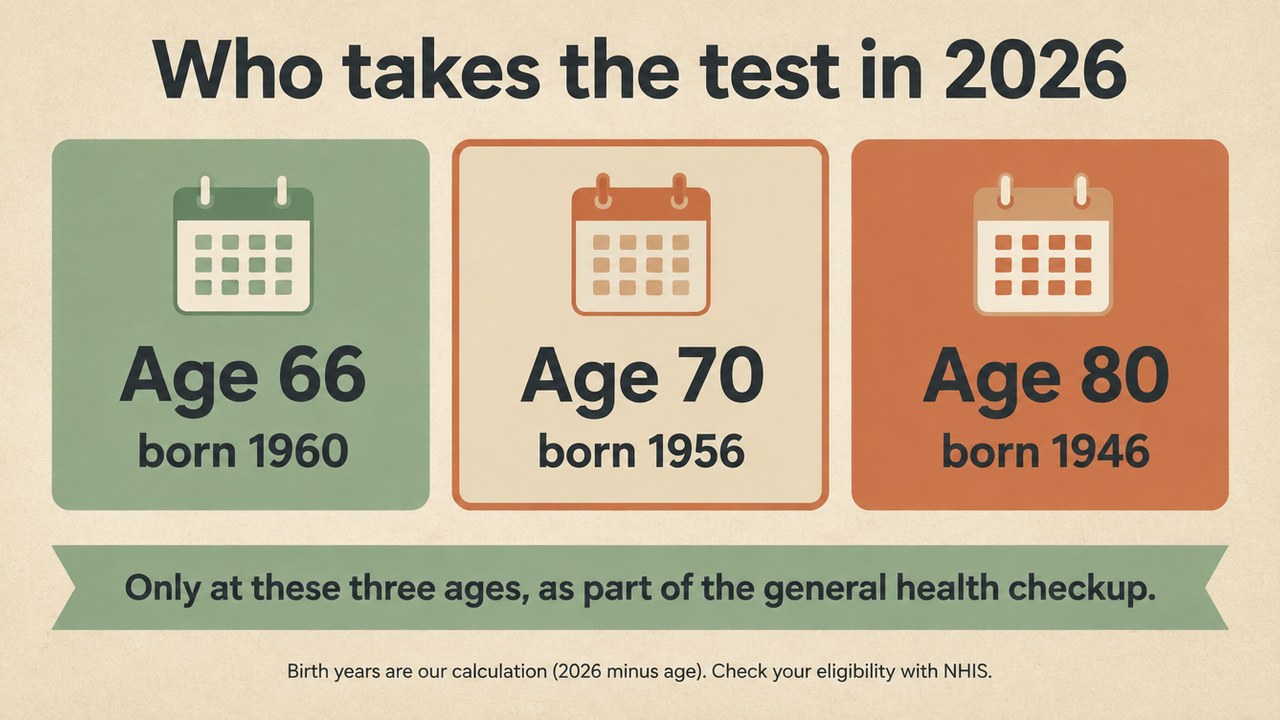
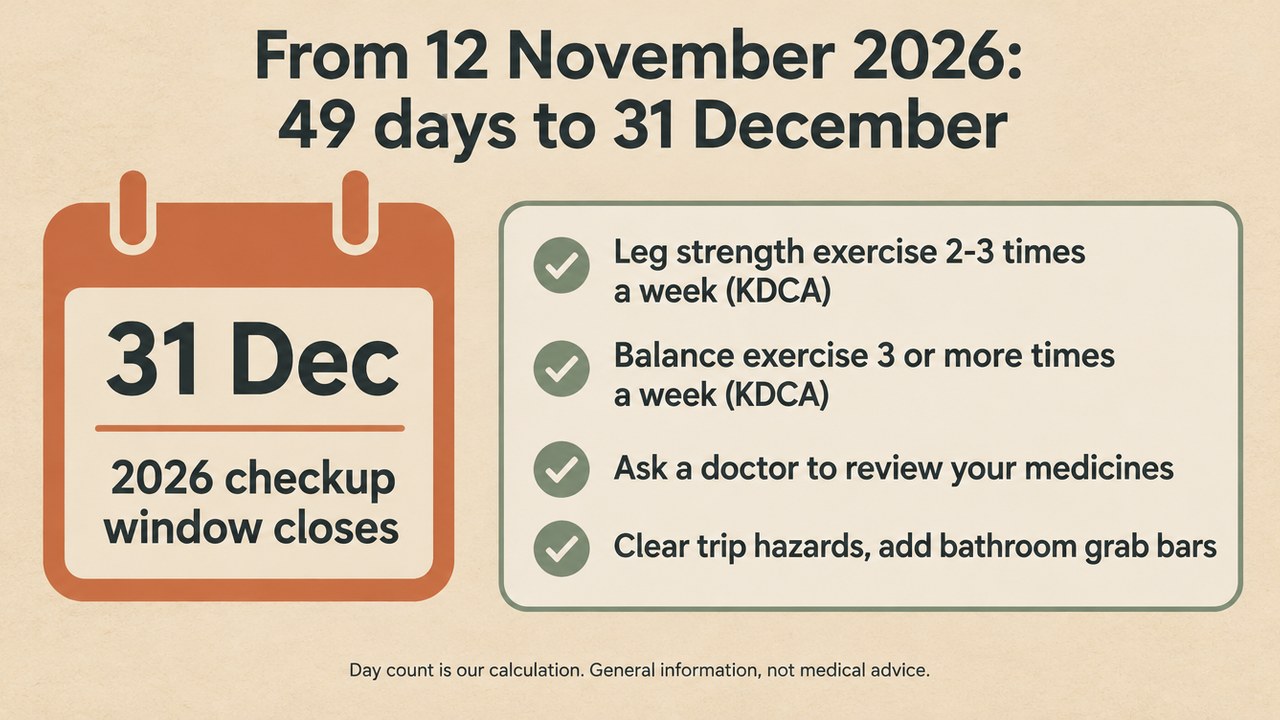
Quick answer: Korea’s national general checkup adds a physical function test (노인신체기능검사), which works as a fall-risk check, at ages 66, 70 and 80 only (NHIS). In 2026 that means people born in 1960, 1956 and 1946 (our calculation). It has two parts. In the lower-limb test you stand up from a chair, walk 3 metres, turn, walk back and sit down. In the balance test you stand on one leg. Under MOHW Annex 4, the walk result is Normal A at 10 seconds or less, Normal B (borderline) at 11–19 seconds and “disease suspected” at 20 seconds or more. The one-leg stand is Normal A at 15 seconds or more with eyes closed (20 or more with eyes open). It is “suspected” at 5 seconds or less with eyes closed (9 or less with eyes open). Faster is better for the walk and longer is better for the stand. The 2026 checkup window closes on Thursday 31 December 2026, 48 days from 13 November.
If your mother turned 70 this year, or your father turned 80, the checkup includes something they have probably never done in a clinic before. A staff member asks them to get up from a chair, walk to a line on the floor and come back, then stand on one foot while someone times them. A few weeks later the result sheet shows a number of seconds and a word: Normal A, Normal B or “disease suspected”. This guide explains who gets the test, what happens on the day, the official cut-offs, what each result does and doesn’t mean, and what families can do next, including fall prevention at home.

Who gets the physical function test, and when
NHIS lists the elderly physical function test (노인신체기능검사) among the age- and sex-specific items of the general checkup, at 66, 70 and 80 (NHIS checkup guide; NHIS policy page). Article 5 of the MOHW Implementation Standards lists the “elderly physical function test” next to bone density and lung function among the general checkup items. The Muan County public health centre and Soonchunhyang University Cheonan Hospital’s checkup centre both describe it as a fall test (낙상검사) with two parts, lower-limb function and balance, at 66, 70 and 80 (Muan public health centre; Soonchunhyang Univ. Cheonan Hospital).
It is offered only at those three ages. A parent who is 71 or 75 this year will not see it on the 2026 checkup.
| Age in 2026 | Birth year (our calculation: 2026 minus age) | Other age-based items that year (NHIS) |
|---|---|---|
| 66 | 1960 | Lung function test; bone density (women); cognitive test (from 66, every 2 years) |
| 70 | 1956 | Cognitive test; lifestyle assessment; depression screening (once in your 70s) |
| 80 | 1946 | Cognitive test |
Birth years are calculated, not printed by NHIS. Korean checkup items are scheduled by the age you reach in the calendar year, so check the exact list on the NHIS “checkup eligibility” (검진대상 조회) page or by calling 1577-1000.
Two practical points:
- The checkup runs from 1 January to 31 December. NHIS says the general checkup window ends on 31 December each year. People who missed last year’s checkup can ask NHIS to be added to this year’s list (NHIS checkup guide).
- Medical Aid recipients get it too. For Medical Aid recipients aged 66 and over, the separate “life-transition checkup” (의료급여 생애전환기검진) includes the same physical function test at 66, 70 and 80 (NHIS policy page; Gov24 service page).
The general checkup is paid for by NHIS. The Soonchunhyang Cheonan page describes the first-stage checkup as fully paid by NHIS, and Muan’s page says Medical Aid recipients pay nothing.
What happens on the day: two short timed tests
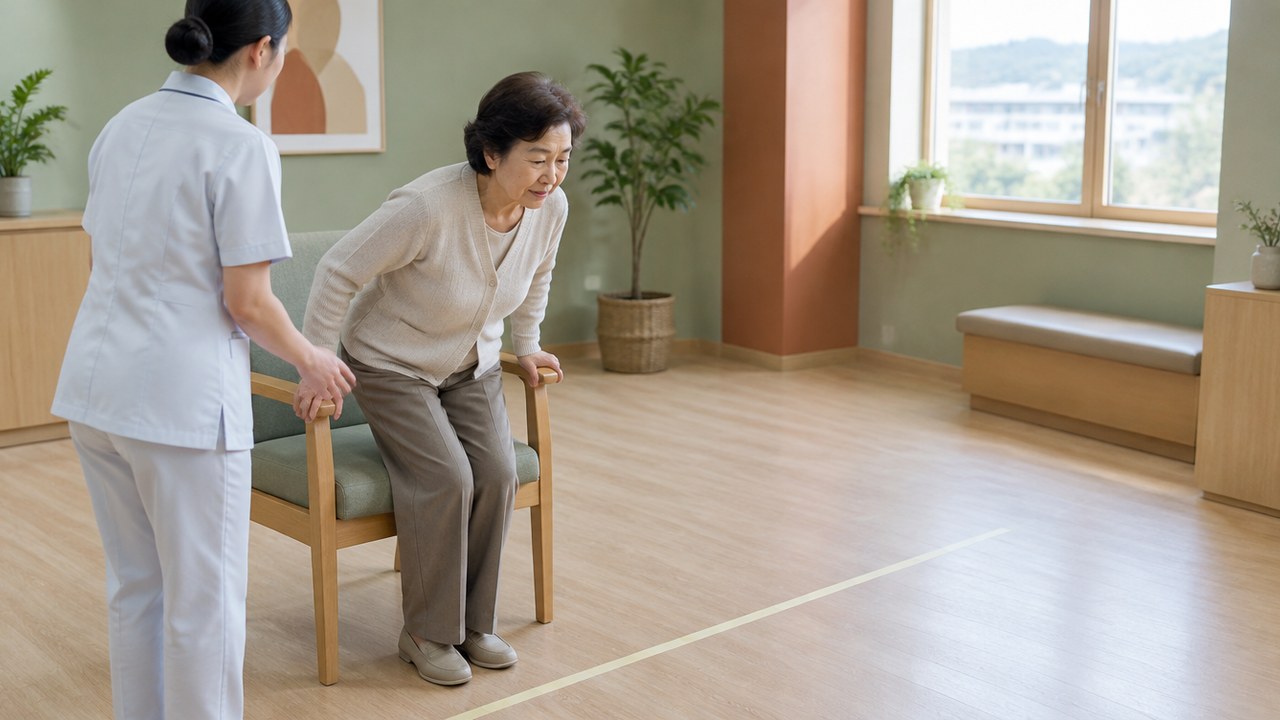
Checkup clinics and public health centres describe the two items together as a fall test. Neither needs a needle, a machine or an X-ray. Both take a few minutes.
1. Lower-limb function: the “timed up-and-go”. You start seated in a chair. On the signal you stand up, walk about 3 metres to a mark, turn, walk back and sit down again. Staff time it from the signal until you are seated. KDCA’s gait-disorder page describes the same test (일어나 걷기 검사, timed up and go test). You start in a chair with armrests, and you may use your usual walking aid, such as a cane (KDCA, gait disorders in older adults). The CDC’s test sheet gives the same steps: regular footwear, walking aid if needed, a line 3 metres away, walk at your normal pace, and staff stay beside you for safety (CDC STEADI, Timed Up & Go).
2. Balance: the one-leg stand. You stand on one leg for as long as you safely can. The result criteria list two versions, eyes closed and eyes open, each with its own cut-offs. The MOHW text we read does not specify which leg, how many attempts or where your hands go. Ask the staff how they run it.
Tips for the day (general, not clinical advice):
- Wear the shoes you normally walk in and clothes you can move in.
- Bring the cane or walker you use every day, and tell staff about it. Don’t leave it behind to “do better”.
- Tell staff before you start if you have had a fall recently, feel dizzy, have knee or hip pain, or have had recent surgery.
- Walk at your normal pace. The test is not a race, and hurrying raises the risk of tripping.
The official cut-offs: Normal A, Normal B and “disease suspected”
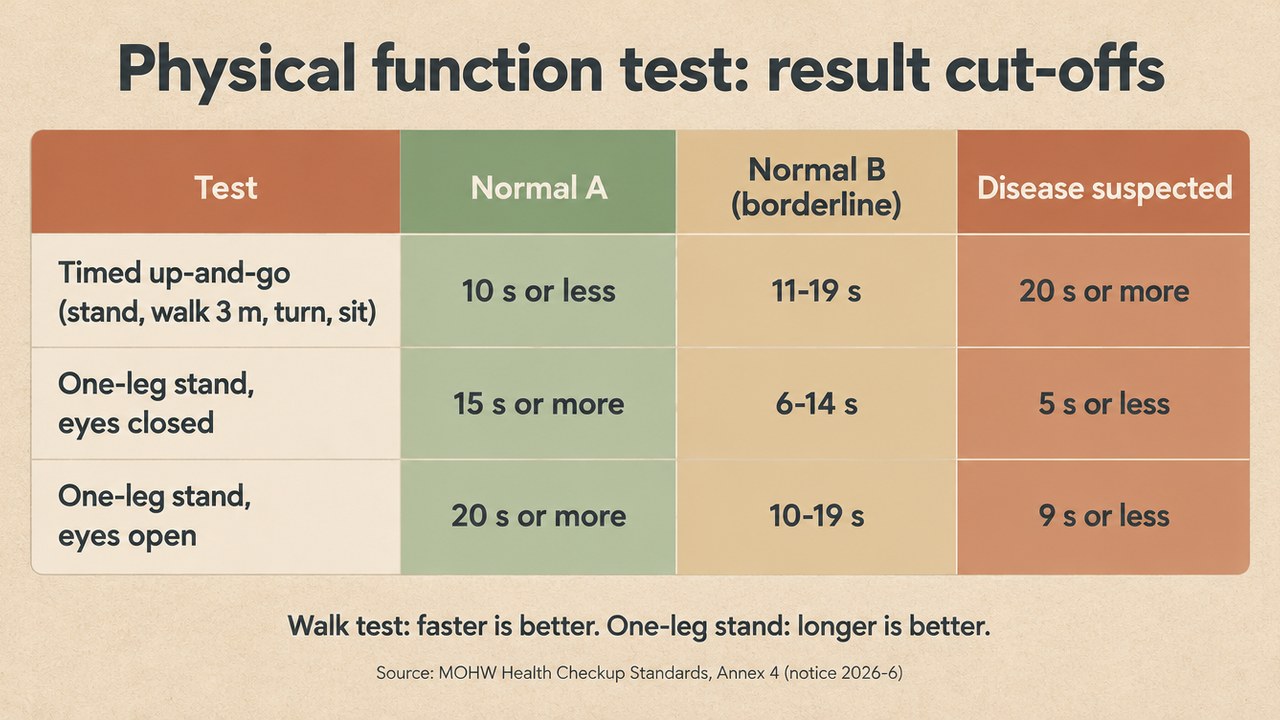
The cut-offs come from the appendix to Annex 4 of the MOHW Implementation Standards, “result criteria by test item” (검사항목별 판정기준), under the target condition “elderly physical function test” (MOHW Annex 4 appendix).
| Test (unit: seconds) | Normal A | Normal B (borderline) | Disease suspected |
|---|---|---|---|
| Lower-limb function (stand, walk 3 m, turn, return, sit) | 10 s or less (10초 이내) | 11–19 s | 20 s or more |
| Balance, one-leg stand, eyes closed | 15 s or more | 6–14 s | 5 s or less (5초 이내) |
| Balance, one-leg stand, eyes open | 20 s or more | 10–19 s | 9 s or less (9초 이내) |
Source: MOHW Health Checkup Implementation Standards (notice 2026-6), Annex 4 appendix, read from the law.go.kr file. For the walk, a shorter time is better. For the one-leg stand, a longer time is better.
Annex 4 itself defines the three labels for the whole checkup (MOHW Annex 4), in our translation:
- Normal A: “health is good”.
- Normal B (borderline): “no health problem, but self-care and preventive measures such as diet, habits and environmental improvement are needed”.
- Disease suspected: “may develop into disease; follow-up tests or accurate diagnosis and treatment through a specialist medical institution are needed”.
KDCA’s gait-disorder page gives an independent reading of the walk test. It says within 10 seconds is generally good, longer times raise the possibility of reduced walking or balance function, and 20 seconds or more may call for further assessment of walking, balance and fall risk. Those are the same two thresholds as the checkup table. The CDC sheet sets a stricter flag: an older adult who takes 12 seconds or more “is at risk for falling”. So part of Korea’s Normal B band (11–19 seconds) is already a fall-risk result by the CDC’s measure. Don’t treat Normal B as “nothing to see”.
A gap to know about. The table uses whole seconds: “10 seconds or less”, then “11–19”. It does not say how a time such as 10.5 seconds is classified. If your parent’s sheet shows a time on a boundary, ask the checkup clinic how they recorded and judged it.
What each result means, and what it doesn’t
Normal A means that on the day, your parent finished the walk and the stand within the “good” range. It is not a promise that they won’t fall. Falls also depend on eyesight, medicines, blood pressure on standing, footwear and the home.
Normal B (borderline) is the government’s “self-care and prevention” band. It is the most useful result to act on, because it often appears before a fall happens. Strength and balance exercise, a medicine review and a safer home are all things a family can start this month.
Disease suspected does not name a disease. The checkup does not diagnose arthritis, Parkinson’s disease, stroke after-effects, an inner-ear problem or anything else. It says the timed result is in the range where Annex 4 calls for a proper look by a doctor. KDCA lists many possible contributors to a slow, unsteady walk: arthritis, neurological conditions such as Parkinson’s disease, stroke or dementia, reduced senses, heart and metabolic disease, and psychological factors such as fear of falling. Finding the cause is the doctor’s job.
One thing that is not included: NHIS’s list of free confirmatory follow-up tests after the checkup covers hypertension, diabetes, dyslipidaemia, pulmonary TB, depression or early psychosis, and hepatitis C. The physical function test is not on that list (NHIS checkup guide). Our reading is that a follow-up visit about walking or balance is ordinary insured care with the usual co-payment, not a free checkup add-on.
Worked examples (illustrative)
These are made-up families to show how the table works. They are not real cases or medical judgements.
Example 1: Mother, 70 (born 1956). Her walk takes 9 seconds, which is Normal A. Her eyes-open one-leg stand lasts 12 seconds, which falls in the 10–19 band and is Normal B. Reading: her walking speed is fine, but balance is the weaker area. Annex 4’s “self-care and prevention” fits. She starts supported balance practice at the kitchen counter and a leg-strength routine, and her son clears the loose rug in the hallway.
Example 2: Father, 80 (born 1946). His walk takes 16 seconds, which is Normal B, and above the CDC’s 12-second risk flag. His eyes-open stand lasts 6 seconds, which is 9 or less and so “disease suspected”. He also mentions he slipped in the bathroom last winter. Reading: this is the profile to take to a doctor, with the result sheet and a list of his medicines. Grab bars and a non-slip mat go into the bathroom before the icy season.
Example 3: Yourself, 66 (born 1960). Your walk is recorded at 10.5 seconds and your eyes-closed stand at 15 seconds, which is Normal A. Reading: the stand is clearly Normal A. The walk sits in the gap between “10 seconds or less” and “11–19”, so check with the clinic which band it was put in. Either way, 66 is a good age to build a strength-and-balance habit. You can repeat the test at 70.
Example 4: Father, 80, who walks with a cane (born 1946). He uses his cane, as KDCA’s description allows, and takes 22 seconds, which is 20 or more and so “disease suspected”. He could not try the one-leg stand safely, so staff did not push it. Reading: a long time with a walking aid is still a result worth discussing with his doctor. If he has trouble with daily activities, the family can also look into a long-term care assessment through NHIS.
What to do next: a practical plan for families
KDCA’s falls page is clear that falls are preventable and that the approach has several parts (KDCA, falls). Based on that page and KDCA’s gait-disorder and older-adult exercise pages:
- Book the checkup if it isn’t done. If your parent is 66, 70 or 80 this year and hasn’t had the 2026 general checkup, there are 48 days from 13 November to 31 December. Search for a checkup clinic on the NHIS site and ask whether they run the physical function test on the same visit.
- Keep the result sheet and the seconds. The number matters more than the label, because you can compare it with the next test at 70 or 80.
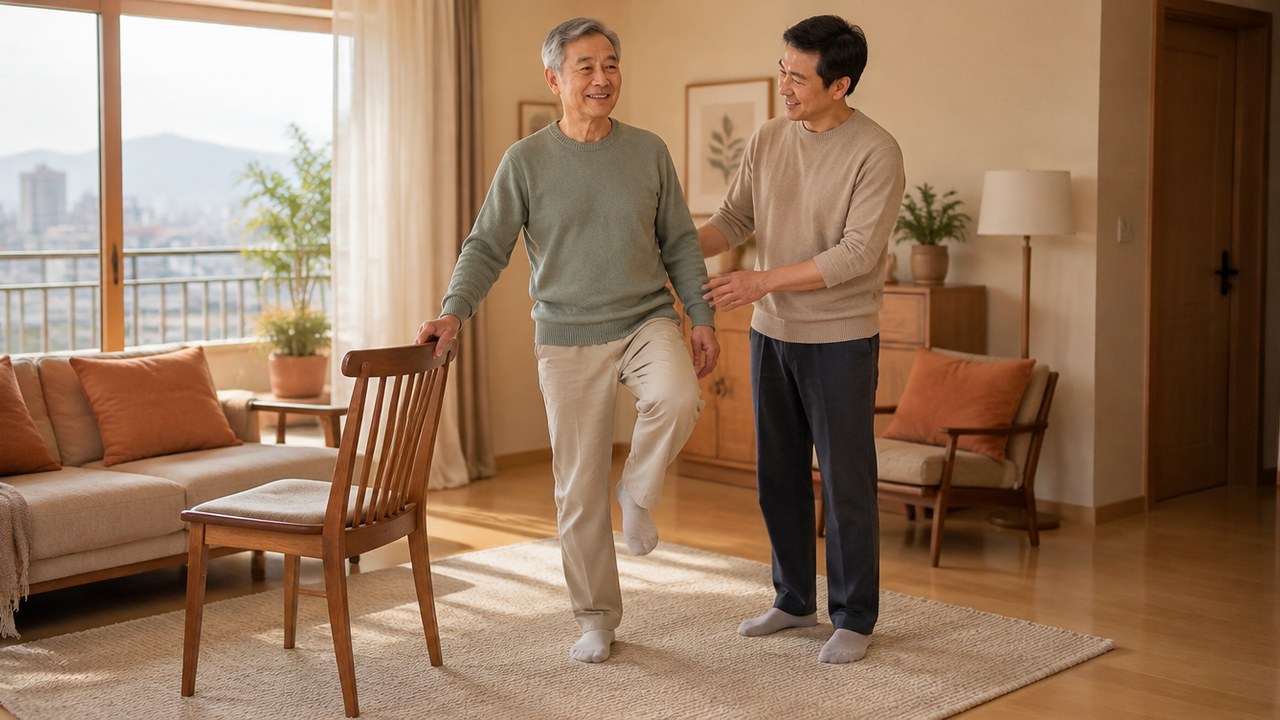
- Exercise for strength and balance. KDCA’s falls page recommends leg-strength exercise 2–3 times a week. Its older-adult exercise page recommends balance exercise 3 or more times a week in a safe setting, for example standing on one leg while holding a fixed support, and making it harder only gradually (KDCA, exercise for older adults). KDCA’s gait page suggests slow sit-to-stands from a chair and heel raises, 10 times for 3 sets, at least 3 times a week. It also notes that rehabilitation programmes kept up for 3 months or more can visibly improve walking speed and stride.
- Review medicines. KDCA notes that sedatives, muscle relaxants and blood-pressure medicines can cause dizziness. It lists taking four or more medicines among fall risk factors. Ask the doctor or pharmacist to review the full list.
- Check eyesight and get up slowly. KDCA advises an eye check and the right glasses, and warns against standing up suddenly from lying or sitting, because blood pressure can drop.
- Make the home safer. KDCA’s list covers wiping up water in the bathroom at once, grab bars by the toilet and bath, non-slip mats, removing door thresholds where possible, clearing cords and clutter, brighter lights in stairs, bedrooms and bathrooms, a lamp within reach of the bed, and well-fitting non-slip shoes.
- Ask about a programme. KDCA advises checking whether your community offers a fall-prevention exercise programme that assesses gait, balance and muscle strength. Your local public health centre is a good place to ask.
- See a doctor for “suspected”, or for any recent fall. Take the result sheet, a medicine list and notes on any falls (when, where, injuries). A family doctor or rehabilitation medicine clinic can look for the cause.
Don’t try the eyes-closed one-leg stand alone at home to “re-check” a result. It is easy to lose balance. Practise balance only with a sturdy support within reach, ideally with someone nearby.
Why this test is worth taking seriously
KDCA’s falls page summarises the national data. In the national survey of older adults, 5.6% of people aged 65 and over reported a fall in the past year, and 58.5% of them needed hospital treatment. In 2024, about 26,000 fall patients visited emergency rooms, according to the KDCA statistics the page cites. People aged 70 and over made up 35.3% of them, and in that age group 38.4% were admitted and 2.8% died. Among older adults who fell, 43.2% fell on pavements, roads or in parks. At home the most common places were the bathroom (18.9%), the living room (17.9%), the bedroom (13.0%) and stairs (9.1%).
KDCA also notes a vicious circle. After one fall, many older people move less for fear of falling again. That weakens their muscles further and makes the next fall more likely. A Normal B result is a chance to break that circle early. If your parent is also older and lives somewhere cold, our guide to hypothermia and frostbite in Korea’s winter covers icy morning walks and doorstep risks.
Related reading
- Korea’s Checkup Cognitive Test from 66: What the KDSQ-C Score Means: the other test on the same visit at 66, 70 and 80
- Korea’s New Checkup Lung Function Test at 56 and 66: what else the 66 checkup includes, and how to read the numbers
- Hypothermia and Frostbite in Korea’s Winter: Parents Over 65: winter safety for older parents, including falls on icy paths
Frequently asked questions
Q. At what ages does Korea’s national checkup include the physical function test?
Only at 66, 70 and 80, according to NHIS. In 2026 that means people born in 1960, 1956 and 1946 (our calculation). Medical Aid recipients get the same test at the same ages in their life-transition checkup. The 2026 checkup window ends on 31 December 2026, 48 days from 13 November.
Q. What are the two parts of the test?
A lower-limb test, in which you stand up from a chair, walk 3 metres, turn, walk back and sit down while staff time you, and a balance test, in which you stand on one leg. You can use your usual cane or walker for the walk. Wear your normal walking shoes.
Q. What are the cut-offs for Normal A, Normal B and disease suspected?
Under MOHW Annex 4: the walk is Normal A at 10 seconds or less, Normal B at 11 to 19 seconds and disease suspected at 20 seconds or more. The eyes-closed one-leg stand is Normal A at 15 seconds or more, Normal B at 6 to 14 and suspected at 5 or less. The eyes-open stand is Normal A at 20 seconds or more, Normal B at 10 to 19 and suspected at 9 or less.
Q. My parent got “disease suspected”. Does that mean they have a disease?
No. The label means the timed result is in the range where the criteria call for follow-up or proper diagnosis. It does not name any condition. Arthritis, neurological conditions, eyesight, medicines and fear of falling can all slow a walk. Take the result sheet and a list of medicines to a doctor. This follow-up is not one of NHIS’s free confirmatory tests.
Q. What can we do at home after a Normal B result?
KDCA recommends leg-strength exercise 2 to 3 times a week and balance exercise 3 or more times a week, holding a fixed support at first. It also recommends a medicine review, an eye check, getting up slowly, bathroom grab bars and non-slip mats, brighter lighting and clearing trip hazards. Don’t practise the eyes-closed stand alone.
Sources
- National Health Insurance Service, 일반건강검진 (general checkup guide): physical function test at 66, 70, 80; other age items; window 1 Jan–31 Dec; missed-last-year add-on; list of free confirmatory tests — https://www.nhis.or.kr/nhis/healthin/wbhaca04500m01.do (checked 12 November 2026)
- National Health Insurance Service, 일반건강검진 제도소개 (policy page): 노인신체기능검사 66, 70, 80; Medical Aid life-transition checkup includes physical function — https://www.nhis.or.kr/nhis/policy/wbhada19700m01.do (checked 12 November 2026)
- MOHW, 건강검진 실시기준 (Health Checkup Implementation Standards, notice no. 2026-6, in force 7 January 2026), Article 5 (elderly physical function test among checkup items) — https://www.law.go.kr/LSW/admRulLsInfoR.do?admRulSeq=2100000272270&chrClsCd=010201 (checked 12 November 2026)
- MOHW, Annex 4 결과 판정기준 (definitions of Normal A, Normal B, disease suspected) — https://www.law.go.kr/LSW/flDownload.do?flSeq=160922523 (law.go.kr file, read 12 November 2026)
- MOHW, Annex 4 appendix 검사항목별 판정기준 (노인신체기능검사: 하지기능 10초 이내 / 11–19초 / 20초 이상; 평형성 눈감은 상태 15초 이상 / 6–14초 / 5초 이내; 눈 뜬 상태 20초 이상 / 10–19초 / 9초 이내) — https://www.law.go.kr/LSW/flDownload.do?flSeq=160922929 (law.go.kr file, read 12 November 2026)
- Gov24, 의료급여 생애전환기검진 지원 (physical function test at 66, 70, 80 for Medical Aid 66+) — https://www.gov.kr/portal/service/serviceInfo/SME000000030 (checked 12 November 2026)
- KDCA National Health Information Portal, 노인 보행장애 (gait disorders in older adults, updated 23 October 2026): timed up and go method, 10 s / 20 s reading, causes, exercise — https://health.kdca.go.kr/healthinfo/biz/health/gnrlzHealthInfo/gnrlzHealthInfo/gnrlzHealthInfoView.do?cntnts_sn=6695 (checked 12 November 2026)
- KDCA National Health Information Portal, 낙상 (falls, updated 23 October 2026): statistics, risk factors, prevention, home safety — https://health.kdca.go.kr/healthinfo/biz/health/gnrlzHealthInfo/gnrlzHealthInfo/gnrlzHealthInfoView.do?cntnts_sn=1743 (checked 12 November 2026)
- KDCA National Health Information Portal, 노인 운동 (exercise for older adults): balance exercise 3+ times a week with a fixed support — https://health.kdca.go.kr/healthinfo/biz/health/gnrlzHealthInfo/gnrlzHealthInfo/gnrlzHealthInfoView.do?cntnts_sn=6758 (checked 12 November 2026)
- Independent: US CDC, STEADI Assessment, Timed Up & Go (3 m line, normal pace, ≥12 s at risk for falling) — https://www.cdc.gov/steadi/media/pdfs/STEADI-Assessment-TUG-508.pdf (checked 12 November 2026)
- Independent: Muan County public health centre, 국가건강검진사업 (노인신체기능검사(낙상검사): 하지기능, 평형성, 66, 70, 80세; Medical Aid no charge) — https://www.muan.go.kr/health/business/integration/national_health (checked 12 November 2026)
- Independent: Soonchunhyang University Cheonan Hospital checkup centre, 국민건강보험공단 일반검진 (낙상검사 at 66, 70, 80; first-stage checkup paid by NHIS) — https://www.schmc.ac.kr/cheonanHealth/contents.do?key=3916 (checked 12 November 2026)
This article is general health information, not medical advice. It does not diagnose any condition and cannot assess anyone’s fall risk. Talk to a doctor about a checkup result, a recent fall, dizziness or any change in walking or balance before starting a new exercise routine.