Korea Health Insurance After Retirement: How Voluntary Continuation Keeps Your Employee Premium for Up to 36 Months
Haesul Economy desk (AI-assisted). Last checked: 2026-11-11 (KST); countdown updated 2026-11-13; first published 8 November 2026. The 2027 rates apply from January 1, 2027 — 49 days from November 13. Eligibility, deadline and formula re-read on the NHIS voluntary continuation guide, and the 2027 rates on Korea.kr and MOHW, on Nov 11. Based on the National Health Insurance Service (NHIS) pages on voluntary continuation and dependant rules, Article 110 of the National Health Insurance Act and its enforcement rules, the Ministry of Health and Welfare (MOHW) premium-reduction notice in force from 1 January 2026, the Ministry of Government Legislation’s EasyLaw guide, and 2026–2027 rate announcements. This is general information, not financial, tax or legal advice. Confirm your own figures with NHIS (1577-1000) before you decide.
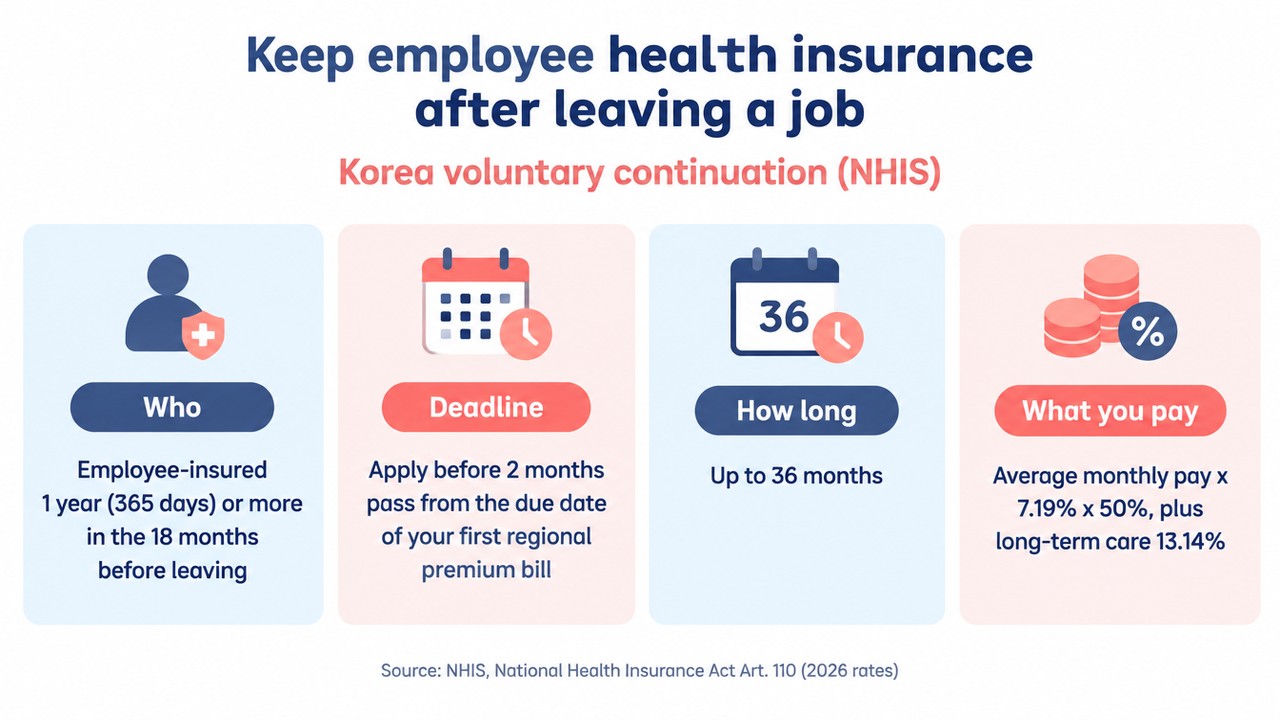
Quick answer: From January 1, 2027 — 49 days from November 13 — the health rate stays 7.19% but long-term care rises to 13.90% of the health premium (Korea.kr; MOHW), so a ₩4,000,000 average costs about ₩163,780 a month instead of ₩162,690. When you leave a job in Korea, you move from employee health insurance to the regional (지역) scheme, where the bill is based on household income and property. If you were employee-insured for at least 1 year (365 days) in the 18 months before you left, you can apply for voluntary continuation (임의계속가입) and keep paying an employee-level premium for up to 36 months instead. You must apply before 2 months pass from the due date of your first regional premium bill. The 2026 premium is roughly your average monthly pay over the last 12 months × 7.19% × 50%, plus long-term care insurance. For someone who averaged ₩4,000,000 a month, that is about ₩162,690 a month in total. It only pays off if your regional bill would be higher, so compare the two first.
For many people in their 50s and early 60s, the first regional health-insurance bill after leaving work is a shock. On a payslip you only ever saw half the premium, because your employer paid the other half (see our guide to the four social insurances on a Korean payslip). After you leave, the regional scheme looks at your whole household: interest, pensions and other income, plus the house or land you own. A paid-off apartment and no salary can still produce a bill well above what you paid at work. Voluntary continuation is the special rule written for exactly this gap.

Who qualifies
The NHIS voluntary continuation page and Article 110 of the National Health Insurance Act set out the conditions. EasyLaw, the government’s plain-language legal guide, repeats them with the same references to the Act and to Article 62 of the enforcement rules.
| Condition | What it means in practice |
|---|---|
| Your employment ended | You resigned, retired or your contract ended, and you became a regional subscriber |
| 1 year in the last 18 months | In the 18 months before your last day, you held employee-insured status for a combined total of at least 1 year (365 days). Gaps between jobs are allowed if the total reaches 365 days |
| Not a sole-proprietor owner | NHIS excludes time spent as the representative of a sole proprietorship (including co-representatives) |
| Nationality | Overseas Koreans and registered foreign residents can also apply, according to NHIS |
Two points are easy to miss. First, the period is counted backwards from the day your employment ended, not from today. Second, if you take a new job during the 36 months, voluntary continuation ends that day. NHIS says you can apply again after leaving the new job if you meet the 1-year-in-18-months test again from that later exit.
The deadline: 2 months from your first regional bill’s due date
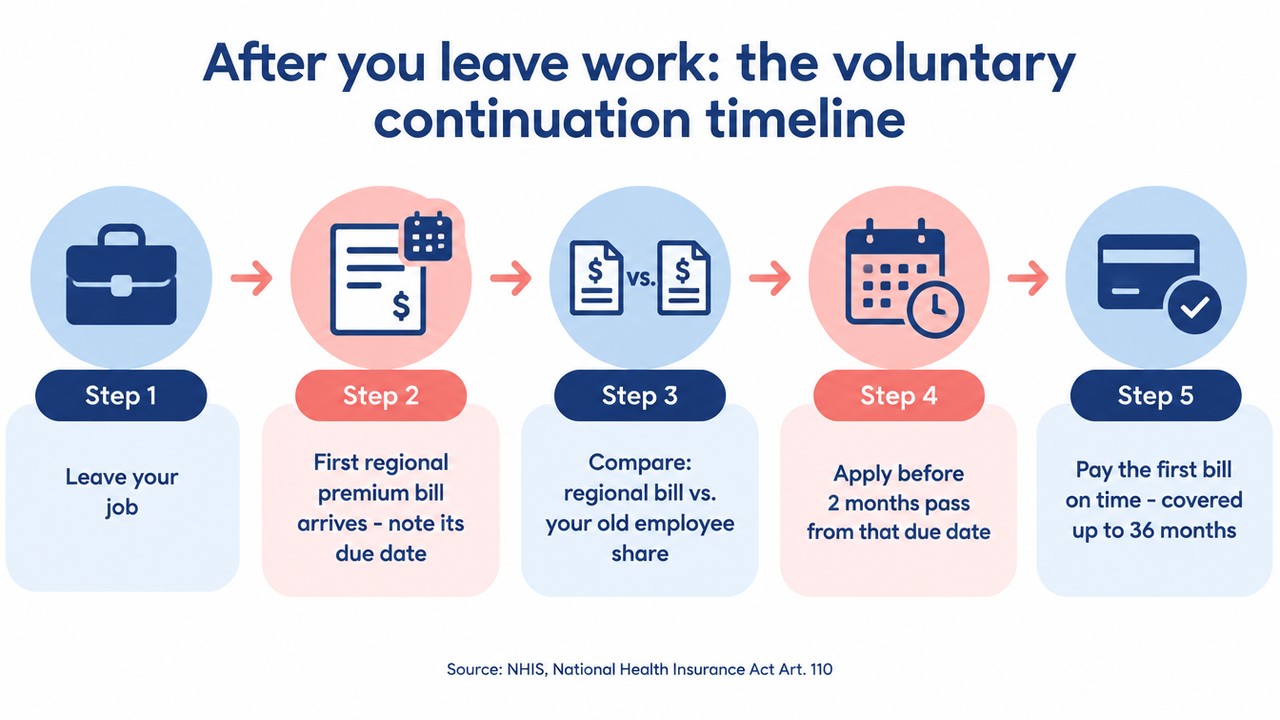
This is the rule that catches people out. You do not apply from your leaving date. You apply after the first regional premium bill arrives, and you must do it before 2 months have passed from that bill’s due date (Article 110(1); NHIS has applied this deadline since 22 May 2013).
A worked timeline makes it concrete. The dates below are an illustration; your bill shows your real due date.
| Step | Example date | What to do |
|---|---|---|
| Last day at work | 30 September 2026 | Ask your employer for your final pay settlement; it feeds the average NHIS uses |
| First regional bill issued | October–November 2026 | Note the amount and the due date printed on it |
| Due date on that bill | e.g. 10 December 2026 | Compare the bill with your estimated voluntary continuation premium (table below) |
| Last safe window to apply | Before 2 months pass from 10 December, i.e. before about 10 February 2027 | Apply online, by phone, fax, post or at a branch. Confirm the exact last day with NHIS, as weekends and late notices can shift it |
| First voluntary continuation bill | After approval | Pay it on time. If it is still unpaid 2 months after its due date, the application is cancelled and you stay regional |
Once approved, EasyLaw notes that you keep employee status counted from the day after your employment ended, for up to 36 months from that day. The period was extended from 24 to 36 months on 1 January 2018, according to NHIS.
How the premium is calculated in 2026
NHIS gives the formula as: average of your monthly pay (보수월액) over the most recent 12 months on which a salary premium was assessed, including the month you left × the employee contribution rate for the year, + any premium on non-salary income. The average uses your final, settled pay figures, so a bonus in the last year can lift it.
Two legal pieces then work against each other:
- Article 110(5) says the voluntary continuer pays the whole salary premium. At work, your employer paid half.
- The MOHW premium-reduction notice (보험료 경감고시, Notice 2025-221, in force 1 January 2026), Article 9, cuts a voluntary continuer’s salary premium by 50%.
The two cancel out. If your 12-month average equals your last salary, you pay the same amount you saw deducted at work. The 2026 contribution rate is 7.19% (Enforcement Decree Art. 44 and the NHIS 2026 changes leaflet), and long-term care insurance is 13.14% of the health premium (MOHW, 4 November 2025 decision). For 2027, the Health Insurance Policy Deliberation Committee voted on 8 September 2026 to keep the rate at 7.19% (Korea.kr policy briefing; also reported by Yonhap), so these figures should still hold next year, apart from any change to the long-term care rate.
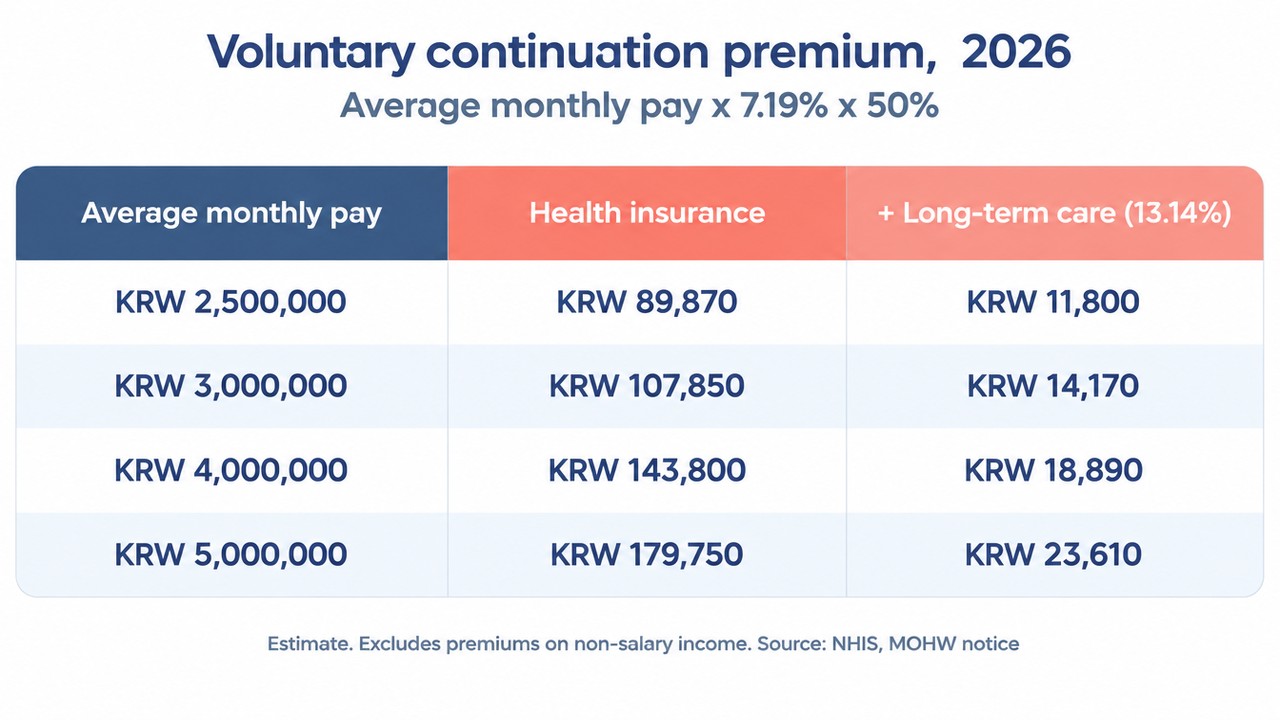
Worked premium table (2026 rates)
| Average monthly pay (last 12 months) | Full salary premium (× 7.19%) | You pay after 50% reduction | Long-term care (× 13.14%) | Monthly total |
|---|---|---|---|---|
| ₩2,500,000 | ₩179,750 | ₩89,870 | ₩11,800 | ₩101,670 |
| ₩3,000,000 | ₩215,700 | ₩107,850 | ₩14,170 | ₩122,020 |
| ₩4,000,000 | ₩287,600 | ₩143,800 | ₩18,890 | ₩162,690 |
| ₩5,000,000 | ₩359,500 | ₩179,750 | ₩23,610 | ₩203,360 |
| ₩6,000,000 | ₩431,400 | ₩215,700 | ₩28,340 | ₩244,040 |
Our calculation from the NHIS formula and the 2026 rates, with amounts under ₩10 dropped. NHIS’s actual bill applies its own rounding and adds a non-salary income premium if you have one, so treat these as estimates.

Rechecked on November 11, 2026 (NHIS / MOHW): the NHIS guide still sets the test at 365 days of employee coverage in the 18 months before leaving (foreign residents included), the deadline at before 2 months pass from the due date of your first regional bill, the premium at the 12-month average pay × that year’s employee rate (plus any non-salary income premium), and the benefit period at 36 months. For 2027, the Health Insurance Policy Deliberation Committee kept the rate at 7.19% (8 September 2026), and MOHW’s long-term care committee set long-term care at 0.9994% of income, 13.90% of the health premium, up from 13.14% (30 October 2026; MOHW’s own example: a ₩100,000 health premium carries ₩13,900). (NHIS; Korea.kr / MOHW; MOHW; read 11 November 2026.)
Worked premium table (2027 rates, from January 1)
| Average monthly pay (last 12 months) | You pay after 50% reduction (7.19%) | Long-term care (× 13.90%) | Monthly total 2027 | Change vs 2026 |
|---|---|---|---|---|
| ₩2,500,000 | ₩89,870 | ₩12,490 | ₩102,360 | +₩690 |
| ₩3,000,000 | ₩107,850 | ₩14,990 | ₩122,840 | +₩820 |
| ₩4,000,000 | ₩143,800 | ₩19,980 | ₩163,780 | +₩1,090 |
| ₩5,000,000 | ₩179,750 | ₩24,980 | ₩204,730 | +₩1,370 |
| ₩6,000,000 | ₩215,700 | ₩29,980 | ₩245,680 | +₩1,640 |
Our calculation, same method and rounding as the 2026 table (amounts under ₩10 dropped). Only the long-term care line moves, because the 7.19% health rate is frozen for 2027. Treat these as estimates; NHIS applies its own rounding.
How the regional premium is calculated
The NHIS regional premium calculator states the 2026 formula: health premium = (monthly income × 7.19%) + (property points × ₩211.5), and long-term care is added on top. Monthly income is your assessed annual income divided by 12. Property points come from a grade table that covers housing, buildings, land and rental deposits. In 2026 the regional premium has a floor of ₩20,160 and a ceiling of ₩4,591,740 (NHIS 2026 changes leaflet). It is billed to the household, so a spouse’s income and property are added in.
That property line is why retirees with a home but little cash income often pay more as regional subscribers than they did at work. Because the property score depends on your own assets, the honest approach is to read the figure off your first regional bill or the NHIS calculator rather than guess it.
Worked comparison: when continuation wins, and when it doesn’t
The two households below are illustrations. Their income and property points are assumptions, not typical values; the rates and formulas are the official 2026 ones.
| Household A: retired at 58 | Household B: retired at 61 | |
|---|---|---|
| Average monthly pay in last 12 months at work | ₩4,000,000 | ₩2,500,000 |
| Voluntary continuation, monthly total | ₩162,690 | ₩101,670 |
| Assumed regional income (annual) | ₩12,000,000 → ₩1,000,000 a month × 7.19% = ₩71,900 | ₩0 |
| Assumed property points | 700 × ₩211.5 = ₩148,050 | 200 × ₩211.5 = ₩42,300 |
| Regional health premium | ₩219,950 | ₩42,300 |
| + Long-term care (13.14%) | ₩28,900 | ₩5,550 |
| Regional monthly total | ₩248,850 | ₩47,850 |
| Better choice | Voluntary continuation: ₩86,160 a month less | Stay regional: ₩53,820 a month less |
| Over 36 months | About ₩3,101,760 saved | Continuation would cost about ₩1,937,520 more |
Household A is the classic case for continuation: a decent last salary but a home that adds a large property score. Household B earned less at work and owns little, so the regional bill is already lower. NHIS describes the scheme as one you choose when the continuation premium is lower than the regional one; nothing stops you from staying regional.
You can also leave voluntary continuation early. If your income or property changes and the regional bill becomes cheaper, file a withdrawal form; NHIS ends your continuation status the day after it receives the form.
The dependant alternative: paying nothing at all
Before choosing between the two premiums, check whether you can pay no premium. If your spouse or one of your children is employee-insured, you may be registered as their dependant (피부양자). NHIS lists three tests, and all must be met:
| Test | 2026 rule (NHIS, Enforcement Rules Annex 1-2) |
|---|---|
| Relationship | Spouse (including common-law), parents and parents-in-law, children and their spouses; siblings only in limited cases |
| Income | Total income from business, interest and dividends, pensions, wages and other sources of ₩20 million a year or less. No business income if you have a business registration; up to ₩5 million if you don’t. Any housing rental income disqualifies you. If you are married, both spouses must pass |
| Property | Property-tax base of ₩540 million or less, or above ₩540 million up to ₩900 million if annual income is ₩10 million or less |
For many retirees the income test is the hard part, because public pensions count in full. A column by the Government Employees Pension Service (GEPS) makes a practical point: if one spouse loses dependant status because of income, the other spouse loses it too, and the status is reviewed every year from November using updated income and property data. GEPS also advises registering soon after retirement, because a late application is not backdated beyond 90 days.
A useful bonus: NHIS says a voluntary continuer can register dependants just like an employee. So if you take continuation, a spouse who meets the dependant tests can sit under your policy rather than being billed in a regional household.
Three routes side by side
| Route | Monthly cost | Who it suits | Main catch |
|---|---|---|---|
| Dependant of a working family member | ₩0 | Low income (≤ ₩20 million) and property within the limits | Income or property changes end it; reviewed yearly |
| Voluntary continuation | Your old employee share (e.g. ₩162,690 at a ₩4 million average) | Higher regional bill because of property or household income | Strict deadline; maximum 36 months; first bill must be paid on time |
| Regional subscriber | Based on household income and property | Little property and income, so the regional bill is low | Can rise each November when new income and property data arrive |
How to apply
NHIS lists several channels:
- Online: NHIS website, Complaints (“민원여기요”) → Personal → Eligibility → apply for voluntary continuation. Online filing is for joining only; withdrawal needs the form.
- The 건강보험 mobile app: the same menu under applications and payments.
- Phone: NHIS call centre 1577-1000 (weekdays 09:00–18:00). From abroad: +82-33-811-2001.
- Branch, fax or post: submit the voluntary continuation (join/withdraw) application form.
EasyLaw notes that you may need a family relationship certificate if your resident register doesn’t show the link to a dependant you want to add, and foreign residents attach a copy of their residence card. If you are also deciding when to draw your National Pension, our guides on pension age by birth year and voluntary National Pension contributions after 60 cover the pension side of the same transition.

A checklist for your first month out of work
- Week 1: Ask HR for your final pay settlement and your health-insurance status record (자격득실확인서), which shows your employee-insured days.
- When the first regional bill arrives: write down the amount and the due date. Put the 2-month deadline in your calendar straight away.
- Estimate continuation: average monthly pay × 7.19% × 50%, then add 13.14% for long-term care, or ask NHIS for the exact figure.
- Check the dependant route: if a spouse or child is employee-insured and you pass the income and property tests, compare ₩0 with both bills.
- Decide and apply well before the deadline, then pay the first continuation bill promptly.
- Each November: regional and dependant figures are recalculated with new data, so look again at whether continuation is still the cheaper route.
Foreign residents who are moving between schemes should also read our 2026 guide to NHIS premiums for foreigners, since some foreign regional subscribers are billed at least the national average premium.
Frequently asked questions
Q. What is voluntary continuation in Korean health insurance?
It is a special rule (임의계속가입, National Health Insurance Act Art. 110) that lets someone who has left a job keep employee-insured status for up to 36 months and pay an employee-level premium instead of a regional premium based on household income and property.
Q. Who can apply for voluntary continuation?
People whose employment ended and who were employee-insured for a combined total of at least 1 year (365 days) in the 18 months before leaving. Time as the representative of a sole proprietorship does not count. Overseas Koreans and foreign residents can apply too.
Q. What is the deadline to apply?
Before 2 months pass from the due date of the first regional premium bill you receive after becoming a regional subscriber. For example, if that bill is due on 10 December, apply before about 10 February, and confirm the exact day with NHIS.
Q. How much is the voluntary continuation premium in 2026?
Roughly your average monthly pay over the last 12 months × 7.19% × 50%, plus long-term care at 13.14% of that amount and any premium on non-salary income. A ₩4,000,000 average gives about ₩143,800 plus ₩18,890, or ₩162,690 a month.
Q. Is it always cheaper than the regional premium?
No. It is cheaper when your regional bill is pushed up by property or household income. If you own little and earned a modest salary, the regional bill can be lower, and you can stay regional or withdraw from continuation at any time.
Q. What will voluntary continuation cost in 2027, and is there a deadline?
From January 1, 2027 (49 days from November 13) the health rate stays 7.19% and long-term care becomes 13.90% of the health premium, so a ₩4,000,000 average works out to about ₩143,800 + ₩19,980 = ₩163,780 a month (our calculation). The deadline is personal, not a calendar date: NHIS must receive your application before 2 months pass from the due date of your first regional premium bill.
Related reading
- Korea NPS catch-up and voluntary continue after 60
- Korea long-term care insurance grades 1–5 and the 2027 limits
- Korea payslip 2027: pension rises to 10%
Sources
- Ministry of Health and Welfare, 2026 5th Long-Term Care Committee (30 October 2026: 2027 long-term care rate 0.9994% of income, 13.90% of the health premium) — https://www.mohw.go.kr/gallery.es?act=view&bid=0003&list_no=380579&mid=a10505000000 (checked 11 November 2026)
- National Health Insurance Service, voluntary continuation guide (eligibility, 365 days in 18 months, deadline, formula, 36 months, dependants, channels) — https://www.nhis.or.kr/nhis/policy/wbhada05500m01.do (checked 8 November 2026; re-checked 11 November 2026)
- National Health Insurance Service, voluntary continuation service page (application channels, cancellation if the first bill is unpaid, re-application after a new job) — https://www.nhis.or.kr/nhis/minwon/wbhapa01000m01.do?articleNo=10946871&mode=view (checked 8 November 2026)
- National Health Insurance Act, Article 110 (special rule for the unemployed), via the NHIS law service — https://www.nhis.or.kr/lm/lmxsrv/law/lawLinkContentView.do?LINKCODE=c011000000&SEQ=27 (checked 8 November 2026)
- MOHW premium-reduction notice (Notice 2025-221, in force 1 January 2026), Article 9: 50% reduction for voluntary continuers — https://www.law.go.kr/LSW/admRulInfoR.do?admRulSeq=2100000270516 (checked 8 November 2026)
- Ministry of Government Legislation, EasyLaw: keeping employee status after unemployment (36 months from the day after leaving, documents) — https://easylaw.go.kr/CSP/CnpClsMain.laf?ccfNo=2&cciNo=1&cnpClsNo=3&csmSeq=1063 (checked 8 November 2026)
- National Health Insurance Act Enforcement Decree, Article 44 (7.19% rate, ₩211.5 per property point) — https://www.law.go.kr/LSW/lsLinkCommonInfo.do?lspttninfSeq=69496 (checked 8 November 2026)
- NHIS 2026 changes leaflet (7.19%, long-term care 0.9448%, ₩211.5, regional floor and ceiling) — https://www.nhis.or.kr/renewal_popup/poster/20260204_poster_longdesc_1.html (checked 8 November 2026)
- NHIS regional premium calculator (formula) — https://www.nhis.or.kr/nhis/minwon/retrieveLocalCalcView.do (checked 8 November 2026)
- MOHW press release: 2026 long-term care rate 0.9448%, 13.14% of the health premium — https://www.mohw.go.kr/board.es?act=view&bid=0027&list_no=1487817&mid=a10503010100 (checked 8 November 2026)
- Korea.kr policy briefing: 2027 health insurance rate held at 7.19% (8 September 2026) — https://www.korea.kr/news/policyNewsView.do?newsId=148971474 (checked 8 November 2026); also Yonhap — https://www.yna.co.kr/view/AKR20260908089851530
- NHIS dependant income and property requirements — https://www.nhis.or.kr/nhis/policy/wbhada07400m01.do (checked 8 November 2026)
- Government Employees Pension Service column on retiree health insurance (dependant review, spouses, 90-day registration) — https://www.geps.or.kr/notiCommunication_notice_center/32676 (checked 8 November 2026)
This article is general information, not financial, tax or legal advice. Premiums depend on your own pay history, household income and property; ask NHIS (1577-1000) for your exact figures before choosing a route.





3 Comments