Korea’s Housing Pension in 2026: How the Reverse Mortgage Works, What It Pays by Age, and What Happens to Your Heirs
Haesul Economy desk (AI-assisted). As of 5 November 2026 (KST), based on the Korea Housing Finance Corporation (HF), the Financial Services Commission (FSC) and the Ministry of Government Legislation’s EasyLaw service. This is general information, not financial, tax or legal advice.
Quick answer: Korea’s housing pension (주택연금, jutaek yeongeum), called the Korean Home Pension on HF’s English site, is a government-guaranteed reverse mortgage. You can join if you or your spouse is 55 or older, the couple’s homes have a combined official assessed price of ₩1.2 billion or less, you live in the home, and at least one of you is a Korean national. You keep living in the house and get a monthly payment for life, and so does your spouse after you die, at the same amount. For applications from 1 March 2026, HF’s table pays, for example, ₩923,000 a month at age 70 on a ₩300 million house and ₩1,264,000 at 65 on a ₩500 million house (lifetime, fixed amount). The upfront guarantee fee was cut to 1.0% of the house price (from 1.5%), and the annual fee is now 0.95% of the balance. Neither is paid in cash: both are added to the loan. When both of you have died, the house is sold. Anything left over goes to your heirs, and if the house is worth less than the loan, HF doesn’t bill them for the gap.
What the housing pension actually is
For many older Koreans, most of their wealth is the home they live in. The housing pension turns part of that value into a monthly income without selling or moving out.
The structure works like this:
- You pledge the home to HF, either with a first-ranking mortgage (mortgage type, 저당권방식, where you stay the registered owner) or by putting it in trust with HF (trust type, 신탁방식, where HF becomes the registered owner on your behalf).
- A bank pays you a monthly amount, and HF guarantees those payments. HF describes it as a scheme the state guarantees, and says there is no risk of the payments being cut off.
- Every payment, plus interest and guarantee fees, builds up as a loan balance. You don’t repay anything while either of you is alive and living there.
- When both spouses have died, the balance is settled from the house.
HF’s myths-and-facts page counts 150,071 members by the end of 2025, and the FSC’s 2026 reform notice also gives roughly 150,000 households. Uptake is still low: HF says fewer than 2.2% of homeowner households aged 60 and over use it.
It isn’t the same as a private reverse mortgage. HF points out that private bank reverse mortgages in Korea have a fixed maturity, so they don’t guarantee lifetime payments or lifetime residence. HF also says they typically charge about 1 percentage point more interest, and that only two banks still offered one in 2025, with very few loans. The housing pension pays for life, and repayment is generally limited to the house itself.
Who can join: age, house price, number of homes, spouse
The rules below come from HF’s product page and the HF explanation form that the government’s EasyLaw service publishes (revised 18 May 2026, in force from 1 June 2026).
| Requirement | Rule (2026) | Notes |
|---|---|---|
| Age | Owner or spouse is 55 or older | Example on HF’s English site: owner 58, spouse 53, eligible. Owner 53, spouse 58, also eligible |
| Nationality | Owner or spouse is a Korean national (overseas Koreans included) | A couple where neither is Korean can’t join |
| House price | Combined official assessed price ₩1.2 billion or less for all homes the couple owns | Raised from ₩900 million for applications from 12 October 2023 |
| More than one home | Allowed if the combined assessed price is ₩1.2 billion or less | Two homes above ₩1.2 billion combined: allowed if you sell one within 3 years |
| Type of home | Houses under the Housing Act (apartments and houses), registered senior welfare housing, officetels used as homes | Officetels and senior welfare housing have their own, lower payout tables |
| Living there | Owner or spouse must actually live in it (resident registration at that address) | From 1 June 2026, exceptions for one-home couples (see below) |
| Capacity | Both must be able to sign | If dementia has affected capacity, HF says a court-appointed adult guardian can be used |
The official assessed price (공시가격) is the government’s published value for tax purposes, and it’s usually below market price. HF uses it only to decide whether you can join. Your monthly payout is worked out from the market price instead: Korea Real Estate Board prices first, then KB Kookmin Bank prices, with an appraisal for homes that have no online price. So a flat that sells above ₩1.2 billion may still qualify if its assessed price is under the cap. There’s a ceiling, though. HF’s explanation form says that if the house is worth more than ₩1.2 billion, the payout is calculated as if it were worth ₩1.2 billion.
The spouse rule matters. HF uses the younger spouse’s age to set the payout. A younger spouse means a smaller monthly amount, because the payments are expected to run longer. “Spouse” means your legal spouse, married to you continuously since you signed. HF’s detail page says a spouse you divorce during the contract can’t receive the pension, and nor can a spouse you marry later.
New in 2026: joining without living there
From 1 June 2026, a couple with only one home can join even if neither of them currently lives there, as long as there’s a reason HF accepts. According to the FSC, those reasons are a stay in hospital or a care facility for treatment or recuperation, a long stay in another home to be looked after by children, or a move into senior housing under the Welfare of the Aged Act. If HF approves the move-out, HF’s explanation form for the mortgage type says the whole home can then be let, but only on a pure monthly rent with no deposit.
That matters for families where a parent has already moved into a care home. If that’s your situation, our guide to Korea’s long-term care insurance grades explains how care-home costs are covered.
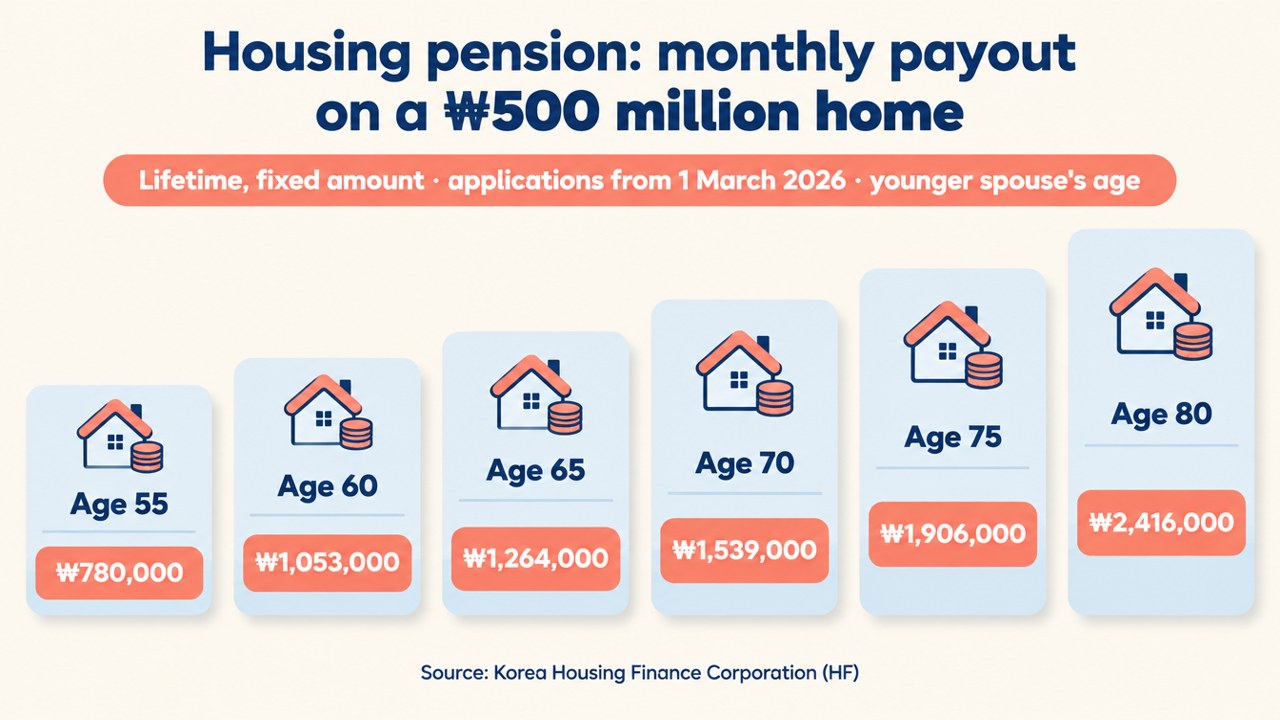
Monthly payout by age and house price (2026 table)
HF adjusted its payout model for applications from 1 March 2026. In its 5 February 2026 notice, HF said payouts for the average member (age 72, ₩400 million home) went up 3.13%. The FSC put numbers on it: at age 72 with a ₩400 million home, the monthly payout rose from ₩1,297,000 to ₩1,338,000, about ₩8.49 million more over an average lifetime. The new rates don’t apply to people who joined before. Your payout is fixed by the rules on the day you sign up.
Here is part of HF’s current table for an ordinary house, lifetime payment, fixed amount. Age is the younger spouse’s age.
| Younger spouse’s age | ₩300 million | ₩500 million | ₩700 million | ₩900 million | ₩1.2 billion |
|---|---|---|---|---|---|
| 55 | ₩468,000 | ₩780,000 | ₩1,092,000 | ₩1,404,000 | ₩1,872,000 |
| 60 | ₩632,000 | ₩1,053,000 | ₩1,475,000 | ₩1,896,000 | ₩2,528,000 |
| 65 | ₩758,000 | ₩1,264,000 | ₩1,770,000 | ₩2,276,000 | ₩3,035,000 |
| 70 | ₩923,000 | ₩1,539,000 | ₩2,155,000 | ₩2,770,000 | ₩3,414,000 |
| 75 | ₩1,143,000 | ₩1,906,000 | ₩2,669,000 | ₩3,431,000 | ₩3,666,000 |
| 80 | ₩1,449,000 | ₩2,416,000 | ₩3,382,000 | ₩4,060,000 | ₩4,060,000 |
Source: HF monthly payout examples (lifetime, fixed, 2026 basis) and HF payout table spreadsheet for applications from 1 June 2026. The general-house figures are the same in both. House price means HF’s market valuation, not the assessed price.
Three things stand out.
Age matters as much as price. At ₩500 million, joining at 65 pays ₩1,264,000. Joining at 55 pays ₩780,000. Our calculation: that’s about 62% more a month for waiting ten years.
The top end flattens out. At 75 the payout stops rising above ₩1 billion (₩3,666,000), and at 80 it stops at ₩900 million (₩4,060,000). That’s because the total loan has a cap. When the ₩1.2 billion house cap came in, HF said it was raising the total loan limit (the present value of payments expected up to age 100) from ₩500 million to ₩600 million. Older owners of pricier homes hit that cap first.
Other home types pay less. For a ₩300 million home at 70, HF’s table gives ₩923,000 for an ordinary house, ₩789,000 for registered senior welfare housing and ₩746,000 for an officetel used as a home.
For your own figure, HF has an online estimate (예상연금조회) on its site, and its call centre is 1688-8114. The real amount depends on the valuation on the day you apply.
A worked example: start at 60 or wait until 65?
Take a couple whose younger spouse is 60, with a ₩500 million flat. All figures below are our calculations from HF’s table. They ignore interest, house-price changes and fee differences.
| Option | Monthly | First 5 years | Difference |
|---|---|---|---|
| Join at 60 | ₩1,053,000 | 60 × ₩1,053,000 = ₩63,180,000 | n/a |
| Join at 65 | ₩1,264,000 | ₩0 (not joined yet) | ₩211,000 more a month from 65 |
Waiting means giving up ₩63.18 million over five years to get ₩211,000 a month more afterwards. ₩63,180,000 ÷ ₩211,000 is about 299 months, so it takes roughly 25 years for the higher payment to catch up. In other words, waiting only pays off in cash terms if the younger spouse lives past about 90. That’s a rough sketch, not a forecast. It leaves out the chance that house prices rise (which would raise a later payout) or fall, and the value of having money sooner. It does show why many families compare the housing pension against other income first. A couple that already gets enough from the National Pension, which starts at 63 to 65 depending on birth year, may have less reason to start early.

Payout options: lifetime, fixed term, loan repayment, preferential
HF offers several ways to take the money. In the table, “lump-sum limit” means the part of your total loan limit you set aside to draw as cash when you need it, instead of as monthly payments.
| Option | How it pays | Lump-sum limit | Payout styles |
|---|---|---|---|
| Lifetime (종신지급방식) | Monthly for life, nothing set aside | None | Fixed, front-loaded or step-up |
| Lifetime mixed (종신혼합방식) | Part kept as a cash reserve, rest monthly for life | Up to 50% (70% for redevelopment levies) | Fixed, front-loaded or step-up |
| Fixed-term mixed (확정기간혼합방식) | Monthly for 10, 15, 20, 25 or 30 years only, but you keep the right to live there for life | Up to 50%; 5% must be held back for medical or upkeep costs after payments end | Fixed only |
| Loan repayment (대출상환방식) | Cash lump sum to clear an existing mortgage, the rest monthly for life | Over 50%, up to 90% | Fixed only |
| Preferential (우대지급방식) | Higher monthly amount for low-value single homes (see below) | None (or 50% in the mixed version) | Fixed only |
Under the lifetime options you choose one of three payout styles, according to HF’s explanation form:
- Fixed (정액형): the same amount every month.
- Front-loaded (초기증액형): more than the fixed amount for the first 3, 5, 7 or 10 years (your choice), then 70% of that early amount for life.
- Step-up (정기증가형): starts lower than the fixed amount and rises 4.5% every three years. Our calculation: after nine years that’s 1.045 × 1.045 × 1.045, or about 14% above the starting figure.
You can switch once, between fixed and one of the other two, within three years of the first payment. Fixed-term periods depend on age. The 30-year option is for 55 to 57, and the 10-year option for 65 to 74 (younger spouse).
The loan repayment option exists because you can’t join with another lender’s mortgage still on the house. You use the lump sum to clear it, and HF’s loan-repayment rate is 0.1 percentage point lower.
The preferential type for low-value homes
If one of you receives the Basic Pension (so is 65 or older), the couple owns only one home, and its market price is under ₩250 million, the preferential type pays more than the standard table. Our Basic Pension 2026 guide explains who receives it. From 1 June 2026 the uplift is bigger for homes under ₩180 million. The FSC’s example, a 77-year-old with a ₩130 million home, gets ₩654,000 a month instead of ₩530,000 on the standard terms. That’s a top-up of ₩124,000, up from ₩93,000 before June. HF says homes from ₩180 million up to ₩250 million get up to about 20% more than the standard payout, and homes under ₩180 million up to about 25% more. If you buy another home after joining, HF says the payout drops back to the standard level.
What it costs: guarantee fees, interest and taxes
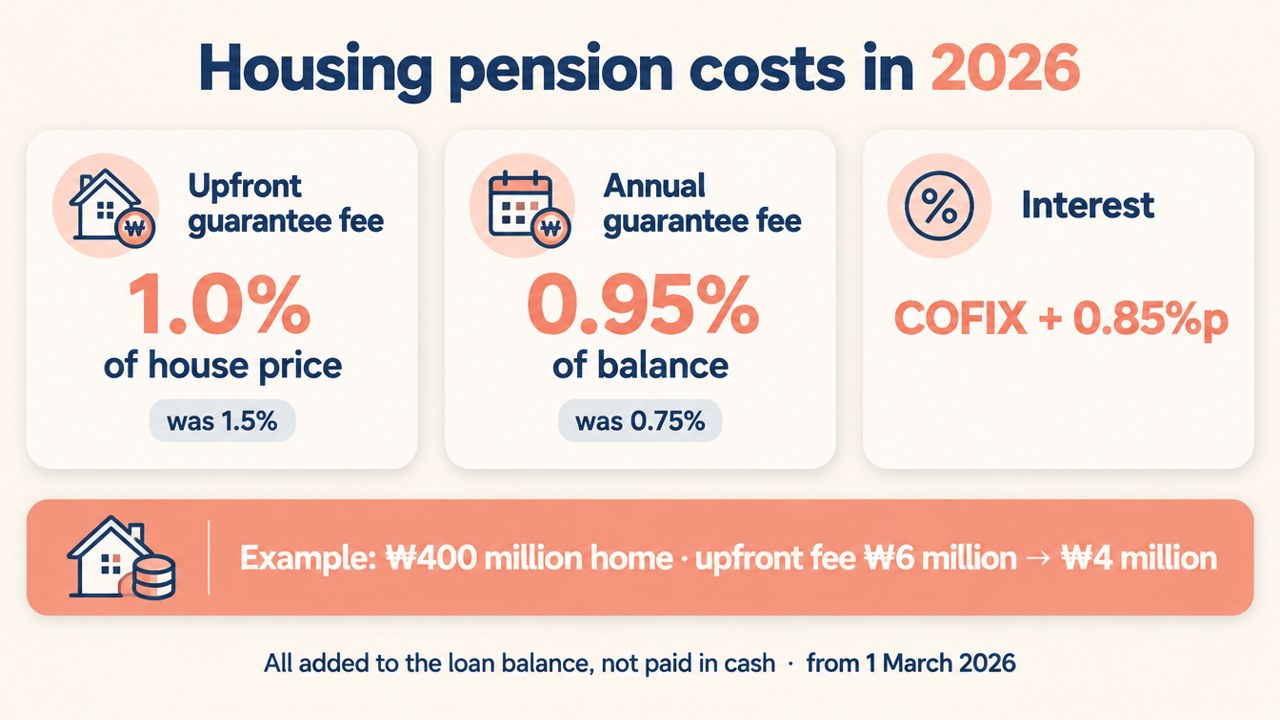
There are three running costs. None of them is paid out of pocket. All are added to the loan balance.
| Cost | 2026 rate (applications from 1 March 2026) | Before March 2026 |
|---|---|---|
| Upfront guarantee fee | 1.0% of the house price, charged on the first payment date | 1.5% |
| Annual guarantee fee | 0.95% a year of the guarantee balance (1.0% for the loan-repayment options), charged monthly | 0.75% |
| Interest | New-loan COFIX (a bank funding-cost index, reset every 6 months) + 0.85 percentage point (+0.75 for loan repayment) | CD-rate option closed to new applications from 13 October 2025 |
The FSC says it cut the upfront fee to make joining cheaper and raised the annual fee slightly so payouts wouldn’t fall. In its own example, the upfront fee on a ₩400 million home falls from ₩6 million to ₩4 million. Also from March 2026, if you repay everything and leave within five years (it used to be three), HF refunds the upfront fee minus a share for the time you used it.
Our calculations, for a sense of scale: on a ₩500 million home the upfront fee is 1.0% × ₩500,000,000 = ₩5,000,000 (₩7,500,000 under the old 1.5%). Once your balance reaches ₩100 million, the annual fee adds about 0.95% × ₩100,000,000 = ₩950,000 a year to it. Interest compounds on the whole balance in the same way. That’s why the balance grows faster than the sum of the monthly payments.
At sign-up you also pay a few costs directly, such as an appraisal fee where there’s no online price for the home (HF pays it for one-home owners under ₩250 million) and registration tax. HF lists these tax breaks, most of them until 31 December 2027:
- Registration tax on the mortgage (0.2% of the secured amount) is halved for one-home households with an assessed price of ₩500 million or less. Others get it halved up to a ₩1.5 million reduction.
- Property tax: 25% off for a one-home household using the mortgage type, on up to ₩500 million of value.
- Income tax: loan interest can be deducted from pension income up to ₩2 million a year.
Two more points from HF. Payments into a dedicated “housing pension guardian account” (주택연금 지킴이 통장) are protected from seizure up to ₩2.5 million a month. And for Basic Livelihood Security recipients, half of the monthly payout counts as income, so the benefit may shrink or stop.
When your parent or spouse dies: what happens to the house
This is where adult children usually come in, and HF’s rules are clear.
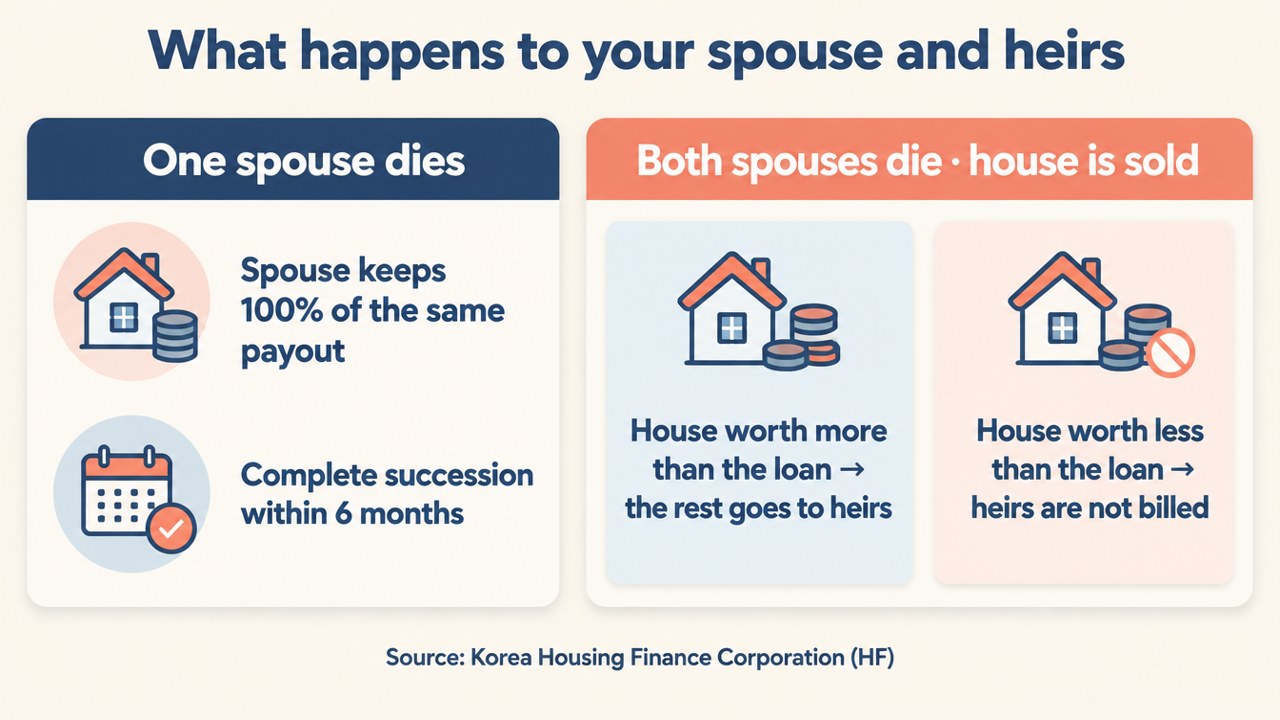
If one spouse dies, the survivor keeps the pension at 100% of the same amount. HF and EasyLaw both say this, and the survivor keeps the right to live in the house. But the payments pause, and the survivor has to complete a succession (debt takeover) within six months:
- Mortgage type: the surviving spouse must take full ownership of the house, which needs the other legal heirs (usually the children) to agree. The FSC’s 2026 FAQ flags this as the main difference. If any part of the house passes to the children, the loan becomes due.
- Trust type: HF already holds the title in trust, so the survivor continues without the children’s consent or a transfer of ownership.
The surviving spouse then handles inheritance tax, acquisition tax and property tax directly with the tax office.
When both have died, the payments end. HF repays the bank and recovers the amount from the house, by court auction (mortgage type) or public sale (trust type). Then:
| Outcome | What heirs get |
|---|---|
| House sells for more than the loan balance | The remainder goes to the heirs (to the person you named, under the trust type) |
| House sells for less than the loan balance | HF absorbs the shortfall. Heirs aren’t billed |
The loan balance is every monthly payment and lump sum plus guarantee fees plus interest. Under HF’s explanation form, citing Article 43-4 of the Korea Housing Finance Corporation Act, HF can claim only against the house. A few exceptions are listed: tax debts, unpaid wages, payments made after the contract should have ended, and damage the borrower caused deliberately or through gross negligence.
Heirs who want to keep the house can repay in cash instead of letting it be sold. Or, with HF’s consent, they can sell it themselves within a set period and repay the lower of the house’s value or the balance. If HF approves, this can take up to three years. A new 2026 option, the “generation link” housing pension (세대이음), lets a child who is 55 or older and inherits the home take out their own housing pension on it, using its lump sum to clear the parent’s balance instead of finding the cash. HF says it applies only if the parent used the mortgage type. If the parent’s balance is more than 90% of the child’s loan limit, the child repays the excess separately.
Things that can stop the payments early
HF’s detail page and the Decree it cites list the main reasons the pension ends while someone is alive:
- Both spouses move their resident registration elsewhere, or both stay away for a year or more, unless HF approves an exception such as hospital, care facility, living with children or senior housing. Tell HF in writing first.
- You lose ownership of the house, for example by selling it.
- A couple that joined with two homes doesn’t sell the second one within three years.
- The surviving spouse doesn’t complete the succession within six months.
You can also leave voluntarily at any time by repaying the full balance. HF’s FAQ says that’s all payments plus fees plus interest. After leaving, you generally can’t rejoin with the same house for three years (moving to a different house is allowed). If you move house while staying in the scheme, the payout is recalculated, and it still stops at the ₩1.2 billion level.
Redevelopment doesn’t automatically rule you out. HF says you can still join a home due for redevelopment until the scheme’s management-and-disposal plan is approved. Existing members can keep the pension through a rebuild and switch the security to the new home, but HF warns they may not be able to get the association’s relocation loan.
Three scenarios: your 40s, 50s and 60s
In your 40s, with parents in their 70s. The common worry is “there’ll be nothing left to inherit.” The rules soften that. If the house is worth more than the balance, the difference comes to you, and if it’s worth less, you owe nothing. What you lose is some or all of the equity. In return, your parents get income that doesn’t depend on you. At 75 on a ₩500 million flat, HF’s table gives ₩1,906,000 a month. Ask whether they’d choose the mortgage or trust type. Under the mortgage type, the surviving parent’s succession depends on your consent.
In your late 50s. You can join from 55, but the payment is lowest then (₩780,000 at 55 on ₩500 million). If you’re still working or have a pension coming, run the start-at-60-or-65 comparison above with your own numbers. Look at the front-loaded style if you expect to spend more in your early retirement years, or the step-up style if you’re worried about prices rising.
In your 60s, house-rich and cash-poor. If most of your wealth is the home and your monthly income falls short, this is the main way to stay put and still raise income. If you still have a mortgage, the loan-repayment option clears it first. If one of you receives the Basic Pension and the home is under ₩250 million, check the preferential type before anything else.
Checklist before you apply
| Step | What to check |
|---|---|
| 1 | Younger spouse’s age: it sets the payout |
| 2 | Combined assessed price of all homes: ₩1.2 billion or less |
| 3 | Market valuation (KREB, then KB, or an appraisal): sets the payout, capped at ₩1.2 billion |
| 4 | Existing mortgage or tenant deposit: needs clearing (loan-repayment option) |
| 5 | Mortgage type vs trust type: affects spouse succession and letting |
| 6 | Lifetime vs fixed-term, and fixed vs front-loaded vs step-up |
| 7 | Basic Pension recipient with a home under ₩250 million: preferential type |
| 8 | Get an estimate on HF’s site or call 1688-8114, and book a consultation |
HF requires a staff member to go through its explanation form and checklist with both spouses before signing. Use it to ask about anything here that doesn’t fit your case.
Frequently asked questions
Q. Who can get Korea’s housing pension (reverse mortgage)?
Homeowners where the owner or spouse is 55 or older, at least one of them is a Korean national, and the couple’s homes have a combined official assessed price of ₩1.2 billion or less. You must normally live in the home. From June 2026, one-home couples can also join if they live elsewhere for reasons HF accepts, such as a care facility or living with children.
Q. How much does the housing pension pay a month in 2026?
It depends on the younger spouse’s age and HF’s valuation of the house. For applications from 1 March 2026, HF’s lifetime fixed table pays ₩780,000 at 55, ₩1,264,000 at 65 and ₩1,906,000 at 75 on a ₩500 million house, and ₩923,000 at 70 on a ₩300 million house. People who joined earlier keep their original amount.
Q. What are the fees for the housing pension?
For new applications from 1 March 2026, an upfront guarantee fee of 1.0% of the house price (down from 1.5%) and an annual fee of 0.95% of the balance (up from 0.75%), plus interest at new-loan COFIX + 0.85 percentage point. All of it is added to the loan balance rather than paid in cash.
Q. Does my spouse keep getting the pension after I die?
Yes, at the same amount, as long as they were your legal spouse when you signed and stayed married to you. The survivor must complete the succession within six months. Under the mortgage type that means taking full ownership of the house, which needs the other heirs’ agreement. Under the trust type it continues without that.
Q. Will my children have to pay back the loan if the house is worth less?
No. When both spouses have died, the house is sold and the balance repaid. If the sale doesn’t cover it, HF absorbs the shortfall and doesn’t bill the heirs, apart from narrow exceptions such as unpaid taxes. If money is left over, it goes to the heirs. Children who want to keep the house can repay the lower of the house’s value or the balance.
Related reading
- Korea Comprehensive Real Estate Tax 2026: thresholds, rates and the Dec 1–15 payment
- Korea Basic Pension 2026: ₩349,700 and the 2027 tiered plan
- Inheriting in Korea: renunciation and limited acceptance within 3 months
Sources
- Korea Housing Finance Corporation, What is the housing pension: eligibility, product types, payout options, costs (checked 5 November 2026)
- Korea Housing Finance Corporation, Monthly payout examples (lifetime, fixed, 2026 basis) and payout table download (checked 5 November 2026)
- Korea Housing Finance Corporation, Notice: monthly payout adjustment from 1 March 2026, 5 February 2026 (checked 5 November 2026)
- Korea Housing Finance Corporation, Details: guarantee term, fees, interest, payment-stop reasons (checked 5 November 2026)
- Korea Housing Finance Corporation, Advantages: lifetime payment, inheritance settlement, tax benefits (checked 5 November 2026)
- Korea Housing Finance Corporation, Procedures after a member’s death (checked 5 November 2026)
- Korea Housing Finance Corporation, Statutory notices: lump-sum uses, residence exceptions, termination reasons (Enforcement Decree arts. 3-2, 28-2) (checked 5 November 2026)
- Korea Housing Finance Corporation, FAQ and Myths and facts (checked 5 November 2026)
- Korea Housing Finance Corporation (English), About Korean Home Pension (checked 5 November 2026)
- Financial Services Commission, 2026 housing pension improvement plan FAQ, 5 February 2026 (checked 5 November 2026)
- Korea.kr (FSC), Housing pension: higher payouts, lower joining costs, 10 February 2026 (checked 5 November 2026)
- Korea.kr (FSC), Housing pension price cap raised from ₩900 million to ₩1.2 billion, 3 July 2023 (checked 5 November 2026)
- Ministry of Government Legislation EasyLaw, Housing pension: advantages and HF explanation form and checklist (mortgage type, in force 1 June 2026) (checked 5 November 2026)
- Seoul Shinmun, Housing pension payouts up 3% from March; upfront fee cut, 5 February 2026 (checked 5 November 2026)
- Maeil Business Newspaper, Housing pension monthly payout up 3%, 15 February 2026 (checked 5 November 2026)
- Etoday, HF: housing pension open to ₩1.2 billion homes from October, 29 August 2023 (checked 5 November 2026)
- Nongmin Shinmun, Housing pension as a retirement income tool, 16 December 2024 (checked 5 November 2026)
This article is general information, not financial, tax or legal advice. It was written with AI assistance and fact-checked against official sources. Your eligibility, payout and costs are decided by the Korea Housing Finance Corporation when you apply. Ask HF (1688-8114) and, for inheritance or tax questions, a tax accountant or lawyer.





One Comment