Pregnant in Korea as a Foreigner: English-Speaking OB-GYNs, Prenatal Costs, NHIS Voucher
Haesul Health desk (AI-assisted). As of 20 November 2026 (KST). Based on the National Health Insurance Service (NHIS) pregnancy and childbirth medical expense page, the Government24 (정부24) service page for the same benefit (last updated 6 November 2026), the Ministry of Health and Welfare (MOHW) programme and co-payment pages, the Health Insurance Review and Assessment Service (HIRA) ultrasound rules, the 2026 national fee schedule, NHIS’s rules for foreign members, two city health centre notices (Suwon, Yongin) and Government24’s status-of-stay page. Independent cross-check: the Ministry of Government Legislation’s English Easylaw guide for foreigners. General information, not medical advice.
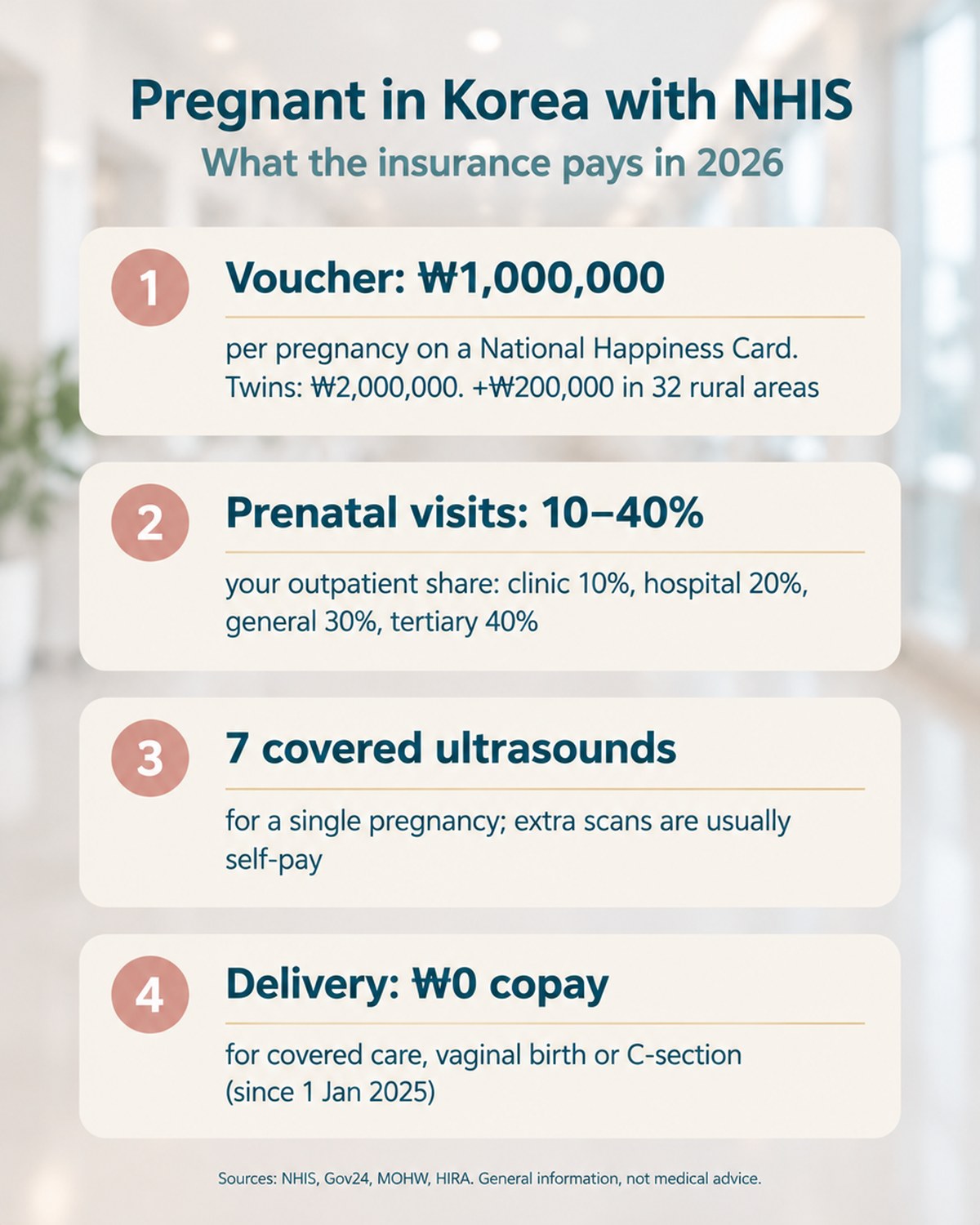
Quick answer: If you are enrolled in Korea’s National Health Insurance (NHIS), as a member or a dependent, you get the same pregnancy support as a Korean: a ₩1,000,000 voucher per pregnancy (₩1,400,000 base for twins or more, topped up to ₩1,000,000 per baby), loaded onto a National Happiness Card (국민행복카드, Kukmin Haengbok Card) and usable until 2 years after your due date or birth. While pregnant you pay a reduced share of covered outpatient bills: 10 percent at a clinic, 20 at a hospital, 30 at a general hospital, 40 at a tertiary hospital. NHIS covers 7 prenatal ultrasounds for a single pregnancy, and the patient share for covered delivery care is ₩0 for both vaginal birth and C-section (since 1 January 2025). If you are not in NHIS you get none of this and pay full price, so check your enrolment first.

Who this applies to
- Foreign residents enrolled in NHIS, as an employee (직장가입자), a self-employed or local member (지역가입자), or a registered dependent (피부양자). NHIS’s rule is about insurance status, not nationality. Government24 lists the people who are excluded: Medical Aid recipients, people who opted out of NHIS, people who lost their NHIS status and people whose benefits are suspended. The Ministry of Government Legislation’s English guide says it directly: foreigners who are NHIS members or dependents “may receive medical expense support for pregnancy and childbirth (National Happiness Card)”.
- Foreign spouses (F-6) and partners of Korean or foreign workers. Your route into NHIS decides when you qualify. See the enrolment table below.
- Visitors and newcomers not yet in NHIS. You cannot get the voucher, and you pay the full price for care. Many hospitals that treat uninsured foreigners charge their own rates. Ask for an estimate before every scan, as our guide to seeing a doctor in English in Korea explains.
Am I in NHIS? The foreigner rules in one table
| Your situation | When NHIS cover starts | Source |
|---|---|---|
| Employed by a Korean workplace | From your first day of work (employee member) | NHIS foreigner page |
| Marriage migrant (F-6), permanent resident (F-5), student (D-2), school student (D-4-3), E-9 worker | From your entry date, or your alien registration date if later (local member) | NHIS foreigner page |
| Other long-stay residents | After 6 months of stay (local member) | NHIS foreigner page |
| Spouse of an NHIS employee member | Can be a dependent straight away; the 6-month rule for dependents does not apply to spouses and children under 19 | NHIS foreigner page (rule in force since 3 April 2024) |
| Other family members who entered on or after 3 April 2024 | Dependent only after 6 months in Korea, unless their visa is on the list above | NHIS foreigner page |
| Tourist, short-term (B, C) or diplomatic (A) status | Not eligible for NHIS | NHIS foreigner page |
If you are unsure, the NHIS call centre is 1577-1000, and its English line, listed on the NHIS English site, is 033-811-2000. Our NHIS guide for foreigners covers premiums and the 6-month rule in detail.
Finding an OB-GYN who speaks English
In Korea, pregnancy care is usually given by an obstetrics and gynaecology clinic (산부인과, sanbu-ingwa) or a women’s hospital (여성병원), not by a family doctor. You can book directly; you do not need a referral for a clinic or a hospital. For a tertiary (university) hospital, NHIS members need a referral letter to pay the NHIS rate (see our English-doctor guide for the referral rule). There is no official national list of English-speaking obstetricians, so use these routes:
- Ask the Medical Korea Information Center (1577-7129, +82-2-1577-7129). Run by the Korea Health Industry Development Institute (KHIDI), it gives hospital information and booking help in English, Chinese, Japanese and Russian, with a walk-in desk at Seoul Station (AREX level B2, weekdays 09:00 to 18:00).
- Use a university hospital’s international healthcare centre. Seoul National University Hospital, Severance, Samsung Medical Center and Asan Medical Center run international centres with English-speaking coordinators, who book appointments with the hospital’s specialist departments. Whether you see an obstetrician who speaks English, or one helped by a coordinator, varies. Ask when you book. These are the right place for complicated or high-risk pregnancies. For a routine pregnancy, a neighbourhood clinic is cheaper (see the cost table below).
- Call 1330 for interpreting. The Korea Travel Helpline offers free interpreting 24/7 in English, Japanese and Chinese, and can set up a three-way call with a clinic.
- Ask other foreign parents in your area. Expat forums regularly ask “Are there any English-speaking gynecology clinics in Seoul?” Treat recommendations as a starting list, then call the clinic yourself.
Questions to ask on the phone before your first visit:
- “Do you deliver babies here (분만 가능해요?), or only do prenatal checks?” Many small clinics do checks only and refer you to another hospital for the birth. Confirm early which hospital will deliver your baby.
- “Can the doctor explain results in English, or is there an interpreter?”
- “Can you issue the NHIS pregnancy confirmation (임신확인서) for the voucher?” Only an OB-GYN specialist can confirm the pregnancy for NHIS, according to the NHIS page.
- “Which tests and scans are non-covered (비급여), and what do they cost?” Ask for prices in advance.
Step by step: claiming the NHIS pregnancy voucher
The voucher is officially the “health insurance pregnancy and childbirth medical expense” (건강보험 임신·출산 진료비) benefit. It works the same for foreign and Korean members. Here are the steps from the NHIS and Government24 pages:
- Get the pregnancy confirmed by an OB-GYN specialist. The doctor either signs the paper application form (건강보험 임신·출산 진료비 지급 신청서) or enters your pregnancy online in HIRA’s provider system.
- Apply for the voucher. With the signed paper form, apply at an NHIS branch or a partner card company, or upload the form on the NHIS website or app. If the clinic entered it online, apply in person, by phone (NHIS or a partner card company), online or through the NHIS app. Community service centres, public health centres and Government24 also take applications made while you are still pregnant.
- Get a National Happiness Card. This is a credit or check card issued by one of the partner companies. MOHW lists BC Card (through member banks such as Woori, IBK, NH and the post office), Samsung Card, Lotte Card, KB Kookmin Card and Shinhan Card, with Hyundai Card taking applications from 1 July 2026. If you already have a National Happiness Card, the points are added to it and there is no new card. Card companies decide who gets a card, so ask them which ID they accept from foreign residents.
- Pay at any clinic, hospital or pharmacy with the card. The money pays your share of both covered and non-covered (급여·비급여) bills. At the terminal, the clinic types code 38 in the instalment field. If the staff seem unsure, point it out.
Apply early. The voucher starts on the day it is issued, and costs from before that date cannot be paid back retroactively. Unused points expire 2 years after your due date (if you applied while pregnant) or 2 years after the birth, miscarriage or stillbirth (if you applied afterwards). If your due date has passed when you apply, you apply as “childbirth”, not “pregnancy”.
How much you get
| Case | Voucher amount | Notes |
|---|---|---|
| Single baby | ₩1,000,000 | Per pregnancy, including miscarriage and stillbirth |
| Twins | ₩1,400,000 base + ₩600,000 = ₩2,000,000 | Top-up to ₩1,000,000 per baby, for a twin pregnancy past 20 weeks; added automatically for applications made since 1 January 2025 |
| Triplets | ₩1,400,000 + ₩1,600,000 = ₩3,000,000 | Same top-up rule (quadruplets: + ₩2,600,000) |
| Living in a low-delivery-access area | + ₩200,000 | 32 counties in 2026 (for example Ganghwa, Yeoncheon, Gapyeong, Yangpyeong, Hwacheon), registered and living there 30 days in a row |
| Teen mothers (19 and under) | Up to ₩1,200,000 more | A separate government programme, claimable at the same time |
Foreigner tip for the rural top-up: Korean citizens get the ₩200,000 automatically. Foreign residents must send the additional payment form (추가 지급 신청서) plus a certificate of alien registration (외국인등록사실증명) issued within the 7 days before applying, to an NHIS branch in person, by post or by fax, Government24 says.
What the card can and cannot pay for
- Can: the pregnant person’s own medical bills, prescribed and over-the-counter medicines approved by the Ministry of Food and Drug Safety, and treatment materials, whether NHIS-covered or not. It can also pay the baby’s medical bills and prescriptions until age 2.
- Cannot: costs from before the voucher was issued, quasi-drugs (의약외품) and health supplements, consumables, document fees such as medical certificates, cosmetic treatment, and use by anyone else. It also cannot be used if you gave birth or miscarried abroad. Abortion is excluded, except in the cases allowed under the Mother and Child Health Act.

What prenatal checks cost on NHIS
Two rules cut your bill while you are pregnant.
1. A lower outpatient share, for any specialty. Since 1 January 2017, the patient share for covered outpatient care while pregnant has been 20 percentage points lower at every type of medical institution. It applies to every department, so a dentist or dermatologist visit during pregnancy counts too. HIRA and the Korean Hospital Association have reminded hospitals that they must apply it automatically. No application is needed.
| Where you are seen | Usual outpatient share | While pregnant |
|---|---|---|
| Clinic (의원) | 30 percent | 10 percent |
| Hospital (병원) | 40 percent (35 in rural towns) | 20 percent |
| General hospital (종합병원) | 50 percent (45 in rural towns) | 30 percent |
| Tertiary hospital (상급종합병원) | Consultation fee + 60 percent | 40 percent |
2. Seven covered ultrasounds. HIRA’s rules cover prenatal ultrasounds for a single pregnancy at these points:
| Stage | Type | Covered scans |
|---|---|---|
| Weeks 13 and under | General | 2 |
| Weeks 11 to 13 | Detailed (정밀) | 1 |
| Weeks 14 to 19 | General | 1 |
| Weeks 20 to 35 | General | 1 |
| Week 36 onward | General | 1 |
| Week 16 onward | Detailed | 1 |
Scans beyond these are usually non-covered (비급여), and you pay the clinic’s own price. HIRA’s answer to a patient at 28 weeks who paid for a second detailed scan: that is correct under the rules. When a doctor judges that the baby has, or is likely to have, a problem that needs closer monitoring, extra scans are covered. Tests the clinic offers on top, such as extra 3D scans or optional screening tests, are often non-covered too. The voucher can pay for them, but ask the price first.
Worked example: covered prenatal costs at a clinic (our calculation)
We multiplied the 2026 fee-schedule points by NHIS’s 2026 conversion factor for clinics (₩95.6 per point), then applied the 10 percent pregnant share. We rounded the patient share down to the nearest ₩100. Real bills vary a little with surcharges (nights, weekends) and how the clinic codes each visit.
| Item (fee code) | 2026 points | Full fee | You pay at a clinic (10 percent) |
|---|---|---|---|
| First visit consultation (AA154) | 197.12 | about ₩18,840 | about ₩1,800 |
| Return visit consultation (AA254) | 139.85 | about ₩13,370 | about ₩1,300 |
| First-trimester general ultrasound (EB511) | 780.49 | about ₩74,620 | about ₩7,400 |
| First-trimester detailed ultrasound (EB513) | 1,392.77 | about ₩133,150 | about ₩13,300 |
| Second/third-trimester general ultrasound (EB515) | 1,104.83 | about ₩105,620 | about ₩10,500 |
| Second/third-trimester detailed ultrasound (EB517) | 2,367.78 | about ₩226,360 | about ₩22,600 |
| All 7 covered ultrasounds (2 × EB511 + EB513 + 3 × EB515 + EB517) | 8,636.02 | about ₩825,600 | about ₩82,500 |
Putting it together (an illustration, not a typical bill): 7 covered scans (about ₩82,500) + a first visit (₩1,800) + 10 return visits (10 × ₩1,300 = ₩13,000) comes to about ₩97,300 of covered prenatal care at a clinic. Add a hypothetical ₩300,000 of non-covered extras (we picked this number to show the arithmetic; real prices vary by clinic) and the total is about ₩397,300. That leaves roughly ₩602,700 of a ₩1,000,000 voucher for the birth and the baby’s first two years. The same 7 scans at a hospital (2026 hospital factor ₩83.8, 20 percent share) come to about ₩144,700. That is one reason to use a neighbourhood clinic for a routine pregnancy and save the big hospital for when you need it.
Giving birth: what’s covered
- Covered delivery care costs ₩0 out of pocket. Vaginal birth already had no patient share. On 3 December 2024 the Cabinet approved a decree that cut the C-section share from 5 percent to 0 percent from 1 January 2025, MOHW announced.
- Still charged: non-covered items, which can include a private or upgraded room, some meals and extras you choose. The voucher can pay for medical non-covered items, so ask the hospital for a price list when you tour it.
- Not in NHIS? You pay the hospital’s full price for the birth. Ask for a written estimate well before your due date.
Free help from your public health centre (it depends on your visa)
Public health centres (보건소, bogeonso) run a pregnancy registration programme. Registered pregnant women get free early-pregnancy blood and urine tests (Suwon also runs a late-pregnancy panel from 34 weeks) and free folic acid and iron supplements at set stages of pregnancy. For foreigners, eligibility is decided locally and is often narrow. Suwon’s health centres limit foreign registration to marriage migrants (F-6, married to a Korean). Yongin’s says foreigners can register only if they live in the city and are married to a Korean citizen. Phone your own centre with your visa type before you go. Whether to take any supplement is a question for your doctor.
After the birth: three things foreign parents miss
- Register the baby’s status of stay within 90 days. A foreign child born in Korea must apply to the local immigration office for a status of stay within 90 days of birth, with a HiKorea visit booking, says Government24. The child’s status follows the parents’ (for example F-5 for a child of a permanent resident, F-1 for a child of an F-2, D-3, E-9 or H-2 holder). Government24 lists an ₩80,000 fee where the child is granted F-2 or F-5. Contact your own embassy about the passport and citizenship registration too.
- Add the baby to NHIS. Children under 19 are exempt from the 6-month waiting rule for dependents, so a newborn can be registered as a dependent of an NHIS employee member straight away (NHIS foreigner rules). The pregnancy voucher can then pay the baby’s medical bills until age 2.
- Know which cash benefits need Korean nationality. The First Encounter Voucher (첫만남이용권: ₩2,000,000 for a first child, ₩3,000,000 for later children born from 2024) and the child allowance go to children with Korean nationality (including dual nationals), recognised refugees and special contributors, according to Easylaw. If both parents are foreign, the child usually doesn’t qualify. Free national childhood vaccinations do not depend on nationality. See our guide to childhood vaccinations in Korea for expat families, and for the allowance rules, Korea’s child allowance in 2026.
Your checklist
- Confirm your NHIS status (1577-1000 or 033-811-2000 in English) before your first scan.
- Choose a clinic that delivers babies, or know where you will be referred for the birth.
- Ask the OB-GYN for the voucher confirmation at the first visit where the pregnancy is confirmed, then apply right away (costs before issuance aren’t paid back).
- Get or top up a National Happiness Card. Remind the clinic about code 38 if the payment fails.
- Check the pregnant share on every covered receipt: 10 percent at a clinic.
- Ask the price of any non-covered (비급여) scan or test before it is done.
- Living in one of the 32 low-delivery-access counties? File the foreigner top-up form with a certificate of alien registration issued within 7 days.
- After the birth: book the immigration visit within 90 days and add the baby to NHIS.
- Routine women’s health between pregnancies: Korea’s free cervical cancer screening runs every 2 years from age 20 for NHIS members (see our Pap smear and HPV guide).
Common problems
- “The clinic charged me 30 percent.” The pregnant share must be applied at every institution once you are pregnant. Tell the front desk you are pregnant (임신 중이에요, imsin jung-ieyo) and ask them to recalculate. HIRA’s Medical Fee Review service can also check a bill.
- “My card was declined at the clinic.” The voucher charge needs code 38 in the instalment field. Small terminals that don’t show an instalment field for payments of ₩50,000 or less need a software update, NHIS notes.
- “I joined NHIS halfway through the pregnancy.” You can apply once you are a member. The voucher covers costs from the day it is issued, not earlier bills.
- “The card company won’t issue me a card.” Try a different partner company or ask an NHIS branch (1577-1000) for help. The benefit itself depends on NHIS status, not on which card you hold.
- “I need an interpreter at the birth.” Arrange it with the hospital’s international team in advance. Keep 1330 for urgent phone interpreting, and call 119 in an emergency.
Frequently asked questions
Q. Can foreigners get the ₩1,000,000 pregnancy voucher in Korea?
Yes, if you are enrolled in NHIS as a member or a registered dependent. The benefit is based on insurance status, not nationality. It is ₩1,000,000 per pregnancy (₩1,400,000 base for multiples, topped up to ₩1,000,000 per baby) on a National Happiness Card, according to NHIS and Government24. Tourists and people not yet in NHIS cannot get it.
Q. How do I find an English-speaking OB-GYN in Korea?
There is no official list. Call the Medical Korea Information Center (1577-7129) for help in English, use a university hospital’s international healthcare centre (Seoul National University Hospital, Severance, Samsung, Asan), or ask other foreign parents locally and then phone the clinic. Ask whether it delivers babies and whether the doctor can explain results in English. 1330 offers free phone interpreting.
Q. How much do prenatal checkups cost in Korea with NHIS?
While pregnant you pay 10 percent of covered outpatient fees at a clinic (20 at a hospital, 30 at a general hospital, 40 at a tertiary hospital). By our calculation from the 2026 fee schedule, a covered return visit at a clinic costs about ₩1,300, and all 7 NHIS-covered ultrasounds together cost about ₩82,500. Non-covered extras are priced by each clinic.
Q. How many ultrasounds does NHIS cover during pregnancy?
Seven for a single pregnancy: two general scans at 13 weeks or earlier, one detailed scan at 11 to 13 weeks, one general scan each at 14 to 19, 20 to 35 and 36 weeks or later, and one detailed scan from 16 weeks, under HIRA’s rules. More scans are covered when a doctor judges the baby needs closer monitoring; otherwise extra scans are non-covered.
Q. Is giving birth free in Korea?
The patient share for NHIS-covered delivery care is 0 percent for both vaginal birth and, since 1 January 2025, C-section, according to MOHW. Non-covered items, such as an upgraded room, are still charged, and the voucher can pay for medical ones. Without NHIS you pay the hospital’s full price.
Q. What must foreign parents do after a baby is born in Korea?
Apply for the baby’s status of stay at the local immigration office within 90 days of birth (book on HiKorea), register the baby with your embassy, and add the baby to NHIS as a dependent. The pregnancy voucher can pay the baby’s medical bills until age 2.
Sources
- NHIS, Pregnancy and childbirth medical expense support (임신·출산 진료비 지원제도; amounts, multiples top-up, rural top-up, use period, scope, OB-GYN confirmation, code 38): https://www.nhis.or.kr/nhis/policy/wbhada13900m01.do
- Government24, Health insurance pregnancy and childbirth medical expense support (eligibility, exclusions, application steps, foreigner top-up documents; last updated 6 November 2026): https://www.gov.kr/portal/rcvfvrSvc/dtlEx/SD0000007672
- MOHW, Pregnancy and childbirth medical expense programme (amounts, partner card companies incl. Hyundai from 1 July 2026, 2026 list of 32 low-delivery-access areas, automatic twin top-up from 2025): https://www.mohw.go.kr/menu.es?mid=a10705020100
- Ministry of Government Legislation, Easylaw (English), Childbirth Support for foreign nationals (voucher eligibility for NHIS members and dependents; First Encounter Voucher and child allowance nationality rules): https://m.easylaw.go.kr/MOM/SubCsmOvRetrieve.laf?ccfNo=1&cciNo=1&cnpClsNo=1&csmSeq=2328&langCd=700101
- MOHW, Health insurance benefit structure (outpatient patient shares incl. pregnant rates): https://www.mohw.go.kr/menu.es?mid=a10705020200 ; National Health Insurance Act Enforcement Decree, Annex 2 (amended 15 September 2026): https://www.law.go.kr/LSW/flDownload.do?flSeq=169270945
- HIRA notice, Pregnant outpatient co-payment reduction (in force 1 January 2017, all departments): https://www.hira.or.kr/bbsDummy.do?brdBltNo=9866&brdScnBltNo=4&pgmid=HIRAA020002000100 ; Korean Hospital Association notice to hospitals (MOHW letter of 29 August 2022): https://www.kha.or.kr/kha_home/notice_list.do?articleNo=39133&attachNo=358547&mode=download
- HIRA, Ultrasound coverage rules (MOHW notice 2023-105, in force 1 July 2023): https://www.hira.or.kr/rc/insu/insuadtcrtr/InsuAdtCrtrPopup.do?mtgHmeDd=20230701&mtgMtrRegSno=0001&sno=1 ; HIRA FAQ, Prenatal ultrasound counts by week (6 March 2024): https://www.hira.or.kr/bbsDummy.do?brdBltNo=47499&brdScnBltNo=4&pgmid=HIRAA010006011400
- 2026 national fee schedule via Docple Check (ultrasound EB511–EB518): https://check-app.docple-plus.com/sugabook/node/55 and (consultations AA154, AA254): https://check-app.docple-plus.com/sugabook/node/10 ; NHIS, Conversion factors by year (2026 clinic ₩95.6, hospital ₩83.8): https://www.nhis.or.kr/announce/wbhaec11413m01.do
- MOHW via Korea.kr, C-section patient share cut to 0 from 1 January 2025 (3 December 2024): https://www.korea.kr/news/policyNewsView.do?newsId=148936995
- NHIS, Foreigner and overseas Korean enrolment (dependent 6-month rule from 3 April 2024; visa exceptions): https://www.nhis.or.kr/nhis/policy/wbhada02400m01.do
- Suwon health centre, Prenatal care (foreign registration F-6 only): https://health.suwon.go.kr/sub.asp?page_code=sub05020101 ; Yongin health centre, Pregnant women’s health care: https://www.yongin.go.kr/home/health/healthSvc/mcHealth/mcHealth08/mcHealth02_01.jsp
- Government24, Grant of status of stay for foreigners (within 90 days of birth): https://www.gov.kr/portal/service/serviceInfo/PTR000050538
- KHIDI, Medical Korea Information Center leaflet (1577-7129, Seoul Station desk, languages): https://www.khidi.or.kr/kohes/fileDownload?fileDownType=C&fileId=2¶mMenuId=MENU02458&titleId=511944 ; Medical Korea, hospitals with international healthcare centres: https://www.medicalkorea.or.kr/en/mostvisitedmedicalinstitutions
- Korea Tourism Organization, 1330 Korea Travel Helpline (interpreting, hours, languages): https://english1.visitkorea.or.kr/enu/TRV/TV_ENG_3_1.jsp ; NHIS English, Insurance Benefits (English consultant line): https://www.nhis.or.kr/english/wbheaa02600m01.do
- Reddit r/Living_in_Korea, “Are there any English-speaking gynecology clinics or hospitals in Seoul or Incheon?” (reader demand): https://www.reddit.com/r/Living_in_Korea/comments/1on6t2g/are_there_any_englishspeaking_gynecology_clinics/
How we checked: On 20 November 2026 (KST) we read the NHIS and Government24 voucher pages, MOHW’s programme and co-payment pages, HIRA’s ultrasound rules, NHIS’s foreigner enrolment rules, two health centre notices and Government24’s status-of-stay page, and checked the voucher rules against the government’s English Easylaw guide. We worked out the clinic costs from the 2026 fee-schedule points and NHIS’s conversion factor. The visit count and the ₩300,000 of extras are invented to show the arithmetic.
This guide is general information, not medical advice. Which tests, scans or medicines you need during pregnancy, and any dose, is for your doctor to decide. In an emergency (heavy bleeding, severe pain, fainting), call 119. For phone interpreting, call 1330. For NHIS questions, call 1577-1000.
Researched and drafted with AI assistance; checked against the sources listed.