Bank of Korea Rate Decision, 26 November 2026: Foreigners’ Loans, Savings and the Won
Haesul Economy desk (AI-assisted). As of 18 November 2026 (KST). Based on the Bank of Korea’s meeting schedule, its 22 October 2026 decision, press-conference remarks and meeting minutes, its 27 August 2026 decision and its September 2026 bank lending and deposit rates (released 29 October 2026), cross-checked with Yonhap, Yonhap Infomax, Hankyoreh and the Financial News. General information, not financial advice.
Quick answer: The Bank of Korea’s Monetary Policy Board makes its last rate decision of 2026 on Thursday 26 November. The base rate is 3.00%: it was raised twice this year (to 2.75% on 16 July and 3.00% on 27 August) and held, unanimously, on 22 October. The Bank said it will decide “the timing and pace of further hikes” based on incoming data, and most economists quoted in the Korean press expect a rise to 3.25%, but a hold is possible. Nobody outside the Board knows the result, so below we show what each outcome would mean for a foreign resident’s loan, savings and money sent home, with worked numbers.

Why it matters to you: bank rates in Korea are already moving. In September 2026 the average rate on new mortgages reached 4.88% and on new savings deposits 3.45%, both well above the levels at the end of 2025 (4.23% and 2.90%), according to the Bank of Korea. The won has also swung widely this year. Whether the Board holds or hikes on 26 November will shape what your bank offers you in December.
Who this guide is for
- Foreign residents with a Korean bank loan: a credit loan, a jeonse or mortgage loan, or a car loan, especially if the rate is variable.
- Anyone holding won savings: time deposits (정기예금) and installment savings (적금) at a Korean bank.
- People who send money home or are paid in won and spend in another currency.
- Anyone following Korea’s economy: students, investors and visitors planning a trip with a won budget.
If you have no Korean loan or savings, the decision still affects you through prices and the exchange rate, but less directly.
The facts: base rate, the last decisions and the date
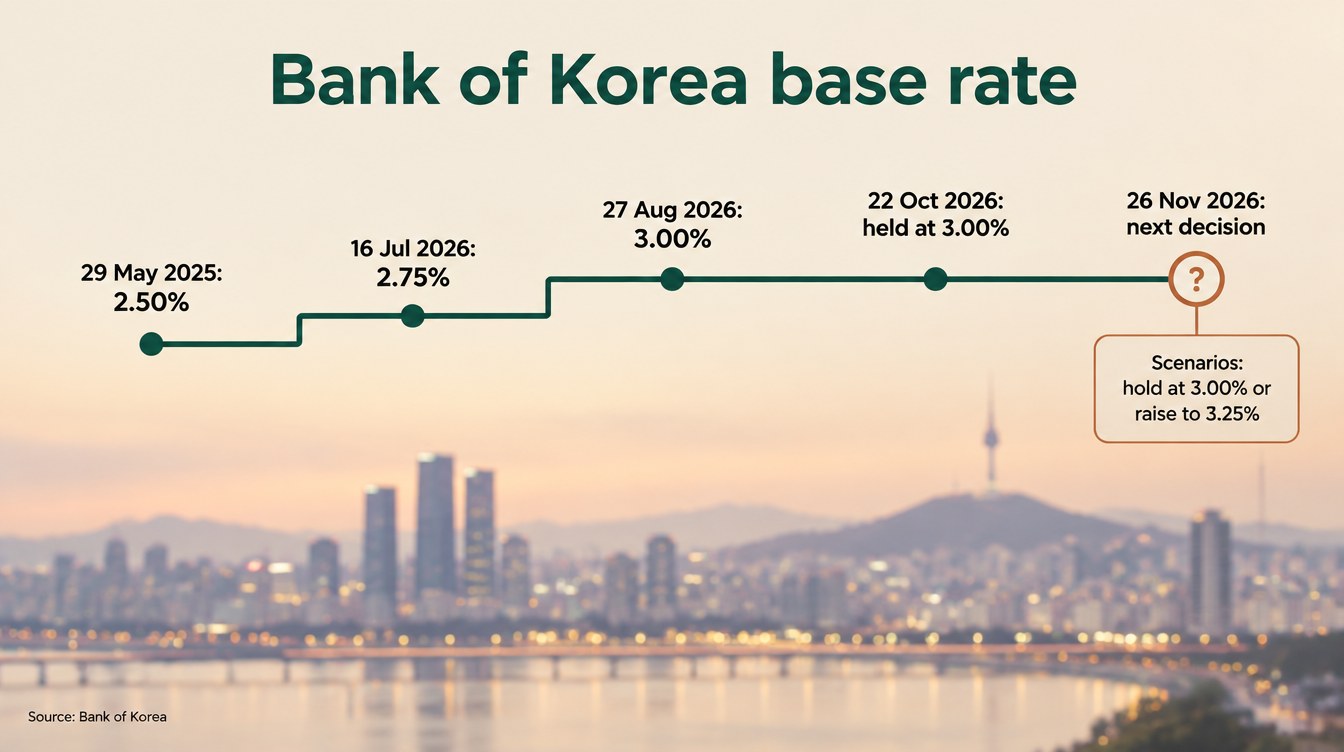
The Bank of Korea’s Monetary Policy Board (금융통화위원회) sets the base rate (기준금리) eight times a year. Its 2026 meeting dates, as listed on the Bank’s own schedule page, were 15 January, 26 February, 10 April, 28 May, 16 July, 27 August, 22 October and 26 November (Thursday). There is no further meeting in 2026, so whatever is decided on 26 November stands until the first meeting of 2027.
| Date | Decision | Base rate after |
|---|---|---|
| 29 May 2025 | Cut | 2.50% |
| 16 July 2026 | Raised 0.25 points | 2.75% |
| 27 August 2026 | Raised 0.25 points | 3.00% |
| 22 October 2026 | Held (7 of 7 members in favour) | 3.00% |
| 26 November 2026 | Next decision | ? |
Source: Bank of Korea base-rate history and decision releases. The July and August moves were the first back-to-back hikes since January 2023, Yonhap reported.
On 22 October the Board said the economy was growing strongly on exports and investment, inflation was “high at around 3%” and financial-stability risks remained, but it wanted to watch the Middle East conflict, policy in major economies and “the effects of the two prior rate hikes” before moving again. In the press conference, the Governor said the Bank would keep responding until it was confident inflation was settling at target, and that “the timing and pace of further hikes” would be decided as data come in. That wording points to hikes, not cuts, as the live question.
What has happened since 22 October
The Bank said in October that it wanted to see third-quarter GDP and October prices before deciding. Both are now out:
- Growth: the Bank of Korea’s advance estimate put third-quarter real GDP up 1.0% on the previous quarter (released 27 October 2026), a strong figure that Hankyoreh described as well above the Bank’s own expectations. Our earlier guide explains the numbers: Korea Q3 2026 GDP: 1.0% growth.
- Prices: consumer prices rose 2.8% on a year earlier in October, down from 2.9% in September (Korea’s national statistics agency, 국가데이터처, formerly Statistics Korea, 3 November 2026). Core inflation was 2.8% in September, the Bank said. Both remain above the Bank’s 2% target. Details: Korea inflation rate October 2026.
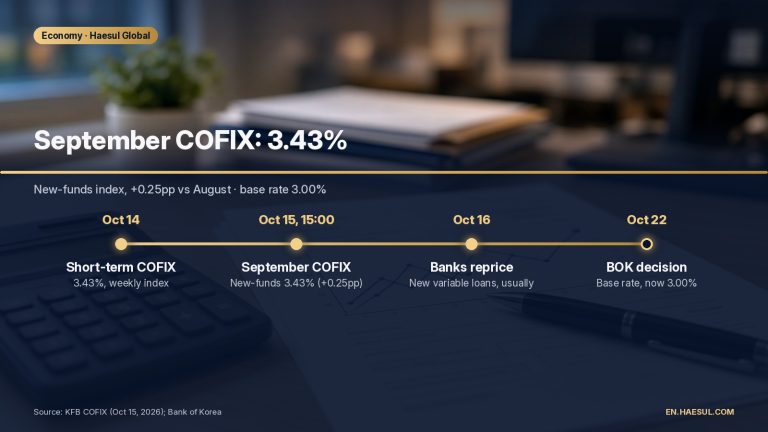
- Bank funding costs: the Korea Federation of Banks’ COFIX index for new funds, which many variable-rate loans follow, rose to 3.62% in October from 3.43% in September (published 16 November). See Korea COFIX rate explained.
- The won: the Bank’s October minutes describe the won-dollar rate falling to the low-to-mid ₩1,300s after the hikes. On 17 November it closed at ₩1,338.2 per US dollar (15:30 rate), as the dollar index hit a 19-month high and foreign investors sold Korean shares, Yonhap reported.
What economists expect (not a forecast from us)
Several published views point the same way, but they are views, not facts:
- Yonhap Infomax (18 November): Seoul’s bond market leans towards a 0.25-point rise to 3.25%; most of 11 bond experts it surveyed on 30 October gave a hike as their base case, and the market sees the peak (“terminal”) rate at 3.25–3.50%.
- NH Investment & Securities (9 November, via Yonhap): kept its call for a 0.25-point hike in November despite the stock-market fall.
- BNP Paribas (10 November, via the Financial News): expects 3.25% with one or two members possibly dissenting in favour of a hold, and sees 3.25% as the peak.
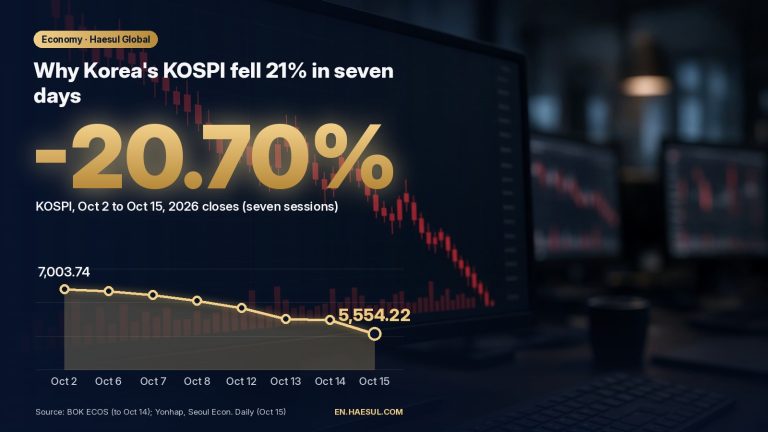
Against a hike: private consumption fell 0.2% in the third quarter (Bank of Korea data, as reported by Daehan Economy), shares have dropped sharply (the KOSPI closed below 5,000 on 17 November, Yonhap reported), and the housing minister has warned that higher rates at year-end could deepen falls in some home prices. The Board can weigh these differently from the market.
In August the Board also published its members’ six-month-ahead conditional rate views: of the 21 points shown, 6 were at 3.50%, 10 at 3.25% and 5 at 3.00%. That is a guide to members’ thinking in August, not a promise.
Three scenarios for 26 November
The table describes what usually follows each outcome. Banks set their own rates and the won reacts to many things besides the Bank of Korea, so treat the right-hand columns as tendencies, not guarantees.
| Outcome | Base rate | Variable-rate loans | New deposits | The won |
|---|---|---|---|---|
| Hold | 3.00% | No push from the base rate; COFIX can still move with bank funding costs, as it did in October | No push from the base rate; offers still vary by bank | Markets had leaned towards a hike (Yonhap Infomax), so a hold would be a surprise; the direction of any reaction cannot be known in advance |
| Hike of 0.25 points | 3.25% | Index rates such as COFIX and bank-bond rates tend to follow; your rate changes only on its next reset date | Banks may raise time-deposit offers; check their notices | Largely priced in already, Yonhap Infomax says; it adds that a higher expected peak rate could support the won |
| Bigger hike or a cut | not signalled | Not expected by the sources above; the Bank has not mentioned cuts | – | – |
A hike to 3.25% would also move one housing rule that affects many foreign tenants: the cap on converting a jeonse deposit into monthly rent is the lower of 10% a year or the base rate plus 2 points (Housing Lease Protection Act Enforcement Decree, Article 9). At 3.00% that cap is 5.0%; at 3.25% it would be 5.25%. Our guide to renting a flat in Korea as a foreigner explains how that cap works.
Where bank rates stood in September 2026
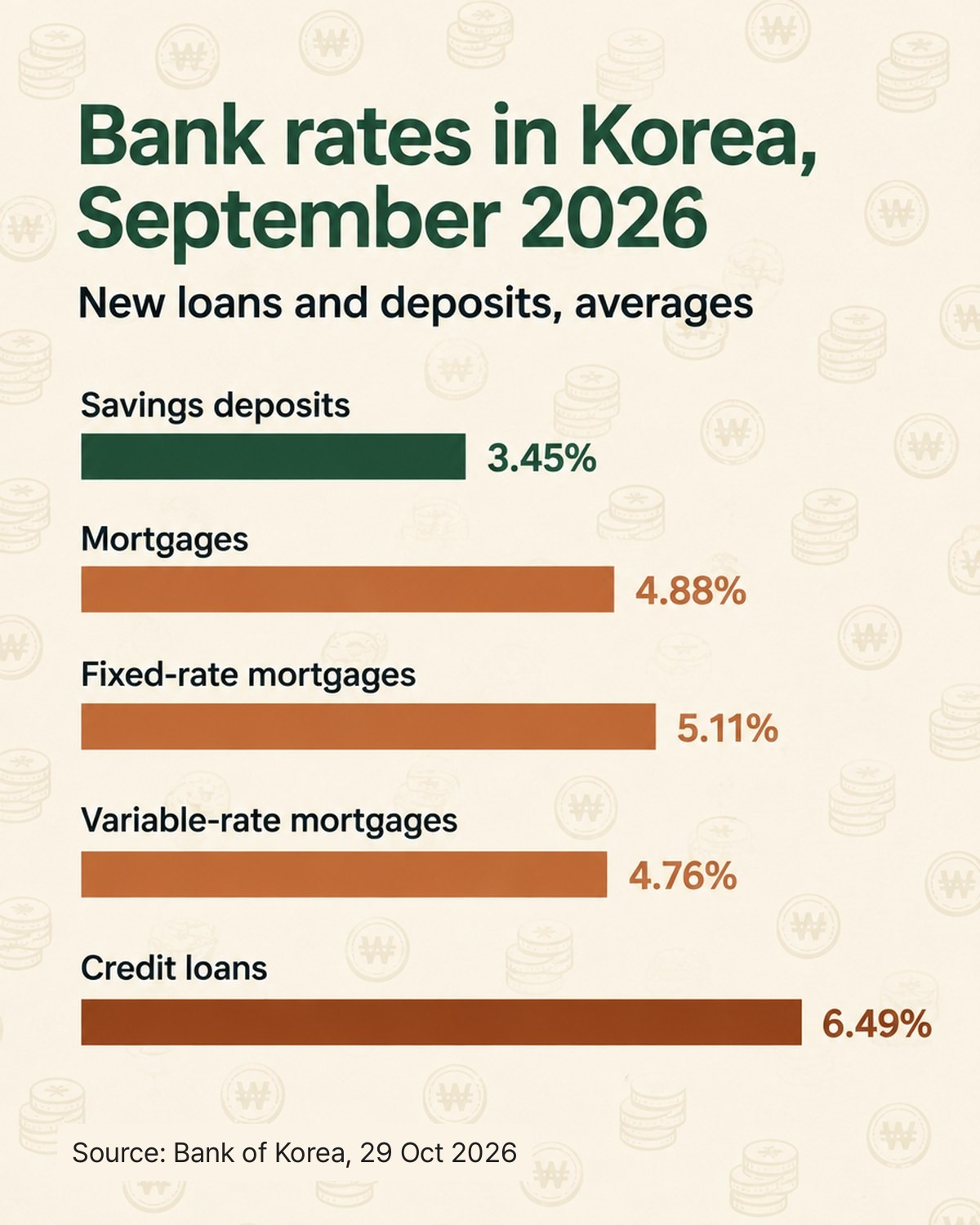
These are the Bank of Korea’s averages for new business at commercial banks, the most recent month published before the decision. Your own offer depends on your credit profile, visa and income.
| Product (new business) | Dec 2025 | Jul 2026 | Aug 2026 | Sep 2026 |
|---|---|---|---|---|
| Savings deposits (all) | 2.90% | 3.21% | 3.21% | 3.45% |
| Household loans (all) | 4.35% | 4.64% | 4.76% | 4.96% |
| Mortgages | 4.23% | 4.48% | 4.66% | 4.88% |
| – fixed-rate mortgages | 4.22% | 4.76% | 4.88% | 5.11% |
| – variable-rate mortgages | 4.32% | 4.35% | 4.53% | 4.76% |
| Unsecured credit loans | 5.87% | 5.97% | 6.33% | 6.49% |
Source: Bank of Korea, “2026년 9월 금융기관 가중평균금리” (29 October 2026); September figures are provisional. Hankyoreh reported the same figures, noting that the 4.88% mortgage average was the highest since April 2012 and that fixed-rate mortgages passed 5% for the first time since that series began in January 2013.
Two things stand out. First, loan rates rose faster than the two 0.25-point hikes alone would suggest: in the October minutes, the Bank’s staff said household loan rates rose more than business loans because banks also added margin to manage household debt. Second, the October figures are normally published at the end of the following month (September’s came on 29 October), so they will probably arrive after the decision; the September table is the latest official picture.
Worked examples: what 0.25 points means in won (our calculation)
These are simple interest-only illustrations, not bank quotes. They assume a rate change passes through in full, which often does not happen exactly.
1. A variable-rate loan. Each 0.25-point rise on ₩100,000,000 of variable-rate debt adds ₩250,000 a year, about ₩20,833 a month. On a ₩30,000,000 unsecured credit loan at the September average of 6.49%, interest is ₩1,947,000 a year; at 6.74% it would be ₩2,022,000, an extra ₩75,000 a year (₩6,250 a month). A fixed-rate loan does not change until its fixed period ends.
2. A one-year time deposit of ₩10,000,000. At the September average of 3.45%, interest before tax is ₩345,000. For a Korean tax resident the bank withholds 14% national income tax (National Tax Service) plus local income tax of one tenth of that (1.4%), together 15.4%, here ₩53,130, so you receive ₩291,870. If deposit rates rose by 0.25 points to 3.70%, interest would be ₩370,000 before tax and ₩313,020 after tax: ₩21,150 more on ₩10 million. Non-residents may be taxed differently under a tax treaty; ask your bank.
3. Money sent home. At ₩1,338.2 per dollar (17 November close), ₩1,500,000 buys about US$1,120.91 before fees. At ₩1,300 it would buy US$1,153.85; at ₩1,380, US$1,086.96. Near today’s level, each ₩10 move in the rate changes that transfer by roughly US$8. For comparison, Yonhap Infomax reported that the dollar was above ₩1,500 in early August: at ₩1,500, the same ₩1,500,000 bought US$1,000. Fees and the bank’s spread come on top; see sending money home from Korea.
| Example | Before | After a 0.25-point change | Difference |
|---|---|---|---|
| ₩100M variable loan, interest per year | – | +₩250,000 | +₩20,833 a month |
| ₩30M credit loan at 6.49% → 6.74% | ₩1,947,000 a year | ₩2,022,000 a year | +₩75,000 a year |
| ₩10M deposit at 3.45% → 3.70%, after 15.4% tax | ₩291,870 | ₩313,020 | +₩21,150 |
What to watch on 26 November and after
- The decision itself and the vote. On 22 October the decision was public in the morning (Yonhap’s report was out by 10:21 KST), followed by the Governor’s press conference. Look for whether any member dissented.
- The new economic outlook. The Bank updates its growth and inflation forecasts in November. In October it said growth for 2026 and 2027 would come in well above its August forecasts of 3.3% and 2.9%, and that 2027 inflation would exceed its 2.3% forecast.
- The forward wording. Does the statement still talk about “the timing and pace of further hikes”, or does it change?
- 15 December: two releases. The minutes of the November meeting are due then (the Bank posts minutes on the first Tuesday after two weeks have passed), and the Korea Federation of Banks normally publishes November COFIX around the same date.
- Your bank’s notices. Banks usually change deposit and loan rates within days of a base-rate move. Check the rate board or app before you renew a deposit or sign a loan.

A short checklist for foreign residents
- Know your loan’s index and reset date. Your contract names the index (often COFIX or a bank-bond rate) and how often the rate resets, commonly every 6 or 12 months. Nothing changes before that date.
- Compare fixed and variable before signing. In September the average fixed-rate mortgage (5.11%) was above the variable average (4.76%), the reverse of what many borrowers expect; ask your bank for both.
- Time a deposit renewal sensibly. If your deposit matures around 26 November, compare offers in the days after the decision; we cannot tell you which way rates will go.
- Stay within the protection limit. Deposits are protected up to ₩100,000,000 per person per bank, principal and interest together, including foreign-currency deposits converted to won (Korea Deposit Insurance Corporation; the limit rose from ₩50 million on 1 September 2025).
- Do not move money on a guess. Exchange rates can move either way on the day; spreading transfers is one way to reduce timing risk.
Common problems
- “My bank raised my loan rate even though the base rate did not change.” Variable rates follow an index such as COFIX plus the bank’s margin. COFIX rose in September and October without a base-rate change, and banks raised household-loan margins too.
- “My deposit rate offer is lower than the average in the table.” The Bank of Korea figure is a weighted average across banks and products; promotional rates and short terms differ.
- “The news says the rate went up, but my payment did not.” Fixed-rate loans and loans before their reset date are not affected until the contract says so.
FAQ
Q. When is the next Bank of Korea interest rate decision?
Thursday 26 November 2026. It is the Monetary Policy Board’s eighth and last rate meeting of 2026, according to the Bank of Korea’s schedule. The minutes are due on 15 December.
Q. What is the Bank of Korea base rate now?
3.00%. It was raised to 2.75% on 16 July 2026 and to 3.00% on 27 August 2026, then held unanimously on 22 October 2026.
Q. Will the Bank of Korea raise rates in November 2026?
Nobody knows until 26 November. The Bank has said it will decide the timing and pace of further hikes from incoming data, and most economists quoted in the Korean press expect a 0.25-point rise to 3.25%, but some expect dissent and a hold remains possible.
Q. Does a base-rate hike change my existing Korean loan right away?
Usually not. A variable-rate loan changes on its next reset date, based on the index named in the contract, such as COFIX. A fixed-rate loan does not change during its fixed period.
Q. How much tax do I pay on interest from a Korean bank deposit?
For a Korean tax resident, banks withhold 14% national income tax plus 1.4% local income tax, 15.4% in total. On ₩345,000 of interest that is ₩53,130. Non-residents may pay a treaty rate; ask your bank.
Q. Are foreigners’ deposits in Korean banks protected?
Yes. Deposit insurance covers each depositor up to ₩100,000,000 per bank, principal and interest together, since 1 September 2025. Foreign-currency deposits count after conversion to won.
Related guides
- Korea COFIX rate explained: latest 3.62% and how it moves your loan
- Bank of Korea base rate 2026: the October 22 decision
- Sending money home from Korea: limits, fees and exchange rates
- Renting a flat in Korea as a foreigner: wolse vs jeonse
- Korea inflation rate October 2026: CPI 2.8%
Sources
- Bank of Korea, monetary policy meeting schedule 2026 (Korean): https://www.bok.or.kr/portal/singl/crncyPolicyDrcMtg/listYear.do?mtgSe=A&menuNo=200755
- Bank of Korea, Monetary Policy Board meeting dates (English): https://www.bok.or.kr/eng/main/contents.do?menuNo=400020
- Bank of Korea, base rate history: https://www.bok.or.kr/portal/singl/baseRate/list.do?dataSeCd=01&menuNo=200643
- Bank of Korea, Monetary Policy Decision and opening remarks, 22 October 2026 (English): https://www.bok.or.kr/eng/bbs/E0000627/view.do?depth=400022&menuNo=400022&nttId=11065824
- Bank of Korea, 통화정책방향 (22 October 2026) and press-conference opening remarks; 통화정책방향 (27 August 2026) with members’ conditional rate views; minutes of the 20th MPB meeting of 2026 (all on the schedule page above)
- Bank of Korea, 2026년 9월 금융기관 가중평균금리 (29 October 2026): https://www.bok.or.kr/portal/bbs/B0000501/view.do?menuNo=200690&nttId=11066053
- Bank of Korea, Real GDP third quarter 2026 (advance estimate): https://www.bok.or.kr/portal/bbs/E0000634/view.do?menuNo=400069&nttId=11065943
- Ministry of Data and Statistics, October 2026 consumer price trends (3 November 2026): https://www.korea.kr/briefing/policyBriefingView.do?newsId=156787698
- Korea Deposit Insurance Corporation, protection limit: https://www.kdic.or.kr/sp/dpstrprot/ProtSystProtLmts/selectScrn.do
- National Tax Service, withholding on interest and dividend income: https://www.nts.go.kr/nts/cm/cntnts/cntntsView.do?cntntsId=7914&mi=6478
- Yonhap, BOK holds key rate steady at 3 pct after 2 consecutive rate hikes (22 October 2026): https://en.yna.co.kr/view/AEN20261022001351320
- Yonhap, won closes at ₩1,338.2 per dollar (17 November 2026): https://www.yna.co.kr/view/AKR20261117129700002
- Yonhap, NH Investment & Securities keeps November hike call (9 November 2026): https://www.yna.co.kr/view/AKR20261109022900008
- Yonhap Infomax via KB Think, market expects a hike despite the stronger won (18 November 2026): https://kbthink.com/news-list/view.html?newsId=20261118083405515
- Financial News, BNP Paribas sees 3.25% as the peak (10 November 2026): https://www.fnnews.com/news/202611102025132714
- Hankyoreh, September mortgage rate 4.88%: https://www.hani.co.kr/arti/economy/economy_general/1284783.html
- Hankyoreh, third-quarter growth 1.0%: https://www.hani.co.kr/arti/economy/economy_general/1284302.html
- Daehan Economy, private consumption and outlook (6 November 2026): https://www.cnews.co.kr/uhtml/view.jsp?idxno=202611051406297040818
How we checked: the meeting date was read on the Bank of Korea’s Korean and English schedule pages and matched against Yonhap; the base rate and the October and August decisions were read in the Bank’s own releases, minutes and base-rate history; September bank rates were read in the Bank’s PDF and matched against Hankyoreh; tax and deposit-protection rules were read on the NTS and KDIC sites. Economists’ expectations are attributed to the outlets that reported them. The scenario table and worked examples are our own and are not forecasts.
This article is general information, not financial advice. Banks set their own loan and deposit rates; check your contract and ask your bank before you borrow, renew a deposit or exchange money. Official information: Bank of Korea.
Researched and drafted with AI assistance; checked against the sources listed.