Flu Shot in Korea If You’re Under 65: Where to Go, What It Costs and Who Gets It Free
Haesul Health desk (AI-assisted). As of 17 November 2026 (KST). Based on the Korea Disease Control and Prevention Agency (KDCA) Vaccination Helper page for the 2026-27 flu programme, KDCA’s 25 August 2026 press release and its FAQ, KDCA’s sentinel surveillance bulletin for week 45, Government24’s service page for the flu programme, the Health Insurance Review and Assessment Service (HIRA) 2026 release on non-covered (uninsured) fees and the HIRA price data as compiled by independent price sites, Wonju public health centre’s flu page, and the migrant-support group MAP’s flu guide, cross-checked with Yonhap (16 September and 16 November 2026), Newsis (13 November 2026), Money Today (21 September 2026), Dailypharm (3 September 2026) and K-Study Times (October 2026). General information, not medical advice.
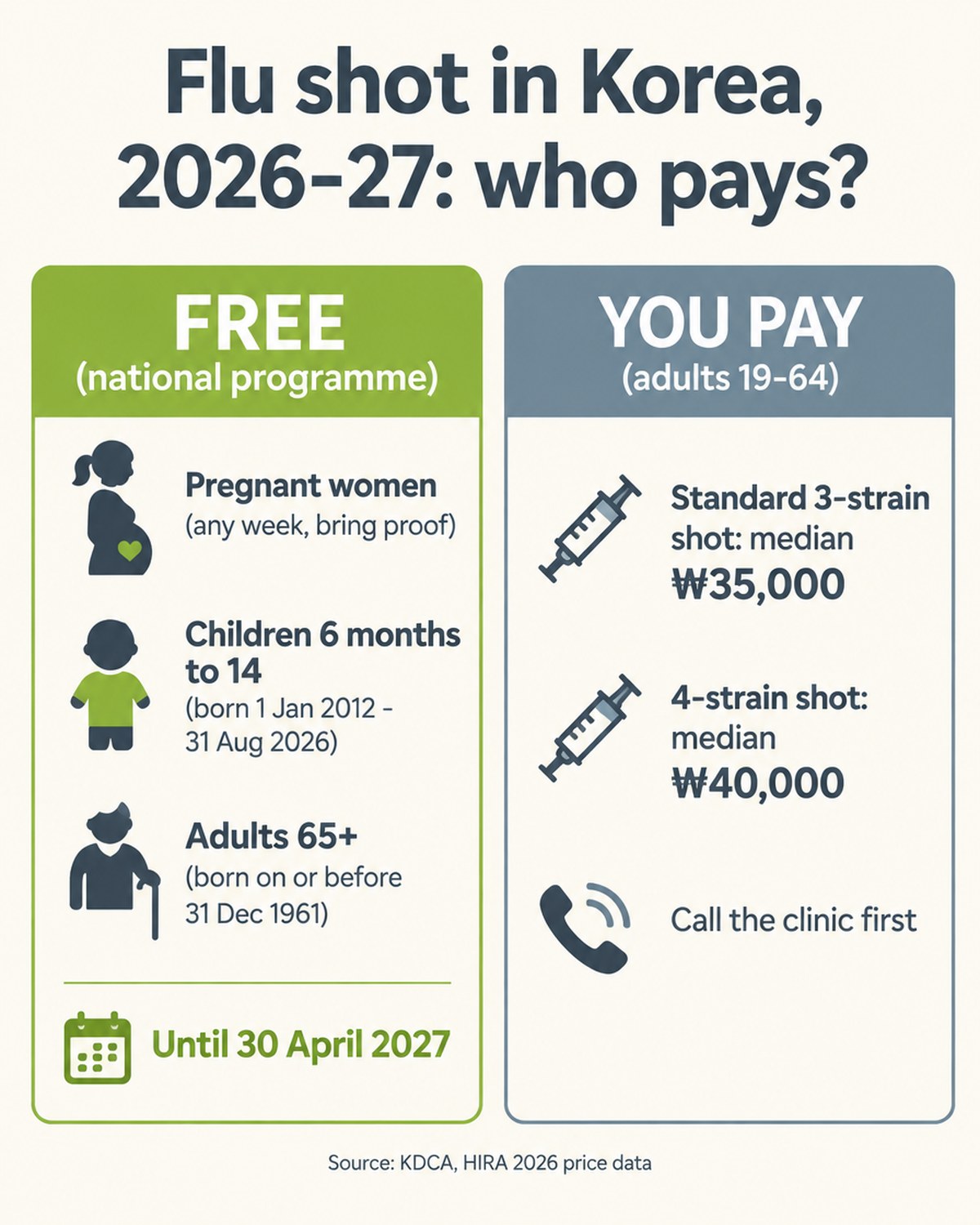
Quick answer: If you are an adult under 65 in Korea and not pregnant, the flu shot is not free: you pay the clinic directly, and in HIRA’s 2026 price data the standard three-strain (trivalent) shot has a median price of about ₩35,000 (quadrivalent about ₩40,000). Any neighbourhood clinic that stocks the vaccine can give it; phone first to check stock. The shot is free at about 23,000 designated clinics and public health centres for pregnant women (any week of pregnancy, with proof), children aged 6 months to 14 (born 1 January 2012 to 31 August 2026) and adults 65 and over (born on or before 31 December 1961), until 30 April 2027. Foreign residents use their Alien Registration Card; long-term residents without one can get a temporary number from a public health centre.
Why now: flu is climbing among working-age adults, not just schoolchildren. In KDCA’s bulletin for week 45 (1 to 7 November 2026), clinics saw 31.9 flu-like illness cases per 1,000 outpatients aged 19 to 49, up from 23.7 the week before, and 17.8 at ages 50 to 64, up from 13.1. Both are above this season’s epidemic threshold of 12.9. KDCA says it takes about two weeks after the shot for protective antibodies to form, so a shot this week protects you from early December. KDCA’s week-46 bulletin had not been posted when we checked on the evening of 17 November.
Who gets a free flu shot in 2026-27, and who pays
Korea’s National Immunization Program (NIP, 국가예방접종) pays for the vaccine and the administration fee for three groups this season. Everyone else pays the clinic’s own price. KDCA’s FAQ says it plainly: people outside the NIP groups can get a paid shot at a clinic that offers it, and some local governments run their own extra subsidy, so ask your local public health centre (보건소, bogeonso).
| Group | Free? | Who exactly (KDCA, 2026-27) | Dates | What to show |
|---|---|---|---|---|
| Adults 19 to 64, not pregnant | No, you pay | Most foreign workers, students and spouses | Any time the clinic has stock | ID; payment |
| Pregnant women | Yes | Confirmed pregnancy, any week | 21 September 2026 to 30 April 2027 | ID + maternity record book (산모수첩) or a pregnancy confirmation or diagnosis note |
| Children 6 months to 14 | Yes | Born 1 January 2012 to 31 August 2026 | 21 September 2026 to 30 April 2027 | Child’s registration number or temporary number |
| Adults 65 and over | Yes | Born on or before 31 December 1961 | From 6, 12 or 15 October 2026 by age, to 30 April 2027 | ID |
Source: KDCA Vaccination Helper, influenza NIP page (last reviewed 25 August 2026) and Government24’s service page (updated 20 October 2026). The NIP vaccine this season is an inactivated trivalent vaccine; you can go to any designated clinic or health centre regardless of your registered address.
Three details catch people out:
- Age is by birth date, not by “Korean age” or school year. A teenager born in December 2011 is 14 today but is not in the free group, because the cut-off is a birth date of 1 January 2012. Our children’s vaccination guide covers the child flu shot, the two-dose rule for under-9s and the temporary number in detail.
- Pregnancy needs paperwork. Government24 lists the maternity record book or a document that confirms the pregnancy (a pregnancy confirmation, a diagnosis certificate or a doctor’s note). Ask your obstetric clinic for one if you do not have the book yet.
- Turning 65 next year does not help now. The senior programme is for people born on or before 31 December 1961. If you are 64, you pay this season. For the 65-plus schedule and the COVID-19 shot that runs alongside it, see our 65+ flu and COVID guide.
Can foreigners get the free shot?
Yes, if you are in one of the three groups and you live here. KDCA’s 2026 guidelines, as summarised by MAP and by K-Study Times, say foreign residents are checked in the same way as Koreans:
- With an Alien Registration Card (외국인등록증): the clinic checks your eligibility with your registration number, the same as for a Korean resident registration number. MAP notes this applies whether or not you are enrolled in National Health Insurance.
- Without a registration number but staying 3 months or longer: visit a public health centre with your passport and ask for a temporary control number (임시관리번호). KDCA’s English vaccination guide describes the same number for children, and Wonju public health centre’s page says people without a registration number who cannot get the free shot at a designated clinic can be vaccinated at the health centre.
- Short-term visitors staying under 3 months: not covered by the national programme. Tourists who want a flu shot pay like any other adult.
None of this changes the main point for most readers: if you are 19 to 64 and not pregnant, your nationality does not matter, because the shot is paid for everyone in that age group.
What a flu shot costs at a Korean clinic in 2026
A paid flu shot is a non-covered item (비급여): National Health Insurance does not pay for it, and each clinic sets its own price. Clinics must report those prices to HIRA, which publishes them every year. In HIRA’s 2026 release (3 September 2026), vaccination fees were the most common category of non-covered item at medical (non-dental) institutions: 34.7 percent of the 71,066 institutions that reported prices listed at least one, and the HIRA price page now links straight to KDCA’s Vaccination Helper.
HIRA’s own release does not print flu-shot medians, so the table below uses HIRA’s 2026 data as compiled by two independent price sites, which agree with each other.
| Type of shot (2026 HIRA data) | Median price | Institutions listing it | Notes |
|---|---|---|---|
| Standard trivalent (3가), same type as the free NIP shot | ₩35,000 (single products ₩30,000 to ₩35,000) | 3,660 | Lowest listed prices about ₩10,000 to ₩15,000, highest ₩40,000 to ₩60,000 by product |
| Quadrivalent (4가) | ₩40,000 | 4,223 | Range ₩15,000 to ₩60,000; median ₩40,000 in all 17 provinces and cities |
| Cell-culture trivalent | ₩30,000 | 533 | Virus grown in cells instead of eggs |
| Adjuvanted quadrivalent | ₩50,000 | 197 | Contains an immune-boosting ingredient |
| Nasal spray (live vaccine) | ₩60,000 | 16 | Very few clinics list it |
| High-dose (for 65 and over only) | ₩100,000 | 49 | Not relevant under 65 |
Sources: HIRA 2026 non-covered fee data as compiled by Hospitalprice.kr (collected 15 November 2026; counts of hospitals and clinics) and Dailyinfoload (product-by-product medians, checked 12 October 2026; it counted 533 institutions for the cell-culture product). The price is per shot and includes the vaccine; whether a separate consultation fee is added depends on the clinic.
Two more official-data points help you judge a quote:
- Where you go matters more than which brand. Dailypharm’s analysis of HIRA’s 2026 figures for one widely used trivalent product found an average of ₩27,600 in Jeju against ₩36,130 in Gangwon, and averages of ₩29,976 at hospitals, ₩32,388 at tertiary hospitals, ₩32,671 at clinics and ₩33,723 at general hospitals. The gaps between clinics are bigger than the gaps between products.
- You can look up the clinic before you go. HIRA’s non-covered fee search (hira.or.kr, or its “건강e음” app) shows each clinic’s reported vaccination price.
The NIP itself switched to trivalent vaccines, which KDCA says contain all the strains the World Health Organization recommended for this season. Many clinics still list a quadrivalent price as well. If you are unsure which one to choose, ask the doctor at the clinic; we do not recommend one product over another.
Worked example: what one household pays this winter
Our calculation, for illustration only, using KDCA’s eligibility rules and the 2026 median prices above. Your clinic’s price will differ.
| Person (example family living in Korea) | Free under NIP? | Paid at the trivalent median | Paid at the quadrivalent median |
|---|---|---|---|
| Parent, 38 | No | ₩35,000 | ₩40,000 |
| Parent, 36, 20 weeks pregnant | Yes (bring the maternity book) | ₩0 | ₩0 |
| Child, 10, born 2016 | Yes (one dose, as children 9 and over get one) | ₩0 | ₩0 |
| Teenager, 14, born December 2011 | No (born before 1 January 2012) | ₩35,000 | ₩40,000 |
| Household total | ₩70,000 | ₩80,000 |
If the same family had no one pregnant, the total at the trivalent median would rise to ₩105,000. And if they wanted protection in place for Christmas Day (Friday 25 December 2026), KDCA’s two-week rule means getting the shots by Friday 11 December; a shot on Wednesday 18 November would give protection from about Wednesday 2 December.
Flu among adults right now: the week-45 numbers
The headline figure in KDCA’s bulletin is for all ages: 28.9 flu-like illness cases per 1,000 clinic outpatients in week 45, the third weekly rise in a row. “Flu-like illness” means a fever of 38°C or higher with a cough or sore throat. The adult rows show why working-age adults are worth a mention this year.
| Age group (KDCA sentinel clinics) | Week 42 | Week 43 | Week 44 | Week 45 (1–7 Nov) |
|---|---|---|---|---|
| All ages | 17.7 | 19.2 | 22.8 | 28.9 |
| 19 to 49 | 20.9 | 22.6 | 23.7 | 31.9 |
| 50 to 64 | 12.1 | 11.5 | 13.1 | 17.8 |
| 65 and over | 5.9 | 7.3 | 10.1 | 9.9 |
| Epidemic threshold, 2026-27 | 12.9 | 12.9 | 12.9 | 12.9 |
Source: KDCA, Sentinel surveillance weekly bulletin, week 45 (posted 12 November 2026), table of flu-like illness per 1,000 outpatients at clinics. Newsis (13 November) reported the same age-group figures, and Yonhap (16 November) the same all-ages trend.
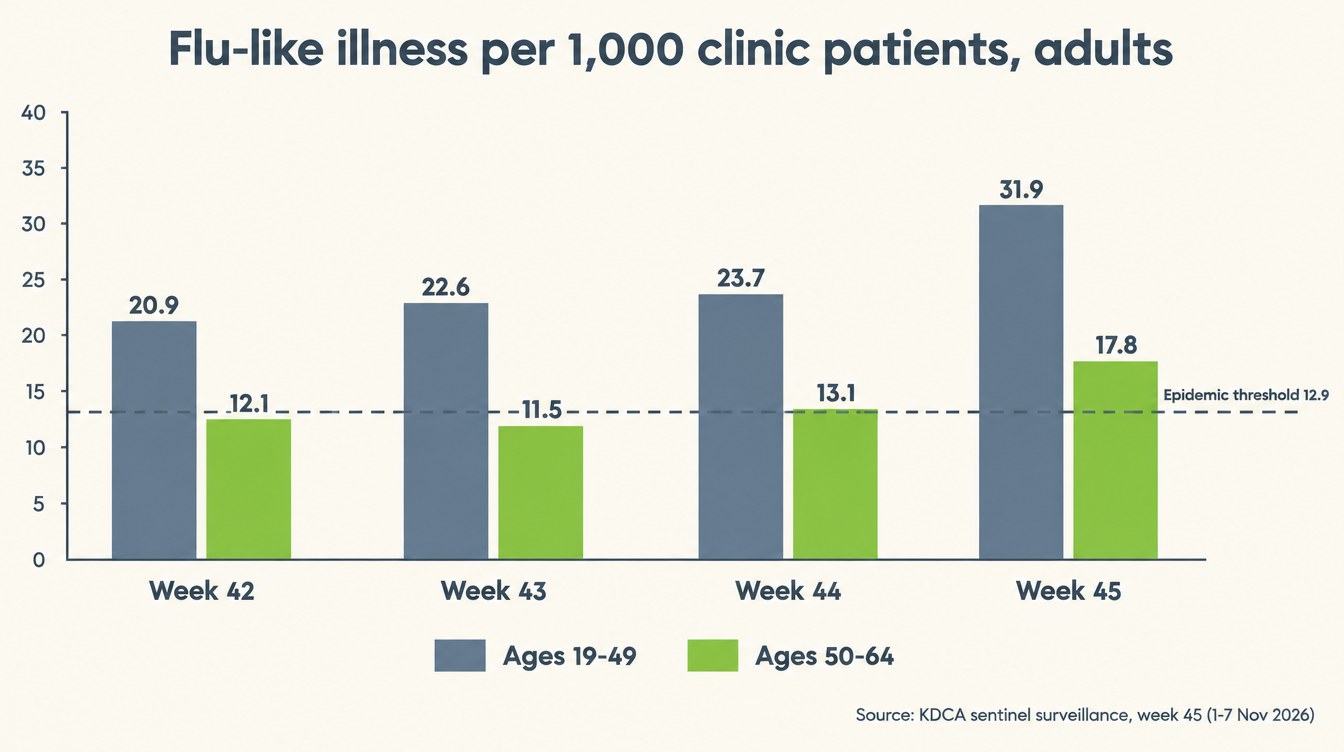
Our reading of the table, not KDCA’s: from week 44 to week 45 the rate for 19 to 49 rose by 8.2 cases per 1,000 (about 35 percent) and for 50 to 64 by 4.7 (about 36 percent). School-age children still have the highest rates (73.5 per 1,000 at 7 to 12) and people 65 and over the lowest; Yonhap reported 73.7 percent flu-shot coverage for people 65 and over on 13 November. In the same bulletin, flu admissions at sentinel hospitals reached 639, and the main strain detected was A(H1N1)pdm09.
KDCA has also said that because this season started early and may last a long time, people who already had flu this season can still catch a different strain, and it recommends vaccination even after an infection (Yonhap, 16 November, about the NIP groups). Whether that applies to you is a question for the doctor at the clinic.
Where to get a flu shot as an adult
- A neighbourhood clinic (의원, uiwon). Any clinic that stocks the vaccine can give a paid shot, for example an internal medicine (내과) or family medicine (가정의학과) clinic; 6,163 clinics listed a flu-shot price in the HIRA data above. If the clinic is also a designated NIP clinic, it can vaccinate a pregnant partner or a child for free in the same visit and you for a fee.
- A public health centre (보건소). Health centres give NIP shots and issue the temporary number for residents without an Alien Registration Card. Whether a centre offers paid shots to other adults varies, so phone first.
- A hospital (병원 or 종합병원). Hospitals list flu-shot prices too (1,128 in the HIRA data above). For the one product Dailypharm analysed, the average was lower at hospitals than at clinics and slightly higher at general hospitals.
- An international clinic or English-speaking doctor. Useful if you want the screening conversation in English; see our guide to seeing a doctor in English in Korea. Check the price, which these clinics also report to HIRA.
Supply this season. In September KDCA said domestic production and imports were about 4 million doses lower than last season, because all three strains changed and yields fell, and it secured about 370,000 extra doses for paid (non-NIP) shots (Yonhap, 16 September 2026). Money Today reported on 21 September that KDCA expected over 90 percent of this year’s doses to ship by early October. That is why “call before you go” matters: a clinic may have NIP stock for children and seniors but run short of paid doses, or the reverse.
Booking and what to bring
KDCA’s only instruction is to check that the clinic can vaccinate you before you visit; its flu page has no booking step, and each clinic handles its own appointments. In practice:
- Find a clinic. For free NIP shots, use the designated-clinic search on the Vaccination Helper site (nip.kdca.go.kr, “지정의료기관 찾기”) or ask your health centre. For a paid shot, any clinic that stocks the vaccine will do; HIRA’s price search shows which ones list a price.
- Phone first. Ask whether you need an appointment, then ask “독감 예방접종 가능한가요? 가격이 얼마예요?” (Can I get a flu shot? How much is it?). Ask whether a consultation fee is added.
- Bring: your Alien Registration Card or passport; for a pregnant patient, the maternity record book or a pregnancy confirmation; a list of any allergies or past vaccine reactions; a payment card.
- Fill in the screening form (예진표, yejinpyo). KDCA publishes the vaccination screening form in 12 languages including English, so ask for it. The doctor then asks a few questions before the shot.
- After the shot, wait at the clinic for 20 to 30 minutes, as KDCA advises, so staff can watch for a reaction. KDCA’s FAQ says the most common reactions are redness and pain where the needle went in, which mostly go within 1 to 2 days.
- Keep the receipt. If your employer, school or private insurer reimburses vaccinations, it will ask for the receipt (영수증).
KDCA’s FAQ also says the flu shot can be given on the same day as a COVID-19 vaccine, in different arms. The national COVID-19 programme is for people 65 and over, immunocompromised people and residents of high-risk facilities, as our 65+ guide explains.
If you are already sick
A flu shot prevents flu; it does not treat it. If you already have a fever and a cough, see a clinic rather than a pharmacy shelf if you feel very unwell. A rapid flu test at a clinic is also a non-covered item: in HIRA’s 2026 release, the rapid influenza A and B antigen test had a median price of ₩30,000 across institutions. For what you can buy without a prescription, see our guide to cold and flu medicine at a Korean pharmacy. For trouble breathing, chest pain or confusion, call 119.
Local extras and other vaccines to ask about
- Local subsidies. Some cities and counties pay for extra groups. For example, Wonju (Gangwon) offers free shots this season from 26 October 2026, until the vaccine runs out, to residents aged 15 to 64 who are registered in Wonju and receive basic livelihood or medical-aid benefits, have a severe disability, are national merit recipients or their spouses, or have pneumoconiosis or are their spouses. Wonju’s page describes residents by resident registration, so foreign residents should ask whether they count. Rules differ in every district: phone your health centre.
- While you are at the clinic. If your last health checkup showed no hepatitis B antibodies, the flu-shot visit is a good moment to ask the doctor about it; our guide to the hepatitis B test on Korea’s checkup explains what the surface antigen and antibody results mean.
Common problems
- “We only have shots for children and seniors.” NIP stock and paid stock are separate. Ask for paid adult stock, or try another clinic.
- The price is above the medians. Prices are set by each clinic. Compare the clinic’s listing on HIRA’s price search, and ask whether the price includes a consultation fee.
- A pregnant patient is asked to pay. Make sure the clinic is a designated NIP clinic for pregnant women (not every clinic joins every programme; Wonju’s list, for instance, marks clinics by programme) and that you brought proof of pregnancy.
- No Alien Registration Card yet. If you will stay 3 months or longer and are in a free group, get the temporary control number at a health centre first. If you are not in a free group, you can simply pay with your passport as ID.
- The screening form is only in Korean. Ask for the English version, or use the Vaccination Helper site, which hosts the multilingual materials.
Frequently asked questions
Q. Is the flu shot free for foreigners in Korea?
Only if you are in an NIP group: pregnant women, children aged 6 months to 14 (born 1 January 2012 to 31 August 2026) and adults 65 and over (born on or before 31 December 1961). Foreign residents in those groups use their Alien Registration Card, or a temporary control number from a public health centre if they have no registration number and stay 3 months or longer. Short-term visitors under 3 months are not covered. Other adults pay the clinic.
Q. How much does a flu shot cost in Korea in 2026?
In HIRA’s 2026 non-covered fee data, the standard trivalent shot has a median price of about ₩35,000 (single products ₩30,000 to ₩35,000) and the quadrivalent shot about ₩40,000, with prices ranging from about ₩15,000 to ₩60,000 between clinics. National Health Insurance does not pay for it, and some clinics add a consultation fee.
Q. Do I need an appointment for a flu shot in Korea?
It depends on the clinic. KDCA’s flu page has no booking step; it only asks you to check that the clinic can vaccinate you before you go. Phone first to ask whether you need an appointment and whether the clinic has paid stock, because supply was tight early this season.
Q. What should I bring to get a flu shot?
Your Alien Registration Card or passport, a payment card, and details of any allergies or past vaccine reactions. Pregnant women getting the free shot should bring the maternity record book or another document that confirms the pregnancy. You will fill in a screening form, which KDCA publishes in English among 12 languages.
Q. Is it too late to get a flu shot in late November?
No. KDCA’s NIP shots run until 30 April 2027, and KDCA says protective antibodies form about two weeks after the shot. Flu-like illness among adults aged 19 to 49 was 31.9 per 1,000 clinic patients in week 45 (1 to 7 November 2026) and still rising, so a shot now would give protection from early December.
Q. Can I get the flu shot and a COVID-19 vaccine together?
KDCA’s FAQ says the two can be given on the same day, in different arms. The national COVID-19 programme is for people 65 and over, immunocompromised people and residents of high-risk facilities, so most adults under 65 are not in it. Ask the doctor about your own health.
Sources
- KDCA Vaccination Helper, Influenza national immunization 2026-27 (children, seniors, pregnant women; last reviewed 25 August 2026): https://nip.kdca.go.kr/irhp/infm/goVcntInfo.do?menuLv=1&menuCd=134
- KDCA press release, 2026-27 influenza NIP extended to age 14 (25 August 2026), with FAQ on paid shots for other groups, local subsidies, two weeks to immunity, same-day COVID-19 shots and common reactions (via the Vaccination Helper board)
- KDCA, Sentinel surveillance weekly bulletin, week 45 (posted 12 November 2026; flu-like illness by age, threshold 12.9, admissions 639, A(H1N1)pdm09): https://dportal.kdca.go.kr/pot/bbs/BD_selectBbs.do?q_bbsDocNo=20261112163809554&q_bbsSn=1010&q_clsfNo=2
- KDCA, Vaccination guide for guardians (English, 2026; temporary control number, screening form in 12 languages): https://nip.kdca.go.kr/irhp/index.jsp
- Government24, Influenza national immunization support (documents: ID, maternity record book or pregnancy confirmation; updated 20 October 2026): https://www.gov.kr/portal/service/serviceInfo/135200000115
- HIRA and Ministry of Health and Welfare, 2026 non-covered fee disclosure (3 September 2026; 753 items, 71,066 reporting institutions, vaccination fees most common, rapid flu test median): https://www.hira.or.kr/bbsDummy.do?brdBltNo=11896&brdScnBltNo=4&pgmid=HIRAA020041000100
- Hospitalprice.kr, Flu vaccination prices from HIRA data (collected 15 November 2026): https://hospitalprice.kr/price/flu-vaccine
- Dailyinfoload, Flu vaccine price comparison from HIRA 2026 data (product medians, checked 12 October 2026): https://dailyinfoload.com/flu-vaccine-price-comparison-2026-hira/
- Dailypharm, Regional differences in flu-shot fees (3 September 2026): https://www.dailypharm.com/user/news/342128
- Wonju public health centre, Influenza vaccination 2026-27 (local programme for ages 15 to 64; vaccination at the centre for people without a registration number): https://www.wonju.go.kr/health/contents.do?key=3712
- MAP, Flu vaccination guide for refugees and migrants (updated 11 October 2026): https://refugeelifekorea.org/ko/news/a-2018-12-de89/
- K-Study Times, 2026-27 flu vaccination for international students (October 2026): https://kstudytimes.kr/news/korea-life/2026/10/international-student-flu-vaccination-korea-2026-2027?lang=en
- Yonhap, Flu up three weeks in a row (16 November 2026): https://www.yna.co.kr/view/AKR20261116083500530
- Newsis, Flu cases among 13 to 18 up 39 percent (13 November 2026; adult age-group rates): https://www.newsis.com/view/NISX20261113_0003866616
- Yonhap, Flu NIP brought forward; 4 million fewer doses (16 September 2026): https://www.yna.co.kr/view/AKR20260916128100530
- Korea.kr (KDCA), Seniors’ flu shots from 6 October; bring ID and wait 20 to 30 minutes after the shot (2 October 2026): https://www.korea.kr/news/policyNewsView.do?newsId=148972954
- Money Today, Paid flu vaccine supply tight; KDCA expects stability by early October (21 September 2026): https://www.mt.co.kr/thebio/2026/09/21/2026092110404316034
How we checked: We read KDCA’s flu programme page, press release and FAQ, the week-45 bulletin (including its age table, downloaded as a PDF), Government24, Wonju’s page and HIRA’s 2026 release on 17 November 2026. Prices come from HIRA’s 2026 data as compiled by two independent sites that agree with each other; the worked example and the week-to-week changes are our own calculations, labelled as such.
This guide is general information, not medical advice. Whether and when to get vaccinated, and which vaccine suits you, is for you and a doctor to decide. In an emergency call 119; for KDCA’s helpline call 1339.
Researched and drafted with AI assistance; checked against the sources listed.