Toothache or a Broken Tooth in Korea: Night and Holiday Dentists, NHIS Cover and Costs
Haesul Health desk (AI-assisted). As of 17 November 2026 (KST). Based on the Health Insurance Review and Assessment Service (HIRA) outpatient copayment rules, its 3 September 2026 release on non-covered (uninsured) fees and its resin-filling coverage notice, the National Health Insurance Service (NHIS) pages on coverage and on foreigners, the Ministry of Health and Welfare (MOHW) holiday-care guidance and its 8 September 2026 coverage briefing, the Korea Disease Control and Prevention Agency (KDCA) health portal page on tooth injuries, and Seoul National University Dental Hospital’s emergency clinic page, cross-checked with the Korean Dental Association’s newspaper Dailydental (7 January 2026), dental-clinic coverage guides, Money Today (28 December 2023) and independent sites that republish HIRA’s price data. General information, not medical or dental advice.
Quick answer: For a bad toothache, a broken tooth or a lost filling at night or on a holiday in Korea, first look for a dental clinic (치과의원, chigwa-uiwon) that is open now on the government’s E-Gen site or app (e-gen.or.kr), or call 129 or 120 and ask. In Seoul, Seoul National University Dental Hospital runs a dental emergency room on weekdays from 18:00 to 08:00 and 24 hours on weekends and public holidays (02-6256-3362). Facial swelling with fever, trouble swallowing or breathing, a jaw injury or bleeding that will not stop is a job for a hospital ER or 119. If you are on NHIS, root canal treatment, extractions and amalgam or glass-ionomer fillings are covered and you pay 30 percent at a clinic; crowns, gold inlays and adult resin fillings are uninsured, and in HIRA’s 2026 price data a zirconia crown has a median of about ₩500,000 to ₩550,000 at dental hospitals.
Why now: the year-end holidays close a lot of small clinics. Christmas Day (Friday 25 December 2026) and New Year’s Day (Friday 1 January 2027) are public holidays, so each one makes a three-day weekend,. Dental pain rarely waits for Monday, so it is worth knowing tonight’s options before you need them.
Who this applies to
- Foreign residents enrolled in NHIS. Since 16 July 2019, foreigners who have stayed in Korea for six months or more are enrolled in National Health Insurance (NHIS English guidance). You get the covered prices and copayment rates below, and you show your alien registration card at reception.
- Tourists and short-stay visitors without NHIS. You can use any of the same clinics and dental hospitals, but you pay the whole bill yourself and claim it from your travel insurance. The emergency options are identical; only the price changes.
- Children. Some rules differ for children (for example, resin fillings are covered from age 5 to 12). This guide is written for adults.
Tonight: where to go with dental pain
| Situation | Where to go | How to find it |
|---|---|---|
| Toothache, a chipped or broken tooth, a lost filling or crown, evening or weekend | A dental clinic (치과의원) or dental hospital (치과병원) that is open now | E-Gen site or app: choose 치과의원 or 치과병원 as the institution type; Naver Map or KakaoMap holiday tabs; call 129 or 120 |
| Severe pain late at night, on a weekend or a public holiday in Seoul | Seoul National University Dental Hospital dental emergency room (치과응급진료실), 2nd floor | Weekdays 18:00–08:00, weekends and public holidays 24 hours; 02-6256-3362 |
| Swelling of the face or neck with fever, trouble swallowing or breathing, a jaw or face injury, bleeding that will not stop | A hospital emergency room, ideally one with oral and maxillofacial surgery | Call 119, or check the ER list on E-Gen; see our guide to Korean ERs |
| A knocked-out adult tooth | Any dentist or dental ER at once, with the tooth kept moist | See the first-aid steps below |
Two things to know about 119. Calling it is free and the operator can give medical advice and tell you what is open nearby. But under the 119 rescue law’s enforcement decree, crews may decline a call for a simple toothache, so for ordinary dental pain you usually travel to the dentist yourself. And at the big emergency centres, insured patients with minor problems pay a much higher share of the bill (the 90 percent rule explained in our ER guide), so an open dental clinic is cheaper and better equipped for a tooth than an ER.
Finding an open dentist on a holiday
- Search E-Gen. The National Emergency Medical Center’s E-Gen site and app has a search for open clinics and pharmacies (문여는 병의원·약국). Pick your city and district, set the institution type to 치과의원 (dental clinic) or 치과병원 (dental hospital), and choose the date. Before Seollal and Chuseok the government also designates and lists clinics that open on the holiday itself.
- Use the phone lines. MOHW names three numbers for finding open clinics during holidays: 129 (Health and Welfare call centre), 120 (city and provincial call centres; Seoul’s 120 Dasan Call Center has foreign-language help) and 119.
- Check the map apps. MOHW notes that Naver Map and KakaoMap show holiday-care and emergency tabs.
- Phone before you go. E-Gen itself warns that hours change, so call the clinic, say what happened and ask whether a dentist is there to treat you, not only to give a consultation.
- Bring your alien registration card (or passport), any medicine you take, and a payment card.
Useful phrases: 이가 너무 아파요 (i-ga neomu apayo, “I have a bad toothache”), 이가 깨졌어요 (i-ga kkaejyeosseoyo, “My tooth broke”), 보험 되나요? (boheom doenayo, “Is this covered by insurance?”) and 비용이 얼마예요? (biyong-i eolmayeyo, “How much will it cost?”).
A broken or knocked-out tooth: the first steps
KDCA’s national health portal gives this first-aid guidance for tooth injuries (general information; follow the dentist on the day):
- Broken (fractured) tooth: if you can find the broken piece, keep it and bring it, because reattaching it can be the best-looking repair. Go to a dentist as soon as you can, especially if the broken surface is sensitive.
- Knocked-out adult tooth: hold it by the crown (the white part), not the root. If it is dirty, rinse it gently with milk, saline or the person’s own saliva, and if possible put it straight back into the socket and bite on gauze, a handkerchief or a napkin to hold it. If it cannot go back, keep it in milk (or saliva in a cup, or saline) and go to a dentist at once: the root surface starts to dry out within minutes. Water is not recommended, though it is better than leaving the tooth in the air. Do not try to put back a baby tooth.
- A re-implanted tooth needs X-rays and splinting for about two weeks, and often a root canal later, so a dental visit is essential even if it seems to sit well.

What NHIS covers at the dentist
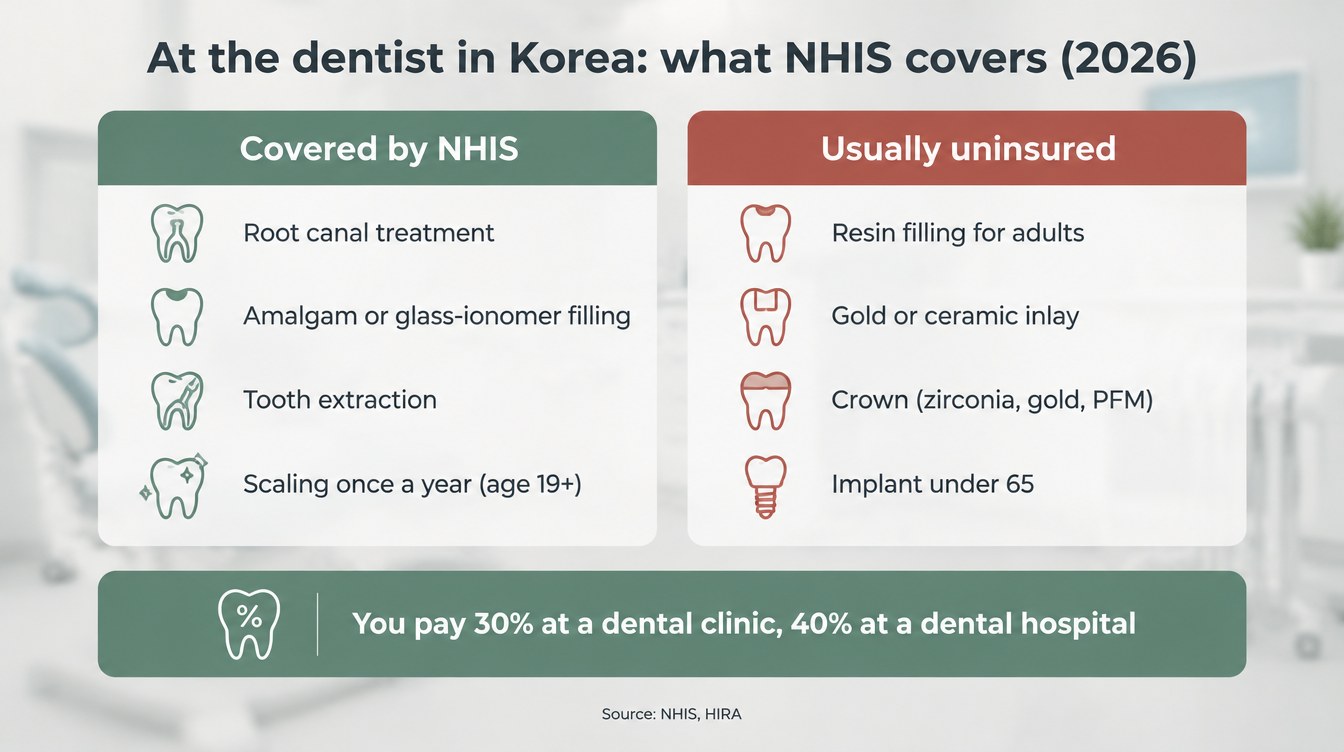
Korea’s health insurance covers treatment of disease, but most dental “prosthetics” (anything made to replace or cover a tooth) are outside it. For an adult on NHIS in 2026 it breaks down like this:
| Treatment | Adult on NHIS (2026) | Notes |
|---|---|---|
| Root canal treatment (근관치료) | Covered | HIRA’s 2026 fee for removing the nerve and filling the canal on the same day is ₩41,920 per canal for an adult tooth; some materials (such as MTA) may be billed separately as uninsured |
| Amalgam or glass-ionomer filling | Covered | Many clinics no longer offer amalgam (see Common problems) |
| Light-cured resin filling (레진) | Uninsured for adults | Covered only for ages 5 to 12, on permanent teeth with decay; ages 5 to 13 from January 2027 |
| Gold or ceramic inlay and onlay | Uninsured | Listed by HIRA as non-covered “fillings using gold and other materials” |
| Crown (zirconia, gold, PFM) | Uninsured | Prosthetics are non-covered under NHIS rules, except dentures and implants at 65+ |
| Implant | Uninsured under 65 | Covered at 65+ (2 per lifetime; bone grafts and similar add-on surgery stay uninsured): see our 65+ implant guide |
| Extraction, including most wisdom teeth | Covered | Impacted wisdom teeth are billed as surgery; dental X-rays (panoramic, periapical) are covered |
| Scaling | Covered once a year from age 19 | The year runs 1 January to 31 December: see our scaling guide |
What you pay on NHIS: the copay by type of clinic
For covered treatment you pay a share of the official fee, set by the type of institution (HIRA outpatient rules, adults under 65, city areas):
| Where you are treated | Your share of the covered fee |
|---|---|
| Dental clinic (치과의원) | 30 percent |
| Dental hospital (치과병원) or other hospital | 40 percent |
| General hospital (종합병원) | 50 percent |
| Tertiary (university) hospital | The whole consultation fee plus 60 percent of the rest |
At night and on holidays, the official consultation fee carries a 30 percent surcharge (for dental clinics: weekdays from 18:00 to 09:00, Saturday afternoons, Sundays and public holidays; dental clinics also add it on Saturday mornings). The surcharge applies to the consultation fee, not to the whole treatment, so on NHIS it changes your bill by a small amount. Uninsured items such as crowns carry no surcharge, because the clinic sets those prices itself.
2026 prices for uninsured dental work
Every year HIRA publishes the prices that hospitals and clinics report for non-covered treatment. The 2026 round (released 3 September 2026) covered 753 items at 74,449 institutions. HIRA’s release names the items dental clinics offer most: a one-surface resin filling, then zirconia crowns, resin fillings for wear, PFM crowns and zirconia implants. HIRA’s downloadable price files cover dental hospitals and hospital dental departments; neighbourhood clinics’ prices are searchable one by one on HIRA’s website and the 건강e음 app.
| Treatment (one tooth) | 2026 median reported price | Who reported it |
|---|---|---|
| Resin filling, one surface of decay | ₩100,000 | About 480 hospital-level institutions (also the Seoul median across dental clinics) |
| Resin filling, two surfaces | ₩150,000 | About 420 hospital-level institutions |
| Gold inlay | ₩450,000 | About 390 hospital-level institutions |
| Zirconia crown | ₩500,000 to ₩550,000 | 231 dental hospitals (₩500,000); 458 dental hospitals and hospital dental departments (₩550,000) |
| PFM crown | ₩450,000 | Dental hospitals and hospital dental departments |
| Gold crown | ₩700,000 | About 440 hospital-level institutions (₩800,000 at dental hospitals only) |
| Implant, all stages (under 65) | ₩1,190,000 | All reporting institutions, HIRA’s own table; zirconia implant at dental clinics ₩1,100,000 |
The implant row is from HIRA’s release itself. The other rows are HIRA’s 2026 reported prices as compiled by independent sites that republish the data (each named in Sources), and the figures for each item agree across them. These are prices clinics report, not bills: a crown quote may or may not include the post and core, temporary crown or X-rays, so compare like with like. Korea’s Medical Service Act (Article 45) requires clinics to tell patients their non-covered prices and not charge more than they have notified, so you can ask to see the price list before you agree to anything.
Worked example: a molar root canal and a crown
Our calculation, for illustration only, from the figures above. A lower molar often has three canals; your dentist decides how many visits and items are needed.
| Item | Adult on NHIS, at a dental clinic | Tourist without NHIS |
|---|---|---|
| Same-day nerve removal and canal filling, 3 canals × ₩41,920 | ₩125,760 fee; you pay 30 percent = ₩37,728 | The whole bill at the clinic’s price (₩125,760 if it charges the official fee) |
| Consultation, X-rays, anaesthesia, later check visits | Extra, covered at 30 percent | Extra, paid in full |
| Zirconia crown (uninsured for everyone under 65) | ₩500,000 to ₩550,000 (2026 median) | Same price range |
| Rough total | About ₩538,000 to ₩588,000 plus the extras, mostly the crown | About ₩626,000 to ₩676,000 plus the extras, if the clinic charges the official fee |
The pattern matters more than the exact figure: on NHIS the root canal itself is cheap and the crown is most of the bill. Without NHIS, both parts are yours to pay, and the canal work alone usually needs more than one visit.
Tourists and travel insurance: what to ask for
- Ask for the receipt (진료비 영수증) and the itemised statement (진료비 세부산정내역서) before you leave, plus a diagnosis certificate (진단서) if your insurer asks for one.
- Ask whether the clinic can give the paperwork in English; if not, keep the Korean originals and check with your insurer what it accepts.
- If you need a crown, ask whether a temporary repair now and the permanent crown at home is possible. A root canal and a crown usually take more than one visit.
Common problems
- “We don’t do amalgam.” Amalgam is covered and cheap, but in 2022 only 5,139 of the 19,413 dental clinics and hospitals that billed NHIS claimed for amalgam fillings, according to NHIS figures reported by Money Today. If you want a covered filling, ask “아말감이나 GI 충전 되나요?” (can you do an amalgam or GI filling?) before treatment starts.
- A quote well above the medians. Prices differ a lot from clinic to clinic; in HIRA’s release, the highest zirconia-implant price at a Seoul dental clinic was ₩1,720,000 against a ₩1,100,000 median. Look the clinic up on HIRA’s non-covered price search, and ask for a written breakdown.
- Pain gone, treatment unfinished. A dental ER at night usually relieves the pain (draining an abscess, a temporary filling, medicine) and sends you back to a regular dentist to finish. Book that visit straight away, especially before a long weekend.
- Holiday hours that changed. Lists on E-Gen and the map apps depend on what clinics report. Always phone first.
Before the holidays: a two-minute plan
- Save E-Gen and the numbers 129, 120 and 119 in your phone, and, if you live in Seoul, the Seoul National University Dental Hospital dental ER line (02-6256-3362).
- If a tooth has been aching or a filling feels loose, see a dentist in early December, before the 25 December and 1 January long weekends.
- If you are on NHIS and have not had your covered scaling this year, it resets on 1 January: our scaling guide explains how to check.
- For a fever, a cold or a child who is unwell over the holidays, our guide to late-night pharmacies and holiday clinics covers the rest.
FAQ
Q. Where can I see a dentist at night in Korea?
Search E-Gen (e-gen.or.kr or the app) for a dental clinic (치과의원) or dental hospital (치과병원) that is open now, or call 129 or 120. In Seoul, Seoul National University Dental Hospital’s dental emergency room is open on weekdays from 18:00 to 08:00 and 24 hours on weekends and public holidays (02-6256-3362). For facial swelling with fever, breathing or swallowing trouble, or a jaw injury, go to an ER or call 119.
Q. Does Korean national health insurance cover a root canal?
Yes. Root canal treatment is a covered NHIS item, so an adult pays 30 percent of the official fee at a dental clinic and 40 percent at a dental hospital. HIRA’s 2026 fee for removing the nerve and filling the canal on the same day is ₩41,920 per canal for an adult tooth. The crown that often follows is not covered.
Q. How much does a dental crown cost in Korea in 2026?
Crowns are uninsured for everyone under 65, so each clinic sets its own price. In HIRA’s 2026 reported prices, the median zirconia crown was about ₩500,000 to ₩550,000 at dental hospitals, a PFM crown about ₩450,000 and a gold crown about ₩700,000. Ask the clinic for its price list before treatment.
Q. Are tooth-coloured resin fillings covered for adults?
No. Light-cured resin fillings are covered only for children aged 5 to 12 with decay in a permanent tooth (rising to age 13 from January 2027). For adults they are uninsured; the 2026 median for a one-surface resin filling was ₩100,000. Amalgam and glass-ionomer fillings are covered for adults.
Q. Will an ambulance take me to hospital for a toothache?
Usually not. Korea’s 119 rescue rules let crews decline a call for a simple toothache, so you normally travel to the dentist yourself. You can still call 119 for advice and for a list of what is open, and it is the right call for facial swelling with fever, trouble breathing or swallowing, heavy bleeding or a serious face or jaw injury.
Q. I am a tourist without Korean insurance. What will I pay?
You pay the whole bill at the clinic’s price and claim it from your travel insurance. The covered-fee figures in this guide show the official starting point (for example, ₩41,920 per canal for root canal work), and crowns cost the same uninsured price as for residents. Ask for the receipt and the itemised statement (진료비 세부산정내역서) for your claim.
Sources
- HIRA, Outpatient copayment rates (외래진료시 본인부담률): https://www.hira.or.kr/dummy.do?pgmid=HIRAA030056020110
- HIRA / MOHW, “병·의원 비급여 진료비 미리 확인하세요” (2026 non-covered fee disclosure, 3 September 2026; PDF attachment, implant tables and top dental-clinic items): https://www.hira.or.kr/bbsDummy.do?brdBltNo=11896&brdScnBltNo=4&pgmid=HIRAA020041000100 and https://www.korea.kr/briefing/pressReleaseView.do?newsId=156780039
- HIRA FAQ, Coverage rule for light-cured resin fillings (ages 5–12, permanent teeth): https://www.hira.or.kr/bbsDummy.do?brdBltNo=47600&brdScnBltNo=4&pgmid=HIRAA010006011600
- NHIS, Coverage expansion by group (resin fillings since 2019; 65+ dentures and implants): https://www.nhis.or.kr/nhis/policy/wbhadd02400m01.do
- NHIS (English), Foreigners who stay 6 months or more must enrol, from 16 July 2019: https://www.nhis.or.kr/static/images/banner/longdesc/20190520_pop02longdesc_eng.html
- MOHW, 15th Health Insurance Policy Deliberation Committee briefing (8 September 2026; resin cover to age 13 and implants for toothless seniors from January 2027): https://www.korea.kr/briefing/policyBriefingView.do?newsId=156780681
- MOHW, Holiday care guidance: E-Gen, 129, 120, 119 and map-app holiday tabs (23 January 2025): https://www.mohw.go.kr/board.es?act=view&bid=0027&list_no=1484434&mid=a10503000000
- E-Gen (National Emergency Medical Center), Open clinics and pharmacies search: https://www.e-gen.or.kr/egen/holiday_medical.do
- Seoul National University Dental Hospital, Dental emergency room: https://www.snudh.org/portal/contents.do?menuNo=23020300
- KDCA National Health Information Portal, Tooth injuries (치아외상; updated 15 May 2026): https://health.kdca.go.kr/healthinfo/biz/health/gnrlzHealthInfo/gnrlzHealthInfo/gnrlzHealthInfoView.do?cntnts_sn=6704
- Dailydental (Korean Dental Association newspaper), 2026 dental fees, including same-day root canal ₩41,920 per canal (7 January 2026): https://www.dailydental.co.kr/news/article.html?no=136277
- Money Today, Only about a quarter of dental clinics bill for amalgam (28 December 2023): https://www.mt.co.kr/thebio/2023/12/28/2023122815494484766
- HIRA 2026 price data as republished: Mediharu, one-surface resin filling, gold inlay and gold crown: https://mediharu.com/nonpay/U02390000, https://mediharu.com/nonpay/UZ0040011 and https://mediharu.com/nonpay/UW607F320; Dentalweb, dental-hospital resin and crown prices: https://dentalweb.co.kr/가격/크라운/index.html; Byeongwonbiyong, crown prices: https://byeongwonbiyong.com/price/crown/; Mediprice, Seoul dental-clinic resin prices: https://mediprice.org/seoul/dental/resin; EUMC price table, dental procedures: https://eumc.co.kr/category.php?cd=1100Z
- Gwanghwamun Sun Dental, Covered and uninsured dental treatments (extraction, X-rays, MTA): https://dentalsun.co.kr/insight/guide/dental-insurance
- Dentalweb, Root canal cost guide (copay rates and crown rule): https://dentalweb.co.kr/가이드/신경치료-비용.html; Moon Dental Hospital, Night and holiday surcharges: https://moondental.co.kr/치과사전/야간·공휴일-치과-진료비-가산/
How we checked: We read each official page on 17 November 2026 (HIRA copay rules, HIRA’s 2026 price release and its PDF, NHIS, MOHW, KDCA, E-Gen and the dental hospital’s own page) and took every number from them or from the named sites that republish HIRA’s 2026 price data, checking each price against at least two of those sites. The worked example is our own arithmetic and is labelled as such.
This guide is general information, not medical or dental advice. For your own treatment, follow a dentist, and in an emergency call 119.
Researched and drafted with AI assistance; checked against the sources listed.




One Comment