Fine Dust Season in Korea 2026–27: PM2.5 Grades, AirKorea, KF Masks and Emergency Rules
Haesul Health desk (AI-assisted). As of 15 November 2026 (KST). Based on AirKorea (run by the Korea Environment Corporation, K-eco), the Ministry of Climate, Energy and Environment press release of 9 November 2026 and its attachments, K-eco’s vehicle-emissions portal (MECAR), the Ministry of Food and Drug Safety (MFDS) mask guidance, and the Seoul and Busan city governments, cross-checked with The Korea Herald (26 March 2026), Korea JoongAng Daily (16 February 2020), Mediapen (9 November 2026) and Gukje News (11 November 2026).
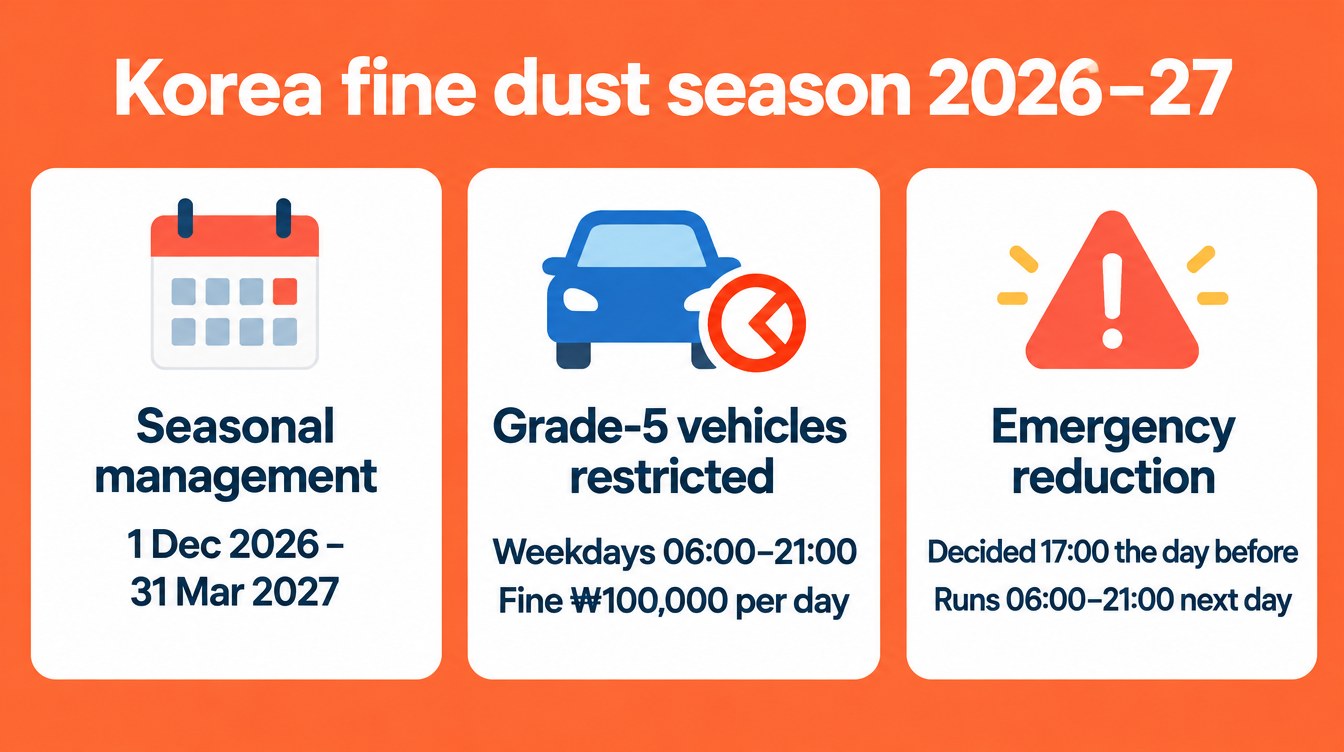
Quick answer: Korea’s 8th fine-dust seasonal management period (미세먼지 계절관리제) runs from 1 December 2026 to 31 March 2027; 1 December is 16 days from 15 November. Check the air on AirKorea, which has English pages: for PM2.5, 0–15 µg/m³ is Good, 16–35 Moderate, 36–75 Unhealthy and 76 or more Very Unhealthy; for PM10 the bands are 0–30, 31–80, 81–150 and 151 or more. On Unhealthy and Very Unhealthy days, cut long or hard outdoor activity, and if you go out wear a mask labelled “의약외품” (quasi-drug) with KF80 or KF94 on it. When PM2.5 is forecast to stay high, regions issue emergency reduction measures (비상저감조치). The decision is made around 17:00 the day before, and the measures run 06:00–21:00 the next day. Older “grade-5” vehicles are restricted on weekdays from 06:00 to 21:00 all season in Seoul, Incheon, Gyeonggi and six other big cities, with a ₩100,000 fine per day.
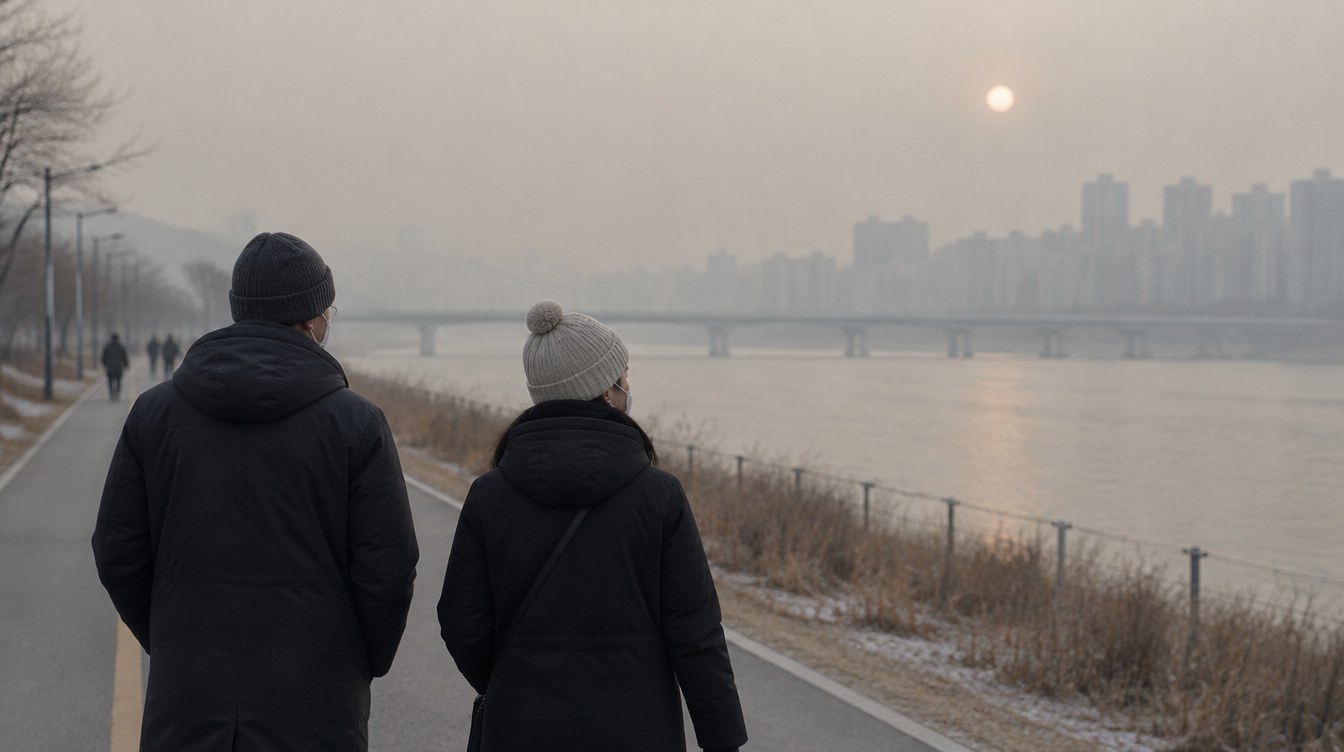
This guide is for foreigners living in Korea or visiting between December and March. It covers how to read the numbers, which mask actually filters fine dust, what happens on an emergency day, and what to do if you own an old diesel car. It is general information, not medical advice. If you have asthma, heart or lung disease, are pregnant, or are caring for a baby or an older relative, ask your doctor how fine dust affects you.
Fine dust in 60 seconds: PM10 vs PM2.5
AirKorea’s behaviour guide defines fine dust (미세먼지, PM10) as particles smaller than 10 micrometres and ultrafine dust (초미세먼지, PM2.5) as particles smaller than 2.5 micrometres. It says they are about 1/20 to 1/30 the width of a human hair (about 60 µm). The same page, citing the Korea Disease Control and Prevention Agency (KDCA), says short-term exposure can make asthma attacks, acute bronchitis and arrhythmia worse in people who already have those conditions. Long-term exposure can raise the risk of heart disease, lung disease and lung cancer. It names the sensitive groups as pregnant women, infants and children, older adults, and people with heart, blood-vessel, respiratory or allergic diseases.
The season matters. K-eco’s MECAR portal says 83% of the days with PM2.5 over 50 µg/m³ in the last three years fell between December and March. That is why the government runs a stricter four-month regime every winter.
How to read the grades: the table to keep on your phone
Korean apps, weather news and building notices use the same four-step scale. AirKorea publishes the bands both on its index page and in its behaviour guide. The guide shows the forecast grades as below and credits them to the Ministry of Environment, now the Ministry of Climate, Energy and Environment.
| Grade (Korean) | Colour on AirKorea | PM2.5 (µg/m³) | PM10 (µg/m³) | What AirKorea advises |
|---|---|---|---|---|
| Good (좋음) | Blue | 0–15 | 0–30 | No restriction in AirKorea’s guide |
| Moderate (보통) | Green | 16–35 | 31–80 | No restriction in AirKorea’s guide |
| Unhealthy (나쁨) | Yellow | 36–75 | 81–150 | Sensitive groups avoid hard outdoor activity; everyone cuts long or strenuous outdoor activity |
| Very Unhealthy (매우나쁨) | Red | 76 or more | 151 or more | Sensitive groups refrain from hard outdoor activity; everyone avoids long or strenuous outdoor activity |
The grade bands use 24-hour average concentrations (AirKorea calls these “24-hour predicted moving averages”). The single hourly figure on a station can jump above or below the band for that day. The advice column condenses AirKorea’s “나쁨/매우나쁨 시” guidance.
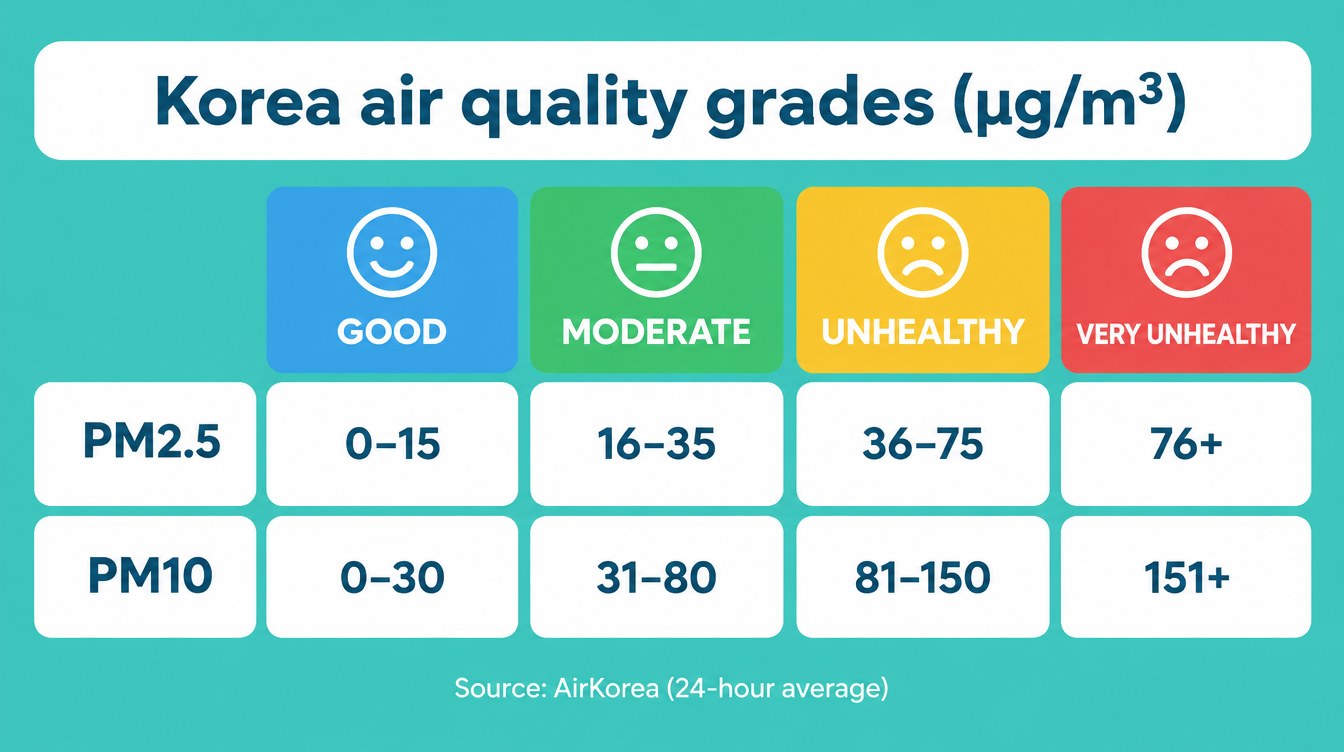
Worked example (our arithmetic from the AirKorea bands): a PM2.5 reading of 44 µg/m³ is Unhealthy, because it sits above 35 and below 76. It is 9 µg/m³ above the top of Moderate and 32 µg/m³ short of Very Unhealthy. The Korea Herald reported exactly that reading for Seoul at 10 a.m. on 26 March 2026 and described levels above 35 as “bad” and above 75 as “very bad”, the same cut-offs. A PM10 reading of 120 µg/m³ is also Unhealthy (81–150), but the same 120 for PM2.5 would be Very Unhealthy. Always check which pollutant a number refers to.
Advisories and warnings (주의보·경보) are a separate system
Grades describe the forecast or the day’s average. Advisories and warnings are alerts that a province or city issues when hourly readings at its monitoring stations stay high. AirKorea lists the criteria, which come from the Clean Air Conservation Act and its enforcement rules:
| Alert | PM2.5 trigger (hourly average) | PM10 trigger (hourly average) | Lifted when |
|---|---|---|---|
| Advisory (주의보) | 75 µg/m³ or more for 2 hours | 150 µg/m³ or more for 2 hours | PM2.5 below 35 / PM10 below 100 |
| Warning (경보) | 150 µg/m³ or more for 2 hours | 300 µg/m³ or more for 2 hours | Downgraded to advisory when PM2.5 is below 75 / PM10 below 150 |
So a PM2.5 advisory means hourly levels have stayed in the Very Unhealthy band for at least two hours. A warning means they have reached twice that threshold.
How to check the air in English
- AirKorea website in English (airkorea.or.kr/eng). The Current Air Quality page shows PM2.5, PM10, ozone and other pollutants by region and station. It has a forecast for today, tomorrow and the day after, and uses the same Good/Moderate/Unhealthy/Very Unhealthy colours. AirKorea says the newest data are posted at the end of each hour and are provisional until confirmed. The Air Quality Watch page shows each hour of today and yesterday for a chosen city, which is handy before a run or a school pick-up.
- AirKorea in Korean (airkorea.or.kr/web) has more pages, such as advisory/warning histories and the “미세먼지 재난 위기경보 발령현황” (fine-dust disaster alert status) page. Browser auto-translate works well enough to read the tables.
- The official app. K-eco also publishes an app called 에어코리아 (AirKorea). We checked only the website’s English pages for this guide, so treat the app’s language options as something to confirm on your phone.
- Emergency text alerts. Under the Ministry’s alert tables, emergency disaster texts (긴급재난문자) are part of the response when a fine-dust crisis alert is issued, and MECAR says emergency measures are announced by disaster text. If an alert arrives on your phone in winter, check AirKorea’s alert pages to see whether it is a fine-dust notice.
- Phone line. AirKorea lists the weather call centre on 131 (charged) for real-time fine-dust and forecast questions.
The seasonal management period, 1 December 2026 to 31 March 2027
The seasonal management system (미세먼지 계절관리제) is, in K-eco’s words, a period of stronger preventive measures than usual from December to March, meant to cut how often and how badly high-concentration episodes happen. It is set under the Special Act on the Reduction and Management of Fine Dust. In its 9 November 2026 release, the Ministry of Climate, Energy and Environment confirmed that the 8th season runs from 1 December 2026 to 31 March 2027. Mediapen and Gukje News reported the same dates, and the Busan city government posted its own 8th-season vehicle notice on 12 November 2026 for the period through 31 March 2027.
What changes for ordinary residents is mostly about cars. Here is the 8th-season rule as K-eco’s MECAR portal sets it out:
| Item | 8th season rule (MECAR) |
|---|---|
| Where | Seoul, Incheon, Gyeonggi, Busan, Daegu, Gwangju, Daejeon, Ulsan, Sejong |
| Which vehicles | Emission grade 5 vehicles (배출가스 5등급) from anywhere in Korea without a low-emission retrofit |
| When | Weekdays 06:00–21:00; Saturdays, Sundays and public holidays excluded |
| Fine | ₩100,000, once per day |
| Common exemptions | Retrofitted (filter-fitted) vehicles, emergency vehicles, vehicles for people with disabilities, national-merit (veterans’) vehicles |
| Questions | 1833-7435 (grade lookups and rules) |
Worked calculation (our arithmetic): 1 December 2026 to 31 March 2027 is 121 days, of which 87 are Monday-to-Friday weekdays before public holidays are taken out. Public holidays are excluded from enforcement, so the real number of enforcement days is lower. A grade-5 van driven into Seoul on three separate weekdays during the season could collect 3 × ₩100,000 = ₩300,000 in fines. Several cameras on the same day still count as one fine.
Conflict we found: the government’s card for the 7th season (2025–26) said Ulsan enforced only until 18:00. MECAR’s 8th-season page lists 06:00–21:00 for all nine regions. If you drive an older vehicle in Ulsan, check the city’s own 8th-season notice before relying on either time.
Is my car grade 5?
Grade 5 is the oldest emission class. The government’s 2025 policy card gives the general cut-offs: petrol and LPG vehicles certified to standards from 1987 or 2000 and earlier (depending on vehicle class), and diesel vehicles certified to standards from before July 2002. The card adds that the year a car was built and the year of the standard it meets can differ. The only reliable check is the 소유차량 등급조회 (owned-vehicle grade lookup) on MECAR (mecar.or.kr) or a call to 1833-7435. If you bought an older used diesel van or truck as a resident, check before 1 December.
Two more Seoul rules can catch the same vehicles. The Seoul city government’s comparison table lists:
- Green Transport Zone (녹색교통지역), inside the old city centre: grade-5 vehicles without a retrofit are restricted every day of the year, 06:00–21:00. The fine is ₩100,000 per day, and ₩200,000 for drivers caught three or more times.
- Capital-area low-emission zone (LEZ): aimed at grade-5 diesel vehicles registered in the capital area that have ignored a retrofit order. It applies 24 hours a day from April to November, with one warning and then ₩200,000 at most once a month.
The city notes that fines under different schemes can be added together if one trip breaks more than one rule.
Subsidy deadline: the government’s 2025 policy card says subsidies for scrapping grade-5 vehicles early or fitting a diesel particulate filter run only until 2026. Gukje News reported on 11 November 2026, citing Gyeongsangnam-do, that support ends at the end of this year. It said vehicles under 3.5 tonnes can get up to ₩3 million, depending on type and conditions, and that some regions have already closed applications. Ask your city, county or district office.
Emergency reduction measures (비상저감조치): what triggers them and what changes
Emergency reduction measures are short-term, region-wide cuts for days when PM2.5 is forecast to be very high. MECAR and the Ministry’s 9 November 2026 alert tables give the same three triggers. A governor or mayor can issue measures for all or part of a region if any one of these is met:
- Today’s PM2.5 average (00:00–16:00) is over 50 µg/m³, and tomorrow’s 24-hour average is forecast over 50 µg/m³.
- A PM2.5 advisory or warning was issued today (00:00–16:00), and tomorrow is forecast over 50 µg/m³.
- Tomorrow is forecast over 75 µg/m³ (the forecast grade Very Unhealthy).
Timeline on the day. MECAR says authorities decide between 17:00 and 17:15 and announce after 17:15 through disaster texts, roadside signboards and TV captions. The measures run 06:00–21:00 the next day. In the capital area, if two of Seoul, Incheon and Gyeonggi meet the criteria, all three take the measures. A lighter preliminary step (예비저감조치), mainly for the public sector, can be taken the day before when the day-after-tomorrow is forecast Very Unhealthy, or when both tomorrow and the day after are forecast over 50 µg/m³.
What changes for you on an emergency day:
- Grade-5 vehicles are restricted 06:00–21:00, with a ₩100,000 fine (MECAR says weekends and holidays are excluded). This applies in every region that issues the measures, not only the nine seasonal-ban regions.
- Public-sector car rules: government offices and public institutions run an odd-even number-plate scheme (차량 2부제) for staff and official cars.
- Construction sites and factories shorten or adjust hours. Public plants cut emissions; under the Ministry’s tables this is 15–20% at the first alert level and 25–30% at the second.
- Schools and nurseries. MECAR’s FAQ says closure or shortened-class recommendations are not automatic. They are considered only when the next day is forecast Very Unhealthy (PM2.5 over 75 µg/m³), or when a PM2.5 warning (150 µg/m³ or more for two hours) is issued during an emergency day. Even then, childcare is still provided. Nurseries normally stay open and tell parents they may keep children at home.
The four-level crisis alert behind it
Since 2019, high PM2.5 has counted as a social disaster under Korea’s disaster-management law. The Ministry’s alert table, attached to its 9 November 2026 release, links emergency measures to a four-level crisis alert:
| Alert level | Main condition (PM2.5) | Extra steps in the Ministry’s table |
|---|---|---|
| Interest (관심, blue) | Emergency-measure criteria met regionally or nationwide | Grade-5 restriction, public-sector odd-even cars, coal-power output caps, public plants −15–20%, masks stocked at facilities for vulnerable groups |
| Caution (주의, yellow) | Interest for 2 days in a row plus one more day expected, or hourly 150 µg/m³ for 2+ hours with tomorrow forecast over 75 | Official cars fully restricted, public plants −25–30%, some public construction work halted, masks handed out at facilities for vulnerable groups |
| Alert (경계, orange) | Caution for 2 days in a row plus one more day expected, or hourly 200 µg/m³ for 2+ hours with tomorrow forecast over 150 | Alert and Serious share one column: voluntary odd-even scheme for private cars, outdoor sports events and concerts asked to reschedule, local governments hand out free masks |
| Serious (심각, red) | Alert for 2 days in a row plus one more day expected, or hourly 400 µg/m³ for 2+ hours with tomorrow forecast over 200 (nationwide) | Same as Alert |
Mediapen’s summary puts the full restriction on official cars at the Alert/Serious level; the Ministry’s own table lists it from Caution. We follow the Ministry’s table.
On 10–11 November 2026 the Ministry ran a national drill with 11 ministries and 16 provinces and cities, testing a Caution-level scenario. No fines were issued during the drill (Ministry release; Mediapen; Gukje News).
Masks: KF80 vs KF94, and what not to buy
The MFDS, Korea’s medicines regulator, approves health masks (보건용 마스크) as quasi-drugs (의약외품). Its February 2025 guidance, published on korea.kr, sets out the grades:
| Mark on the pack | What MFDS says it filters | When it fits |
|---|---|---|
| KF80 | At least 80% of particles averaging 0.6 µm | Everyday fine-dust days; easier breathing |
| KF94 | At least 94% of particles averaging 0.4 µm | Higher-pollution days; tighter fit, harder to breathe through |
| KF99 | At least 99% of particles averaging 0.4 µm | Rarely needed by the public; hardest to breathe through |
MFDS says a higher number blocks more but can make breathing harder or uncomfortable. It advises choosing a grade by how bad the dust is and how much air you need, for example while walking uphill or commuting by bike. Korea JoongAng Daily’s explainer gives the same 80%/0.6 µm and 94%/0.4 µm definitions.
MFDS’s rules for wearing one, in short:
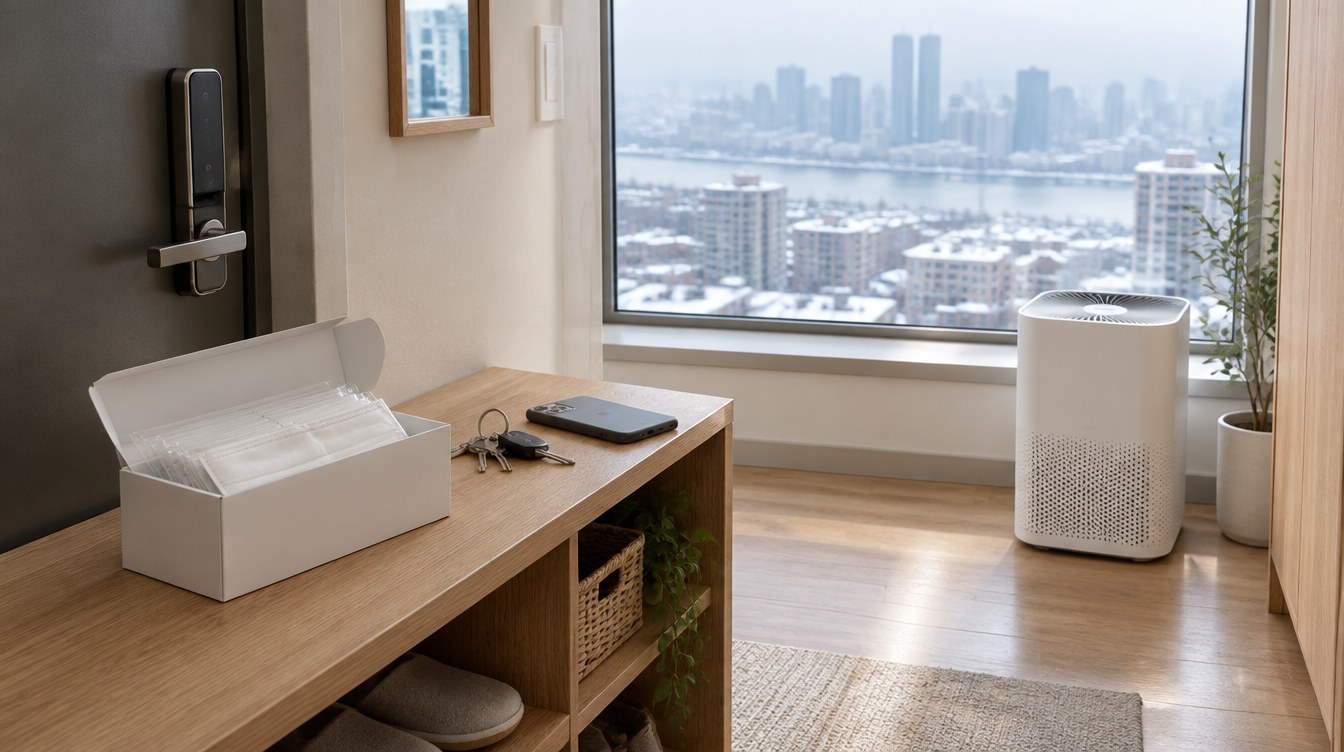
- Buy the right product. Look for the words “의약외품” and a KF80, KF94 or KF99 mark on the box or wrapper, in pharmacies, supermarkets, convenience stores or online. MFDS warns that some cold-weather face covers and unapproved masks are sold as if they block fine dust. Online, check the listing shows the KF mark. Product details can be looked up on the MFDS drug-information site (nedrug.mfds.go.kr).
- Check the expiry date. MFDS says filtering performance is guaranteed only within the approved shelf life.
- Fit matters. Cover nose and mouth completely and press the edges so there are no gaps. Do not stuff a tissue or towel inside, because that breaks the seal.
- Do not wash or reuse. Washing deforms the filter, and a used mask may carry dust and germs.
- Stop if breathing gets hard. MFDS and AirKorea both say pregnant women, children, older adults and people with heart or lung disease should take the mask off if it makes breathing difficult or causes chest pain, and talk to a doctor if needed.
- A mask is not a force field. MFDS stresses that health masks do not block fine dust completely, so on very bad days the main advice is still to cut time outdoors, and to wash your face and hands when you get home.
What to do on a bad-air day: a practical checklist
From AirKorea’s behaviour guide (which cites KDCA for the health sections):
- Before you go out: check the forecast grade, not just the current number, and plan the day around it.
- Outdoors: on Unhealthy days, cut long or strenuous activity such as running, cycling, hiking or marathons. Exercise indoors at a lower intensity. Avoid main roads and construction sites, where levels run higher.
- At home: AirKorea still recommends ventilating about three times a day for 30 minutes, between 10:00 and 21:00 rather than in stagnant early-morning air, opening windows on opposite sides. Use a HEPA-filter air purifier as a supplement, not a replacement. Keep indoor humidity at 40–60% in winter.
- Cooking: on high-dust days, go easy on grilling and frying. Run the hood fan and air the kitchen afterwards.
- Smoking, candles, incense: AirKorea says indoor smoking produces PM10 at Very Unhealthy and PM2.5 at Unhealthy levels, and asks people to avoid candles, incense and air fresheners indoors.
- Hydration and hygiene: drink enough water and wash hands and face after coming in.
- Symptoms: for itchy eyes or a runny nose, AirKorea suggests ordinary symptomatic care. People with asthma, heart disease, eczema or allergic rhinitis should get their usual treatment promptly. It also says fine dust does not build immunity: every exposure can affect you.
If someone has chest pain, severe shortness of breath or confusion, call 119 (an interpreter is available). Our guides on winter cold-related illness in Korea and Korea’s checkup lung function test cover related winter and lung-health questions. If you have just arrived, start with Living in Korea as a Foreigner: your first 90 days.
Common problems and quick fixes
| Problem | What to do |
|---|---|
| The app colour and the number disagree | Check whether it is PM2.5 or PM10, and whether it is an hourly figure or the 24-hour grade. AirKorea’s grades use 24-hour averages |
| A Korean disaster text arrives in the evening | It may be the emergency-measure notice for the next day, which MECAR says goes out after 17:15. Check AirKorea’s alert pages |
| The pharmacy mask has no KF mark | Do not count on it for fine dust. MFDS says only approved “의약외품” KF products are tested for particle filtering |
| You own an old diesel van as a resident | Look up its grade on MECAR or call 1833-7435 before 1 December. Ask your district office about retrofit or scrappage support before year-end |
| Your child’s school sends a closure notice | Closures are recommended only on Very Unhealthy forecasts or PM2.5 warnings during emergency days. Childcare continues (MECAR FAQ) |
Winter air is dry as well as dusty: see Dry skin and eczema in Korea’s winter: when to see a dermatologist and what NHIS covers.
Frequently asked questions
Q. When is fine dust season in Korea in 2026–27?
The government’s 8th seasonal management period runs from 1 December 2026 to 31 March 2027 (Ministry of Climate, Energy and Environment, 9 November 2026). K-eco says 83% of days with PM2.5 over 50 µg/m³ in the last three years fell in December to March. The Korea Herald noted in March 2026 that yellow dust from overseas can add to spring pollution.
Q. What PM2.5 level is “bad” in Korea?
On AirKorea’s scale, PM2.5 of 36–75 µg/m³ is Unhealthy (나쁨) and 76 or more is Very Unhealthy (매우나쁨). Good is 0–15 and Moderate is 16–35. For PM10, Unhealthy is 81–150 and Very Unhealthy is 151 or more.
Q. Is there an English version of AirKorea?
Yes. airkorea.or.kr/eng has English pages for current air quality by region and station, a three-day forecast and hourly trends, with data posted at the end of each hour.
Q. Should I buy KF80 or KF94?
MFDS says KF80 filters at least 80% of 0.6 µm particles and KF94 at least 94% of 0.4 µm particles. A higher grade blocks more but is harder to breathe through, so choose by the dust level and your own breathing. Either way, buy only packs marked “의약외품” with a KF mark, and stop wearing one if breathing becomes difficult.
Q. What happens on an emergency reduction day?
It is decided around 17:00 the day before and runs 06:00–21:00. Grade-5 vehicles are restricted with a ₩100,000 daily fine, public offices run odd-even car rules, construction and plants cut hours, and schools may be advised to close only if PM2.5 is forecast over 75 µg/m³ or a warning is issued.
Q. Does the grade-5 vehicle ban apply to foreigners and rental cars?
It applies to the vehicle, not the driver’s nationality. Any grade-5 vehicle without a retrofit is restricted on weekdays 06:00–21:00 in the nine regions during the season, wherever it is registered. Check a vehicle’s grade on MECAR (mecar.or.kr) or at 1833-7435.
Q. Should I stop opening windows during fine dust season?
AirKorea still recommends short ventilation, about three times a day for 30 minutes between 10:00 and 21:00, even on high-dust days, with a HEPA air purifier as a supplement.
Not medical advice. This article is general information about Korea’s air-quality system, not medical advice. If you have asthma, heart or lung disease, are pregnant, or care for a young child or older relative, ask a doctor how to manage fine-dust days. For live readings and official guidance, use AirKorea; in an emergency call 119.
Sources
- Ministry of Climate, Energy and Environment, press release “고농도 초미세먼지 발생… 실전처럼 훈련하고 빈틈없이 대응한다” (9 November 2026), with attachments on crisis-alert criteria and alert-level measures (PDF read in full): https://mcee.go.kr/home/web/board/read.do?boardId=1905730&boardMasterId=939&menuId=10598
- AirKorea (K-eco), Comprehensive Air-quality Index page (grade bands, 24-hour moving averages): https://www.airkorea.or.kr/web/khaiInfo?pMENU_NO=129
- AirKorea, fine-dust advisory/warning criteria: https://www.airkorea.or.kr/web/pmWarning?pMENU_NO=115
- AirKorea mobile, fine-dust behaviour guide (grades, alerts, sensitive groups, ventilation, masks; cites the Ministry of Environment and KDCA): https://m.airkorea.or.kr/info/behaviorInfo1
- AirKorea English, Current Air Quality and Air Quality Watch: https://airkorea.or.kr/eng/currentAirQuality?pMENU_NO=68 and https://airkorea.or.kr/eng/airQualityWatch?pMENU_NO=153
- K-eco MECAR, seasonal management vehicle restriction (8th season): https://www.mecar.or.kr/dr/info/seasonManagement.do
- K-eco MECAR, emergency reduction measures (criteria, timeline, school FAQ): https://www.mecar.or.kr/dr/info/emergencyReductionDr.do
- Ministry of Climate, Energy and Environment via korea.kr, “배출가스 5등급 차량 운행제한 시행” (7th season card, 12 November 2025): https://www.korea.kr/news/policyNewsView.do?newsId=148954594
- Busan Metropolitan City, notice 2026-3254 on the 8th season grade-5 restriction (12 November 2026): https://www.busan.go.kr/nbgosi/view?gosiGbn=A&sno=80385
- Seoul Metropolitan Government, grade-5 vehicle restriction schemes (updated 10 March 2026): https://news.seoul.go.kr/env/archives/505710
- MFDS via korea.kr, “황사·미세먼지에는 ‘보건용 마스크’ 착용” (28 February 2025): https://www.korea.kr/news/policyNewsView.do?newsId=148940117
- MFDS press release “생활 속 미세먼지 대처법” (6 March 2019, PDF): https://www.mfds.go.kr/mfds/pop/files/pop_hyp5_doc_01.pdf
- The Korea Herald, “Spring’s here, but beware of toxic air” (26 March 2026): https://www.koreaherald.com/article/10703378
- Korea JoongAng Daily, “Everything you wanted to know about masks, but were afraid to ask” (16 February 2020): https://www.koreajoongangdaily.com/business/everything-you-wanted-to-know-about-masks-but-were-afraid-to-ask/10763525
- Mediapen, “초미세먼지 재난대응 실전 점검…정부, 16개 지방정부와 대응훈련” (9 November 2026): https://www.mediapen.com/news/view/1136151
- Gukje News, “초미세먼지 ‘주의’ 발령되면 무슨 일이 벌어질까?” (11 November 2026): https://www.gukjenews.com/news/articleView.html?idxno=3748887
- VISITKOREA, “Disaster Safety Services for International Visitors in Korea” (119 interpreter; 2 October 2025): https://english.visitkorea.or.kr/svc/contents/contentsView.do?vcontsId=248145
How we checked: On 15 November 2026 we read the Ministry’s 9 November release and its PDF attachments, the AirKorea index, warning, behaviour-guide and English pages, both MECAR restriction pages, the Seoul and Busan pages and the two MFDS mask documents. We then matched the season dates, grade bands, triggers and mask definitions against The Korea Herald, Korea JoongAng Daily, Mediapen and Gukje News. The 121-day and 87-weekday counts, the ₩300,000 example and the “9 µg/m³ above Moderate” comparison are our own arithmetic from the published dates, fines and bands. The Ulsan enforcement-hours conflict is recorded above.
Researched and drafted with AI assistance; checked against the sources listed.


2 Comments