Bogeonjeung in Korea: Who Needs a Health Certificate, the ₩3,000 Test and Online Reprints
Haesul Health desk (AI-assisted). As of 20 November 2026 (KST). Based on the Food Sanitation Act and its Enforcement Rule, the Ministry of Food and Drug Safety (MFDS) Rule on Health Examinations for Food Sanitation Workers (in force from 29 September 2026), the Gov24 service page, the e-Health public health portal, and fee pages of district health centres in Seoul, Busan, Incheon and Gyeonggi. Visa checks: the HRD Korea employment-permit guide, a Korean embassy notice on tuberculosis certificates and a Seoul city hospital’s price list. General information, not medical or legal advice.
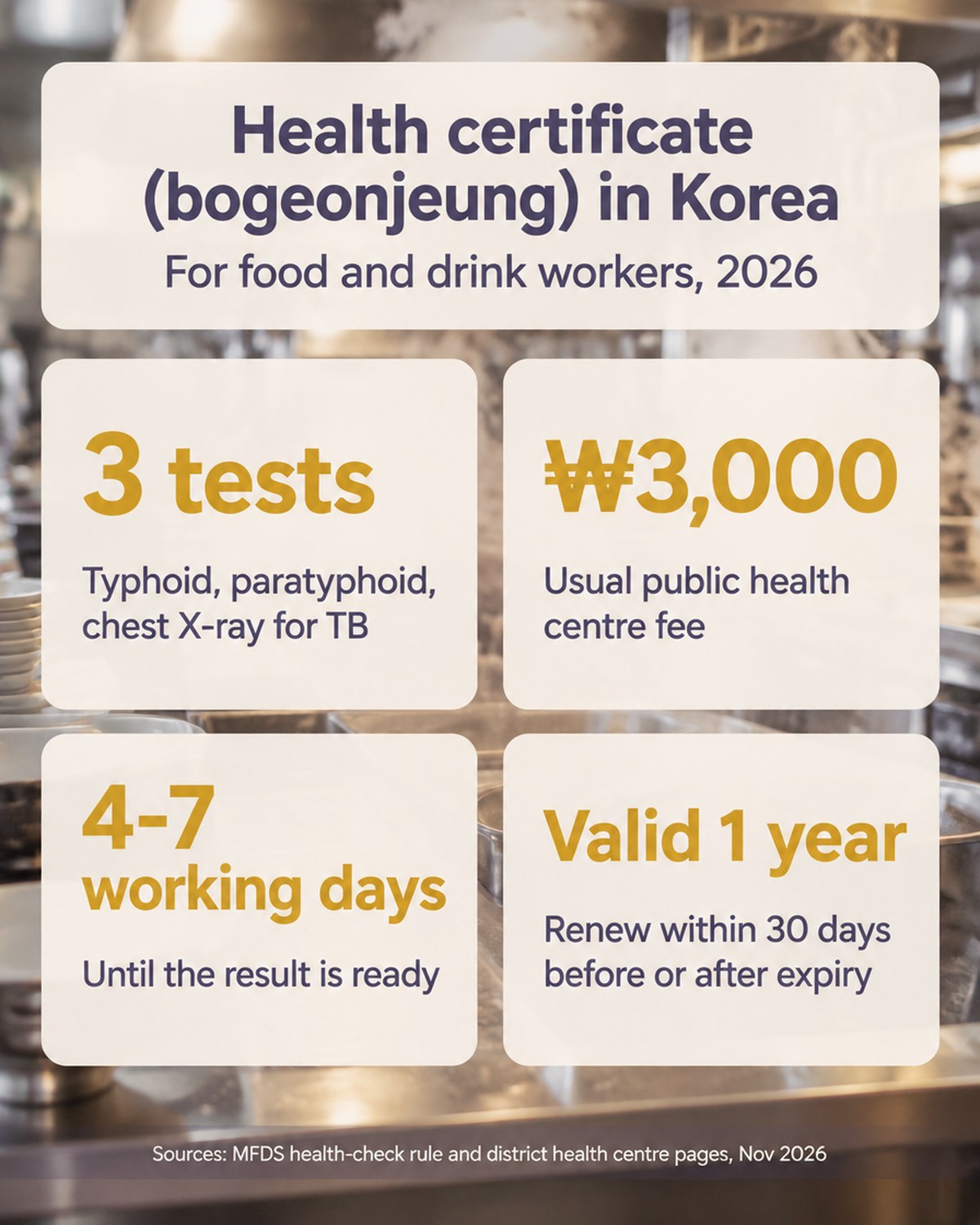
Quick answer: If you will cook, prepare, store, carry or sell unpackaged food or drinks in Korea (restaurant kitchen, café, bakery, food factory, canteen), you need a health certificate (건강진단결과서, still called 보건증, bogeonjeung) before your first shift. It covers three tests: typhoid, paratyphoid and a chest X-ray for tuberculosis. At a public health centre (보건소, bogeonso) it usually costs ₩3,000, and the result takes about 4 to 7 working days. It is valid for one year. Once your result is normal, you can print it free online at e-health.go.kr or Gov24. It is not the same as a visa medical check. An E-2 drug test or a TB certificate for immigration does not replace it.

What the health certificate is (and isn’t)
The bogeonjeung is a food-safety document. Article 40 of the Food Sanitation Act says business operators and staff who handle food must have a health examination. The detailed rule is the MFDS Rule on Health Examinations for Food Sanitation Workers (식품위생 분야 종사자의 건강진단 규칙). The official name of the paper you get is the “health examination result for food sanitation workers” (식품위생 분야 종사자 건강진단 결과서). Koreans still say bogeonjeung, the name of the older card, and most health-centre pages print both names.
It checks only whether you might pass on a few food-borne or airborne infections. It is not a general health check-up, it says nothing about your fitness for work, and it is not a visa document. If you want a full check-up, see our guide to Korea’s national health checkup. For questions about the chest X-ray, see what a chest X-ray result means in a Korean checkup.
Who needs one
Article 49 of the Food Sanitation Act Enforcement Rule sets the group. It covers business operators and employees who directly gather, make, process, cook, store, transport or sell food or food additives. People who only transport or sell fully packaged food are exempt. Staff must take the test before they start the business or start working. Health-centre pages give the same list. Osan’s centre, for example, names general restaurants, snack bars (휴게음식점) and bars as typical workplaces.
In practice, that usually means:
- Restaurant and café staff who cook, make drinks, plate food or wash dishes (kitchen and floor staff who handle food)
- Bakery, bunsik, fried-chicken and delivery-kitchen workers
- Food factory and food-processing line workers, including foreign workers placed in food manufacturing
- Staff of group canteens (집단급식소) such as company, school and hospital cafeterias. Gov24 also lists school-meal law and the separate check for entertainment-venue (유흥업) workers as legal bases.
- Owners of these businesses, not just employees
Students on a D-2 or D-4 visa who have part-time work permission, working-holiday (H-1) visitors and spouses on F-visas follow the same rule if the job involves handling food. The rule depends on what the job involves, not on your nationality or visa. Someone who only stocks sealed packaged snacks may be exempt. Ask your employer what your exact tasks are. Both you and the owner can be fined if you work without a valid result.
What happens if you skip it
The penalty schedule in the Food Sanitation Act Enforcement Decree (Annex 2) sets these administrative fines:
| Who | 1st violation | 2nd | 3rd or later |
|---|---|---|---|
| Employee who did not take the exam | ₩100,000 | ₩200,000 | ₩300,000 |
| Owner (or canteen operator) who did not take it | ₩200,000 | ₩400,000 | ₩600,000 |
| Owner who lets an unexamined person work: 5+ staff, half or more unexamined | ₩500,000 | ₩1,000,000 | ₩1,500,000 |
| Same, 5+ staff, under half unexamined / 4 or fewer staff, half or more | ₩300,000 | ₩600,000 | ₩900,000 |
| Same, 4 or fewer staff, under half unexamined | ₩200,000 | ₩400,000 | ₩600,000 |
| Owner who lets someone work after a result showing a disease that could harm others | ₩1,000,000 | ₩2,000,000 | ₩3,000,000 |
The government’s Easylaw service gives the same figures. Article 50 of the Enforcement Rule lists the conditions that stop you working with food until you are cleared: infectious tuberculosis, certain notifiable infections, and skin disease or other pus-forming infections.
The three tests
Since 8 January 2024 the exam has three items (Rule Article 2):
- Typhoid (장티푸스)
- Paratyphoid (파라티푸스), which replaced the old infectious-skin-disease check
- Pulmonary tuberculosis (폐결핵), checked with a chest X-ray
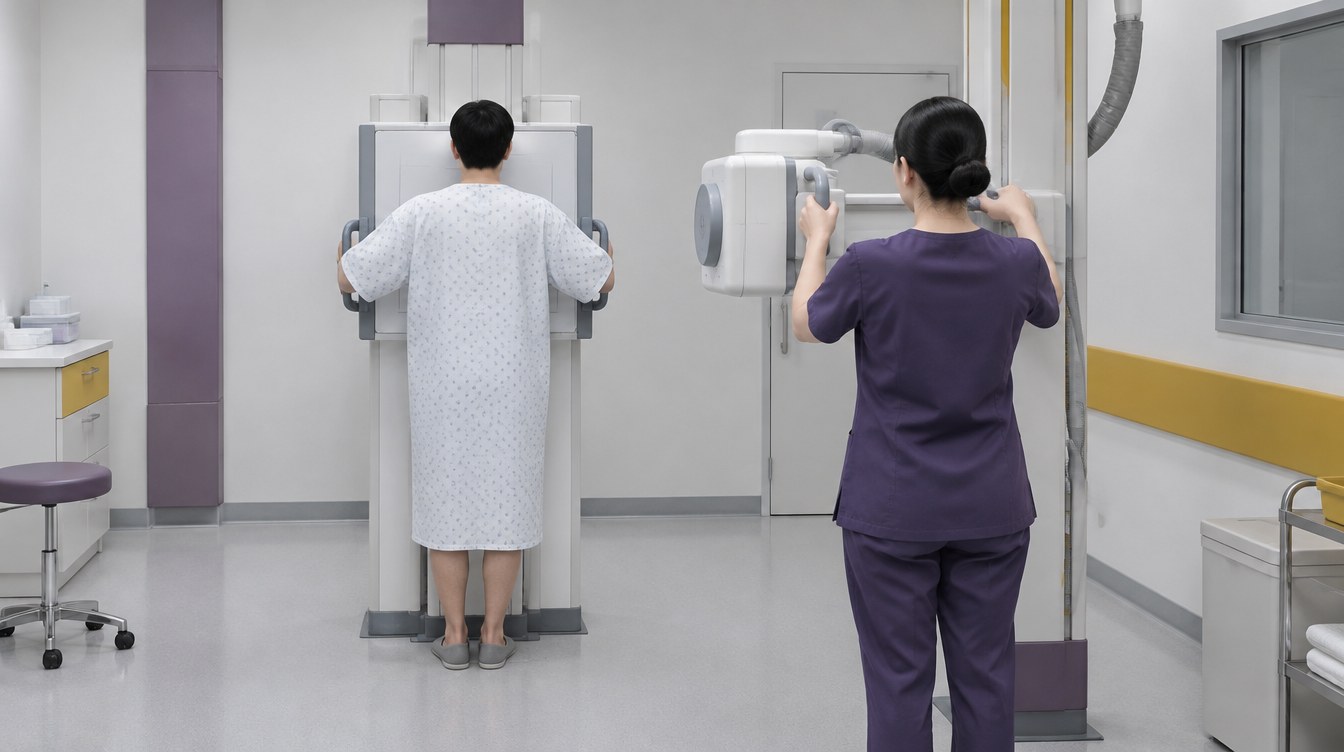
For the typhoid and paratyphoid tests, staff take a sample. Bupyeong District’s health centre lists stool, rectal swab, blood or urine as possible samples. Rapportian, reporting the 2024 change, describes the usual method: a cotton swab inserted 2.5–4 cm into the anus. The tuberculosis part is a standard chest X-ray. Soonchunhyang University Bucheon Hospital’s check-up centre says no fasting is needed for this exam.
Step by step at a public health centre
- Find your health centre. Every city district (구) or county has one. Search “[district name] 보건소 건강진단결과서” or call the district office. Many centres only take this test on certain weekdays or until mid-afternoon. Gyeongju, for example, runs its tests until 15:00 on Wednesdays and Fridays and until 17:00 on other weekdays. Arrive early.
- Bring ID. Yeongdeungpo and Bucheon list the alien registration card (외국인등록증) for foreigners. If you don’t have one yet, ask whether your passport is accepted before you go. Bring the fee in card or cash. The centre will give you a short application form to fill in.
- Pay and get tested. The route in Yeongdeungpo is reception → doctor’s room → X-ray room → lab sample → collect at reception.
- Wait for the result. Busanjin, Bucheon, Gyeongju and Buan say 4 days (excluding holidays). Yeongdeungpo says 5 and Osan says 7. Gov24 says “about 5 days”.
- Collect it. Either go back to the centre with your ID, or print it online (next section). Someone else can collect it with a signed proxy form (대리수령 위임장) and both people’s IDs.
- Give a copy to your employer. Keep the PDF on your phone. Inspectors check whether the result is still valid.
If something abnormal shows up, such as a shadow on the X-ray, the centre will call you for further tests. You cannot get a “normal” certificate online until that is cleared. Our guide to seeing a doctor in English in Korea explains interpreting lines and international clinics if you need follow-up care.
Getting it online, and reprints
Gov24’s page for this service says the result can be issued offline at the centre or online through the public health portal (www.e-health.go.kr): Online civil services → Certificates → Health examination result (보건증). It can also be issued on Gov24 (gov.kr). The e-Health portal adds some limits:
- Only results with a “normal / suitable” (정상/적합) decision can be viewed online. Anything else must be collected in person.
- It only holds results from public institutions (health centres, public medical centres). If you tested at a private clinic or hospital, ask that hospital for copies. Yeongdeungpo says a health centre cannot reissue a private hospital’s result.
- You must log in with a simple-authentication app or a joint certificate, and the name must match. As a foreigner, you’ll usually need a Korean phone line or bank certificate in your own name, linked to your alien registration number. If yours is in an employer’s or friend’s name, it won’t work.
- Help line: 1566-3232 (ARS 5 then 3, weekdays 9:00–18:00).

Reprints are cheap. Osan and Bucheon charge ₩400 / ₩300 for a paper reprint at the counter and nothing online. Busanjin and Yeongdeungpo say results from most health centres are linked nationwide. If you moved city, a normal result can usually be printed at another health centre.
What it costs: health centre vs private clinic
Since November 2024, Rule Article 5 lets each local government set the health-centre fee by ordinance. In practice, every centre we checked still lists ₩3,000:
| Health centre (page checked Nov 2026) | Fee | Time to result | Paper reprint |
|---|---|---|---|
| Yeongdeungpo-gu, Seoul | ₩3,000 | 5 working days | linked nationwide |
| Busanjin-gu, Busan | ₩3,000 | 4 days | other centres can issue if normal |
| Bucheon, Gyeonggi | ₩3,000 | 4 days | ₩300 (free online) |
| Osan, Gyeonggi | ₩3,000 | 7 days | ₩400 (free online) |
| Gyeongju, Gyeongbuk | ₩3,000 | 4 days | — |
| Buan, Jeonbuk | ₩3,000 | 4 days | online issue; reprints at the counter |
Private hospitals and clinics can also do the exam (Rule Article 3), and some will even visit a workplace if the business asks. They set their own prices. For example, Soonchunhyang University Bucheon Hospital’s check-up centre lists ₩15,000 for a bogeonjeung, with walk-in testing. Prices elsewhere vary, so phone first and ask for the “식품위생 건강진단결과서” total.
Worked example (our calculation from the fees above). Say you work in a café for three years and renew every year:
| Route | Year 1 | Over 3 years (3 exams) | Extra |
|---|---|---|---|
| Health centre, print online | ₩3,000 | ₩9,000 | ₩0 |
| Health centre, one paper reprint a year | ₩3,300–3,400 | ₩9,900–10,200 | ₩300–400 per reprint |
| Private hospital (Bucheon example) | ₩15,000 | ₩45,000 | depends on hospital |
| Working without one (first employee fine) | ₩100,000 | — | about 33 health-centre exams’ worth |
The health centre is five times cheaper than the hospital example. The trade-off is time: you wait 4–7 working days, and centres keep shorter hours. If a job starts tomorrow, a private clinic may be faster. Ask when the result will be ready before you pay.
Renewing: the 30-day window
The certificate is valid for one year. Since 8 January 2024 you can renew within 30 days before or after the expiry date. The new year counts from the day after the old one expires, so renewing early doesn’t cost you days (Rule Article 2(3)–(4)). For illness, an accident or a disaster, the local government can extend the deadline once by up to one month.
Bupyeong District’s MFDS-based example uses a certificate valid until 10 March 2024. The renewal window ran from 9 February to 9 April 2024, or to 9 May with the one-month extension. Applying the same rule to a certificate valid until 15 December 2026 gives a window of 15 November 2026 to 14 January 2027, or to about 14 February 2027 if an extension is granted (our calculation). Put the date in your phone calendar.
Not the same as your visa medical check
Many foreign workers have already had a medical for their visa, so this causes confusion. These are different checks, for different authorities, with different tests:
| Check | Who asks for it | What it tests | Typical cost (example) | Replaces bogeonjeung? |
|---|---|---|---|---|
| Health certificate (보건증) | Food business / district hygiene office | Typhoid, paratyphoid, chest X-ray | ₩3,000 at a health centre | — |
| TB certificate for immigration (결핵진단서/결핵확인서) | Immigration office, for nationals of 35 TB high-risk countries applying for long-term stays (visa applications since 1 April 2020; also asked at some extensions and status changes) | Chest X-ray, sputum test if abnormal; valid 3 months | Health centres: test free at Osan and Bucheon, certificate ₩500–2,000; Busanjin ₩6,760 | No (no typhoid tests) |
| E-2 teaching visa medical (채용신체검사서) | Immigration, at alien registration; Ministry of Justice-designated hospitals | Body measurements, blood, urine, chest X-ray, drug screen, syphilis | ₩80,000 at Seoul Children’s Hospital | No |
| E-9 employment-permit check | HRD Korea / employment-training centre | Re-checked during the 16-hour training after arrival; failing means being sent home | Arranged through the programme | No |
The Food Sanitation Act does say that an exam with the same content under another law counts (Article 40(1) proviso). None of the visa checks above includes the typhoid and paratyphoid tests, so they do not count (our reading of the rules; your health centre has the final say). If your factory or restaurant job is on an E-9 visa, you will usually need a bogeonjeung on top of the E-9 medical.
Having a valid health certificate doesn’t make you eligible for national health insurance either. For that, see how NHIS premiums work for foreigners in 2026. If you’re at the health centre in winter anyway, it’s a good time to plan your flu shot in Korea.
Your checklist
- [ ] Ask your employer: does my job involve unpackaged food or drinks?
- [ ] Find your district health centre’s test days and hours
- [ ] Bring your alien registration card (or ask if a passport is accepted) and ₩3,000
- [ ] Expect a chest X-ray and a swab or stool sample
- [ ] Wait 4–7 working days; print the normal result free at e-health.go.kr or Gov24
- [ ] Give your employer a copy; save the PDF on your phone
- [ ] Put the expiry date in your calendar and renew within 30 days either side
Common problems
- “I can’t log in to e-Health.” The simple-authentication app must be in your own name and linked to your alien registration number. If it isn’t, go back to the centre with your ID.
- “My result isn’t online.” Either it isn’t “normal” yet, or you tested at a private hospital. Call the health centre, or ask that hospital.
- “The health centre was full.” Some centres limit daily numbers or close the test early in the afternoon. Arrive in the morning, or use a private clinic that offers the test.
- “My job starts before the result is ready.” The rule says the exam must come before you start. Talk to your employer. Don’t work with food until you have the result.
- “Language.” Call the tourism and interpreting line 1330, or ask a Korean-speaking colleague to phone the centre first.
Frequently asked questions
Q. What is a bogeonjeung in Korea?
It is the common name for the health examination result for food sanitation workers (건강진단결과서). Anyone who cooks, prepares, stores, carries or sells unpackaged food or drinks for a business in Korea needs one before starting work. It covers typhoid, paratyphoid and a chest X-ray for tuberculosis, and it is valid for one year.
Q. How much does a health certificate cost at a Korean health centre?
Every health centre we checked in November 2026 (Yeongdeungpo, Busanjin, Bucheon, Osan, Gyeongju and Buan) charges ₩3,000. Since November 2024 local governments set the fee by ordinance, so check your own centre. Private hospitals set their own price. One university hospital in Bucheon lists ₩15,000.
Q. Can foreigners get a health certificate at a public health centre?
Yes. The rule depends on the job, not your nationality. Bring your alien registration card, which Yeongdeungpo and Bucheon list for foreigners. If you don’t have one yet, ask whether your passport is accepted. The result usually takes 4 to 7 working days.
Q. How do I reissue or print my health certificate online?
Log in to the public health portal e-health.go.kr or Gov24 with a simple-authentication app or joint certificate in your own name, then choose the health examination result. Only normal results from public health centres can be printed online, and online copies are free. Results from private hospitals must be reissued by that hospital.
Q. How long is a Korean health certificate valid?
One year. Since 8 January 2024 you can renew within 30 days before or after the expiry date, and the new year starts the day after the old one ends. The local government can extend the deadline once by up to one month for illness, an accident or a disaster.
Q. Does my visa medical check count as a health certificate?
Usually not. Immigration TB certificates, E-2 hiring medicals and E-9 employment-permit checks do not include the typhoid and paratyphoid tests the food rule requires, so a food job needs a separate health certificate. Your health centre has the final say.
Sources
- MFDS, Rule on Health Examinations for Food Sanitation Workers (식품위생 분야 종사자의 건강진단 규칙; Prime Minister’s Ordinance 2156, in force 29 September 2026; Articles 2, 3 and 5): https://www.law.go.kr/LSW/lsInfoP.do?ancYnChk=0&efYd=20260929&lsiSeq=290621
- Food Sanitation Act Enforcement Rule, Article 49 (who must be examined, before starting work): https://www.law.go.kr/lsLinkCommonInfo.do?chrClsCd=010202&lsJoLnkSeq=1032280395
- Easylaw (Ministry of Government Legislation), Health examinations for food business operators and staff (Article 40 proviso, Article 50 diseases, fines under Enforcement Decree Annex 2): https://www.easylaw.go.kr/CSP/CnpClsMain.laf?ccfNo=3&cciNo=2&cnpClsNo=1&csmSeq=302
- Gov24, Health examination result (보건증) issuance (procedure, about 5 days, e-Health and Gov24 online issuance, legal bases): https://www.gov.kr/portal/service/serviceInfo/135200000129
- e-Health public health portal, Certificate issuance guide (normal results only, public institutions only, authentication, 1566-3232): https://www.e-health.go.kr/gh/caSrvcGud/selectScrtfIssGud.do?menuId=200022
- Yeongdeungpo-gu Health Centre, Health certificate guide (₩3,000, 5 working days, ID incl. alien registration card, nationwide link, private-hospital reissue rule, test route): https://www.ydp.go.kr/health/contents.do?key=5690
- Bupyeong-gu Health Centre, Changes to the health certificate from 8 January 2024 (items, 30-day window, one-month extension, MFDS example and Q&A): https://www.icbp.go.kr/clinic/bbs/bbsMsgDetail.do?bcd=branch_notice&msg_seq=3754
- Rapportian, “Food workers should renew health certificates before expiry” (16 February 2024; 2024 changes, swab method): https://www.rapportian.com/news/articleView.html?idxno=203595
- Busanjin-gu Health Centre, Certificate fees 2026: https://www.busanjin.go.kr/health/index.busanjin?menuCd=DOM_000000503000000000
- Bucheon Health Centre, Certificate fees (updated 5 January 2026): https://pubhealth.bucheon.go.kr/site/homepage/menu/viewMenu?menuid=161002005
- Osan Health Centre, Certificate guide (₩3,000, 7 days, ₩400 reprint, foreigner TB certificate): https://www.osan.go.kr/depart/contents.do?mId=0502020500
- Gyeongju Health Centre, Examination fees (updated 20 October 2026): https://www.gyeongju.go.kr/health/page.do?mnu_uid=3841
- Buan County Health Centre, 2026 certificate and test fees: https://www.buan.go.kr/healthcenter/index.buan?menuCd=DOM_000000802001000000
- Soonchunhyang University Bucheon Hospital check-up centre, Health certificate price (₩15,000, no fasting): https://www.schmc.ac.kr/bucheonHealth/contents.do?key=3999
- HRD Korea, Employment Permit System guide for workers, From entry to departure (16-hour training, health check repeated, failure means return): https://eps.hrdkorea.or.kr/e9/user/employment/employment.do?method=immigrationLabor
- Embassy of the Republic of Korea in Belarus, TB certificate requirement for long-term visas (35 countries, from 1 April 2020, valid 3 months): https://overseas.mofa.go.kr/by-ko/brd/m_7630/view.do?page=1&seq=1346790
- Seoul Metropolitan Children’s Hospital, Hiring medicals incl. E-2 and H-2 (items and prices; updated 9 November 2026): https://childhosp.seoul.go.kr/medical-info/health-medical-examination/employed-physical-examination
How we checked: On 20 November 2026 (KST) we read the current MFDS rule and Article 49 of the Enforcement Rule on the national law portal, the Gov24 and e-Health pages, and six health-centre fee pages. We checked the fines against the Enforcement Decree annex and Easylaw, and the 2024 changes against a health-centre notice and trade press. The cost comparison, three-year totals and renewal dates are our own arithmetic from those pages.
This guide is general information, not medical or legal advice. Test results and whether you may work with food are decided by the health centre or hospital and your local hygiene office. If you have a cough lasting more than two weeks, fever or diarrhoea, see a doctor before working with food. In an emergency, call 119. For interpreting, call 1330.
Researched and drafted with AI assistance; checked against the sources listed.





One Comment