Korea’s Chronic Disease Programme for Hypertension and Diabetes: Can NHIS Foreigners Join?
Haesul Health desk (AI-assisted). As of 14 November 2026 (KST). Based on the Ministry of Health and Welfare (MOHW) press release and annex of 30 September 2024, the National Health Insurance Service (NHIS) programme page and its English pages for foreigners, the Health Insurance Review and Assessment Service (HIRA) fee guide of December 2025, and Korean and English news reports from 2024 to November 2026.
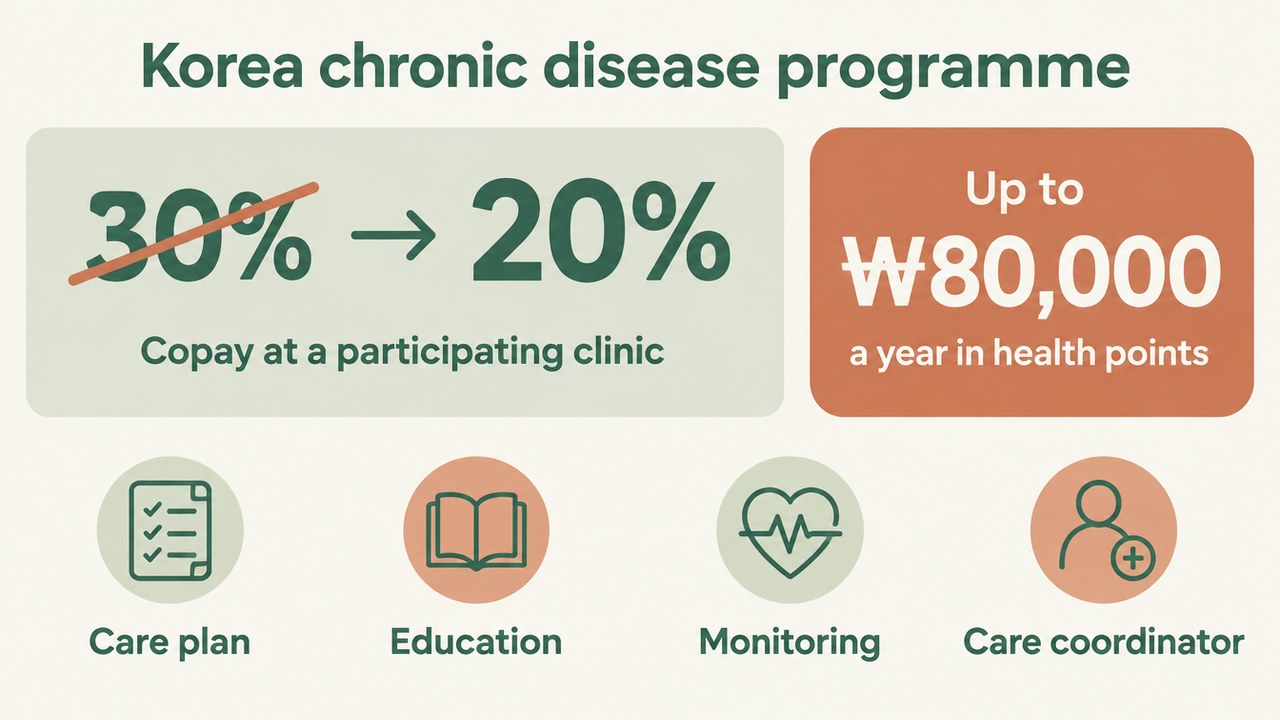
Quick answer: Probably yes, if you are enrolled in NHIS and a clinic doctor has diagnosed you with hypertension or diabetes. Korea’s Primary Care Chronic Disease Management programme (일차의료 만성질환관리 사업) is open to NHIS members and their dependants, and NHIS says its insurance for foreigners “has the same coverage as it does for the Korean citizens”. No official page we read says “foreigners” in so many words, so ask the clinic to confirm before you sign. At a participating clinic you get a one-year care plan, education, blood pressure or blood sugar monitoring and, in some clinics, a care coordinator. Your copay on the programme fee, the related tests and the follow-up consultation falls from 30% to 20%. You can also earn up to ₩80,000 a year in health points.

If your checkup result sheet flagged blood pressure or blood sugar, this programme is what comes after the flag, not something the checkup itself enrols you in. The national checkup is a screening. The programme starts only once a clinic doctor has made a diagnosis and you have signed up. The checkup year ends on 31 December, 47 days from 14 November, so the practical order is: get the confirmatory test, get the diagnosis if it applies, then ask about the programme.
This guide explains who can join, what a participating clinic actually does, what it costs with a worked example, and how to find a clinic that takes patients. It does not tell you how to treat your condition; that is for your doctor.
Can foreigners on NHIS join? What the sources say and do not say
There is no foreigner-specific rule in any of the pages we read. Eligibility follows two things: your NHIS status and your diagnosis. Here is what each official source says.
| Question | What the source says | Source |
|---|---|---|
| Who is the programme for? | Patients with hypertension or diabetes who attend a clinic (의원) as outpatients | MOHW annex, HIRA guide |
| Which diagnoses count? | Hypertension (ICD codes I10–I13, I15) and diabetes (E10–E14); if you have both, the diabetes process is followed | HIRA fee guide, Dec 2025 |
| Insurance requirement | NHIS programme page: aimed at “health insurance members or dependants” (건강보험 가입자 또는 피부양자) | NHIS programme page |
| Do foreign NHIS members get the same cover? | “National Health Insurance for foreigners has the same coverage as it does for the Korean citizens” | NHIS English page for foreigners |
| Is a foreign ID accepted at registration? | The HIRA consent form lists the ID numbers collected as “resident registration number, alien registration number” (주민등록번호, 외국인등록번호) | HIRA fee guide, Dec 2025 |
| Is “foreigner eligible” stated outright? | Not in the pages we read | n/a |
So the evidence points to yes, and nothing we found excludes foreigners, but it is an inference from NHIS membership plus the foreign ID line, not a quoted rule. Foreigners staying more than six months are enrolled in NHIS (the NHIS English page says enrolment has been mandatory since 16 July 2019); our guide to health insurance for foreigners in 2026 covers how that works and what it costs.
Two practical limits apply to everyone:
- A diagnosis is required. A checkup flag alone is not enough. The doctor must diagnose hypertension or diabetes and you must sign an application form and a consent form (신청서, 동의서) at the clinic.
- Clinics cap their patients. HIRA’s guide sets a limit of 500 enrolled patients per clinic, so a clinic can be full. NHIS’s clinic finder tells you to check with the clinic before visiting.
What a participating clinic does
The programme runs in one-year cycles with one doctor you choose. NHIS and HIRA describe four steps.
- Registration. You get an explanation of the programme, sign the application and consent forms, and the clinic registers you in HIRA’s system. NHIS receives the registration the next day.
- Care plan (케어플랜). The doctor does a comprehensive assessment: questions, a physical examination and clinical tests. From that the doctor writes a one-year plan with your treatment goals, medication, education and lifestyle targets. Patients are placed in a low, medium or high risk group; for hypertension, three or more risk factors such as age 65 or over, smoking, obesity or abnormal lipids put you in the medium group, and having had heart or brain disease puts you in the high group.
- Education, monitoring and coordination. The clinic provides education and counselling on your condition and lifestyle, up to 10 sessions a year according to MOHW’s fee annex. It must check your blood pressure (or blood sugar, or both) remotely and ask about medication, side effects, complications and progress towards your lifestyle goals, using a two-way channel such as a messenger app or phone. It can also link you to local services such as public health centres.
- Review. Up to two follow-up checks a year on how well you are keeping to the plan and how the condition is doing.
The care coordinator
A clinic chooses between two models. In the first it employs a care coordinator (케어코디네이터), who must be a licensed nurse or dietitian, to run the patient-management and lifestyle sessions. In the second the doctor does all of it. Korean press reports that few clinics have hired a coordinator: the Maeil Shinmun reported on 13 October 2026, citing a National Assembly Futures Institute report, that only 2.3% of participating clinics had directly employed one. Expect your doctor, and perhaps a nurse, to be your main contact.
What it costs: the copay cut
MOHW says that taking part lowers your copay from the 30% that applies to a clinic outpatient visit to 20%. The cut applies to three things, according to MOHW’s footnote: the chronic disease integrated management fee (만성질환 통합관리료), the hypertension and diabetes tests on the approved list, and the follow-up consultation fee (재진진찰료). HIRA’s guide adds that the cut covers outpatient visits where hypertension or diabetes is the main diagnosis. The 30% clinic copay is NHIS’s standard rate, shown on its English insurance-benefits page.
The programme fee has four parts. These are the 2024 clinic amounts in MOHW’s annex; HIRA’s December 2025 guide uses the same points, and the Maeil Shinmun still quoted ₩35,060 for the first assessment on 13 October 2026. The per-point value behind these fees is revised each year and we could not find the 2026 value, so ask the clinic for the current figure.
| Fee item | Fee per item (2024 clinic rate) | Maximum per cycle | Your 20% share per item | Your share at the old 30% |
|---|---|---|---|---|
| Comprehensive assessment and care plan, first cycle | ₩35,060 | 1 | ₩7,012 | ₩10,518 |
| Education and counselling | ₩13,630 to ₩15,330 depending on the method | 10 | ₩2,726 to ₩3,066 | ₩4,089 to ₩4,599 |
| Patient management | ₩11,070 to ₩12,820 depending on risk | 12 | ₩2,214 to ₩2,564 | ₩3,321 to ₩3,846 |
| Check and evaluation | ₩27,500 | 2 | ₩5,500 | ₩8,250 |
Worked example: the ceiling for one year (our calculation)
This is our calculation from the table above, before rounding. It assumes the clinic bills every item up to the maximum, which most patients will not reach, and it leaves out the consultation fee, lab tests and medicines.
| Scenario | Total programme fees | You pay at 20% | You would pay at 30% | Difference |
|---|---|---|---|---|
| Lowest rates, all items used up to the maximum | ₩359,200 | ₩71,840 | ₩107,760 | ₩35,920 |
| Highest rates, all items used up to the maximum | ₩397,200 | ₩79,440 | ₩119,160 | ₩39,720 |
How we got there: ₩35,060 + 10 × ₩13,630 + 12 × ₩11,070 + 2 × ₩27,500 = ₩359,200, and ₩35,060 + 10 × ₩15,330 + 12 × ₩12,820 + 2 × ₩27,500 = ₩397,200. Then 20% and 30% of each. A patient who has the care plan, four education sessions and two checks would pay roughly ₩7,012 + 4 × ₩2,726 + 2 × ₩5,500 = ₩28,916 at the low-rate end (our calculation), against about ₩43,374 at 30%.
Two things the cut does not do. Medicines are bought at a pharmacy, where NHIS’s standard copay is 30%, and the MOHW list of reduced items does not include them. And HIRA’s guide says how the patient-management fee is collected is decided between the clinic and the patient, so ask what you will be charged before you register.
The health points: up to ₩80,000 a year
People registered in the programme can also join the healthy lifestyle practice support grant (건강생활실천지원금). MOHW’s annex sets the point scale: the maximum is 80,000 points in a year, and you can start using points once you have at least 10,000.
| Activity | Points |
|---|---|
| Applying to take part | 5,000 (once) |
| Care plan drawn up | 5,000 (once) |
| Walking at or above your plan’s step target | 100 a day, up to 20,000 |
| Self-measured blood pressure or sugar, once or twice a week | 250 each time, up to 20,000 |
| Education and counselling, 1 to 5 times a year | 4,000 each, up to 20,000 |
| Check and evaluation, at least twice a year | 10,000 (once) |
Since December 2025, according to the Maeil Shinmun and Bosa reports, the clinic can deduct points directly from your bill, so you no longer need a separate card. The grant is still a pilot, and the Maeil Shinmun says its operating period runs to the end of June 2027. Applying is done in NHIS’s app, on nhis.or.kr, by fax or in person at an NHIS branch, per MOHW; we have not confirmed whether the online route works for everyone with a foreign registration card, so ask at a branch if you cannot get in.
How to find a clinic and sign up
- Search NHIS’s clinic finder. On nhis.or.kr, go to the institution search for clinics taking part in the primary care chronic disease management programme, choose your district and read the list. The page warns that clinics with no registered patients do not show up and that records may be out of date, so always call.
- Call and ask three things: whether they are taking new programme patients (the 500 cap), whether they run it with a care coordinator, and whether they can handle an English-speaking patient or have an interpreter option.
- Bring your NHIS card or your alien registration card and your checkup result sheet. The clinic will repeat the tests it needs for the assessment.
- Sign the application and consent forms. They are in Korean. Ask for a translation or use a translation app and ask what you are consenting to before signing.
- Check the first bill. The assessment and plan fee, a consultation fee and the tests should show the 20% rate.
If you cannot read Korean, NHIS’s call centre is 1577-1000 and its English line is 033-811-2000, both on NHIS’s English pages. A weekday call is more likely to be answered. Our guide to reading your blood pressure result and the metabolic syndrome criteria explain what the flags on the checkup sheet mean.
What to check before you register
- Timing. According to HIRA’s guide, the copay cut applies for six months from your application date, and once the clinic bills your care plan it runs for 12 months from that date. If no care plan is billed within the six months, the cut ends and you are barred from the cut for 12 months. If you stop, you cannot rejoin the same clinic for 12 months. If you are already in another chronic-care scheme, ask first: HIRA says the older clinic chronic-care fee cannot be billed alongside this programme.
- Not every district has a clinic. The Seoul Economic Daily (2 October 2026), citing data from an opposition lawmaker’s office, reported that 32 of 225 municipal districts had no clinic enrolling patients and 26 had only one. Check the finder for your own district before you plan around it.
- Few people use it. The Maeil Shinmun reported on 13 October 2026 that only about 5% of hypertension and diabetes patients are registered, though Bosa reported on 10 November 2026 that the number of clinics billing and patients is rising. The table below lists the figures we checked.
- Older patients. The Maeil Shinmun reports that for people aged 65 and over, the fixed-amount outpatient copay can make the programme cost more than a normal visit; a clinic doctors’ association gave an example of ₩1,500 for a basic visit rising to ₩6,900 with an education session. This does not affect most working-age expats but matters for older family members.
- Changes ahead. Bosa reports that the Korea Disease Control and Prevention Agency (KDCA) will convert its 19 local registration centres into chronic disease management centres from 2028 and that the health points may be allowed for medicine costs later. Nothing there changes what you can do now.
| Figure (reported) | Value | Source |
|---|---|---|
| Clinics with registered patients, May 2026 | 5,220 | Bosa, 10 Nov 2026 |
| Cumulative registered patients, May 2026 | 860,000 | Bosa, 10 Nov 2026 |
| Share of hypertension and diabetes patients registered | about 5% | Maeil Shinmun, 13 Oct 2026 |
| Districts with no participating clinic, 2019 to 2025 | 32 of 225 | Seoul Economic Daily, 2 Oct 2026 |
Illustrative scenarios
These show how the rules apply and are not real cases.
- A 38-year-old teacher on an E-2 visa is told on her checkup sheet that her blood pressure is flagged. She sees a clinic doctor, who measures it again and diagnoses hypertension. She asks about the programme, signs the forms, and her follow-up visits and tests are billed at 20%. If the doctor does not find hypertension, she is not eligible, whatever the flag said.
- A 52-year-old F-6 spouse with type 2 diabetes already visits a clinic every month. The clinic says it is not taking more programme patients because it has reached its limit. He uses NHIS’s clinic finder to find another one, and confirms by phone before he goes.
- A 29-year-old student on D-2 with a high fasting glucose on the checkup has not been diagnosed. She asks the clinic for a confirmatory test first. Whether she can join depends on the diagnosis, and the programme does not apply until the doctor makes one.
What to do before 31 December
- If your result sheet flagged blood pressure or sugar, book the confirmatory visit now. Our guide to checkup catch-up rules for foreign residents explains the 31 December deadline for the 2026 checkup.
- If you are diagnosed, ask the clinic whether it takes programme patients and phone the one NHIS’s finder lists nearest to you.
- Ask the clinic what the first-year bill is likely to be at the 20% rate, and what is not included.
- Keep your checkup sheet and any home blood pressure or glucose log; the clinic’s assessment will use them.
Related reading
- Blood pressure on Korea’s national checkup: what 140/90 means on your result sheet
- Korea health insurance for foreigners in 2026: who pays ₩158,630 a month, and who pays less
- HbA1c and fasting glucose on a Korean checkup: what 100, 126 and 6.5% mean
- Metabolic syndrome on Korea’s national checkup

FAQ
Q. Can a foreigner on NHIS join Korea’s chronic disease management programme?
Probably yes, but no official page we read says so outright. The programme is for NHIS members and dependants with a diagnosis of hypertension or diabetes, NHIS says foreigners’ insurance has the same coverage as Koreans’, and HIRA’s consent form lists the alien registration number among the IDs it collects. Ask the clinic to confirm before you sign.
Q. Does my checkup result alone qualify me?
No. A doctor at a participating clinic has to diagnose hypertension (codes I10 to I13 and I15) or diabetes (E10 to E14), and you must sign the application and consent forms. A checkup flag is a reason to book a confirmatory visit, not a diagnosis.
Q. How much does the programme cost me?
You pay 20% instead of 30% on the integrated management fee, the listed tests and the follow-up consultation. On the 2024 fee amounts, our calculation puts the ceiling for a full year of every item at about ₩71,840 to ₩79,440 at 20%, against ₩107,760 to ₩119,160 at 30%. Most people use fewer items. Medicines at the pharmacy are not on the reduced list.
Q. What does the care coordinator do?
A coordinator, who must be a licensed nurse or dietitian employed by the clinic, runs patient management and lifestyle education so the doctor does not have to. Clinics can instead have the doctor do everything, and only 2.3% reportedly hired a coordinator, so do not expect one.
Q. How do I find a participating clinic?
Use NHIS’s institution search for the primary care chronic disease management programme at nhis.or.kr, choose your district and then phone the clinic. Clinics with no registered patients do not show up, each clinic is limited to 500 patients and records can be out of date, so confirm by phone first.
Q. Do I have to finish before 31 December?
No. The programme has its own one-year cycle from your application and care plan, and the sources do not tie it to the calendar year. The 31 December date is the end of the national checkup year, so use it as a reason to get a diagnosis sorted out now, not as a programme deadline.
General information, not medical advice. Diagnosis, treatment targets and medicines are decided by your doctor. The programme rules are as published by MOHW, NHIS and HIRA on the dates above; check the official programme page at https://www.nhis.or.kr/nhis/healthin/retrieveFrstMdcCrntDiseMgmtNew.do or call NHIS on 1577-1000.
Sources
- MOHW press release, “Primary care chronic disease management moves to the full programme” (30 September 2024), with annex (fee table and health-points table): https://www.mohw.go.kr/board.es?act=view&bid=0027&list_no=1483237&mid=a10503000000
- NHIS, primary care chronic disease management programme page: https://www.nhis.or.kr/nhis/healthin/retrieveFrstMdcCrntDiseMgmtNew.do
- NHIS, institution finder for participating clinics: https://www.nhis.or.kr/nhis/healthin/retrieveMdcCrntDiseMgmtDmnsJngMdcAdminSearch.do
- NHIS English, guidance for foreigners (same coverage as Korean citizens; mandatory enrolment): https://www.nhis.or.kr/english/wbheaa02900m01.do
- NHIS English, insurance benefits (30% clinic copay, 30% pharmacy copay, call centre numbers): https://www.nhis.or.kr/english/wbheaa02600m01.do
- HIRA, chronic disease integrated management fee guide (December 2025): https://www.hira.or.kr/bbs/bbsCDownLoad.do?apndBltNo=157&apndBrdBltNo=11909&apndBrdTyNo=2&apndNo=1
- Korea Policy Briefing (korea.kr), MOHW news (30 September 2024): https://www.korea.kr/news/policyNewsView.do?newsId=148934539
- Korea Biomedical Review, “Korea expands chronic disease care at clinics” (30 September 2024): https://www.koreabiomed.com/news/articleView.html?idxno=25265
- Maeil Shinmun, “Register for primary care chronic disease management and pay 20%” (13 October 2026): https://www.imaeil.com/page/view/2026101310103441426
- Seoul Economic Daily (English), “Chronic Disease Care Program Leaves 32 Districts Without a Single Clinic” (2 October 2026): https://en.sedaily.com/business/2026/10/02/chronic-disease-care-program-leaves-32-districts-without-a
- Bosa (Medical News), participation figures and KDCA centre plans (10 November 2026): https://www.bosa.co.kr/news/articleView.html?idxno=3015996
How we checked: We opened each page above in full on 14 November 2026 and took the eligibility, fee, copay and points facts from MOHW, NHIS and HIRA, then matched the 20% copay and ₩80,000 points against Korea Biomedical Review and the Maeil Shinmun. The “foreigners can join” answer is our inference from NHIS membership and the alien registration number on HIRA’s form, because no source states it; all won figures are 2024 clinic rates and our own calculations are labelled.
Researched and drafted with AI assistance; checked against the sources listed.