Korea Electricity Bill in Winter: How the 200 and 400 kWh Tiers and the 1,000 kWh Super-User Rate Set Your December Bill
Haesul Living desk (AI-assisted). As of 13 November 2026 (KST). Based on the residential tariff tables of Korea Electric Power Corporation (KEPCO) on its Cyber Branch site, KEPCO’s notice on the October to December 2026 fuel cost adjustment rate, the Enforcement Decree of the Electricity Business Act on the electricity fund levy, and the Government24 (gov.kr) page on KEPCO’s welfare discounts. Worked bills are our own calculation and were cross-checked against two independent public calculators.
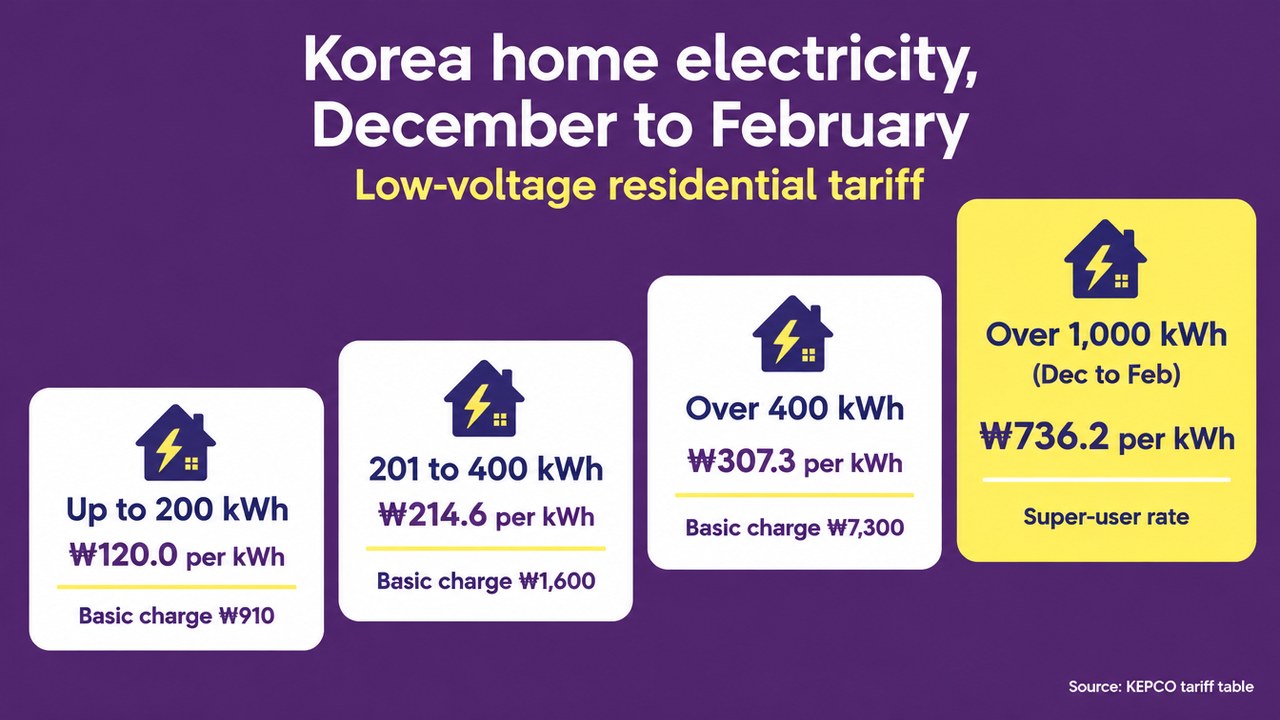
Quick answer: A Korean home on the standard low-voltage residential tariff pays ₩120.0 per kWh for the first 200 kWh, ₩214.6 for the next 200 kWh and ₩307.3 for every kWh above 400, plus one basic charge set by the tier your total falls in: ₩910, ₩1,600 or ₩7,300. From 1 December to the end of February, every kWh above 1,000 kWh a month costs ₩736.2, the so-called super-user rate. KEPCO kept the fuel cost adjustment at +₩5.0 per kWh for October to December 2026. On those figures, a December bill for 350 kWh comes to about ₩70,640 and one for 450 kWh to about ₩108,050 (our calculation, before any discount). The single most expensive step is crossing 400 kWh: one extra kWh raises the bill by about ₩6,780.
Winter is when many households in Korea suddenly start reading their electricity bill line by line. Apartments with gas floor heating usually see only a modest rise, but homes that lean on electric heaters, electric floor mats, heat-pump units or a second fan heater in a cold room can jump a whole tier in a single month. Because Korea’s residential electricity tariff is progressive, a jump in use does not raise the bill in a straight line. This guide shows exactly where the steps are, what changes on 1 December, and how to estimate your own bill before it arrives.
The figures below are for the standard low-voltage residential tariff (주택용 저압), which covers most houses, villas, officetels used as homes and apartments where each household has its own contract with KEPCO. A short section further down covers the high-voltage tariff that some apartment complexes use.
The three tiers and the basic charge
KEPCO’s residential tariff page lists two seasons for households. July and August are the “summer” season, when the tier limits are widened to 300 and 450 kWh. Every other month, including December, January and February, uses the narrower limits of 200 and 400 kWh. The unit prices are the same in both seasons; only the width of the steps changes.
| Low-voltage residential tariff (non-summer months, incl. Dec to Feb) | Basic charge (per household) | Energy charge (per kWh) |
|---|---|---|
| Up to 200 kWh used | ₩910 | ₩120.0 for the first 200 kWh |
| 201 to 400 kWh used | ₩1,600 | ₩214.6 for the next 200 kWh |
| More than 400 kWh used | ₩7,300 | ₩307.3 above 400 kWh |
| Super-user rate (1 December to end of February only) | (no extra basic charge) | ₩736.2 for each kWh above 1,000 kWh |
Source: KEPCO Cyber Branch, residential tariff (low voltage), rates in force since 16 May 2023 and unchanged in the table dated 9 November 2023.
Two rules trip people up.
- The energy charge is stepped, the basic charge is not. Each kWh is priced by the band it falls in: if you use 350 kWh, the first 200 are charged at ₩120.0 and the next 150 at ₩214.6. The basic charge, by contrast, is a single amount chosen by the band your total lands in. Use 400 kWh and the basic charge is ₩1,600; use 401 kWh and it becomes ₩7,300.
- The super-user rate is seasonal. KEPCO applies ₩736.2 per kWh to use above 1,000 kWh only in the summer months (July and August) and the winter months (1 December to the end of February). In November or March, the same usage is charged at ₩307.3 above 400 kWh with no super-user premium.
What else is added to the bill
KEPCO describes the electricity charge as the sum of four parts: the basic charge, the energy charge, the climate and environment charge and the fuel cost adjustment charge. On top of that total come value-added tax and the electricity industry fund levy.
- Climate and environment charge: ₩9.0 per kWh. KEPCO’s tariff sheet notes this rate is reviewed every year, so check your January bill for any change.
- Fuel cost adjustment charge: +₩5.0 per kWh for October to December 2026. KEPCO’s notice of 21 September 2026 shows the formula would have produced +₩7.3, but the rate is capped at plus or minus ₩5.0, so +₩5.0 applies. Yonhap reported that this is the 18th quarter in a row at the cap, since the third quarter of 2022. The January to March 2027 rate had not been announced as of 13 November 2026; KEPCO published the fourth-quarter figure about ten days before the quarter began.
- VAT: 10% of the electricity charge.
- Electricity industry fund levy: 2.7% of the electricity charge since 1 July 2025, under article 36 of the Enforcement Decree of the Electricity Business Act. It was 3.7% before July 2024, as the government announced when it cut the levy in two steps.
Bills can also carry items that have nothing to do with your usage, such as the TV licence fee where it is billed with electricity, apartment common-area electricity, or arrears, so compare like with like when you check our figures against your own bill.
Worked December bills, 150 to 1,200 kWh
The table applies the figures above to a December bill on the low-voltage tariff, with no discount. We followed the rounding steps that public calculators describe as KEPCO’s (energy charge rounded down to the won, VAT rounded, the fund levy rounded down to ₩10, and the total rounded down to ₩10). Two independent public calculators built on the same tariff gave identical totals.
| Monthly use (December) | Tier | Basic charge | Energy charge | Estimated bill (our calculation) |
|---|---|---|---|---|
| 150 kWh | 1 | ₩910 | ₩18,000 | ₩23,670 |
| 200 kWh | 1 | ₩910 | ₩24,000 | ₩31,220 |
| 250 kWh | 2 | ₩1,600 | ₩34,730 | ₩44,880 |
| 300 kWh | 2 | ₩1,600 | ₩45,460 | ₩57,760 |
| 350 kWh | 2 | ₩1,600 | ₩56,190 | ₩70,640 |
| 400 kWh | 2 | ₩1,600 | ₩66,920 | ₩83,530 |
| 401 kWh | 3 | ₩7,300 | ₩67,227 | ₩90,310 |
| 450 kWh | 3 | ₩7,300 | ₩82,285 | ₩108,050 |
| 500 kWh | 3 | ₩7,300 | ₩97,650 | ₩126,160 |
| 600 kWh | 3 | ₩7,300 | ₩128,380 | ₩162,370 |
| 800 kWh | 3 | ₩7,300 | ₩189,840 | ₩234,790 |
| 1,000 kWh | 3 | ₩7,300 | ₩251,300 | ₩307,220 |
| 1,200 kWh | 3 + super-user | ₩7,300 | ₩398,540 | ₩476,310 |
Step by step for 350 kWh in December (our calculation):
- Basic charge: 350 kWh falls in tier 2, so ₩1,600.
- Energy charge: 200 × ₩120.0 = ₩24,000, plus 150 × ₩214.6 = ₩32,190, total ₩56,190.
- Climate and environment charge: 350 × ₩9.0 = ₩3,150.
- Fuel cost adjustment: 350 × ₩5.0 = ₩1,750.
- Electricity charge: ₩1,600 + ₩56,190 + ₩3,150 + ₩1,750 = ₩62,690.
- VAT 10%: ₩6,269. Fund levy 2.7%: ₩1,692.6, rounded down to ₩1,690.
- Bill: ₩62,690 + ₩6,269 + ₩1,690 = ₩70,649, rounded down to ₩70,640.

The two cliffs: 400 kWh and 1,000 kWh
The table shows two places where a small change in use moves the bill a lot.
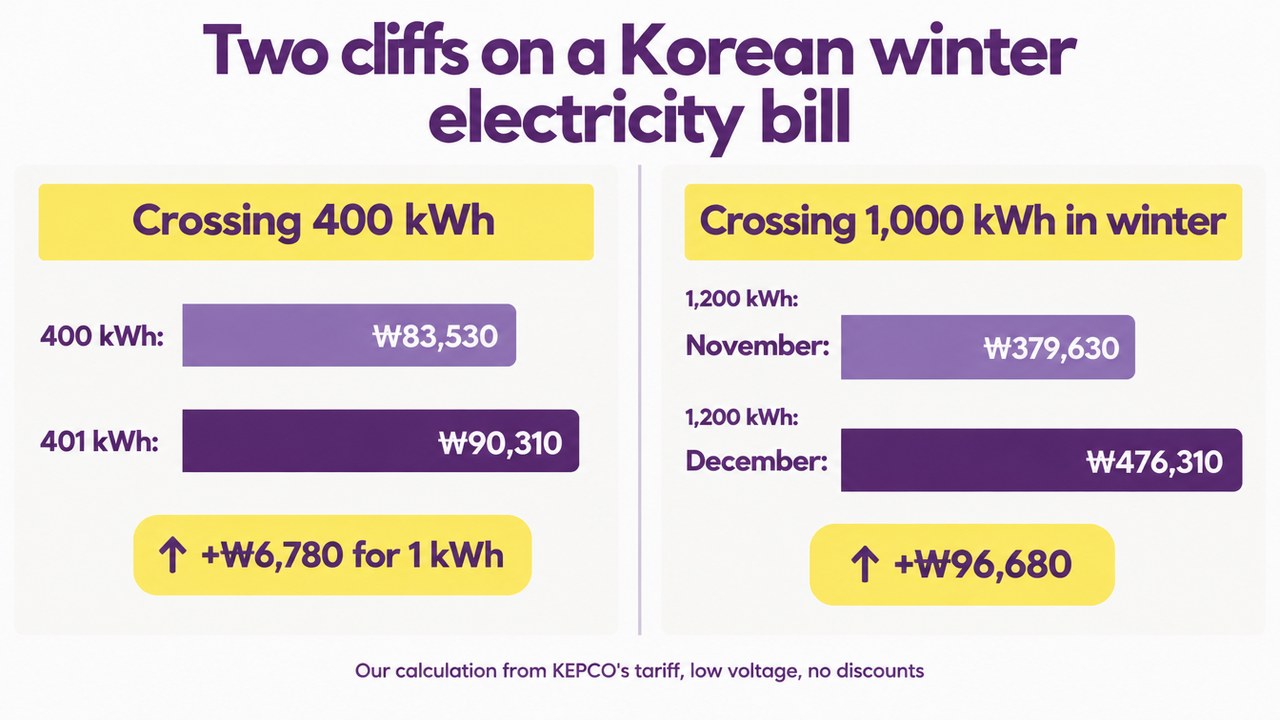
Crossing 400 kWh. Going from 400 to 401 kWh raises the estimated December bill from ₩83,530 to ₩90,310, a jump of ₩6,780 for one kWh. Most of that is the basic charge rising from ₩1,600 to ₩7,300. Every kWh after that is charged at ₩307.3, more than two and a half times the first-tier price. Crossing 200 kWh is much gentler: 200 to 201 kWh adds about ₩1,040.
Crossing 1,000 kWh in winter. In December, January and February, every kWh above 1,000 costs ₩736.2 instead of ₩307.3. Using our figures, 1,200 kWh costs about ₩476,310 in December but about ₩379,630 in November, a gap of ₩96,680 for the same usage (our calculation). Households that heat the whole home with electricity, or run a heat pump and several heaters at once, are the ones most likely to reach this line.
A practical rule for most families: if your autumn bills have been sitting between 300 and 400 kWh, one new electric heater running several hours a day can be enough to push December over 400 kWh. Look at your November usage when the bill arrives and estimate the extra load before the cold peaks.
How much does an electric heater add?
Your bill counts kilowatt-hours, so the sum is simple: the appliance’s power in kilowatts × hours a day × days. These are illustrations, not measurements; check the rating label on your own appliance.
| Illustrative appliance (rated power) | Use | Extra kWh a month (our calculation) |
|---|---|---|
| Fan heater, 2 kW on full | 3 hours a day × 30 days | 180 kWh |
| Oil-filled radiator, 1.5 kW | 4 hours a day × 30 days | 180 kWh |
| Electric floor mat, 0.2 kW | 8 hours a day × 30 days | 48 kWh |
So a household that used 300 kWh in November and adds one 2 kW fan heater for three hours a night would land near 480 kWh in December, in tier 3. On our table that is roughly the difference between a bill of about ₩57,760 and one of more than ₩108,050. Thermostats cycle on and off, so the real figure is often lower than the label suggests, but the direction is the same.
Ways people in Korea usually keep winter use down: heat one room rather than several, use a floor mat or electric blanket instead of a fan heater where it is safe to do so, close off unused rooms, and switch heaters off at the plug rather than leaving them on standby. Older people should not trade warmth for savings: cutting back should mean using heat smarter, not going without. Our guide to KDCA’s cold-illness data, linked below, explains why parents over 65 are most at risk in a Korean winter.
Meter reading dates and apartment contracts
Your bill covers the period between two meter readings, not the calendar month. Public calculators built on KEPCO’s supply terms point out that when a reading period straddles a season change, such as 1 December, the charge is split by days between the two seasons. So a bill read on 15 December may contain only part of the super-user season.
In many apartment complexes, the whole complex has a single high-voltage contract with KEPCO and the management office passes the cost on in the monthly maintenance bill. The complex-wide method and the share for common areas vary, so your apartment’s figure may not match our table. KEPCO’s site lists the high-voltage residential tariff separately: ₩730 / ₩1,260 / ₩6,060 basic charges and ₩105.0 / ₩174.0 / ₩242.3 per kWh at the same 200 and 400 kWh steps. KEPCO’s web table gives ₩593.3 for the high-voltage winter super-user rate; some KEPCO tariff sheets show ₩601.3, so check the figure on your own bill if you are near 1,000 kWh.
Discounts you might be missing
KEPCO’s welfare discounts are listed on Government24 and can be applied for at any time, through KEPCO’s online service (KEPCO ON), at a local community service centre, at a KEPCO office or by calling 123.
| Who (as listed on Government24) | Discount on the monthly residential bill |
|---|---|
| Households with 3 or more children, households of 5 or more people, households with a baby (출산 가구) | 30% of the month’s bill, up to ₩16,000 a month |
| People with severe disabilities, national merit recipients with grade 1 to 3 injuries, independence patriots, livelihood or medical benefit recipients | Up to ₩16,000 a month (₩20,000 in summer) |
| Housing or education benefit recipients | Up to ₩10,000 a month (₩12,000 in summer) |
| Near-poverty (차상위) households | Up to ₩8,000 a month (₩10,000 in summer) |
| Households using life-support equipment such as oxygen generators or ventilators | 30% of the month’s bill |
If your parents are 65 or older and receive the basic livelihood or near-poverty benefits, they may also qualify for the energy voucher, a separate winter subsidy that can be applied for until 31 December 2026. Our guides below explain who qualifies and how to apply.
What to do before the December bill
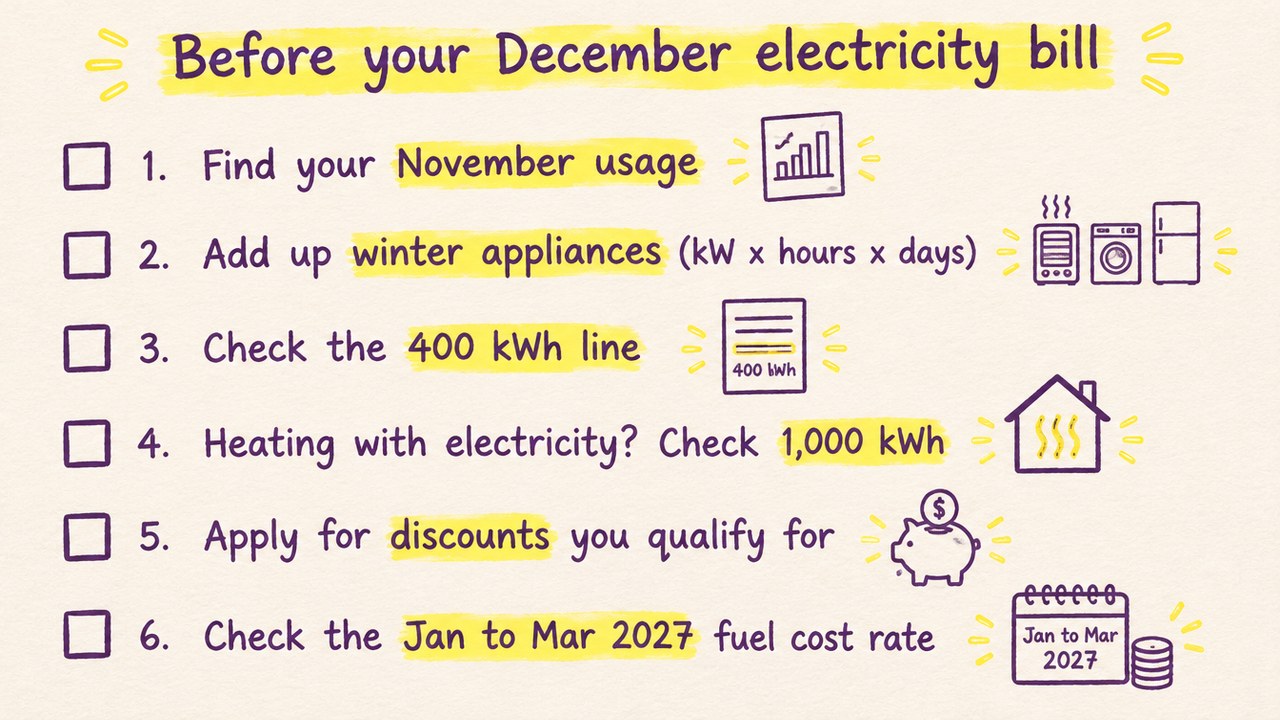
- Find your November usage on the bill or in KEPCO ON. Note whether it is below 200, between 200 and 400, or above 400 kWh.
- Add up the winter appliances you plan to use, with the kW × hours × days rule.
- Check whether you will cross 400 kWh. If you are close, the cheapest kWh is the one that keeps you under it.
- If you heat with electricity, check 1,000 kWh for December to February.
- Apply for any discount you qualify for; they are not automatic for large families or households with a new baby.
- Check the January to March 2027 fuel cost adjustment rate when KEPCO announces it, likely in late December, and the climate charge on your January bill.
Related reading
- Korea’s energy voucher 2026: how the winter heating subsidy works
- Still apply by 31 December: Korea energy voucher documents and steps
- Hypothermia and frostbite in Korea’s winter: what KDCA’s cold-illness data say about parents over 65
Frequently asked questions
Q. What are Korea’s residential electricity tiers in winter?
On the low-voltage residential tariff, December to February use the same tiers as most of the year: ₩120.0 per kWh up to 200 kWh, ₩214.6 from 201 to 400 kWh and ₩307.3 above 400 kWh, with a basic charge of ₩910, ₩1,600 or ₩7,300 depending on the tier your total falls in.
Q. What is the super-user rate and when does it apply?
It is a higher price of ₩736.2 per kWh for use above 1,000 kWh in a month on the low-voltage tariff. KEPCO applies it in July and August and from 1 December to the end of February. In other months there is no super-user premium.
Q. Why did my bill jump so much after just a little more use?
Most likely you crossed 400 kWh. The basic charge rises from ₩1,600 to ₩7,300 at 401 kWh, and every kWh above 400 costs ₩307.3. On our calculation, going from 400 to 401 kWh in December adds about ₩6,780.
Q. Is the fuel cost adjustment going up this winter?
For October to December 2026 KEPCO kept it at +₩5.0 per kWh, the maximum allowed. The January to March 2027 rate had not been announced as of 13 November 2026, so check KEPCO’s notice in late December.
Q. How do I estimate what a heater adds?
Multiply its power in kilowatts by the hours you use it each day and by the number of days. A 2 kW heater run for 3 hours a day for 30 days adds about 180 kWh, enough to move many households from tier 2 into tier 3.
Q. Do large families get a discount on electricity in Korea?
Yes. Government24 lists a 30% discount on the monthly residential bill, up to ₩16,000 a month, for households of five or more, households with three or more children and households with a baby. You apply through KEPCO ON, a community service centre, a KEPCO office or by calling 123.
Worked bills are our calculation from KEPCO’s published tariff as of 13 November 2026, for the low-voltage residential tariff without discounts. Your bill depends on your contract type, meter reading dates and other items billed with electricity.
Sources
- KEPCO Cyber Branch, residential tariff (low and high voltage), rates since 16 May 2023, table dated 9 November 2023: https://cyber.kepco.co.kr/ckepco/front/jsp/CY/E/E/CYEEHP00101.jsp
- KEPCO Cyber Branch, structure of the electricity charge: https://cyber.kepco.co.kr/ckepco/front/jsp/CY/E/E/CYEEHP00110.jsp
- KEPCO newsroom notice, October to December 2026 fuel cost adjustment rate (21 September 2026): https://www.kepco.co.kr/home/media/newsroom/notice/boardView.do?boardMngNo=14&boardNo=2759
- Ministry of Government Legislation, amendment of the Enforcement Decree of the Electricity Business Act (fund levy 3.7% to 3.2% to 2.7%): https://opinion.lawmaking.go.kr/lmSts/govLm/2000000307558/detailRP
- Korea.kr policy briefing, cut in the electricity fund levy (28 May 2024): https://www.korea.kr/news/policyNewsView.do?newsId=148929635
- Government24, KEPCO electricity welfare discounts (last updated 14 August 2026): https://www.gov.kr/portal/rcvfvrSvc/dtlEx/B41000200003
- Yonhap News, fourth-quarter electricity tariff frozen, fuel cost adjustment +₩5 (independent cross-check): https://www.yna.co.kr/view/AKR20260921019151003
- Obyeol Lab electricity tier guide and calculator (independent cross-check of worked bills): https://obyeollab.com/energy/progressive/
- Deios tools electricity calculator, 450 kWh worked example (independent cross-check of rounding): https://tools.deios.kr/life/electricity/