Hepatitis B Test at 40 on Korea’s Checkup: What Surface Antigen and Antibody Results Mean, and What to Do Next
Haesul Health desk (AI-assisted). As of 13 November 2026 (KST). Based on the National Health Insurance Service (NHIS) general checkup pages, the Ministry of Health and Welfare (MOHW) Health Checkup Implementation Standards (notice no. 2026-6), and the Korea Disease Control and Prevention Agency (KDCA) National Health Information Portal pages on hepatitis B, serology tests for infections and the national checkup. Independent cross-check: the US Centers for Disease Control and Prevention (CDC) guidance on hepatitis B testing and result interpretation. This is general information, not medical advice. Only a doctor who knows your history can tell you what your own result means.
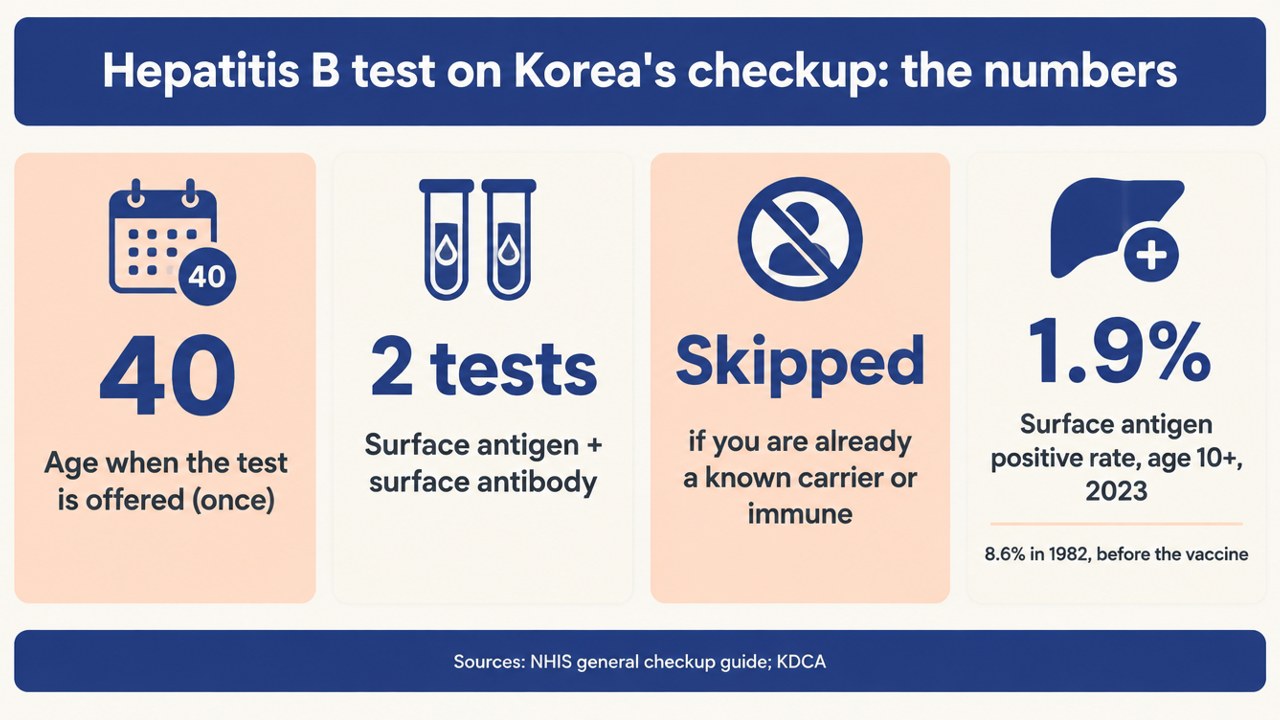
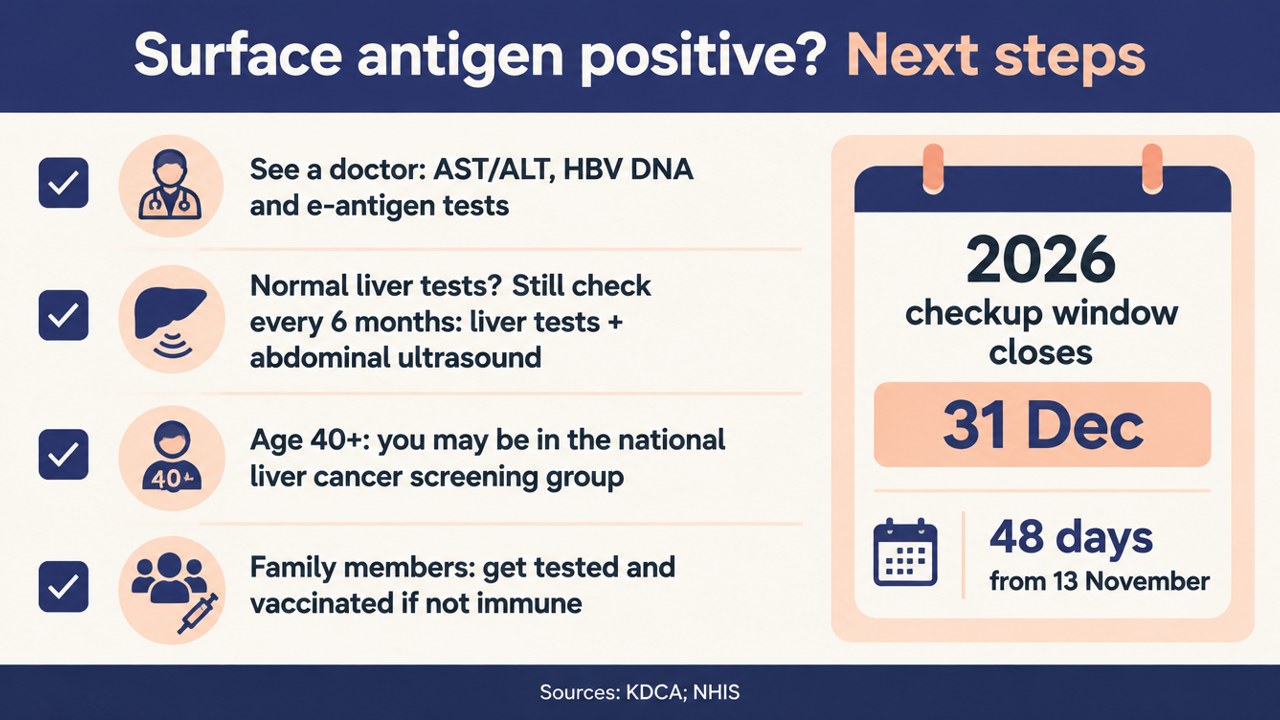
Quick answer: Korea’s national general checkup tests for hepatitis B (B형간염) once, at age 40, unless you are already known to be a carrier or immune. It checks two things in your blood: the surface antigen (HBsAg), which shows whether the virus is there, and the surface antibody (anti-HBs), which shows whether you are protected. Antigen negative and antibody positive means you are immune, from a past infection or a vaccine. Both negative means you have not been infected but have no protection, and KDCA recommends the three-dose vaccine (0, 1 and 6 months) for adults with no evidence of immunity. Antigen positive means current infection or carrier status is suspected, and you should see a doctor for liver tests. KDCA advises carriers to have liver tests and an abdominal ultrasound every 6 months even when they feel fine. The 2026 checkup window closes on 31 December 2026, 48 days from 13 November.
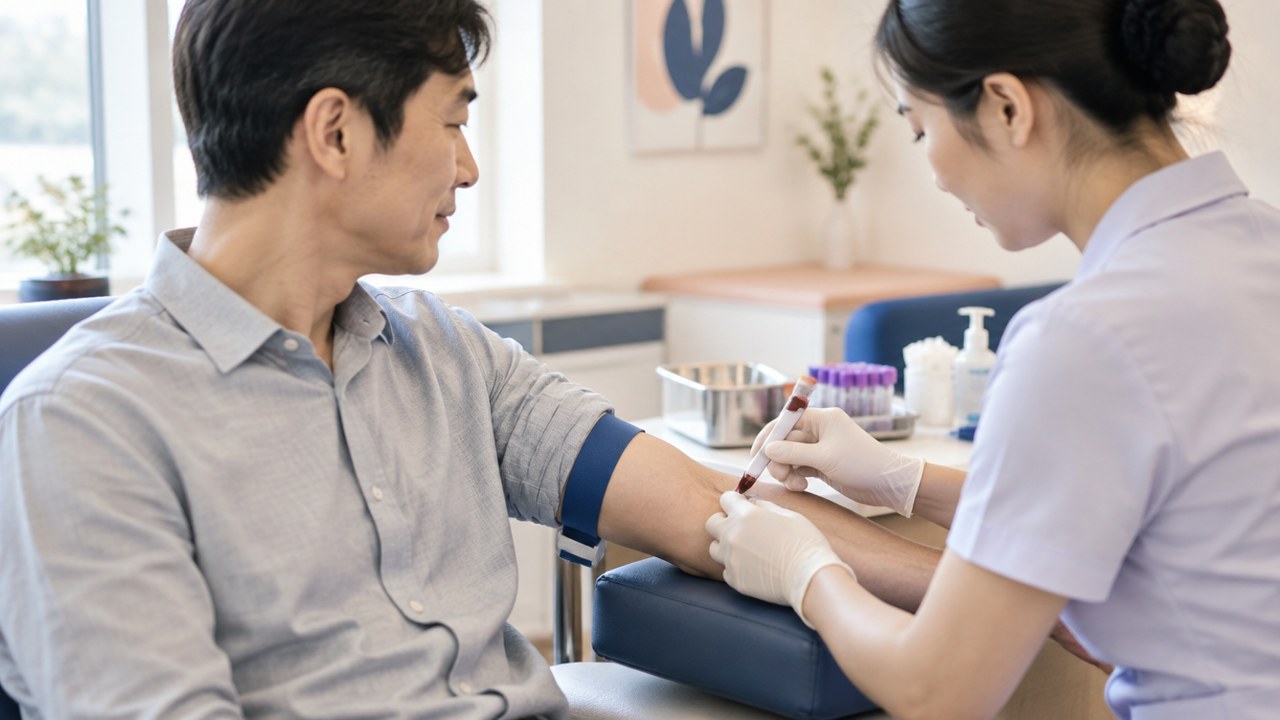
If you turned 40 this year, or will before the end of December, your checkup may include a line you have not seen before: B형간염 with two results next to it. Many people in their 40s were born before Korea started routine infant vaccination for hepatitis B, so this is often the first time they find out whether they are protected. It is also the only time the national checkup offers the test, so it is worth reading the result properly.
This guide covers who gets the test, how to read the two results, what to do in each case, and how hepatitis B links to Korea’s other liver checks. If you are 56, you may also get a separate hepatitis C test this year; see our hepatitis C screening guide. For everything else that is due by age, see Korea’s national health checkup by age.
Who gets the hepatitis B test on Korea’s checkup
The NHIS general checkup table lists hepatitis B as an age-specific item:
| Item (NHIS general checkup) | Rule |
|---|---|
| Who | People having the general checkup in the year they are 40 |
| What | Hepatitis B surface antigen and surface antibody (KDCA checkup guide) |
| Who is left out | People already known to be carriers or immune |
| How often | Once (it is a 40-only item) |
| 2026 window | 1 January to 31 December 2026 |
| Results | The clinic must send them within 15 days, by post, email or mobile |
The test item itself is written into the MOHW Health Checkup Implementation Standards (article 5(1), item 7: “hepatitis B test, hepatitis C test”). It is a blood test taken from the same sample as your other checkup blood work, so there is nothing extra to prepare. KDCA’s page on serology tests says these tests need no special preparation.
Remember that the general checkup runs every two years for most people: in the even year if you were born in an even year, in the odd year if you were born in an odd year, and every year for non-office workers. If you were born in 1986, 2026 is your checkup year. If your checkup is due but not done, it has to be finished by 31 December.
How to read your two results
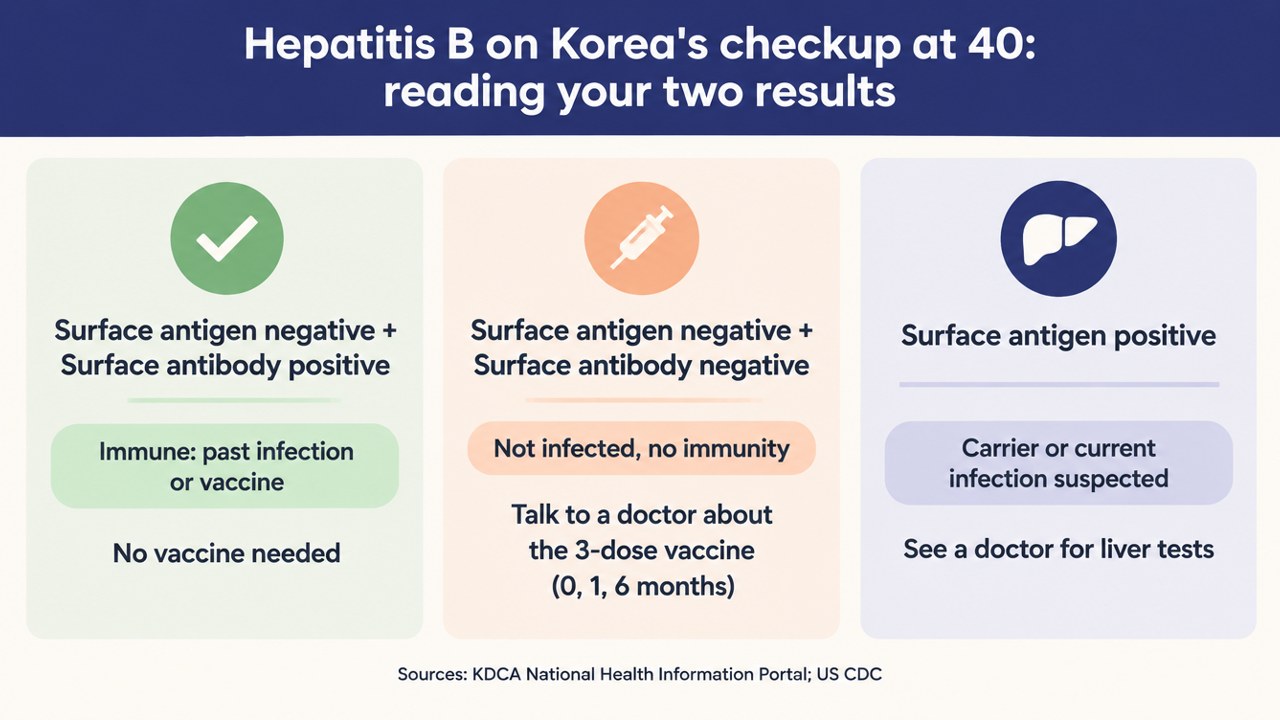
KDCA’s page on serology tests for infections explains what each marker means. The surface antigen is “found in acute infection or in chronic carriers”. The surface antibody “prevents infection”: if it is positive, you have recovered from a past infection or gained immunity from vaccination; if it is negative, you have not been infected but you have no immunity either. Put together:
| Surface antigen (HBsAg) | Surface antibody (anti-HBs) | What it usually means (KDCA) | Usual next step |
|---|---|---|---|
| Negative | Positive | Immune: past infection that cleared, or a vaccine | Nothing more for hepatitis B |
| Negative | Negative | Not infected, but no immunity | Talk to a doctor about the vaccine |
| Positive | Negative | Current infection or carrier status suspected | See a doctor for liver tests |
The US CDC reads the same markers the same way: a positive surface antigen means the person has the virus and can pass it on, and a positive surface antibody generally means recovery and immunity, or a successful vaccine. CDC adds one detail worth knowing. The surface antigen can show up as positive for a short time within 30 days of a hepatitis B vaccine dose, so tell the clinic if you were vaccinated just before the checkup.
Why this matters in your 40s
KDCA says Korea’s surface-antigen positive rate was about 8.6% in 1982, before the vaccine. Vaccination was recommended from 1984 and became part of the national infant programme in 1995, and the rate has fallen since. In the 2023 Korea National Health and Nutrition Examination Survey, it was 1.9% among people aged 10 and over, and it has stayed under 3% since 2013. Most people in their 40s now were children before infant vaccination became routine, which is one reason the checkup tests at 40.
The other reason is that hepatitis B is often silent. KDCA notes that symptoms such as severe tiredness, nausea or jaundice can appear, but many people have none. CDC says more than half of people with hepatitis B are unaware of their infection.
If both results are negative: think about the vaccine
A double negative is not bad news. It means you have not had the infection. It also means you are not protected. KDCA recommends hepatitis B vaccination for all infants and for adults with no evidence of immunity. It counts as evidence of immunity a past hepatitis B diagnosis, a positive antibody result, or a record of hepatitis B vaccination.
The adult schedule KDCA gives is three doses at 0, 1 and 6 months, 1.0 mL each for people aged 11 and over, injected into the upper arm. KDCA lists groups at higher risk, such as family members of carriers, people who often receive blood products, people on dialysis, healthcare workers, people who inject drugs, and inmates and staff of institutions such as prisons. If you are in one of these groups, the vaccine matters more.
Before you book, check whether you were vaccinated before and simply lost measurable antibodies. CDC notes that antibody levels can fall over the years in people who responded to a full vaccine course, and that most of them stay protected, so people with a documented complete series usually do not need to start again unless they are in special groups such as dialysis patients or healthcare workers. If you have no record, ask your doctor. The checkup itself does not include the vaccine, so ask the clinic about the cost when you book.

If the surface antigen is positive: what happens next
A positive surface antigen on a screening test is a reason to see a doctor, not a diagnosis of liver disease. KDCA describes several further tests your doctor may order:
- Liver function tests (AST, ALT) to check for inflammation. Our guide to liver enzymes on your checkup explains those numbers.
- Hepatitis B core antibody (anti-HBc). KDCA says IgM core antibody points to a recent infection, while IgG core antibody alone points to a past infection or a chronic carrier.
- Hepatitis B e-antigen and e-antibody. A positive e-antigen means the virus is actively multiplying and more infectious.
- Hepatitis B virus DNA, which measures how much virus is present and is essential for deciding whether to treat and checking that treatment works.
Hepatitis B is not on the NHIS list of free confirmatory tests after the checkup. That list covers high blood pressure, diabetes, dyslipidaemia, pulmonary tuberculosis, depression or early psychosis, and hepatitis C. So follow-up tests for hepatitis B are ordinary insured care, with the usual co-payment.
“Healthy carrier” still means regular checks
KDCA describes a healthy hepatitis B carrier as someone whose blood shows the virus but whose liver tests are normal, meaning there is virus but no inflammation. Many do not need treatment straight away. There is still no medicine that removes the virus completely, and some carriers go on to chronic hepatitis, so KDCA advises liver function tests and an abdominal ultrasound every 6 months, and avoiding alcohol and medicines that strain the liver. For people who do need treatment, KDCA says oral antiviral medicines are recommended to slow progression to cirrhosis and lower the rate of liver cancer.
KDCA also explains why age at infection matters: more than 90% of people infected at birth become chronically infected, compared with about 10% of people infected as adults.
The liver cancer screening link
A positive surface antigen also matters for cancer screening. Korea’s national liver cancer screening covers adults aged 40 or older in a high-risk group, which includes people with a positive hepatitis B surface antigen. They get a liver ultrasound and an AFP blood test every 6 months. NHIS mainly identifies them from insurance claims and past checkup results. Our liver cancer screening guide explains who is eligible, what it costs and how to read the result.
Family and everyday life
KDCA says hepatitis B spreads through blood and body fluids: unsafe injections, acupuncture, piercing, tattoos, shared razors, transfusion and sexual contact, and from mother to baby at birth. KDCA also says it is not easily passed on in everyday life, which is why only diagnosed patients are reported. If your result is positive, the practical steps are for the people close to you: family members and partners should get tested, and those without immunity should get vaccinated. Do not share razors or toothbrushes.
If you are planning a pregnancy, tell your doctor. KDCA says babies born to mothers with a positive surface antigen receive immunoglobulin and the first vaccine dose within 12 hours of birth, and a national perinatal prevention programme covers the cost.

Worked examples (illustrative)
| Person (illustrative) | Result | What the guidance points to |
|---|---|---|
| Woman, 40, office worker, no vaccine record | Antigen −, antibody − | Not infected, not protected: ask about the 3-dose vaccine |
| Man, 40, vaccinated in his 20s (has the record) | Antigen −, antibody − | CDC: a documented full course usually needs no restart; confirm with a doctor |
| Man, 40, mother is a carrier | Antigen +, antibody − | See a doctor for liver tests, HBV DNA and e-antigen; family members get tested |
| Woman, 40 | Antigen −, antibody + | Immune; nothing more for hepatitis B |
Before 31 December: a short checklist
- Check whether your 2026 checkup is due and done. The window closes on 31 December 2026, 48 days from 13 November. If you were due last year and missed it, NHIS lets you ask to be added to this year’s list.
- When your result arrives (within 15 days), find the hepatitis B row and read both results together.
- Both negative? Book a doctor’s appointment about the vaccine, or look for your old vaccination record first.
- Antigen positive? Book a doctor’s appointment for liver tests, and ask about follow-up every 6 months and liver cancer screening.
- Tell family members, especially if you are a carrier.
Related reading
- Hepatitis C Test at 56 in Korea: who gets it, what it costs, and what a positive result means
- Korea Liver Cancer Screening for High-Risk Adults: ultrasound and AFP every 6 months for hepatitis B carriers aged 40 and over
- Korea’s National Health Checkup by Age: every age-specific test, from 20 to 80
Frequently asked questions
Q. When does Korea’s national checkup test for hepatitis B?
Once, at age 40, as part of the general checkup. NHIS leaves out people already known to be carriers or immune. The test measures the hepatitis B surface antigen and surface antibody from your checkup blood sample, and the 2026 window closes on 31 December 2026.
Q. What does “surface antigen negative, surface antibody negative” mean?
According to KDCA, it means you have not been infected with hepatitis B but you have no immunity. KDCA recommends the vaccine for adults with no evidence of immunity, in three doses at 0, 1 and 6 months. If you have a record of a full vaccine course, tell your doctor, because CDC notes that most people who responded stay protected even when antibody levels fall.
Q. My surface antigen is positive. Do I have liver disease?
Not necessarily. A positive surface antigen means the virus is present, either as a current infection or as a carrier. KDCA says a healthy carrier has normal liver tests and often needs no treatment straight away, but should still have liver tests and an abdominal ultrasound every 6 months. Your doctor will usually order liver function tests, e-antigen tests and an HBV DNA test.
Q. Is the follow-up test for hepatitis B free?
No. The NHIS list of free confirmatory tests after the checkup covers high blood pressure, diabetes, dyslipidaemia, pulmonary tuberculosis, depression or early psychosis, and hepatitis C, not hepatitis B. Follow-up tests are ordinary insured care with the usual co-payment.
Q. Can I pass hepatitis B to my family through food or hugs?
KDCA says hepatitis B spreads through blood and body fluids, such as shared razors, unsafe needles, sexual contact and from mother to baby at birth, and that it is not easily passed on in daily life. Family members and partners should still get tested and vaccinated if they are not immune.
Sources
- National Health Insurance Service, 일반건강검진 (general checkup guide): hepatitis B test at 40, excluding carriers or immune people; results within 15 days; free confirmatory test list; window 1 January to 31 December; missed-last-year add-on — https://www.nhis.or.kr/nhis/healthin/wbhaca04500m01.do (checked 13 November 2026)
- National Health Insurance Service, 일반건강검진 제도소개 (checkup items by age: B형간염 40세, 보균자 또는 면역자 제외; checkup cycle) — https://www.nhis.or.kr/nhis/policy/wbhada19700m01.do (checked 13 November 2026)
- MOHW, 건강검진 실시기준 (Health Checkup Implementation Standards, notice no. 2026-6), article 5(1) item 7 (hepatitis B and C tests), NHIS law service full text — https://www.nhis.or.kr/lm/lmxsrv/law/lawFullContent.do?SEQ=80 (checked 13 November 2026)
- KDCA National Health Information Portal, 알아두면 도움이 되는 ‘건강검진’ (checkup guide: hepatitis B surface antigen and antibody at 40; two-year cycle; result categories) — https://health.kdca.go.kr/healthinfo/biz/health/ntcnInfo/healthSourc/thtimtCntnts/thtimtCntntsView.do?thtimt_cntnts_sn=7 (checked 13 November 2026)
- KDCA National Health Information Portal, 감염질환의 혈청검사 (serology tests for infections: meaning of HBsAg, anti-HBs, anti-HBc, HBeAg, anti-HBe, HBV DNA; no special preparation) — https://health.kdca.go.kr/healthinfo/biz/health/gnrlzHealthInfo/gnrlzHealthInfo/gnrlzHealthInfoView.do?cntnts_sn=5533 (checked 13 November 2026)
- KDCA National Health Information Portal, B형간염 (hepatitis B, updated 5 November 2026: 8.6% in 1982, 1.9% in 2023; vaccine 0, 1, 6 months for adults with no evidence of immunity; high-risk groups; healthy carriers and 6-monthly checks; chronic infection rates; transmission; perinatal programme) — https://health.kdca.go.kr/healthinfo/biz/health/gnrlzHealthInfo/gnrlzHealthInfo/gnrlzHealthInfoView.do?cntnts_sn=6672 (checked 13 November 2026)
- NHIS, 암검진 제도소개 (liver cancer screening for high-risk adults aged 40 and over, every 6 months) — https://www.nhis.or.kr/nhis/policy/wbhada19800m01.do (as summarised in our 9 November 2026 liver cancer screening guide)
- Independent: US Centers for Disease Control and Prevention, Clinical Testing and Diagnosis for Hepatitis B (reviewed 2 November 2026: interpretation of HBsAg, anti-HBs, anti-HBc; transient HBsAg after vaccination; waning antibodies after a full series) — https://www.cdc.gov/hepatitis-b/hcp/diagnosis-testing/index.html (checked 13 November 2026)
This article is general information, not medical advice. The worked examples are illustrations, not a reading of your result. Talk to a doctor about your own hepatitis B result, vaccination and follow-up.