Chest X-ray on Korea’s National Checkup: What “Normal”, “Inactive TB” and “Disease Suspected” Mean, and the Free TB Test to 31 March 2027
Haesul Health desk (AI-assisted). As of 11 November 2026 (KST). Based on the National Health Insurance Service (NHIS) general checkup guide, the Ministry of Health and Welfare (MOHW) Health Checkup Implementation Standards (notice no. 2026-6, in force 7 January 2026) with its Annex 4 result criteria and result form 6 (revised 1 January 2026), and Korea Disease Control and Prevention Agency (KDCA) tuberculosis pages. Independent cross-checks: the World Health Organization (WHO), Seoul National University Bundang Hospital, Eunpyeong St. Mary’s Hospital, the National Masan Hospital and Yonhap News. This is general information, not medical advice. It cannot tell you what your own X-ray shows. Only your doctor can do that.
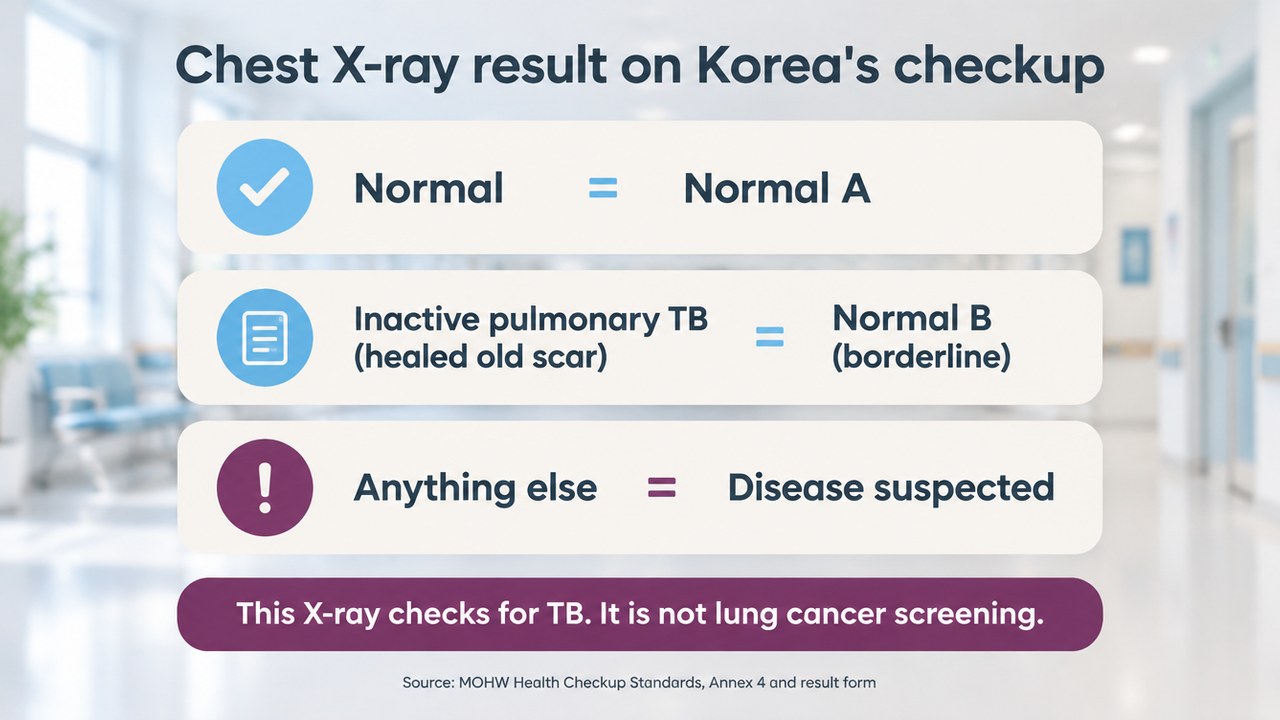
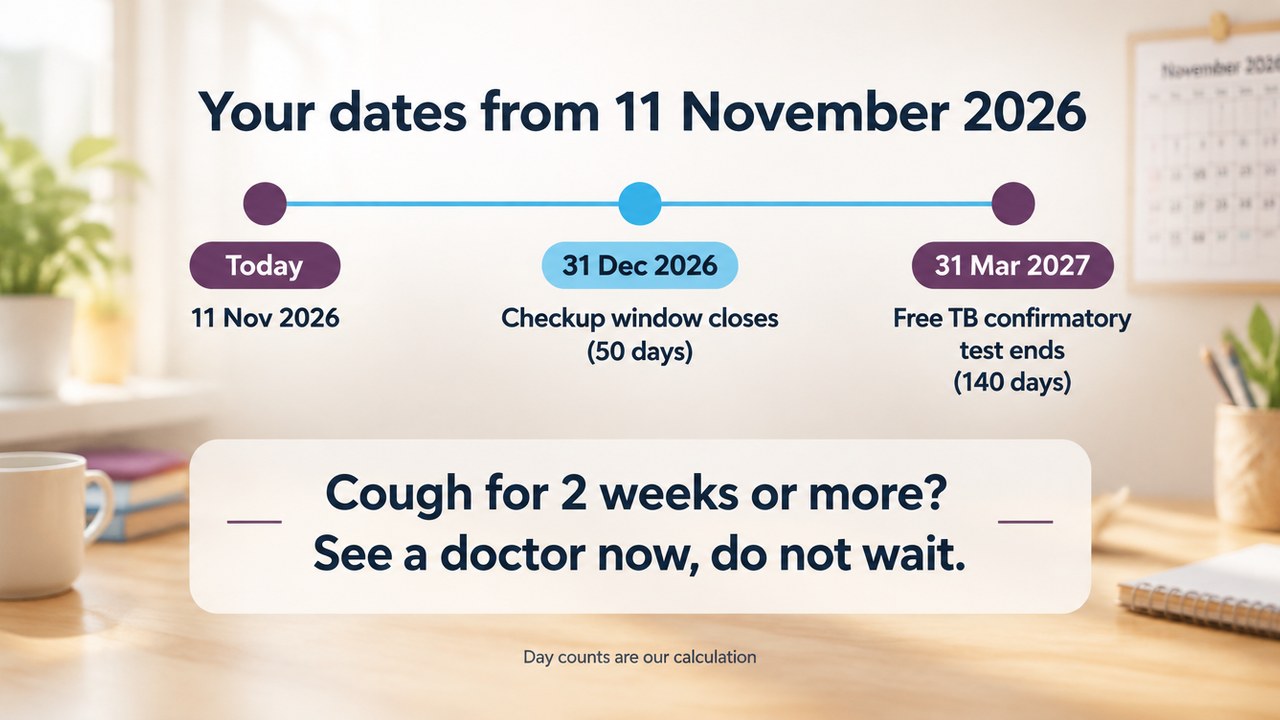
Quick answer: The chest X-ray (흉부방사선) on Korea’s national general checkup is there to look for pulmonary tuberculosis (TB) and other chest disease. The official result form says it plainly: it is a TB test, not lung cancer screening. Your sheet shows one of three results. Normal counts as Normal A. Inactive pulmonary TB (a healed old scar) counts as Normal B (borderline). Anything else counts as “disease suspected”. If the doctor ticks pulmonary TB as a suspected disease on page 1, you get one free first visit: a consultation, a sputum smear and culture, and a TB nucleic acid amplification test (NAAT). You can get it at any clinic or hospital, including the big university hospitals, until 31 March 2027 (NHIS). The 2026 checkup itself closes on Thursday 31 December 2026, 48 days from 13 November.
Most people in their 40s, 50s and 60s have had so many checkup chest X-rays that they no longer look at that line. Then one year the box next to it changes. It might say “inactive pulmonary TB” when you never knew you had TB. Or a note says “disease suspected” and asks you to see a clinic. This guide covers what each result means in the government’s own wording, what the free follow-up test involves, how long the answers take, and what is free and what is not. It also covers the date mismatch between two government pages, so you don’t miss the window.

What the checkup chest X-ray is for, and what it is not
The chest X-ray is one of the common items that every general checkup includes, whatever your age. NHIS lists it alongside the doctor’s consultation, height, weight, waist, vision and hearing, blood pressure, the basic blood panel, a urine test and the oral exam (NHIS general checkup guide). Article 5 of the MOHW Implementation Standards lists “chest radiography” among the general checkup items, and Annex 4 names its target disease as “pulmonary tuberculosis and other chest diseases”.
The 2026 version of the official result form (form 6) carries a footnote that answers a question many readers have. It reads, in our translation: “The chest X-ray is a test for diagnosing pulmonary tuberculosis; it is not lung cancer screening.” (MOHW result form 6).
That matters for two reasons:
- A normal checkup X-ray does not rule out lung cancer. Seoul National University Bundang Hospital’s pulmonology page notes that most small lung nodules, especially faint “ground-glass” nodules, are hard to see on a plain X-ray and are usually found on CT (SNUBH). Korea’s separate lung cancer screening uses low-dose CT, every two years, for current heavy smokers aged 54 to 74. See our guide to Korea’s lung cancer screening and pack-years.
- An X-ray alone cannot prove TB is active. KDCA calls the chest X-ray “the most basic test” for diagnosing pulmonary TB. It also says the X-ray alone makes it hard to judge whether TB is active. Doctors compare it with your old films and, if active TB is suspected, test your sputum for the bacteria (KDCA, Tuberculosis).
So treat the checkup X-ray result as a sorting step. It decides whether you need a TB work-up, not whether you have a disease.
The three possible results, in the official wording
Annex 4 of the Implementation Standards (its appendix, “result criteria by test item”) sets the chest X-ray scale. The result form then turns it into tick boxes.
| Result on your sheet | Official criterion (Annex 4) | What it counts as | Free first follow-up visit? |
|---|---|---|---|
| Normal (정상) | Normal | Normal A for this item | Not needed |
| Inactive pulmonary TB (비활동성 폐결핵) | Inactive pulmonary TB | Normal B (borderline) for this item | No, it is not a “suspected” result |
| Disease suspected (질환의심), with pulmonary TB ticked on page 1 | Anything other than normal or inactive TB | Suspected pulmonary TB | Yes: consultation, sputum smear and culture, NAAT, until 31 March 2027 |
| Disease suspected, with another chest finding written in (TB not ticked) | Anything other than normal or inactive TB | Suspected other chest disease | Not under this scheme (our reading of the NHIS list, which names TB only) |
Sources: MOHW Health Checkup Implementation Standards, Annex 4 and its appendix (box copies of the law.go.kr annex files); result form 6 (2026-01-01 revision); NHIS general checkup guide. Annex 4 excludes poor-quality or untaken films from “disease suspected”. The last row is our reading: the NHIS list of free confirmatory visits names pulmonary TB, not other chest diseases.
The overall verdict at the top of page 1 has five boxes: Normal A, Normal B (borderline), general disease suspected, hypertension/diabetes/dyslipidaemia suspected, and “existing condition”. The chest X-ray is one input to that verdict. Annex 4 defines Normal B as no health problem but a need for self-care and prevention. It defines general disease suspected as a result that could develop into disease and needs follow-up testing or an accurate diagnosis and treatment at a specialist facility.
“Inactive pulmonary TB”: a healed scar, not an infection
This is the result that surprises people most. KDCA’s TB page explains it in its FAQ. Inactive tuberculosis means TB bacteria once caused a lesion in the lung, and the lesion was later controlled, either by treatment or by the body’s own immune response. The bacteria are no longer multiplying, and no further treatment is needed. It typically shows on an X-ray like a scar (KDCA).
KDCA also answers the common follow-up: “I was never diagnosed with TB, so how can I have a scar?” Some people who get TB recover through their own immunity without ever taking TB drugs. The healed lesion then shows up years later on a chest X-ray. KDCA calls this inactive TB and says it needs no TB treatment. SNUBH makes a similar point about nodules. Many small lung spots in Koreans are traces of old inflammation, often from TB, because TB was very common in Korea in the past. Such traces “do not fundamentally need treatment” (SNUBH).
There are two cautions, both from KDCA:
- On X-ray alone, active and inactive TB can be hard to tell apart. If you have symptoms, or your doctor thinks the picture has changed, sputum tests decide it, not the label.
- In some situations a healed lesion still matters. In its guidance on latent TB infection, KDCA lists “never treated for TB, but the chest X-ray shows a naturally healed trace” among the high-risk groups that are prioritised for latent-TB testing and treatment when they are close contacts of a TB patient. Diabetes, chronic kidney failure and long-term steroid or immunosuppressant use are on the same list. If any of that applies to you, mention the X-ray result to your doctor.
Practical point: keep this year’s result sheet. If a future X-ray is read differently, the comparison with an old film is part of how doctors judge it.
“Disease suspected”: the two different routes
A “disease suspected” chest X-ray can lead to two very different next steps, and the result sheet shows which one applies.
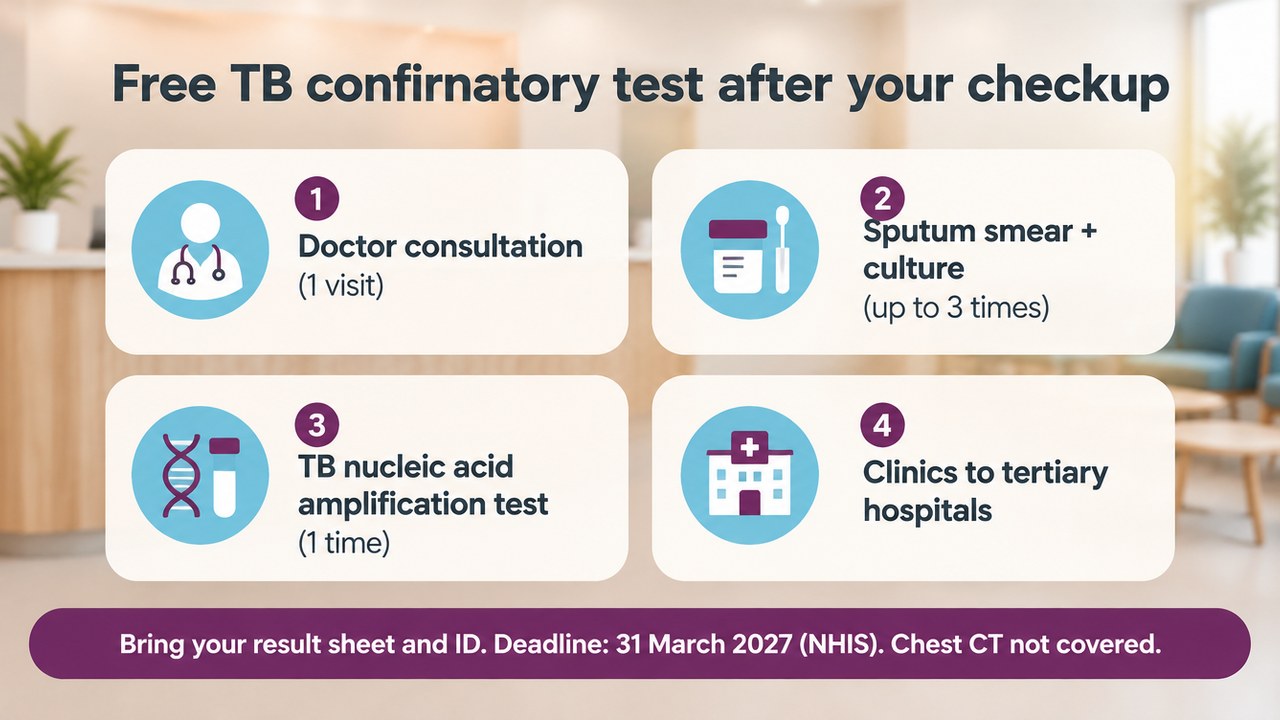
Route 1: pulmonary TB is ticked. Page 1 of form 6 has a “suspected disease” line with seven boxes: hypertension, diabetes, dyslipidaemia, pulmonary TB, depression, early psychosis and hepatitis C. Under it, the form says people suspected of these conditions can have one first visit with no out-of-pocket charge until 31 March of the year after the checkup. For TB the footnote lists “consultation, sputum smear and culture, and nucleic acid amplification test”, and adds that general and tertiary hospitals are included (form 6; NHIS).
Route 2: another chest finding. Annex 4’s “disease suspected” covers anything that is neither normal nor inactive TB, so it can be something other than TB. Examples are a nodule the reader wants checked, an enlarged heart shadow or fluid. In that case the doctor usually writes a note under “other” or in the comments. The NHIS free-visit list names pulmonary TB and not other chest diseases. So a follow-up for those findings is, by our reading, an ordinary insured visit with the usual co-payment. A CT is not part of the free TB test either: the 2020 MOHW/KDCA announcement of the scheme says chest CT is not covered (MOHW/KDCA briefing, 24 Dec 2020).
If you are not sure which route your sheet shows, call the checkup clinic that read your X-ray. They can tell you what they saw and whether they flagged it as suspected TB.

The free TB confirmatory test: who, what, where, until when
| Item | Detail | Source |
|---|---|---|
| Who | People whose general checkup result is “pulmonary TB suspected” | NHIS guide; form 6 |
| What is free | One first visit: consultation, sputum smear and culture, TB nucleic acid amplification test. The 2020 announcement set the scope at 1 consultation, smear and culture up to 3 times, NAAT once | NHIS; MOHW/KDCA 2020 briefing |
| Not covered | Chest CT; other tests beyond the listed ones (“other tests are charged”) | 2020 briefing; NHIS |
| Where | Clinics, hospitals, general hospitals and tertiary hospitals. Dental clinics, Korean-medicine clinics, long-term-care hospitals and psychiatric hospitals are excluded | NHIS; form 6 |
| Bring | Your general checkup result sheet and photo ID | NHIS |
| Medical Aid recipients | Go to a nearby clinic first, following the Medical Aid referral system | NHIS |
| Deadline | 31 March of the year after the checkup, so 31 March 2027 for a 2026 checkup | NHIS; form 6 |
| What it replaced | Before 2021, people paid about ₩160,000 themselves for these tests (2020 estimate) | 2020 briefing |
The date conflict, in one line. NHIS’s live checkup page and the 2026 result form both say 31 March of the following year. KDCA’s national-checkup page still says 31 January in its FAQ. The original 2020 announcement also said 31 January, and so does one hospital’s checkup page we checked (KDCA checkup page; Eunpyeong St. Mary’s). We follow NHIS, which pays for the visit, and the current legal form. But the simplest way to avoid any argument is to go before 31 January 2027. That is 79 days from 13 November, and in any case you should not wait months on a suspected TB result. (31 January 2027 is a Sunday. The day counts are our calculation.)
There is a second, smaller mismatch. One procedural paragraph on the KDCA checkup page says TB confirmatory visits exclude general and tertiary hospitals. The NHIS page, form 6, the 2020 announcement and KDCA’s own detailed section all say they are included. We follow the majority, and the form.
How the three tests work, and how long the answers take
Everything below is from KDCA’s TB page unless marked otherwise.
- Sputum smear (객담 도말). A stained sample of your phlegm is checked under a microscope for acid-fast bacteria. The result usually comes within 24 hours, which helps identify people who are highly infectious. It is less sensitive than culture. KDCA puts the detection rate from a single sample at about 85%, and still advises at least 2, ideally 3 samples to raise it.
- Sputum culture (객담 배양). The sample is grown on a medium. KDCA calls this the most accurate test for diagnosing pulmonary TB. It tells TB apart from non-tuberculous mycobacteria and allows drug-sensitivity testing. The catch is time: 2 to 8 weeks, depending on the method.
- Nucleic acid amplification test (핵산증폭검사, often called TB PCR). It looks for the bacterium’s genetic material. KDCA describes it as a supplementary test, useful when the smear is negative. It reports a sensitivity range of 25 to 83% and recommends using it together with culture. WHO recommends rapid molecular tests as the initial test for anyone with TB signs and symptoms. It says they can give initial results within 48 hours of sample collection (WHO TB fact sheet).
Collecting a good sample. KDCA advises: collect it in the morning, on an empty stomach, after brushing your teeth. Take three deep breaths, then cough hard to bring up phlegm from deep in the chest, not saliva. Do this outdoors or in a well-ventilated place away from other people. If you cannot hand the cup in straight away, keep it in the fridge (4°C) and deliver it soon. KDCA notes that even people without much phlegm can often produce a usable sample this way.
What a negative smear means. Not much on its own. KDCA says culture often finds TB that the smear missed, so when the smear is negative you wait for the culture result. In “culture-negative TB”, a doctor may still treat if the X-ray, symptoms and history point to TB. That is a doctor’s decision, not something to work out from the sheet.
Worked example result sheets (illustrative)
These are made-up examples that show how to read the boxes. They are not real patients, and they are not a guide to your own result.
Example 1: Normal. A 47-year-old office worker, checked in November 2026. – Chest X-ray: ☑ Normal. – What it means: Normal A for this item. Nothing to do about the X-ray. The next general checkup for office workers comes in two years (NHIS: every 2 years, yearly for non-office workers). – What it does not mean: that lung cancer is ruled out. If he were a current heavy smoker aged 54 to 74, lung CT screening would be a separate question.
Example 2: Inactive pulmonary TB. A 63-year-old woman who has never been treated for TB. – Chest X-ray: ☑ Inactive pulmonary TB. Page 1 “suspected disease”: TB not ticked. – What it means: Normal B (borderline) for this item. By KDCA’s definition, a healed lesion needs no TB treatment. There is no free confirmatory visit because the result is not “suspected”. – What to do: keep the sheet for comparison next time. See a doctor if she develops a cough lasting two weeks or more, or other TB symptoms. If she has diabetes or takes steroids, or a household member is ever diagnosed with TB, she should mention this result.
Example 3: Suspected pulmonary TB. A 55-year-old man, checked on 20 November 2026. – Chest X-ray: ☑ Disease suspected. Page 1 “suspected disease”: ☑ pulmonary TB. – What it means: one free first visit until 31 March 2027. That is 131 days after his checkup (our calculation), but there is no reason to wait. – What happens: a consultation, then 2 to 3 morning sputum samples. The smear result comes in about a day. The NAAT runs alongside, and the culture takes 2 to 8 weeks. If TB is confirmed, the doctor reports it and registers him for the TB co-payment exemption (see below). If everything is negative, the doctor decides on any further follow-up.
Example 4: Disease suspected, another finding. A 58-year-old woman. – Chest X-ray: ☑ Disease suspected. “Other” note: a small nodule, follow-up advised. Pulmonary TB not ticked. – What it means: by our reading of the NHIS list, the free TB visit does not apply. A clinic visit and any CT are ordinary insured care with the usual co-payment. – What to do: book a chest or respiratory clinic and bring the result sheet. Ask the checkup clinic for a copy of the image. SNUBH notes that most nodules are benign, often old inflammation, and that the decision on CT follow-up depends on the nodule’s size and shape.
If TB is confirmed: treatment is free at the point of care
Since 1 July 2016, people diagnosed with TB pay 0% co-payment for covered TB care. The hospital reports the case to the health authorities and registers the patient with NHIS under the TB co-payment exemption (산정특례, code V000) (NHIS co-payment special cases; KDCA TB ZERO). The National Masan Hospital, a national TB hospital, describes it as NHIS paying the full treatment cost (0% patient share), from the start date until treatment ends. Since 1 July 2021 there has been a similar one-year exemption for latent TB treatment (National Masan Hospital).
The usual NHIS rules still apply. The exemption covers insured items only; non-covered and fully self-paid items are outside it. Medical Aid recipients register through their local district office instead.
What treatment looks like, per KDCA: usually about 6 months. That is four drugs for the first 2 months, then 2 to 3 drugs for 4 months, taken every day without stopping, because irregular use breeds drug resistance. KDCA says infectiousness drops sharply about 2 weeks after effective treatment starts. Household contacts are offered free contact screening.
Why a chest X-ray result is worth acting on in Korea
Korea has far less TB than it used to, but it is not rare:
- 17,070 TB patients were reported in 2025 (33.5 per 100,000), of whom 13,713 were new patients (26.9 per 100,000) (KDCA TB ZERO statistics). Yonhap’s report of KDCA’s March 2026 release gives the same patient count. Yonhap prints the overall rate as 33.6, against 33.5 on KDCA’s own table (Yonhap, 24 Mar 2026).
- Age matters most. In the same release, 62.5% of patients (10,669) were 65 or older. Their rate was 101.5 per 100,000, against 15.8 for people under 65, which KDCA puts at 6.4 times higher. KDCA asks people 65 and over to have a TB check every year.
- Korea still has the second-highest TB incidence in the OECD, according to KDCA’s portal and the March release (2024 basis).
- KDCA explains why so many older Koreans carry old TB: the disease spread widely during and after the Korean War, many people from that era carry latent infection, and it can reactivate as immunity weakens with age or illness.
- WHO estimates about a quarter of the world’s population has been infected with TB bacteria. About 5 to 10% of infected people eventually develop TB disease. KDCA puts it at about 10% over a lifetime, half of them within the first 1 to 2 years.
When the scheme was announced in 2020, the government said about 12,000 people a year got a “suspected pulmonary TB” result at the national checkup, and only 57% went on to the confirmatory test. That was one reason the test was made free (2020 briefing). That figure is from 2020; we did not find a newer one.
Symptoms that should not wait for a checkup
KDCA’s TB page lists the common symptoms of pulmonary TB as a long-lasting cough, weight loss, night sweats, fever, general weakness and loss of appetite. Coughing up blood can occur in advanced disease. Its FAQ says the most common symptom is a cough lasting 2 weeks or more. Doctors should consider TB when respiratory symptoms last 2 to 3 weeks or more with no clear cause. WHO’s list is similar: prolonged cough (sometimes with blood), chest pain, weakness, fatigue, weight loss, fever and night sweats.
Two KDCA points matter for the 40 to 60 group and their parents. Older adults often lack the typical symptoms. And in people with COPD or asthma, TB symptoms can look like their usual condition, which delays diagnosis. A “normal” checkup X-ray from months ago is not a reason to ignore new symptoms. See a doctor.
Your next steps
- Find the chest X-ray line in the results table of your sheet (“흉부촬영”, under imaging), and the “suspected disease” boxes in the summary on page 1.
- Normal: nothing to do for the X-ray.
- Inactive pulmonary TB: keep the sheet, and tell your doctor if you have diabetes, kidney disease or take immune-suppressing drugs, or if someone at home is diagnosed with TB.
- Pulmonary TB ticked: book a clinic or hospital now. Bring the result sheet and ID, ask for the free TB confirmatory test, and if possible go before 31 January 2027 to avoid the date conflict. The NHIS deadline is 31 March 2027.
- Another chest finding: book a respiratory clinic. Expect normal co-payments.
- Not checked yet this year? The window closes on 31 December 2026. If you missed last year, NHIS lets you apply to be added this year. Our Dec 31 deadline and catch-up guide covers the details. Fast from 9 pm the night before (NHIS).
Related reading
- Korea Lung Cancer Screening: Who Qualifies at 54–74, What a Pack-Year Is: the low-dose CT programme, which is separate from the checkup X-ray
- Korea’s New Checkup Lung Function Test at 56 and 66: the other lung test on the general checkup, and how to read its numbers
- Korea’s National Health Checkup Ends Dec 31: Missed-Checkup and Catch-Up Rules: how to get checked before the window closes
Frequently asked questions
Q. Is the chest X-ray on Korea’s national checkup a lung cancer screening?
No. The official 2026 result form states that the checkup chest X-ray is a test for pulmonary tuberculosis and is not lung cancer screening. Korea’s lung cancer screening is a separate low-dose CT programme for current heavy smokers aged 54 to 74. Many small nodules are hard to see on a plain X-ray.
Q. My result says “inactive pulmonary TB”. Do I have tuberculosis?
Not active TB. Under the MOHW result criteria, inactive pulmonary TB counts as Normal B (borderline). KDCA describes it as a healed lesion, often like a scar, that needs no TB treatment, even if you were never diagnosed. See a doctor if you develop a cough lasting 2 weeks or more or other symptoms, because an X-ray alone cannot always separate active from inactive disease.
Q. What is included in the free TB confirmatory test?
If pulmonary TB is ticked as suspected, NHIS covers one first visit with no co-payment: a consultation, sputum smear and culture, and a TB nucleic acid amplification test. The 2020 government announcement set this at 1 consultation, smear and culture up to 3 times, and the NAAT once. Chest CT is not covered.
Q. What is the deadline for the free TB test after a 2026 checkup?
NHIS and the 2026 result form say 31 March of the following year, which is 31 March 2027. A KDCA FAQ still says 31 January, so going before 31 January 2027 avoids any dispute. With a suspected TB result, it is better not to wait at all.
Q. Can I take the free TB test at a big university hospital?
Yes. For pulmonary TB, NHIS and the result form list clinics, hospitals, general hospitals and tertiary hospitals. Dental, Korean-medicine, long-term-care and psychiatric hospitals are excluded. Bring the checkup result sheet and photo ID. Medical Aid recipients go to a nearby clinic first.
Sources
All sources below were checked on 11 November 2026 unless noted.
- National Health Insurance Service, 일반건강검진 (general checkup guide): chest X-ray as a common item; confirmatory test for pulmonary TB = consultation, sputum smear and culture, nucleic acid amplification; clinics to tertiary hospitals; until 31 March of the next year; bring result sheet and ID; checkup period 1 Jan–31 Dec; fasting — https://www.nhis.or.kr/nhis/healthin/wbhaca04500m01.do (checked 11 November 2026)
- MOHW, 건강검진 실시기준 (Health Checkup Implementation Standards, notice no. 2026-6, in force 7 January 2026), Article 5 (chest radiography), Article 6(4) (result criteria in Annex 4) — https://www.law.go.kr/LSW/admRulLsInfoR.do?admRulSeq=2100000272270&chrClsCd=010201 (checked 11 November 2026)
- MOHW, Annex 4 결과 판정기준 and its appendix 검사항목별 판정기준 (chest X-ray: normal = Normal A; inactive pulmonary TB = Normal B; other = disease suspected, excluding poor or untaken films) — https://www.law.go.kr/LSW/flDownload.do?flSeq=160922523 and https://www.law.go.kr/LSW/flDownload.do?flSeq=160922929 (read from box copies, 11 November 2026)
- MOHW, form 6 일반건강검진 결과통보서 (rev. 1 January 2026): “chest X-ray is a TB diagnostic test, not lung cancer screening”; suspected-disease boxes; free first visit to 31 March of the next year; TB footnote incl. (tertiary) general hospitals — https://www.law.go.kr/LSW/flDownload.do?flSeq=160922671 (checked 11 November 2026)
- KDCA National Health Information Portal, 결핵 (Tuberculosis, updated 8 June 2026): X-ray role and limits; smear, culture, NAAT; sputum collection; inactive TB FAQ; symptoms; treatment length; OECD ranking — https://health.kdca.go.kr/healthinfo/biz/health/gnrlzHealthInfo/gnrlzHealthInfo/gnrlzHealthInfoView.do?cntnts_sn=6561 (checked 11 November 2026)
- KDCA National Health Information Portal, 건강검진(국가건강검진) (updated 1 June 2026): confirmatory tests; FAQ deadline “31 January” (conflict noted) — https://health.kdca.go.kr/healthinfo/biz/health/gnrlzHealthInfo/gnrlzHealthInfo/gnrlzHealthInfoView.do?cntnts_sn=6671 (checked 11 November 2026)
- KDCA TB ZERO, 주요통계 (TB statistics 2013–2025; last reviewed 24 March 2026) — https://tbzero.kdca.go.kr/tbzero/content/getTbStats.do (checked 11 November 2026)
- KDCA TB ZERO, 결핵 산정특례 (TB co-payment exemption) — https://tbzero.kdca.go.kr/tbzero/contents.do?leftMenuId=5¶mBoardId=C00050¶mGubun=M¶mMenuId=581&subTabMenuId=&subTabSelected= (checked 11 November 2026)
- NHIS, 본인일부부담금 산정특례 제도 (exempt TB special case V000; scope rules) — https://www.nhis.or.kr/static/html/wbma/c/wbmac0215.html (checked 11 November 2026)
- MOHW and KDCA via Korea.kr, 내년부터 결핵진단 위한 추가검사 비용 국가 전액지원 (24 December 2020): scope (1 consultation; smear and culture up to 3; NAAT once); CT not covered; ~₩160,000; ~12,000 suspected a year, 57% tested — https://www.korea.kr/briefing/policyBriefingView.do?newsId=148881652 (checked 11 November 2026)
- Independent: WHO, Tuberculosis fact sheet (symptoms; rapid molecular tests within 48 hours; a quarter of the world infected; 5–10% progress) — https://www.who.int/news-room/fact-sheets/detail/tuberculosis (checked 11 November 2026)
- Independent: Seoul National University Bundang Hospital, 건강검진서 발견된 폐결절, 혹시 폐암일까? (nodules often invisible on X-ray; most benign; old TB traces) — https://www.snubh.org/service/info/com/view.do?BNO=202&Board_ID=B003 (checked 11 November 2026)
- Independent: Eunpyeong St. Mary’s Hospital, 일반건강검진안내 (TB confirmatory incl. tertiary hospitals; smear and culture up to 3; states 31 January) — https://www.cmcep.or.kr/hospitalguide.normal_checkup.sp (checked 11 November 2026)
- Independent: National Masan Hospital, 결핵·잠복결핵 산정특례등록 (0% patient share; TB from 1 July 2016; latent TB from 1 July 2021) — https://www.mnth.go.kr/html/content.do?depth=hi&menu_cd=08_13_00_02 (checked 11 November 2026)
- Independent: Yonhap News, 국내 결핵환자 14년 연속 감소…고령층선 소폭 증가 (24 March 2026) — https://www.yna.co.kr/view/AKR20260324046900530 (checked 11 November 2026)
This article is general health information, not medical advice. It does not diagnose tuberculosis or any other disease, and it cannot interpret your own X-ray. Talk to your doctor about your result, any symptoms and any tests or treatment.