Korea’s New Checkup Lung Function Test at 56 and 66: Who Gets It and How to Read the Result Sheet
Haesul Health desk (AI-assisted). As of 9 November 2026 (KST), based on the National Health Insurance Service (NHIS) general health checkup page, the Ministry of Health and Welfare (MOHW) Health Checkup Implementation Standards as amended by Notice 2026-6 (7 January 2026) with its result-criteria annex and result-sheet form (Korean Law Information Center), the MOHW press release of 18 September 2025, the government public-health portal (e-health.go.kr), and the Korea Disease Control and Prevention Agency (KDCA) National Health Information Portal page on spirometry. Independent cross-checks: a June 2026 review in the Journal of the Korean Medical Association, the Korean Academy of Tuberculosis and Respiratory Diseases spirometry slides and Yonhap News. This is general information, not medical advice. Talk to a doctor about your own breathing, results and follow-up.
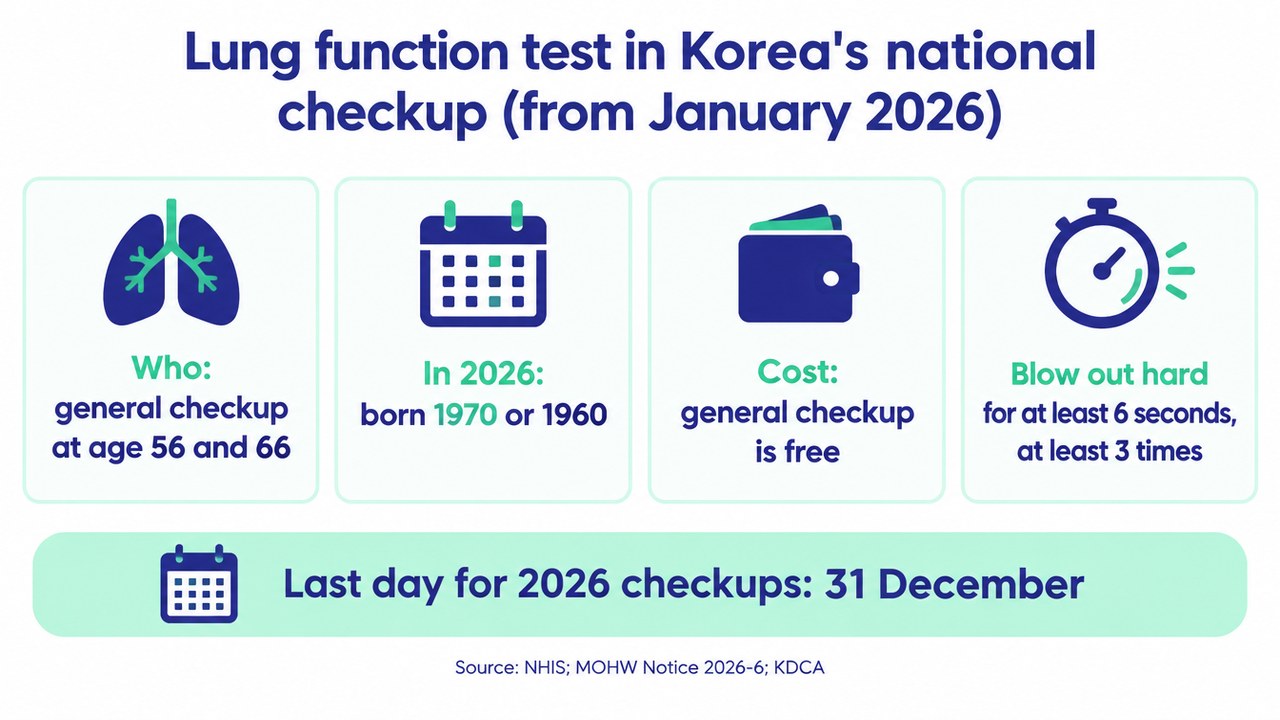
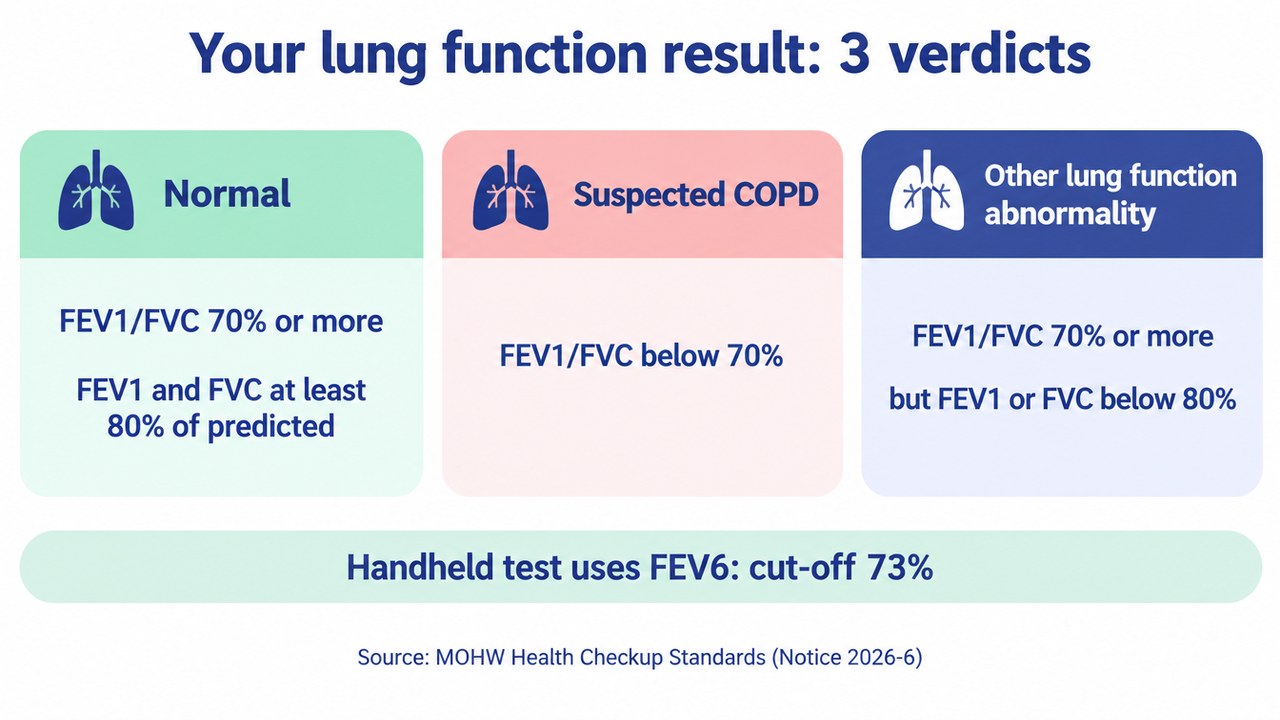
Quick answer: Since January 2026, Korea’s free national general health checkup includes a lung function test (폐기능검사, spirometry) at age 56 and age 66 — twice in a lifetime. In 2026 that means people born in 1970 or 1960; both are even birth years, which are the ones scheduled for the general checkup this year. You breathe in fully and blow out as hard and as long as you can into a tube, at least three times. The result sheet gives one of three verdicts: normal (FEV1/FVC 70% or more, and FEV1 and FVC each at least 80% of the predicted value), suspected COPD (FEV1/FVC below 70%), or other lung function abnormality (ratio normal, but FEV1 or FVC below 80%). A “suspected” result is a reason to see a doctor for a confirmatory test, not a diagnosis. The 2026 checkup year ends on 31 December — 48 days from 13 November.
Chronic obstructive pulmonary disease (COPD) is the main target. MOHW says about 12% of Korean adults have it, but only 2.3% know they do, because it usually causes few symptoms until lung function has fallen a long way. The test is new, so many people in their 50s and 60s see an unfamiliar row on their result sheet with three numbers and a percentage. This guide explains who gets the test, how it works and how to read that row. If you are also checking what else is due at your age, see our Korea national health checkup by age guide.
Who gets the lung function test
The NHIS general checkup page lists the lung function test (폐기능검사) among the sex- and age-specific items, at 56 and 66. MOHW’s January 2026 amendment to the Health Checkup Implementation Standards added it as a new test item and set its timing.
| Item | Rule |
|---|---|
| Programme | National general health checkup (일반건강검진); also the Medical Aid life-transition checkup at 66 |
| Ages | 56 and 66 — twice in a lifetime |
| Born in (2026 checkup year) | 1970 (age 56) or 1960 (age 66) |
| Started | January 2026 (MOHW Notice 2026-6, 7 January 2026) |
| Cost | Part of the general checkup, which is free (no copayment) |
| Checkup year | 1 January – 31 December 2026 |
| Goal | Early detection of COPD, linked to stop-smoking and health-management programmes |
Sources: NHIS general health checkup page; MOHW press release, 18 September 2025; e-health.go.kr 2026 general checkup page; Yonhap, 8 October 2026 (free general checkup, even birth years in 2026).
Who is eligible for the general checkup itself? NHIS lists regional heads of household, employee subscribers, household members and dependants aged 20 or over, and Medical Aid recipients aged 20–64. The checkup runs every two years by birth-year parity — even birth years in 2026 — while non-office workers are checked every year. Because 1970 and 1960 are both even years, anyone in those birth cohorts is already on this year’s list. Your NHIS checkup notice (sent electronically or by post) shows the exact items for you, and you can print a checkup confirmation from the NHIS website if you lost it.
The test is for everyone at those ages, not only smokers. The JKMA review notes that nearly half of COPD cases in Korea are now in people who never smoked, linked to things like childhood chest infections, long-standing asthma, workplace dust and air pollution.
What happens during the test
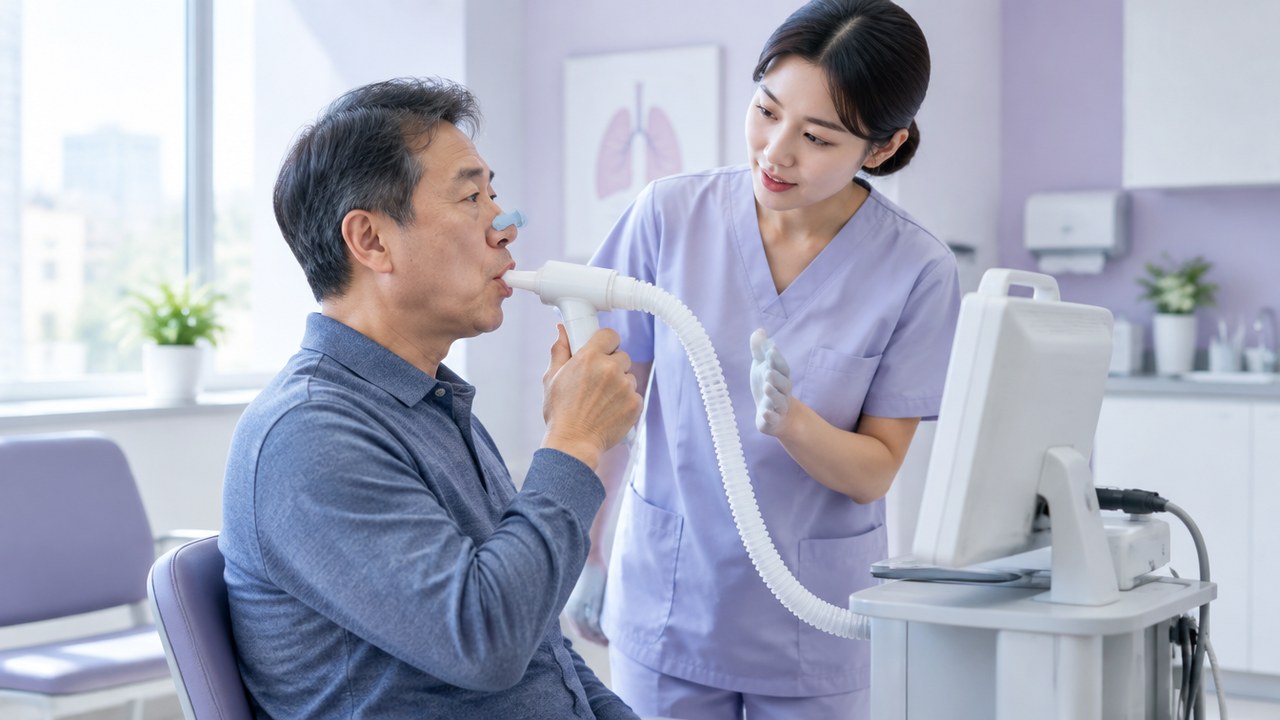
KDCA describes a simple, non-invasive test. Staff check your age, sex, height and weight (the “predicted” values depend on them). You sit upright, a clip closes your nose, and you breathe through a mouthpiece connected to a spirometer:
- Breathe in as deeply as you can.
- Blow out as fast and as hard as you can, and keep blowing until the tester says stop — usually at least 6 seconds.
- Repeat at least three times; a blow that leaks, starts slowly or ends with a cough is redone.
The checkup may use a full spirometer or, in some clinics, a handheld device. The handheld version measures air blown out in 6 seconds (FEV6) instead of the full forced vital capacity (FVC), and uses a slightly different cut-off.
Before the test (KDCA): no smoking for 1 hour, no alcohol for 4 hours, no hard exercise for 30 minutes and no large meal for 2 hours beforehand; wear loose clothing. Tell the staff if you have had recent eye, chest or abdominal surgery, a recent heart attack or unstable angina, a collapsed lung, or unexplained coughing up of blood — the test may need to wait. The general checkup’s usual fasting rule (nothing after 9 p.m. the night before) still applies for the blood tests.

The three numbers on your result sheet
The MOHW result-sheet form (일반건강검진 결과통보서) has a lung function row listing:
- FEV1 (1초노력호기량) — litres blown out in the first second, and that as a % of the predicted value for someone of your age, sex and height.
- FVC (노력성폐활량) — total litres blown out, and its % predicted. (Handheld test: FEV6 instead.)
- FEV1/FVC (%) — the share of your breath that comes out in the first second. Handheld: FEV1/FEV6 (%).
The verdict follows the MOHW result criteria annex:
| Result on the sheet | Full spirometer | Handheld (FEV6) | Standard message |
|---|---|---|---|
| Normal (정상) | FEV1/FVC ≥ 70%, and FEV1 ≥ 80% and FVC ≥ 80% of predicted | FEV1/FEV6 ≥ 73%, and FEV1 and FEV6 ≥ 80% | None needed |
| Suspected COPD (만성폐쇄성폐질환 의심) | FEV1/FVC < 70% | FEV1/FEV6 < 73% | Obstructive pattern suspected; visit a nearby clinic for further evaluation |
| Other lung function abnormality (기타 폐기능 이상) | FEV1/FVC ≥ 70%, but FEV1 or FVC < 80% of predicted | FEV1/FEV6 ≥ 73%, but FEV1 or FEV6 < 80% | Lung function abnormality suspected; visit a nearby clinic |
Sources: MOHW Health Checkup Implementation Standards, Annex 1 result criteria, and result-sheet form (Notice 2026-6); JKMA review Table 1 (June 2026); KDCA spirometry page (80% predicted, 0.7 ratio).
Worked examples: reading four sample results
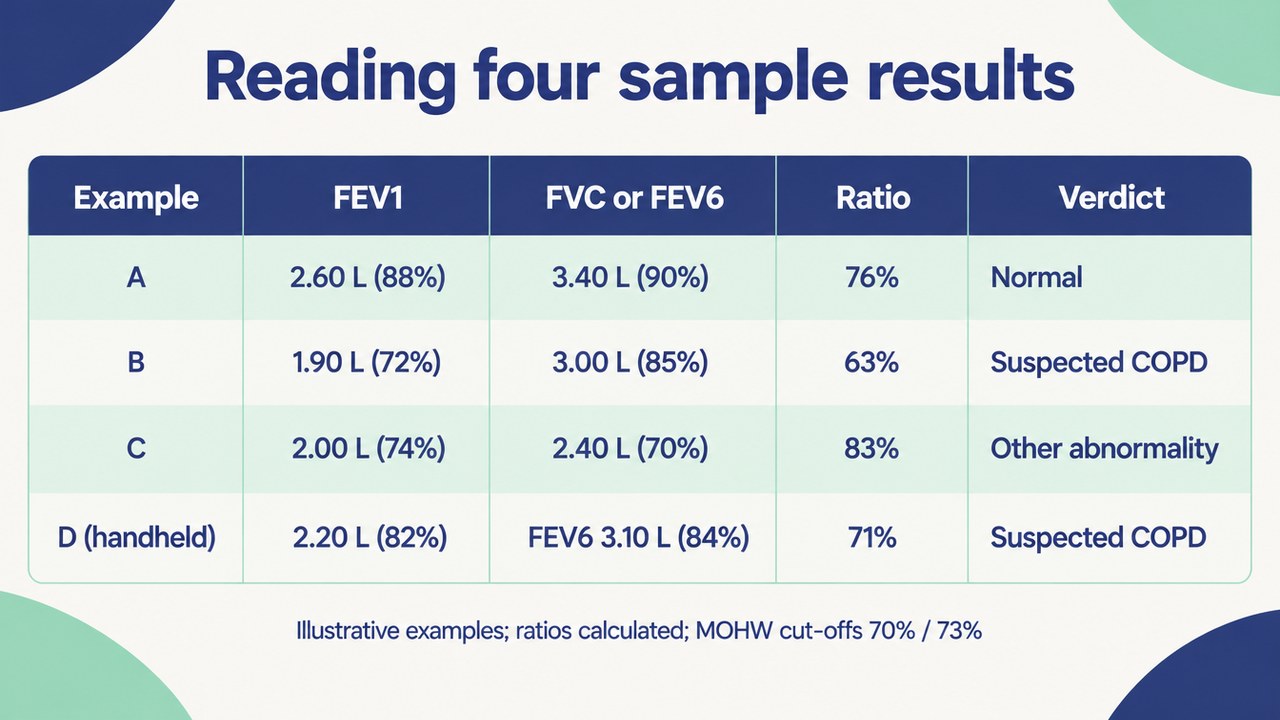
These four results are made up for illustration; the ratios are calculated from the litres shown, and the verdict applies the MOHW cut-offs above.
| Example | FEV1 (% predicted) | FVC or FEV6 (% predicted) | Ratio (calculated) | Verdict on the sheet |
|---|---|---|---|---|
| A, full spirometer | 2.60 L (88%) | FVC 3.40 L (90%) | 2.60 ÷ 3.40 = 76% | Normal — ratio ≥ 70%, both ≥ 80% |
| B, full spirometer | 1.90 L (72%) | FVC 3.00 L (85%) | 1.90 ÷ 3.00 = 63% | Suspected COPD — ratio below 70% |
| C, full spirometer | 2.00 L (74%) | FVC 2.40 L (70%) | 2.00 ÷ 2.40 = 83% | Other abnormality — ratio fine, FEV1 and FVC below 80% |
| D, handheld | 2.20 L (82%) | FEV6 3.10 L (84%) | 2.20 ÷ 3.10 = 71% | Suspected COPD — handheld cut-off is 73% |
Two things stand out. First, the ratio is checked first: in example B, an FVC of 85% does not rescue a 63% ratio. Second, example D would count as normal under the 70% full-spirometer rule but not under the 73% handheld rule — so look at which test your clinic used before comparing with a friend’s result.
What a “suspected” result means — and what it doesn’t
The checkup test is done without an inhaled bronchodilator. The JKMA review points out that COPD is confirmed by a ratio below 0.70 after a bronchodilator, so anyone flagged needs a repeat test at a clinic, usually with a respiratory (호흡기내과) or internal-medicine doctor. KDCA adds that a normal spirometry result does not rule out every lung problem — a tumour, for example, can leave the numbers normal.
The “other abnormality” group covers two different patterns, according to the review: a low FEV1 with a normal ratio (sometimes called PRISm, linked to a higher later risk of COPD and heart disease), and a low FVC alone, which can point to a restrictive problem such as interstitial lung disease, obesity, or old tuberculosis damage. Both need a doctor to sort out; chest imaging and further breathing tests may follow.
Cost of follow-up. The NHIS list of checkup findings whose first follow-up visit is copay-free (hypertension, diabetes, dyslipidaemia, pulmonary tuberculosis, depression or early psychosis, hepatitis C) does not include COPD or abnormal spirometry, so expect ordinary health-insurance outpatient charges for the confirmatory visit. Bring your result sheet.
Whatever the result, KDCA’s advice for people with reduced lung function is the same core list: stop smoking, avoid colds and chest infections, and — if you are 65 or older or have a lung condition — get flu, COVID-19 and pneumococcal vaccines. If you smoked heavily, also check whether you qualify for low-dose CT lung cancer screening; see our Korea lung cancer screening guide.

If you are 56 or 66 and haven’t had the 2026 checkup
- Book now. The checkup year closes on 31 December 2026; clinics fill up in December. Our Dec 31 checkup catch-up guide covers booking and what happens if you miss it.
- Check the clinic does the test. Ask when booking whether they perform the 폐기능검사 for 56- and 66-year-olds.
- At 56, two new tests come together. The same checkup adds a one-off hepatitis C antibody test — see our hepatitis C test at 56 guide.
- Missed it? NHIS says people who missed the previous year’s checkup can ask to be added to the next year’s list. Whether the lung test is then given at 57 or 67 is not stated on the NHIS page, so ask NHIS (1577-1000) before you book.
- Helping a parent born in 1960? At 66 the checkup also includes bone density (women), cognitive screening and a physical function (fall-risk) test, so it is a longer visit.
Frequently asked questions
Q. Who gets the lung function test in Korea’s national health checkup?
People having the national general checkup at age 56 and age 66 — in 2026, those born in 1970 or 1960. It started in January 2026 under MOHW Notice 2026-6 and is given twice in a lifetime. At 66 it is also part of the Medical Aid life-transition checkup.
Q. How much does the checkup lung function test cost?
Nothing. It is part of the general health checkup, which NHIS provides without a copayment. A later confirmatory visit at a clinic, if your result is abnormal, is charged at normal health-insurance rates, because COPD is not on the NHIS list of copay-free follow-ups.
Q. What is a normal FEV1/FVC ratio on the Korean checkup?
70% or more on a full spirometer, with FEV1 and FVC each at least 80% of your predicted value. On a handheld device that measures FEV6, the cut-off is 73%. A ratio below those levels is reported as “suspected COPD”.
Q. Does “suspected COPD” mean I have COPD?
No. The checkup test is done without a bronchodilator, and a ratio can be low for other reasons, including a poor blow. COPD is confirmed by a repeat test after a bronchodilator at a clinic. Take your result sheet to a doctor.
Q. I have never smoked. Do I still need the lung function test?
It is offered to everyone at 56 and 66, smokers or not. A June 2026 review in the Journal of the Korean Medical Association notes that nearly half of COPD in Korea occurs in people who never smoked, linked to causes such as childhood chest infections, asthma, dust at work and air pollution.
Sources
- National Health Insurance Service (NHIS), 일반건강검진 page (eligibility; every 2 years, non-office yearly; 폐기능검사 at 56 and 66; 15-day result notice; copay-free follow-up list; checkup year 1 Jan–31 Dec; prior-year add-on) — https://www.nhis.or.kr/nhis/healthin/wbhaca04500m01.do (confirmed 9 November 2026)
- Ministry of Health and Welfare, Health Checkup Implementation Standards (건강검진 실시기준), Notice 2026-6, 7 January 2026 — revision reason: lung function test added for 56 and 66 — https://www.law.go.kr/LSW/admRulRvsInfoR.do?admRulSeq=2100000272270 (confirmed 9 November 2026)
- MOHW Health Checkup Implementation Standards, Annex 1 “검사항목별 판정기준” (lung function: normal / suspected COPD / other abnormality; 70% and 73% cut-offs) — https://www.law.go.kr/flDownload.do?bylClsCd=200207&flNm=%5B%EB%B3%84%EC%B2%A8+1%5D+%EA%B2%80%EC%82%AC%ED%95%AD%EB%AA%A9%EB%B3%84+%ED%8C%90%EC%A0%95%EA%B8%B0%EC%A4%80&flSeq=160922929 (confirmed 9 November 2026, via search extract)
- MOHW general checkup result-sheet form (일반건강검진 결과통보서: FEV1, FVC, FEV1/FVC, FEV6 rows) — https://www.law.go.kr/LSW/flDownload.do?flSeq=160922671 (confirmed 9 November 2026, via search extract)
- MOHW press release, 18 September 2025, “만성폐쇄성 폐질환 검사 국가검진 도입” (56 and 66 from 2026; prevalence 12%, awareness 2.3%) — https://www.mohw.go.kr/board.es?act=view&bid=0027&list_no=1487450&mid=a10503010200 (confirmed 9 November 2026)
- e-health.go.kr (public health portal), 2026 일반건강검진 사업 (lung function test 56 and 66; Medical Aid 66; birth-year parity) — https://www.e-health.go.kr/gh/heSrvc/selectBbsDtlViewInfo.do?bbsId=U00322&bbsNo=381805&bbsSeCd=&menuId=200036&pageIndex=1&schSe=&schText=%EA%B1%B4%EA%B0%95%EA%B2%80%EC%A7%84 (confirmed 9 November 2026)
- KDCA National Health Information Portal, “폐기능검사” (updated 3 August 2026: procedure, preparation, 80% predicted and 0.7 ratio, cautions, advice) — https://health.kdca.go.kr/healthinfo/biz/health/gnrlzHealthInfo/gnrlzHealthInfo/gnrlzHealthInfoView.do?cntnts_sn=6258 (confirmed 9 November 2026)
- Moon J-Y. “Introduction of pulmonary function testing into the National Health Screening Program in the Republic of Korea.” Journal of the Korean Medical Association, published online 10 June 2026 (Table 1 criteria and messages; pre-bronchodilator caveat; ~1.5 million eligible a year; non-smoker COPD) — https://doi.org/10.5124/jkma.26.0057 (confirmed 9 November 2026)
- Korean Academy of Tuberculosis and Respiratory Diseases, spirometry interpretation slides (screening result is a screen; FEV1/FVC < 0.7 obstructive) — https://new.lungkorea.org/assets/image/file/KATRD_01.pdf (confirmed 9 November 2026, via search extract)
- Yonhap News, 8 October 2026, “올해 국가건강검진은 짝수년도 출생자” (free general checkup; even birth years in 2026; non-office yearly) — https://www.yna.co.kr/view/AKR20261008065100530 (confirmed 9 November 2026)
This article is general information, not medical advice. A screening result is not a diagnosis. If you have breathlessness, a long-lasting cough or an abnormal result, see a doctor; in an emergency call 119.




4 Comments