Korea Insurance Premium Tax Credit 2026: 12% on Up to ₩1 Million, and Whose Policies Actually Count
Haesul Economy desk (AI-assisted). As of 9 November 2026 (KST), based on Article 59-4 (special tax credits), Article 50 (basic deduction) and Article 53 (how dependants are judged) of the Income Tax Act and Article 118-4 of its Enforcement Decree, all read on the Korean Law Information Center, plus the National Tax Service (NTS) wage-income guide and the Korea Post insurance tax page. Independent cross-checks: Korea Taxpayers Association Q&A, Taxnet’s dual-income couple summary and two Korean insurance trade papers. This is general information, not tax advice. Check your own case with your employer’s payroll team, Hometax or the NTS call centre (126).
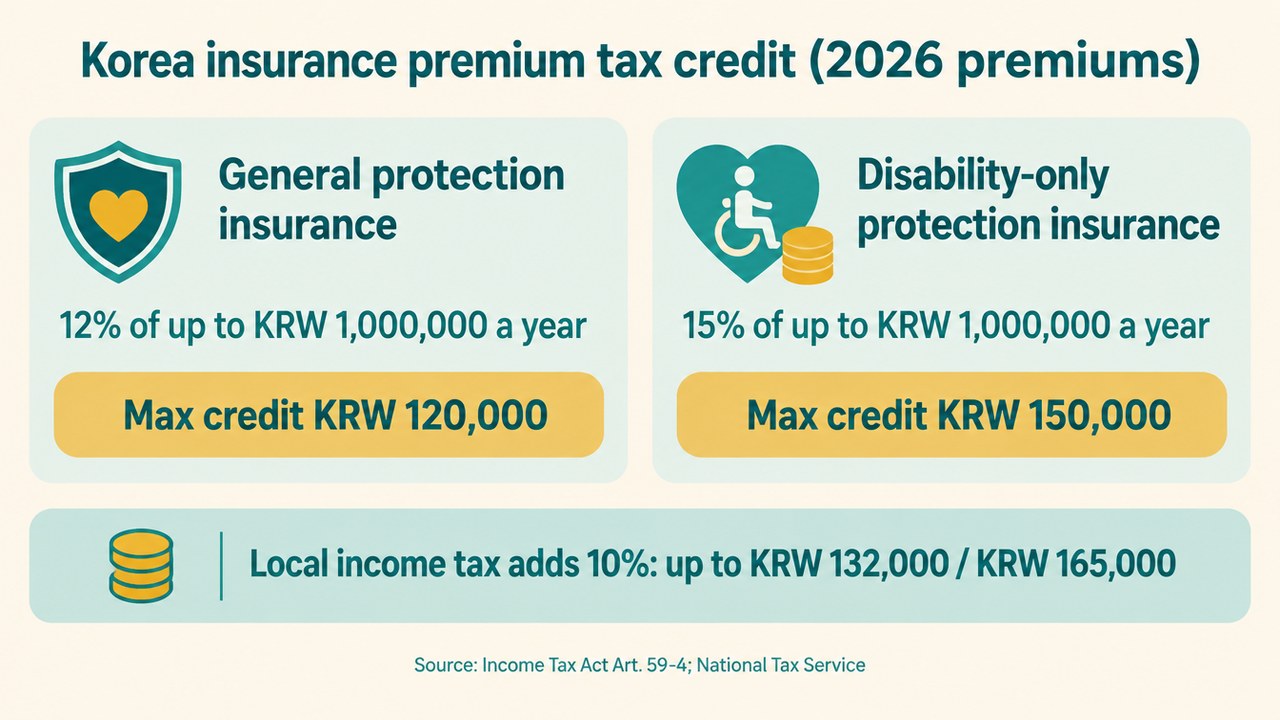
Quick answer: If you earn a salary in Korea, the protection-type insurance premiums (보장성보험료) you pay in 2026 for yourself or for a family member you claim as a dependant earn a 12% tax credit on up to ₩1,000,000 a year — at most ₩120,000 off your national income tax. Policies labelled disability-only (장애인전용) have their own separate ₩1,000,000 limit at 15% (at most ₩150,000). Local income tax adds 10% on top, so the most you save is about ₩132,000 and ₩165,000. Savings-type policies, where the maturity payout is more than you paid in, do not count. The trap for couples in their 40s to 60s is the policyholder–insured rule: if both spouses work, a policy one of you pays for that covers the other usually earns no credit for either of you.
For most mid-career workers this is a small, almost automatic line on the year-end settlement form — the premiums are in the Hometax simplified data, and payroll applies the credit. But “almost automatic” is where the money leaks. In your 40s and 50s you may be paying for a parent’s cancer policy, a spouse’s medical-expense (실손) cover and your own life insurance, all on different policyholders. Some of those premiums count, some do not, and the ₩1 million cap means that beyond a certain point extra premiums add nothing. With seven weeks of 2026 left, this is a good moment to check. If you are also gathering medical receipts, see our Korea medical expense tax credit guide.

What the insurance premium tax credit is
Article 59-4(1) of the Income Tax Act gives the credit to a resident with wage income (day labourers are excluded) who pays premiums during the tax year under an insurance contract whose maturity refund does not exceed the premiums paid — the legal definition of protection (보장성) insurance. Two baskets each have their own annual limit:
| Basket | What it covers | Annual premium limit | Credit rate | Largest national-tax credit |
|---|---|---|---|---|
| General protection insurance | Policies insuring you or a basic-deduction dependant: life, accident, household property/damage insurance (including personal car insurance), certain mutual-aid (공제) contracts, and rental-deposit return guarantees on deposits of ₩300 million or less | ₩1,000,000 | 12% | ₩120,000 |
| Disability-only protection insurance (장애인전용) | Policies whose insured or beneficiary is a dependant with a disability, and which the contract or premium receipt marks as disability-only | ₩1,000,000 | 15% | ₩150,000 |
Sources: Income Tax Act Art. 59-4(1); Enforcement Decree Art. 118-4; NTS wage-income guide (보험료 세액공제 table). Largest credit = limit × rate (calculated).
The insurance trade press commonly adds local income tax (개인지방소득세, 10% of income tax) to quote the totals of ₩132,000 and ₩165,000. Because it is a credit, not a refund cheque, it can only reduce tax you actually owe for 2026. If your calculated tax is already zero, there is nothing left for it to reduce.
What counts in practice? The trade papers list whole-life, cancer, personal car, fire and indemnity medical (실손) policies as typical protection insurance; a savings or annuity product that pays back more than you put in does not count. National Health Insurance and employment insurance contributions are not part of this credit — they are handled as a separate income deduction on the same form.
Who you can claim for: the dependant test
The credit covers premiums on policies that insure you or a basic-deduction dependant (기본공제대상자). Unlike the medical-expense and education credits — where the law says the dependant’s age and income limits do not apply — Article 59-4(1) has no such exception. So for insurance, both the age test and the income test apply:
| Family member | Age test (2026) | Income test |
|---|---|---|
| Spouse | None | Income of ₩1 million or less (or wage-only total pay of ₩5 million or less) |
| Parent or grandparent | 60 or older — born in 1966 or earlier | Same ₩1 million / ₩5 million test |
| Child or grandchild | 20 or younger — born in 2006 or later | Same test |
| Brother or sister | 20 or younger, or 60 or older | Same test |
| Any of the above with a registered disability | Age limit does not apply | Income test still applies |
Sources: Income Tax Act Art. 50(1) and Art. 53(4)–(5) (status judged on 31 December; an age limit is met if you reach it on any day of the year). Birth years calculated for 2026.
Two consequences for a typical 50-something worker. A 24-year-old student with no income is past the age limit, so a policy covering them earns nothing here (their medical bills can still count under the medical credit). And a parent aged 60 or over qualifies only if their own income is ₩1 million or less and nobody else in the family claims them — a parent living on a sizeable pension may fail the income test. Parents do not have to share your address if they live apart for housing reasons (Art. 53(3)).
Whose name is on the policy: the couple trap
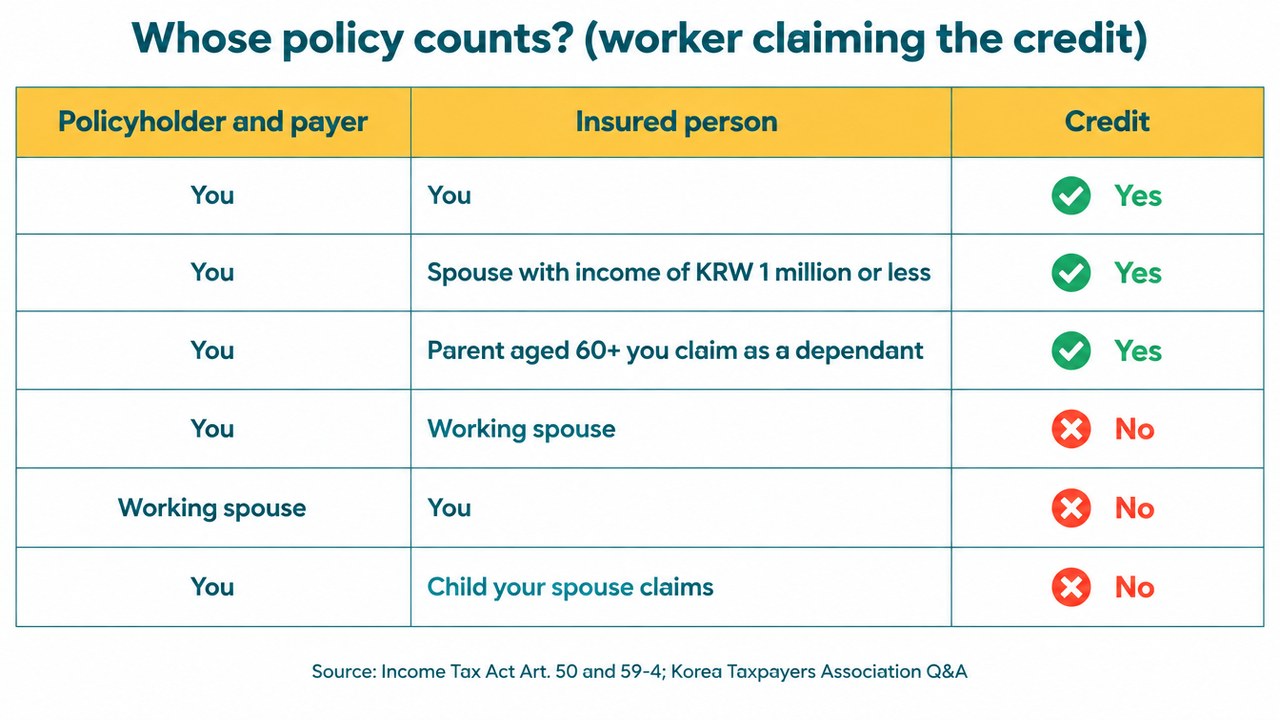
Payroll looks at three names: who holds the policy and pays, who is insured, and who claims the dependant. Korea Taxpayers Association Q&A and Taxnet’s dual-income summary set out the outcomes in the same way:
| Policyholder and payer | Insured person | Credit? |
|---|---|---|
| You | You | Yes |
| You | Your spouse with income of ₩1 million or less | Yes |
| You | A parent aged 60+ (or child 20 or under) you claim as a dependant | Yes |
| You | Your working spouse | No — for either of you |
| Your working spouse | You | No — for either of you |
| You | A child your spouse claims as a dependant | No — for either of you |
| You | You and your spouse jointly (e.g. a joint car policy) | Yes, for you |
Sources: Income Tax Act Art. 50 and 59-4(1); Korea Taxpayers Association year-end Q&A; Taxnet, “맞벌이 부부 연말정산 요약”. Not an exhaustive list — unusual contracts can differ.
The rule behind the table is simple: the insured must be you or your own basic-deduction dependant, and the premium must be yours. When both spouses work, neither is the other’s dependant, so cross-cover fails; and if the father claims the children but the mother pays their policy, neither side meets both conditions. The practical fix happens when you plan who claims whom — before 31 December for future premiums, not after the fact. The same “who claims the dependant” choice drives the card deduction too; see our card and cash-receipt deduction guide.

Worked examples: what the credit is worth in 2026
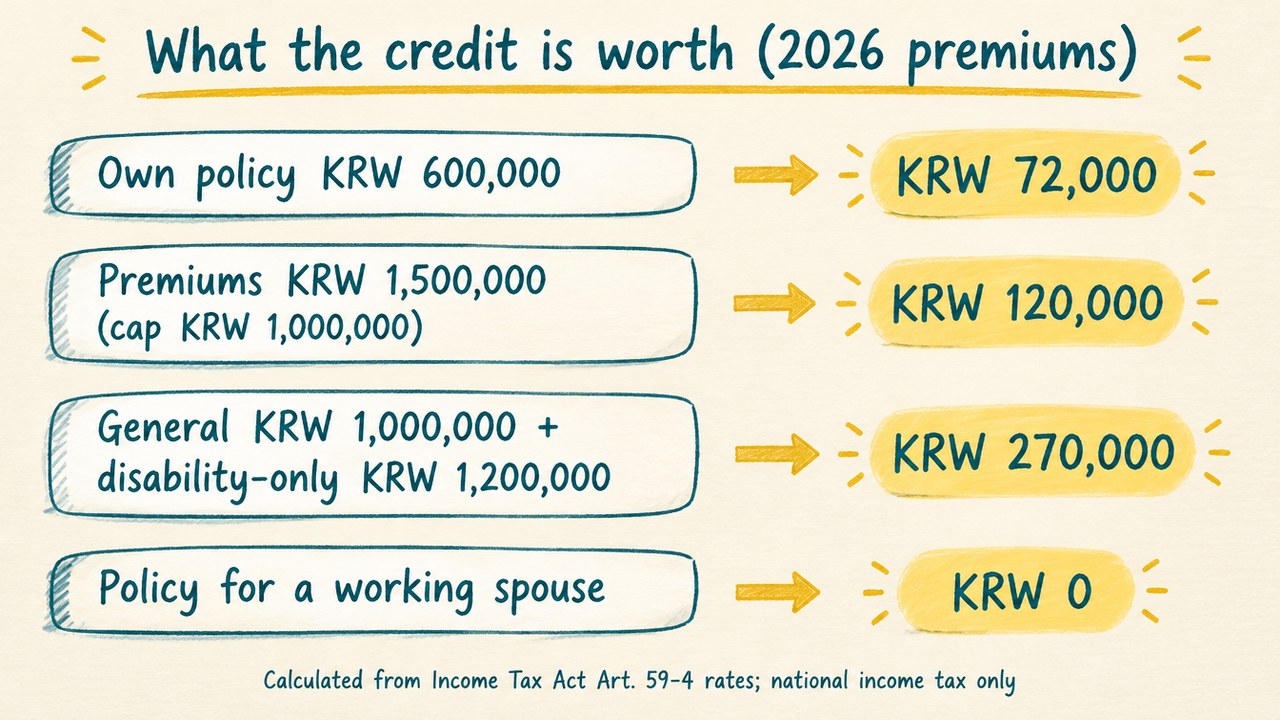
All figures below are national income tax only, before local income tax, and assume the worker owes at least that much tax. They are calculated from the statutory rates and limits; your payslip and settlement may round differently.
| Case | Premiums paid in 2026 | Calculation | National-tax credit |
|---|---|---|---|
| A. Own cancer policy only | ₩50,000 × 12 = ₩600,000 | ₩600,000 × 12% | ₩72,000 |
| B. Own life + car insurance | ₩1,500,000 | capped at ₩1,000,000 × 12% | ₩120,000 (₩500,000 earns nothing) |
| C. General ₩1,000,000 + disability-only policy for a dependent parent ₩1,200,000 | ₩2,200,000 | ₩1,000,000 × 12% + ₩1,000,000 × 15% | ₩270,000 |
| D. Retired at the end of June; ₩90,000 a month | Jan–Jun = ₩540,000 counts | ₩540,000 × 12% | ₩64,800 |
| E. Policy for a working spouse | ₩720,000 | does not qualify | ₩0 |
Calculated from Income Tax Act Art. 59-4(1). Case D: the NTS guide says workers who join or leave mid-year get special credits only for spending during the months they worked. Case C: the two baskets have separate ₩1 million limits; Korea Taxpayers Association Q&A confirms ₩1 million each can be claimed when both exist.
Case B is the most common for people in their 40s and 50s: once your household’s qualifying premiums pass ₩1 million, more cover may be worth buying for its own sake, but it brings no further tax saving. Case D matters for anyone retiring or changing jobs this year — premiums you pay after your last payday do not count on that employer’s settlement.
How to make sure it is claimed
- Check the Hometax simplified data in January 2027. Insurers report premiums to the NTS, and insurance premiums are among the items the year-end simplified service carries. Check that each policy appears under the right person.
- Look for missing policies. If a policy you pay for is missing or listed under the wrong person, ask the insurer for a premium payment certificate (보험료 납입증명서) and hand it to payroll.
- Mark disability-only cover correctly. Only policies labelled disability-only on the contract or receipt get 15%. A disabled parent’s ordinary policy goes in the 12% basket.
- Do not double up. Each policy’s premium can be claimed once, by the person who meets both the payer and dependant tests.
- Fix past mistakes. If an earlier year’s settlement missed the credit, a correction claim (경정청구) on Hometax is generally possible within five years of the filing deadline — the same route explained in our year-end tax settlement guide for foreigners.
A note on the standard credit. Article 59-4(9) gives a flat ₩130,000 standard tax credit to wage earners who do not apply for any special income deductions or special tax credits (including this one) or the monthly-rent credit. If your only special item were a small insurance premium, the standard credit could be larger; but choosing it means giving up the whole bundle, including the health and employment insurance premium deduction. Compare both with the NTS year-end mock calculator or ask payroll before deciding.

What the credit does not cover
- Group insurance your employer pays and that is not treated as your wages does not earn the credit. If the employer pays your personal premium and adds it to your taxable pay, it does (Korea Taxpayers Association Q&A).
- Policies insuring an unborn child do not count — a foetus is not yet a dependant.
- Self-employed income does not qualify; this is a wage-income credit. A worker with side business income still claims it on their salary.
- Premiums paid late, in January 2027, for 2026 count in 2027. Year-end settlement uses the year you actually paid.
- Indemnity (실손) insurance payouts are a separate issue: the premium counts here, but medical bills reimbursed by 실손 must be removed from the medical-expense credit.
If you are using the last weeks of the year to plan other credits, our IRP and pension savings tax credit guide covers the largest one most mid-career workers can still act on before 31 December, and the monthly rent tax credit guide covers renters.
Frequently asked questions
Q. How much is the insurance premium tax credit in Korea for 2026?
For wage earners, 12% of qualifying protection-type premiums, counting at most ₩1,000,000 a year, so up to ₩120,000 off national income tax. Disability-only protection policies have a separate ₩1,000,000 limit at 15%, up to ₩150,000. Local income tax adds 10%, which is why insurers quote about ₩132,000 and ₩165,000.
Q. Can I claim insurance premiums I pay for my parents?
Yes, if you are the policyholder who pays and the insured parent is your basic-deduction dependant: aged 60 or over (born in 1966 or earlier for 2026), with income of ₩1 million or less, and not claimed by a sibling. If the parent is registered as disabled, the age limit does not apply, but the income limit does.
Q. My spouse and I both work. Can I claim the policy I pay for my spouse?
No. A working spouse is not your basic-deduction dependant, so a policy you pay that insures your spouse — or one your spouse pays that insures you — earns no credit for either of you. Each of you can claim policies you hold and pay that insure yourselves or your own dependants.
Q. Does my indemnity medical insurance (실손) count?
Yes. It is protection-type insurance, so its premiums count toward the same ₩1,000,000 limit as your other policies. Separately, any medical bills the policy reimbursed must be left out of your medical-expense credit claim.
Q. Is a savings insurance policy eligible?
No. The law covers only contracts whose maturity refund is not more than the premiums paid. Savings-type and many annuity products that return more than you paid in fall outside the credit; your insurer’s premium certificate shows whether a policy qualifies.
Sources
- Income Tax Act, Art. 59-4 (special tax credits: insurance premiums 12% / 15%, ₩1 million limit per basket; mid-year status rule; ₩130,000 standard credit), law in force 1 January 2026 — https://www.law.go.kr/LSW/lsLinkProc.do?joNo=005904&lsNm=%EC%86%8C%EB%93%9D%EC%84%B8%EB%B2%95&mode=11 (confirmed 9 November 2026)
- Income Tax Act, Art. 50 (basic deduction: spouse and dependants, ₩1 million / ₩5 million income test, ages 60+ and 20 or under, disability exception) — https://www.law.go.kr/LSW/lsLinkProc.do?joNo=005000&lsNm=%EC%86%8C%EB%93%9D%EC%84%B8%EB%B2%95&mode=11 (confirmed 9 November 2026)
- Income Tax Act, Art. 53 (dependants living apart; status on 31 December; age reached on any day of the year) — https://www.law.go.kr/LSW/lsLinkProc.do?joNo=005300&lsNm=%EC%86%8C%EB%93%9D%EC%84%B8%EB%B2%95&mode=11 (confirmed 9 November 2026)
- Enforcement Decree of the Income Tax Act, Art. 118-4 (disability-only labelling; eligible insurance types incl. rental-deposit guarantees up to ₩300 million), in force 1 October 2026 — https://www.law.go.kr/lsLinkCommonInfo.do?lsJoLnkSeq=1031480855 (confirmed 9 November 2026)
- National Tax Service, “근로소득” guide — special tax credits, insurance premium table, mid-year joiners and leavers — https://nts.go.kr/nts/cm/cntnts/cntntsView.do?cntntsId=7874&mi=6595 (confirmed 9 November 2026)
- Korea Post Insurance (government), “보험과 세제” (12% / 15%, ₩1 million, wage earners only, insured must be a basic-deduction dependant) — https://epostlife.go.kr/ASTXDM0000.do (confirmed 9 November 2026)
- Korea Taxpayers Association, year-end settlement Q&A on insurance premiums (policyholder/insured cases, disability-only plus general, employer-paid premiums, unborn child) — https://www.koreatax.org/tax/taxpayers/work/tax_sangdam_04.php3?s_code=9215 (confirmed 9 November 2026)
- Taxnet, “[2025 귀속 연말정산] 맞벌이 부부 연말정산 요약 안내” (cross-cover between working spouses not allowed; joint policy exception) — https://www.taxnet.co.kr/contents/insightpreview/practicecommentary-detail?id=6693&practiceCode=PG0020 (confirmed 9 November 2026)
- Framework Act on National Taxes, Art. 45-2 (correction claims within five years) — https://www.law.go.kr/LSW/lsLinkProc.do?joNo=004502&lsNm=%EA%B5%AD%EC%84%B8%EA%B8%B0%EB%B3%B8%EB%B2%95&mode=11 (confirmed 9 November 2026)
- Insurance Journal, 24 February 2026, “보장성 보험편” (₩132,000 / ₩165,000 incl. local tax; wage earners only) — https://www.insjournal.co.kr/news/articleView.html?idxno=30354 (confirmed 9 November 2026)
- Korea Insurance Newspaper, “’13월의 월급’ 키우는 보험료 세액공제” (typical eligible policies; 실손 premiums vs payouts; cash basis; employer-paid group cover) — https://www.insnews.co.kr/news/articleView.html?idxno=88796 (confirmed 9 November 2026)
This article is general information, not tax advice. Rules can change with each year’s tax law. Your actual credit depends on your own income, family situation and tax liability; confirm with your employer, Hometax or the NTS call centre (126) before you file.





2 Comments