Korea Stomach Cancer Screening: Gastroscopy Ages, NHIS Cost Share, and the 31 December Window
By the Haesul Global health desk (AI-assisted). Last checked: 2026-11-10 (KST); countdown updated 2026-11-13. The 2026 cancer screening window closes in 48 days (December 31, 2026). Rechecked on the NHIS cancer screening guide (read on Nov 9: stomach 40+ every 2 years by gastroscopy; NHIS 90% / you 10%; period 1.1–12.31 with no extension; stage 2 to Jan 31). General health information, not medical advice; your doctor interprets your own results.
Quick answer: If you are 40+ and due this year, book the gastroscopy by December 31, 2026 — 48 days left from November 13 (NHIS). Under Korea’s stomach cancer screening programme, men and women aged 40 and over can have a gastroscopy (upper endoscopy) every two years. For most NHIS subscribers in the higher half by premium, NHIS pays 90% and you pay 10%; people in the lower 50% by the previous November’s premium, and Medical Aid recipients, pay nothing. Sedation (“sleep” endoscopy) and H. pylori tests cost extra. Book the screening itself by 31 December 2026 (48 days left); if a stage-1 finding needs a stage-2 follow-up, that can run until 31 January of the next year. Check whether your birth year is due this year—two-year cancer checks follow the even/odd birth-year cycle.

Who is eligible for Korea stomach cancer screening
Korea’s National Cancer Screening Program covers six cancers. For stomach cancer, the National Cancer Information Center (cancer.go.kr, last updated 3 August 2026), the National Health Insurance Service (NHIS), the Ministry of Health and Welfare, and KDCA all state the same operational rule: men and women aged 40 and over, every two years.
That interval is administered on the even/odd birth-year cycle. Gov.kr’s national checkup guide (updated 10 September 2026) says items on a two-year cycle use birth-year even/odd matching. Because 2026 is an even year, people born in an even year who are 40 or older are typically on this year’s list. Always confirm on the NHIS site or app (건강검진 대상조회) or by calling 1577-1000—notices can differ if you were deferred or added late.
Foreign residents who are enrolled in NHIS are covered the same way; cancer checkups are listed among NHIS benefits on the English benefits page. For the wider age map of the national checkup, see Korea’s national health checkup by age for expats. For how colon screening works differently (yearly and free for everyone), see Korea colon cancer screening: free FIT at 50+.
NHIS also notes a deferral: people registered under the stomach-cancer co-payment special case (산정특례) are left off the list for that period, though you can still ask NHIS to add you if you want the screening.
What the test is: gastroscopy first
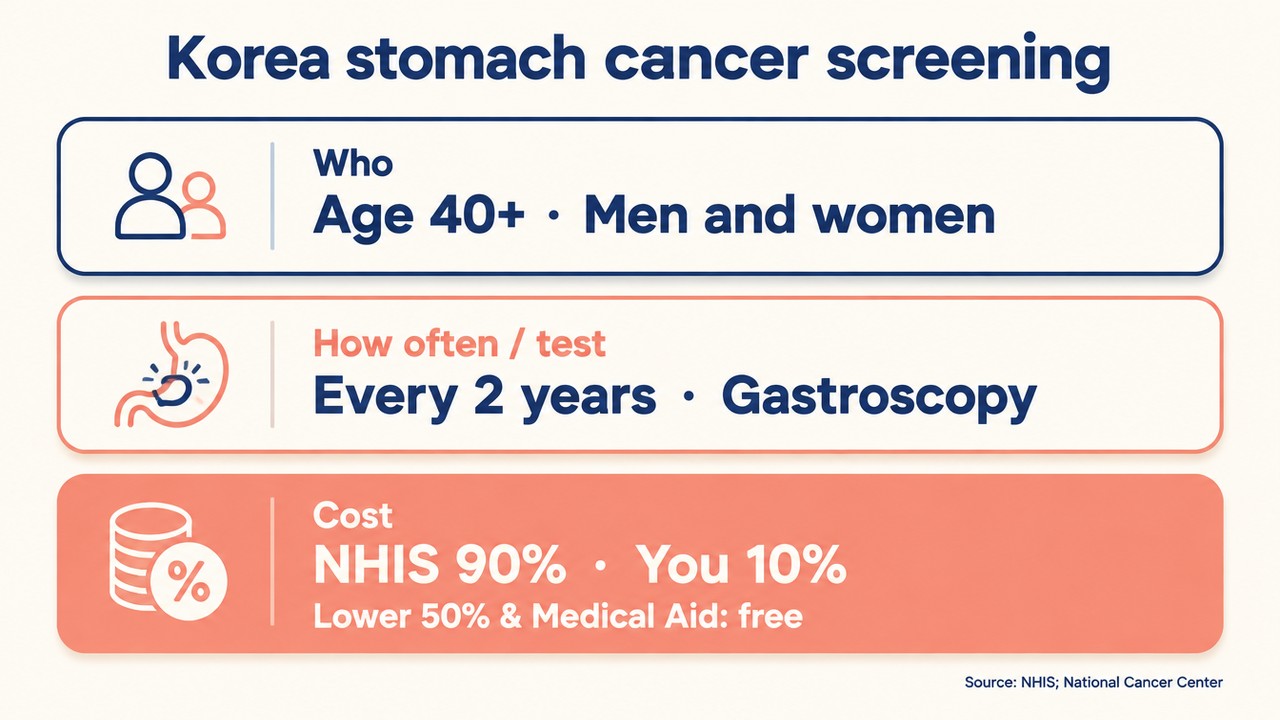
The programme’s basic test is a 위내시경검사—a gastroscopy, or upper gastrointestinal endoscopy. The National Cancer Information Center and KDCA both say that if gastroscopy is difficult for you, a 위장조영검사 (upper GI barium / contrast study) can be used instead. During gastroscopy, a biopsy (조직진단) can be taken when needed; NHIS and the cancer centre say the cost of that biopsy is supported in full or in part.
What you usually pay yourself, according to the same official pages:
- Sedation (“sleep” endoscopy / 수면내시경). Extra cost is yours.
- H. pylori testing done during the screening endoscopy. Extra cost is yours.
In June 2026, Yonhap reported that the National Cancer Center released a revised national stomach cancer screening guideline (2025)—the first full revision since 2015. The revised guideline recommends gastroscopy alone as the primary screening method every two years, and treats barium studies as something to consider only when endoscopy is not possible (generally “conditionally not recommended”). The guideline’s recommended age band for asymptomatic adults is 40–74; for people 75 and over, it advises talking with a clinician about benefits and harms. That is a clinical guideline. The operational programme pages on NHIS and cancer.go.kr still list eligibility as age 40 and over without an upper cut-off. Use the programme rules for booking and cost; use your doctor for whether screening still makes sense for you personally.
What it costs in 2026
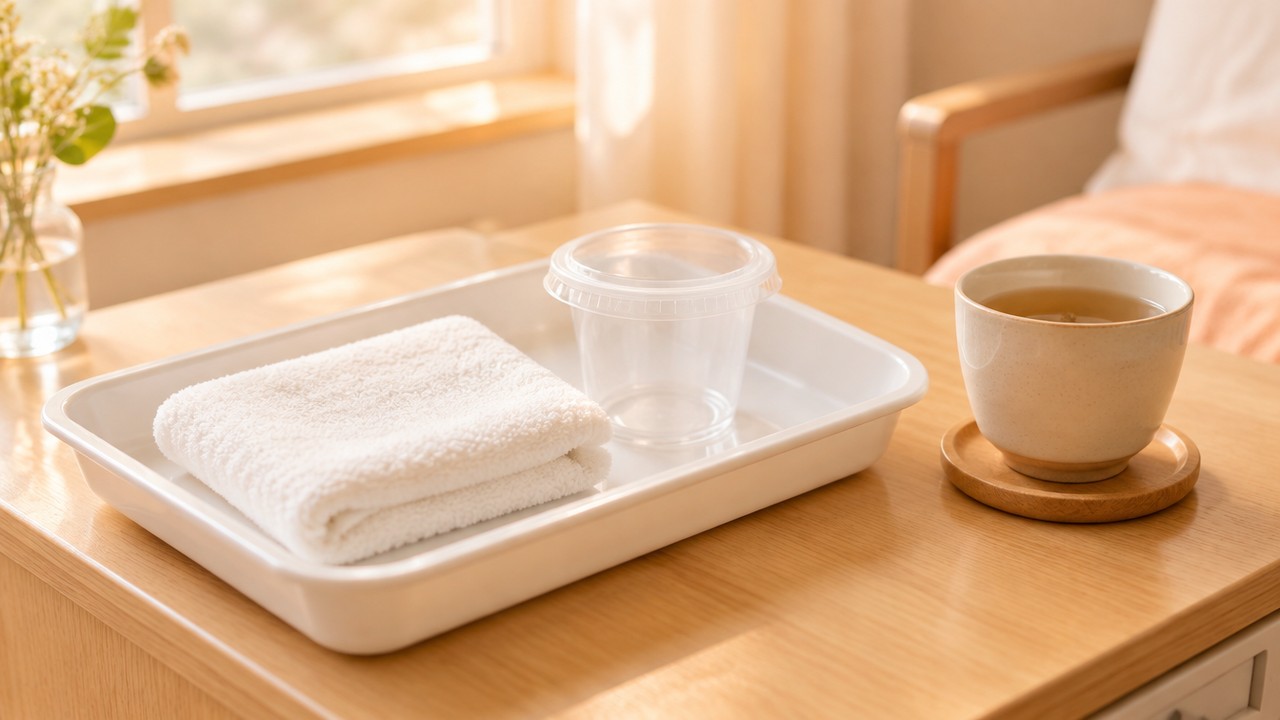
Stomach screening is not free for every subscriber the way colorectal and cervical screening are. Official cost rules:
| Who you are | Stomach (gastroscopy) co-payment | Colorectal stool test (for comparison) |
|---|---|---|
| NHIS subscriber, higher 50% by premium (prior November) | NHIS 90% / you 10% | NHIS 100% (free) |
| NHIS subscriber, lower 50% by premium (prior November) | Nothing to pay | Nothing to pay |
| Medical Aid recipient | Nothing to pay | Nothing to pay |
Sources: NHIS cancer screening page; NHIS 건강iN cancer guide; NHIS English benefits page; National Cancer Information Center cost table. The lower-50% cut-off uses the premium charged in November of the previous year.
So if you have heard that “national cancer screening costs 10%,” that is the default for stomach, breast, liver and lung for higher earners. Colorectal and cervical are the exceptions that are free for everyone. Our colon screening guide spells out that difference in more detail.
Exact won amounts vary by clinic and whether you add sedation or H. pylori testing. Ask the designated cancer-screening clinic for a quote when you book.
Timing: the 31 December window (and 31 January for stage 2)
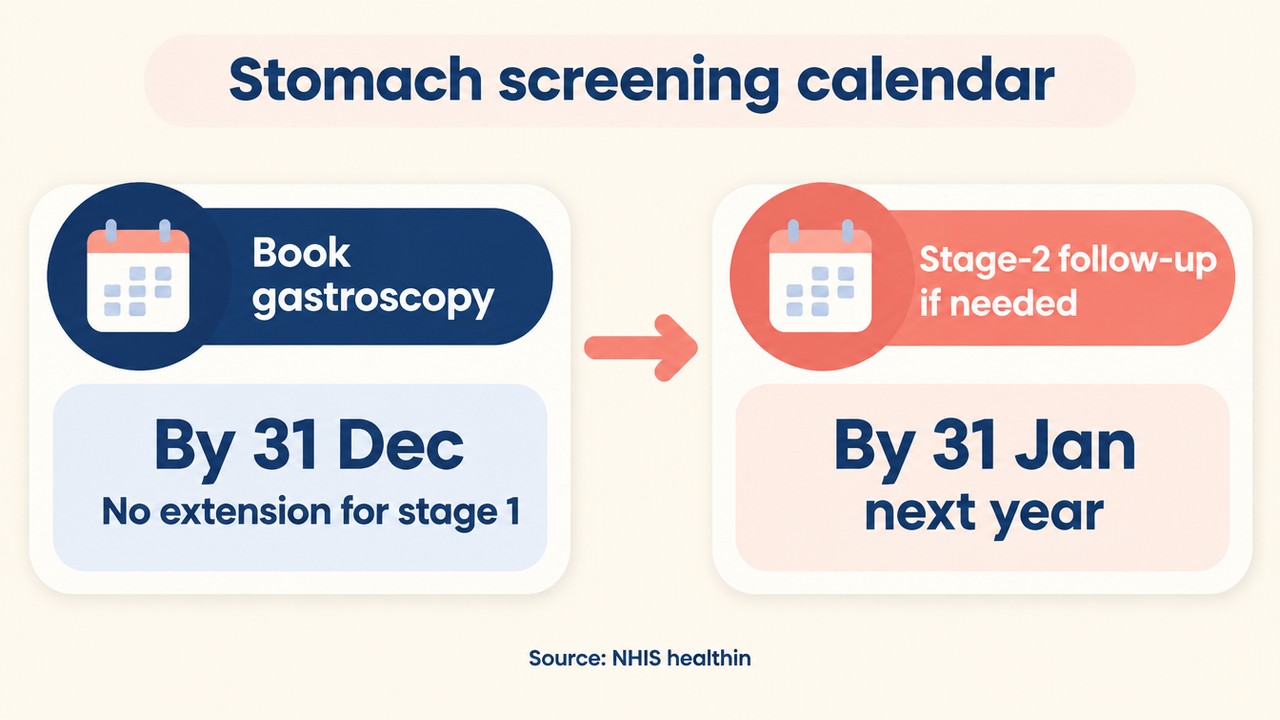
NHIS’s cancer-screening guide is clear about the calendar:
| Step | What | Deadline |
|---|---|---|
| 1. Confirm you’re on the list | NHIS site/app or 1577-1000; even birth year in 2026 if on a 2-year cycle | Any time in 2026 |
| 2. Book and complete gastroscopy (or barium if endoscopy is not possible) | Designated cancer-screening clinic; bring ID | 1 January – 31 December 2026 (NHIS: no extension for this stage) |
| 3. Result | Clinic notifies you by post or email | Within 15 days of the exam |
| 4. Stage-2 follow-up, if needed after an abnormal stage-1 finding | Further programme testing as directed | By 31 January 2027 |
Sources: NHIS 건강iN (검진기간 안내); cancer screening implementation criteria on law.go.kr (stage-2 stomach/colorectal exams may run to the end of January of the following year).
If you miss the previous year, NHIS says you can ask to be added to this year’s list, but cost rules may differ, so call 1577-1000 or a local branch first. Booking tips, ID rules and catch-up options are covered in Korea’s 31 December checkup deadline and catch-up guide.
November and December are the rush months. Clinics fill up, and sedation slots go first. If you are due in 2026 and have not booked yet, do it now.
How to book, and what to bring

Practical steps from NHIS:
- Check eligibility on the NHIS website or app (건강모아 → 나의 건강 → 검진대상 조회), or call 1577-1000.
- Find a designated cancer-screening clinic and book in advance—walk-ins are often refused in late year.
- Bring ID. NHIS lists a resident registration card, driver’s licence, passport, or other ID that confirms who you are under the National Health Insurance Act rules. Medical Aid recipients bring the relevant card. The paper notice helps, but KDCA notes that ID alone is often enough to confirm you are on the list.
- Ask about sedation and H. pylori when you book, so the extra cost is not a surprise.
- Tell the clinic which medicines you take (especially blood thinners and diabetes medicines). The clinic will say whether anything needs to change before endoscopy—do not stop medicines on your own.
Results come from the clinic within 15 days. An abnormal finding is not a cancer diagnosis by itself; it is a reason for the next step your doctor sets.
What screening is—and is not
Screening is for people without symptoms. The National Cancer Information Center’s stomach-cancer page notes that early stomach cancer often has no symptoms, which is why the programme starts at 40. Progressive disease can bring repeated vomiting, difficulty swallowing, weight loss, gastrointestinal bleeding or anaemia—those need a doctor promptly, not a wait for the next screening slot.
KDCA’s cancer-screening explainer also stresses the usual screening trade-offs: false positives, false negatives, procedure risks (bleeding or perforation are uncommon but real with endoscopy and biopsy), and anxiety from follow-up. The revised National Cancer Center guideline, as reported by Yonhap, likewise frames ages 75+ as a personalised discussion because benefits may be smaller relative to harms for some older adults.
This article does not diagnose conditions, interpret your personal results, or recommend treatment. It summarises how Korea’s public programme is organised so you can book the right test at the right time.
A practical checklist for late 2026
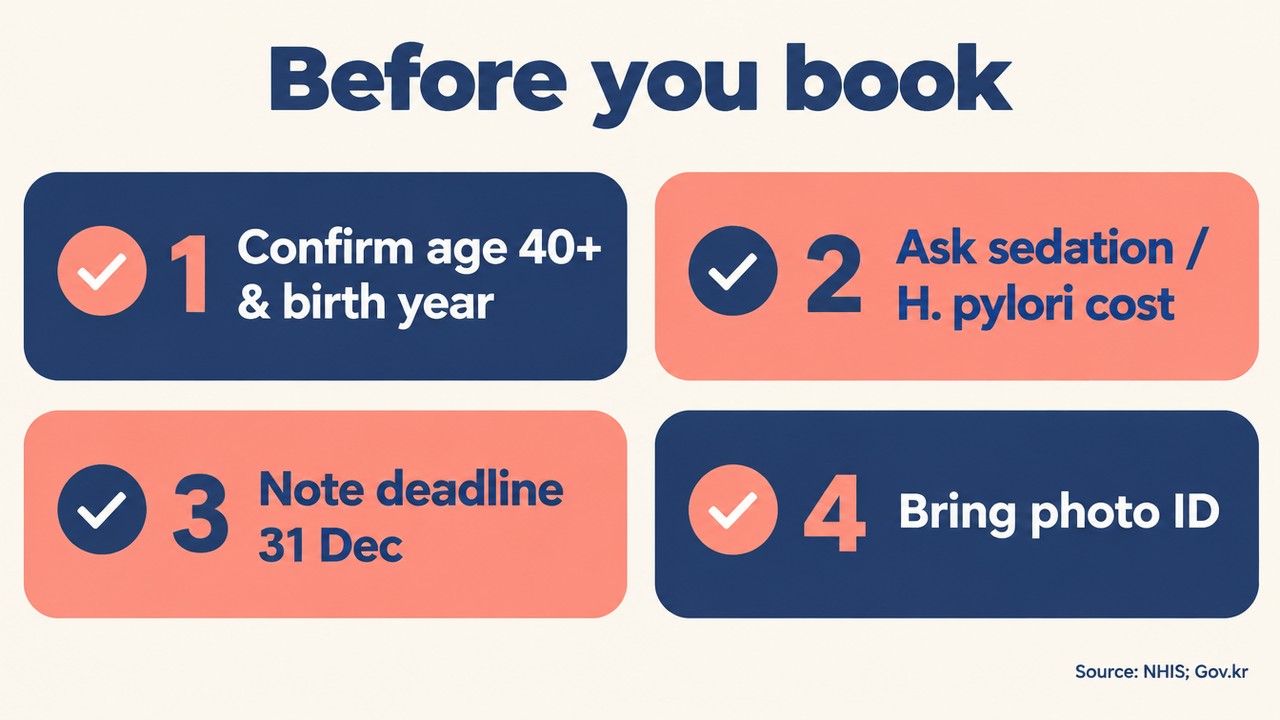
| Before you go | Why it matters |
|---|---|
| Confirm 2026 eligibility (even birth year + age 40+, or NHIS notice) | Two-year items follow even/odd birth years |
| Ask the clinic’s quote for gastroscopy with and without sedation | Sedation is self-pay |
| Ask whether H. pylori testing would be billed separately | Extra cost is yours under the programme |
| Note any stomach symptoms for the doctor | Symptoms need clinical care, not only screening |
| Leave time before 31 December | No extension for the main screening exam |
| Keep 31 January in mind only if stage 2 is ordered | Stage-2 window after an abnormal stage-1 result |
Frequently asked questions
Q. I’m 40+ and due in 2026. How long do I have left to get the gastroscopy?
Until December 31, 2026 — 48 days left from November 13. NHIS says the cancer screening period runs January 1–December 31 every year with no extension; only a stage-2 follow-up after an abnormal stage-1 stomach result can run to January 31, 2027 (NHIS cancer screening guide, checked Nov 9). Clinics fill up in December, so book now.
Q. At what age does Korea stomach cancer screening gastroscopy start?
The national programme covers men and women aged 40 and over, every two years. Gov.kr notes that two-year cancer checks follow the even/odd birth-year cycle, so in an even year such as 2026, even birth years are typically due. Confirm on the NHIS site or by calling 1577-1000.
Q. How much do I pay for the NHIS stomach cancer gastroscopy?
For NHIS subscribers in the higher 50% by the previous November’s premium, NHIS pays 90% and you pay 10%. The lower 50% by that premium cut-off, and Medical Aid recipients, pay nothing. Sedation and H. pylori tests done during screening are extra and billed to you.
Q. Is there a 31 December deadline for stomach cancer screening?
Yes. NHIS says the screening year runs from 1 January to 31 December with no extension for the main (stage-1) exam. If a stage-1 stomach finding needs a stage-2 follow-up under the programme, that follow-up can be done until 31 January of the next year.
Q. Can I choose a barium swallow instead of gastroscopy?
Official programme pages still allow an upper GI barium study when gastroscopy is difficult. The revised 2025 National Cancer Center guideline, reported in June 2026, recommends gastroscopy alone as the primary method and treats barium as an option only when endoscopy cannot be done. Ask your clinic which method they offer under the programme.
Q. I’m a foreigner with NHIS. Am I eligible for Korea stomach cancer screening?
Yes, if you are enrolled in National Health Insurance and meet the age and birth-year rules. Cancer checkups, including stomach, are listed among NHIS benefits. Check eligibility on the NHIS site or app, or call 1577-1000 (overseas +82-33-811-2001).
Related reading
- Korea breast cancer mammography screening (women 40+)
- Korea colon cancer screening: free FIT at 50+
- Free bone density test at 54, 60 and 66 (women)
Sources
- National Cancer Information Center (National Cancer Center), National Cancer Screening Program: ages and intervals (page updated 2026-08-03; checked 2026-11-07)
- National Cancer Information Center, Eligibility / subject selection, Screening intervals and methods and Results and cost (checked 2026-11-07)
- National Cancer Center, National Cancer Screening Program overview (checked 2026-11-07)
- National Health Insurance Service, Cancer screening: eligibility, intervals and cost (checked 2026-11-07)
- National Health Insurance Service (건강iN), Cancer screening guide: procedures, cost, Dec 31 / Jan 31 windows (checked 2026-11-07; re-checked 2026-11-09)
- National Health Insurance Service (English), Benefits: health and cancer checkups (checked 2026-11-07)
- Ministry of Health and Welfare, National Cancer Screening Program (updated 2026-09-23; checked 2026-11-07)
- Gov.kr, Health checkup implementation guide (even/odd birth-year rule for 2-year items; updated 2026-09-10; checked 2026-11-07)
- Korea Disease Control and Prevention Agency, National Health Information Portal, Health checkups (cancer screening) (updated 2026-05-15; checked 2026-11-07)
- Cancer screening implementation criteria (암검진 실시기준), law.go.kr administrative rule (stage-2 timing to end of January next year; checked 2026-11-07)
- Yonhap News Agency, Revised national stomach cancer screening guideline: gastroscopy as sole primary method (2026-06-24; checked 2026-11-07)
- National Cancer Information Center, Stomach cancer: early detection page (2015 guideline table; checked 2026-11-07)
This article is general information about Korea’s public screening programme. It is not medical advice, not a diagnosis, and not a treatment recommendation. Talk with a licensed clinician about your own health, medicines and test results.





4 Comments