Korea Credit Card and Cash-Receipt Deduction 2026: Rates, Caps and Year-End Tips
Haesul Economy desk (AI-assisted). Last checked: 2026-11-10 (KST); countdown updated 2026-11-13; first published 7 November 2026. Only spending dated by December 31, 2026 counts for tax year 2026 — 48 days left. Rates and limits re-read on the NTS cash-receipt consumer-deduction page on Nov 10. Based on the National Tax Service (NTS) cash-receipt / card consumer-deduction page, NTS call-centre Q&A on card spending, EasyLaw’s plain-language summary of Article 126-2 of the Restriction of Special Taxation Act, and the statutory basic-limit text on the Korean Law Information Center. This is general information, not tax, financial or legal advice. Confirm your own numbers with payroll or a licensed tax adviser before you file.
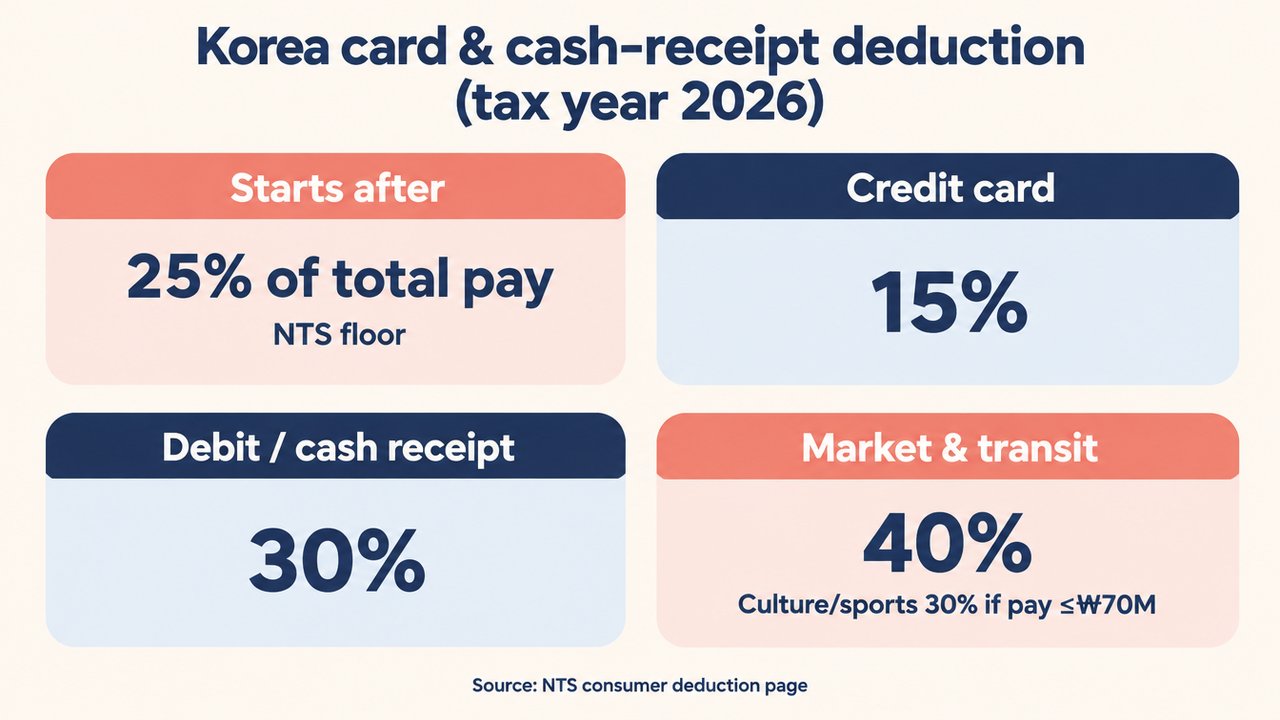
Quick answer: You have 48 days left (to December 31, 2026, from November 13) to shape 2026 card spending (NTS). Korea’s credit-card and cash-receipt income deduction (신용카드등 사용금액 소득공제) only starts on the part of eligible spending that exceeds 25% of your total pay (총급여). On that excess, rates are 15% for credit cards, 30% for debit/check cards, named prepaid cards and cash receipts (현금영수증), 40% for traditional-market and public-transit spending, and 30% for books, newspapers, performances, museums, galleries, cinemas, swimming pools and gyms if your total pay is ₩70 million or less. The basic annual limit for tax year 2026 is ₩3.0 / ₩3.5 / ₩4.0 million (no child / one child / two or more) when total pay is ₩70 million or less, and ₩2.5 / ₩2.75 / ₩3.0 million when it is higher. Extra market, transit and culture spending can add up to ₩3.0 million (or ₩2.0 million above ₩70 million) after the basic limit. Overseas card spend does not count. Foreigners’ residency and flat-tax limits are covered in our year-end settlement guide; this post deep-dives the card and cash-receipt rules themselves.
Year-end tax settlement (연말정산) turns a year of payroll withholding into your real income tax. The card and cash-receipt deduction is an income deduction: it lowers taxable wage income before rates are applied. It is not a tax credit like medical expenses. This guide is for tax year 2026 spending (1 January–31 December 2026), settled with employers in early 2027. For the wider timeline, Hometax login steps and who can claim what as a foreign resident, see the settlement overview linked above. If you are weighing progressive rates against the flat rate, read our 19% flat-tax guide first — choosing the flat rate usually means giving up this deduction.

Who can claim it
According to the NTS and EasyLaw’s reading of Article 126-2, a resident wage earner (not a daily worker) can claim the deduction when the annual sum of eligible credit-card, debit-card, named prepaid-card and cash-receipt spending exceeds 25% of total pay. Spending by a spouse or a direct ascendant or descendant who lives with you can be added if that person’s annual income is ₩1 million or less (or ₩5 million total pay if they only have wages). Brothers and sisters do not count even if they are basic-deduction dependants. Dual-income spouses each claim their own cards; you cannot pool a spouse who earns above the income test. Family cards are claimed by the cardholder, not by whoever pays the bill.
Non-residents and people who chose the 19% flat tax for foreign workers generally cannot stack this special income deduction. Keep that in mind before you lock in the flat-tax election on your deduction form.
The 25% floor: why light spenders get zero
Only the part of eligible spending above 25% of total pay enters the rate calculation. Total pay here is the same 총급여 figure your employer uses for settlement.
| Total pay (총급여) | 25% floor (no deduction below this) |
|---|---|
| ₩30,000,000 | ₩7,500,000 |
| ₩40,000,000 | ₩10,000,000 |
| ₩50,000,000 | ₩12,500,000 |
| ₩70,000,000 | ₩17,500,000 |
| ₩100,000,000 | ₩25,000,000 |
Source: NTS consumer deduction page (cntntsId=7794): deduction on the amount exceeding 25% of total pay; floor amounts calculated from that rule.
So a worker on ₩50 million who spent ₩11 million on eligible cards and cash receipts gets no card income deduction. The same worker who spent ₩20 million has ₩7.5 million of excess before rates and caps.
The statutory formula fills the 25% floor first with credit-card spending (15%), then with debit/cash/culture spending (30%), then with traditional-market and transit spending (40%). In practice that means early-year debit or cash-receipt spend is not “wasted” on simply reaching the floor — the lowest-rate method is subtracted first.
Rates by payment type and place (tax year 2026)
The NTS table currently in force (checked 7 November 2026) is:
| Category | Deduction rate | Who gets it |
|---|---|---|
| Credit card (general merchants) | 15% | All eligible wage earners |
| Debit/check card, named prepaid card, cash receipt | 30% | All eligible wage earners |
| Books, newspapers, performances, museums, galleries, cinemas, swimming pools, gyms | 30% | Total pay ₩70 million or less only |
| Traditional markets | 40% | All eligible wage earners |
| Public transport | 40% | All eligible wage earners |
Sources: NTS cntntsId=7794 rate stack; NTS call-centre card Q&A rate table (same 15% / 30% / 40% / culture 30%). Swimming-pool and gym facility fees count in the culture/sports bucket for spending from 1 July 2025; lesson fees and membership costs that are not facility use are excluded, and when facility and non-facility charges are not separated only 50% counts (NTS page).
Culture and sports at 30% is a separate category only for workers at or below ₩70 million. Above that, the same book or cinema purchase is simply taxed at whichever payment-method rate you used (15% or 30%).
Basic limits and the 2026 children boost
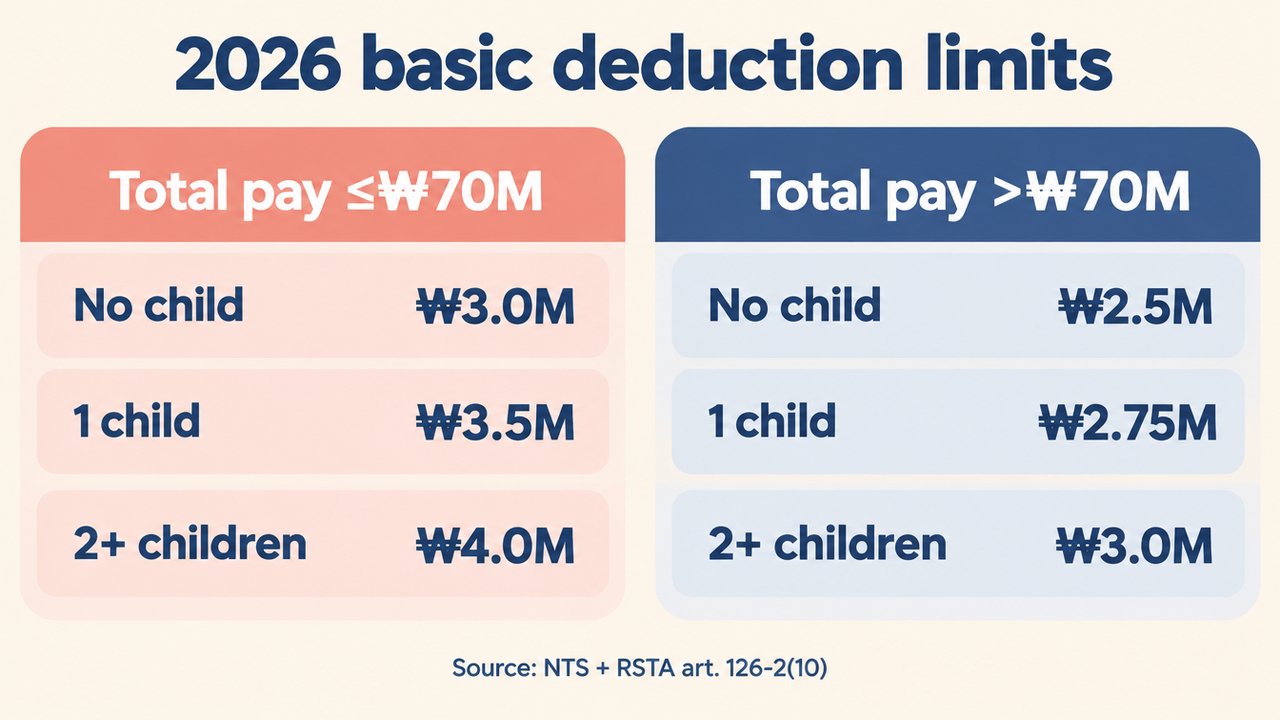
The NTS still quotes the base annual limits as ₩3.0 million (total pay ≤₩70 million) and ₩2.5 million (above). From tax year 2026 spending, Article 126-2(10) of the Restriction of Special Taxation Act raises those ceilings when you have children or grandchildren who meet the decree definition:
| Children (자녀등) | Total pay ≤₩70M | Total pay >₩70M |
|---|---|---|
| None | ₩3,000,000 | ₩2,500,000 |
| One | ₩3,500,000 | ₩2,750,000 |
| Two or more | ₩4,000,000 | ₩3,000,000 |
Sources: NTS page for the ₩3.0M / ₩2.5M base; Korean Law Information Center, Restriction of Special Taxation Act art. 126-2(10) as amended 23 December 2025 (enforcement text opened 7 November 2026) for the children uplift.
These figures are the ceiling on the income-deduction amount, not on how much you can spend. Spending more after you hit the ceiling does not increase the deduction unless the additional market / transit / culture rules below open room.
Additional deduction after the basic limit
If your calculated deduction exceeds the basic limit, the NTS lets you claim an extra amount equal to the smaller of (a) the excess over the basic limit and (b) traditional-market, public-transit and (for ≤₩70M) culture/sports spending each multiplied by their rates. That add-on is capped at ₩3.0 million a year if total pay is ₩70 million or less, and ₩2.0 million if it is higher.

Worked example (illustrative payslip inputs)
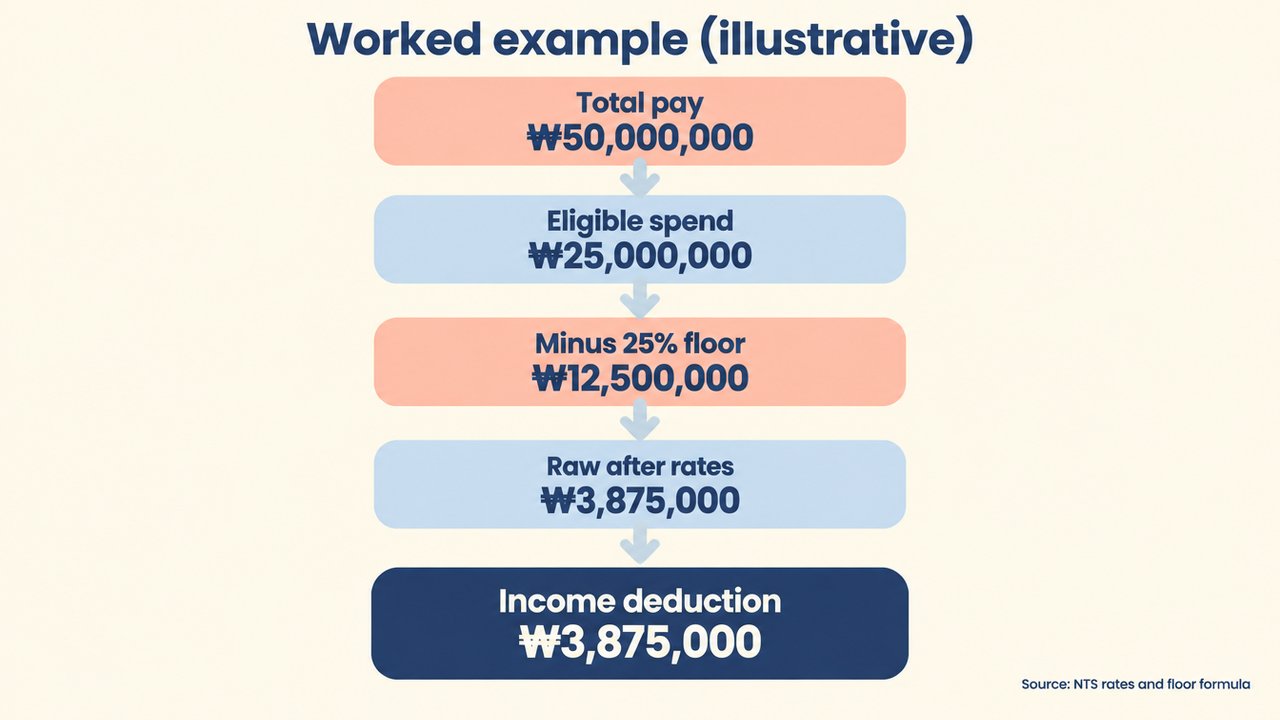
Take a resident employee with ₩50,000,000 total pay in 2026 and no children. Eligible spending for the year:
- Credit card (general): ₩15,000,000
- Debit card and cash receipts: ₩5,000,000
- Traditional market: ₩3,000,000
- Public transit: ₩2,000,000
- Total eligible: ₩25,000,000
Step 1 — 25% floor. 25% of ₩50,000,000 = ₩12,500,000.
Step 2 — apply rates, then subtract the floor at the statutory fill order. Because credit-card spend (₩15M) already covers the floor:
| Line | Calculation | Amount |
|---|---|---|
| Credit card × 15% | ₩15,000,000 × 15% | ₩2,250,000 |
| Debit / cash × 30% | ₩5,000,000 × 30% | ₩1,500,000 |
| Traditional market × 40% | ₩3,000,000 × 40% | ₩1,200,000 |
| Public transit × 40% | ₩2,000,000 × 40% | ₩800,000 |
| Subtotal before floor | ₩5,750,000 | |
| Minus floor × 15% | ₩12,500,000 × 15% | −₩1,875,000 |
| Raw deduction | ₩3,875,000 |
Step 3 — basic limit and add-on. Basic limit (no child, ≤₩70M) = ₩3,000,000. Excess over basic = ₩875,000. Eligible add-on from market and transit rate amounts = ₩1,200,000 + ₩800,000 = ₩2,000,000. Add-on = min(₩875,000, ₩2,000,000) = ₩875,000 (under the ₩3.0M add-on cap).
| Step | Amount |
|---|---|
| Raw deduction | ₩3,875,000 |
| Basic limit applied | ₩3,000,000 |
| Additional (market + transit) | +₩875,000 |
| Income deduction claimed | ₩3,875,000 |
How much tax that saves depends on your marginal bracket. At a 24% national rate the illustrative national-tax cut is about ₩930,000, with local income tax (usually 10% of the national figure) moving in the same direction. Your payroll software or Hometax preview will use your real bracket.
Sources: NTS rate stack and floor formula; NTS / statute basic limit; illustrative spending mix. Not a personal tax calculation.
 medical expense tax credit and the card/cash-receipt income deduction on the same eligible medical spend.

Timing checklist for tax year 2026
| When | Action |
|---|---|
| All of 2026 | Track whether you have cleared 25% of expected total pay; prefer debit/cash receipt and market/transit once you have |
| Autumn 2026 | Use Hometax’s year-end preview (미리보기) if open, to see January–September card totals |
| Mid-January 2027 (expected) | Hometax simplified data opens with card and cash-receipt lines |
| Before your employer’s internal deadline | Submit the deduction form; fix missing cash receipts with issuer proof |
| February 2027 pay | Refund or extra withholding through payroll |
Exact 2027 Hometax opening dates had not been posted as of 7 November 2026; the mid-January pattern follows the January 2026 cycle described in our settlement guide.
Rechecked on November 10, 2026 (NTS): the deduction applies to card, debit, prepaid and cash-receipt spending above 25% of total pay, at 15% to 40%; the basic limit is ₩3 million (total pay ₩70 million or less) or ₩2.5 million (above), with up to ₩3 million / ₩2 million more for traditional-market, public-transit and culture spending. Swimming-pool and gym fees paid from July 1, 2025 count at 30% for total pay of ₩70 million or less; where the facility fee is not separated from other charges, 50% of the total is treated as the fee (NTS, read 10 November 2026).
Frequently asked questions
Q. Until when does card spending count for the 2026 deduction?
Only spending dated January 1–December 31, 2026 — 48 days left from November 13. The NTS applies the deduction to the part of card, debit, prepaid and cash-receipt spending above 25% of total pay, with a basic limit of ₩3 million (total pay ₩70 million or less) or ₩2.5 million above (NTS page, checked Nov 10). If you are already past the 25% floor, debit cards, cash receipts, markets and transit earn more per won than a credit card for the rest of December.
Q. Do I get 15% or 30% back as cash?
No. Those percentages build an income deduction, not a rebate. They reduce taxable wage income. Your tax saving is roughly the deduction times your marginal rate (plus local tax), and only up to the tax you actually owe.
Q. I spent a lot on my credit card abroad. Why is none of it in Hometax?
Overseas spending is excluded by statute. The NTS call-centre Q&A states foreign card use is not deductible, and it does not appear in simplified year-end data. See also the foreigners’ settlement overview.
Q. Should I stop using my credit card after I pass 25% of pay?
Not automatically. After the floor, debit cards and cash receipts earn double the rate of credit cards on ordinary spend, and market/transit earn more still — but only until you hit the annual caps, and only if rewards, interest and cash-flow still make sense. Many people keep a rewards credit card for big purchases and shift groceries and transit once the floor is cleared.
Q. Can foreigners on the 19% flat tax claim this deduction?
Generally no. The flat tax under the Restriction of Special Taxation Act is an alternative to the normal progressive system with its deductions and special credits. Compare both paths before you choose; see our flat-tax guide.
Q. My spouse has a job. Can I add their card spend?
Only if their annual income stays within the ₩1 million / ₩5 million wage test. Dual-income couples each claim their own spending. Family cards follow the named cardholder.
Q. How do cash receipts help if I already use a debit card?
They cover cash purchases at merchants that do not take cards. Same 30% rate as debit once you are above the floor. Register your phone or other issuance method on Hometax under your ARN so the lines appear in January.
Related reading
- Korea IRP and pension savings tax credit 2026
- Korea medical expense tax credit 2026
- Korea year-end tax settlement for foreigners 2026
Sources
- National Tax Service, Cash receipt / card overview — consumer income deduction (cntntsId=7794) (checked 7 November 2026; re-checked 10 November 2026)
- NTS call centre, Card spending Q&A (CTG11898) (checked 7 November 2026)
- EasyLaw (법제처), Credit-card benefits — income deduction inclusions and exclusions (checked 7 November 2026)
- Korean Law Information Center, Restriction of Special Taxation Act art. 126-2(10) basic limits with children (checked 7 November 2026)
- Moneyplus, Year-end card deduction basics (NTS-based summary) (independent cross-check, 9 September 2026 update)
- Haesul, Korea year-end tax settlement for foreigners 2026
- Haesul, Korea 19% flat tax for foreign workers
- Haesul, Korea medical expense tax credit 2026
General information only, not tax or financial advice. Written with AI assistance and checked against the sources above. Rules can change; verify against the NTS notice for the January 2027 settlement season before you file.





5 Comments