LDL Cholesterol on a Korean Checkup: When NHIS Flags You and the Confirmatory Test Window
Updated 6 November 2026 · General health information, not medical advice. Only your doctor can interpret your results or decide on treatment.
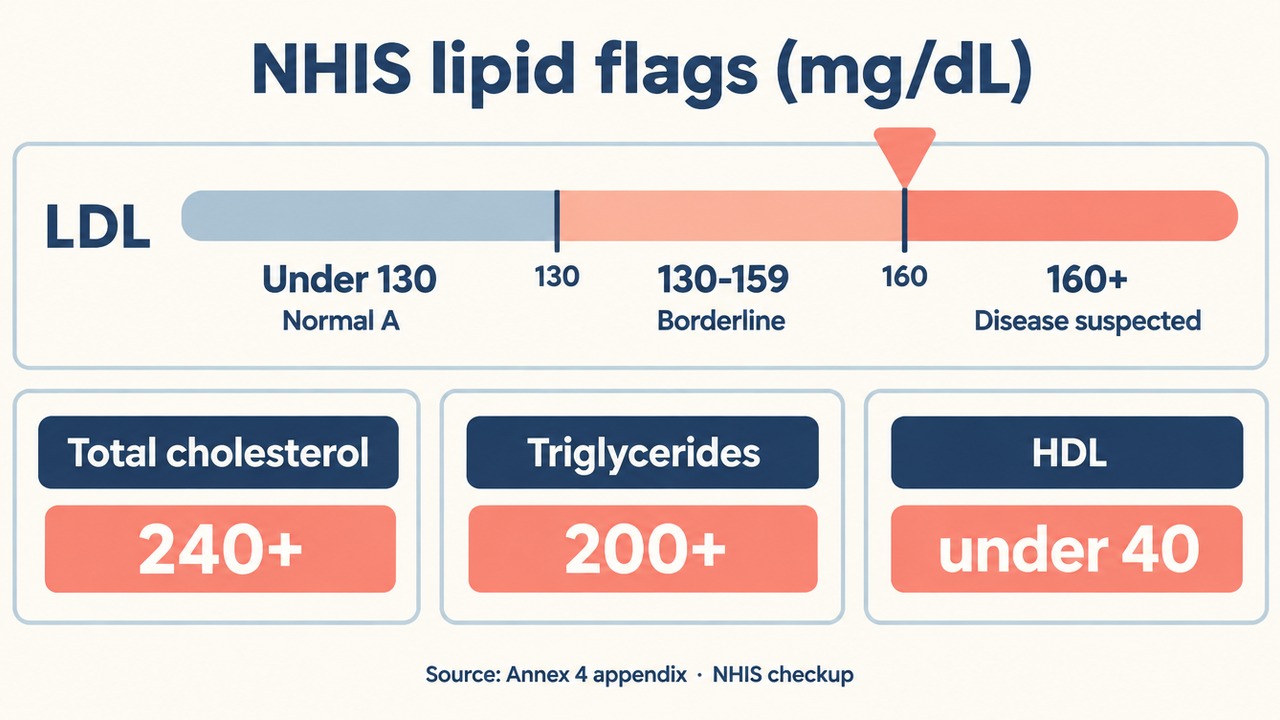
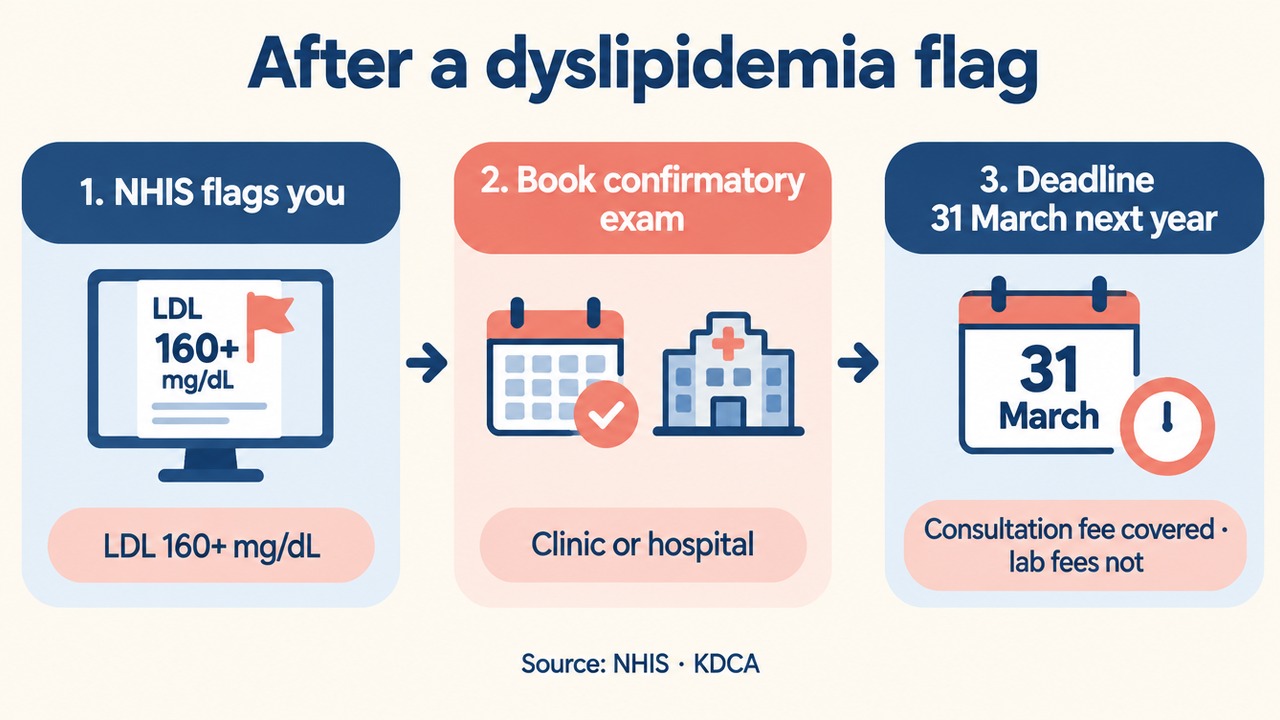
Quick answer: On Korea’s national (NHIS) general checkup, LDL cholesterol under 130 mg/dL is normal A, 130–159 mg/dL is normal B (borderline), and 160 mg/dL or higher is a dyslipidemia (이상지질혈증) disease-suspected flag. The same annex also flags total cholesterol at 240+, triglycerides at 200+, and HDL below 40. A flag is not a diagnosis. If you are flagged, NHIS covers one first confirmatory visit (for dyslipidemia, that visit is a doctor’s examination; lab test fees are not covered) at a clinic or hospital until 31 March of the year after your checkup. Bring your result sheet and ID. For the ordinary lab ranges themselves, see our cholesterol levels guide.

Is LDL even on your free checkup this year?
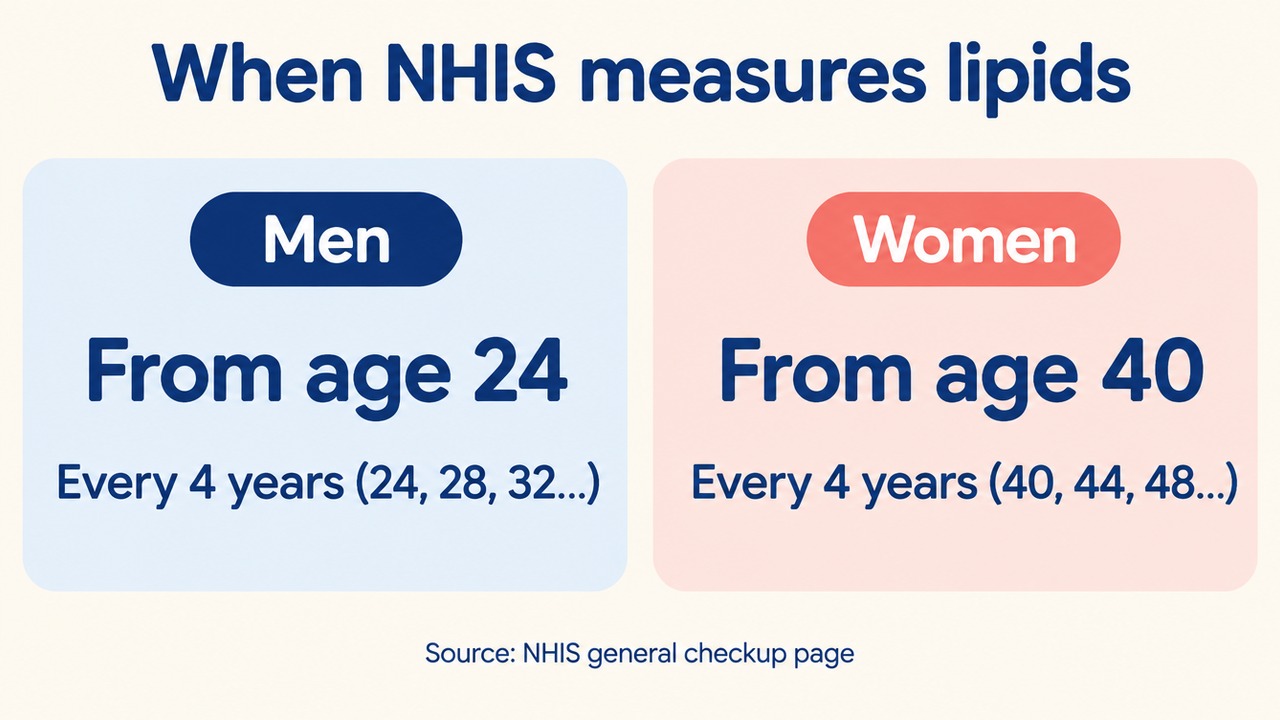
The lipid panel (total cholesterol, HDL, triglycerides, LDL) is not in every year’s common blood list. NHIS runs it as a sex- and age-based item:
| Who | How often |
|---|---|
| Men aged 24 and over | Every 4 years (ages 24, 28, 32, …) |
| Women aged 40 and over | Every 4 years (ages 40, 44, 48, …) |
Source: NHIS general checkup page (성·연령별 검사 항목).
If this is not your lipid year, your result sheet will not show LDL — that does not mean your cholesterol is fine. You can still ask a clinic to order a panel, or wait for your next scheduled lipid year. The common free blood tests every cycle are hemoglobin, fasting glucose, AST, ALT, γ-GTP, creatinine and eGFR; glucose flags are covered in our HbA1c and fasting glucose guide.
The NHIS flag table for lipids (official annex)
Korea’s Health Checkup Implementation Standards, Annex 4 appendix (검사항목별 판정기준), sets the lines the national result sheet uses. Numbers are in mg/dL:
| Item | Normal A | Normal B (borderline) | Disease suspected |
|---|---|---|---|
| Total cholesterol | Under 200 | 200–239 | 240 or higher |
| HDL cholesterol | 60 or higher | 40–59 | Under 40 |
| Triglycerides | Under 150 | 150–199 | 200 or higher |
| LDL cholesterol | Under 130 | 130–159 | 160 or higher |
Sources: Annex 4 appendix PDF from law.go.kr (flSeq 160922523 / 160922929), opened 6 November 2026; KDCA monthly health note uses the same 240 / 160 / under-40 / 200 cut-offs as a diagnostic description of dyslipidemia.
A footnote on the annex says that when diabetes is also present, doctors may treat an LDL line near under 100 as the relevant reference and may adjust judgment. That is a clinical note on the form, not a separate free test by itself.
How this differs from MedlinePlus “optimal” ranges
US consumer pages often aim lower than Korea’s national screening flag. MedlinePlus (NHLBI) groups adult LDL as:
| LDL (mg/dL) | MedlinePlus category |
|---|---|
| Under 100 | Optimal |
| 100–129 | Near optimal / above optimal |
| 130–159 | Borderline high |
| 160–189 | High |
| 190 or higher | Very high |
So an LDL of 145 is borderline on both systems, but only 160+ makes the Korean national checkup print a dyslipidemia disease-suspected box that unlocks the free confirmatory visit. An LDL of 120 can look “near optimal” on MedlinePlus and still sit in Korea’s normal A screening band. Use the printed Korean flag for the free-visit benefit, and use your doctor’s risk assessment (diabetes, prior heart disease, smoking, blood pressure) for treatment goals. Our ranges-by-agency guide compares those tables in more detail; this article stays on the flag and follow-up window.
What “disease suspected” actually triggers
The result sheet’s judgment codes include 정상A, 정상B(경계), 일반 질환의심, 고혈압·당뇨병·이상지질혈증 질환의심, and 유질환자 (already diagnosed and on drug treatment). Only the disease-suspected lipid flag (or the combined hypertension/diabetes/dyslipidemia suspected box) starts the confirmatory pathway for lipids.
Borderline (normal B) is not the free confirmatory ticket. It means the annex sees room for diet, activity and self-care, not that NHIS will waive a clinic visit. Already on lipid medicine is coded as a known patient (유질환자), which is a different path from a new flag.

The confirmatory window: until 31 March next year
NHIS’s general checkup page states the confirmatory (확진검사) rules as follows:
| Rule | Detail |
|---|---|
| Who | People whose general checkup result is disease-suspected for hypertension, diabetes, dyslipidemia, pulmonary tuberculosis, depression or early psychosis, or hepatitis C |
| Dyslipidemia visit content | Examination (진찰) only |
| Where | Clinic or hospital (의원·병원). Not a dental, Korean-medicine, long-term-care or psychiatric hospital for this pathway |
| Deadline | Until 31 March of the year after the checkup |
| Cost | First visit: no out-of-pocket for the covered confirmatory items. KDCA adds that for dyslipidemia, the support is the consultation fee; extra lab test fees are not covered |
| What to bring | Result notification sheet + ID |
Sources: NHIS general checkup page (확진검사 section; “검진 다음연도 3월 31일까지”); official result-sheet form (다음연도 3월 31일); KDCA national checkup page (이상지질혈증: 진찰료 지원, 검사비 지원 불가).
Example: If your 2026 checkup flags LDL at 168 mg/dL, the free confirmatory examination window runs through 31 March 2027. Miss that date and ordinary outpatient co-pays apply.
Older KDCA FAQ text on the same portal still mentions a 31 January line in one answer block; the live NHIS page and the current result-sheet PDF both say 31 March. This article follows NHIS and the result form. If your paper letter shows a printed deadline, obey the letter in your hand.
If you still need to book the checkup itself before year-end, see our December 31 deadline and catch-up guide.

Frequently asked questions
Q. What LDL number makes the Korean national checkup flag me?
160 mg/dL or higher is the disease-suspected line for LDL on the official annex. 130–159 is borderline (normal B). Under 130 is normal A.
Q. Is the follow-up after an LDL flag completely free?
The first confirmatory examination is covered with no out-of-pocket charge until 31 March of the following year. For dyslipidemia, NHIS/KDCA describe that support as the consultation; additional laboratory tests you and your doctor choose are not covered under that confirmatory benefit.
Q. My LDL is 150. Do I get the free visit?
Not from that LDL line alone. 150 sits in normal B (borderline). The free confirmatory path is for disease-suspected results (LDL 160+, or the other lipid disease-suspected lines). Borderline still deserves a conversation about diet, activity and overall risk.
Q. How often does the free checkup measure LDL?
Every four years for men from age 24 and women from age 40, on the NHIS schedule. Other years you can pay for a clinic panel if you need one sooner.
Q. Does a high LDL on the checkup mean I already have heart disease?
No. It is a screening flag. Diagnosis and treatment need a clinician’s judgment, often with a repeat test and a look at your other risk factors. Seek urgent care for chest pain, sudden weakness or trouble speaking — do not wait for a routine confirmatory slot.
Sources
- NHIS, General health checkup (일반건강검진) — lipid schedule and confirmatory rules (checked 6 November 2026)
- Health Checkup Implementation Standards, Annex 4 / Annex 4 appendix PDFs (LDL 130 / 160 lines; checked 6 November 2026)
- Official general checkup result sheet form — 31 March confirmatory note (checked 6 November 2026)
- KDCA National Health Information Portal, 건강검진(국가건강검진) — dyslipidemia confirmatory = consultation fee only (checked 6 November 2026)
- KDCA, monthly health note on cardiovascular risk factors — 160 / 240 / under-40 / 200 diagnostic cut-offs (checked 6 November 2026)
- MedlinePlus / NHLBI, LDL: The “Bad” Cholesterol — optimal / high adult categories (checked 6 November 2026)
- Haesul, Cholesterol levels: LDL, HDL, triglycerides ranges
- Haesul, Korea health checkup Dec 31 deadline
- Haesul, HbA1c and fasting glucose on a Korean checkup
This article is general health information, not medical advice. It was written with AI assistance and fact-checked against the sources above. Only your doctor can interpret your results and decide on tests or treatment.






3 Comments