Shingles Vaccine in Korea: Cost, Types and Who Pays (Age 50+)
Updated 4 November 2026 · General health information, not medical advice. Ask your doctor which vaccine suits you.
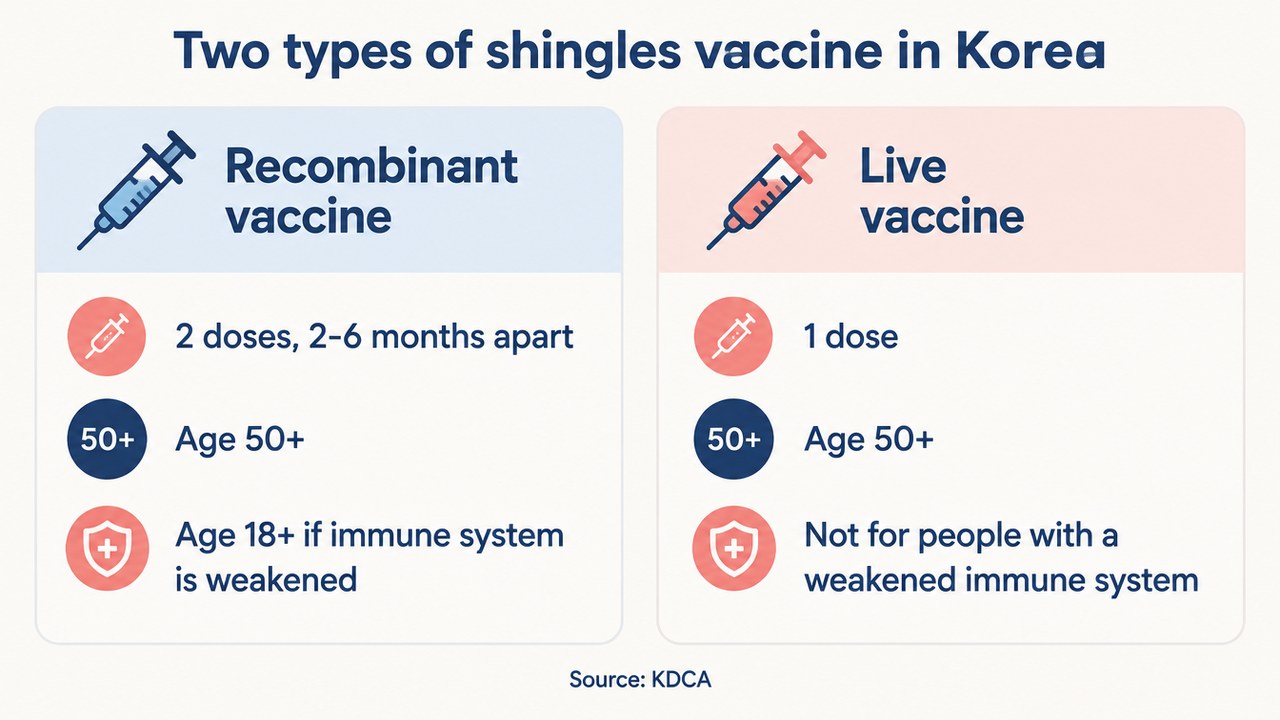
Quick answer: Korea offers two kinds of shingles (herpes zoster, 대상포진) vaccine for adults 50 and over. The recombinant vaccine (Shingrix) takes 2 doses, 2–6 months apart, is preferred by the Korea Disease Control and Prevention Agency (KDCA), and is also for adults 18+ with a weakened immune system. The live vaccine (Zostavax, SKYZoster) is 1 dose. Shingles vaccination is not in the National Immunization Program and isn’t covered by National Health Insurance, so most adults pay themselves. At Korean hospitals, HIRA price data puts the recombinant shot at a median of about ₩250,000 per dose (about ₩500,000 for the full course) and the live shots at about ₩150,000–170,000. Many cities and districts subsidise the live vaccine for residents aged 65+.
Why people in their 50s and 60s get it
Shingles is a reactivation of the chickenpox virus that stays dormant in nerve cells after childhood chickenpox. KDCA estimates that about 30% of people get shingles in their lifetime, and the US CDC similarly puts it at 1 in 3. The risk climbs with age. KDCA reports, citing Health Insurance Review and Assessment Service (HIRA) data, that the incidence in Korea rose from 4.23 per 1,000 people in 2006 to 9.22 per 1,000 in 2022, and that about 64% of patients are 50 or older.
The most feared complication is post-herpetic neuralgia, nerve pain that can last months or years after the rash heals. Both KDCA and the CDC note that vaccination protects against it as well as against the rash. If you do get shingles, KDCA says antiviral treatment works best when started within 72 hours of the rash appearing, so see a doctor quickly.
The two vaccine types
| Recombinant (Shingrix) | Live (Zostavax, SKYZoster) | |
|---|---|---|
| Who | 50+; also 18+ with weakened immunity | 50+ |
| Doses | 2 (second dose 2–6 months later; 1–2 months if immunocompromised) | 1 |
| How it’s given | 0.5 mL into the upper-arm muscle | Under the skin (0.65 mL Zostavax, 0.5 mL SKYZoster) |
| Weakened immune system | Safe to use | Not suitable (live virus) |
| Prevention in trials | 96.6% (50–59), 97.4% (60–69), 91.3% (70+) | 69.8% (50–59), 64% (60–69), 38% (70+) |
| Typical hospital price (HIRA data) | Median ~₩250,000 per dose | Median ~₩170,000 (Zostavax), ~₩150,000 (SKYZoster) |
Dose and route details come from KDCA’s immunization helper site. The trial efficacy figures come from the Korean Society of Infectious Diseases (KSID) adult vaccination guideline, and the CDC reports matching numbers for Shingrix (97% at 50–69, 91% at 70+). KSID notes the recombinant vaccine was approved in Korea on 6 September 2021 and came into use in December 2022. It also notes the live vaccine’s advantages: it is cheaper and causes fewer reactions.
KDCA’s guidance is that the recombinant vaccine is preferred over the live one, and that it can be used by people with weakened immune systems, such as those having cancer treatment or taking immune-suppressing drugs. In the US, the live vaccine has not been available since November 2020, according to the CDC.

What it costs, and who pays
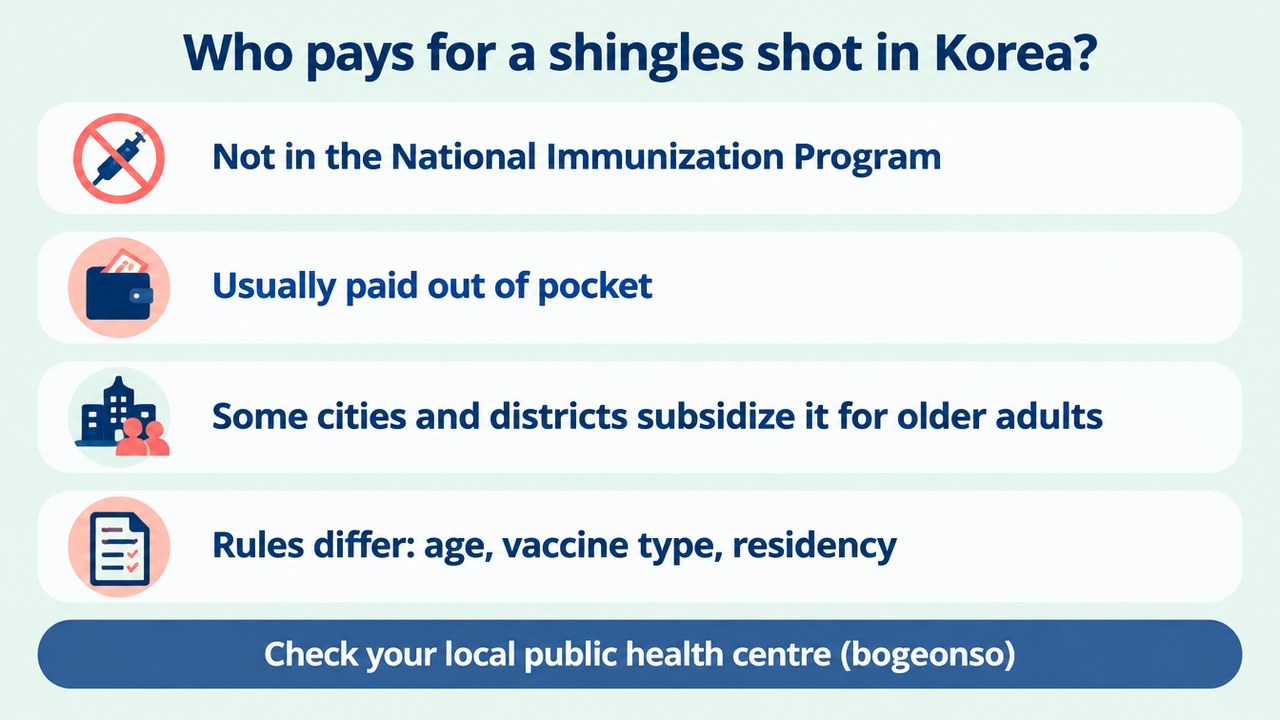
Shingles vaccination is not part of Korea’s National Immunization Program (NIP) for adults, and it is a non-covered (비급여) item. That means hospitals set their own prices and you pay the full amount, even if you have National Health Insurance. Our guide to Korean health insurance for foreigners explains what NHIS does cover.
Hospitals must report non-covered prices to HIRA, which publishes them. Two independent compilations of that HIRA data (one covering 1,226 hospitals, published 20 October 2026, and one covering 1,315 hospitals, published 2 November 2026) both put the recombinant vaccine at a median of ₩250,000 per dose, with most hospitals between about ₩160,000 and ₩350,000. That makes about ₩500,000 for both doses. The same data shows live vaccines at a median of about ₩170,000 (Zostavax) and ₩150,000 (SKYZoster). These figures cover hospitals; neighbourhood clinics (의원) aren’t in that dataset and often charge different prices, so ask the clinic for its price before booking, or search “대상포진” on HIRA’s non-covered price service.
Local subsidies (mostly the live vaccine, 65+)
Many local governments run their own programmes. As Dong-A Ilbo reported on 21 October 2026, 55 of Korea’s 230 local governments offer no support, and the other 175 differ in age limits, amounts and vaccine type. At the October 2026 National Assembly audit, the KDCA commissioner said the agency would review targets and funding for a national programme, starting with high-risk groups. Nothing has been decided yet.
Two examples of 2026 programmes, taken from the local health offices’ own pages:
- Namdong-gu, Incheon: a free single dose of live vaccine for residents aged 65+ (born on or before 31 December 1961) who have lived in the district for at least one year. Bring a resident registration abstract with your address history and ID.
- Suwon: for residents aged 65+ born on or before 31 December 1960 in an even-numbered birth year (2026’s rotation), the live vaccine is free but you pay a ₩19,610 administration fee at a designated clinic. Basic livelihood and near-poor recipients get it free at the public health centre. People who can’t have a live vaccine get the same amount put toward the recombinant shot and pay the difference.
Rules change every year and budgets can run out early, so call your local public health centre (보건소) before you go. Registered foreign residents should ask specifically whether they qualify and which documents are accepted.
Worked examples
| Situation | Likely option | Rough out-of-pocket cost |
|---|---|---|
| Healthy 58-year-old in Seoul, wants the strongest protection | Recombinant, 2 doses 2–6 months apart | About ₩500,000 at the hospital median (₩250,000 × 2) |
| 67-year-old, 3 years in Namdong-gu, happy with live vaccine | District programme, 1 dose | ₩0 |
| 66-year-old in Suwon, born 1960, healthy | City programme, live vaccine | ₩19,610 administration fee |
| 55-year-old on cancer treatment | Recombinant only; second dose can be 1–2 months later | Full price unless a local scheme helps |
| 70-year-old who had the live vaccine in 2019 | Recombinant can be considered now (about 5 years later) | About ₩500,000 at the hospital median |
Timing rules worth knowing
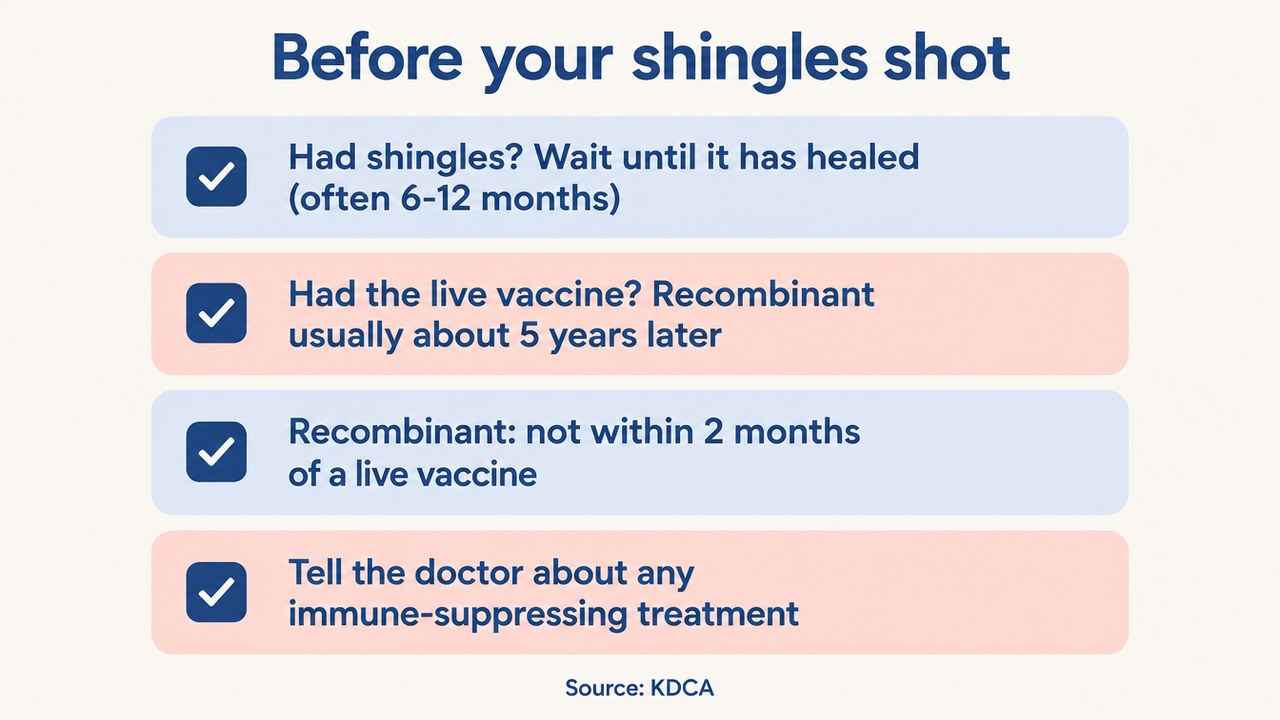
- Had shingles before? Get vaccinated anyway. KDCA generally suggests waiting 6–12 months after recovery, and Suwon’s programme uses the same window. The CDC says there’s no fixed wait, as long as the rash has gone.
- Had the live vaccine? You can still get the recombinant vaccine. KDCA says this is usually about 5 years later, and it may be considered sooner if you’re 70+ or at high risk. It shouldn’t be given within 2 months of a live vaccine.
- Recombinant always needs both doses. KDCA says the series is two doses for everyone, and KSID gives 4 weeks as the absolute minimum gap between them.
- Don’t get it if you’ve had a severe allergic reaction to the vaccine or to a previous dose. Postpone it if you’re pregnant or have an acute illness with fever (KDCA, CDC).
- Expect a sore arm. Pain at the injection site, tiredness, muscle aches and fever are common and usually pass in 2–3 days, according to both KDCA and the CDC.
If you’re also catching up on other preventive care this year, see our guide to finishing your national health checkup before 31 December and what an H. pylori positive result on a Korean checkup means.
Frequently asked questions
Q. How much is the shingles vaccine in Korea?
It varies by hospital. HIRA’s non-covered price data shows a median of about ₩250,000 per dose for the recombinant vaccine (two doses, so about ₩500,000), and about ₩150,000–170,000 for a single live-vaccine dose. Clinics may charge differently, so ask before booking.
Q. Is the shingles vaccine free for seniors in Korea?
Not nationally. It isn’t in the National Immunization Program. Many cities and districts offer a free or cheap live vaccine to residents aged 65+, but 55 of 230 local governments had no programme as of October 2026, so check with your local public health centre.
Q. Which is better, Shingrix or the live vaccine?
KDCA prefers the recombinant vaccine (Shingrix). In trials it prevented over 90% of cases in every age group, and it is safe for people with weakened immunity. The live vaccine is a single, cheaper dose, but it is less effective, especially at 70+.
Q. I already had shingles. Do I still need the vaccine?
Yes. KDCA and the CDC both recommend vaccination after shingles, because it can come back. KDCA generally suggests waiting 6–12 months after you’ve recovered.
Q. Does National Health Insurance cover the shingles vaccine?
No. It’s a non-covered item, so you pay the clinic’s price unless a local subsidy applies.
Sources
- Korea Disease Control and Prevention Agency, Immunization Helper, Herpes zoster vaccine (checked 4 November 2026)
- Korea Disease Control and Prevention Agency, National Health Information Portal, Chickenpox and herpes zoster (checked 4 November 2026)
- US Centers for Disease Control and Prevention, Shingles vaccination (checked 4 November 2026)
- Korean Society of Infectious Diseases, Adult vaccination guideline: herpes zoster (checked 4 November 2026)
- Health Insurance Review and Assessment Service, Non-covered medical fee information (search “대상포진”; checked 4 November 2026)
- Namdong-gu Public Health Center, Shingles vaccination (checked 4 November 2026)
- Suwon City Public Health Center, 2026 shingles vaccination support (checked 4 November 2026)
- Dong-A Ilbo, Shingles vaccine support varies by local government (21 October 2026)
This article is general health information, not medical advice. It was written with AI assistance and fact-checked against official sources. Prices are medians of hospital-reported data and will differ at your clinic. Ask a doctor which vaccine suits you.



One Comment