Sending Money Home from Korea: The US$50,000 Limit for Foreigners, Fees and Exchange Rates
Haesul Economy desk (AI-assisted). As of 16 November 2026 (KST). Based on the Foreign Exchange Transactions Regulation (외국환거래규정) as in force from 2 November 2026 on the National Law Information Center, the Enforcement Decree of the Foreign Exchange Transactions Act (Art. 10), the Bank of Korea’s foreign-exchange FAQ and its page on the Overseas Remittance Integration System, the Ministry of Economy and Finance (MOEF) announcement of 8 December 2025 on korea.kr, the government’s Easy Law (easylaw.go.kr) English guide for foreign nationals and the Financial Supervisory Service (FSS) register of small-sum remittance companies, cross-checked with Yonhap, PwC Korea and the English remittance pages of three Korean banks. General information, not financial, tax or legal advice.
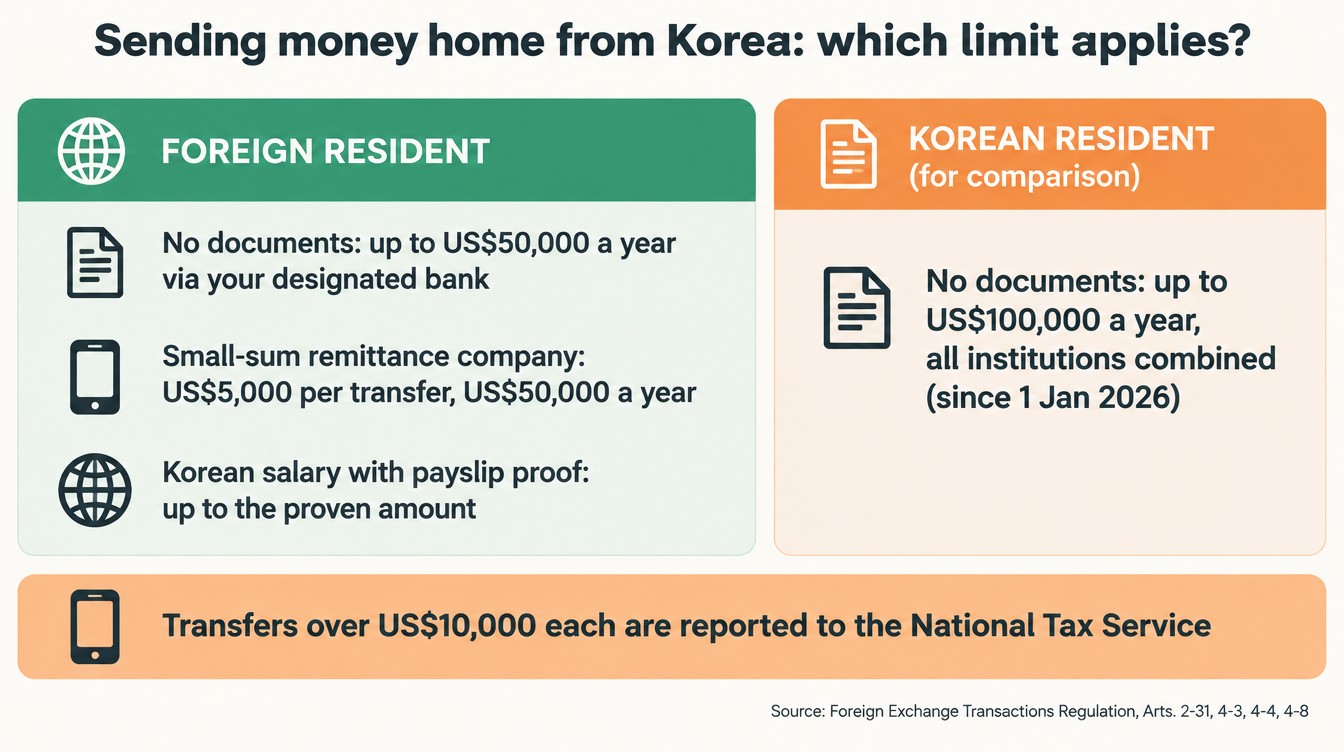
Quick answer: If you are not a Korean citizen, you can send up to US$50,000 a year abroad without any documents, through one bank you designate (지정거래외국환은행, “designated foreign-exchange bank”). Licensed small-sum remittance companies (소액해외송금업자, the remittance apps) can send up to US$5,000 per transfer and US$50,000 a year for you. Above that, you can send your Korean salary, freelance income or Korean pension in full, as long as you show the designated bank proof of how you earned it (a payslip confirmed by your employer, or an income and tax certificate if you are self-employed). The headline change of 2026, a US$100,000 no-document limit across all institutions, applies to Korean residents only; the regulation expressly leaves foreign residents out.

Year-end bonuses, the Lunar New Year at home and contracts that end in December make November and December busy months for transfers. Before you send a large amount, it helps to know which of the rules below is yours. Most of the 2026 coverage, including English-language news reports, is about the new US$100,000 figure; for a foreign worker or student in Korea, that number is the wrong one.
First: which rules apply to you?
Korean foreign-exchange law sorts people by residence and nationality, not by visa type.
- You count as a resident (거주자) if you are a foreigner who works or does business in Korea, or who has stayed in Korea for 6 months or more (Enforcement Decree of the Foreign Exchange Transactions Act, Art. 10(1)4). Diplomats and consular staff of foreign missions, people on official business for a foreign government or international organisation, and members of the U.S. Forces Korea and their civilian staff are treated as non-residents instead (Art. 10(2)).
- The regulation then splits residents in two. Article 4-3, the article that gives Koreans their US$100,000 no-document allowance, opens with “residents (excluding foreign residents)” (거주자(외국인거주자는 제외한다)). Foreign residents and non-residents are covered by a separate article, Article 4-4, together.
In practice this means the same rules apply to an E-9 factory worker, an E-7 engineer, a D-2 student and a short-stay visitor: Article 4-4 and the remittance-company rule in Article 2-31. The table below puts the numbers side by side.
The limits at a glance (as of 16 November 2026)
| Route | Who | Limit without documents | With documents | Rule |
|---|---|---|---|---|
| Bank, through your designated foreign-exchange bank | Foreign residents and non-residents | US$50,000 a year | Your Korean salary, freelance income, Korean social insurance or pension, up to the amount you prove | Regulation Art. 4-4(1)3 and 4-4(2) |
| Licensed small-sum remittance company (app) | Foreign residents and non-residents | US$5,000 per transfer, US$50,000 a year (the same caps apply to money you receive) | — | Regulation Art. 2-31(1)2 |
| Bank or remittance company | Korean citizens resident in Korea (for comparison) | US$100,000 a year, all institutions combined, no designated bank (since 1 January 2026) | Any amount the bank can confirm from documents | Regulation Art. 4-3(1)1–2 |
| Reporting to the tax office | Anyone sending through a bank | Each transfer over US$10,000 is reported to the National Tax Service (NTS) | — | Regulation Art. 4-8(1)4 |
Two smaller routes also exist for foreign residents: up to US$10,000 for overseas travel expenses (Art. 4-4(3)2), and remittance through the post office (우체국) if you bring the same proof of income (Art. 4-4(3)3). Money you originally brought in or received from abroad can also be sent back out up to that amount, with the bank’s purchase receipt or other proof (Art. 4-4(1)1).
What changed in 2026, and what did not
On 8 December 2025 the Ministry of Economy and Finance announced that from January 2026 it would scrap the designated-bank system for Korean residents and merge their two allowances (US$100,000 a year through a bank, US$50,000 through other institutions) into a single US$100,000 a year across all institutions. Transfers are now tracked in real time by the Overseas Remittance Integration System (ORIS, 해외송금 통합관리시스템), which the Bank of Korea runs with the government. The amended regulation (MOEF Notice 2025-57 of 29 December 2025) took effect on 1 January 2026, and Yonhap, PwC Korea and the Korean-language explainers we checked all describe the same change.
What did not change is the foreigner side. In the regulation as in force on 16 November 2026 (Notice 2026-110, effective 2 November 2026):
- Article 4-4(2), the US$50,000 no-document allowance for foreign residents and non-residents, still sends you through your designated bank (or a designated card company), and its wording dates from 2008 and 2024 amendments, not from the 2026 overhaul.
- Article 2-31(1)2 still caps remittance companies at US$5,000 per transfer and US$50,000 a year per foreign customer, while Korean residents’ cap at the same companies rose to the combined US$100,000.
- The one 2026 change that does touch foreigners is about money coming in: the new Article 4-4(4) says a foreign resident or non-resident may receive up to US$5,000 per transfer without documents, and may bring in their own funds held abroad without documents where no report is required.
So if a bank clerk or an app mentions “US$100,000 a year”, ask whether that figure applies to your status. In the regulation it does not.
Route 1: a bank wire through your designated bank
A bank wire (해외송금, telegraphic transfer) is the classic route and the only one that takes you above US$50,000.
- Pick one bank and designate it (거래외국환은행 지정). The Easy Law guide says foreign nationals must designate a foreign-exchange bank for overseas remittance of Korean income, Korean social insurance and pensions, and the US$50,000 allowance. Citibank Korea’s English page says the designation is done by visiting a branch with your passport and, for salary transfers, documents from your employer; iM Bank’s foreign-workers’ remittance guide lists a combined “designation and payment application” form.
- Bring your ID: passport and residence card (외국인등록증). KB Kookmin Bank’s English page puts it simply: designate KB and you can send up to the equivalent of US$50,000 a year at any KB branch.
- Give the recipient’s details: full name, bank name, branch and location, account number, phone number and bank (SWIFT) code (the list on KB’s English page).
- Tell the bank what the money is for. Even when no documents are needed, Article 4-3(2) for Koreans and the bank’s own checks for everyone mean you will be asked the purpose: family support, your own account abroad, and so on.
- Keep the receipt. If you later need to show that money you sent came from your salary, the bank’s records and your payslips are the trail.
Ask your bank whether later transfers can be made in its app or internet banking once the designation is in place, and whether the first designation can be done online; the regulation does not say, and practice differs between banks.
Route 2: licensed small-sum remittance companies (the apps)
Korea also registers small-sum remittance companies (소액해외송금업자): fintech firms that send money abroad without being a bank. Many foreign workers use them because they are app-based, open in the evening and often cheaper than a branch wire. The rules for foreign customers:
- US$5,000 per transfer and US$50,000 a year (Regulation Art. 2-31(1)2). Money you receive through them has the same two caps.
- No designated bank needed. Article 2-31(7) says the designated-bank requirements in Articles 4-3(3), 4-4(1)3, 4-4(2) and 4-5 “may not apply” to payments under this article.
- They must be registered. The FSS consumer portal FINE (fine.fss.or.kr) lists every registered company under 금융회사 정보 → 소액해외송금업자 → 등록현황 조회, with its registration number, the countries and currencies it handles, and its per-transfer and annual limits. On 16 November 2026 the stand-alone (독립형) list had 33 entries, including some marked closed (폐지); there is a second list for the “consignment” (위탁형) type. The Bank of Korea’s ORIS page also names the 23 remittance companies that report into the integrated system, alongside the banks.
- Your money has a backstop. Each company must lodge a performance bond (이행보증금) with the FSS, at least ₩300 million (Regulation Art. 2-35(2)). If the company takes your money and fails to send it, you can apply to the FSS for payment from that bond (Art. 2-36).
- They must show you the key terms. The regulation lists the information that counts as key for small-sum remittance: the expected time to pay out, the fee you pay, the amount in won and in foreign currency with the exchange rate applied, and the dispute procedure and contact (Art. 2-32(4)). If an app does not show you all four before you confirm, do not send.
We do not compare or rank individual apps here: their fees and rates change daily and differ by country and payout method. Check that the company is on the FINE list, then compare the amount your family receives for the same won amount, on the same day.

Sending more than US$50,000: proving your income
If your savings from several years of work add up to more than US$50,000, or you want to send a large lump sum when you leave Korea, the route is Article 4-4(1)3: you may send income from employment or self-employment in Korea, and social insurance, benefits or pensions paid from Korea, up to the amount you can prove, through your designated bank. The Bank of Korea’s FAQ adds that no report to the Bank of Korea is needed; you only show the designated bank the documents.
What to bring (the regulation calls them “documents proving how the funds were acquired”, 취득경위 입증서류):
| Your income | Documents named by official or bank sources |
|---|---|
| Salary from a Korean employer | Payslips or a pay statement confirmed by your employer (BOK FAQ: 고용주가 확인한 급여명세서). Easy Law also lists the wage and salary income tax withholding receipt and certificate of employment as salary documents when opening an account |
| Freelance or self-employed income | Certificate of income amount (소득금액증명) and tax payment certificate (납세증명서) (iM Bank guide) |
| Korean social insurance, benefits or pension (for example a National Pension lump-sum refund) | The payment receipt or notice from the insurer or pension body |
| E-9 workers’ departure guarantee insurance (출국만기보험) | Under Art. 4-4(1)3 this payout does not have to go through the designated bank |
| Foreign currency you brought or wired in | The bank’s foreign-exchange purchase certificate (외국환매입증명서) or receipt |
Two bank pages describe how the amounts stack. The iM Bank guide says that with salary proof you can send US$50,000 a year plus the amount on your proof, and KB says you can send the full amount of wage income, excluding income taxes. In other words, the proof covers what you actually earned after tax, not your gross salary. For how much tax and insurance comes off a Korean payslip, see our guide to Korea payslip deductions.

Fees and the exchange-rate spread: where the money goes
Every international transfer has two costs, and only one of them is labelled “fee”.
- The fee you see. Banks usually charge a sending commission (송금수수료) plus a cable or telegraphic charge (전신료), and a bank abroad may take its own charge before the money arrives, so ask what the recipient will actually be credited. Remittance companies usually show one fee.
- The exchange-rate spread you don’t see. Banks and apps convert your won at their own rate. Banks base theirs on the day’s market reference rate (매매기준율) and quote a less favourable rate for sending (전신환 매도율, “TT selling”); the gap between the two is the spread. A 1% spread costs the same as a ₩15,000 fee on a ₩1,500,000 transfer.
That is why the only fair comparison is won in, foreign currency out: put the same won amount into each option on the same day and compare what the recipient gets, after every fee.
Worked example: a ₩1,500,000 monthly transfer (our calculation)
All figures below are our own arithmetic, not any bank’s or app’s price. We use the won-dollar rate of ₩1,336.7 per US$ at the 3:30 p.m. close in Seoul on 13 November 2026 (Yonhap), and show how much a spread and a flat fee cost at that rate.
| You send ₩1,500,000 | Rate applied | Dollars before fees | Cost compared with the market rate |
|---|---|---|---|
| At the market rate (no spread) | ₩1,336.70 | US$1,122.17 | — |
| With a 0.5% spread | ₩1,343.38 | US$1,116.58 | US$5.58 (about ₩7,500) |
| With a 1% spread | ₩1,350.07 | US$1,111.06 | US$11.11 (about ₩14,900) |
| With a 2% spread | ₩1,363.43 | US$1,100.16 | US$22.00 (about ₩29,400) |
Add any flat fee on top: a ₩5,000 fee is about US$3.74 at this rate, a ₩15,000 fee about US$11.22. On a ₩1,500,000 transfer, a 1% spread and a ₩15,000 fee cost almost exactly the same, which is why an app with “no fee” can still be the more expensive option.
Does a year of monthly transfers hit the limit? Twelve transfers of ₩1,500,000 come to US$13,466 at this rate, about a quarter of the US$50,000 allowance. Each one is also under US$5,000, so it fits a remittance company’s per-transfer cap.
A year-end bonus. Sending a ₩5,000,000 bonus in one go is US$3,740.56 at this rate, still under the US$5,000 per-transfer cap. A ₩7,000,000 transfer would not be: US$5,000 is ₩6,683,500 at this rate, so above that a remittance company would have to split it or you would use a bank.
Leaving Korea with savings. Sending US$60,000 (₩80,202,000 at this rate) is above the US$50,000 no-document allowance, so the designated bank will ask for payslips or other proof covering at least the part above it. Any single bank transfer over US$10,000 (₩13,367,000 at this rate) is also reported to the NTS.
Exchange rates move every day; recalculate with the rate on the day you send.
Will the tax office see my transfers?
Yes, in some cases, and that is normal. Banks must report to the National Tax Service, by the 10th of the following month, any transfer over US$10,000 per transaction that does not fall under the Koreans-only categories (Regulation Art. 4-8(1)4), and the same threshold applies to reports to the Korea Customs Service and the FSS (Art. 4-8(2)6 and 4-8(3)4). Remittance companies report every month on each sender and recipient to the Korea Financial Intelligence Unit, the NTS, the Korea Customs Service and the FSS (Art. 2-31(5)).
Article 4-8 is a notification duty on the bank, not a charge on you: being reported does not by itself create a tax bill. What the tax office cares about is that your Korean income is declared correctly. If you are on a single-rate tax arrangement or doing your own filing, see Korea’s 19% flat tax for foreign workers and, for freelancers with a November bill, Korea’s interim income tax for foreign freelancers (due 30 November 2026).
Before you send: a short checklist
- Check which rule is yours: as a non-Korean you are under Article 4-4 (US$50,000) whatever your visa, not the US$100,000 Korean-resident rule.
- Designate one bank if you will wire through a bank, and ask it to note your salary proof if you expect to go above US$50,000 in 2026.
- For an app, check the FINE register (fine.fss.or.kr) before your first transfer.
- Compare won in, currency out on the same day, with all fees included.
- Keep payslips and receipts for every transfer, especially if you plan to send savings when you leave.
- Check the recipient details twice: name exactly as on the account, bank (SWIFT) code and account number.
Common problems
- “The app says I’ve reached my limit.” Remittance companies cap foreign customers at US$5,000 per transfer and US$50,000 a year (Art. 2-31(1)2). Above that, use your designated bank with salary proof.
- “The bank wants documents for a small amount.” Banks must check whether a transfer needs a report and explain the purpose (Art. 2-1-2 and 4-3(2) for Koreans; Art. 4-4 for foreigners). If you have not designated the bank, it cannot use your US$50,000 allowance.
- “My friend who is Korean can send US$100,000.” Correct, for Korean residents since 1 January 2026; the same article excludes foreign residents.
- “I’m leaving Korea and my account is about to close.” Send your savings before you close the account, through the designated bank with your final payslips and, for E-9 workers, the departure guarantee insurance notice. National Pension refunds have their own claim procedure: see our guide to the lump-sum refund.
FAQ
Q. Is the no-document limit for foreigners US$50,000 or US$100,000 in 2026?
US$50,000 a year for foreign residents and non-residents, through a designated bank (Foreign Exchange Transactions Regulation Art. 4-4(2), as in force from 2 November 2026). The US$100,000 combined limit introduced on 1 January 2026 is in Article 4-3, which applies to residents “excluding foreign residents”.
Q. Can I send my whole salary home even if it is more than US$50,000 a year?
Yes. Income from employment or self-employment in Korea, and Korean social insurance or pension payments, can be sent up to the amount you prove, through your designated bank (Art. 4-4(1)3). Bring payslips confirmed by your employer, or an income certificate and tax payment certificate if you are self-employed.
Q. Do I need a designated bank to use a remittance app?
No. Article 2-31(7) says the designated-bank rules may be disapplied for small-sum remittance companies. Their own caps apply instead: US$5,000 per transfer and US$50,000 a year for foreign customers.
Q. How do I know a remittance app is licensed?
Look it up on the FSS consumer portal FINE (fine.fss.or.kr) under the small-sum remittance company register (소액해외송금업자 등록현황). On 16 November 2026 the stand-alone list had 33 entries, some marked closed. Registered companies must also lodge a performance bond of at least ₩300 million with the FSS.
Q. Will the National Tax Service be told about my transfers?
Banks report any transfer over US$10,000 per transaction to the NTS each month (Art. 4-8(1)4), and remittance companies report their customers’ transfers monthly (Art. 2-31(5)). The report is a notification duty on the bank or company; it does not by itself create a tax charge.
Q. Can my family send money to me in Korea?
Yes. Since the 2026 amendment (MOEF Notice 2025-57) the regulation says a foreign resident or non-resident can receive up to US$5,000 per transfer without documents (Art. 4-4(4)). Through a remittance company the cap is US$5,000 per transfer and US$50,000 a year (Art. 2-31(1)2).
Related guides
- Korea payslip deductions 2026: the four social insurances
- Korea’s 19% flat tax for foreign workers
- Interim income tax for foreign freelancers (due 30 November 2026)
- National Pension lump-sum refund for foreigners
General information, not financial, tax or legal advice. Rules are as published on 16 November 2026; your bank or remittance company applies them to your case. For a binding answer, ask your designated bank’s foreign-exchange desk or the Bank of Korea foreign-exchange examination team (02-759-5300).
Sources
- Foreign Exchange Transactions Regulation (외국환거래규정), MOEF Notice 2026-110, in force 2 November 2026, Arts. 2-31, 2-32, 2-35, 2-36, 4-3, 4-4, 4-8 (National Law Information Center): https://www.law.go.kr/LSW/admRulInfoP.do?admRulSeq=2100000287720
- Enforcement Decree of the Foreign Exchange Transactions Act, Art. 10 (residents and non-residents), in force 28 April 2026: https://www.law.go.kr/LSW/lsSideInfoP.do?docCls=jo&joBrNo=00&joNo=0010&lsiSeq=285607&urlMode=lsScJoRltInfoR
- Bank of Korea, foreign-exchange FAQ (residence test; foreign residents remitting Korean income): https://www.bok.or.kr/portal/bbs/B0000267/list.do?menuNo=200796&searchOptn2=01
- Bank of Korea, Integrated Management System for Overseas Remittances (participating institutions): https://www.bok.or.kr/eng/main/contents.do?menuNo=400525
- Ministry of Economy and Finance via korea.kr, “무증빙 해외송금 업권 구분 없이 연 10만 달러” (8 December 2025): https://www.korea.kr/news/policyNewsView.do?newsId=148956081
- Easy Law (Ministry of Government Legislation), Financial transactions for foreign nationals, overseas remittance: https://easylaw.go.kr/CSM/CsmOvSave.laf?ccfNo=1&cciNo=1&cnpClsNo=1&csmSeq=2500
- Financial Supervisory Service, FINE register of small-sum remittance companies (stand-alone type): https://fine.fss.or.kr/fine/fncco/smlamtLnd/list.do?menuNo=900041
- Yonhap News Agency, “Gov’t to allow overseas remittances of up to US$100,000 through all financial institutions from 2026” (8 December 2025): https://en.yna.co.kr/view/AEN20251208006500320
- Yonhap, won-dollar close on 13 November 2026 (₩1,336.7): https://www.yna.co.kr/view/AKR20261113137600002
- PwC Korea Customs Newsletter, January 2026 (remittance overhaul, Notice 2025-57): https://www.pwccs.co.kr/ko/publications/pwc-customs-newsletter_kr_202601.pdf
- Citibank Korea, remittance by purpose (English): https://www.citibank.co.kr/FxdServCnts0103_en.act
- KB Kookmin Bank, overseas remittance for foreigners (English): https://omoney.kbstar.com/quics?page=C021162
- iM Bank, foreign workers’ domestic income remittance guide: https://www1.mybank.co.kr/uib/jsp/guest/fxd/fxd80/fxd8010/fxd801020/CFXD801020_i_05.jsp
How we checked: On 16 November 2026 (KST) we read the full text of the regulation as in force from 2 November 2026 (Articles 2-31 to 2-36, 4-2 to 4-5 and 4-8, with their amendment tags), the decree’s residence article, both Bank of Korea pages, the MOEF announcement, the Easy Law guide and the FSS register, and matched each limit against a second source (Yonhap, PwC Korea, bank pages). The conversions and the worked example are our own arithmetic at the 13 November 2026 closing rate; bank and app rates on the day you send will differ.
Researched and drafted with AI assistance; checked against the sources listed.





One Comment