Bringing Medicine into Korea: 6-Bottle Rule, MFDS Permit for ADHD and Sleep Meds, Refills
Haesul Health desk (AI-assisted). As of 16 November 2026 (KST). Based on the Korea Customs Service (KCS) traveller guide and its personal-use table, the KCS English page on medicines with narcotic ingredients, the Ministry of Food and Drug Safety (MFDS) notice and user manual for the self-treatment narcotics permit, MFDS guidance as published by the Korean embassies in Japan (August 2026) and Belgium, the MFDS country entry with the International Narcotics Control Board (January 2025) and the Ministry of Health and Welfare (MOHW) page on the separation of prescribing and dispensing, cross-checked with the U.S. Embassy in Seoul, The Korea Herald (18 and 25 August 2026), and the international-patient FAQs of Samsung Medical Center and Asan Medical Center. General information, not medical or legal advice.
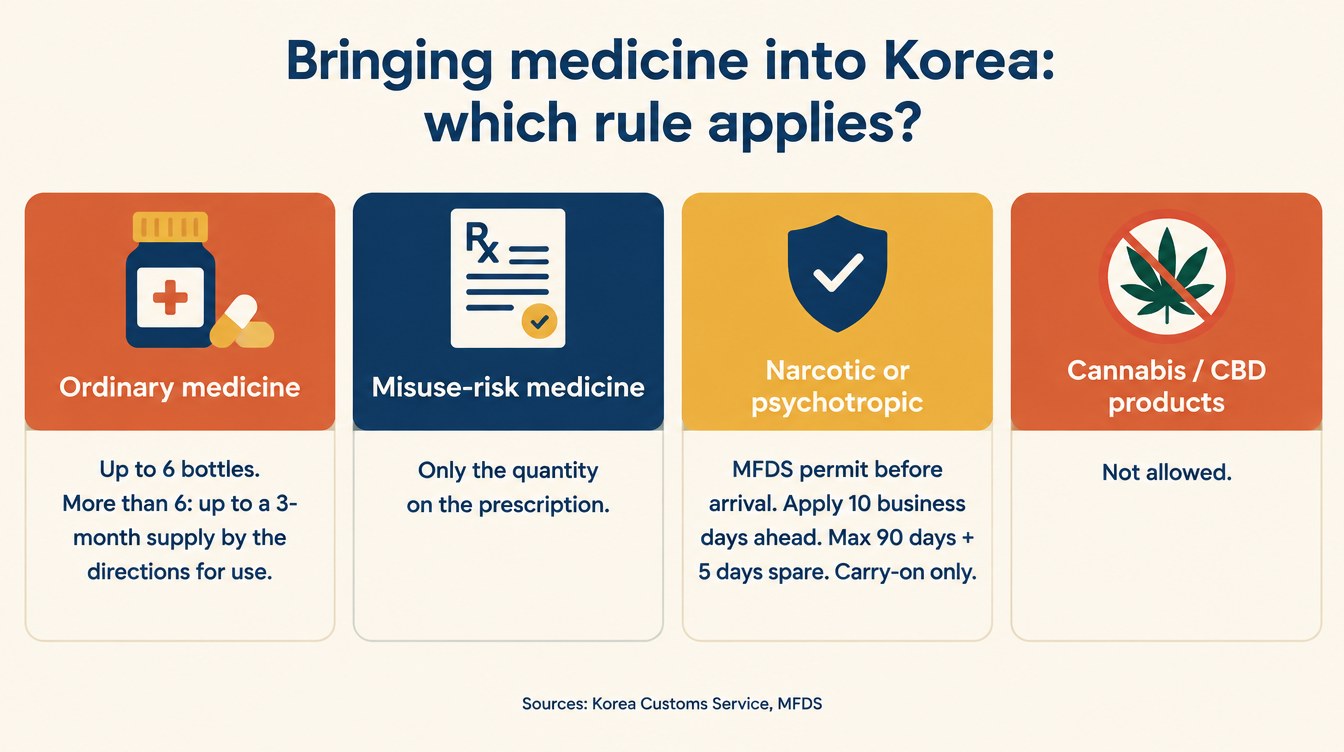
Quick answer: Ordinary medicine for your own use can come into Korea up to 6 bottles, or, if you need more than 6, up to a 3-month supply by the directions for use, according to the Korea Customs Service. Anything containing a narcotic or psychotropic ingredient (many ADHD stimulants, codeine painkillers, some sleeping pills and anti-anxiety drugs, even dextromethorphan cough medicine) needs an MFDS permit before you land, whatever your nationality. Apply online at least 10 business days ahead; the permit covers at most 90 days plus up to 5 days spare, and the medicine must travel in your carry-on. Once you are here, a Korean pharmacy will not fill a foreign prescription: you see a Korean doctor, get a local prescription, and take it to any pharmacy (약국).
If you are flying in for Christmas, New Year or the winter semester, this is the moment to check. A permit application filed on Thursday 10 December 2026 is, by our count, the latest that still leaves 10 Korean business days before a Christmas Eve arrival (Thursday 24 December 2026). That count is ours, not MFDS’s, and it leaves no margin for a request for extra documents, so we would apply in November.
The rules at a glance (official categories)
Korean customs sorts medicine into a few groups. Which group your medicine falls into depends on its active ingredient (성분), not on the brand name or on whether it was sold freely in your home country. The KCS page on narcotic ingredients puts it bluntly: cold medicine, sleeping pills and diet pills bought abroad can count as narcotics in Korea.
| Group (Korean term) | Examples named by Korean authorities | What the rule says | Who rules on it |
|---|---|---|---|
| Ordinary medicine for personal use (의약품, 자가사용) | Most prescription and over-the-counter medicines | Up to 6 bottles in total; more than 6 only up to a 3-month supply by the directions for use | Korea Customs Service |
| Medicine with misuse risk (오·남용우려의약품) | Erectile-dysfunction drugs are the example KCS gives | Only the quantity written on the prescription | Korea Customs Service |
| Narcotics (마약) | Codeine, morphine, oxycodone, tapentadol, methadone | MFDS permit before entry | MFDS (마약정책과, Narcotics Policy Division) |
| Psychotropic medicines (향정신성의약품) | Methylphenidate, amphetamine isomers, dextromethorphan, alprazolam, zolpidem, clonazepam, lorazepam, zaleplon | MFDS permit before entry | MFDS |
| Cannabis (대마) | Products containing CBD, THC or cannabinol | Bringing it in is banned | MFDS / customs |
Sources: KCS traveller guide (the personal-use table based on KCS Notice Article 67) and KCS English page “Precautions for medicines containing narcotic ingredients”; Korean embassy in Japan (MFDS guidance, cannabis ban). The ingredient lists are examples, not complete lists.
Ordinary medicine: the 6-bottle rule
For medicine that has no controlled ingredient, the customs limit is about quantity. The KCS traveller guide, 여행자 휴대품 통관 길라잡이, says health supplements and medicines can be brought in within the range accepted as personal use (자가사용), and its table sets that range for medicine at 6 bottles in total, or, above 6 bottles, a 3-month supply by the medicine’s directions for use (총 6병, 6병 초과의 경우 의약품 용법상 3개월 복용량). The U.S. Embassy in Seoul gives the same “six bottles (or a three-month supply)” figure for non-controlled medicine.
The same table adds conditions that catch travellers out:
- Unclear packaging gets checked. Even within the limit, products whose outer packaging does not clearly show the ingredients, and products MFDS has banned or flagged as harmful, are subject to inspection.
- Some decongestant and ergot ingredients get checked. Single-ingredient medicines containing ephedrine, norephedrine, pseudoephedrine, ergotamine or ergometrine are listed for a requirements check.
- Misuse-risk medicines are cleared only up to the quantity on the prescription.
Worked example (our illustration): you are moving to Korea with 8 bottles of a non-controlled daily tablet. Because that is more than 6 bottles, the customs test becomes whether 8 bottles is no more than a 3-month supply at the dose on the label or prescription. If it is more, the excess can be held. Customs officers make the final call at the airport, which is why both KCS and the U.S. Embassy point you to carrying the prescription and keeping the medicine in its original pack.
What to carry for ordinary medicine (from the U.S. Embassy’s advice): your original prescription, a letter from your doctor about your condition, and a list of the medicines you are bringing. We would add one thing that the MFDS forms ask for anyway: the generic name (the active ingredient) next to every brand name.
Controlled medicine: you need an MFDS permit first
This is the rule that causes most trouble. Since 23 October 2009, under the Enforcement Rule of the Narcotics Control Act, anyone entering Korea with medicine containing a narcotic or psychotropic substance for their own treatment needs MFDS approval (마약류 취급승인), regardless of nationality. That includes Korean citizens and long-term residents. The KCS page even lists, as an example of illegal import, taking medicine prescribed at a Korean hospital abroad and bringing it back without MFDS approval.
What is controlled surprises people. The KCS list of medicines seized at the border includes methylphenidate (the ingredient in several ADHD medicines), amphetamine compounds, zolpidem, alprazolam, lorazepam, clonazepam, codeine combination painkillers and cough medicines, and dextromethorphan, an ingredient in some common US cold and flu products. The Korea Herald (25 August 2026) also points to dextromethorphan as a psychotropic substance under Korean law.
How to apply (step by step)
Since 27 December 2024 the application is online, on MFDS’s Drug Safety Korea site (의약품안전나라).
- Go to Drug Safety Korea (nedrug.mfds.go.kr). On the English site the menu item is Permit To Bring In Narcotics For Self-treatment; on the Korean site it is under 전자민원/보고 (E-Civil Service Application/Report) → 자가치료용 마약류 휴대 반입. The Korea Herald notes that the form itself runs on the Korean site, with English labels on each field.
- Verify your email (이메일 인증) and log in with the code; the MFDS manual and The Korea Herald both describe this email login.
- Enter your stay (entry date, flights, any onward trip) and each medicine: product name, active ingredient, single dose, doses per day and the end date of the period you need it for. The system works out the daily dose and the number of days.
- Attach the documents (below), save, and submit. You can track the status online and answer requests for extra documents (보완) there.
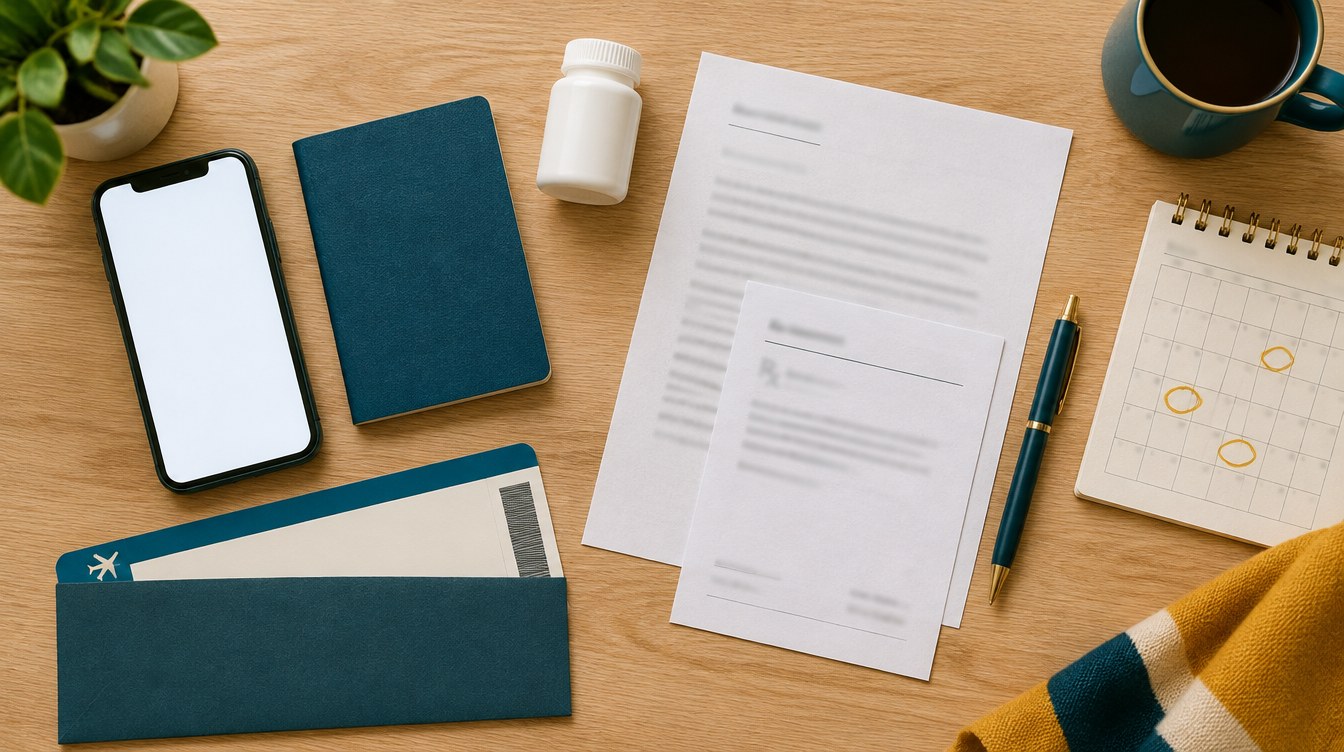
- Carry the medicine in your hand luggage, with the prescription and doctor’s letter.
Documents MFDS asks for
| Document (Korean term) | What it must show |
|---|---|
| Full-page passport copy (여권 사본) | Photo and passport number clearly visible |
| Flight e-ticket (항공권 예매 티켓) | Entry and exit dates, inbound flight number and airport, passenger name |
| Doctor’s letter or medical certificate (진단서) | Hospital name, patient name, doctor’s name and signature, diagnosis, medicine name with the active ingredient, how to take it, single and daily dose, total prescribed, date of issue |
| Prescription (처방전) | Patient details, date, active ingredient, strength, total quantity |
| Export certificate from your country’s authorities (반출승인서), if your country issues one | If you submit it, the doctor’s letter and prescription can be skipped |
| Proof of a long stay, for work or study | For example an exchange-student certificate or a posting letter |
Source: MFDS guidance as published by the Korean embassies in Japan (August 2026) and Belgium; MFDS user manual (December 2024). Documents must be in Korean or English; anything else needs a notarised translation submitted with the original.
Limits that apply to every permit
- 90 days at most. The permit is capped at a 90-day (3-month) supply, matched strictly to the length of your stay. MFDS also gave the International Narcotics Control Board “up to 90 days’ worth” for both narcotics and psychotropics. Anything beyond 90 days should be prescribed by a doctor in Korea.
- Up to 5 days spare for flight delays or long journeys, no more.
- Onward travel: if you fly on to another country, you can carry enough for that leg too, but only if you attach that ticket.
- 10 business days. That is the legal processing period, so apply at least 10 business days before entry. Late or incomplete applications can be rejected. The Korea Herald adds that processing can take longer when extra documents are requested.
- Only the patient can get the permit. You cannot get one for a family member’s or friend’s medicine, or carry theirs in.
- Never post it. Sending narcotic or psychotropic medicine to Korea by mail or courier is banned; customs returns or destroys it.
Worked example (our calculation): you are visiting for 21 days and take one controlled tablet a day. The most a permit could cover is 21 days for the stay plus up to 5 spare days, so 26 tablets. If you are staying 6 months on a study visa, the permit covers at most 90 days, and you would need a Korean prescription for the rest.
Contacts listed by the KCS guide and MFDS: email [email protected], fax +82-43-719-2800. The Drug Safety Korea English site lists +82-43-719-1564 for English enquiries.
Once you are in Korea: clinic first, then pharmacy
Korea separates prescribing from dispensing (의약분업). Since 1 July 2000, doctors diagnose and prescribe, and pharmacists dispense, so most people visit a clinic and then a pharmacy (MOHW). For a foreigner with a regular medicine, that means:
- A foreign prescription will not be filled. Asan Medical Center’s international FAQ says pharmacists can’t fill a foreign prescription and you need to see a doctor for a refill. Samsung Medical Center says the same: prescription drugs can’t be dispensed without a valid local prescription, so you must see a doctor in person, even for the same medicine you already take.
- Over-the-counter medicine is sold at pharmacies without a prescription, while antibiotics, hormone medicines and other prescription drugs need one (Korean embassy in the Netherlands guide). Our late-night pharmacy and holiday guide covers what convenience stores can sell and which pharmacies open late.
- Prescriptions expire. Samsung Medical Center says its prescriptions for outside pharmacies are valid for 14 days. Check the validity box on yours and fill it promptly.
- English prescriptions exist. Samsung Medical Center says it can issue an English prescription for medicine filled at an outside pharmacy. Ask your clinic, especially if you plan to travel with the medicine later.
Asking for your medicine by its generic name
Brand names change across borders, so the same ingredient may be sold in Korea under a different name, or not sold at all. The Korea Herald advises checking both the active ingredient and the product name, and points to MFDS’s Drug Information Search (also on the Drug Safety Korea English site), which shows whether a product is approved in Korea. In practice:
- Write down the generic name and strength of each medicine (the doctor’s letter you prepared for customs already has them).
- Search the ingredient on Drug Safety Korea before you run out, so you know whether a Korean equivalent exists.
- Show the generic name to the Korean doctor and pharmacist. If your exact ingredient isn’t approved in Korea, only the doctor can decide on an alternative; don’t change medicines on your own.
What it costs
If you are enrolled in the National Health Insurance Service (NHIS), the doctor’s visit and the prescription are charged at the insured share; without NHIS you pay the full price. Our guide to health insurance for foreigners in 2026 explains when coverage starts. If your regular medicine is for blood pressure or diabetes, see whether you can join Korea’s chronic disease programme, which lowers the visit copay at participating clinics. And if you suddenly run out at night and feel unwell, our ER guide for foreigners explains when to call 119.
A 5-minute checklist before you fly
- Read the active ingredient on every box, including cold medicine and sleep aids in your washbag.
- Check it against the controlled-substance lists (KCS examples above; ask MFDS at [email protected] if unsure).
- Controlled? Apply on Drug Safety Korea at least 10 business days before you fly, for no more than your stay (maximum 90 days) plus up to 5 days.
- Not controlled? Stay within 6 bottles, or a 3-month supply if you need more.
- Pack it in your carry-on, in original packaging, with the prescription and a doctor’s letter that names the generic ingredient.
- Plan the refill: for a long stay, book a Korean doctor before your supply runs out.
Common problems
- “It was over the counter at home.” Doesn’t matter. Korea goes by ingredient; dextromethorphan and codeine products are the usual examples.
- “I’ll ask family to post it.” Narcotic or psychotropic medicine sent by mail or courier is banned, and customs returns or destroys it.
- “I missed the 10-day window.” Late applications can be rejected. Ask MFDS directly and talk to your doctor about an alternative.
- “I’m staying a year.” The permit tops out at 90 days. Plan to see a doctor in Korea for the rest of your supply.
- CBD and THC products. They are banned, even when legal where you bought them. The U.S. Embassy also warns about layovers.
FAQ
Q. How much ordinary medicine can I bring into Korea?
Up to 6 bottles in total for personal use. If you need more than 6 bottles, the Korea Customs Service accepts up to a 3-month supply by the directions for use. Misuse-risk medicines are limited to the quantity on the prescription, and customs makes the final decision at the airport.
Q. Do I need permission to bring ADHD medication into Korea?
If it is a stimulant, yes. Methylphenidate and amphetamine compounds are psychotropic substances in Korea, so you need a permit from the Ministry of Food and Drug Safety before you arrive, whatever your nationality. Apply online on Drug Safety Korea at least 10 business days before entry.
Q. Are sleeping pills controlled in Korea?
Some are. The Korea Customs Service lists zolpidem, alprazolam, lorazepam and clonazepam among psychotropic medicines, which need an MFDS permit. Check the active ingredient of anything you take for sleep or anxiety before you pack it.
Q. How long can an MFDS permit cover?
At most 90 days, matched to your stay, plus up to 5 days spare for delays. If you stay longer than 90 days, MFDS guidance says the rest should be prescribed by a doctor in Korea.
Q. Can a Korean pharmacy fill my prescription from home?
No. Korean pharmacies dispense prescription medicine only on a local prescription, so you need to see a doctor in Korea first, even for a medicine you already take. Bring the generic name and strength to the appointment.
Q. Can my family mail my medicine to me in Korea?
Not if it contains a narcotic or psychotropic ingredient: posting it to Korea is banned and customs returns or destroys it. Ordinary medicine sent by post is judged against the same personal-use limits.
General information, not medical or legal advice. Rules can change and customs officers decide at the border. Before you travel, check the MFDS Drug Safety Korea site and the Korea Customs Service, and ask your own doctor about your medicines and doses. Don’t stop or change a medicine without medical advice.
Sources
- Korea Customs Service, traveller guide 여행자 휴대품 통관 길라잡이 (PDF, March 2025; personal-use table, MFDS permit section, [email protected] and fax): https://www.customs.go.kr/common/nttFileDownload.do?fileKey=0ec4db5ef2360e89022e1b8f5149dca9
- Incheon Airport Customs (KCS), personal-use standards, KCS Notice Article 67 (6 bottles / 3-month supply; misuse-risk medicine): https://www.customs.go.kr/incheon_airport/cm/cntnts/cntntsView.do?cntntsId=6719&mi=12713
- Korea Customs Service, precautions for medicines containing narcotic ingredients (ingredient lists, re-import example): https://www.customs.go.kr/english/cm/cntnts/cntntsView.do?cntntsId=7640&mi=13807
- MFDS notice, “Self Treatment Narcotics Bring in Permit” (since 23 October 2009; online since 27 December 2024; Narcotics Policy Division): https://www.mfds.go.kr/brd/m_74/view.do?seq=43906
- MFDS, “Permit To Bring In Narcotics For Self-treatment” user manual (English, December 2024), attached to the notice above
- MFDS Drug Safety Korea, English site (Drug Information Search, permit menu, English line): https://nedrug.mfds.go.kr/eng/index
- Korean Embassy in Japan, online application notice with MFDS guidance (18 August 2026): https://overseas.mofa.go.kr/jp-ko/brd/m_25645/view.do?seq=1320273
- Korean Embassy in Belgium, “Guideline on permit to bring in narcotics for self-treatment” (8 July 2024): https://www.mofa.go.kr/be-en/brd/m_7437/view.do?seq=761077
- International Narcotics Control Board, country information for travellers: Korea (10 January 2025): https://www.incb.org/incb/uploads/documents/Travellers/files/ROK_ENG_2025.pdf
- Ministry of Health and Welfare, separation of prescribing and dispensing (의약분업): https://www.mohw.go.kr/menu.es?mid=a10702040100
- Korean Embassy in the Netherlands, “Living in Korea 3 – Pharmacy” (2012): https://overseas.mofa.go.kr/nl-en/brd/m_6971/view.do?seq=689302
- U.S. Embassy and Consulate in Korea, “Information on controlled substances”: https://kr.usembassy.gov/services-controlled-substance/
- The Korea Herald, “Can I bring my medication into Korea?” (18 August 2026): https://www.koreaherald.com/article/10844086
- The Korea Herald, “How to get permission to bring controlled medication into Korea” (25 August 2026): https://www.koreaherald.com/article/10851424
- Samsung Medical Center, international patient FAQ (medication and prescription): https://www.samsunghospital.com/en/patient-guide/faq.do?searchText=&type=PRESCRIPTION
- Asan Medical Center, international patient FAQ: https://eng.amc.seoul.kr/gb/lang/patients/faq/langPatientsFaqList.do
How we checked: On 16 November 2026 (KST) we read the KCS traveller guide and both KCS pages, the MFDS notice and its English user manual, the Drug Safety Korea English home page, two embassy notices carrying MFDS guidance, the INCB country sheet and the MOHW page in full, and matched each limit against a second source (U.S. Embassy, The Korea Herald, hospital FAQs). The worked examples and the Christmas-Eve filing date are our own arithmetic. The 90-day, 5-day and 10-business-day limits come from MFDS guidance as relayed by two Korean embassies and the INCB sheet, not from a page on mfds.go.kr itself.
Researched and drafted with AI assistance; checked against the sources listed.



2 Comments