Depression Screening on Korea’s National Checkup: PHQ-9 Score Bands, Who Gets It at 40, 50, 60 and 70, and What to Do Next
Haesul Health desk (AI-assisted). As of 10 November 2026 (KST). Based on the National Health Insurance Service (NHIS) general checkup page; the official checkup judgment table (Health Checkup Implementation Standards, Annex 4, file dated 14 January 2026 on law.go.kr); and the Korea Disease Control and Prevention Agency (KDCA) National Health Information Portal page on national checkups (updated 1 June 2026). Independent cross-check of the PHQ-9 bands: Seodaemun-gu Public Health Center’s PHQ-9 self-check page. Crisis line details are from the Ministry of Health and Welfare’s 109 page. This is general information, not medical advice. A questionnaire score is not a diagnosis.
Quick answer: Korea’s national general checkup includes a depression questionnaire, the PHQ-9, once in each decade from your 40s to your 70s (40–49, 50–59, 60–69 and 70–79). Younger adults get it more often. Scores are banded as 0–4: no depressive symptoms, 5–9: mild depressive symptoms, 10–19: moderate depression suspected, and 20 or more: severe depression suspected. Any answer above 0 on question 9 (thoughts of being better off dead or of self-harm) also puts you in the severe band. If the result flags suspected depression, NHIS covers a confirmatory visit at a psychiatry clinic or hospital until 31 March 2027 for a 2026 checkup. KDCA says the first visit has no out-of-pocket fee. The 2026 checkup itself must be done by Thursday 31 December 2026.
If you are thinking about suicide or self-harm now, call 109, Korea’s suicide prevention line, which answers 24 hours a day. In an emergency, call 119.
The depression questionnaire is the part of the checkup most people rush. It comes on a form or tablet between the blood test and the chest X-ray, nine short questions about the last two weeks. A few weeks later a line on the result sheet says “mild depressive symptoms” or “moderate depression suspected”, and many people in their 40s, 50s and 60s don’t know what to make of it. Adult children see it on a parent’s sheet and worry. This guide explains who gets the test and when, how the score is counted, what each band means on a Korean result sheet, and what to do before the year ends.

Who gets depression screening, and when
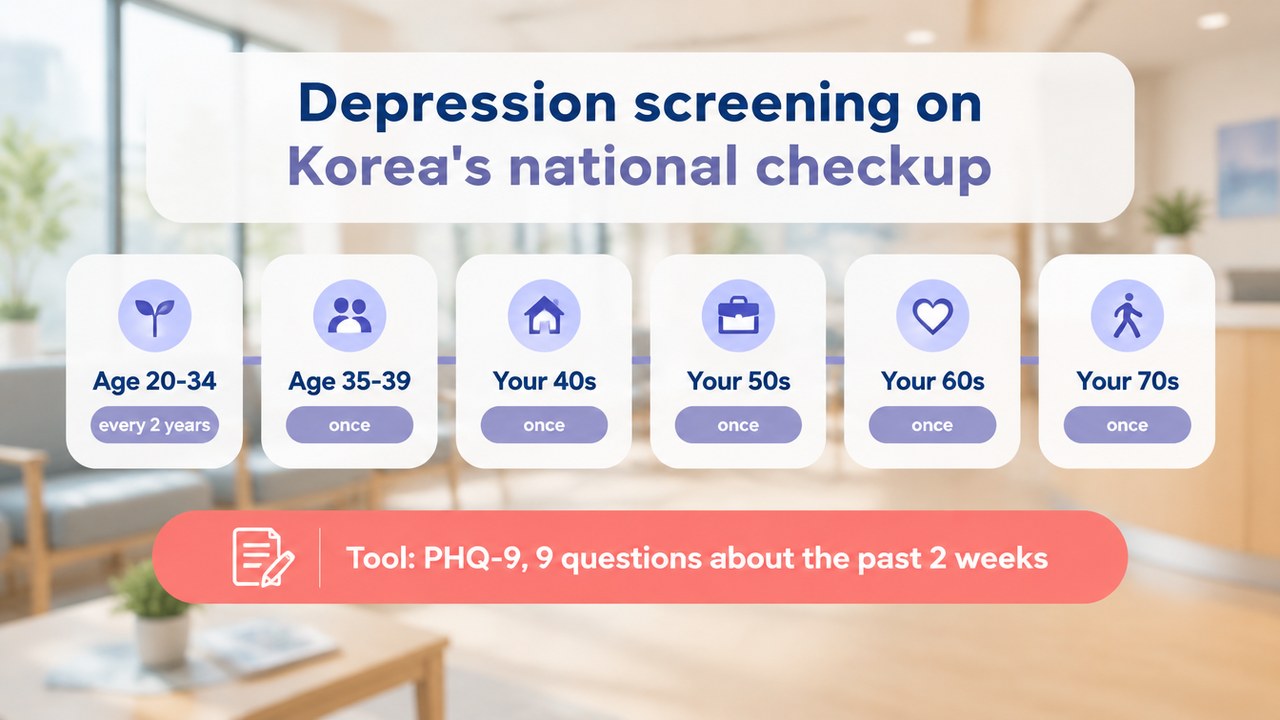
NHIS lists depression under the checkup’s “mental health test” (정신건강검사), with these timings:
| Age band | How often | NHIS note |
|---|---|---|
| 20–34 | Every 2 years | Ages 20, 22, 24 … 32, 34 |
| 35–39 | Once | Once within ages 35–39 |
| 40–49 | Once | Once within the 40s |
| 50–59 | Once | Once within the 50s |
| 60–69 | Once | Once within the 60s |
| 70–79 | Once | Once within the 70s |
KDCA’s national checkup page gives the same schedule and names the tool: the PHQ-9 (Patient Health Questionnaire-9). The general checkup itself runs every 2 years for most people, and every year for non-office workers. So in a given decade, your PHQ-9 comes with one of your checkups, not with every one.
Three practical points follow:
- Check your 2026 checkup items. The NHIS checkup-target lookup (건강모아 → 나의 건강 → 검진대상 조회) shows whether you are due a checkup this year.
- The checkup is free. KDCA says NHIS pays the full general checkup cost, and medical aid recipients are covered by the state and local government.
- The window closes on 31 December 2026. If you missed last year’s checkup, NHIS lets you apply to be added to this year’s list. See our guide to the 31 December checkup deadline and catch-up rules.
Depression is not the only questionnaire at these ages. From 66, the checkup adds a cognitive questionnaire every 2 years, and the 40, 50, 60 and 70 checkups include a lifestyle assessment. Our national health checkup by age guide lists every item by age.
How the PHQ-9 is scored
The PHQ-9 asks how often, over the last 2 weeks, you have been bothered by nine problems. The Korean version used by public health centres (Seodaemun-gu’s self-check page cites Park et al., 2010) lists them as:
- Feeling down, depressed or hopeless
- Little interest or pleasure in things you usually do
- Trouble falling or staying asleep, or sleeping too much
- Poor appetite or eating more than usual
- Moving or speaking slowly enough that others notice, or being so restless you can’t sit still
- Feeling tired or having little energy
- Feeling that you did something wrong or failed, or let yourself or your family down
- Trouble concentrating on everyday things such as reading the newspaper or watching TV
- Thinking you would be better off dead, or thinking of hurting yourself
Each answer scores 0 to 3. On the Korean form the choices are not at all (0), 2–6 days (1), 7–12 days (2) and nearly every day (3). Add the nine answers to get a total from 0 to 27.
What each band means on the result sheet
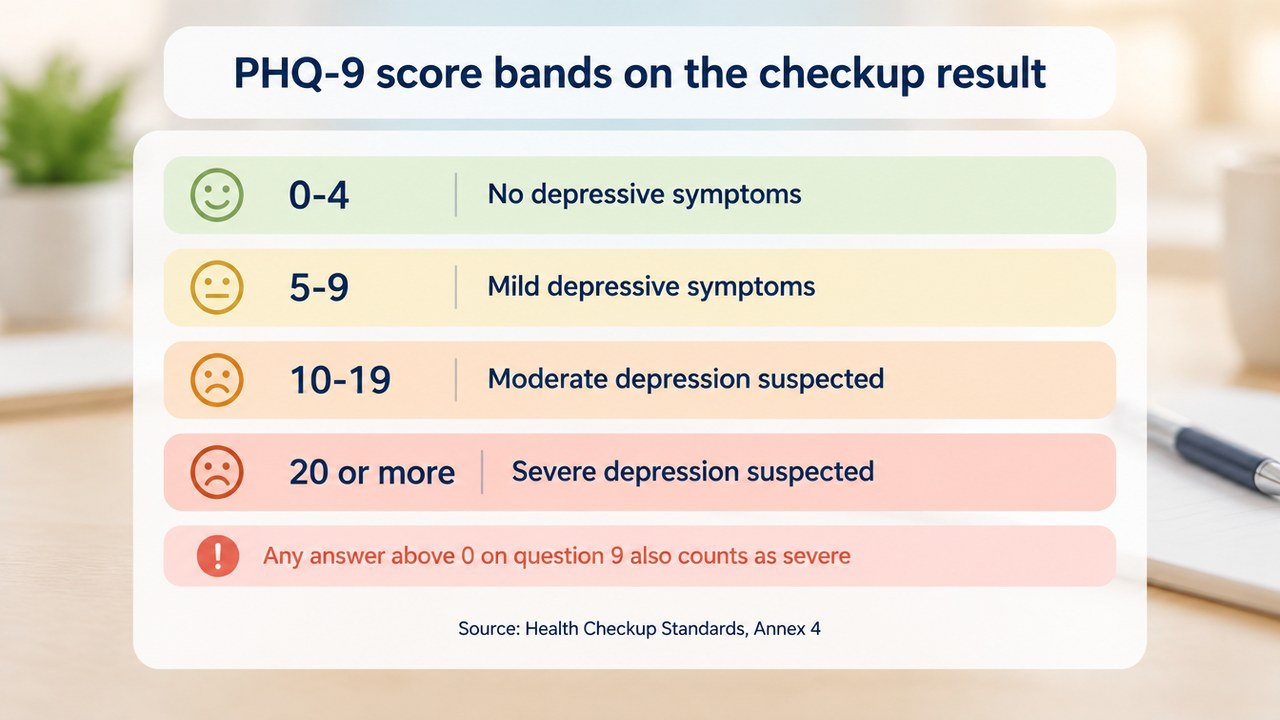
The official judgment table in the checkup standards (Annex 4) sets four result bands:
| PHQ-9 total | Result wording (Annex 4) | Seodaemun PHC’s description |
|---|---|---|
| 0–4 | No depressive symptoms (우울증상이 없음) | No significant low mood |
| 5–9 | Mild depressive symptoms (가벼운 우울증상) | Mild low mood that doesn’t disrupt daily life; visit a mental health welfare centre if it persists |
| 10–19 | Moderate depression suspected (중간정도 우울증 의심) | Can make daily life harder; get a fuller assessment at a local centre or specialist |
| 20 or more, or question 9 scored 1+ | Severe depression suspected (심한 우울증 의심) | Severe level; treatment and assessment by a specialist service needed |
The question-9 rule matters. On the checkup, a total of 6 is normally “mild”. But if one of those points came from question 9, the official table puts the result in the severe band. Even an occasional thought of being better off dead is treated as a reason to see a professional.

Worked readings: three example answer sheets
These are illustrative answer patterns, not real patients. Totals are calculated and read against the Annex 4 bands.
| Example | Answers to Q1–Q9 | Total (calculated) | Band |
|---|---|---|---|
| A. 52-year-old, busy autumn, sleeping badly | 1, 1, 2, 1, 0, 2, 1, 0, 0 | 8 | Mild depressive symptoms (5–9) |
| B. 47-year-old after a job loss | 2, 2, 2, 1, 1, 2, 1, 1, 0 | 12 | Moderate depression suspected (10–19) |
| C. 68-year-old living alone since a spouse died | 1, 1, 1, 1, 0, 1, 0, 0, 1 | 6 | Severe depression suspected (question 9 scored 1) |
Example C is the one families miss. The total looks low, but the answer to question 9 changes the band. If you see “severe depression suspected” next to a modest number on a parent’s sheet, this is likely why. It is a reason to have a calm, direct conversation and to book a confirmatory visit, not to panic.
Example A shows the other side. A score in the mild band after a hard few weeks is common. It is a signal to watch, not a diagnosis. If the low mood lasts, Seodaemun’s centre suggests visiting a local mental health welfare centre or specialist service.
What to do next, by result
If your sheet says “suspected depression”: the confirmatory visit
The NHIS checkup page lists depression among the conditions with a covered confirmatory test (확진검사):
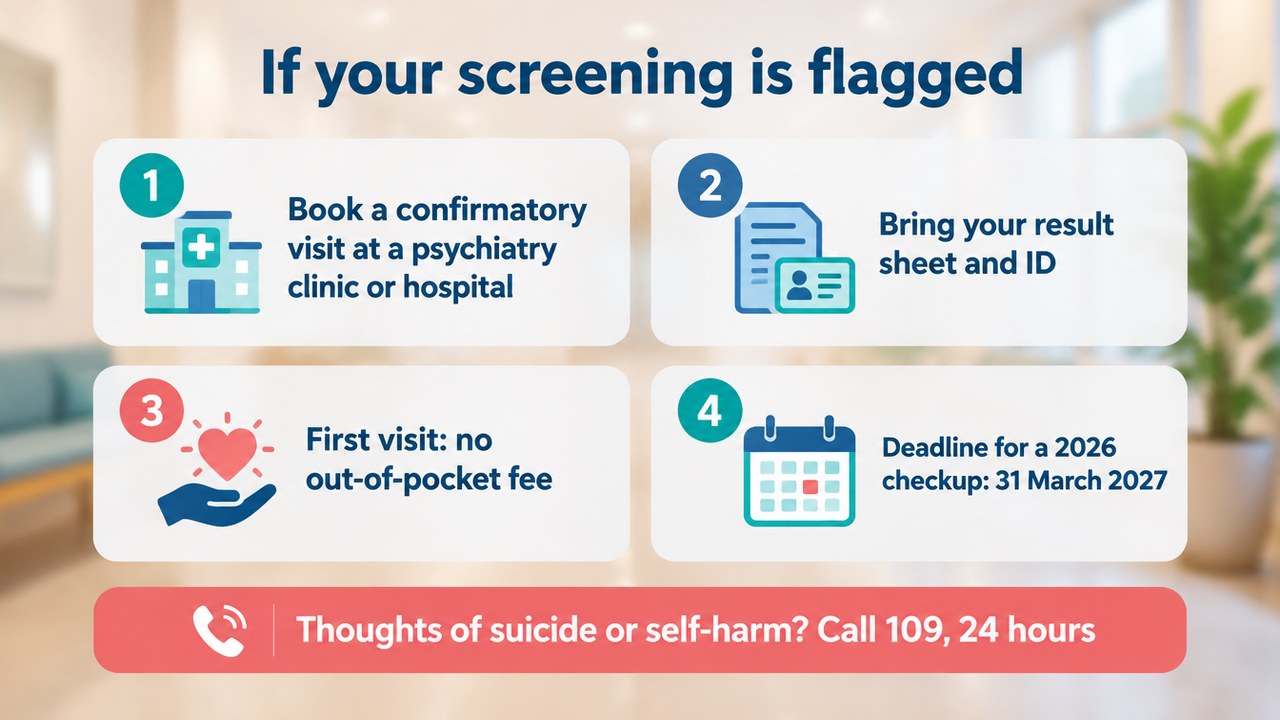
- What it includes: a consultation, a test (a symptom and behaviour rating scale), and counselling (individual psychotherapy).
- Where: a psychiatry (정신건강의학과) clinic or hospital. Psychiatric hospitals (정신병원), dental, Korean-medicine and long-term care hospitals are excluded.
- When: until 31 March of the year after the checkup, so 31 March 2027 for a 2026 checkup.
- Cost: KDCA says the confirmatory test is free of out-of-pocket charges the first time. Other tests or later visits are billed normally.
- What to bring: the checkup result sheet and ID.
KDCA adds that clinics can check whether you are a confirmatory-test target on the NHIS provider portal. If you are unsure whether your band qualifies, phone the clinic with your result sheet in hand.
If your result is mild (5–9)
No confirmatory pathway is printed for this band. Still, notice whether it lasts. If it does, talk to your family doctor, or contact your district’s mental health welfare centre (정신건강복지센터). The 1577-0199 mental health counselling line also takes calls.
If anything points to suicide or self-harm
Call 109 (24 hours). Since 1 January 2024, Korea’s suicide-prevention counselling has been consolidated under 109. MOHW says calls are confidential. In high-risk cases, the line can connect you, with your consent, to a local mental health welfare centre or suicide prevention centre for face-to-face support. In an emergency, call 119.

For adult children: when it’s a parent’s result
For readers in their 40s and 50s, the most common search behind this topic is a parent’s result sheet. A few points help:
- Low mood in older people can look like memory trouble. Our guide to the checkup cognitive test from 66 notes that low mood or depression is one of the reasons a KDSQ-C score can rise. If a parent was flagged on both, mention both to the doctor.
- If question 9 was the reason for the flag, take it seriously. Talk calmly with your parent, help book the confirmatory visit soon, and if you are worried about their safety, call 109 together.
- Use the deadline. A 2026 flag can be followed up at no first-visit charge until 31 March 2027. Book the visit in December or January rather than leaving it to March.
- Go with them if they want you to. Bring the result sheet and ID, and a short list of changes you have noticed (sleep, appetite, interest, energy).
A short year-end plan
- By 31 December 2026: have this year’s checkup if you are due. Answer the questionnaire honestly, because it only helps if it reflects the last two weeks.
- About 2 weeks later: NHIS says the checkup centre sends results within 15 days. Find the depression line and its band.
- If flagged: book a confirmatory visit at a psychiatry clinic or hospital before 31 March 2027.
- If mild: note it and recheck how you feel in a few weeks. Ask for help early if it doesn’t lift.
- Any time: 109 for suicidal thoughts, 1577-0199 for mental health counselling.
Need to talk to someone in English, not just read a score? See Mental health help in English in Korea: 109, 1577-0199 and counselling centres.
Frequently asked questions
Q. At what ages does Korea’s national checkup screen for depression?
Every 2 years from 20 to 34, once between 35 and 39, and then once in each decade: once in your 40s, once in your 50s, once in your 60s and once in your 70s. The tool is the PHQ-9 questionnaire.
Q. What do PHQ-9 scores mean on the checkup result?
0–4 no depressive symptoms; 5–9 mild depressive symptoms; 10–19 moderate depression suspected; 20 or more severe depression suspected. A score of 1 or more on question 9, about thoughts of death or self-harm, also counts as severe regardless of the total.
Q. Is the follow-up test free if my checkup flags depression?
The confirmatory test (consultation, rating scale and counselling) is covered at a psychiatry clinic or hospital, and KDCA says the first one has no out-of-pocket fee. Further visits are billed normally. Bring your result sheet and ID.
Q. What is the deadline for the depression confirmatory test?
NHIS says confirmatory tests run until 31 March of the year after the checkup, so 31 March 2027 for a checkup done in 2026. The 2026 checkup itself must be done by 31 December 2026.
Q. Who can I call if I’m worried about suicide in Korea?
Call 109, the suicide prevention line, 24 hours a day. The 1577-0199 mental health line handles general mental health counselling. In an emergency, call 119.
Sources
- National Health Insurance Service, 일반건강검진 (general checkup): depression screening ages (20–34 every 2 years; 35–39, 40s, 50s, 60s, 70s once each), confirmatory test for suspected depression (consultation, rating scale, individual psychotherapy) at psychiatry clinics/hospitals excluding psychiatric hospitals, until 31 March of the following year, bring result sheet and ID, results within 15 days, checkup period 1 Jan–31 Dec, prior-year non-attenders can be added — https://www.nhis.or.kr/nhis/healthin/wbhaca04500m01.do (confirmed 10 November 2026)
- Health Checkup Implementation Standards, Annex 4 and appendix (검사항목별 판정기준), law.go.kr files dated 14 January 2026: PHQ-9 bands 0–4 / 5–9 / 10–19 / 20+ or question 9 ≥ 1 — https://www.law.go.kr/LSW/flDownload.do?flSeq=160922523 (confirmed 10 November 2026 from box copies downloaded on 8 November 2026)
- Korea Disease Control and Prevention Agency, National Health Information Portal, “건강검진(국가건강검진)” (updated 1 June 2026): same depression schedule with the PHQ-9 tool, checkup free of charge, confirmatory test first visit free of out-of-pocket charges, eligibility lookup on the provider portal — https://health.kdca.go.kr/healthinfo/biz/health/gnrlzHealthInfo/gnrlzHealthInfo/gnrlzHealthInfoView.do?cntnts_sn=6671 (confirmed 10 November 2026)
- Independent: Seodaemun-gu Public Health Center, 우울증(PHQ-9) 자가검진: the nine questions, 0–3 answer scale (none / 2–6 days / 7–12 days / nearly every day), bands 0–4, 5–9, 10–19, 20–27 with descriptions; citing Park et al. (2010), Korean PHQ-9 — https://www.sdm.go.kr/health/mentalhealth/selfexmn/dprs2 (confirmed 10 November 2026)
- Ministry of Health and Welfare, 129 Health and Welfare Call Centre, 109 suicide prevention line: 24-hour counselling, consolidated under 109 from 1 January 2024, 1577-0199 continues for mental health counselling, confidentiality and linkage to local centres — https://www.129.go.kr/109/index.do (confirmed 10 November 2026)
This article is general health information, not medical advice. The PHQ-9 is a screening questionnaire, not a diagnosis. Talk to a doctor or mental health professional about your result. If you are in crisis, call 109 (24 hours) or 119.


2 Comments