Dental Implants in Korea at 65+: NHIS Covers 2 per Lifetime, You Pay 30% (About ₩405,000 Each) — and What Changes on 1 January 2027
Haesul Living desk (AI-assisted). As of 10 November 2026 (KST). Based on the National Health Insurance Service (NHIS) dental implant benefit page, the Health Insurance Review and Assessment Service (HIRA) Q&A on the implant coverage rule (posted 17 March 2026), and the Ministry of Health and Welfare (MOHW) briefing after the 15th Health Insurance Policy Deliberation Committee on 8 September 2026. 2026 fees come from HIRA’s 2026 fee file as reported by the Korean dental press and the Korea Dental Technicians Association’s fee table. Amounts marked “calculated” are our arithmetic. General information only; this is not medical or financial advice.
Quick answer: Anyone aged 65 or older in Korea’s National Health Insurance (as a subscriber or a dependent) can get up to 2 dental implants per lifetime under insurance. You pay 30% of the covered fee. In 2026 the covered fee for one implant at a dental clinic is ₩1,351,040, so your share is about ₩405,000 per implant (calculated), plus 30% of the implant parts. Until 31 December 2026, the benefit is only for a jaw that still has some natural teeth. From 1 January 2027, MOHW says people whose upper or lower jaw has no teeth at all can also get 2 covered implants. Your dentist has to register you with NHIS before treatment.
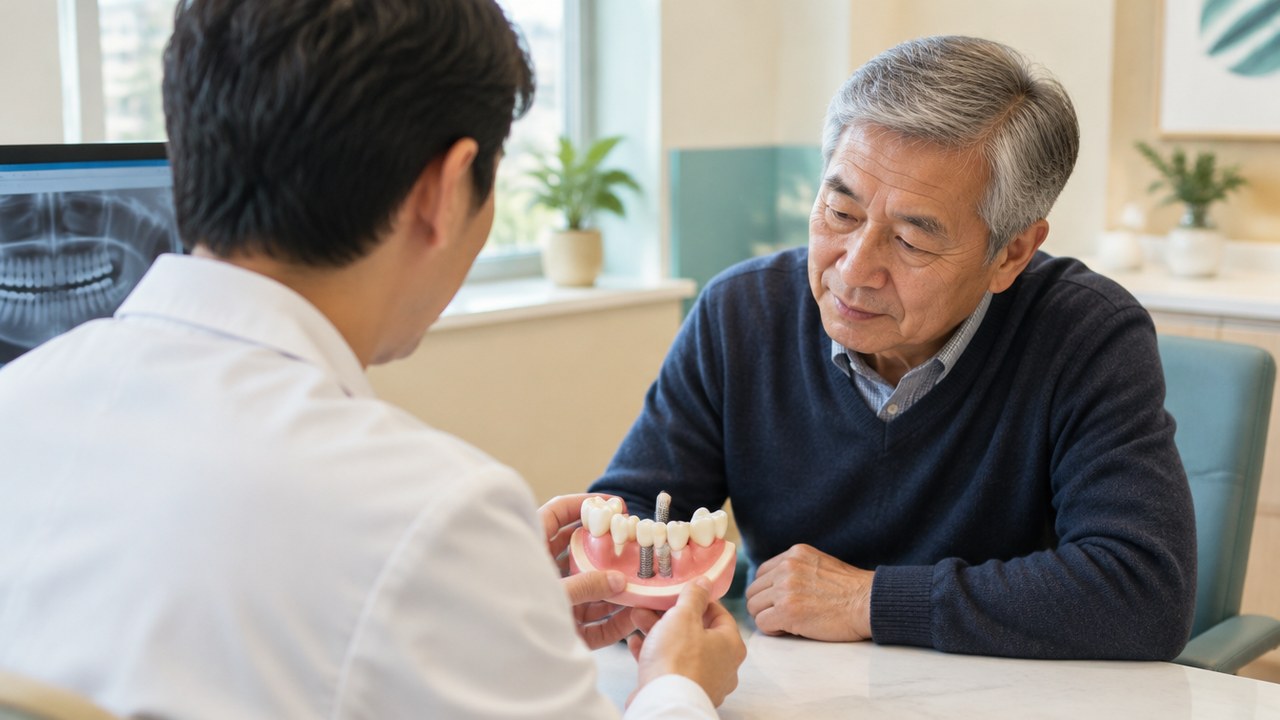
Most readers who search for this are in one of two places. Some are in their 60s and have been told they need an implant. Others are in their 40s or 50s and trying to help a parent compare a dentist’s quote with what insurance covers. This guide is for both. It explains who qualifies, what one implant actually costs under the 2026 fee table, what stays outside the insurance price, and why a parent whose jaw has no teeth left may want to talk to the dentist about January 2027.
Who qualifies in 2026
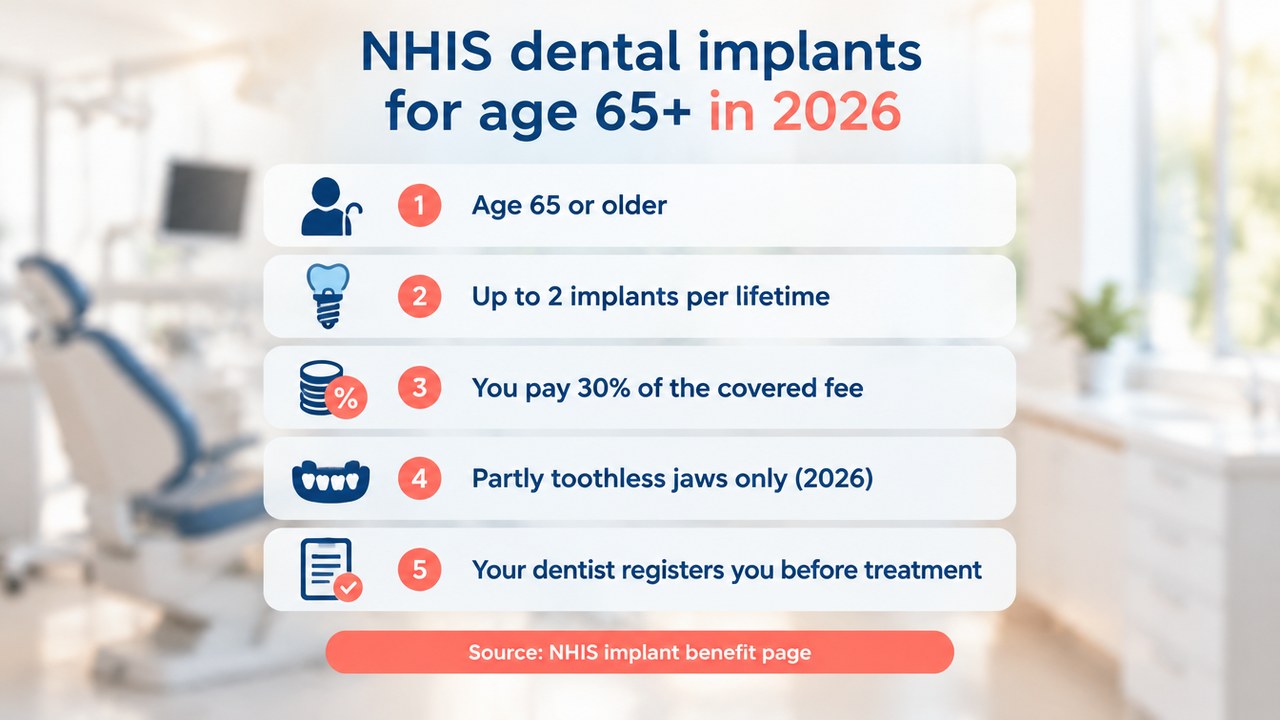
The NHIS implant page sets out the rules. Four things decide whether an implant can be billed to insurance:
- Age 65 or older. The age started at 75 in July 2014, dropped to 70 in July 2015 and has been 65 since July 2016. Both subscribers (가입자) and dependents (피부양자) qualify, so a parent registered as a dependent under a son’s or daughter’s workplace insurance is covered.
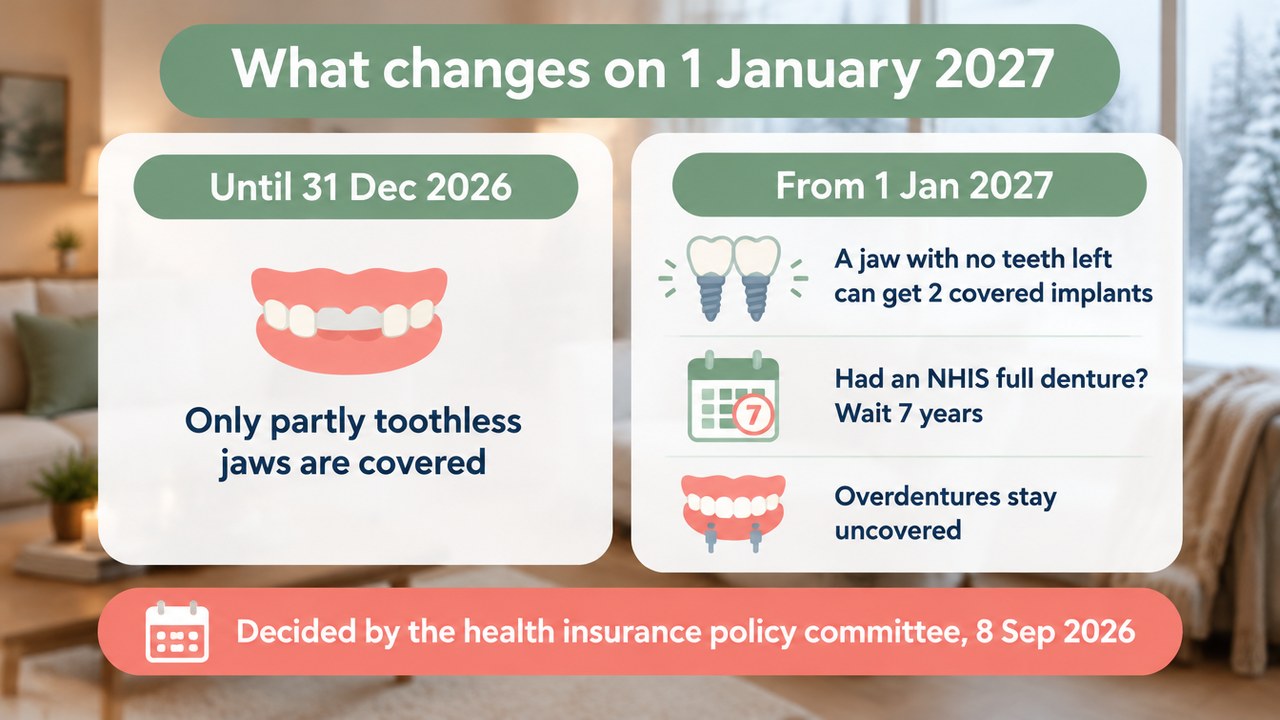
- A partly toothless jaw. In 2026 the benefit covers only “partially edentulous” patients, meaning the jaw still has some natural teeth. A jaw with no teeth at all is excluded until the 2027 change described below.
- Any tooth position. Since July 2015, front and back teeth, upper and lower, are all covered. Before then it was mainly molars.
- Two per person, for life. The count is per person, not per jaw or per year. If the dentist decides on medical grounds that a procedure has to stop, that implant does not use up one of your two.
Partial dentures and implants can both be covered for the same person. The NHIS page says the two benefits are allowed together.
What one implant costs under the 2026 fee table
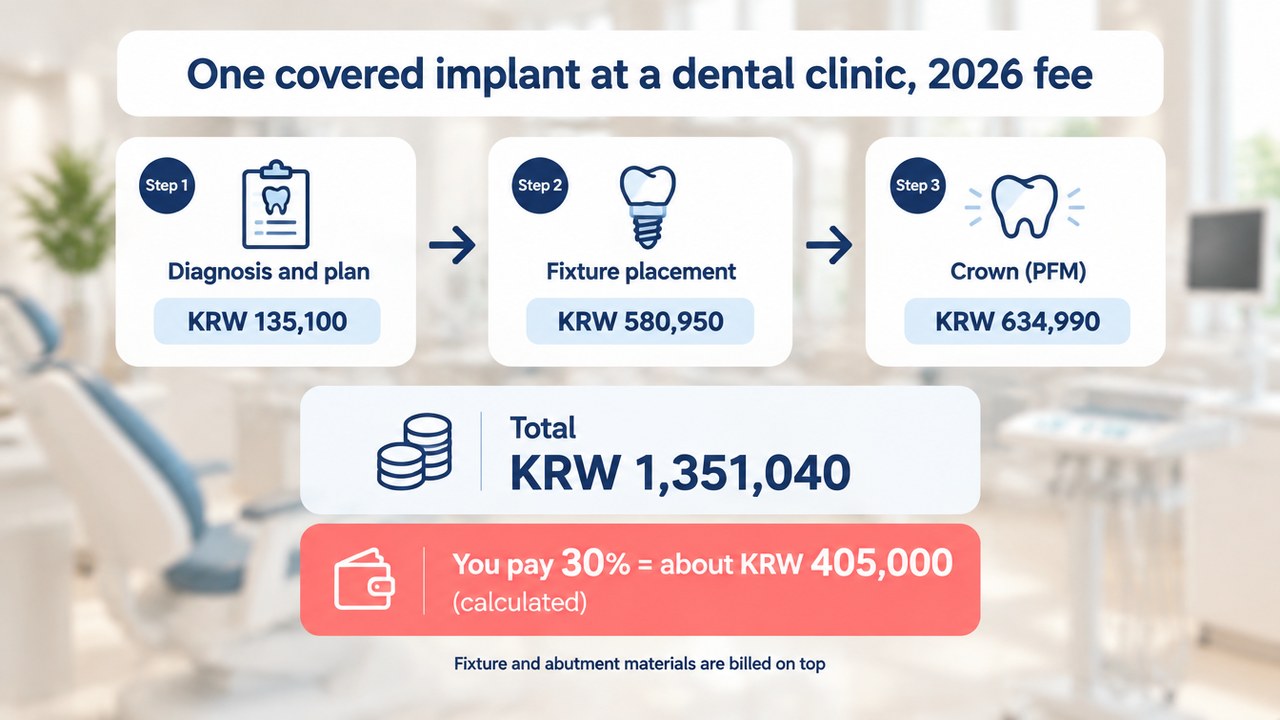
Insurance pays implants in three stages. The 2026 fee for each stage at a dental clinic (치과의원), from HIRA’s 2026 fee file as reported by the dental press and the Korea Dental Technicians Association, is shown below. Your 30% share is our calculation.
| Stage | 2026 fee at a dental clinic | Your 30% (calculated) |
|---|---|---|
| 1. Diagnosis and treatment plan | ₩135,100 | ₩40,530 |
| 2. Fixture (implant body) placement | ₩580,950 | ₩174,285 |
| 3. Crown (prosthetic restoration) | ₩634,990 | ₩190,497 |
| Total per implant | ₩1,351,040 | ₩405,312 |
The dental press prints the patient share as ₩405,100. The ₩212 gap from our figure is small and probably comes from rounding at each stage. Treat it as “about ₩405,000”. At a dental hospital (치과병원), the 2026 fee is ₩1,409,790, so 30% is about ₩422,937 (calculated). The fee rose by ₩26,720 from 2025’s ₩1,324,320 at clinics, after a 2% rise in dental fees for 2026.
The parts are billed on top
The stage fees above do not include the two main parts. The fixture (the screw placed in the bone) and the abutment (the connector that holds the crown) are charged separately, at the price the clinic actually paid, up to a cap. The Korea Dental Technicians Association’s 2026 table gives these caps: ₩57,410 to ₩185,040 for a fixture and ₩20,800 to ₩54,590 for an abutment, depending on the product. These parts are covered items, so you pay 30% of them too.
Worked example: one and two implants for a parent
All figures below are calculated from the fees above. Your clinic’s bill will depend on the parts it uses.
| Scenario (dental clinic, regular NHIS, 30%) | Covered total | Patient share |
|---|---|---|
| 1 implant, cheapest parts (₩57,410 + ₩20,800) | ₩1,429,250 | about ₩428,775 |
| 1 implant, most expensive parts (₩185,040 + ₩54,590) | ₩1,590,670 | about ₩477,201 |
| 2 implants, cheapest parts | ₩2,858,500 | about ₩857,550 |
| 2 implants, most expensive parts | ₩3,181,340 | about ₩954,402 |
So a parent who uses both lifetime implants at a clinic should expect to pay roughly ₩860,000 to ₩950,000 in covered charges before any uncovered extras. These include bone grafts, covered further down.
Lower rates for some groups
The NHIS page lists lower copay rates for some people:
| Group | Copay rate | Share of the ₩1,351,040 clinic fee (calculated) |
|---|---|---|
| Regular NHIS subscriber or dependent | 30% | ₩405,312 |
| Near-poverty group, rare/intractable disease (차상위 C) | 10% | ₩135,104 |
| Near-poverty group, chronic disease etc. (차상위 E, F) | 20% | ₩270,208 |
| Medical aid, type 1 (의료급여 1종) | 10% | ₩135,104 |
| Medical aid, type 2 (의료급여 2종) | 20% | ₩270,208 |
One catch: NHIS says implant copays are excluded from the annual out-of-pocket ceiling (본인부담상한제). Implant spending does not count toward that cap and is not refunded under it.

What insurance does not pay for
Implant quotes often confuse families because the insurance price and the final bill are different things. These are the main gaps:
- Extra surgery done to make an implant possible. HIRA’s Q&A cites the benefit standards rule (별표 2) under which additional surgery done for prosthetics or implants is non-covered. Bone grafting is the most common example. The implant itself stays covered if it meets the conditions.
- Whole procedure non-covered in four cases. HIRA and NHIS list them: a fully toothless patient (until the 2027 change); an implant passing through the upper jaw into the cheekbone (zygomatic); a one-piece implant instead of the two-piece type; and a crown made of any material other than the covered ones. In these cases the entire implant becomes non-covered, not just the extra part.
- Crown material. The NHIS page still names porcelain-fused-to-metal (PFM) crowns. HIRA’s Q&A, citing the coverage notice in force since 1 February 2025, lists PFM or zirconia. HIRA is the agency that reviews claims, so ask your dentist which crown is being billed as covered.
- A custom abutment. HIRA says the custom part itself is non-covered, while the procedure stays covered.
- Maintenance of the crown. For the first 3 months after the crown is fitted, only the consultation fee can be charged. After that, prosthetic maintenance is non-covered. Gum disease around an implant is treated and billed under the normal covered items.
A good question to ask: “Which lines on this quote are the insurance implant, and which are non-covered extras?” Ask for the estimate split that way.
How to use the benefit: register first
NHIS describes four steps:
- The dentist examines you and decides whether you qualify.
- The clinic registers you with NHIS on your behalf through the provider portal. You do not need to visit an NHIS branch. For medical aid recipients, registration goes through the city, county or district office instead.
- NHIS confirms the registration.
- Treatment starts after the clinic has checked the registration.
If a parent has had an implant before, ask the clinic to check how many of the two lifetime implants are left before planning. Clinics can look this up on the NHIS provider portal. Families can call NHIS on 1577-1000.
What changes on 1 January 2027
On 8 September 2026 the Health Insurance Policy Deliberation Committee approved the first stage of a coverage package. In its briefing, MOHW said that from January 2027, older people with no teeth will also get implant treatment covered. It expects about 70,000 people to benefit, by about ₩2.3 million each a year. Press reports of the same decision give ₩2.28 million.
According to MOHW’s explanation as reported by Hankook Ilbo, Yonhap and Dental News, the change works like this:
- Who: people aged 65 or older whose upper or lower jaw has no teeth at all. Today they can only get a covered full denture, once every 7 years.
- How many: 2 implants. MOHW says the implants can then be combined with a partial denture to improve chewing.
- Wait period: anyone who already had a full denture under NHIS can get the implant benefit only 7 years after that denture.
- Not included: the Korean Dental Association warns that implant-supported overdentures (피개의치) remain non-covered for the whole process, implants and denture together.
The detailed coverage notice is not yet in force. Final wording, and the 2027 fee level (the dental fee for 2027 was negotiated at 2.6% higher), will come with it. Do not quote 2027 prices from this article.
Should a parent wait until January?
That depends on the mouth, so it is a question for the dentist. The rule change does give families one concrete point to raise:
| Parent’s situation | 2026 | From 1 Jan 2027 (as announced) |
|---|---|---|
| Some natural teeth left in the jaw | Covered, 2 per lifetime, 30% | Same |
| One jaw with no teeth, never had an NHIS full denture | Implant not covered (full denture only) | 2 implants covered |
| One jaw with no teeth, NHIS full denture made in 2022 | Implant not covered | Covered only from 2029 (7 years after the denture; calculated) |
| Wants an overdenture on implants | Non-covered | Still non-covered |
If a parent with a fully toothless jaw is about to start a private, non-covered implant plan in November or December, it is worth asking whether starting under the 2027 rule would change the cost. Do not delay treatment your dentist says is urgent.

Implants, dentures and scaling: how they fit together
For people aged 65 or older, NHIS also covers dentures. Full and partial dentures are covered once every 7 years per jaw, with the same 30% copay. In 2026 a partial denture for one jaw costs ₩1,668,540 at a clinic, so about ₩500,562 is the patient’s share (calculated). Implants and partial dentures can be combined.
Gum health matters before and after an implant. Adults aged 19 and over get one covered scaling per calendar year. If a parent has not used the 2026 one, see our guide to NHIS dental scaling once a year before 31 December. The national checkup also includes a basic dental exam. Our national health checkup by age guide explains what each age group gets. If you pay a parent’s treatment costs, our medical expense tax credit guide explains how year-end tax settlement treats medical receipts.
A checklist for the family conversation
- Confirm the parent’s age (65 on or after the birthday) and NHIS status (subscriber, dependent or medical aid).
- Ask the dentist whether the jaw is “partly” or “fully” toothless, because that decides 2026 vs 2027 eligibility.
- Ask how many of the 2 lifetime implants are left.
- Ask for the quote split into insurance stages, parts, and non-covered extras such as bone grafts.
- Check which crown material is being billed as covered.
- Make sure the clinic registers the parent with NHIS before the first stage.
Frequently asked questions
Q. At what age does Korean health insurance cover dental implants?
From age 65. Both NHIS subscribers and dependents qualify. The age was 75 when the benefit began in July 2014 and has been 65 since July 2016.
Q. How many implants does NHIS cover?
Two per person for life, in any tooth position, upper or lower. A procedure stopped by the dentist on medical grounds does not count toward the two.
Q. How much do I pay for one covered implant in 2026?
The covered fee at a dental clinic is ₩1,351,040, and a regular subscriber pays 30%, about ₩405,000 (calculated). The fixture and abutment are billed on top, also at 30%. Bone grafts and other extra surgery are non-covered. At a dental hospital the fee is ₩1,409,790.
Q. Can someone with no teeth get covered implants?
Not in 2026. A fully toothless patient is excluded. From 1 January 2027, MOHW says people aged 65 or older whose upper or lower jaw has no teeth can get 2 covered implants. Those who had an NHIS full denture must wait 7 years from that denture.
Q. Do I need to apply to NHIS myself?
No. The dental clinic registers you through the NHIS provider portal before treatment starts. For medical aid recipients, registration is handled through the city, county or district office.
Sources
- National Health Insurance Service, 치과임플란트 급여안내 (dental implant benefit): age 65+, history of age limits, partly toothless only, 2 per lifetime, all tooth positions, two-piece fixture and PFM crown, combination with partial dentures, four non-covered cases, copay rates 30% / 10% / 20%, exclusion from the out-of-pocket ceiling, 3 stages, maintenance, registration steps — https://www.nhis.or.kr/nhis/policy/wbhada13600m01.do (confirmed 10 November 2026)
- Health Insurance Review and Assessment Service, Q&A “65세 이상 치과임플란트의 급여기준” (17 March 2026): PFM or zirconia crown, additional surgery non-covered, custom abutment non-covered, maintenance rules, notice 2025-23 in force 1 February 2025 — https://www.hira.or.kr/bbsDummy.do?brdBltNo=47748&brdScnBltNo=4&pgmid=HIRAA010006011100 (confirmed 10 November 2026)
- Ministry of Health and Welfare, briefing on the 15th Health Insurance Policy Deliberation Committee (8 September 2026, Korea.kr): implants for older people with no teeth from January 2027, about 70,000 people, about ₩2.3 million each — https://www.korea.kr/briefing/policyBriefingView.do?newsId=156780681 (confirmed 10 November 2026)
- Independent: Hankook Ilbo, “무치악 65세 이상 노인, 내년부터 임플란트 2개 건강보험 지원” (8 September 2026): upper or lower jaw with no teeth, 2 implants, ₩2.28 million, 7-year wait after an NHIS full denture — https://www.hankookilbo.com/news/article/A2026090811280005516 (confirmed 10 November 2026)
- Independent: Dental News (치과신문), “65세 이상 완전 무치악 임플란트 급여 적용” (10 September 2026): in force 1 January 2027, overdentures non-covered (Korean Dental Association), 2027 dental fee rise 2.6% — https://www.dentalnews.or.kr/news/article.html?no=48170 (confirmed 10 November 2026)
- Independent: Yonhap News, “희귀·난치환자 본인부담 10→5%…중증 2형 당뇨도 기기 지원” (8 September 2026): implants for people aged 65+ with no teeth, about 70,000 people, ₩2.28 million, 7-year wait after an NHIS full denture — https://www.yna.co.kr/view/AKR20260908033400530 (confirmed 10 November 2026 via search extract)
- Daily Dental (치과의료정책 전문지), “올해 주요 항목 수가·본인부담금 확인 ‘꼭'” (7 January 2026), citing HIRA’s 2026 fee file: implant ₩1,351,040 clinic / ₩1,409,790 hospital, patient share ₩405,100 / ₩422,700, partial denture ₩1,668,540 — https://www.dailydental.co.kr/news/article.html?no=136277 (confirmed 10 November 2026)
- Korea Dental Technicians Association bulletin no. 504, 2026 NHIS denture and implant fee table: stage fees ₩135,100 / ₩580,950 / ₩634,990, 2025 fee ₩1,324,320, fixture cap ₩57,410–₩185,040, abutment cap ₩20,800–₩54,590 — https://www.kdtech.or.kr/PDS/gibo/%EC%B9%98%EA%B3%BC%EA%B8%B0%EB%B3%B4%20504%ED%98%B8%20compressed.pdf (confirmed 10 November 2026 via search extract)
- National Health Insurance Service, 노인틀니 건강보험 적용 (dentures for 65+): once every 7 years per jaw, 30% — https://www.nhis.or.kr/nhis/policy/wbhada13800m01.do (confirmed 10 November 2026 via search extract)
This article is general information, not medical or financial advice. Whether an implant, a denture or another treatment is right depends on a dental examination. Confirm coverage, registration and your final bill with your dentist and NHIS (1577-1000).






One Comment