Korea Inheritance Renunciation vs Limited Acceptance: The 3-Month Deadline When a Parent Leaves Debts
Haesul Economy desk (AI-assisted). As of 10 November 2026 (KST), based on the Civil Act (민법) Articles 157, 160, 161, 1000, 1003, 1009, 1019, 1026, 1028, 1030, 1032 and 1041–1043 as published on the Korean Law Information Center (version in force from 17 March 2026), the Supreme Court’s e-civil-service fee table for family non-contentious cases, the Supreme Court’s 23 March 2023 en banc decision 2020그42, a Busan High Court notice on 2026 service fees, and the government’s Safe Inheritance (안심상속) one-stop service. Independent cross-checks: two Korean law-practice explainers and the National Tax Service page on the same service. This is general information, not legal or tax advice. Talk to the family court’s civil-service desk or the Korea Legal Aid Corporation (call 132) about your own family.
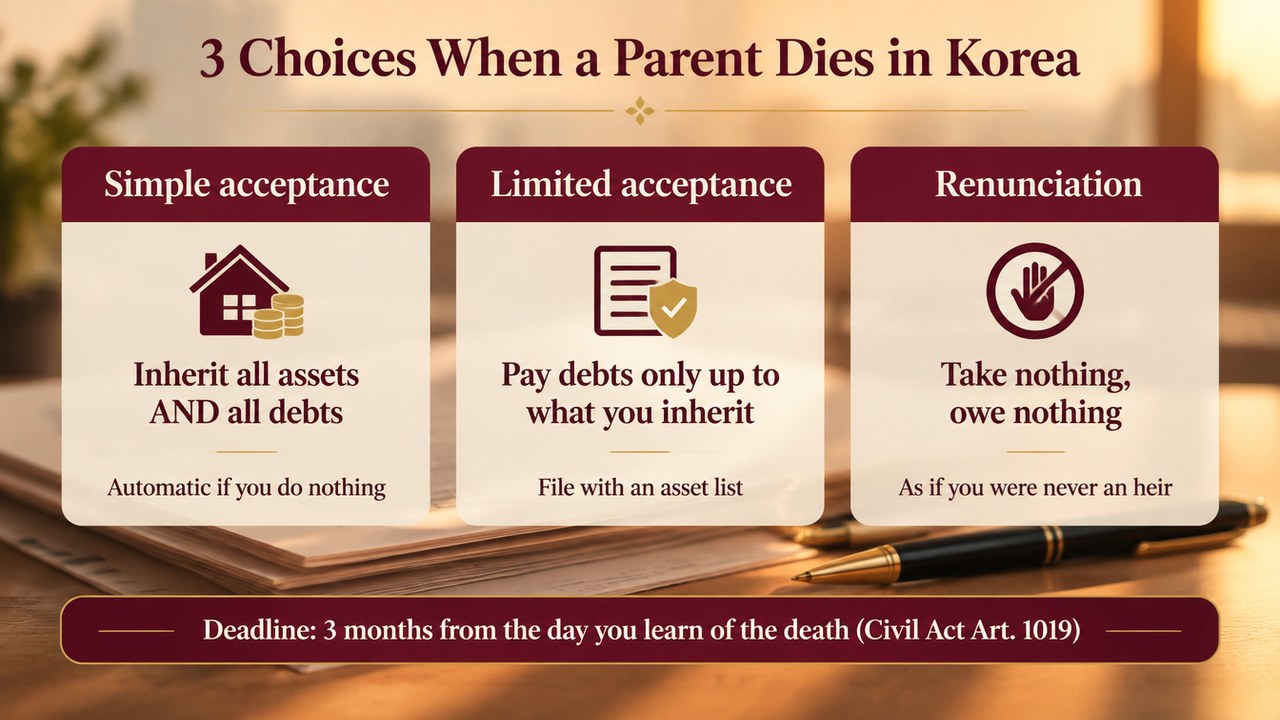
Quick answer: When a parent dies in Korea, each heir has 3 months from the day they learned that the inheritance opened (Civil Act Art. 1019(1)) to choose. Do nothing and you are treated as having accepted everything — assets and debts (Art. 1026). Limited acceptance (한정승인) means you pay the parent’s debts only up to what you inherit; you file with an inventory of the estate (Arts. 1028, 1030). Renunciation (상속포기) means you take nothing and owe nothing, as if you had never been an heir (Arts. 1041–1042). Both are filed with the family court for the parent’s last address, at ₩5,000 in stamps per person plus a service-fee deposit (6 rounds; ₩33,840 at the July-2026 rate, calculated). Selling, spending or collecting the parent’s property before you decide can count as acceptance — so investigate first, touch nothing, and file before the deadline.
If you are in your 40s, 50s or 60s and have just lost a father or mother, the paperwork arrives at the worst time: the funeral, the death registration, the pension office, the bank. Inheritance law adds a quiet clock on top. Korean law does not wait to see whether the estate is in the black. If a parent left a mortgage, a business loan, a guarantee they signed for someone else, or card debt, those debts pass to the heirs together with any savings — unless the heirs act within three months. This guide walks through the three choices, how to count the deadline to the exact day, a worked example with real numbers, what it costs, and the traps that most often catch families.

The three choices the Civil Act gives you
Article 1019(1) of the Civil Act gives every heir three options within the same period: simple acceptance (단순승인), limited acceptance (한정승인) or renunciation (포기).
| Choice | What happens to the parent’s debts | How you do it | Article |
|---|---|---|---|
| Simple acceptance | You take over all rights and duties, so your share of the debts becomes yours — even if it is bigger than your share of the assets | Nothing to file. It also happens automatically if the 3 months pass, or if you dispose of estate property | Arts. 1019, 1026 |
| Limited acceptance | You accept the inheritance on condition that you pay the debts and bequests only up to the value of what you inherit | File with the court within the period, attaching an inventory of the estate; then publish a notice to creditors within 5 days | Arts. 1028, 1030, 1032 |
| Renunciation | You are treated as never having been an heir, back to the moment of death. You get no assets and owe none of the debts | File a renunciation report with the family court within the period | Arts. 1041, 1042 |
Source: Civil Act Arts. 1019, 1026, 1028, 1030, 1032, 1041 and 1042 (law.go.kr, version in force 17 March 2026).
Two practical points follow from the wording. First, simple acceptance is the default: Article 1026(2) says an heir who does not file limited acceptance or renunciation within the Article 1019(1) period is deemed to have accepted. Second, the law lets you investigate the estate before you decide (Art. 1019(2)), so you are not forced to choose blind — but the investigation has to fit inside the same three months, and the court can extend the period only on request (see below).
When the 3 months start — and how to count the last day
The clock runs from the day the heir learned that the inheritance had opened (상속개시 있음을 안 날) — usually the day you learned of the death and that you are an heir — not necessarily the day of death. The Supreme Court’s e-civil-service fee table summarises it for renunciation as “within 3 months of the death”, and one law-practice guide notes that the court’s own pages word it differently from the statute; if the two dates differ for you (for example, you were estranged and heard months later), ask the receiving court which date to write on the form.
Korean law counts months by the calendar with three rules from the Civil Act’s general part:
- Art. 157: the first day is not counted (the period starts the next day).
- Art. 160(2): a period of months ends on the day before the corresponding day in the last month — in practice, the same date three months later.
- Art. 161: if the last day falls on a Saturday or public holiday, the period ends on the next day.
Applying those rules (calculated by us; the court decides in a dispute):
| You learned of the death on | Period runs from | Last day to file | Note |
|---|---|---|---|
| Mon 10 Aug 2026 | 11 Aug 2026 | Tue 10 Nov 2026 | Already passed (as of 13 November 2026) — get legal advice promptly |
| Tue 1 Sep 2026 | 2 Sep 2026 | Tue 1 Dec 2026 | |
| Sun 20 Sep 2026 | 21 Sep 2026 | Mon 21 Dec 2026 | 20 Dec 2026 is a Sunday → moves to Monday (Art. 161) |
| Thu 24 Sep 2026 | 25 Sep 2026 | Thu 24 Dec 2026 | Christmas Day is a holiday, so don’t plan on the 25th |
Calculated from Civil Act Arts. 157, 160 and 161; weekdays checked against the 2026 calendar.
What has to happen inside the period is the filing, not the court’s decision: Articles 1030(1) and 1041 require the heir to report to the court within the period. The court’s acceptance ruling (심판) can arrive later.
Extension. Article 1019(1) lets the family court extend the period on the request of an interested party or a prosecutor. The law does not say by how much, so if the estate is complicated (a business, overseas assets, loans you cannot trace), file the extension request before the three months run out rather than hoping for one afterwards.
A worked example: ₩30 million of savings, ₩80 million of debt
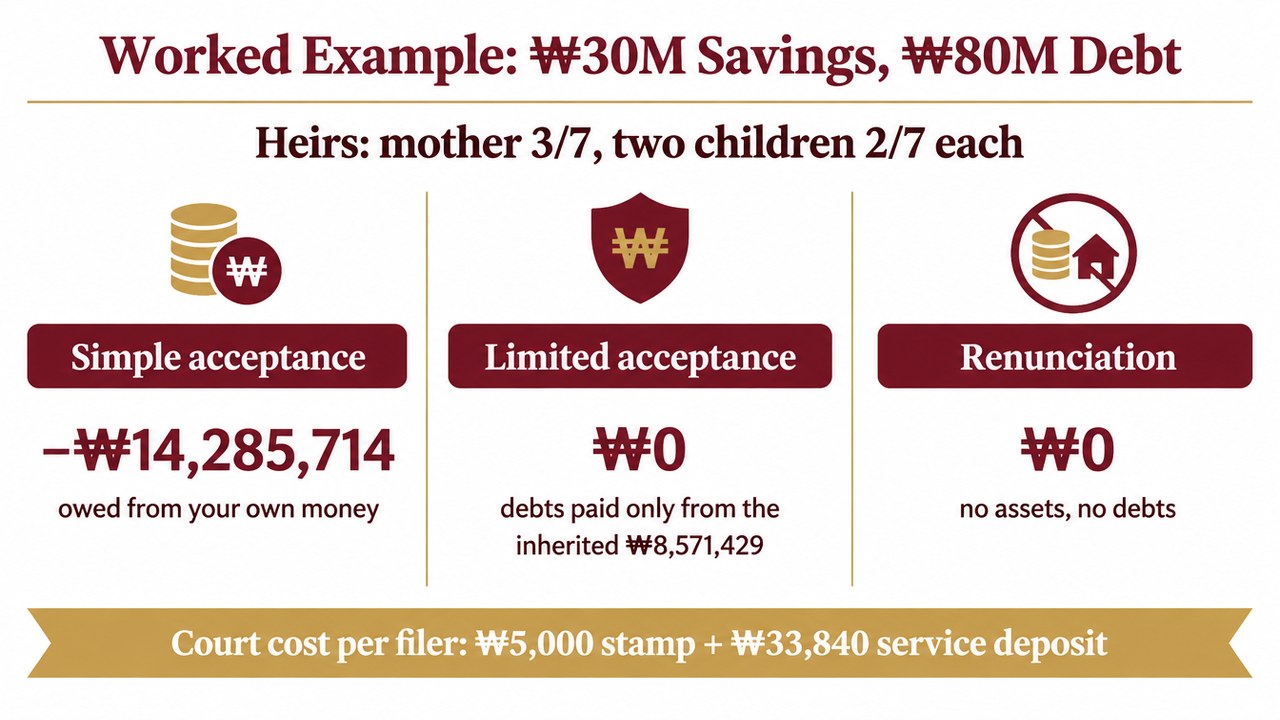
Suppose a father dies in 2026 leaving ₩30,000,000 in deposits and ₩80,000,000 in debts (a business loan and card balances). He is survived by his wife and two adult children, aged 52 and 48.
Who inherits and in what shares. Article 1000 puts the children (lineal descendants) first in line; Article 1003 makes the spouse a co-heir with them. Article 1009 gives same-rank heirs equal shares and adds 50% for the spouse. With two children the ratio is 1.5 : 1 : 1, i.e. 3/7 for the mother and 2/7 for each child.
| Per heir (calculated) | Mother (3/7) | Each child (2/7) |
|---|---|---|
| Share of the ₩30M assets | ₩12,857,143 | ₩8,571,429 |
| Share of the ₩80M debts | ₩34,285,714 | ₩22,857,143 |
| Simple acceptance: net position | −₩21,428,571 | −₩14,285,714 |
| Limited acceptance: most of your own money at risk | ₩0 (debts paid only out of the inherited ₩12.86M) | ₩0 (debts paid only out of the inherited ₩8.57M) |
| Renunciation: assets / debts | ₩0 / ₩0 | ₩0 / ₩0 |
Calculated from Civil Act Arts. 1000, 1003, 1009, 1028 and 1042. Figures rounded to the won. Illustrative family; real estates often include property, insurance and deposits that need separate checking.
Read the table this way: if the family does nothing, each child ends up personally owing about ₩14.3 million more than they received, and the mother about ₩21.4 million — payable from their own salaries and savings. With limited acceptance, creditors are paid from the inherited assets, and the heirs’ own money is protected as long as they follow the procedure. With renunciation, that heir drops out entirely.
Why “who renounces” matters: the 2023 Supreme Court ruling
Renunciation does not make the debt vanish. Under Article 1043, when one of several heirs renounces, that share goes to the remaining heirs in proportion to their shares. Families used to be caught out when all the children renounced but the spouse did not: an older ruling (2015) said the spouse and the grandchildren then became co-heirs, so the debt reached the next generation. On 23 March 2023 the Supreme Court’s full bench (case 2020그42) changed that: if the spouse stays and all the children renounce, the spouse becomes the sole heir, and grandchildren or the deceased’s parents do not join. The facts of that case are the pattern many families use: the widow filed limited acceptance and all four children renounced.
In our example that would mean: the mother files limited acceptance (so the ₩80M is paid only out of the ₩30M estate), the two children renounce, and nobody pays from their own pocket. The ruling also says Article 1043 does not apply when the spouse and all the children renounce — so if everyone in the first line renounces, check with the court or Legal Aid whether the next relatives in line under Article 1000 (for example grandchildren, the deceased’s parents or siblings) now need to file their own renunciation within their own three months. Each new heir’s clock starts when that person learns they have become an heir.

Limited acceptance vs renunciation: how to choose
There is no single right answer, and the choice depends on facts only your family knows. The trade-offs in the law are:
| Question | Limited acceptance | Renunciation |
|---|---|---|
| Do you keep any assets? | Yes — whatever is left after creditors are paid | No |
| Do you need an inventory? | Yes, filed with the report (Art. 1030) | No |
| Work after filing | Notice to creditors within 5 days, claim period of at least 2 months, then pay creditors in proportion (Art. 1032 onward) | Very little once the court accepts |
| Effect on other relatives | You remain an heir, so your share does not pass on | Your share passes to the other heirs (Art. 1043); if everyone in a line renounces, the next line may be called |
| Late discovery of debts | A special limited acceptance is possible within 3 months of learning that debts exceed assets, if you missed it without gross negligence (Art. 1019(3)) | Not available late — Art. 1019(3) allows only limited acceptance |
Sources: Civil Act Arts. 1019(3), 1030, 1032, 1041–1043.
When limited acceptance usually makes sense: when you are not sure whether debts exceed assets, when there is a house or car the family wants to keep if anything is left, or when one heir (often the surviving parent) stays in so the debt does not travel to other relatives. When renunciation is simpler: when the debts clearly exceed the assets and the remaining heirs have a plan (for example, the surviving parent files limited acceptance, as in the 2023 case).
Late-discovered debt. Article 1019(3) — amended in December 2022 — lets an heir who, without gross negligence, did not know within the first three months that debts exceeded assets file limited acceptance within 3 months of finding out. If you already disposed of some estate property, you must also list what you disposed of and its value (Art. 1030(2)). Article 1019(4) adds a separate rule for heirs who were minors: they can file limited acceptance within 3 months of learning the facts after reaching adulthood.
The trap: acting like an owner before you decide
Article 1026(1) says an heir who disposes of estate property is deemed to have accepted. Article 1026(3) adds that hiding estate property, spending it improperly, or deliberately leaving it off the inventory after limited acceptance or renunciation also counts as acceptance. In practice that means: do not sell the parent’s car, cash out their account, collect debts owed to them or transfer property into your name while you are still deciding. Investigating is allowed (Art. 1019(2)); disposing is not. One law-practice guide puts it simply: if debt is a worry, ask the court’s civil-service desk or Legal Aid before you move anything — including withdrawing money from the parent’s account to pay bills.

Step 1: find out what the parent owned and owed — Safe Inheritance (안심상속)
The government’s Safe Inheritance one-stop service lets an heir request, in one application, checks on the deceased’s financial accounts (deposits, loans, insurance, securities, cards), land, buildings, cars, national and local taxes, and pension memberships (National Pension and the public-sector pensions, including loans from them).
| Item | What the official pages say |
|---|---|
| Who can apply online | First-line heirs (children, spouse); second-line heirs (parents, spouse) only when there is no first-line heir |
| Second-line heirs who became heirs because the first line renounced | Visit in person only (not online) |
| Where | Government24 online, or any city/district office or community service centre |
| Deadline | Within 1 year from the last day of the month of death |
| Results | Land, buildings, cars, local tax: within about 7 days; financial, national tax, pensions: within about 20 days (checked on each agency’s site) |
Sources: Government24 Safe Inheritance page; National Tax Service guide to the same service; government policy weekly K-Gonggam (3 March 2026).
The financial result tells you whether accounts and loans exist, at which institution, and rough balances; for decision-level detail you contact each institution. Because results take up to about 20 days, apply in the first weeks so the answer lands well inside your three months. If your parent had a reverse mortgage (주택연금), the house is tied to that loan — our Korea housing pension guide explains how the scheme works, so you know what to ask the lender before deciding.
Step 2: file at the right court, with the right papers and fees
Which court. The family court (or the district court/branch acting as one) for the deceased’s last address — not the court near where you live.
Documents (Supreme Court e-civil-service table for 상속포기·한정승인): the filer’s resident registration and certificate of seal impression (인감증명); basic certificate and family relationship certificate; the deceased’s closed basic certificate (for deaths reported from 2008) or removed register; the deceased’s cancelled resident registration; and, for limited acceptance only, the estate inventory. Courts may ask for more, so call ahead.
Fees per filer (calculated):
| Item | Per person | Three siblings filing | Source |
|---|---|---|---|
| Court stamp (인지) | ₩5,000 (₩4,500 if filed electronically, a 10% e-filing discount) | ₩15,000 | Supreme Court fee table; family-litigation fee rules as summarised by a law firm |
| Service-fee deposit (송달료), 6 rounds | ₩33,840 (6 × ₩5,640 since 1 July 2026) | ₩101,520 | Busan High Court notice; law-practice fee table |
| Total at the court | ₩38,840 paper / ₩38,340 e-filed | ₩116,520 paper | Calculated |
| Newspaper notice (limited acceptance only) | Paid to the newspaper; one law firm quotes from about ₩70,000–80,000 to over ₩200,000 | — | Law firm (single source; ask the newspaper) |
The Supreme Court table still lists ₩31,200 for the service deposit — that is six rounds at the older ₩5,200 rate; the unit rose to ₩5,500 in June 2025 and ₩5,640 from 1 July 2026. Unused service fees are refunded after the case closes.
After filing limited acceptance, Article 1032 requires a public notice to creditors within 5 days of the limited acceptance, giving them at least 2 months to file claims. The court’s table says to publish within 5 days of receiving the decision. Keep every receipt and the decision document (심판문) — creditors and banks will ask for it.
A 10-point checklist for a 40–60 heir
- Write down the date you learned of the death; work out your last filing day with the table above.
- Apply for Safe Inheritance within days of the death registration.
- Do not sell, withdraw, transfer or collect anything that belonged to the parent.
- Gather the parent’s mail: card statements, loan letters, guarantee contracts, tax bills.
- Decide as a family who stays in (often the surviving parent with limited acceptance) and who renounces — the 2023 ruling makes the spouse the sole heir if all children renounce.
- If debts may exceed assets and you cannot tell yet, consider limited acceptance rather than letting the deadline pass.
- Need more time? Request an extension from the family court before the period ends.
- File at the family court for the parent’s last address, with stamps and the service deposit for each filer.
- After limited acceptance, publish the creditor notice within 5 days.
- Ask Legal Aid (132) or the court desk if a relative in the next line may need to file too.
Other money tasks after a parent’s death often overlap with year-end tax: medical bills you paid for a parent may count toward your medical expense tax credit, and if the parent was in long-term care, our long-term care insurance guide explains how those costs were shared.
Frequently asked questions
Q. How long do I have to renounce an inheritance in Korea?
Three months from the day you learned that the inheritance opened — normally the day you learned of the death and that you are an heir (Civil Act Art. 1019(1)). The first day is not counted, the period ends on the same date three months later, and a last day on a Saturday or public holiday moves to the next day. The family court can extend the period on request.
Q. What is the difference between renunciation and limited acceptance?
Renunciation makes you a non-heir from the moment of death: no assets, no debts, and your share passes to the other heirs. Limited acceptance keeps you as an heir but limits your liability for the parent’s debts to the value of what you inherit; you file an estate inventory and must publish a notice to creditors within 5 days.
Q. If all the children renounce, does the debt pass to the grandchildren?
Not if the surviving spouse stays in. Since the Supreme Court’s 23 March 2023 en banc decision (2020그42), when the spouse remains and all the children renounce, the spouse becomes the sole heir. If the spouse and all the children renounce, that ruling does not apply, so ask the court whether the next relatives in line must file their own renunciation.
Q. I found out about my parent’s debt after the 3 months. Is it too late?
Possibly not. Article 1019(3) allows a special limited acceptance within 3 months of learning that the debts exceed the assets, if you did not know within the original period without gross negligence. Renunciation is not available at that stage, and you must list any estate property you already disposed of.
Q. How much does it cost to file with the family court?
Each filer pays ₩5,000 in court stamps (₩4,500 if filed electronically) plus a service-fee deposit of six rounds — ₩33,840 at the ₩5,640 rate in force since 1 July 2026 — so about ₩38,840 per person on paper. Limited acceptance also needs a newspaper notice paid to the newspaper. Lawyer or judicial scrivener fees are extra if you use one.
Sources
- Civil Act, Art. 1019 (3-month period; extension; investigation; late and minor heirs’ limited acceptance), law in force 17 March 2026 — https://www.law.go.kr/LSW/lsLinkProc.do?joNo=101900&lsNm=%EB%AF%BC%EB%B2%95&mode=11 (confirmed 10 November 2026)
- Civil Act, Art. 1026 (deemed simple acceptance) — https://www.law.go.kr/LSW/lsLinkProc.do?joNo=102600&lsNm=%EB%AF%BC%EB%B2%95&mode=11 (confirmed 10 November 2026)
- Civil Act, Arts. 1028 and 1030 (limited acceptance; inventory) — https://www.law.go.kr/LSW/lsLinkProc.do?joNo=102800&lsNm=%EB%AF%BC%EB%B2%95&mode=11 and https://www.law.go.kr/LSW/lsLinkProc.do?joNo=103000&lsNm=%EB%AF%BC%EB%B2%95&mode=11 (confirmed 10 November 2026)
- Civil Act, Art. 1032 (notice to creditors within 5 days, period of at least 2 months) — https://www.law.go.kr/LSW/lsLinkProc.do?joNo=103200&lsNm=%EB%AF%BC%EB%B2%95&mode=11 (confirmed 10 November 2026)
- Civil Act, Arts. 1041, 1042, 1043 (renunciation filed with the family court; retroactive effect; share passes to other heirs) — https://www.law.go.kr/LSW/lsLinkProc.do?joNo=104100&lsNm=%EB%AF%BC%EB%B2%95&mode=11 , https://www.law.go.kr/LSW/lsLinkProc.do?joNo=104200&lsNm=%EB%AF%BC%EB%B2%95&mode=11 , https://www.law.go.kr/LSW/lsLinkProc.do?joNo=104300&lsNm=%EB%AF%BC%EB%B2%95&mode=11 (confirmed 10 November 2026)
- Civil Act, Arts. 1000, 1003, 1009 (order of heirs; spouse; statutory shares) — https://www.law.go.kr/LSW/lsLinkProc.do?joNo=100000&lsNm=%EB%AF%BC%EB%B2%95&mode=11 , https://www.law.go.kr/LSW/lsLinkProc.do?joNo=100300&lsNm=%EB%AF%BC%EB%B2%95&mode=11 , https://www.law.go.kr/LSW/lsLinkProc.do?joNo=100900&lsNm=%EB%AF%BC%EB%B2%95&mode=11 (confirmed 10 November 2026)
- Civil Act, Arts. 157, 160, 161 (counting periods; weekends and holidays) — https://www.law.go.kr/LSW/lsLinkProc.do?joNo=015700&lsNm=%EB%AF%BC%EB%B2%95&mode=11 , https://www.law.go.kr/LSW/lsLinkProc.do?joNo=016000&lsNm=%EB%AF%BC%EB%B2%95&mode=11 , https://www.law.go.kr/LSW/lsLinkProc.do?joNo=016100&lsNm=%EB%AF%BC%EB%B2%95&mode=11 (confirmed 10 November 2026)
- Supreme Court e-civil-service centre, “첨부서류 – 가사비송절차” (documents, ₩5,000 stamp per filer, court of the deceased’s last address, 5-day newspaper notice) — https://www.scourt.go.kr/nm/min_3/min_3_10/min_3_10_3/index.html (confirmed 10 November 2026)
- Supreme Court, en banc decision of 23 March 2023, 2020그42 (spouse becomes sole heir when all children renounce) — https://www.scourt.go.kr/supreme/news/NewsViewAction2.work?gubun=4&seqnum=9115 (confirmed 10 November 2026)
- Busan High Court, “1회 송달료 기준금액 인상 안내”, 30 June 2026 (₩5,500 → ₩5,640 from 1 July 2026) — https://bsgodung.scourt.go.kr/dcboard/new/DcNewsViewAction.work?gubun=41&seqnum=20455 (confirmed 10 November 2026)
- Government24, “안심상속” Safe Inheritance one-stop service (who can apply, deadline) — https://www.gov.kr/portal/onestopSvc/safeInheritance (confirmed 10 November 2026)
- National Tax Service, guide to the Safe Inheritance one-stop service (information provided, eligibility) — https://www.nts.go.kr/nts/cm/cntnts/cntntsView.do?cntntsId=7725&mi=7711 (confirmed 10 November 2026, search extract)
- K-Gonggam (government policy weekly), “안심상속 원스톱 서비스”, 3 March 2026 (result times 7 / 20 days) — https://gonggam.korea.kr/newsContentView.es?mid=a12602000000&news_id=75888cdc-0cf2-4061-a279-a25dde78d7e6§ion_id= (confirmed 10 November 2026, search extract)
- Independent: Sinwoo judicial scriveners, “법원 송달료 1회분 5,640원으로 인상” (renunciation/limited acceptance = 6 rounds per party, ₩33,840) — https://korea.legal/%ec%8b%a4%eb%ac%b4%ec%9e%90%eb%a3%8c/%eb%b2%95%ec%9b%90-%ec%86%a1%eb%8b%ac%eb%a3%8c-1%ed%9a%8c%eb%b6%84-5640%ec%9b%90%ec%9c%bc%eb%a1%9c-%ec%9d%b8%ec%83%81-2026-07-01/ (confirmed 10 November 2026)
- Independent: colaydle, “상속포기·한정승인 신청 순서: 3개월 기산일, 내는 법원, 인지 5,000원” (statute-by-statute walkthrough; e-filing 9/10 stamp rule) — https://colaydle.com/inheritance-renounce-how-to/ (confirmed 10 November 2026)
- Independent: Kangho law firm, “상속포기·한정승인 비용” (₩4,500 e-filed stamp; newspaper notice price range) — https://www.oh-law.co.kr/inheritance/fee/ (confirmed 10 November 2026, search extract)
This article is general information, not legal or tax advice. Inheritance outcomes depend on the full family tree, the estate and the exact dates. Before you file — and before you touch any of the deceased’s property — confirm your case with the family court’s civil-service desk or the Korea Legal Aid Corporation (132).