Korea Long-Term Care Grade Appeal: How to Object After a Parent’s Notice, and When to Ask for Re-assessment Instead
Haesul Travel & Living desk (AI-assisted). As of 8 November 2026 (KST), based on the Long-Term Care Insurance Act on law.go.kr (in force 26 May 2026), the Enforcement Decree (in force 12 May 2026), the Enforcement Rule as published in the NHIS statute viewer, EasyLaw (Ministry of Government Legislation), the Ministry of Health and Welfare long-term care re-review committee page (last updated 31 March 2026), NHIS application pages, and the official review-request form (Form 32). This is general information, not legal, financial or benefits advice. Confirm the deadline printed on the notice you received, or with the National Health Insurance Service (NHIS) on 1577-1000, before you file.
Quick answer: If you disagree with a parent’s Korea long-term care grade — or with a denial — the legal step is a review request (심사청구) to NHIS. Many families, and some official pages, still call this an objection (이의신청). You generally have 90 days from the day you became aware of the decision, and you cannot file once 180 days have passed since the decision was made, unless you can prove a justifiable reason for missing the window. This is not the same as a grade-change application when your parent’s condition later changes, or an ordinary renewal before the certificate expires.
The notice that arrives after the grading committee meets is a decision you can live with, or a decision you can challenge. For how grades work, who can apply the first time and what a grade pays for in 2026, start with our Korea long-term care insurance grade guide. This post stays on the next question: what a son or daughter in their 40s, 50s or 60s should do when the result is a denial, or a lighter grade than the family expected.

Appeal, grade-change or renewal — three different tracks
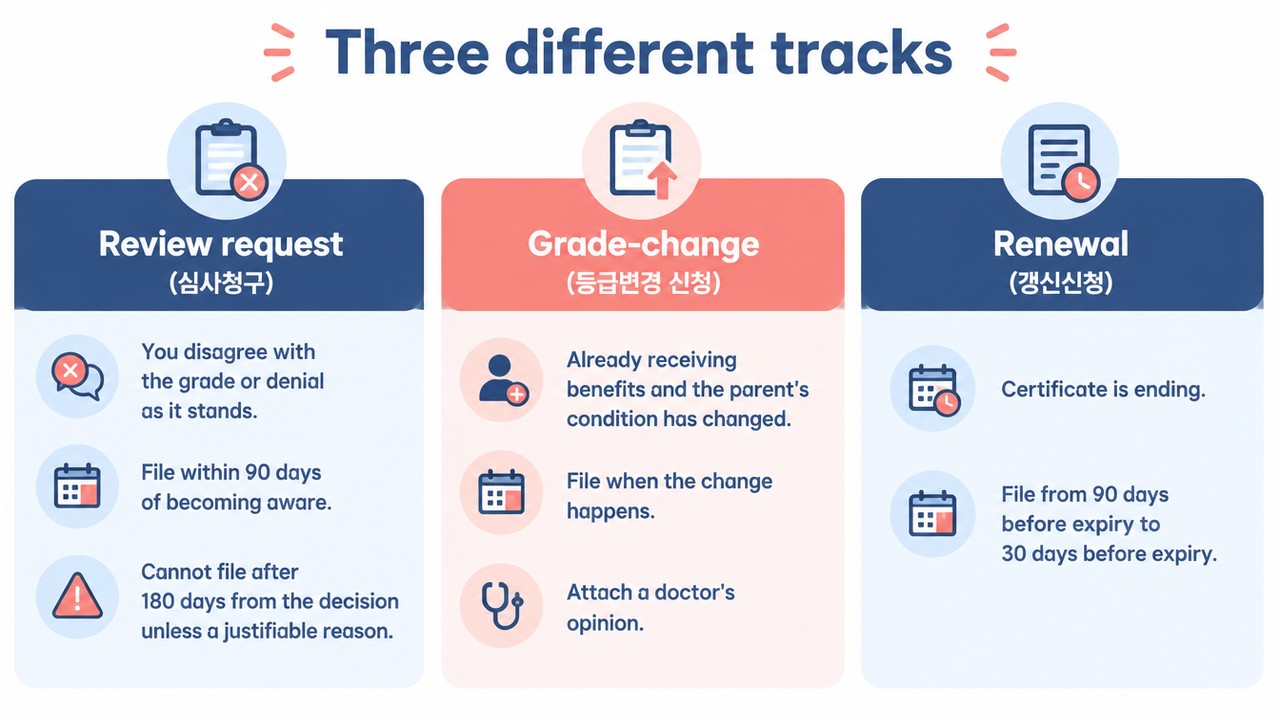
Families often search for “이의신청”, “재신청” or “재평가” as if they were one procedure. They are not. The statute and the NHIS long-term care site keep them apart.
| What you want | Official name | When it is the right track | Where the rule lives |
|---|---|---|---|
| You disagree with the grade (or the denial) as it stands — the home visit missed night-time wandering, the doctor’s notes were thin, the facts at the time were not reflected | Review request (심사청구). Older everyday language, and some official headings, still say objection (이의신청) | From the day you became aware of the decision, generally within 90 days; you cannot file once 180 days have passed since the decision was made, unless you prove a justifiable reason | Long-Term Care Insurance Act art. 55; EasyLaw appeal page |
| Your parent already receives long-term care benefits, and their physical or mental state has changed since then | Grade-change application (등급변경 신청) | When the change happens — there is no 90-day clock of the kind that applies to an appeal | Act art. 21; Enforcement Rule art. 9; longtermcare.or.kr application-types table |
| The certificate is about to expire and you want benefits to continue | Renewal (갱신신청) | File in the window that runs from 90 days before expiry to 30 days before expiry (see the note below) | Act art. 20; Enforcement Rule art. 8; longtermcare.or.kr table |
| You want a different mix of services (home care versus a facility, for example), not a new grade | Change of benefit type or content (급여종류·내용 변경 신청) | When that reason arises; a fact-confirmation statement is added if NHIS asks for one | longtermcare.or.kr application-types table; Act art. 21 |
A few sources blur these lines, and it is worth saying so plainly.
“이의신청” versus “심사청구”. Until 11 December 2019 the first challenge to an NHIS decision was called an objection (이의신청). Act No. 15881, promulgated on 11 December 2018 and in force one year later, renamed that step a review request (심사청구) and renamed the next step a re-review request (재심사청구). Pending cases were carried over under the new names (supplementary provision art. 9 of that amendment). EasyLaw still titles its explainer “이의신청” even though the body correctly tells you to file a 심사청구. The Ministry of Health and Welfare (MOHW) flowchart also uses both words side by side. At an NHIS operations centre you may still hear staff say 이의신청. The current statutory form, revised on 12 June 2019, is headed 심사청구서 (Form 32).
“재신청” and “재평가”. The official types table on longtermcare.or.kr lists first recognition, renewal, grade-change and benefit-type change. It does not list a separate track called 재평가 (re-evaluation). The same page does use 재신청 in one narrower sentence: people under 65 cannot apply online for a first application or a re-application (최초, 재신청), and neither can foreigners. That “re-application” is not the appeal, and it is not the grade-change route for someone who is already a beneficiary. In practice it describes applying again — for example after a denial, or after an earlier recognition has ended without going through the renewal window. EasyLaw’s own renewal-and-change table also slips: the first-application row tells readers to “file a change application,” which is copy-paste language from the change rows below it. If a helper at a community centre says “just reapply,” ask whether they mean a review request, a grade-change application, or a brand-new recognition application.
The 90-day (and 180-day) clock
Article 55 of the Act is the rule that matters once the notice is in your hands.
- A person who objects to an NHIS disposition on long-term care recognition, grade, benefits, unjust enrichment, benefit costs or premiums may file a review request with NHIS.
- The request must be made in a document (including an electronic document under the Electronic Government Act) within 90 days of the day the person became aware that the disposition existed.
- The request cannot be filed once 180 days have passed since the disposition was made, unless the person proves they could not file in time for a justifiable reason.
EasyLaw restates the same 90-day / 180-day pair. Form 32 asks you to write “the day the disposition existed (or was delivered),” which is usually the day the notice reached the household. Check that date on the letter, and ask NHIS on 1577-1000 or the operations centre named in the notice to confirm the last calendar day you can file. Period-counting rules (including public holidays) sit in other statutes this desk has not reconstructed here, so treat the dates below as a planning illustration.
Worked timeline (planning illustration)
Suppose the grade notice is delivered on 10 September 2026, and that is also the day the family becomes aware of the decision.
| Step | What happens | Timing in the statute or rule | In this illustration |
|---|---|---|---|
| 1. Notice arrives | NHIS sends the grade (or a denial with reasons) | After the grading committee decides. A first-time decision itself is supposed to be finished within 30 days of the original application, extendable by up to 30 days — that 30-day period is not the appeal deadline | 10 September 2026 |
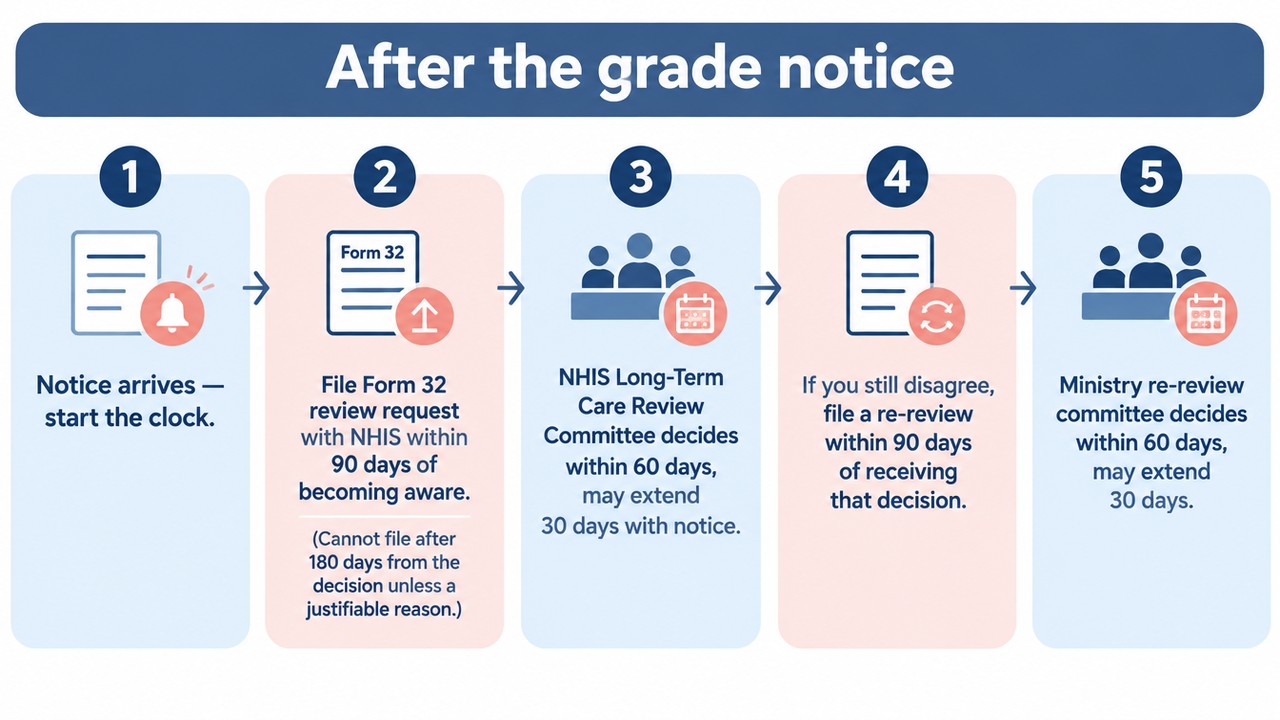
| 2. File the review request | Submit Form 32 plus documents that support what you are arguing | Within 90 days of becoming aware, and before 180 days have passed since the decision was made | Plan to file well before mid-December 2026; confirm the last day with NHIS |
| 3. NHIS reviews | The Long-Term Care Review Committee examines the request | NHIS must decide within 60 days of receiving the request, and may extend that by up to 30 days if unavoidable, telling you the reason and the extra period | A decision letter could arrive about two months later, or up to about three if extended |
| 4. If you still disagree | File a re-review request with MOHW’s Long-Term Care Re-review Committee | Within 90 days of receiving the review-decision notice | Count 90 days from the day that second letter arrives |
| 5. Re-review decision | The re-review committee decides | Within 60 days of receiving the re-review request, extendable by up to 30 days with notice | Another two to three months |
| 6. Still unresolved | Administrative lawsuit under the Administrative Litigation Act | Article 57 allows a lawsuit against the original NHIS decision or against a review or re-review decision. You are not required to finish the review steps before going to court | Ask a lawyer about court deadlines; they are separate from the 90-day review clock |
Families sometimes hear “you have 30 days.” That figure belongs to other parts of the system: NHIS is supposed to finish the original grade decision within 30 days of the application, and a renewal must be completed by 30 days before the certificate expires. It is not the deadline in article 55. If someone at a counter quotes 30 days for an objection, show them the notice and ask them to check article 55.
How to file the review request
Enforcement Rule article 39 is short and specific. A person who wants to challenge an NHIS disposition submits Form 32, the review-request form (심사청구서), to NHIS, attaching documents that can prove the facts they assert. NHIS must then send a copy to interested parties without delay. When the committee has decided, NHIS writes a review decision (심사결정서, Form 33) and sends the original to the person who filed and a copy to interested parties.
The current Form 32 (revised 12 June 2019) is addressed to the chairperson of NHIS. It asks for:
- The name, resident-registration number, address and telephone number of the applicant — the person who received the disposition (your parent).
- A summary of the disposition, including which NHIS regional headquarters or branch issued it.
- The date the notice was received.
- The purpose and reasons for the review request — what you want NHIS to decide, and the legal and factual grounds.
The form has a separate agent (대리인) block for name, resident-registration number, relationship to the applicant, address and telephone number, so an adult child can file on a parent’s behalf. Article 22 of the Act lets family members, relatives or other interested people act as agents for recognition, renewal and grade-change applications “and the like.” For a review request, Form 32 itself is the clearer written authority. Ask the operations centre named on the notice what identification and relationship documents they want to see.
Where to file. Article 39 says to submit the form “to the Corporation” — NHIS — not to the district office, the community centre (행정복지센터) or a public health centre. The recognition-application pages spell out visit, post, fax, internet and (for renewals only) telephone; the review-request rule does not repeat that menu. The Act does allow an electronic document. The practical starting point is the NHIS long-term care operations centre that issued the notice, by visit or by post, after you have asked that centre or 1577-1000 whether they will also accept a fax or an electronic filing in your case. This desk did not find a dedicated public online window for the first-level review request that matches the re-review site described below.
Supporting documents. The rule does not publish a fixed checklist. It asks for documents that can prove the facts you assert — extra medical notes about daily function, a written account of nights, bathing, toileting, falls or behaviour that a short daytime visit may not have shown, or pages from the original file you think were incomplete. Write those facts into box ④ of the form; the instructions say this is where you state what you want decided and why.
Fees. Neither the Act, the Enforcement Rule nor Form 32 lists a filing fee for the review request. That is not the same as a published “free of charge” notice. Ask the operations centre if any copying or postage costs apply in your case.

What happens after you file
Enforcement Decree article 22 gives NHIS 60 days from the day it receives the review request to decide. If circumstances make that impossible, it may add up to 30 days and must promptly tell you the reason and the extra period. Form 32 prints the same 60-day processing time at the top.
The review is not a second home visit you book yourself, and it is not the original grading committee meeting again under another name. Article 55 places a Long-Term Care Review Committee inside NHIS, with a chairperson and up to 50 members. Under the Enforcement Decree, the chairperson is an NHIS standing director who handles long-term care work; members include doctors, dentists or Korean-medicine doctors, nurses and social workers with at least ten years’ experience, NHIS officers, and legal or long-term care specialists. A sitting is the chairperson plus six designated members — seven people — and it decides by a majority of those present after a majority have attended.
You will know the result from the 심사결정서. Read it end to end. This desk did not find an official public page that lists the decision labels (accepted, dismissed, and so on) in plain language, so we are not inventing them: the letter itself is the outcome.
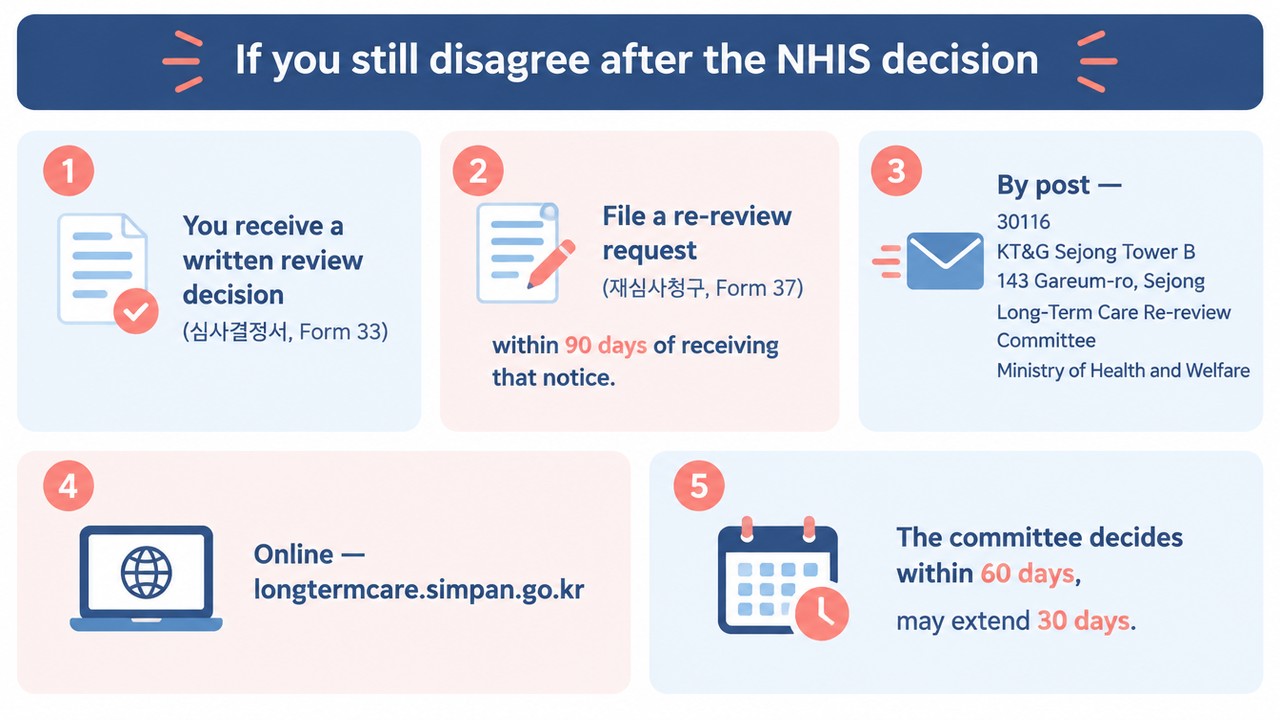
If you disagree with that letter, article 56 gives you 90 days from the day you receive the decision notice to file a re-review request (재심사청구) with the Long-Term Care Re-review Committee, which sits under the Minister of Health and Welfare. The committee has a chairperson and up to 20 members; more than half of the members must not be public officials. MOHW’s committee page (last updated 31 March 2026) says you file:
- By post to 30116, KT&G Sejong Tower B, 143 Gareum-ro, Sejong, Long-Term Care Re-review Committee, Ministry of Health and Welfare
- Online at longtermcare.simpan.go.kr
- Using Form 37, the re-review request form (Enforcement Rule art. 40)
Article 40 of the Enforcement Rule tells you what Form 37 must contain: the claimant’s and the disposition recipient’s name, resident-registration number and address; the claimant’s relationship if they are not the recipient; the day the review decision was received; a summary of that decision; the purpose and reasons for the re-review; and whether NHIS informed you of the re-review right. Attach documents that support your claim. The committee sends a copy to NHIS, and NHIS has 10 days to file an answer and the related papers. The committee then has 60 days to decide, extendable by up to 30 days with notice (Enforcement Decree art. 27). MOHW’s page lists the division telephone number as 044-202-3497.
Two further paths sit beside this ladder.
- You may go to court without finishing the review steps. Article 57 says a person who objects to the original NHIS disposition, or who disagrees with a review or re-review decision, may file an administrative lawsuit under the Administrative Litigation Act. MOHW’s flowchart says the same: you can file a lawsuit without going through the objection or the review request.
- After a re-review, you cannot also file an administrative appeal (행정심판) under the Administrative Appeals Act. Article 56-2 says the Administrative Appeals Act applies to the re-review procedure itself, and that once the re-review is finished you may not file a separate administrative appeal on the same matter.
Court deadlines are their own subject. Do not treat the 90-day review clock as the lawsuit deadline.
If your parent’s condition has changed: the grade-change application
An appeal argues that the decision was wrong on the facts as they were. A grade-change application argues that the facts are no longer the same.
Article 21 says a beneficiary who is already receiving long-term care benefits and who wants the grade — or the type or content of benefits — changed must apply to NHIS. The same recognition and grading procedure then applies again (article 21(2) applies articles 12 to 19). Enforcement Rule article 9 tells you to file the change-application form (the same statutory Form 1-2 family used for recognition and renewal) and, when the request is for a grade change, to attach a doctor’s opinion. The longtermcare.or.kr types table puts it in everyday language: file a grade-change application when the reason arises, during a period when the person is receiving benefits and their physical or mental state has changed.
That is the track for a parent who already has a grade and then has a stroke, a sharp decline in walking or toileting, or a clear worsening of dementia-related behaviour weeks or months after the notice. It is not a way around a missed 90-day appeal deadline, and it is not available to someone who was never recognised as a beneficiary. A person who was denied a grade and whose condition later changes would file a new recognition application (the “재신청” of the under-65 online-filing sentence), not a grade-change application.
Family members can file this application as agents under article 22, on the same basis as a first application or a renewal: the older person, a family member, relative or other interested person, a social-welfare official, the head of a dementia relief centre if the applicant has dementia, or a person designated by the mayor, county head or district head.
Ordinary renewal before the certificate expires
Renewal is calendar work, not an argument about the last decision.
Article 20 says a beneficiary who wants benefits to continue after the validity period ends must apply to NHIS for a renewal, and that the renewal application must be completed by 30 days before the expiry date. Enforcement Rule article 8 then sets the filing window: submit the renewal application form plus a doctor’s opinion from 90 days before expiry until 30 days before expiry. The longtermcare.or.kr types table uses the same 90-to-30-day window. EasyLaw’s prose follows the Act (“by 30 days before expiry”) and cites both the Act and the NHIS site; it does not repeat the 90-day starting point in that sentence. The safest reading, using both official texts, is: start from 90 days before the expiry date printed on the certificate, and finish by 30 days before.
Two extras on the NHIS and longtermcare pages are easy to miss:
- If NHIS, while doing its ordinary work, confirms that the beneficiary intends to renew, the renewal is treated as having been filed — the doctor’s opinion must still be submitted (Enforcement Rule art. 8(2)).
- A renewal may be filed by telephone after the caller’s identity is checked. NHIS says telephone filing is available for renewals only. People under 65 making a first application or a re-application, and foreigners, cannot use the internet or the app.
Look at the expiry date on the long-term care certificate itself. The Act says the validity period is at least one year and is set by presidential decree; the grading committee may lengthen or shorten it, within limits set in the decree. This post does not restate those decree figures, because families should work from the date printed on their own certificate rather than from a general table.
Three family scenarios
Min-seo, 52, whose mother was given a lighter grade than the family expected. The NHIS visit was in the early afternoon. Mother was alert and keen to show she could walk to the bathroom. The visit did not capture night-time wandering or the help she needs to bathe. Min-seo disagrees with the grade as it stands, so she files a review request well inside the 90-day window, names the issuing branch on Form 32, and attaches a recent specialist note plus a written account of a typical night and bath. She does not file a grade-change application: nothing about her mother’s condition has changed since the visit. The condition was already there; the decision, in the family’s view, did not reflect it.
Jun-ho, 58, whose father was denied a grade. If he believes the reasons in the denial letter are wrong, he uses the same review request and the same 90-day / 180-day clock. If months pass, the window closes, and his father’s walking and toileting then clearly worsen, the next official door is a new recognition application — not a grade-change application (his father is not a current beneficiary) and not a late appeal unless he can prove a justifiable reason for missing the deadline.
Hye-jin, 47, whose father already has a grade and then has a stroke. Six months after the notice he can no longer transfer from bed to chair without two people. That is not an argument that last spring’s grade was wrong. It is a grade-change application, filed when the change happened, with a doctor’s opinion attached. Separately, she puts the certificate’s expiry date in her calendar so the renewal is filed in the 90-to-30-day window.
If you are also lining up your parent’s other later-life paperwork, our guide to the Korea Basic Pension in 2026 covers the separate income-tested pension for people aged 65 and over. Readers who are themselves approaching retirement, and who are sorting their own NHIS status while they help a parent, may want our note on health insurance voluntary continuation after retirement.
Frequently asked questions
Q. How long do I have to appeal a Korea long-term care grade?
Under article 55 of the Long-Term Care Insurance Act, file a review request (심사청구) with NHIS within 90 days of the day you became aware of the decision. You cannot file once 180 days have passed since the decision was made, unless you prove you could not file in time for a justifiable reason. EasyLaw restates the same pair of deadlines. Confirm the last day with the notice and with NHIS on 1577-1000. The 30-day figure that families sometimes hear is the time NHIS has to finish the original grade decision, or the “complete a renewal by 30 days before expiry” rule — it is not the appeal deadline.
Q. What is the difference between an appeal and a grade-change application?
An appeal (심사청구, still often called 이의신청) challenges the decision as it was made. A grade-change application (등급변경 신청) is for a person who is already receiving benefits and whose physical or mental state has changed since then. Article 21 and Enforcement Rule article 9 require a change-application form and, for a grade change, a doctor’s opinion. The longtermcare.or.kr types table says to file when the change arises. Someone who was denied a grade is not yet a beneficiary, so a later new application is a recognition application (sometimes called 재신청 on the NHIS site), not a grade-change.
Q. Who can file the review request and where do I submit it?
The applicant on Form 32 is the person who received the disposition — your parent. The form includes an agent section, so an adult child can file on their behalf. Submit the form and supporting documents to NHIS (Enforcement Rule art. 39), practically the long-term care operations centre named on the notice, after confirming whether that centre will take a visit, a posted packet or an electronic document. Do not assume the district office or community centre can accept it. NHIS’s general number is 1577-1000.
Q. What happens if the appeal does not change the grade?
You will receive a written review decision (심사결정서, Form 33). If you disagree, you have 90 days from the day you receive that notice to file a re-review request with the Long-Term Care Re-review Committee at the Ministry of Health and Welfare (Act art. 56), using Form 37, by post to the Sejong address on the MOHW page or online at longtermcare.simpan.go.kr. That committee also has 60 days to decide, extendable by 30 days. You may instead, or later, file an administrative lawsuit (Act art. 57). After a re-review is finished you cannot also file a separate administrative appeal under the Administrative Appeals Act (art. 56-2).
Q. When should we renew instead of appealing?
Renew if the certificate is approaching its expiry date and you want benefits to continue, even if you were content with the grade. File the renewal application and a doctor’s opinion from 90 days before expiry until 30 days before expiry (Enforcement Rule art. 8 and the longtermcare.or.kr table). The Act itself says the renewal must be completed by 30 days before expiry. NHIS may accept a renewal by telephone after checking the caller’s identity. A renewal is not a substitute for an appeal, and an appeal is not a substitute for watching the expiry date.
Sources
- Korean Law Information Center (law.go.kr), Long-Term Care Insurance Act, arts. 17, 19–22, 55–57 and 56-2 (in force 26 May 2026; confirmed 8 November 2026)
- Korean Law Information Center (law.go.kr), Enforcement Decree of the Long-Term Care Insurance Act, arts. 22, 23, 24 and 27 (in force 12 May 2026; confirmed 8 November 2026)
- National Health Insurance Service statute viewer, Enforcement Rule of the Long-Term Care Insurance Act, arts. 8, 9, 39 and 40 (confirmed 8 November 2026)
- Korean Law Information Center, Enforcement Rule Form 32, Review Request (별지 제32호서식 심사청구서) (revised 12 June 2019; confirmed 8 November 2026)
- EasyLaw / Ministry of Government Legislation, Objection to a long-term care grade decision (confirmed 8 November 2026)
- EasyLaw / Ministry of Government Legislation, Applying for and investigating long-term care recognition (confirmed 8 November 2026)
- Ministry of Health and Welfare, Long-Term Care Re-review Committee (page last updated 31 March 2026; confirmed 8 November 2026)
- NHIS long-term care site, Recognition procedure and application types (confirmed 8 November 2026)
- National Health Insurance Service, Long-term care recognition application (confirmed 8 November 2026)