Korea Cervical Cancer Screening: Free Pap Smear Every 2 Years, What the Result Categories Mean and Where the HPV Test Fits
Haesul Health desk (AI-assisted). As of 8 November 2026 (KST), based on the National Health Insurance Service (NHIS) cancer screening table, the National Cancer Center (NCC) national cancer screening programme and National Cancer Information Center pages, the Ministry of Health and Welfare (MOHW) cancer screening result criteria (Annex 2, 2026 version), a public health centre guide, Seoul National University Hospital’s medical library, and reporting on the HPV debate. This is general information, not medical advice. Talk to a doctor about your own results and symptoms.
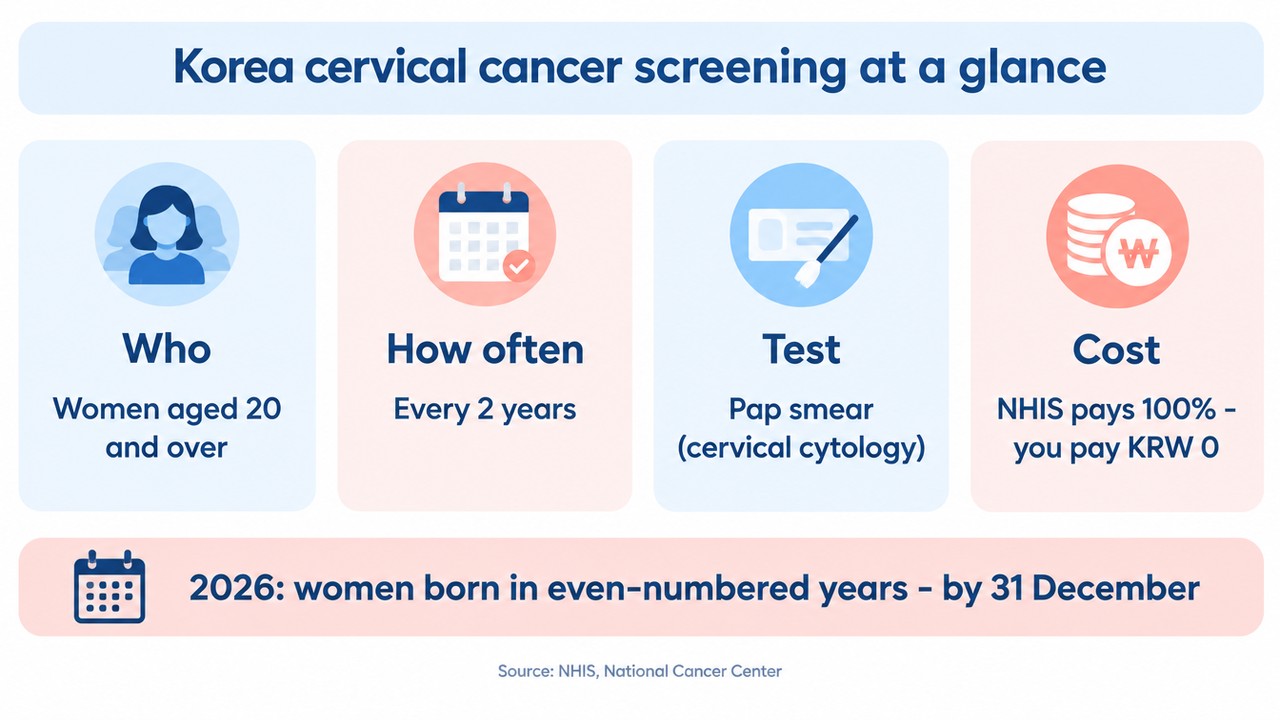
Quick answer: Korea’s national cervical cancer screening (국가 자궁경부암검진) is for women aged 20 and over, once every 2 years, using a Pap smear (cervical cytology). NHIS pays the full cost, so the screening itself is free for eligible women, whatever their premium level. In 2026 the invitation goes to women born in even-numbered years, and it must be used by 31 December. An HPV test is not part of the national programme in 2026; clinics may offer it as an optional extra that you usually pay for. Results come back in five categories, from “normal” to “unsatisfactory, repeat the test”.
Cervical screening is the national cancer check that starts earliest, at 20, and it is one of only two (with colon screening) that NHIS pays for in full. It is also one that many women in their 40s, 50s and 60s let slide once they are past childbearing years, even though the programme has no upper age limit in the NHIS table. If you are already planning your other year-end checks, our Korea national health checkup by age guide lists what else may be due.

Who is eligible and how often
The NHIS cancer screening table and the NCC programme page give the same core facts:
| Item | National programme rule |
|---|---|
| Who | Women aged 20 and over (no upper age is listed in the NHIS table) |
| Interval | Every 2 years |
| Test | Cervical cytology, the Pap smear (자궁경부세포검사) |
| Reported by | A pathologist, using the Bethesda System, according to the National Cancer Information Center |
| Cost | NHIS pays 100% for cervical and colorectal screening; other cancers are 90% NHIS / 10% you |
| Who issues the invitation | NHIS, based on your birth year (even years in even years, odd years in odd years) |
Two details are worth knowing. First, the professional guideline is slightly different from the programme. The 2015 national screening recommendation drawn up by the Korean Society of Gynecologic Oncology and the NCC, as shown on the National Cancer Information Center site, recommends screening women 20 and over every 3 years, with a Pap smear or liquid-based cytology, and a Pap plus HPV test as an optional approach. The state programme is more generous: it pays every 2 years. Second, cost is the same for everyone. For most other cancers, only people in the lowest 50% of premiums and Medical Aid recipients pay nothing, but for cervical screening NHIS covers the whole fee.
Is it your year? A birth-year check for 2026
A public health centre guide (Incheon Geomdan-gu) puts the rule plainly: in odd years, people born in odd years are invited, and in even years, people born in even years. The screening period runs to the end of the year. Yonhap’s 8 October 2026 report of NHIS guidance confirms that this year’s general checkup targets are those born in even-numbered years.
| Born in | Age in 2026 | Invited in 2026? | Next routine invitation |
|---|---|---|---|
| 2006 | 20 | Yes (even year) | 2028 |
| 1986 | 40 | Yes | 2028 |
| 1981 | 45 | No (odd year) | 2027 |
| 1976 | 50 | Yes | 2028 |
| 1971 | 55 | No | 2027 |
| 1966 | 60 | Yes | 2028 |
| 1961 | 65 | No | 2027 |
Our table, applying the even/odd rule to the 20+ age limit (age here is 2026 minus your birth year). If you were invited in 2025 and missed it, NHIS told Yonhap that people who missed last year’s national checkup can ask to be added until 31 December 2026; call NHIS on 1577-1000 to check your own record.
What happens at the appointment
A Pap smear is short. A doctor collects cells from the surface of the cervix with a small brush or spatula, and the sample goes to a lab where a pathologist looks at the cells under a microscope. The National Cancer Information Center describes the test as simple, painless and cheap, and gives these practical tips:
- Timing: avoid your period if possible; days 10 to 20 after your period starts are best.
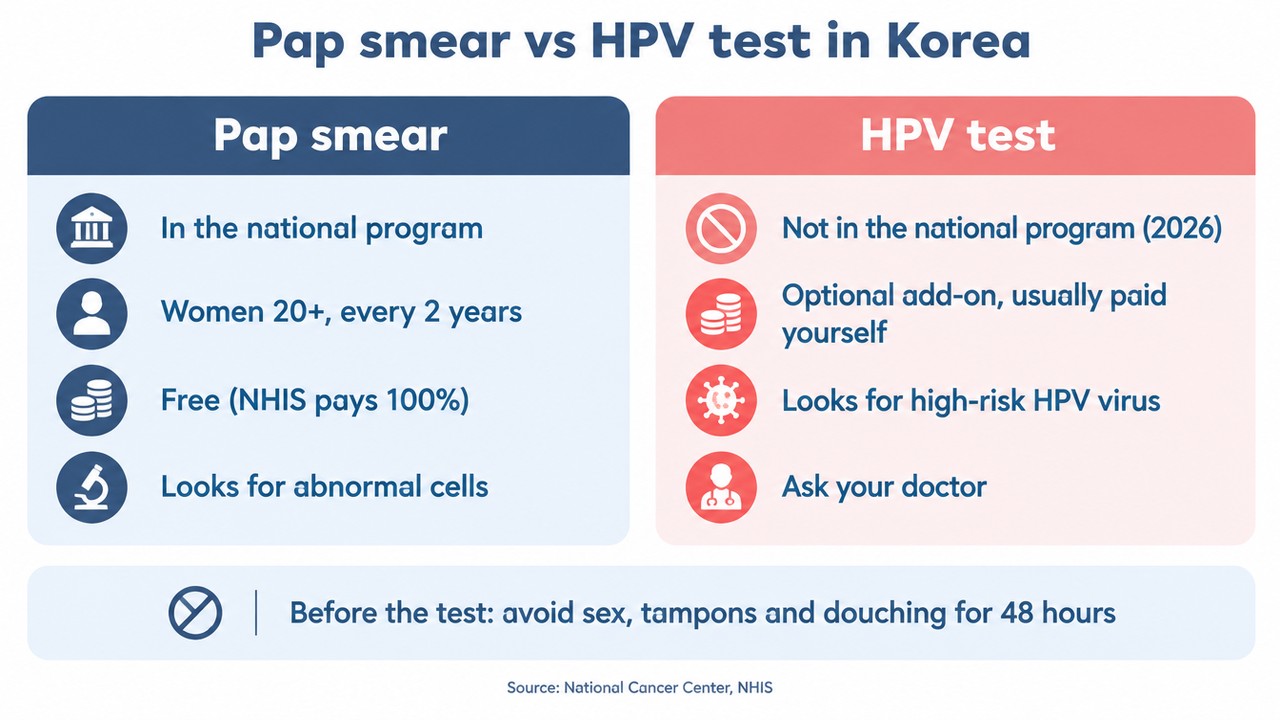
- 48 hours before: avoid sex, tampons, vaginal douching, and vaginal medicines, lubricants or contraceptives.
- Symptoms change things: if you have bleeding outside your period or an unusual, bad-smelling discharge, get checked regardless of timing. Do not wait for a screening invitation.
The same page is frank about the test’s limits: a conventional Pap smear can miss lesions that are present, with a false-negative rate it puts as high as 50%. Liquid-based cytology lowers that rate, and HPV testing or cervicography are sometimes added to improve accuracy. This is the main reason regular repeat screening matters: one normal result is not a lifetime guarantee.

Reading your result: the five categories
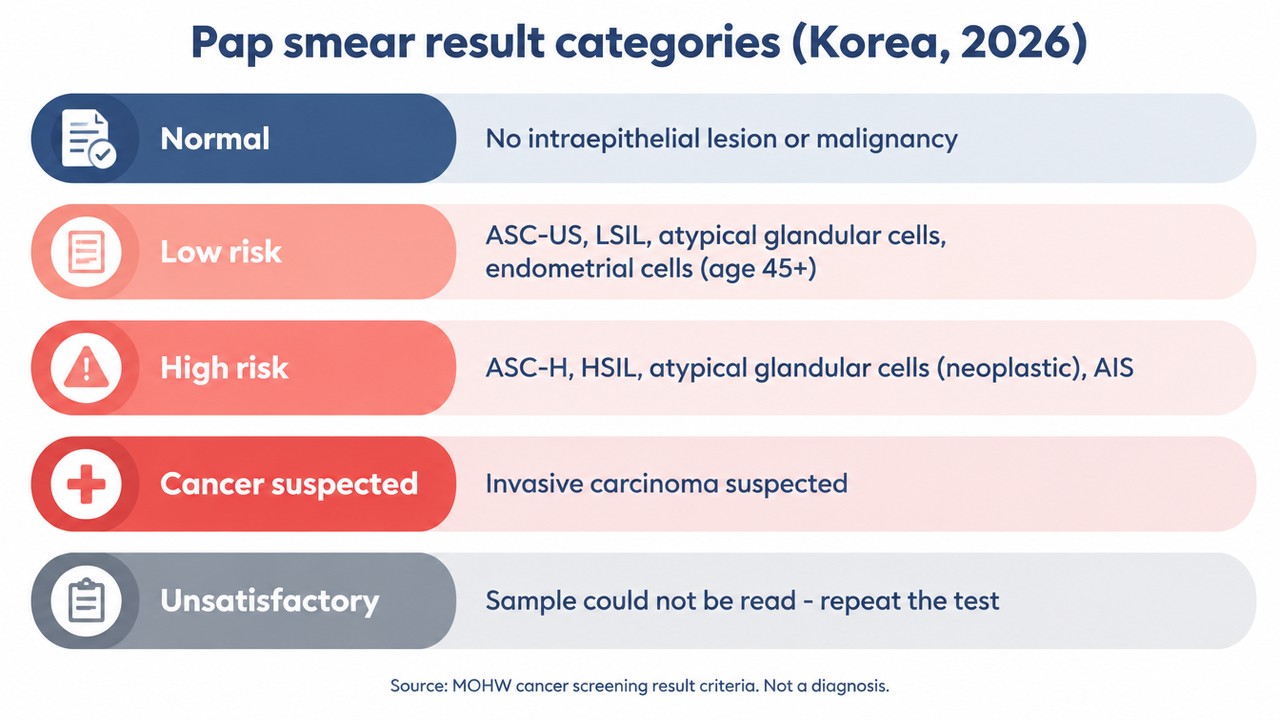
The MOHW cancer screening result criteria (Annex 2 of the screening standards, 2026 version) set out how cervical results are reported on the national result sheet. In plain English:
| Category on the result sheet | What it covers | What usually comes next |
|---|---|---|
| Normal (no intraepithelial lesion or malignancy) | The doctor finds no precancerous or cancerous change | Next routine screening in 2 years |
| Low risk (atypical cells or low-grade lesion) | ASC-US (atypical squamous cells of undetermined significance), LSIL (low-grade squamous intraepithelial lesion), atypical glandular cells (not otherwise specified), endometrial cells in women 45+ | Follow-up as your doctor advises, often a repeat test, an HPV test or colposcopy |
| High risk (suspected precancer) | ASC-H (atypical squamous cells, cannot exclude a high-grade lesion), HSIL (high-grade lesion), atypical glandular cells favouring neoplasia, adenocarcinoma in situ | Prompt specialist assessment, usually colposcopy and biopsy |
| Cancer suspected | Invasive squamous cell carcinoma or invasive adenocarcinoma suspected | Urgent referral for diagnosis |
| Unsatisfactory (repeat recommended) | The sample could not be read properly | Repeat the Pap smear |
Seoul National University Hospital’s medical library explains the most common abnormal result, ASC-US, in helpful terms: these are cells altered mainly by persistent HPV infection, and ASC-US carries a lower chance of a serious lesion than ASC-H, so treatment such as excision should not be decided on the Pap result alone. SNUH describes the usual options as a repeat Pap test, a high-risk HPV test or colposcopy. For ASC-H, it says colposcopy is recommended. An abnormal Pap result is a signal to follow up, not a diagnosis.
Where the HPV test fits in 2026
HPV (human papillomavirus) causes nearly all cervical cancers, and many countries now use an HPV test as the first screening step. Korea has not yet done so. The national programme in 2026 still uses the Pap smear, as the NHIS and NCC tables show.
That may change. In a March 2026 interview with Korea Health Log, the chair of the Korean Society of Obstetrics and Gynecology, who also heads the Korean Society of Gynecologic Oncology, called for HPV testing to enter the national programme. The societies proposed a two-year pilot of about 100,000 women starting in 2026, nationwide expansion to women 25 and over from 2028, and HPV-based intervals of 3 to 5 years. Their 2025 practice recommendation (version 5.0) keeps the 2-yearly Pap test for women 20 and over as the basic option, and says women 25 and over may consider a high-risk HPV test as the first screening test. These are proposals and professional recommendations, not current NHIS benefits.
| Pap smear | HPV test | |
|---|---|---|
| In the national programme (2026) | Yes | No |
| Who | Women 20+ | Offered by clinics; societies discuss 25+ |
| Interval | Every 2 years (programme) | 3–5 years proposed if negative |
| Cost to you | ₩0 under the programme | Usually paid yourself as an add-on; ask the clinic for the price first |
| What it looks for | Abnormal cells | High-risk HPV infection |
If a clinic offers an HPV test with your free Pap smear, it is reasonable to ask why it is recommended for you and how much it costs before agreeing. It is also often used after an abnormal Pap result, as SNUH describes for ASC-US.

How to book before 31 December
- Check you are on the list: look up your screening targets on the NHIS website or the 건강보험 app, or call 1577-1000. Your invitation letter lists the cancers you can be screened for this year.
- Pick a clinic: cervical screening is done at designated national screening institutions, including many obstetrics and gynaecology clinics and health screening centres. NHIS lists them online.
- Book by phone: the Geomdan health centre guide advises calling ahead. December appointments fill up, so earlier is better.
- Bring: your screening notice (if you have it) and photo ID.
- Combine: if your breast or stomach screening is also due, you can often book them on the same day.
Our year-end guides cover breast mammography screening for women 40+ and the 31 December deadline and catch-up rules for national checkups. If you smoked heavily, also check whether you qualify for lung cancer screening at 54–74.
Frequently asked questions
Q. Is cervical cancer screening free in Korea?
Yes, for eligible women in the national programme. NHIS pays the full cost of cervical and colorectal screening, unlike most other national cancer screenings where you pay 10% unless you are in the lowest 50% of premiums or on Medical Aid.
Q. At what age and how often is the national Pap smear?
Women aged 20 and over can have a Pap smear every 2 years. In 2026 women born in even-numbered years are invited, and the screening must be done by 31 December.
Q. Is the HPV test included in Korea’s national screening?
No. In 2026 the national programme uses the Pap smear only. Clinics may offer an HPV test as an optional extra, usually at your own cost. Medical societies have proposed adding HPV testing from 2028, but this is not yet policy.
Q. What does ASC-US mean on a Pap result?
ASC-US means atypical squamous cells of undetermined significance. In Korea’s 2026 result criteria it falls under “low risk”. It is not a cancer diagnosis. A doctor usually suggests a repeat Pap test, an HPV test or colposcopy.
Q. How should I prepare for a Pap smear?
The National Cancer Information Center suggests booking 10 to 20 days after your period starts and avoiding sex, tampons, douching and vaginal medicines or lubricants for 48 hours before the test. If you have unusual bleeding or discharge, see a doctor whatever the timing.
Sources
- National Health Insurance Service, cancer screening policy page (women 20+, every 2 years; cervical and colorectal fully NHIS-funded) — https://www.nhis.or.kr/nhis/policy/wbhada19800m01.do (checked 8 November 2026)
- National Cancer Center, national cancer screening programme (women 20+, 2 years, cervical cytology) — https://www.ncc.re.kr/main.ncc?uri=manage01_4 (checked 8 November 2026)
- National Cancer Information Center (NCC), cervical cancer early detection (2015 guideline, programme table, Bethesda reporting, false-negative rate, preparation tips) — https://www.cancer.go.kr/lay1/program/S1T211C211/cancer/view.do?cancer_seq=4877&menu_seq=4886 (checked 8 November 2026)
- MOHW, cancer screening result criteria (Annex 2, 2026 version, via law.go.kr) — https://www.law.go.kr/LSW/flDownload.do?flSeq=170591787 (checked 8 November 2026)
- Incheon Geomdan-gu Public Health Center, national cancer screening (even/odd birth-year rule, cost, booking) — https://www.geomdan.go.kr/clinic/business/checkup/cancer.jsp (checked 8 November 2026)
- Yonhap News, 8 October 2026: NHIS urges checkups before year-end; even-year births in 2026; last year’s missed checkups can be added by 31 December — https://www.yna.co.kr/view/AKR20261008065100530 (checked 8 November 2026)
- Seoul National University Hospital medical library, atypical squamous cells (ASC-US / ASC-H follow-up) — https://www.snuh.org/health/nMedInfo/nView.do?medid=AA001249 (checked 8 November 2026)
- Korea Health Log, 9 March 2026: obstetrics and gynaecologic oncology societies on HPV testing in national screening — https://www.koreahealthlog.com/news/articleView.html?idxno=56165 (checked 8 November 2026)
This article is general information, not medical advice. It does not diagnose or interpret your own result. If you have bleeding between periods, after sex or after menopause, pelvic pain or unusual discharge, see a doctor without waiting for a screening invitation.




One Comment