Asthma and COPD in Korea’s Winter: Getting Inhalers, NHIS Costs and When to Go to the ER
Haesul Health desk (AI-assisted). As of 20 November 2026 (KST). Based on the Korea Disease Control and Prevention Agency (KDCA) health portal pages on asthma (updated 6 May 2026), COPD (updated 1 June 2026) and fine dust, the Ministry of Food and Drug Safety (MFDS) drug database, the National Health Insurance Service (NHIS) co-payment and conversion-factor pages, the 2026 national fee schedule, the Health Insurance Review and Assessment Service (HIRA) quality ratings, and the Ministry of Health and Welfare (MOHW) emergency-room briefing of 13 September 2024. Independent cross-checks: the UK NHS asthma page, Yonhap and Korean medical trade press. General information, not medical advice.
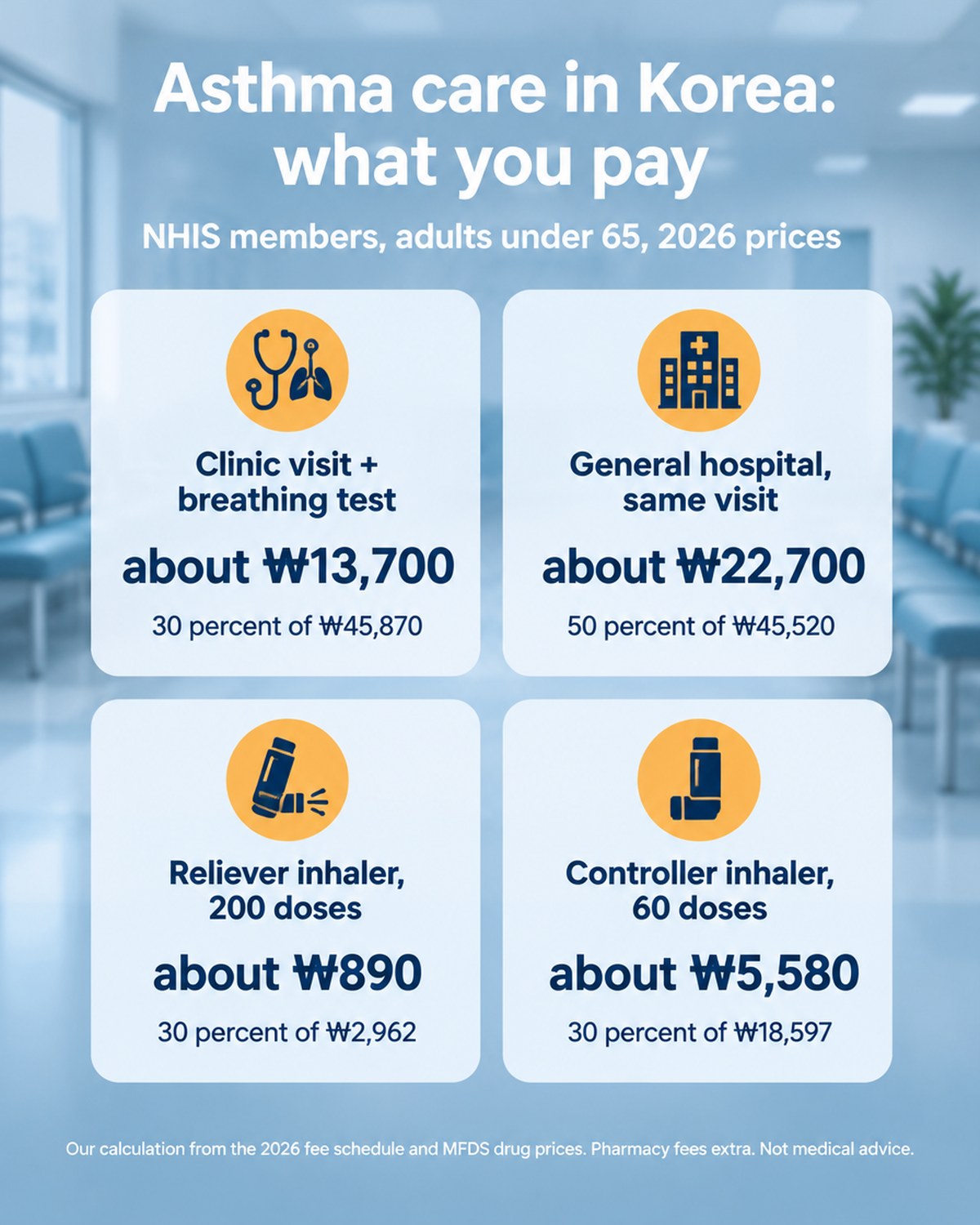
Quick answer: In Korea, asthma and COPD inhalers are prescription-only medicines (전문의약품). A pharmacy cannot sell you one over the counter. The fastest route is a neighbourhood internal-medicine clinic (내과, naegwa). Many do a breathing test (spirometry) on the spot and give you a prescription the same day. With NHIS, a first clinic visit plus a breathing test costs about ₩13,700. At the pharmacy, a 200-dose salbutamol reliever costs about ₩890 and a 60-dose budesonide/formoterol controller about ₩5,580, before dispensing fees (our calculation from 2026 official prices). Use a pulmonologist (호흡기내과) at a hospital if your asthma is hard to control. Call 119 if you are getting worse, your reliever isn’t helping, or you can’t speak in full sentences.
Why winter is hard on lungs in Korea
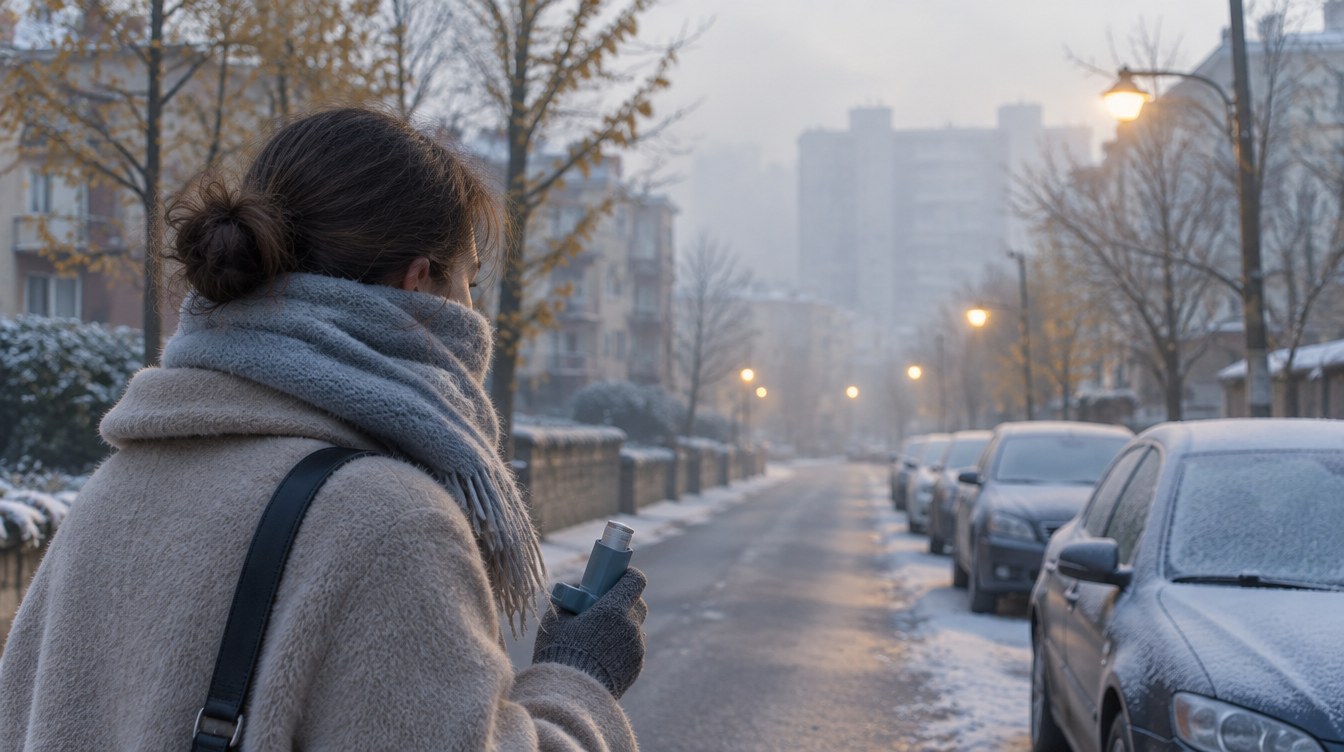
Korea’s winter brings two triggers together: cold, dry air and fine-dust episodes. KDCA’s asthma page says symptoms often get worse at night and early in the morning, and with exercise, cold wind and some medicines. It also says asthma patients should avoid exercising when the weather is very cold or dry. KDCA’s fine-dust page says fine dust worsens chronic conditions such as asthma and COPD. It cites a study in which hospital admissions of asthma patients rose 18 percent for every 10 µg/m³ rise in fine dust. The NHS lists the same triggers: air pollution, cold air, infections and allergens.
The third winter trigger is infection. KDCA calls colds and other acute respiratory infections a major cause of asthma attacks. It recommends a flu shot for people with asthma, and a pneumococcal vaccine as well. For COPD, KDCA’s 2026 page stresses steady inhaler use to prevent sudden flare-ups (“acute exacerbations”), and getting care at once if symptoms get worse.
How common is this? KDCA estimates that about 3 to 5 percent of people in Korea have asthma. For COPD, it says roughly 13 percent of adults aged 40 and over have it, about 3 million people, but only 2.8 percent of them have been diagnosed. Many people find out only after a breathing test. Korea added that test to the national checkup at ages 56 and 66 in 2026. See our guide to the new lung function test on the national checkup.
For daily fine-dust readings, the KF mask grades and the December-to-March seasonal measures, see our fine dust season guide. This guide covers the medical side: getting your inhaler, choosing a doctor, what it costs, and when to go to hospital.
Who this applies to
- Foreign residents enrolled in NHIS (employees, local members and dependents). You pay the same co-payment shares as Korean members. All prices below are NHIS prices for adults under 65 on a weekday daytime visit. Night, weekend and holiday surcharges are extra, and people aged 65 and over have their own clinic rules.
- Visitors and newcomers not yet in NHIS. You can see the same doctors and use the same pharmacies, but you pay the full price. Clinics may charge uninsured patients more than the fee schedule, so treat the full prices below as a minimum.
- Visitors bringing their own inhalers. The rules on how much medicine you can bring, and when you need paperwork, are in our guide to bringing medicine into Korea. This article starts once you are here.
Getting an inhaler: prescription only
Korea’s MFDS drug database lists the common inhalers as 전문의약품 (jeonmun uiyakpum, prescription-only medicine). That includes the most-used salbutamol metered-dose reliever (sold as Ventolin in many countries) and the budesonide/formoterol dry-powder inhaler used as a controller. No pharmacy can hand one over without a Korean prescription. A prescription from your home country doesn’t work at a Korean pharmacy either. You need a Korean doctor to examine you and write one.
Step by step:
- Collect what you have. Bring your current inhaler, or a clear photo of its label showing the ingredient name and strength, plus any letter from your home doctor. Korean doctors prescribe by ingredient and product, so the generic name (salbutamol, budesonide, fluticasone, formoterol, tiotropium and so on) speeds things up.
- Pick a clinic. Look for 내과 (internal medicine) on the sign. Clinics that add 호흡기 (respiratory) or 알레르기 (allergy) see more asthma and COPD patients. Children go to 소아청소년과 (paediatrics). No appointment is usually needed. Bring your residence card (or your passport) so the clinic can check your NHIS status.
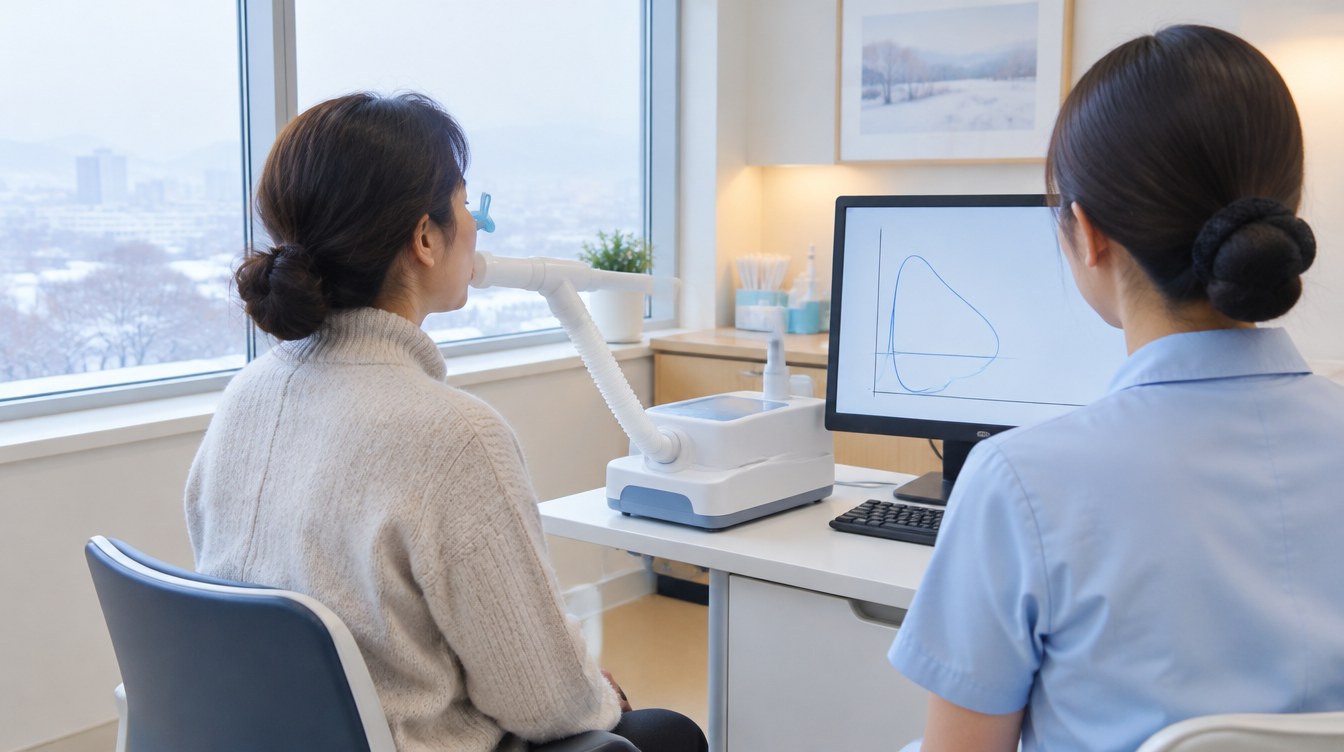
- Expect a breathing test. KDCA calls spirometry (폐기능검사, lung function test) the most important test for checking for asthma. The national quality ratings reward clinics that do it at least once a year (see below). It takes a few minutes: you wear a nose clip and blow hard into a tube.
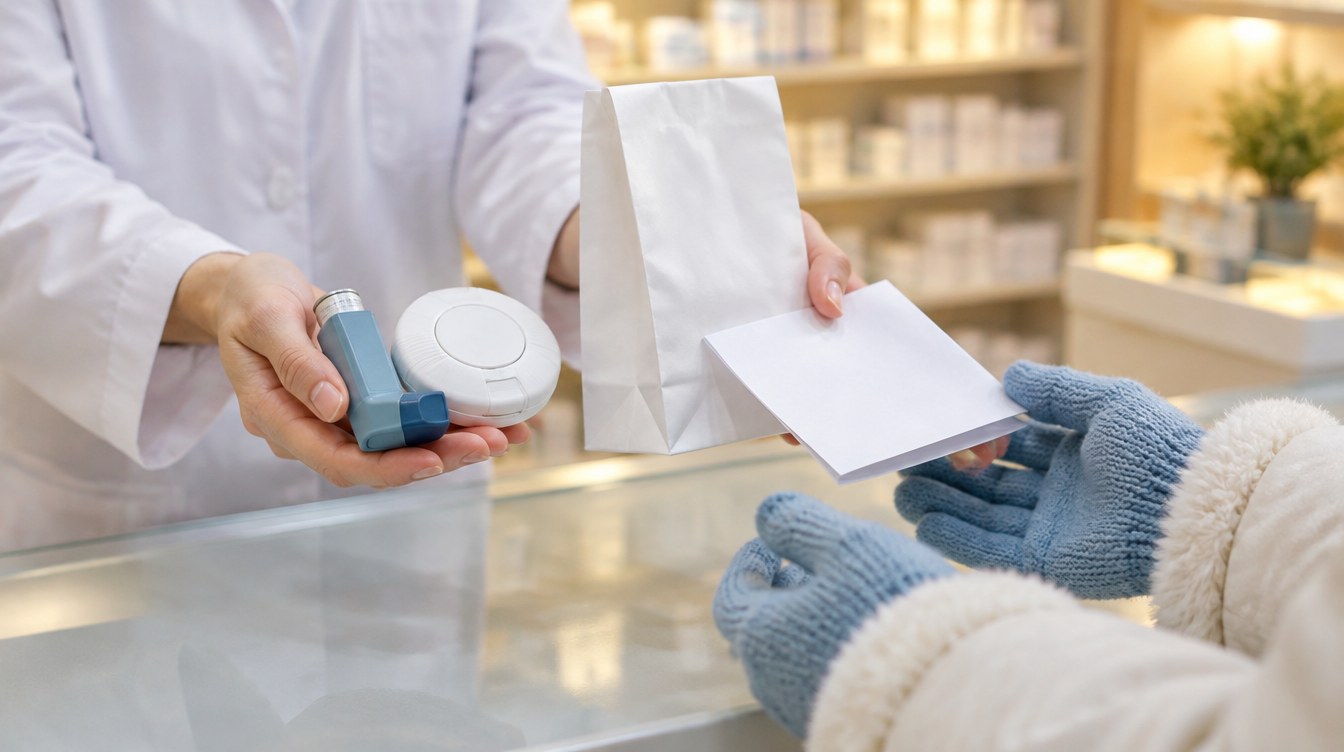
- Get the prescription and go to any pharmacy. Korea separates prescribing and dispensing. The clinic gives you a paper prescription (처방전) and you take it to any pharmacy (약국), often one in the same building. Ask the pharmacist to show you how to use the device. KDCA warns that using an inhaler wrongly makes it work less well.
- Plan your return visit. KDCA says follow-up visits are usually every 1 to 3 months at the start of treatment, then every 3 to 12 months. After a flare-up you should go back within a week.
If your English and the clinic’s English don’t meet, the Korea Travel Helpline 1330 offers free phone interpreting, and the Medical Korea Information Center (1577-7129) can point you to hospitals with international clinics.
Clinic, pulmonologist or university hospital?
| Where | Korean name | Best for | Your share (NHIS, outpatient) | Notes |
|---|---|---|---|---|
| Neighbourhood clinic | 내과 의원 (naegwa uiwon) | First diagnosis, breathing test, routine refills | 30 percent | No referral needed; HIRA grades clinics 1 to 5 for asthma care |
| Hospital or general hospital | 병원 / 종합병원, 호흡기내과 (pulmonology) or 알레르기내과 (allergy) | Asthma or COPD that is hard to control, more tests | 40 percent (hospital) or 50 percent (general hospital, in cities) | No referral needed |
| Tertiary (university) hospital | 상급종합병원 | Severe asthma, specialist treatments | Consultation fee in full + 60 percent of the rest | Referral letter (진료의뢰서) needed, or you pay 100 percent |
| Emergency room | 응급실 | A severe attack that isn’t responding to your reliever | Depends on triage; see the ER section | Call 119 |
The shares come from NHIS’s co-payment page and the National Health Insurance Act Enforcement Decree, Annex 2. Pharmacy bills are 30 percent for NHIS members. The referral rule is real money: HIRA upheld a full 100 percent charge for a patient who went to a tertiary hospital without a referral letter. Any clinic or hospital can write one after seeing you.
KDCA’s advice on severe asthma is to see a specialist and get a personal treatment plan. Severe here means asthma that keeps flaring up even on regular inhaled steroids. If you need a specialist, a hospital pulmonology department (호흡기내과, hoheupgi naegwa) is the usual step up from a clinic.
How to find a well-rated clinic: HIRA’s quality grades
HIRA rates clinics every year on three measures of good asthma care: the share of patients given a breathing test in the year, the share who keep coming back (3 or more visits), and the share prescribed an inhaled steroid (ICS). For COPD it rates hospitals and clinics on breathing tests, regular visits and inhaled bronchodilator prescriptions. Results are on HIRA’s website (hira.or.kr: 의료정보 → 의료평가정보 → 만성질환 → 천식·만성폐쇄성폐질환) and in HIRA’s mobile app 건강e음 (“우리지역 좋은병원 찾기”, find good hospitals near me). Both are in Korean, but the search is a short menu path, and the map view works without reading much.
The latest results, for care given in 2025, came out in November 2026:
| HIRA quality rating (care in 2025) | Asthma (12th round) | COPD (11th round) |
|---|---|---|
| Who is graded | Clinics only | Clinics and hospitals |
| Graded facilities | 9,827 clinics | 1,805 facilities |
| Top grade (1등급) | 1,960 clinics (19.9 percent) | 690 facilities (38.2 percent) |
| Breathing test at least once a year | 44.6 percent of patients | 81.5 percent (clinics: 56.5 percent) |
| Inhaled medicine prescribed | 55.6 percent got an inhaled steroid | 93.2 percent got an inhaled bronchodilator |
Sources: HIRA results as reported by Medifonews (3 November 2026) and Medical World News (12 November 2026); the COPD average score of 71.9 is cross-checked by Yonhap (16 November 2026). HIRA’s last press release (25 October 2024, care in 2023) used the same method and the same search path.
The figures show why the clinic you pick matters. Fewer than half of asthma patients had a breathing test during the year, and at COPD clinics the rate was 56.5 percent, against 92.1 percent at tertiary hospitals. A top-grade clinic is more likely to test you, follow you up and prescribe a controller. HIRA’s own caution applies: a grade measures the care process, not how sick each clinic’s patients are.
What it costs: a worked example from the 2026 fee schedule
NHIS prices are fee-schedule points multiplied by a yearly conversion factor. In 2026 that is ₩95.6 per point at clinics and ₩83.8 at hospitals (NHIS, disclosed 23 July 2026). Hospitals then add a type surcharge to tests: 5 percent for a hospital, 10 percent for a general hospital and 15 percent for a tertiary hospital. Clinics add none. The breathing test used here is the standard spirometry with a flow-volume curve (F6002, 282.75 points). The consultation codes are AA154 (clinic first visit, 197.12 points), AA254 (clinic return visit, 139.85), AA156 (general hospital first visit, 232.33) and AA157 (tertiary first visit, 255.79).
| Visit (adult under 65, weekday) | Consultation | Breathing test | Total fee | You pay with NHIS | Without NHIS (minimum) |
|---|---|---|---|---|---|
| Clinic, first visit + test | ₩18,840 | ₩27,030 | ₩45,870 | 30 percent ≈ ₩13,700 | ₩45,870 |
| Clinic, return visit, no test | ₩13,360 | — | ₩13,360 | 30 percent ≈ ₩4,000 | ₩13,360 |
| General hospital, first visit + test | ₩19,460 | ₩26,060 | ₩45,520 | 50 percent ≈ ₩22,700 | ₩45,520 |
| Tertiary hospital, first visit + test (with referral) | ₩21,430 | ₩27,240 | ₩48,670 | ₩21,430 + 60 percent of ₩27,240 ≈ ₩37,700 | ₩48,670 |
Our calculation: points × conversion factor (× type surcharge for the test), cut to the ₩10, then the patient share cut to the ₩100. Real bills add any X-ray, allergy or blood tests the doctor orders, and evening or weekend surcharges.
Then the pharmacy. MFDS lists the official NHIS price of each inhaler:
| Inhaler (one pack) | NHIS list price | You pay with NHIS (30 percent, medicine only) | Without NHIS |
|---|---|---|---|
| Salbutamol reliever, 100 µg metered-dose, 200 doses | ₩2,962 (since 1 December 2024) | ≈ ₩890 | ₩2,962 |
| Budesonide/formoterol 160/4.5 µg dry-powder inhaler, 60 doses | ₩18,597 (since 1 January 2026) | ≈ ₩5,580 | ₩18,597 |
| Same, 120 doses | ₩27,979 (since 1 January 2026) | ≈ ₩8,390 | ₩27,979 |
Prices are cross-checked against the Yakcheck drug-price site (₩2,962 and ₩18,597). The pharmacy also charges dispensing fees, of which NHIS members pay 30 percent. Which inhaler you get, how often you use it and how long a pack lasts is for your doctor to decide. These two products are just common examples with official prices.
Putting it together (our calculation): an NHIS member who sees a clinic for the first time, has a breathing test and fills a reliever plus a 60-dose controller pays about ₩13,700 + ₩890 + ₩5,580 ≈ ₩20,200, plus pharmacy dispensing fees. A visitor without NHIS pays at least ₩45,870 + ₩2,962 + ₩18,597 ≈ ₩67,400 plus fees. Travel insurance may refund it if you keep the receipt (영수증) and itemised bill (진료비 세부내역서).
Winter self-care that KDCA recommends
These are KDCA’s general measures, not a treatment plan:
- Keep your reliever with you whenever you go out or exercise. KDCA says to stop exercising at once if symptoms start, and suggests warm, humid activities such as swimming over hard running in cold air.
- Indoors: KDCA suggests keeping the home cool and dry rather than hot and humid: humidity 40 to 50 percent, temperature 18 to 23°C. Wash bedding weekly in water above 55°C, deal with mould, and avoid strong sprays. Clean humidifiers and air conditioners regularly.
- On high-dust days: stay indoors where you can, and if you must go out wear a health mask (보건용 마스크, KF-rated). Wash your face and hands when you get home. KDCA also says to air the home when outdoor dust is low.
- Vaccines: KDCA recommends a flu shot for people with asthma, and a pneumococcal vaccine too. Adults 65 and over can get the PPSV23 pneumococcal shot free. See our guide to the free pneumococcal vaccine for 65+.
- Medicines that can trigger attacks: KDCA names aspirin, other anti-inflammatory painkillers (NSAIDs) and beta-blockers. Tell the pharmacist you have asthma before buying cold or pain medicine.
- No smoking, including e-cigarettes. KDCA says smoking makes asthma harder to control and e-cigarettes are not recommended either. It also says about a quarter of COPD patients have never smoked.
When to go to the ER, and what it costs
Call 119 for an ambulance, or go to an emergency room, if:
- your breathing is getting worse at any point, or
- your reliever isn’t helping, or you’ve reached the maximum your written plan allows, or
- you can’t finish a sentence, your lips or fingertips look blue or grey, or you feel drowsy or confused.
The first two points follow the NHS’s “call an ambulance” rules. KDCA warns that a severe attack can stop the lungs getting enough oxygen and can be fatal. Don’t drive yourself.
The ER cost rule changed in 2024. Since 13 September 2024, patients triaged as mild (KTAS 4) at a regional emergency centre (권역응급의료센터), or non-urgent (KTAS 5) at a regional or local emergency centre (지역응급의료센터), pay 90 percent of the ER bill. That is up from about 50 to 60 percent before, according to MOHW’s briefing that day and Yonhap. Mild patients who use a smaller local emergency room (지역응급의료기관) or a clinic see no increase. Triage is done by the hospital, so a real asthma attack with breathlessness is not “mild”. The 90 percent rule is aimed at people who use big ERs for minor problems. Our guide to going to the ER in Korea as a foreigner explains KTAS triage, the three ER levels and what to bring.
If the attack settles with your reliever, KDCA says you should still see your doctor within 1 to 2 weeks, and the NHS says within 2 days. Either way, don’t wait for the next one.
Your checklist
- Photo of your inhaler labels (ingredient + strength) saved on your phone.
- Residence card or passport for every clinic visit; NHIS status checked.
- A 내과 clinic near home picked, ideally a top-grade one on HIRA’s asthma or COPD list.
- A written action plan from your doctor (when to use which inhaler, when to call 119).
- Flu shot done; pneumococcal vaccine discussed with your doctor.
- Health masks at home for fine-dust days; AirKorea or a weather app set to show PM2.5.
- Receipts and itemised bills kept if you’re claiming on travel insurance.
Common problems
- “The pharmacy won’t sell me an inhaler.” That’s the law: inhalers are prescription-only in Korea. Go to a 내과 clinic first.
- “My exact brand isn’t sold here.” Ask the doctor for the same ingredient and strength. Many inhalers are sold under the same or similar names, but the device can differ, so ask the pharmacist to show you how to use it.
- “I was sent to a university hospital and charged full price.” You need a referral letter (진료의뢰서) for NHIS rates at tertiary hospitals. Get one from your clinic first.
- “The ER bill was huge for a mild problem.” Since September 2024, mild and non-urgent cases at big ERs pay 90 percent. For anything short of an emergency, use a clinic, a night clinic or a smaller local ER.
- “I’m not in NHIS yet.” You pay the full fee-schedule price or more. Ask for the price before tests and keep all receipts.
Frequently asked questions
Q. Can I buy an asthma inhaler over the counter in Korea?
No. Korea’s drug database lists common inhalers such as salbutamol relievers and budesonide/formoterol controllers as prescription-only medicines (전문의약품). You need a prescription from a Korean doctor. An internal-medicine clinic (내과) can usually examine you and write one the same day.
Q. How much does an asthma inhaler cost in Korea with NHIS?
The official 2026 NHIS list price is ₩2,962 for a 200-dose salbutamol reliever and ₩18,597 for a 60-dose budesonide/formoterol 160/4.5 controller. NHIS members pay 30 percent at the pharmacy, about ₩890 and ₩5,580, plus dispensing fees (our calculation). Without NHIS you pay the full price.
Q. Should I see a clinic or a pulmonologist for asthma in Korea?
Start at a neighbourhood internal-medicine clinic (내과) for diagnosis, a breathing test and routine refills. You pay 30 percent with NHIS, and HIRA grades clinics 1 to 5 for asthma care. If your asthma stays poorly controlled, KDCA advises specialist care: a hospital pulmonology department (호흡기내과). A university hospital needs a referral letter.
Q. What does a first asthma visit with a breathing test cost?
At a clinic on a weekday, the 2026 fee schedule gives ₩18,840 for a first consultation and ₩27,030 for spirometry with a flow-volume curve, ₩45,870 in total. An NHIS member pays about ₩13,700 (30 percent). Without NHIS it is at least ₩45,870 (our calculation).
Q. When should I go to the emergency room for asthma in Korea?
Call 119 if your breathing keeps getting worse, your reliever isn’t helping or you’ve reached your plan’s maximum, or you can’t speak in full sentences or your lips look blue. Since 13 September 2024, only patients triaged as mild or non-urgent pay 90 percent at big ERs. A real attack is not triaged as mild.
Q. Is fine dust dangerous if I have asthma or COPD?
KDCA says fine dust worsens asthma and COPD and cites hospital admissions of asthma patients rising 18 percent for every 10 µg/m³ increase. On high-dust days, stay indoors where you can, wear a KF-rated health mask outside and keep your reliever with you. Check AirKorea readings before going out.
Sources
- KDCA National Health Information Portal, Asthma (천식; prevalence 3–5 percent, triggers, inhaler FAQ, indoor 40–50 percent humidity and 18–23°C, follow-up intervals, flu and pneumococcal vaccines, aspirin/NSAID/beta-blocker warning; updated 6 May 2026): https://health.kdca.go.kr/healthinfo/biz/health/gnrlzHealthInfo/gnrlzHealthInfo/gnrlzHealthInfoView.do?cntnts_sn=6784
- KDCA, Asthma prevention rules (이달의 건강정보): https://health.kdca.go.kr/healthinfo/biz/health/ntcnInfo/healthSourc/thtimtCntnts/thtimtCntntsView.do?thtimt_cntnts_sn=25
- KDCA, COPD (만성폐쇄성폐질환; about 13 percent of adults 40+, 2.8 percent diagnosed, a quarter never smoked; updated 1 June 2026): https://health.kdca.go.kr/healthinfo/biz/health/gnrlzHealthInfo/gnrlzHealthInfo/gnrlzHealthInfoView.do?cntnts_sn=6536
- KDCA, Yellow dust and fine dust (asthma admissions +18 percent per 10 µg/m³; protective measures): https://health.kdca.go.kr/healthinfo/biz/health/gnrlzHealthInfo/gnrlzHealthInfo/gnrlzHealthInfoView.do?cntnts_sn=5482
- MFDS drug database (nedrug), salbutamol 100 µg metered-dose inhaler (prescription-only; NHIS price ₩2,962 from 1 December 2024): https://nedrug.mfds.go.kr/pbp/CCBBB01/getItemDetail?itemSeq=199906869 ; budesonide/formoterol 160/4.5 µg dry-powder inhaler (prescription-only; ₩18,597 for 60 doses, ₩27,979 for 120 doses, from 1 January 2026): https://nedrug.mfds.go.kr/pbp/CCBBB01/getItemDetail?itemSeq=200109101
- Yakcheck drug-price pages (independent cross-check of the two prices): https://www.yakcheck.co.kr/medicine/650000471 ; https://www.yakcheck.co.kr/medicine/650700251
- NHIS, Scope of benefits and cost sharing (clinic 30, hospital 40, general hospital 50 in cities, tertiary consultation in full + 60, pharmacy 30): https://www.nhis.or.kr/static/html/wbma/c/wbmac0103.html ; National Health Insurance Act Enforcement Decree, Annex 2 (amended 15 September 2026): https://www.law.go.kr/LSW/flDownload.do?flSeq=169270945
- HIRA, Full charge upheld for a tertiary-hospital visit without a referral letter (case, 7 November 2017): https://www.hira.or.kr/bbsDummy.do?brdBltNo=45358&brdScnBltNo=4&pgmid=HIRAA010002080200
- 2026 national fee schedule via Docple Check’s republication: consultations (AA154 197.12, AA254 139.85, AA156 232.33, AA157 255.79): https://check-app.docple-plus.com/sugabook/node/10 ; respiratory function tests (F6002 282.75): https://check-app.docple-plus.com/sugabook/node/33 ; type surcharges (hospital 5, general 10, tertiary 15, clinics none): https://check-app.docple-plus.com/sugabook/node/5
- NHIS, Conversion factors by year (2026: hospital ₩83.8, clinic ₩95.6; disclosed 23 July 2026): https://www.nhis.or.kr/announce/wbhaec11413m01.do
- HIRA press release, 2023 asthma and COPD quality assessment results (method, grading, search path on hira.or.kr and the 건강e음 app; 25 October 2024): https://www.hira.or.kr/bbsDummy.do?brdBltNo=11298&brdScnBltNo=4&pageIndex=1&pageIndex2=1&pgmid=HIRAA020041000100
- Medifonews, Analysis of HIRA’s 2025 (12th) asthma assessment (9,827 graded clinics, 1,960 top grade, breathing test 44.6 percent, ICS 55.6 percent; 3 November 2026): https://www.medifonews.com/news/article.html?no=218360
- Medical World News, HIRA’s 2025 (11th) COPD assessment (690 of 1,805 top grade, breathing test 81.5 percent, clinics 56.5 percent, bronchodilator 93.2 percent; 12 November 2026): https://medicalworldnews.co.kr/m/view.php?idx=1510978350 ; Yonhap, COPD assessment average score 71.9 (16 November 2026): https://www.yna.co.kr/view/AKR20261116105000055 ; Korean Academy of Tuberculosis and Respiratory Diseases notice of both results: https://new.lungkorea.org/board/insurance/view/15032
- MOHW via Korea.kr, Emergency medical daily briefing (90 percent for mild and non-urgent patients at regional and local emergency centres from 13 September 2024): https://www.korea.kr/briefing/policyBriefingView.do?newsId=156650977 ; Yonhap, ER co-payment 60 to 90 percent from today (13 September 2024): https://www.yna.co.kr/view/AKR20240913068200530
- NHS, Asthma (triggers, when to call an ambulance, follow-up after an attack): https://www.nhs.uk/conditions/asthma/asthma-attack/
- Reddit r/Living_in_Korea, “Where to get inhalers” and “Recommendation for Asthma specialist” (reader demand): https://www.reddit.com/r/Living_in_Korea/comments/wqoxrl/where_to_get_inhalers/ ; https://www.reddit.com/r/Living_in_Korea/comments/13iljt3/recommendation_for_asthma_specialist/
How we checked: On 20 November 2026 (KST) we read KDCA’s asthma, COPD and fine-dust pages, the two inhaler entries in the MFDS drug database, NHIS’s co-payment and conversion-factor pages, the 2026 fee-schedule entries and HIRA’s referral case and 2024 quality-rating release. We checked the drug prices against an independent price site and the 2025 HIRA ratings against two trade-press reports and Yonhap. The cost tables are our own arithmetic from those official prices.
This guide is general information, not medical advice. Which inhaler you use, how much and how often, and your action plan are for your doctor to decide. Don’t change or stop your medicine on your own. In an emergency, call 119. For phone interpreting, call 1330. For NHIS questions, call 1577-1000.
Researched and drafted with AI assistance; checked against the sources listed.