Cold and Flu Medicine in Korea: What You Can Buy Without a Prescription, and How to Ask by Ingredient
Haesul Health desk (AI-assisted). As of 17 November 2026 (KST). Based on the Korea Disease Control and Prevention Agency (KDCA) weekly sentinel surveillance bulletin for week 45, the Ministry of Health and Welfare (MOHW) page on safe household medicines, the government’s Easy Law guide to pharmacies, and the approved labels of individual medicines on the Ministry of Food and Drug Safety (MFDS) Drug Safety database (nedrug), cross-checked with Yonhap and Newsis (13 and 16 November 2026), the Daegu and Pocheon city health pages, the UK NHS paracetamol guide, a local public-health-centre notice relaying the MFDS pseudoephedrine rules (6 November 2026), Segye Ilbo (12 November 2026) and Money Today (10 November 2026). General information, not medical advice.
Quick answer: In Korea you can buy ordinary cold and flu medicine without a prescription at any pharmacy (약국, yakguk): these are “general medicines” (일반의약품). When pharmacies are shut, registered 24-hour convenience stores sell a fixed list of just 13 safe household medicines (안전상비의약품), one pack per item, and never to children under 12. The easiest way to get what you use at home is to ask by active ingredient, not by brand: acetaminophen is 아세트아미노펜, ibuprofen is 이부프로펜, pseudoephedrine is 슈도에페드린. Two limits catch visitors out: the approved labels cap acetaminophen at 4,000 mg a day from all products combined, and since early November 2026 pharmacies have been reminded to sell no more than a 4-day supply of pseudoephedrine decongestants per person. Antiviral flu medicine and antibiotics need a doctor’s prescription.

Why now: flu is rising again. KDCA’s week 45 bulletin (1 to 7 November 2026, published 12 November) counted 28.9 people with flu-like illness per 1,000 outpatients at sentinel clinics, up from 17.7 in week 42, 19.2 in week 43 and 22.8 in week 44, the third weekly rise in a row. Hospital flu admissions at sentinel hospitals rose to 639 from 461 a week earlier. KDCA had already declared the 2026–2027 flu season advisory (인플루엔자 유행주의보) on 11 September 2026, earlier than usual. The highest rates are in school-age children (73.5 per 1,000 among 7- to 12-year-olds), but adults aged 19 to 49 were at 31.9, so if you share an office, a dorm or a subway carriage, a cold or flu this winter is likely. This guide is about the practical part: what to buy, where, and how to read the limits.
Where to get what: pharmacy, convenience store or clinic
Korea separates medicine into two legal classes. General medicines (일반의약품) are those with low risk of misuse that can be used safely without a doctor; you can buy them at a pharmacy with no prescription (Pharmaceutical Affairs Act, Art. 50(4), as summarised by Easy Law). Prescription medicines (전문의약품) can only be dispensed against a Korean doctor’s or dentist’s prescription (Art. 50(2)); a pharmacy that sells them without one faces up to a year in prison or a ₩10 million fine. A small subset of general medicines, the safe household medicines, may also be sold outside pharmacies.
| Where | What you can get for a cold or flu | Prescription? | Good to know |
|---|---|---|---|
| Pharmacy (약국) | Any general medicine: pain and fever relievers, multi-symptom cold tablets and syrups, decongestants, cough and phlegm medicine, throat lozenges and sprays | No | The pharmacist chooses from dozens of products; you can ask by ingredient. Most close in the evening and on Sundays (see our late-night pharmacy guide) |
| Registered 24-hour convenience store | Only the 13 safe household medicines listed below | No | One pack per item per purchase; not sold to children under 12; the store must be registered |
| Clinic (의원) then pharmacy | Prescription medicine: flu antivirals such as oseltamivir, antibiotics, stronger cough medicine | Yes | You see a doctor first, then take the prescription to any pharmacy |
The MFDS database lists oseltamivir capsules (the best-known flu antiviral) as a prescription medicine, so you cannot buy them over the counter, however sure you are that it is flu. If you have a foreign prescription, note that Korean pharmacies dispense only Korean prescriptions; our guide to bringing medicine into Korea covers what you can carry in and how refills work.
The 13 convenience-store medicines, by ingredient
MOHW designates the safe household medicines and caps the list at 20 items; it currently stands at 13. The scheme began on 15 November 2012. The official list names specific products, which is why they appear here by brand. We looked up each cold-relevant product’s approved label on the MFDS database to list its active ingredients. The pack sizes come from MOHW’s table and match Easy Law and the Daegu city list.
| Group | Product (Korean name) | Pack | Active ingredients per unit (MFDS label) | Adult use on the label |
|---|---|---|---|---|
| Fever and pain | Tylenol 500 mg (타이레놀정 500mg) | 8 tablets | Acetaminophen 500 mg | Age 12+ and adults: 1–2 tablets, 3–4 times a day, every 4–6 hours as needed; no more than 8 tablets (4 g) a day |
| Fever and pain | Tylenol 160 mg (타이레놀정 160mg) | 8 tablets | Acetaminophen 160 mg | Lower-strength tablet; follow the age table on the pack |
| Fever and pain (children) | Children’s Tylenol 80 mg (어린이용 타이레놀정 80mg) | 10 tablets | Acetaminophen 80 mg | Children; by age on the pack |
| Fever and pain (children) | Children’s Tylenol suspension (어린이타이레놀현탁액) | 100 mL | Acetaminophen (liquid) | Children; by age on the pack |
| Fever and pain (children) | Children’s Brufen syrup (어린이부루펜시럽) | 80 mL | Ibuprofen 2 g per 100 mL (= 100 mg per 5 mL) | Children by age; the label also gives adult doses |
| Cold | Pancol A oral solution (판콜에이내복액) | 30 mL × 3 bottles | Per bottle: acetaminophen 300 mg, guaifenesin 80 mg, pentoxyverine citrate 15 mg, phenylephrine 10 mg, chlorpheniramine 2.5 mg, caffeine 30 mg | Adults: 1 bottle, 3 times a day, 30 minutes after meals |
| Cold | Panpyrin T tablet (판피린티정) | 3 tablets | Per tablet: acetaminophen 300 mg, chlorpheniramine 2 mg, caffeine 30 mg | Adults: 1 tablet, 3 times a day, 30 minutes after meals |
| Digestion | Bearse, Dr. Bearse, Festal Gold, Festal Plus (베아제정, 닥터베아제정, 훼스탈골드정, 훼스탈플러스정) | 3 or 6 tablets | Digestive aids | Not cold medicine |
| Patches | Jeil Cool Pap, Sinsin Pas Arex (제일쿨파프, 신신파스아렉스) | 4 patches | Pain-relief patches | For muscle aches, not colds |
Three things stand out for a foreign shopper. First, every cold product on the list already contains acetaminophen, so a convenience-store “cold medicine plus painkiller” combination doubles up on the same ingredient. Second, none of the 13 contains pseudoephedrine (Pancol A uses phenylephrine as its decongestant and Panpyrin T has none), so for a strong decongestant you need a pharmacy. Third, the only adult ibuprofen in a convenience store is the children’s syrup; ibuprofen tablets are a pharmacy purchase. That is our reading of the labels above, not an official classification.
The store rules matter too. Only stores open 24 hours all year that have registered with the local public health centre, sent staff to 4 hours of training and installed a barcode system that blocks recalled products may sell these medicines. They must sell one pack per item per purchase, must not sell to children under 12 (including primary-school pupils), must not open packs to sell them loose, and must display the medicines apart from food with the precautions posted. In practice a 3-tablet pack of Panpyrin T, or a 3-bottle pack of Pancol A, is one day at the label dose.
Asking by ingredient at a Korean pharmacy
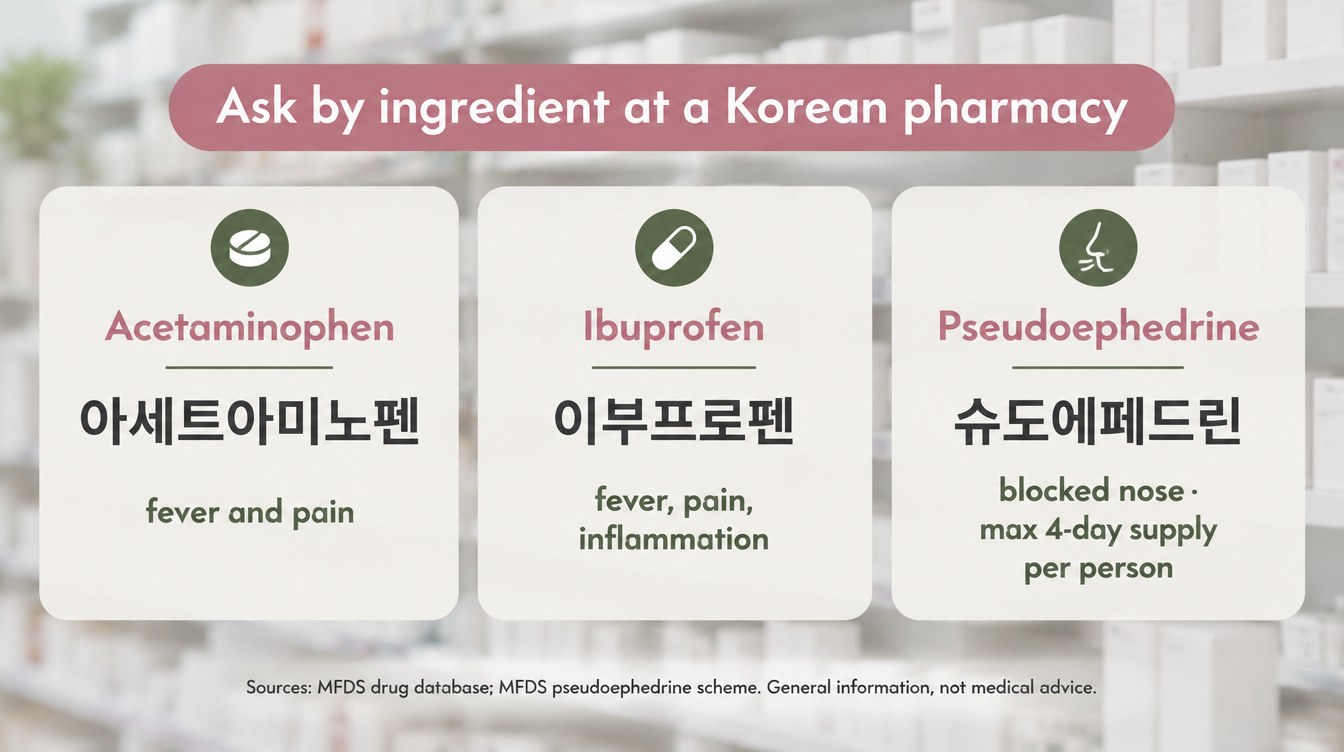
Brand names change across borders, but ingredient names travel. Korean pharmacists use the international non-proprietary names transliterated into Korean, so showing the word on your phone usually works better than describing symptoms. A few you are likely to need:
| What you want | Ingredient (English) | Korean | Roughly how it sounds |
|---|---|---|---|
| Fever, headache, body aches | Acetaminophen (paracetamol) | 아세트아미노펜 | a-se-teu-a-mi-no-pen |
| Fever and pain, anti-inflammatory | Ibuprofen | 이부프로펜 | i-bu-peu-ro-pen |
| Blocked nose (strong decongestant) | Pseudoephedrine | 슈도에페드린 | syu-do-e-pe-deu-rin |
| Blocked nose (another decongestant, the one in Pancol A) | Phenylephrine | 페닐레프린 | pe-nil-le-peu-rin |
| Runny nose, sneezing (antihistamine; labels warn it can cause drowsiness) | Chlorpheniramine | 클로르페니라민 | keul-lo-reu-pe-ni-ra-min |
| Chesty cough, phlegm | Guaifenesin | 구아이페네신 | gu-a-i-pe-ne-sin |
Useful phrases: “감기약 주세요” (gam-gi-yak ju-se-yo, “cold medicine, please”); “아세트아미노펜만 들어 있는 약 있어요?” (“Do you have something with only acetaminophen?”); “졸리지 않은 약으로 주세요” (“Something that won’t make me drowsy, please”); and “지금 다른 약 먹고 있어요” (“I’m taking other medicine”). Show the pharmacist what you already take, including anything you brought from home, so they can avoid doubling an ingredient. If you prefer to talk to a doctor in English first, our guide to seeing a doctor in English in Korea explains how international clinics and interpretation work.
You can also check any Korean medicine yourself: Easy Law points to the MFDS drug database (nedrug.mfds.go.kr, 의약품안전나라), where each product page shows whether it is a general or prescription medicine, its active ingredients and its approved directions. The consumer summaries there (e약은요) are written in plain Korean and translate well with a phone camera app.
Dose limits: what the labels say, and how they add up
This is not dosing advice: always follow the leaflet in your pack and ask the pharmacist. But the label limits are worth knowing because combination products make it easy to exceed them without noticing. Every acetaminophen label we read on the MFDS database says not to exceed 4,000 mg of acetaminophen a day and not to take it with other products containing acetaminophen; the Tylenol 500 mg label puts this as no more than 8 tablets a day, which matches the UK NHS guidance for 500 mg tablets (1 or 2 per dose, at least 4 hours apart, no more than 8 in 24 hours). The labels also warn anyone who regularly drinks three or more alcoholic drinks a day to talk to a doctor or pharmacist first because of the risk of liver damage.
Worked example (our calculation from the label figures above, not a recommendation): a day of convenience-store cold medicine plus painkillers.
| Product, taken at its label maximum for one day | Acetaminophen per unit | Units per day | Acetaminophen per day |
|---|---|---|---|
| Pancol A oral solution | 300 mg per bottle | 3 bottles | 900 mg |
| Panpyrin T | 300 mg per tablet | 3 tablets | 900 mg |
| Tylenol 500 mg | 500 mg per tablet | 8 tablets | 4,000 mg |
| Tylenol at maximum + Pancol A at its label dose | 4,900 mg: 900 mg over the 4,000 mg cap | ||
| Pancol A + Panpyrin T together | 1,800 mg: under the cap, but both labels say not to combine them with other cold medicine |
The second line of the bottom pair is the subtle one: the Pancol A and Panpyrin T labels each tell you not to take other cold medicines, fever reducers, cough and phlegm medicines or antihistamine-containing medicines with them, and both share chlorpheniramine and caffeine as well as acetaminophen. Both labels also warn of drowsiness (no driving), say not to drink alcohol while taking them, and say to stop and see a doctor or pharmacist if symptoms have not improved after 5 or 6 doses. The same logic applies to anything you brought from home: many Western “cold and flu” sachets and tablets already contain paracetamol (acetaminophen), and the NHS likewise warns against taking paracetamol with other paracetamol-containing cold remedies. Counting milligrams of acetaminophen across everything you take that day is the simplest safety check.
The NHS guide also says not to take paracetamol for more than 3 days without a doctor’s advice. If a fever or cough is not improving, see a clinic rather than buying more medicine (more below).
Pseudoephedrine: why the pharmacist may limit you to 4 days
Pseudoephedrine is the decongestant in many strong blocked-nose tablets and syrups, and in Korea it is still a pharmacy-only general medicine. According to Money Today, citing MFDS, 284 general medicines from 70 companies contained it as of 5 November 2026. Because it can be diverted to make methamphetamine, MFDS has run a management scheme for pseudoephedrine products since 5 April 2017 (and for ephedrine since 4 July 2017). The parts that affect you at the counter, as relayed by the Bupyeong-gu public health centre on 6 November 2026:
- Blister-packed products may be sold to one person only up to a 4-day supply. The 4 days are counted from the product’s approved directions, so the number of tablets depends on the product. For a tablet taken once three times a day, that is 12 tablets (our calculation).
- Bottle packs supplied for dispensing are sold only against a prescription.
- Pharmacists are asked to report bulk buying, repeated small purchases, or purchases with an unclear purpose to MFDS.
The scheme is not new, but it is being enforced more visibly. In early November 2026 police announced arrests over methamphetamine made from cold medicine, and MFDS re-sent the guidance to pharmacies; Segye Ilbo reported on 12 November that pharmacists were unsure how to apply the 4-day limit to 20-tablet packs, and that MFDS had approved a change for one product family from 20 to 10 tablets per pack on 20 October. Money Today reported on 10 November that police had asked MFDS to consider making pseudoephedrine products prescription-only and that MFDS would review sales controls with MOHW; as of 17 November 2026 no change of status has been announced. So: expect the pharmacist to ask what it is for, to sell you a small pack, and possibly to decline a second one. Money Today also notes that pseudoephedrine carries a higher risk of side effects for people with high blood pressure, heart disease or an enlarged prostate, so the pharmacist will want to know about those. If you plan to carry pseudoephedrine products into Korea, read the import rules in our medicine import guide first.
When to skip the pharmacy and see a doctor
General medicines treat symptoms; they do not tell you whether you have flu, COVID-19 or something else. Clinics can test, and only a doctor can prescribe an antiviral. KDCA’s bulletin shows that flu is the main virus found in respiratory patients at sentinel clinics this month (27.7 percent of samples in week 45, mostly A(H1N1)pdm09). See a doctor rather than self-treating if you are pregnant, have a chronic condition, are buying for a child, are taking other regular medicine, or are not improving after a few days. A cough that lasts 2 weeks or more is worth a doctor’s visit on its own: KDCA names it as the most common symptom of tuberculosis, which our guide to the checkup chest X-ray and TB result explains.
At night or on a Sunday, our late-night pharmacy and holiday clinic guide shows how to find what is open; for breathing difficulty, chest pain or confusion, call 119. KDCA’s call centre is 1339. For prevention, the flu vaccine schedule (free groups and timing) is in our flu and COVID vaccine guide.
Common problems
- “The convenience store wouldn’t sell me two packs.” That is the law: one pack per item per purchase. Buy one, or go to a pharmacy.
- “My teenager was refused.” Stores may not sell these medicines to children under 12, including primary-school pupils.
- “I can’t find a strong decongestant in the store.” None of the 13 contains pseudoephedrine; ask at a pharmacy, which may limit you to a 4-day supply.
- “The pharmacist won’t sell me Tamiflu.” Oseltamivir is a prescription medicine in Korea. See a clinic first.
- “Which painkiller is in my cold medicine?” Read the ingredient list (성분) on the box, or search the product on nedrug.mfds.go.kr. Both cold products in convenience stores contain acetaminophen.

Feeling rough after a year-end party? See Hangover IV drip clinics in Korea for what is in the drip, what it costs (NHIS pays nothing) and the painkiller warning on Korean labels.
FAQ
Q. Can I buy cold medicine in Korea without a prescription?
Yes. General medicines (일반의약품), which include most cold, cough, fever and pain products, are sold at pharmacies without a prescription. Registered 24-hour convenience stores also sell 13 safe household medicines, including two cold medicines and five fever and pain relievers.
Q. Which medicines can a Korean convenience store sell?
Only the 13 products MOHW designates: acetaminophen tablets in 500 mg, 160 mg and children’s 80 mg strengths, a children’s acetaminophen suspension, a children’s ibuprofen syrup, two cold medicines (Pancol A oral solution and Panpyrin T), four digestives and two pain-relief patches. One pack per item per purchase, and no sales to children under 12.
Q. What is acetaminophen called in Korea?
아세트아미노펜 (a-se-teu-a-mi-no-pen). It is the same ingredient as paracetamol. Ibuprofen is 이부프로펜 and pseudoephedrine is 슈도에페드린; showing the Korean word to the pharmacist is the quickest way to get the ingredient you use at home.
Q. What is the daily limit for acetaminophen on Korean labels?
The approved labels on the MFDS database say not to exceed 4,000 mg of acetaminophen a day and not to combine it with other acetaminophen products; for Tylenol 500 mg tablets that is no more than 8 tablets a day. Both convenience-store cold medicines contain 300 mg per dose, so they count towards the same total. Follow your own pack and ask a pharmacist.
Q. Why will a pharmacy only sell me a small pack of pseudoephedrine?
Under an MFDS management scheme in place since 2017 and re-sent to pharmacies in November 2026, blister-packed pseudoephedrine products are sold up to a 4-day supply per person, and pharmacists report bulk or repeated buying. The limit exists because the ingredient can be used to make methamphetamine.
Q. Can I buy Tamiflu over the counter in Korea?
No. The MFDS database lists oseltamivir as a prescription medicine, so you need to see a doctor, who can also test for flu. Take the prescription to any pharmacy to have it filled.
Sources
- KDCA, 2026 sentinel surveillance weekly bulletin, week 45 (published 12 November 2026): https://dportal.kdca.go.kr/pot/bbs/BD_selectBbs.do?q_bbsDocNo=20261112163809554&q_bbsSn=1010&q_clsfNo=2
- KDCA via Korea.kr, “2026–2027 influenza season advisory issued” (11 September 2026): https://www.korea.kr/briefing/pressReleaseView.do?newsId=156781268
- MOHW, Sale of safe household medicines outside pharmacies (13 products, pack sizes, seller rules; updated 31 March 2026): https://www.mohw.go.kr/menu.es?mid=a10702040200
- Easy Law (Ministry of Government Legislation), Using pharmacies: general vs prescription medicines, the 13 safe household medicines and seller rules (as of 15 October 2026): https://www.easylaw.go.kr/CSP/CnpClsMain.laf?ccfNo=2&cciNo=1&cnpClsNo=2&csmSeq=906&menuType=cnpcls&popMenu=ov
- MFDS Drug Safety database (nedrug), approved labels: Tylenol 500 mg (item 202106092), Pancol A oral solution (196800036), Panpyrin T (199400202), Children’s Brufen syrup (198601920), Tamiflu 75 mg capsules (200008798, prescription medicine): https://nedrug.mfds.go.kr/
- Bupyeong-gu Public Health Centre (Incheon), notice relaying the MFDS pseudoephedrine and ephedrine general-medicine management scheme (6 November 2026): https://www.icbp.go.kr/clinic/bbs/bbsMsgDetail.do?bcd=branch_notice&msg_seq=4607
- Daegu Metropolitan City, safe household medicine list (updated 15 July 2025): https://www.daegu.go.kr/health/index.do?menu_id=00933168
- Pocheon City Public Health Centre, safe household medicine list: https://www.pocheon.go.kr/pbhlth/contents.do?key=9400
- NHS (UK), How and when to take paracetamol for adults: https://www.nhs.uk/medicines/paracetamol-for-adults/how-and-when-to-take-paracetamol-for-adults/
- Yonhap News, “Flu up for 3 weeks running” (16 November 2026): https://www.yna.co.kr/view/AKR20261116083500530
- Newsis, flu week 45 and age-group rates (13 November 2026): https://www.newsis.com/view/NISX20261113_0003866616
- Segye Ilbo, pharmacies and the pseudoephedrine 4-day guidance (12 November 2026): https://www.segye.com/newsView/20261111516911
- Money Today, government reviews pseudoephedrine cold medicine controls (10 November 2026): https://www.mt.co.kr/thebio/2026/11/10/2026110919344584802
How we checked: flu figures were read from KDCA’s week 45 bulletin and matched against Yonhap and Newsis; the convenience-store list and rules were read on the MOHW page and matched against Easy Law and two city health pages; ingredients and label limits were read on each product’s MFDS database page, with the acetaminophen limit cross-checked against the NHS. The pseudoephedrine rules come from an MFDS scheme relayed by a public health centre and two newspapers; the 284-product count and the 20-to-10 pack change appear only in press reports citing MFDS. Worked totals are our own arithmetic from label figures.
This article is general information, not medical advice. It does not tell you what or how much to take. Read the leaflet in your pack, and ask a pharmacist or doctor, especially for children, during pregnancy, or if you have a long-term condition or take other medicines. Official information: MFDS drug database and KDCA.
Researched and drafted with AI assistance; checked against the sources listed.