Korea Liver Cancer Screening for High-Risk Adults: Ultrasound and AFP Every 6 Months, and What the Result Means
Haesul Health desk (AI-assisted). As of 9 November 2026 (KST), based on the National Health Insurance Service (NHIS) cancer-screening and general-checkup pages, the Ministry of Health and Welfare (MOHW) Cancer Screening Implementation Standards and their result-criteria annex (Korean Law Information Center), the Korea Disease Control and Prevention Agency (KDCA) National Health Information Portal, and the National Cancer Center (NCC) / Korean Association for the Study of the Liver screening recommendation. This is general information, not medical advice. Talk to a doctor about your own liver condition, results and follow-up.
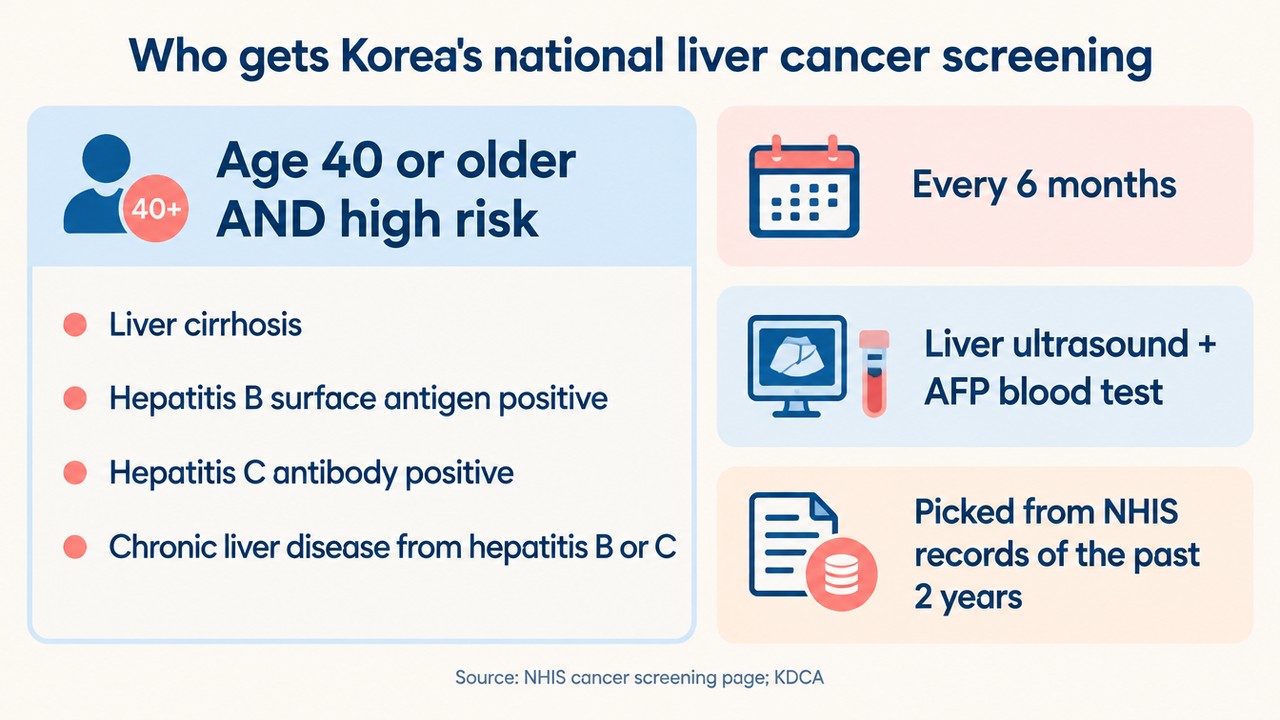
Quick answer: Korea’s national liver cancer screening (간암검진) is not for everyone. It covers adults aged 40 or older who are in a high-risk group — people with liver cirrhosis, a positive hepatitis B surface antigen, a positive hepatitis C antibody, or chronic liver disease caused by hepatitis B or C. NHIS picks them mainly from their health-insurance claims in the previous two years (and past checkup hepatitis results). Those people get a liver ultrasound plus an AFP (alpha-fetoprotein) blood test every 6 months — in 2026, once in January–June and once in July–December, so the second round has to be done by 31 December 2026. NHIS pays 90% and you pay 10%; Medical Aid recipients and people in the lowest 50% by premium pay nothing. A result of “follow-up within 3 months” or “suspected liver cancer” is a signal for more tests, not a diagnosis.
If you are in your 40s, 50s or 60s and know you carry hepatitis B, were treated for hepatitis C, or were once told you have cirrhosis, this is the national cancer screening that is meant for you — and it runs on a tighter clock than the others. Stomach and breast screening come every two years; liver screening for high-risk adults comes twice a year. It is also easy to miss, because it only shows up on your screening record if NHIS has you on the high-risk list. For the rest of what may be due this year, see our Korea national health checkup by age guide.

Who is eligible for liver cancer screening in Korea
The NHIS cancer-screening table lists liver cancer separately from the other five national cancer screenings:
| Item | National liver cancer screening rule |
|---|---|
| Age | 40 or older |
| Who | People in the liver-cancer high-risk group (간암발생고위험군) |
| High-risk conditions | Liver cirrhosis; hepatitis B surface antigen (HBsAg) positive; hepatitis C antibody (anti-HCV) positive; chronic liver disease caused by hepatitis B or C |
| How NHIS finds you | Insurance claims for those conditions in the two years before the screening year, or a positive HBsAg or HCV antibody result on a past general checkup |
| Interval | Every 6 months (first half and second half of the year) |
| Tests | Liver ultrasound (간초음파) + serum alpha-fetoprotein (AFP) blood test |
Sources: NHIS cancer screening page; KDCA National Health Information Portal, “건강검진(암 검진)” (updated 15 May 2026).
The National Cancer Center’s recommendation, developed with the Korean Association for the Study of the Liver, uses almost the same groups: adults 40 or older who carry hepatitis B or C virus, and people diagnosed with cirrhosis at any age, screened every 6 months with abdominal ultrasound and AFP. It adds that doctors may screen other people they judge to be at high risk, and may shorten the interval or add a CT scan for someone at higher risk. Those clinical extras are decisions for your doctor; the national programme itself uses the NHIS list above.
Two points people often misunderstand:
- Heavy drinking or fatty liver alone does not put you on the national list. The NHIS high-risk definition is built around cirrhosis and hepatitis B or C. If you have another liver condition, ask your doctor whether separate monitoring makes sense.
- You may be high-risk without a recent clinic visit. If an old general checkup showed a positive hepatitis B surface antigen or hepatitis C antibody, NHIS can use that result. The general checkup itself includes a hepatitis B test at age 40 (unless you are already a known carrier or immune), and a hepatitis C antibody test is offered at 56 — covered, with its own sources, in our hepatitis C test at 56 guide.
Twice a year: how the 2026 calendar works
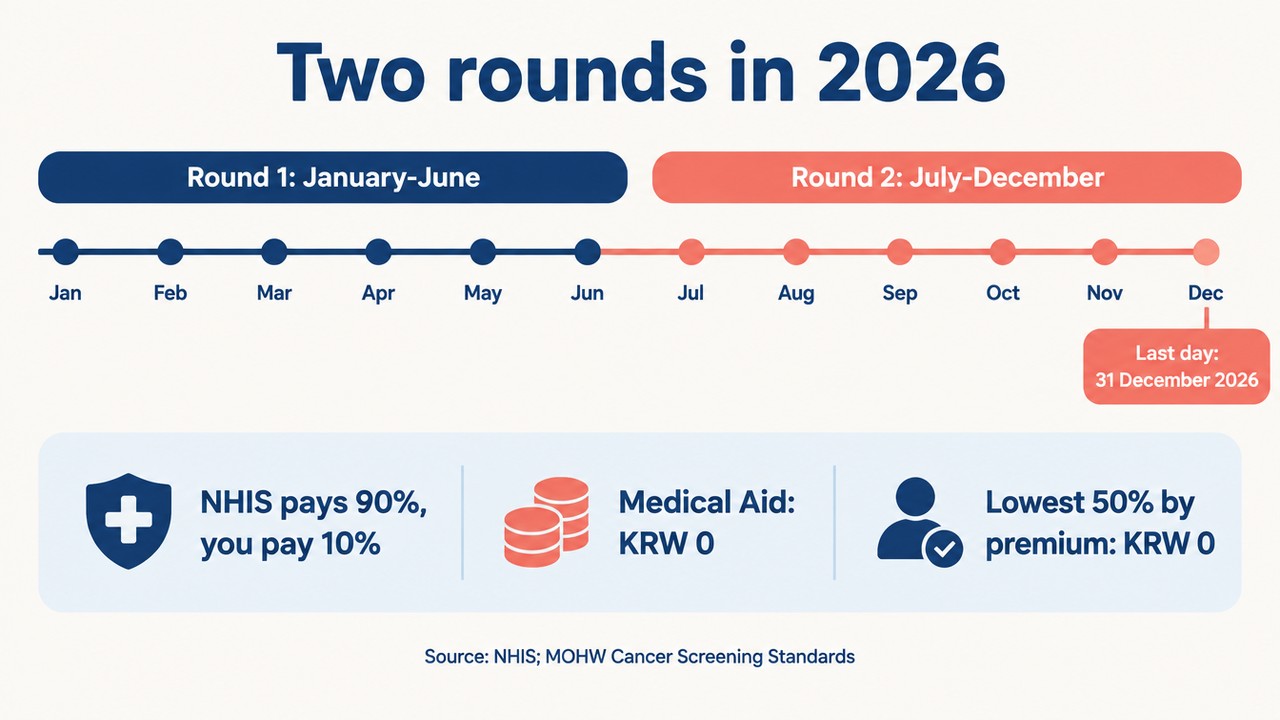
The MOHW Cancer Screening Implementation Standards (암검진 실시기준) say each cancer screening must be done within its screening year. For liver cancer, KDCA describes that as twice a year: once in the first half and once in the second half.
| 2026 round | Window | What to do now (9 November 2026) |
|---|---|---|
| Round 1 | January–June 2026 | Already closed. If you missed it, it cannot be made up in December |
| Round 2 | July–December 2026 | Book now. The last day is 31 December 2026 — 48 days from 13 November (calculated) |
| Next round | January–June 2027 | Your 2027 eligibility is re-checked against claims from 2025–2026 |
Sources: MOHW Cancer Screening Implementation Standards Art. 6; KDCA cancer screening page; NHIS cancer screening page. Day count calculated by Haesul.
Year-end clinics fill up, and some screening centres book ultrasound slots weeks ahead. If you are on the list, it is worth calling this week rather than in mid-December. Our 31 December checkup deadline guide covers booking steps that apply to all national checkups.
How to check whether you are on the list: look for the liver item on your NHIS screening notice (건강검진표), check the NHIS website or app under the screening-eligibility menu, or call NHIS on 1577-1000. You do not need the paper notice to attend: the standards let the screening centre confirm your eligibility and test items from your ID card through the NHIS system.
What it costs: the 10% copay and who pays nothing
National cancer screening is mostly paid by NHIS. The cost rule in the standards (Art. 11) and on the NHIS page is:
| Who you are | NHIS share | Your share for liver screening |
|---|---|---|
| Health-insurance subscriber or dependant (standard) | 90% | 10% |
| Subscriber or dependant whose premium is in the lowest 50% (based on the previous November’s premium) | 90% (+ 10% paid by national and local government) | ₩0 |
| Medical Aid recipient | Paid by national and local government | ₩0 |
Sources: NHIS cancer screening page; MOHW Cancer Screening Implementation Standards Arts. 10–11.
How much is 10%? The MOHW and National Cancer Center 2026 programme guide, as reproduced by Korean welfare-information site Bokjiclick, puts the total fee for liver ultrasound plus AFP at ₩117,930–₩126,840. On those figures, a standard copay works out to about ₩11,793–₩12,684 per round, or roughly ₩23,600–₩25,400 for both 2026 rounds (calculated). The same summary notes a common consultation and admin fee and weekend or holiday surcharges, so your receipt can differ. Treat these as rough guides and confirm with the clinic.
Unlike colon and cervical screening, which NHIS pays in full, liver screening carries the 10% copay unless you are in the free groups above. If an abnormal result leads to a CT, MRI or specialist visit, those are generally separate medical care, not part of the screening fee; ask the clinic what will be billed.
What happens at the appointment
- Bring your ID card (and the screening notice if you have it).
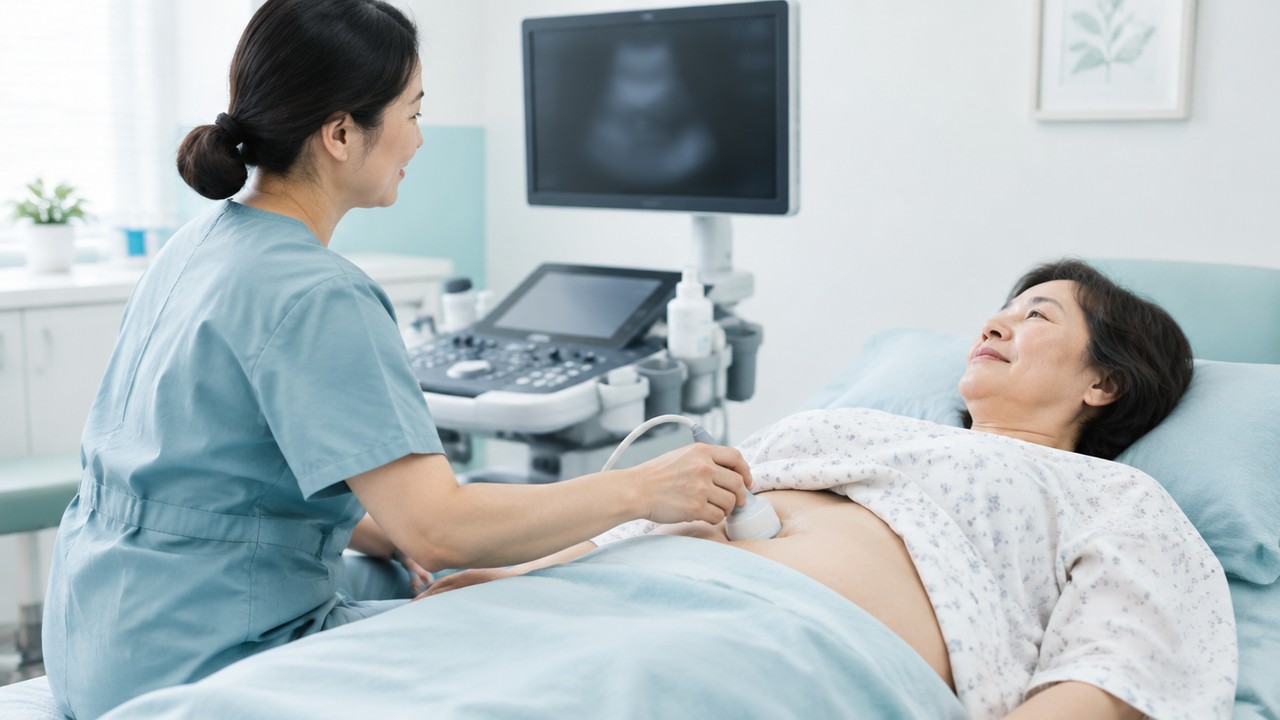
- Liver ultrasound: you lie on your back while a probe with gel is moved over the upper right abdomen, where the liver sits.
- AFP blood test: a normal blood draw. It is read together with the ultrasound: on the official criteria, a raised AFP on its own is a follow-up finding, not a cancer result.
- Preparation: ask the clinic when you book whether you need to fast before the ultrasound, and follow their instructions.
- Results: the screening centre must send your result within 15 days of the exam, by post, email or mobile (standards Art. 9).
If you are booking other national cancer screenings this year, you can often do them the same day. Our guides to stomach cancer screening and lung cancer screening explain those programmes.
How to read your liver screening result
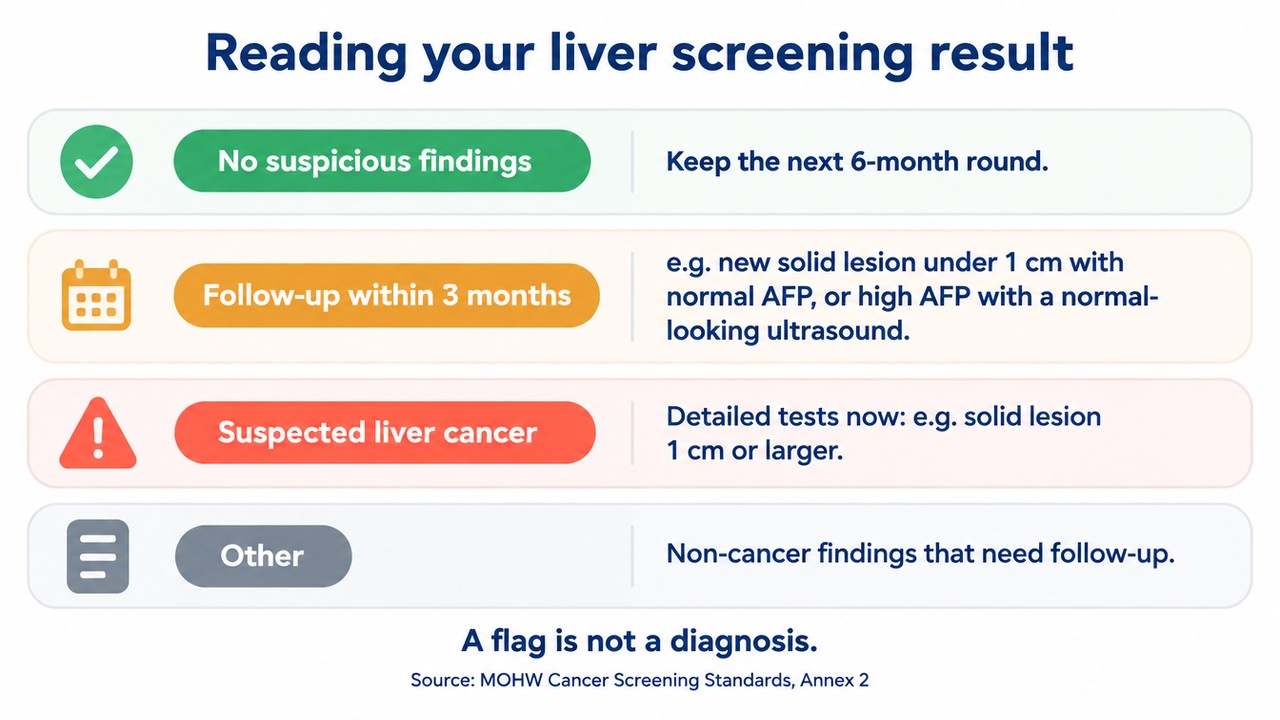
The result-criteria annex to the MOHW standards (Annex 2) uses five categories for liver cancer screening. Here is what each one means, in plain English:
| Result on the sheet | What the annex says it means | Typical next step |
|---|---|---|
| No findings suspicious of liver cancer (간암의심 소견 없음) | No liver-cancer-related abnormality on this round | Keep the next 6-month round |
| Follow-up needed within 3 months (추적검사 요망) | An abnormality that needs a repeat check within 3 months — for example, AFP within the normal range but a new solid lesion under 1 cm, or AFP above the normal range with no suspicious ultrasound finding | Book the follow-up check within 3 months |
| Suspected liver cancer (간암의심, 정밀검사 요망) | Detailed tests are needed right away — for example, AFP above the normal range together with a solid lesion under 1 cm, or, whatever the AFP, a solid lesion of 1 cm or more, a portal or hepatic vein thrombus, or bile-duct dilatation | See a specialist promptly for confirmatory tests |
| Other (기타) | Findings not related to liver cancer that still need testing or follow-up | Follow the clinic’s advice |
| Existing cancer patient (기존 암환자) | Already being treated for, or followed after, one of the six national-screening cancers | Follow your treating team’s schedule |
Source: MOHW Cancer Screening Implementation Standards, Annex 2 (암검진 결과 판정기준), opened via law.go.kr on 9 November 2026. Plain-English wording by Haesul.
KDCA’s cancer-screening page is clear that most abnormal screening findings turn out not to be cancer, and that false positives — a result that looks suspicious when there is no cancer — are the most common harm of screening. A “follow-up” or even “suspected” result means the screening did its job of flagging something to look at more closely. It does not mean you have cancer. Equally, a clear result does not rule out disease for the next six months, which is why the interval matters.

If you are in your 40s, 50s or 60s
- Hepatitis B carriers: you are the largest group this programme is built for. If you have not had an ultrasound since spring, book the second 2026 round now.
- Treated hepatitis C: our hepatitis C guide explains that a positive antibody can reflect a past, cleared infection. NHIS can still list you as high-risk, and the NCC recommendation is framed around people who carry the virus or have cirrhosis. Ask your doctor whether ongoing 6-monthly surveillance is right for you.
- Cirrhosis at any age: the NCC recommendation applies regardless of age, while the national programme starts at 40. If you are younger, your specialist may still recommend regular monitoring outside the programme.
- Already seeing a liver specialist: many hospital patients get ultrasound and AFP as part of their usual care. Ask your clinic how your routine scans relate to the national screening round, so you do not pay twice for the same test.
- Helping a parent: check the parent’s screening notice or call 1577-1000 together. Many older adults ignore the liver item because they feel well — but early liver cancer usually has no symptoms, which is exactly why the screening exists.
Questions to ask the doctor
- Am I on the NHIS liver-cancer high-risk list, and for which reason?
- Do I need to fast before the ultrasound, and for how long?
- What does my AFP number mean against your lab’s normal range?
- If I get a “follow-up within 3 months” result, what test will be used, and will it be billed as screening or as ordinary care?
- Given my history (cirrhosis, viral load, drinking, family history), should I be monitored more often or with a different test?
Frequently asked questions
Q. Who is eligible for liver cancer screening in Korea?
Adults aged 40 or older in the NHIS liver-cancer high-risk group: people with liver cirrhosis, a positive hepatitis B surface antigen, a positive hepatitis C antibody, or chronic liver disease caused by hepatitis B or C. NHIS identifies them from insurance claims in the previous two years and from positive hepatitis results on past general checkups. Check your screening notice, the NHIS website or app, or call 1577-1000.
Q. How often is liver cancer screening done in Korea?
Every 6 months. KDCA describes it as twice a year, once in the first half (January–June) and once in the second half (July–December). Each round is a liver ultrasound plus an AFP blood test. For 2026, the second round must be done by 31 December 2026.
Q. How much does the national liver cancer screening cost?
NHIS pays 90% and you pay 10%. Medical Aid recipients and people whose health-insurance premium is in the lowest 50% pay nothing. The 2026 programme guide, as reproduced by Bokjiclick, puts the total fee for ultrasound plus AFP at ₩117,930–₩126,840, so a 10% copay is about ₩11,800–₩12,700 per round (calculated); confirm the exact amount with your clinic.
Q. Does a high AFP mean I have liver cancer?
No. On the official criteria, a raised AFP with no suspicious ultrasound finding is read as “follow-up within 3 months”, not as cancer. A result becomes “suspected liver cancer” when, for example, AFP is raised together with a small solid lesion, or there is a solid lesion of 1 cm or more. Even then, specialist tests are needed before any diagnosis.
Q. I have fatty liver or drink heavily. Can I get the free liver screening?
Not under the national programme unless you also meet the NHIS high-risk definition (cirrhosis, hepatitis B or C markers, or chronic hepatitis B or C liver disease). The National Cancer Center recommendation lets doctors screen others they judge to be at high risk, but that would be ordinary care. Ask your doctor whether separate monitoring is sensible for you.
Sources
- National Health Insurance Service, cancer screening policy page (liver cancer: age 40+, high-risk group from previous two years’ claims or past positive HBsAg / HCV antibody, every 6 months; cost 90/10; lowest 50% and Medical Aid free) — https://www.nhis.or.kr/nhis/policy/wbhada19800m01.do (confirmed 9 November 2026)
- National Health Insurance Service, general checkup policy page (hepatitis B test at 40) — https://www.nhis.or.kr/nhis/policy/wbhada19700m01.do (confirmed 9 November 2026)
- Ministry of Health and Welfare, Cancer Screening Implementation Standards (암검진 실시기준), Notice 2025-220, in force 1 January 2026 (Arts. 6, 7, 9, 10, 11) — https://www.law.go.kr/LSW/admRulInfoR.do?admRulSeq=2100000270432 (confirmed 9 November 2026)
- Ministry of Health and Welfare, Cancer Screening Implementation Standards, Annex 2 (암검진 결과 판정기준; liver cancer categories) — https://www.law.go.kr/LSW/flDownload.do?flSeq=170591787 (confirmed 9 November 2026)
- KDCA National Health Information Portal, “건강검진(암 검진)” (liver screening twice a year, high-risk criteria, cost, false positives; updated 15 May 2026) — https://health.kdca.go.kr/healthinfo/biz/health/gnrlzHealthInfo/gnrlzHealthInfo/gnrlzHealthInfoView.do?cntnts_sn=5296 (confirmed 9 November 2026)
- National Cancer Center, National Cancer Information Center, “간암 — 검진권고안” (NCC / Korean Association for the Study of the Liver: 40+ hepatitis B or C carriers and cirrhosis at any age; every 6 months; abdominal ultrasound + AFP) — https://www.cancer.go.kr/lay1/program/S1T211C223/cancer/view.do?cancer_seq=3317&menu_seq=3326 (confirmed 9 November 2026)
- Bokjiclick, “국가암검진 2026” (fee table from the MOHW/NCC 2026 National Cancer Screening Programme Guide: liver ultrasound + AFP ₩117,930–₩126,840; lowest-50% premium lines) — https://bokjiclick.co.kr/guide/cancer-screening (confirmed 9 November 2026; secondary reproduction of the official guide)
This article is general information, not medical advice. It does not diagnose or interpret your own result. If you have new symptoms or worries about your liver, see a doctor promptly — do not wait for the next screening round.