Korea Household Debt Hits ₩2,030.5 Trillion: What It Means for Foreigners’ Loans
Haesul Economy desk (AI-assisted). As of 20 November 2026 (KST). Based on the Bank of Korea’s release “Household Credit in Q3 2026 (preliminary)” of 18 November 2026, its September 2026 lending-rate statistics, the Korea Federation of Banks’ COFIX notice, Financial Services Commission rules, the Korea Housing Finance Corporation’s guarantee page and a bank’s published loan terms, cross-checked with Yonhap, Etnews, the Financial News and Businesskorea. General information, not financial advice.
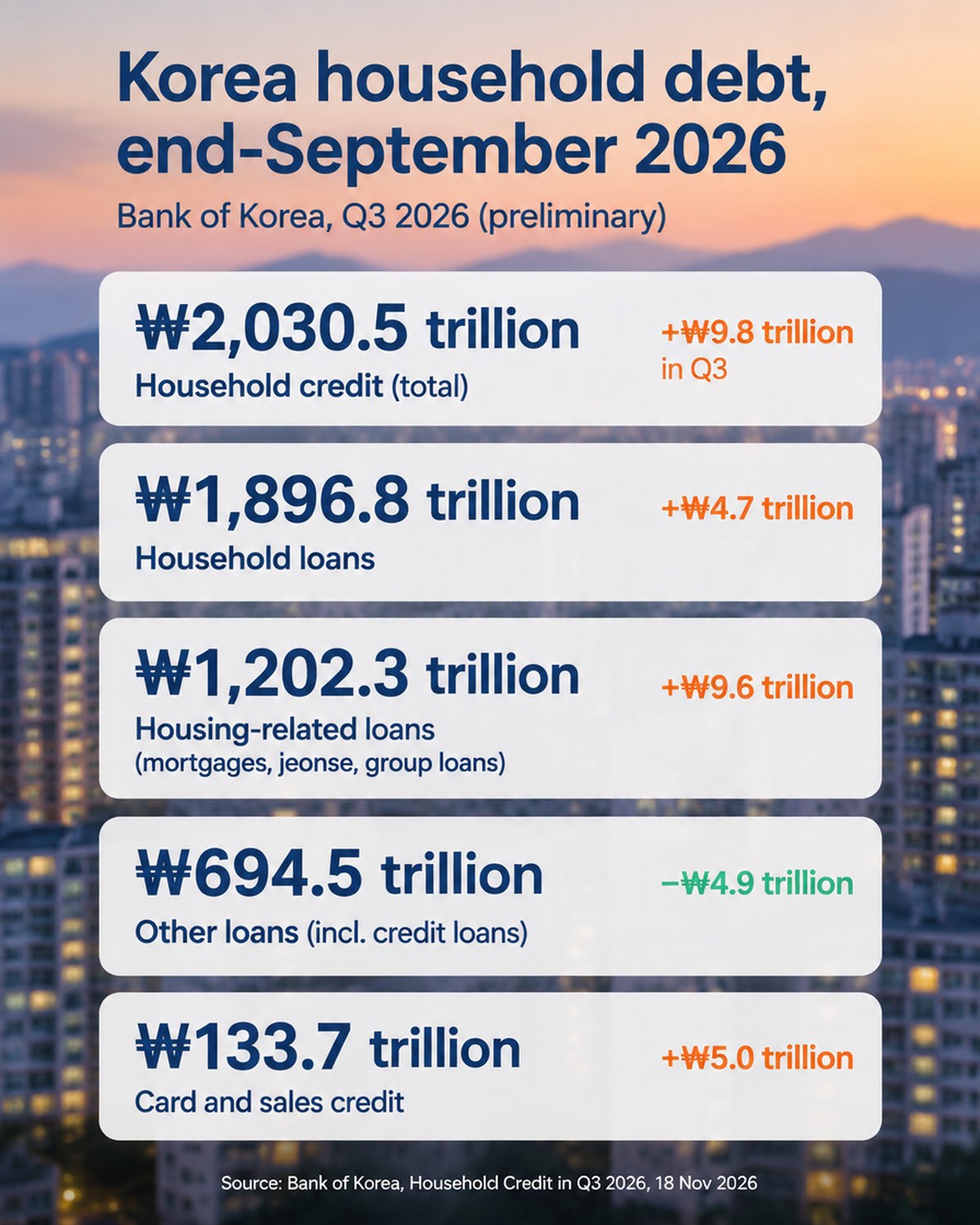
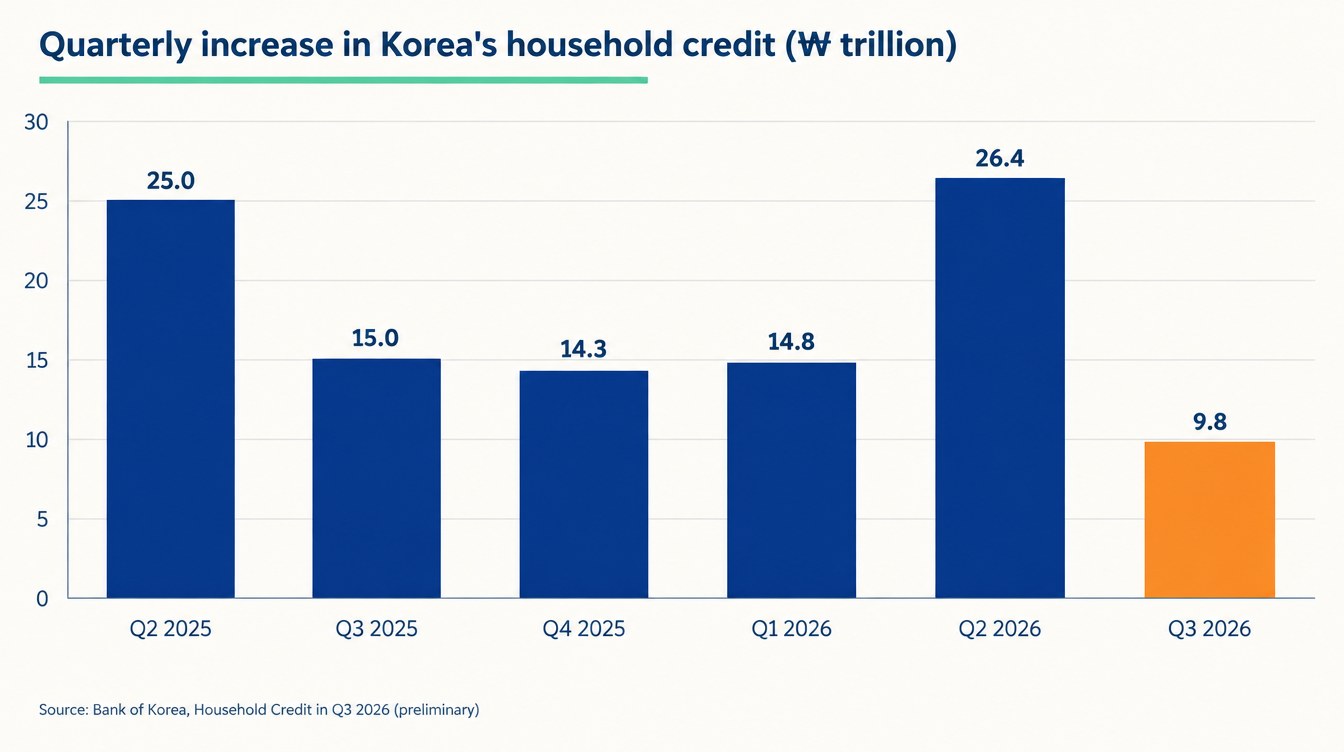
Quick answer: Korean households owed a record ₩2,030.5 trillion at the end of September 2026, the Bank of Korea said on 18 November. But the debt grew by only ₩9.8 trillion in the third quarter, about a third of the ₩26.4 trillion added in the second quarter and the smallest rise since early 2025. Credit loans fell as the stock market corrected, while housing loans, which include jeonse loans, still grew by ₩9.6 trillion. For a foreign resident the practical message is this: loan rates are high and still rising, lenders are under pressure to keep household lending in check, and the next Bank of Korea rate decision is on Thursday 26 November 2026.

Why now: this is the last household-debt release before the Bank of Korea’s final rate meeting of 2026, six days later (counting from 20 November). The Board weighs financial stability, including household debt, alongside inflation, so these numbers are part of the picture. If you hold, or plan to take, a Korean mortgage, jeonse loan or credit loan, here is what the data say and what they mean for your monthly payments.
Who this guide is for
- Foreign residents renting on jeonse (전세, a large lump-sum deposit instead of monthly rent) who borrowed part of the deposit, or plan to.
- Foreign homeowners or would-be buyers with a Korean mortgage (주택담보대출), especially a variable-rate one.
- Anyone with a credit loan (신용대출) or a large card balance in Korea.
- Students, investors and visitors following Korea’s economy who want to understand the “record household debt” headlines.
If you have no Korean debt at all, the figures still matter for rents, deposit rates and the won, but less directly.
The numbers: what the Bank of Korea published
“Household credit” (가계신용) is the Bank of Korea’s widest measure of what households owe to financial institutions. It has two parts: household loans (가계대출) from banks, credit unions, insurers, card companies and others, plus sales credit (판매신용), which is mainly unpaid card purchases. Here are the end-September figures from the release, with the change over the quarter:
| ₩ trillion | End-June 2026 | End-September 2026 | Change in Q3 | Change in Q2 |
|---|---|---|---|---|
| Household credit (total) | 2,020.8 | 2,030.5 | +9.8 | +26.4 |
| Household loans | 1,892.1 | 1,896.8 | +4.7 | +25.3 |
| of which housing-related loans | 1,192.7 (our calc) | 1,202.3 | +9.6 | +12.2 |
| of which other loans (incl. credit loans) | 699.4 (our calc) | 694.5 | −4.9 | +13.1 |
| Sales credit (card purchases etc.) | 128.7 | 133.7 | +5.0 | +1.1 |
Source: Bank of Korea, “2026년 3/4분기 가계신용(잠정)”, 18 November 2026, tables on pages 1–3. The end-June split between housing and other loans is our subtraction from the published end-September balances and Q3 changes. Figures from 2025 onwards are preliminary and can be revised.
Three points help you read the table:
- “Housing-related loans” include jeonse loans. The Bank of Korea’s footnote defines them as individual mortgages plus jeonse deposit loans (전세자금대출) plus group loans for new apartments (집단대출). So when you read that “mortgages” passed ₩1,200 trillion for the first time, that total also contains the jeonse loans many tenants, including foreign ones, rely on.
- The total is a record, the pace is not. Household credit first went above ₩2,000 trillion at the end of June 2026. On a year earlier it grew 3.3 percent in the third quarter, down from 3.6 percent in the second quarter (BOK table: +₩65.2 trillion on end-September 2025).
- The slowdown came from credit loans, not housing. Other loans fell by ₩4.9 trillion. Yonhap attributed the slowdown to “less demand for home purchases and investment-related loans”, and Etnews, reading the same release, reported that bank credit loans and securities firms’ margin lending (down ₩3.1 trillion) shrank as the stock market corrected. Housing-related loans kept growing by ₩9.6 trillion, and at deposit banks alone they grew faster than in the second quarter (+₩9.0 trillion against +₩6.8 trillion).
Who lent the money
The release also breaks the quarter’s loan growth down by lender. Banks kept lending; the others pulled back:
| Lender type (Bank of Korea category) | Change in Q3 2026 | Balance at end-September |
|---|---|---|
| Deposit banks (commercial and regional banks) | +₩8.1 trillion | ₩1,031.0 trillion |
| – of which bank housing-related loans | +₩9.0 trillion | ₩787.1 trillion |
| Non-bank deposit takers (savings banks, credit unions, mutual finance, saemaeul) | −₩1.0 trillion | ₩327.6 trillion |
| Other financial institutions (insurers, card companies, securities firms, public lenders) | −₩2.4 trillion | ₩538.3 trillion |
Source: Bank of Korea, same release, page 2. Etnews and the Financial News reported the same breakdown on 18 November.
Sales credit is the other number worth noticing: it rose ₩5.0 trillion in one quarter, about four times the second quarter’s ₩1.1 trillion and, Etnews reported, the biggest jump since the third quarter of 2024. Almost all of it came through card companies (+₩5.0 trillion at specialised credit lenders, BOK table). In plain terms, people are spending more on cards and carrying larger balances, and card balances count as household credit.
What it means for your loan rate
The household-debt total does not set your interest rate. Three other things do: the Bank of Korea’s base rate, the funding-cost indices that variable loans follow, and each bank’s own margin. Here is where those stood as of 20 November 2026:
| Indicator | Latest figure | Earlier figure | Source |
|---|---|---|---|
| Bank of Korea base rate | 3.00 percent (held 22 October) | 2.50 percent before the July and August 2026 hikes | Bank of Korea; Yonhap |
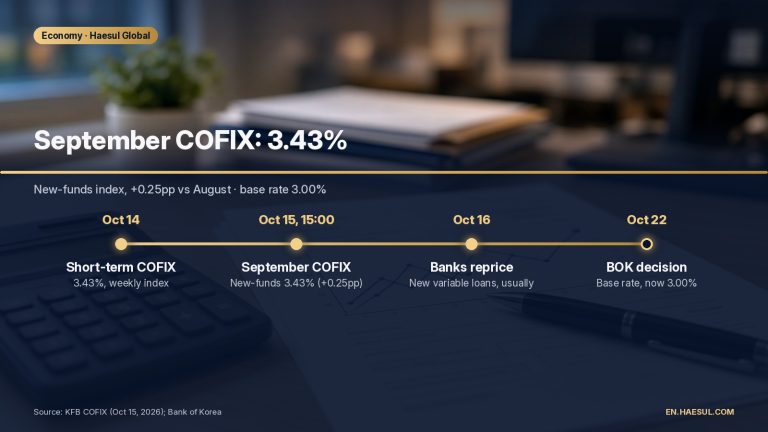
| New COFIX (variable-rate benchmark), October | 3.62 percent (published 16 November) | 3.43 percent in September | Korea Federation of Banks; Yonhap |
| Average new mortgage rate at banks, September | 4.88 percent | 4.23 percent in December 2025 | Bank of Korea; Asia Business Daily |
| – fixed rate / variable rate | 5.11 / 4.76 percent | 4.66 percent (all mortgages) in August | Bank of Korea |
| Average new jeonse loan rate, September | 4.57 percent | 3.99 percent in December 2025 | Bank of Korea; Newsworks |
| Average new general credit loan rate, September | 6.49 percent | 5.87 percent in December 2025 | Bank of Korea; Newsworks |
Rates are annual. September is the latest month the Bank of Korea has published; October’s lending rates are normally released at the end of November.
Two things stand out. First, rates have risen a long way in 2026: the average new mortgage rate went up 0.65 percentage points between December 2025 and September 2026, and the Bank of Korea’s own table shows the fixed mortgage rate above 5 percent. Second, COFIX kept rising in October even though the Bank held its rate, because banks were paying more for time deposits. Yonhap reported on 16 November that two big banks raised their COFIX-linked variable mortgage rates by 0.19 points from 17 November. Our COFIX explainer shows how the index feeds into your rate.
So does slower debt growth mean cheaper loans? Not by itself. The slowdown came mainly from credit loans being paid down as shares fell, not from banks cutting rates. Banks have been adding margin to manage household lending (the Bank of Korea’s staff said so in the October meeting minutes, as covered in our 26 November rate-decision preview). Lower loan demand can, over time, let banks compete harder on price, but the base rate and COFIX are moving the other way for now.
Worked examples: what the rates mean in won (our calculation)
These are illustrations using the official averages above. Your own rate depends on your bank, credit score, income proof and visa, so plug in the figure on your loan statement instead.
Example 1: a ₩200 million jeonse loan, interest only. Most jeonse loans are interest-only until the deposit comes back.
| Annual rate | Monthly interest | Yearly interest |
|---|---|---|
| 3.99 percent (December 2025 average) | ₩665,000 | ₩7,980,000 |
| 4.57 percent (September 2026 average) | ₩761,667 | ₩9,140,000 |
| 4.82 percent (September average + 0.25 points) | ₩803,333 | ₩9,640,000 |
Our calculation: loan × rate ÷ 12. The jump from the December 2025 average to the September 2026 average adds about ₩96,700 a month. Another 0.25 points, the size of a typical base-rate move, would add about ₩41,700 a month, if your bank passed it on in full at your next reset.
Example 2: a ₩300 million mortgage over 30 years, equal monthly payments.
| Annual rate | Monthly payment |
|---|---|
| 4.23 percent (December 2025 average) | ₩1,472,309 |
| 4.76 percent (September 2026 variable average) | ₩1,566,751 |
| 4.88 percent (September 2026 average, all mortgages) | ₩1,588,535 |
| 5.11 percent (September 2026 fixed average) | ₩1,630,693 |
| 5.13 percent (4.88 + 0.25 points) | ₩1,634,384 |
Our calculation: standard annuity formula, 360 monthly payments, no fees or insurance. At the September average, a 0.25-point rise adds about ₩45,800 a month.
Example 3: how much a bank may lend you under the stress DSR rule. Korea limits loans by the debt service ratio (DSR, 총부채원리금상환비율): once your total household loans exceed ₩100 million, a bank may lend only if all your yearly loan repayments stay within 40 percent of your yearly income (50 percent at non-bank lenders), under a Financial Services Commission rule. Since 2024 the check adds a “stress rate” on top of the actual rate, so the bank tests whether you could still pay if rates rose. For variable-rate mortgages in the Seoul capital area and other regulated areas, the stress rate is at least 3.0 percentage points; for mortgages elsewhere only half of the calculated stress rate applies until 31 December 2026 (FSC guidance of 12 December 2025, extended on 30 June 2026). Korean press reports (Herald Economy, Newspim) put that at 1.5 points × 50 percent, or 0.75 points.
| Borrower with ₩60 million yearly income and no other loans | Rate the bank tests | Largest 30-year loan within 40 percent DSR |
|---|---|---|
| No stress rate (for comparison) | 4.88 percent | about ₩378 million |
| Outside the capital area, variable rate (+0.75 points) | 5.63 percent | about ₩347 million |
| Capital area / regulated area, variable rate (+3.0 points) | 7.88 percent | about ₩276 million |
Our calculation: ₩24 million a year (40 percent of ₩60 million) of equal monthly repayments, 360 months, at the tested rate. It shows the DSR limit only; loan-to-value caps, bank policy and other rules can cut the amount further. Hybrid and periodic fixed-rate loans get a smaller stress add-on under the FSC table. The FSC notices apply to household loans at these lenders and do not set separate DSR rules for foreign borrowers.
Jeonse loans for foreigners: what is actually on offer
The household-debt release counts jeonse loans inside housing-related loans, but it does not show who can get one. Two official pages give a picture:
- A bank product written for foreigners. KB Kookmin Bank publishes a jeonse loan for foreign nationals and overseas Koreans (KB WELCOME PLUS 전세자금대출), guaranteed by Seoul Guarantee Insurance. Its terms, as shown on 20 November 2026: aged 19 or over, living in Korea with at least 3 months of Korean income you can prove; visa valid for at least 3 more months on the loan date; a listed visa type (the list runs from A-1 to H-2 and includes D-2, E-2, E-7, F-2, F-4, F-5 and F-6); a lease signed through a licensed agent with at least 5 percent of the deposit paid; up to ₩200 million, and no more than 80 percent of the deposit. Its rate table on the same day: new 6-month COFIX 3.62 percent + 2.50 points margin, minus up to 1.40 points of discounts, so 4.72 to 6.12 percent. An independent guide (Gonjin, October 2026) describes the same visa and income conditions. We name it as an example of what exists, not as a recommendation; other banks have their own products.
- The public guarantee route. The Korea Housing Finance Corporation (HF, 한국주택금융공사) general jeonse guarantee lists deposits up to ₩700 million in Seoul, Gyeonggi and Incheon (₩500 million elsewhere), a guarantee of up to ₩400 million, a loan of at most 80 percent of the deposit and a guarantee ratio of 90 percent (80 percent in the capital area and regulated areas). The page does not mention nationality, but it asks for a resident registration abstract (주민등록등본) and ID. We could not confirm on an official page whether foreign residents are accepted, so ask the bank before you sign a lease.

Using the KB rate table, a foreigner borrowing the full ₩200 million would pay between about ₩786,700 a month (4.72 percent, all discounts) and ₩1,020,000 a month (6.12 percent, no discounts) in interest. That gap is bigger than the effect of any single rate decision, which is why the discount conditions (salary transfer, card use, automatic payments) matter.
Before you borrow against a deposit, make sure the deposit itself is protected: the move-in report, fixed date and HUG guarantee are explained in our rental deposit protection guide for foreigners.
What to watch on 26 November and after
- The rate decision, Thursday 26 November 2026. The base rate is 3.00 percent. Economists quoted in the Korean press mostly expect a 0.25-point rise to 3.25 percent, but a hold is possible. Our rate-decision preview sets out the scenarios. If the Board hikes, the jeonse-to-monthly-rent conversion cap (base rate + 2 points under the Housing Lease Protection Act Enforcement Decree) would rise from 5.0 to 5.25 percent; see our guide to renting a flat in Korea as a foreigner.
- What the Board says about household debt. Slower credit growth gives it a little more room, but housing loans are still growing by roughly ₩10 trillion a quarter. Listen for whether the Governor calls household debt stable or still a risk.
- October lending rates (end of November) and November COFIX (mid-December). These show whether banks are passing on higher funding costs.
- The stress DSR rules for 2027. The current FSC guidance runs to 31 December 2026; the half-rate treatment for mortgages outside the capital area ends then unless it is extended.
- Fourth-quarter household credit, due in February 2027 if the Bank follows its usual timetable.
A short checklist for foreign residents
- Find your reset date. On a variable loan, your rate changes only when it resets (often every 6 or 12 months). Check the date and the index (new COFIX, new balance COFIX or bank bonds) on your loan contract.
- Ask about discounts. Bank rate tables show margins and maximum discounts. Salary transfer and card-use discounts can be worth more than a base-rate move.
- Check your visa date before applying. Foreigner loan products typically need several months left on your stay; renew first if you are close.
- Keep 3 months of Korean income records. Payslips and income certificates are the usual minimum for foreigners.
- Watch card balances. Revolving card debt counts in household credit and costs far more than a secured loan.
- Protect the deposit before borrowing against it. Report your move, get the fixed date and consider a deposit-return guarantee.
Common problems
- “My rate went up but the Bank of Korea didn’t move.” COFIX and bank margins can rise without a base-rate change, as in October 2026.
- “The bank says I don’t qualify under DSR.” The stress rate can cut the amount sharply in the capital area. A longer fixed-rate period reduces the stress add-on under the FSC table; ask the bank to run both.
- “My income is paid abroad.” Korean lenders generally want Korean income records; KB’s foreigner jeonse product asks for at least 3 months of income in Korea.
- “The headline says debt is falling.” It is not: the total rose to a record. What fell is the pace of growth, and credit loans.
Frequently asked questions
Q. How much household debt does Korea have in 2026?
The Bank of Korea put household credit at ₩2,030.5 trillion at the end of September 2026, a record, up ₩9.8 trillion in the third quarter. Household loans were ₩1,896.8 trillion and sales credit, mainly card purchases, ₩133.7 trillion.
Q. Why did Korea’s household debt grow more slowly in the third quarter of 2026?
Other loans, which include credit loans, fell by ₩4.9 trillion as the stock market corrected and investment-related borrowing shrank. Housing-related loans still rose by ₩9.6 trillion, so housing remained the main source of growth.
Q. Does slower debt growth mean mortgage rates in Korea will fall?
Not by itself. In September 2026 the average new bank mortgage rate was 4.88 percent and October’s new COFIX rose to 3.62 percent. The Bank of Korea’s base rate is 3.00 percent and its next decision is on 26 November 2026.
Q. Can foreigners get a jeonse loan in Korea?
Some banks offer one. KB Kookmin Bank’s foreigner jeonse loan, for example, lends up to ₩200 million (no more than 80 percent of the deposit) to residents with listed visas, at least 3 months of Korean income and 3 months left on their visa. Ask your bank for its own conditions.
Q. What is stress DSR in Korea?
It is a loan limit test. Banks add a stress rate to your loan rate and check that all your yearly repayments stay within 40 percent of income (50 percent at non-banks). For variable-rate mortgages in the capital area the add-on is at least 3.0 percentage points.
Q. When is the next Bank of Korea rate decision?
Thursday 26 November 2026, the last meeting of the year. The base rate is 3.00 percent after hikes in July and August and a hold on 22 October 2026.
Related guides
- Bank of Korea rate decision, 26 November 2026: loans, savings and the won
- Korea COFIX rate explained and how it moves your loan
- Protecting a rental deposit in Korea as a foreigner
- Renting a flat in Korea as a foreigner: wolse vs jeonse
- Korea’s housing subscription savings deduction for 2026: who qualifies
Sources
- Bank of Korea, 2026년 3/4분기 가계신용(잠정) (Household Credit in Q3 2026, preliminary), 18 November 2026 (totals, quarterly changes, housing/other split, lenders, sales credit, footnote defining housing-related loans): https://www.bok.or.kr/portal/bbs/B0000501/view.do?menuNo=201264&nttId=11066748 ; English release: https://www.bok.or.kr/eng/bbs/E0000634/view.do?menuNo=400069&nttId=11066749
- Bank of Korea, 2026년 9월 금융기관 가중평균금리 (Interest Rates, September 2026), 29 October 2026 (new mortgage 4.88, fixed 5.11, variable 4.76, jeonse 4.57, credit 6.49; December 2025 comparisons): https://www.bok.or.kr/eng/bbs/E0000634/view.do?menuNo=400069&nttId=11066055
- Korea Federation of Banks, COFIX (October 2026 new COFIX 3.62, announced 16 November 2026): https://m.kfb.or.kr/eng/cofix/cofix.php
- Financial Services Commission, Notice 2022-30 (borrower DSR 40 percent banks / 50 percent non-banks above ₩100 million): https://www.fsc.go.kr/comm/getFile?fileNo=2&fileTy=ATTACH&srvcId=BBSTY1&upperNo=78432 ; FSC Notice 2025-954, third-stage stress DSR guidance for 2026 (12 December 2025; capital-area and regulated-area mortgages at least 3.0 points, other loans 1.5 to 3.0 points) ; FSC, third-stage stress DSR guidance change (30 June 2026; half rate for mortgages outside the capital area extended to 31 December 2026): https://better.fsc.go.kr/fsc_new/file/displayFile.do?filePath=/2026/06/30&orgFileName=260701_3단계+스트레스DSR+행정지도+변경시행.pdf&sysFileName=b80d2de1d3c34b3ea4ad057ec48aa7fc.pdf
- Korea Housing Finance Corporation, General jeonse loan guarantee (일반전세자금보증): https://www.hf.go.kr/ko/sub02/sub02_01_02.do
- KB Kookmin Bank, KB WELCOME PLUS 전세자금대출 (foreigner jeonse loan terms and rate table, 20 November 2026): https://obank.kbstar.com/quics?QSL=F&cc=b028364:b061618&page=C060283&브랜드상품코드=LN20001120
- Yonhap, “Household credit growth slows in Q3 amid high market rate” (18 November 2026): https://en.yna.co.kr/view/AEN20261118003300320 ; Yonhap, “Banks’ household mortgage lending rates up for 5th month in Sept.” (29 October 2026): https://en.yna.co.kr/view/AEN20261029003200320 ; Yonhap, new COFIX at 2-year-8-month high (16 November 2026): https://www.yna.co.kr/view/AKR20261116115851002
- Etnews, Q3 household credit analysis (18 November 2026): https://www.etnews.com/20261118000057 ; Financial News, housing loans pass ₩1,200 trillion (18 November 2026): https://www.fnnews.com/news/202611181805033877 ; Businesskorea, household debt tops ₩2,030 trillion: https://www.businesskorea.co.kr/news/articleView.html?idxno=281592
- Asia Business Daily, fixed mortgage rate 5.11 percent (29 October 2026): https://www.asiae.co.kr/en/article/2026102911552819039 ; Newsworks, September lending rates by type: https://www.newsworks.co.kr/en/articleView.html?idxno=901266
- Herald Economy, stress DSR outside the capital area in H2 2026: https://biz.heraldcorp.com/article/10793378 ; Newspim (30 June 2026): https://www.newspim.com/news/view/20260630001010
- Gonjin, “Can Foreigners Get a Jeonse Loan in Korea?” (October 2026): https://www.gonjin.com/2026/10/foreigners-jeonse-loan-korea-visa-eligibility.html ; Reddit r/Living_in_Korea, “Jeonse loan for foreigner?” (reader demand): https://www.reddit.com/r/Living_in_Korea/comments/1duvp8r/jeonse_loan_for_foreigner/
How we checked: On 20 November 2026 (KST) we read the Bank of Korea’s Korean release PDF and English summary for the third-quarter household credit figures and its September lending-rate tables, the KFB’s COFIX page, the FSC’s DSR notices, HF’s guarantee page and KB’s product page, and cross-checked the headline numbers with Yonhap, Etnews and the Financial News. The end-June housing/other split and all worked examples are our own calculations from those figures.
This guide is general information, not financial advice. Loan terms, rates and eligibility differ by lender and change often; confirm with your bank before you sign a lease or a loan.
Researched and drafted with AI assistance; checked against the sources listed.