Korea’s ISA Account in 2026: ₩20 Million a Year, ₩2 Million Tax-Free, and What to Do When the 3 Years Are Up
Haesul Economy desk (AI-assisted). As of 10 November 2026 (KST). Based on the current text of the Restriction of Special Taxation Act (조세특례제한법) article 91-18 and article 129-2 and the Income Tax Act article 59-3 on the National Law Information Center (law.go.kr), the National Tax Service (NTS) page on pension accounts, and the Ministry of Economy and Finance (MOEF) press release of 1 September 2026 on the 2026 tax reform bill. Independent cross-checks: Sejung Ilbo and the Korea Financial Newspaper (both 1 September 2026), Samil PwC’s commentary on the 2021 ISA amendment and the Korea Financial Investment Association’s ISA practice guideline. This is general information, not tax or investment advice.
Quick answer: Korea’s ISA (개인종합자산관리계좌, Individual Savings Account) still works the same way in 2026. You can put in ₩20 million a year, and unused room carries over, up to ₩100 million in total. When you close the account, the net interest and dividend income across the whole account is tax-free up to ₩2 million (general type) or ₩4 million (low-income / farmer and fisher type). Anything above that is taxed at a flat 9% (9.9% with local income tax), kept out of comprehensive income tax. The minimum term is 3 years. After that you can extend, close, or move the money into a pension account within 60 days for an extra tax-credit base of 10% of the amount moved, up to ₩3 million. The government’s 2026 reform bill drops its August plan to cap the term and end the carry-over. Its proposed new “Productive Finance ISA” is still before the National Assembly.
If you are in your 40s, 50s or early 60s, the ISA is usually the second tax-advantaged account people ask about, after the pension savings and IRP accounts. It is not a retirement account. Your money is not locked up until 55, and the tax break comes at the end, when you close it, rather than every year at year-end settlement. That makes it useful for medium-term money: a deposit you would otherwise hold in a bank, a dividend fund, or money you plan to move into a pension later. This guide covers who can open one, what the limits are in 2026, how the tax-free amount works, a worked calculation, what the 2026 reform bill really changes, and your choices at the 3-year mark.

Who can open an ISA
Article 91-18(1) of the Restriction of Special Taxation Act lets two groups of residents (거주자) open an account:
- anyone 19 or older on the day they open or extend it; or
- anyone 15 or older who had earned income (근로소득) in the previous tax year (tax-exempt income alone does not count).
Two limits apply to everyone:
| Rule | What the law says |
|---|---|
| One account per person | Article 91-18(3)1: “1명당 1개의 계좌만 보유할 것”. You can move it between banks and brokers, but you cannot hold two at once |
| Financial-income comprehensive taxpayers excluded | Article 129-2: no ISA tax benefit if you were a financial-income comprehensive taxpayer (금융소득종합과세 대상자) in any one of the three tax years before the opening or extension date. In practice that means interest and dividends above ₩20 million in a year |
| Account types | Brokerage type (투자중개형), discretionary type (투자일임형) or trust type (신탁형), opened with an investment broker, a discretionary manager or a trust company |
| What it can hold | Deposits and similar products, domestic funds (foreign collective investment securities excluded), derivative-linked securities, listed shares and other assets set by decree |
Sources: law.go.kr, 조세특례제한법 제91조의18 and 제129조의2 (in force 18 September 2026). The ₩20 million comprehensive-taxation threshold is from an independent tax guide, not from the article itself.
Foreign residents. The law talks about residents, not nationality. The Korea Financial Investment Association’s guideline tells brokers to add a resident-status check to the forms for foreign workers. A foreigner who is a Korean tax resident can usually open one. Bring your residence card and ask the branch which papers it needs.
Which type of tax-free amount you get depends on last year’s income. Article 91-18(2) gives the ₩4 million “low-income” (서민형) amount if your previous-year total salary was ₩50 million or less, or your comprehensive income was ₩38 million or less (with salary not above ₩50 million), or you are an eligible farmer or fisher. Everyone else gets ₩2 million. For the ₩4 million type you need an income confirmation certificate (소득확인증명서) from the tax office. Under the KOFIA guideline, an adult opening a general-type account needs only ID.
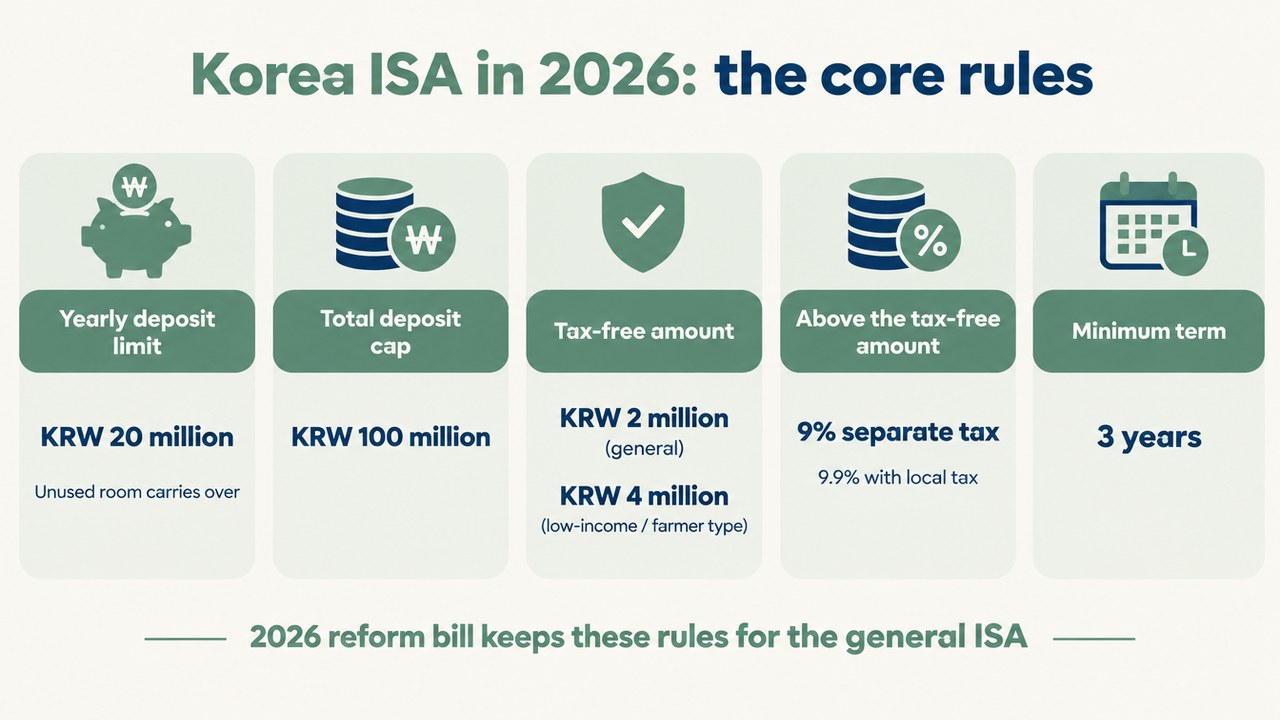
The 2026 limits, one by one
| Item | 2026 rule | Where it comes from |
|---|---|---|
| Yearly deposit limit | ₩20 million | MOEF 1 Sept 2026 release (“연 2천만원, 총 1억원” as the current rule) |
| Unused yearly room | Carries over to later years | MOEF release (current rule kept); Samil PwC 2021 commentary |
| Total deposit cap | ₩100 million (less any 재형저축 / long-term fund savings you hold) | Art. 91-18(3)5 |
| Tax-free amount | ₩2 million general · ₩4 million low-income / farmer-fisher | Art. 91-18(2) |
| Tax above the tax-free amount | 9% separate taxation, not added to comprehensive income | Art. 91-18(1) |
| Minimum contract term | 3 years | Art. 91-18(3)4 |
| Maximum term | No limit: you can extend before expiry | Art. 91-18(4); MOEF release |
How the carry-over works. Samil PwC’s commentary on the 2021 amendment gives the formula for the deposit room: ₩20 million × (1 + years elapsed, up to 4), within the ₩100 million total. So unused room builds up. Say you opened an account in 2023 and put almost nothing in. By 2026 you may have up to ₩80 million of room (₩20 million × 4, calculated). Someone who has filled the account every year has only the ₩20 million for 2026. Your broker shows the exact figure in its app. Trust that number over your own count.
So is 31 December a deadline for an ISA? Not for deposits. Because unused room carries over, nothing is lost if you do not top up by the end of the year. That is the big difference from the pension savings and IRP credit, where 2026 deposits must land by 31 December (see our IRP and pension savings tax credit guide). December still matters in one case: when your ISA matures and you want to move the money into a pension account. That transfer counts in the tax year in which it lands (see below).
How the tax-free amount really works
The ISA’s tax break is calculated once, on the day you close the account (art. 91-18(5)–(6)). The provider adds up the interest and dividend income from everything in the account and subtracts losses from the assets held in it (the method is set by decree). It applies the tax-free amount to that net figure and withholds 9% on the rest. Outside an ISA, each interest payment or dividend is usually taxed when it is paid, at 14% income tax plus local tax, 15.4% in all, and a loss on one product does not reduce the tax on another.
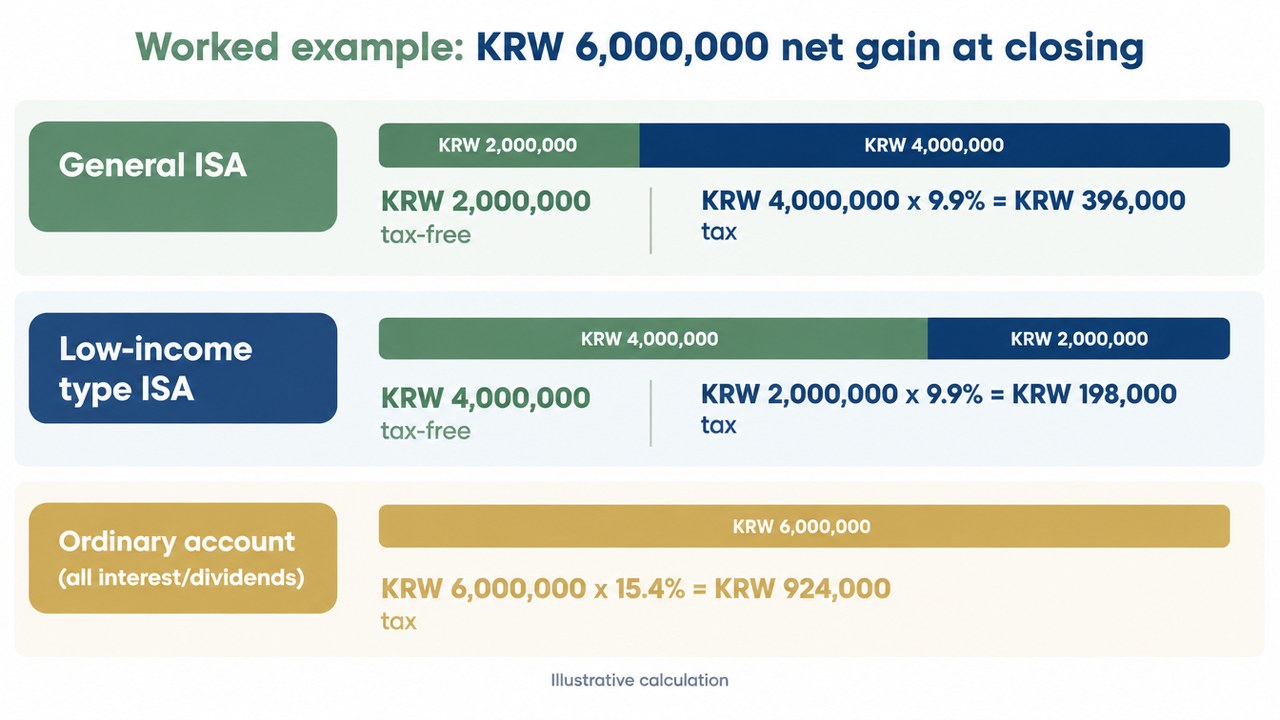
Worked example: ₩6 million of net income at closing
Assume that after three years the account’s interest and dividend income, minus losses, comes to ₩6,000,000. This is an illustrative number, calculated with the rates above:
| Account | Tax-free part | Taxed part | Tax |
|---|---|---|---|
| General ISA | ₩2,000,000 | ₩4,000,000 × 9.9% | ₩396,000 |
| Low-income type ISA | ₩4,000,000 | ₩2,000,000 × 9.9% | ₩198,000 |
| Ordinary account (if all ₩6,000,000 were interest/dividends taxed at 15.4%) | — | ₩6,000,000 × 15.4% | ₩924,000 |
Calculated. 9.9% = 9% (art. 91-18(1)) plus 10% local income tax on that, as independent guides show it. The 15.4% ordinary rate covers interest and dividends only. Gains on domestic listed shares sold in an ordinary account are treated differently, so this comparison does not apply to a share-trading portfolio.
So for this example the ISA saves about ₩528,000 (general) or ₩726,000 (low-income type) against an ordinary account (calculated). The saving grows with the income the account earns, and the netting of losses helps most in a mixed account. The ISA is not a guarantee of profit. Funds and shares inside it can lose money like anywhere else.
Leaving early: what you lose
The three years run from the day you first opened the account. If you close it before then, the provider must claw back the tax you were spared (art. 91-18(7)). The exceptions are death, emigration and the other unavoidable reasons set by decree. The 2021 commentary lists natural disasters and illness among them. You can take money out before three years without that happening, but only up to the total you have paid in. Taking out more than that counts as closing early (art. 91-18(8)).
What the 2026 tax reform bill really changes
There is a lot of confusing material online, so here is the timeline from the government’s own release:
| Date | What happened |
|---|---|
| 3 Aug 2026 | MOEF’s 2026 tax reform plan proposes capping the general ISA at 5 years in total, ending the carry-over of unused room and adding a 31 Dec 2029 sunset |
| 1 Sep 2026 | Cabinet approves the final government bill. All three ISA changes are dropped (“현행 유지”). The general ISA keeps the 3-year minimum, no maximum term, ₩20M/₩100M and the carry-over |
| 1 Sep 2026 | The same bill adds a new Productive Finance ISA (생산적금융 ISA, new art. 91-29): ₩20M a year, ₩200M in total, carry-over allowed, interest and dividends tax-free, aimed at domestic shares and funds. A youth version adds a 10% income deduction |
| Since Sep 2026 | The bill is before the National Assembly. Reports in early November put it at the tax subcommittee stage, not yet passed |
Sources: MOEF press release “2026년 세제개편안 정부안 확정” (1 Sept 2026) and its annex; Sejung Ilbo and Korea Financial Newspaper, 1 Sept 2026.
What this means for you. If you already hold an ISA, nothing in the bill shortens your term or takes away your carried-over room. The Productive Finance ISA would apply only to accounts opened from 2027, and only if the Assembly passes it. Its final terms could still change, so do not close an existing ISA now to wait for it. Claims of “₩40 million a year” or “₩5 million tax-free” come from earlier proposals that never became law. The figures in the law today are ₩20 million, ₩2 million and ₩4 million.
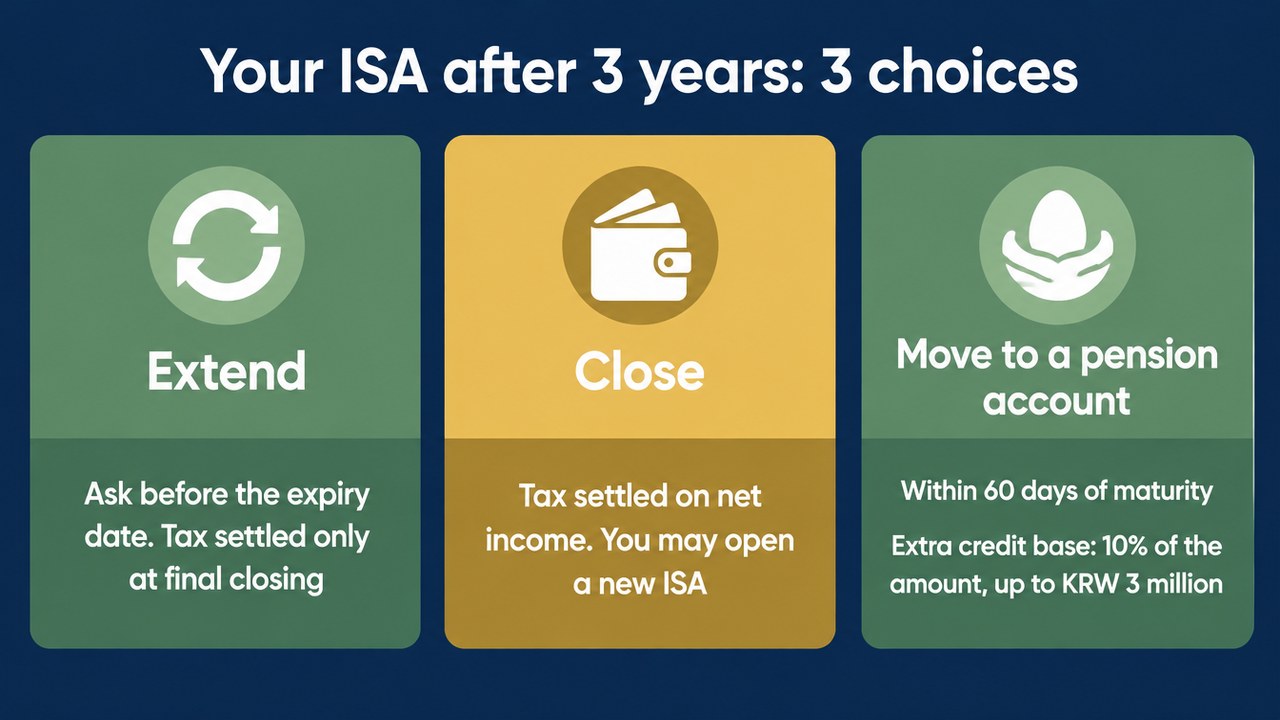
At the 3-year mark: extend, close, or move to a pension
Once three years have passed, you have three choices:
- Extend. Article 91-18(4) lets you extend the contract before it expires, with no maximum term. The tax-free amount is still settled only once, at final closing. Ask your provider before the expiry date, because the extension has to happen before the account expires.
- Close and take the money. Tax is settled on the net income as described above, and you receive the balance. The 2021 commentary notes that you can open a new ISA after closing or maturity, with a fresh 3-year clock.
- Move it into a pension account. Under Income Tax Act art. 59-3(3)–(4), you can pay all or part of the matured balance into a pension savings account or an IRP. That amount (전환금액) then counts toward your pension contributions for the year in which you pay it in. It also raises your tax-credit base by 10% of the amount moved, up to ₩3 million, on top of the usual ₩9 million. The NTS says the payment must be made within 60 days of the ISA’s maturity, and that it does not count toward the ₩18 million yearly pension payment cap. If you move money after the 3-year point, art. 91-18(11) treats the ISA as having matured.
Quick illustration (calculated): you move ₩30,000,000 from a matured ISA into a pension account. The extra base is the smaller of 10% × ₩30M = ₩3,000,000 and ₩3,000,000, so ₩3,000,000. At the 12% or 15% pension credit rate, that is up to ₩360,000 or ₩450,000 less tax, but only if you have enough tax to absorb it. Moving ₩20,000,000 gives a ₩2,000,000 extra base (₩240,000 or ₩300,000). Who gets 12% and who gets 15%, the ₩9 million base and early-withdrawal rules are all in our IRP and pension savings guide. We don’t repeat them here.
The December point. The extra base counts in the tax year the money arrives. If your ISA matures in November or December 2026, a transfer that lands by 31 December 2026 counts in this winter’s year-end settlement (see our year-end tax settlement guide). A transfer in January 2027, still inside the 60 days, counts for tax year 2027. The law also covers transfers spread across two tax years: the ₩3 million cap is shared between them.
One more thing for 50- and 60-somethings. Money moved into a pension account follows pension rules: you take it as a pension from 55, and taking it early is taxed differently. Only move money you won’t need before then. If you are weighing this against topping up your National Pension, our NPS catch-up and voluntary contribution guide covers that route.

A checklist before you act
- Check your opening date in the provider’s app: it sets your 3-year date and your carried-over deposit room.
- Check your type: general (₩2M) or low-income (₩4M). The low-income type depends on the previous year’s income and a tax-office certificate.
- Check the last three years: if your interest and dividends were above the comprehensive-taxation threshold in any of them, the tax benefit does not apply.
- Mark the expiry date: extend before it, or plan the pension move within 60 days after it.
- If you are moving money to a pension, decide whether you want it to land in 2026 or 2027, and confirm it with the provider.
- Don’t act on the reform bill yet: the general ISA rules stay as they are under the government bill, and the new account is not law.
Frequently asked questions
Q. What is the ISA deposit limit in Korea in 2026?
₩20 million a year, and unused room carries over to later years, up to ₩100 million in total. The government’s 2026 reform bill keeps these limits for the general ISA; its August plan to end the carry-over was withdrawn on 1 September 2026.
Q. How much ISA income is tax-free?
₩2 million of net interest and dividend income for the general type, or ₩4 million for the low-income and farmer/fisher type (previous-year salary of ₩50 million or less, or comprehensive income of ₩38 million or less). Income above that is taxed at a flat 9% (9.9% with local tax) and is not added to your comprehensive income.
Q. Can I close my ISA before 3 years?
You can, but the tax benefit is clawed back unless the reason is death, emigration or another unavoidable reason set by decree. You can withdraw up to the total you have paid in before 3 years without it counting as early closing; withdrawing more does.
Q. How do I move a matured ISA into a pension account?
Ask your provider to transfer all or part of the balance into your pension savings account or IRP within 60 days of the ISA’s maturity. The amount counts for the tax year it lands in and raises your credit base by 10% of the amount moved, up to ₩3 million, on top of the usual ₩9 million.
Q. Is the Productive Finance ISA available now?
No. It is part of the government’s 2026 tax reform bill (₩20 million a year, ₩200 million in total, tax-free interest and dividends), which was still before the National Assembly in early November 2026. If passed, it would apply to accounts opened from 1 January 2027.
Sources
- National Law Information Center, 조세특례제한법 제91조의18 (개인종합자산관리계좌에 대한 과세특례), in force 18 Sept 2026 (eligibility 19+ or 15+ with earned income; ₩4M/₩2M tax-free; 9% separate tax; one account; 3-year term; ₩100M total; extension; loss netting; early-closure clawback and exceptions; withdrawals up to principal; pension transfer deemed maturity) — https://law.go.kr/lsLinkCommonInfo.do?lsJoLnkSeq=1021859593 (confirmed 10 November 2026)
- National Law Information Center, 조세특례제한법 제129조의2 (저축지원을 위한 조세특례의 제한) (financial-income comprehensive taxpayers in any of the prior 3 tax years excluded) — https://www.law.go.kr/LSW/lsLawLinkInfo.do?chrClsCd=010202&lsJoLnkSeq=1034806529 (confirmed 10 November 2026)
- National Law Information Center, 소득세법 제59조의3 (연금계좌세액공제), in force 1 July 2026 (12%/15% credit; ₩6M/₩9M; ISA transfer amount counts in year paid; extra 10% up to ₩3M; split across two years) — https://www.law.go.kr/lsLinkCommonInfo.do?lsJoLnkSeq=1001059880 (confirmed 10 November 2026)
- National Tax Service, 연금소득 (pension account payment rules: ISA maturity balance may be paid in within 60 days of maturity, on top of the ₩18M yearly cap) — https://www.nts.go.kr/nts/cm/cntnts/cntntsView.do?cntntsId=7885 (confirmed 10 November 2026)
- Ministry of Economy and Finance, “2026년 세제개편안 정부안 확정” press release and annex, 1 September 2026 (general ISA term, ₩20M/₩100M limits and carry-over kept; Productive Finance ISA §91-29 terms) — https://www.mofe.go.kr/com/cmm/fms/FileDown.do?atchFileId=ATCH_000000000032613&fileSn=2 (confirmed 10 November 2026, search extract of the release)
- Independent: Sejung Ilbo, “정부, 2026년 세제개편안 확정…ISA·종부세 개편 일부 철회”, 1 September 2026 — https://www.sejungilbo.com/news/articleView.html?idxno=59908 (confirmed 10 November 2026)
- Independent: Korea Financial Newspaper (한국금융신문), “정부, ISA 계약기간·납입한도 현행 유지”, 1 September 2026 — https://www.fntimes.com/html/view.php?ud=202609011613272775179ad43907_18 (confirmed 10 November 2026, search extract)
- Independent: Samil PwC, 2021 개정세법 해설, 조세특례제한법 (ISA carry-over formula ₩20M × (1 + years elapsed, max 4); re-opening after closing; early-closure exceptions) — https://www.samili.com/mImage/etc/organ/2021/a-5_1-202104-14.pdf (confirmed 10 November 2026, search extract)
- Independent: Korea Financial Investment Association, 투자중개형 개인종합자산관리계좌 실무지침 (documents by type; resident check for foreign workers; prior-3-year exclusion notice) — https://law.kofia.or.kr/service/law/detailArticlePrint.do?contentSeq=233171&historySeq=1446&seq=343 (confirmed 10 November 2026)
- Independent: Nomiclens, “생산적금융 ISA 총정리” (bill status checked 3 Nov 2026: tax subcommittee, in committee) — https://nomiclens.com/productive-finance-isa/ (confirmed 10 November 2026, search extract)
This article is general information, not tax, legal or investment advice. ISA products can lose money, and the tax figures above are illustrations. Confirm your own deposit room, type and dates with your provider, and check the final law if the 2026 reform bill passes.




One Comment