Cholesterol Levels Explained: LDL, HDL, Triglycerides and Total Cholesterol, Agency by Agency
Quick answer: For adults, US MedlinePlus lists healthy levels as total cholesterol under 200 mg/dL, LDL under 100 mg/dL, HDL 60 mg/dL or higher, and triglycerides under 150 mg/dL. The UK’s NHS gives its guide in mmol/L: total cholesterol below 5, HDL above 1.0 (men) or 1.2 (women), and non-HDL below 4. Korea’s KDCA publishes the levels at which dyslipidaemia is diagnosed, which is a different kind of number. The agencies use different units and measure slightly different things, so this guide shows each one’s figures exactly as published and doesn’t convert or merge them.
What a cholesterol test measures
A standard test, called a lipid profile or lipid panel, reports:
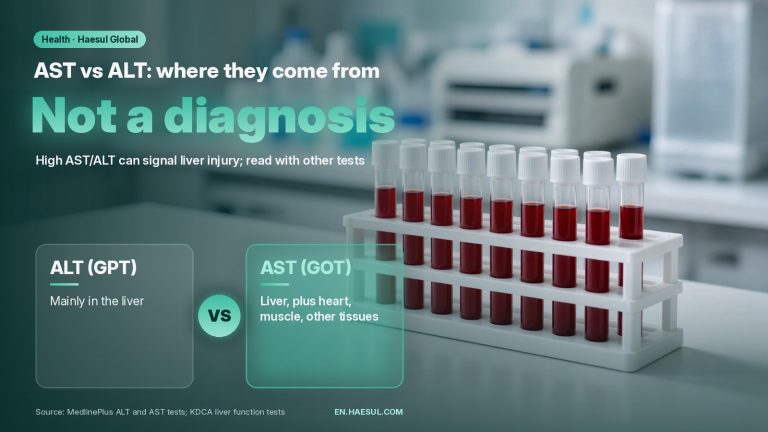
- LDL (“bad”) cholesterol: high levels can lead to plaque in the arteries, which can cause heart disease or stroke (CDC).
- HDL (“good”) cholesterol: helps remove LDL from the blood (MedlinePlus).
- Triglycerides: a type of fat in the blood that the body uses for energy (CDC).
- Total cholesterol: the overall amount of cholesterol in the blood.
- Non-HDL cholesterol: total cholesterol minus HDL. The NHS reports this measure (NHS).
The numbers, source by source
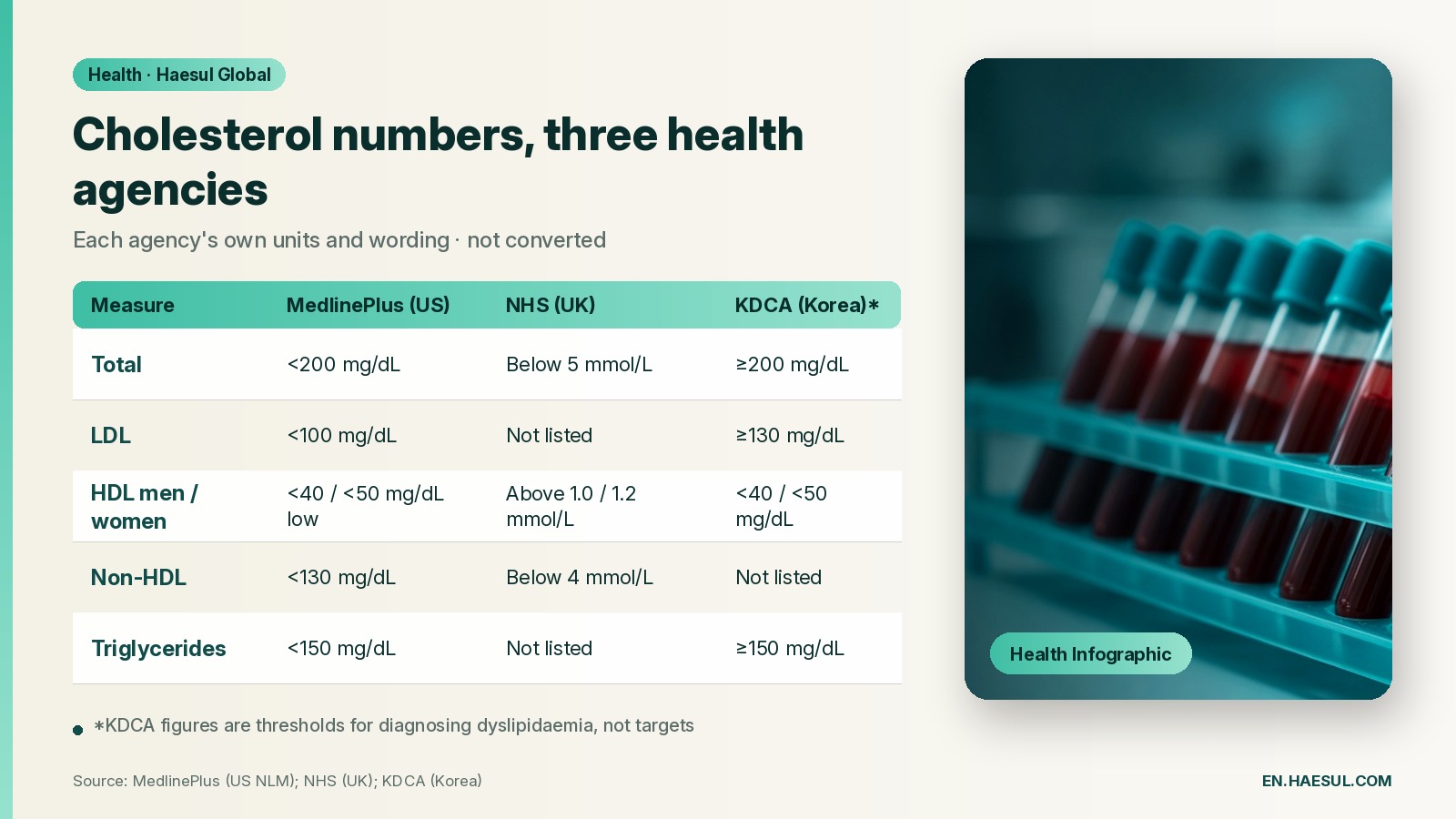
| Measure | MedlinePlus (US), adults 20+ | NHS (UK), healthy adults | KDCA (Korea): dyslipidaemia diagnosed if |
|---|---|---|---|
| Total cholesterol | Less than 200 mg/dL | Below 5 mmol/L | 200 mg/dL or higher |
| LDL | Less than 100 mg/dL | Not given on the page | 130 mg/dL or higher |
| HDL | 60 mg/dL or higher is best; low is under 40 (men) or under 50 (women) | Above 1.0 mmol/L (men) or 1.2 mmol/L (women) | Under 40 mg/dL (men) or under 50 mg/dL (women) |
| Non-HDL | Less than 130 mg/dL | Below 4 mmol/L | Not in the diagnostic list |
| Triglycerides | Less than 150 mg/dL (healthy) | Not given on the page | 150 mg/dL or higher |
Sources: MedlinePlus – Cholesterol Levels, MedlinePlus – Triglycerides Test, NHS – Cholesterol levels, KDCA National Health Information Portal – Dyslipidaemia.
MedlinePlus also gives separate healthy levels for people aged 19 or younger: total under 170 mg/dL, non-HDL under 120 mg/dL, LDL under 110 mg/dL and HDL over 45 mg/dL.
Why the numbers differ
- Different units. MedlinePlus and KDCA use mg/dL. The NHS uses mmol/L. The two scales are not the same, so 5 mmol/L is not “5” of anything on a mg/dL report. Check which unit your lab report uses.
- Different purposes.
- MedlinePlus and the NHS describe healthy levels, numbers to aim for.
- KDCA lists diagnostic thresholds, the levels at which dyslipidaemia is diagnosed.
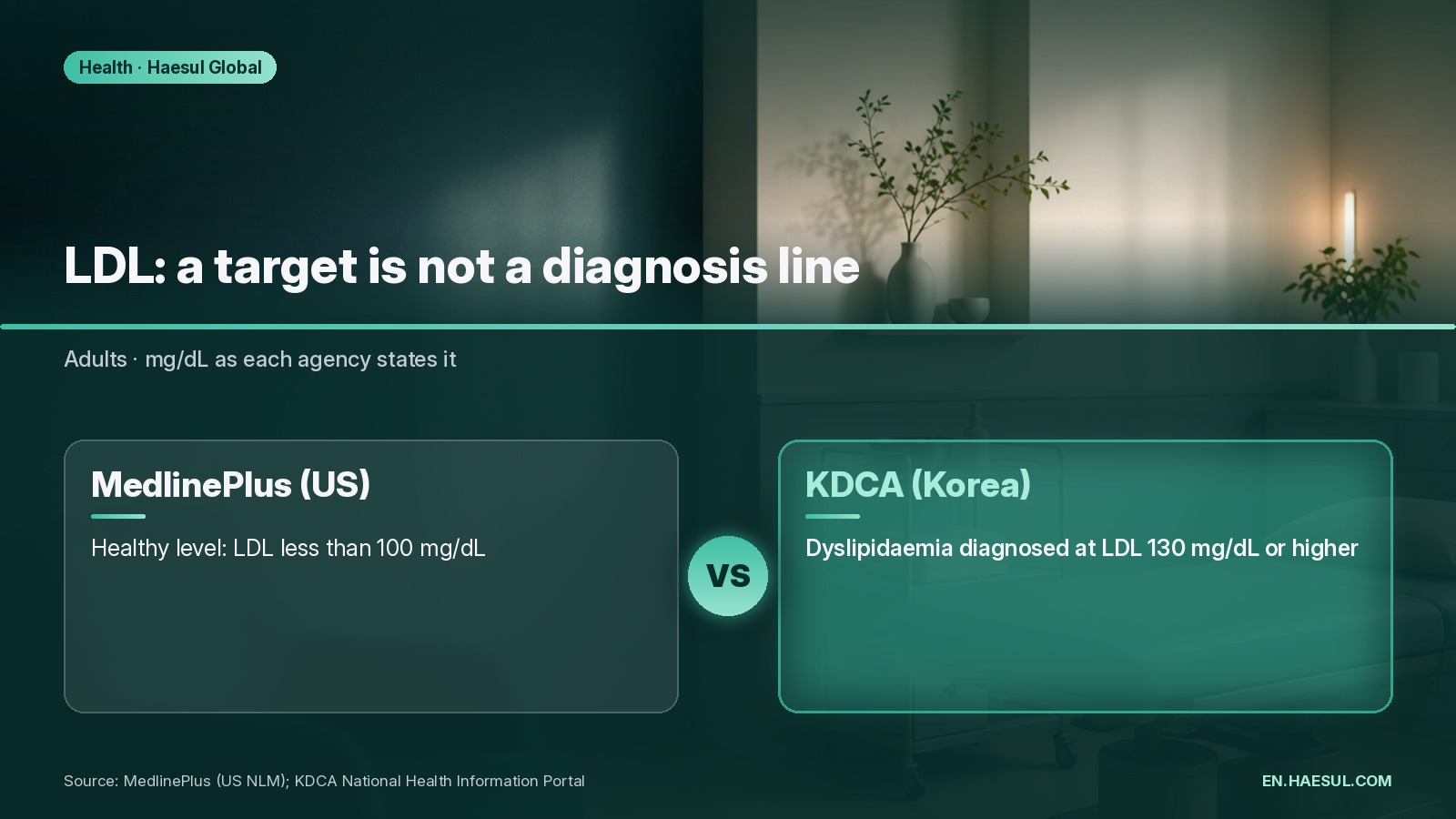
- So MedlinePlus’s healthy LDL is “less than 100 mg/dL,” while KDCA diagnoses dyslipidaemia at “130 mg/dL or higher.” The two statements don’t contradict each other: one is a target and the other is a diagnosis line.
- KDCA also says LDL treatment thresholds and targets depend on a person’s cardiovascular risk group.
- Different measures.
- The NHS page gives total, HDL and non-HDL cholesterol, but no LDL or triglyceride figures.
- KDCA lists non-HDL only as a supporting indicator.
- Personal risk matters. All three agencies say your own target depends on factors such as age, health conditions and cardiovascular risk. The NHS says GPs may use a QRISK score to estimate the 10-year risk.
Triglycerides: MedlinePlus categories
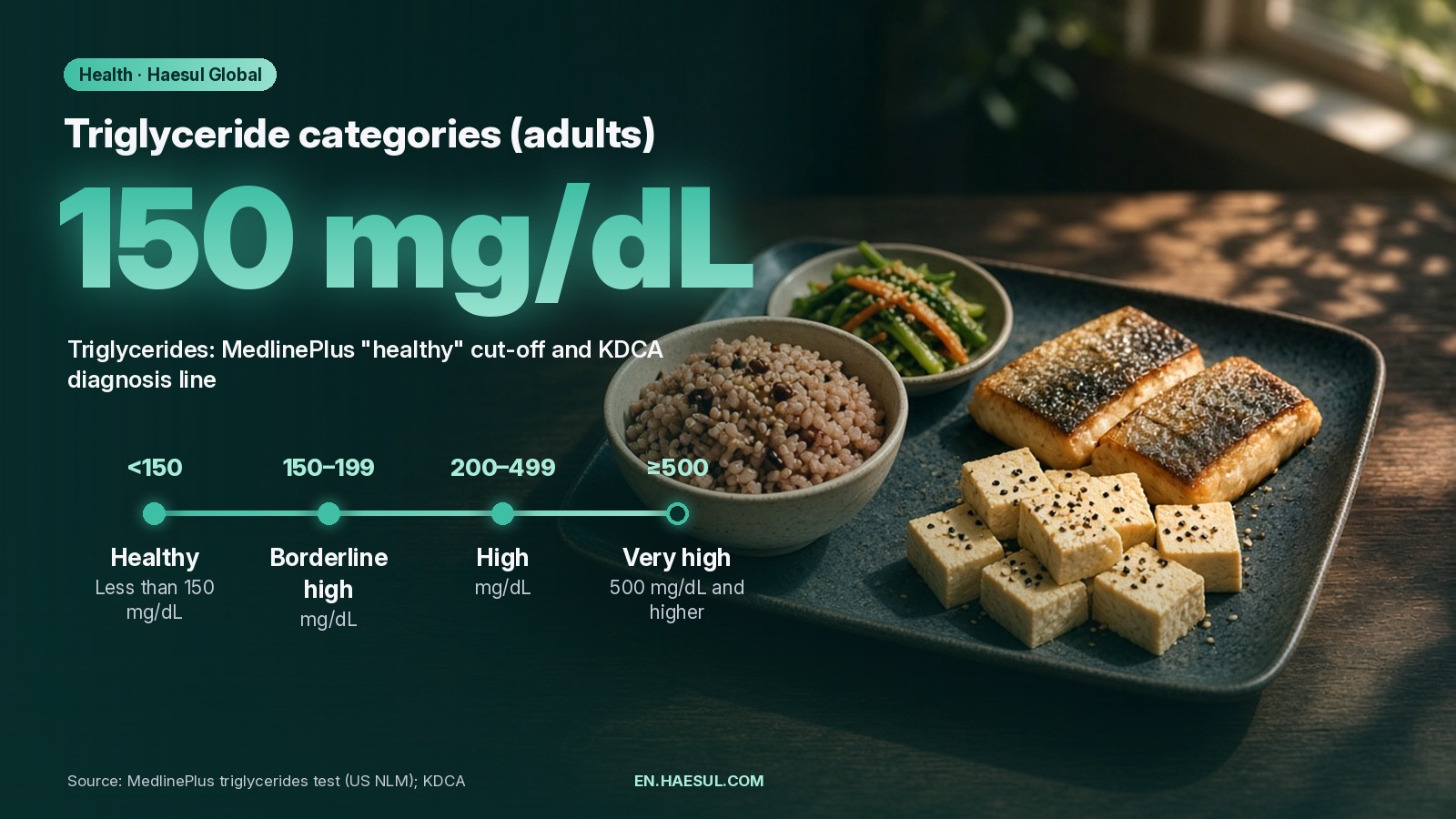
| Category (adults) | MedlinePlus |
|---|---|
| Healthy | Less than 150 mg/dL |
| Borderline high | 150 to 199 mg/dL |
| High | 200 to 499 mg/dL |
| Very high | 500 mg/dL and higher |
MedlinePlus says very high triglycerides raise the risk of sudden pancreatitis. KDCA likewise says treatment is needed at 500 mg/dL or higher because of the risk of acute pancreatitis (KDCA).
Korea note: KDCA thresholds
On its National Health Information Portal (updated August 19, 2026), Korea’s KDCA says dyslipidaemia is diagnosed when one or more of these is true:
– total cholesterol of 200 mg/dL or higher
– LDL of 130 mg/dL or higher
– HDL under 40 mg/dL (men) or under 50 mg/dL (women)
– triglycerides of 150 mg/dL or higher
KDCA reports that about 47.4% of Korean adults had dyslipidaemia in 2024.
Fasting before the test
The three agencies give different advice on fasting:
– MedlinePlus: you may need to fast for 9 to 12 hours.
– CDC: you may need to fast for 8 to 12 hours.
– KDCA: at least 9 hours, with 12 recommended. Without fasting, only total and HDL cholesterol can be used.
– NHS: it “does not make much difference” whether you have eaten.
Follow your own clinic’s instructions.
How often to get tested
- CDC: most healthy adults should be checked every 4 to 6 years, and more often with heart disease, diabetes or a family history of high cholesterol.
- MedlinePlus: younger adults every 5 years, men aged 45–65 and women aged 55–65 every 1–2 years, and people over 65 every year.
FAQ
Which numbers should I use?
Use the ones your doctor and lab use, and note the unit (mg/dL or mmol/L). The agencies differ in units and purpose, as explained above.
Is LDL under 130 mg/dL “normal”?
Not necessarily. 130 mg/dL is KDCA’s diagnosis line. MedlinePlus lists under 100 mg/dL as healthy. Your own target depends on your risk.
Why does the NHS show no LDL figure?
The NHS page lists total, HDL and non-HDL cholesterol only.
Can I convert mmol/L to mg/dL myself?
None of the sources used here give a conversion, so we haven’t done one. Ask your lab or doctor.
This article is general information, not medical advice. Talk to a doctor or other healthcare professional about your results, symptoms and treatment.
Sources
- MedlinePlus (US National Library of Medicine), Cholesterol Levels — https://medlineplus.gov/lab-tests/cholesterol-levels/ (2026년 10월 15일 확인)
- MedlinePlus (US National Library of Medicine), Triglycerides Test — https://medlineplus.gov/lab-tests/triglycerides-test/ (2026년 10월 15일 확인)
- NHS, High cholesterol – Cholesterol levels (last reviewed 13 March 2026) — https://www.nhs.uk/conditions/high-cholesterol/cholesterol-levels/ (2026년 10월 15일 확인)
- CDC, Testing for Cholesterol (May 15, 2024) — https://www.cdc.gov/cholesterol/testing/index.html (2026년 10월 15일 확인)
- 질병관리청 국가건강정보포털, 이상지질혈증 (updated 2026-08-19) — https://health.kdca.go.kr/healthinfo/biz/health/gnrlzHealthInfo/gnrlzHealthInfo/gnrlzHealthInfoView.do?cntnts_sn=6715 (2026년 10월 15일 확인)