How to Book KTX Trains in Korea as a Foreigner: Korail Pass vs Tickets, Fares and Refunds
Haesul Travel desk (AI-assisted). As of 16 November 2026 (KST). Based on Korail’s English ticketing guide, Korail Pass page, pass FAQ and notices on korail.com, Korail’s 5 August 2026 press release on the KTX–SRT merger and the Ministry of Land, Infrastructure and Transport’s 1 October 2026 notice, cross-checked against Hankyung, Maeil Shinmun and independent travel guides.
Quick answer: Book KTX tickets yourself on Korail’s English website, korail.com/global/eng (the old letskorail.com address now forwards there), with an email address, a password and an overseas credit card; no Korean phone number or membership is needed. Since 1 September 2026 a Seoul–Busan economy ticket costs ₩54,400, so a return trip (₩108,800) is cheaper than a 2-day Korail Pass (₩131,000). Seats go on sale at 07:00 Korea time two months before departure, and Monday–Thursday trains can be cancelled free until three hours before departure.

This guide is for visitors and foreign residents who want to ride the KTX, Korea’s high-speed train, without paying a reseller’s mark-up. It covers where to book in English, how the booking window and refund fees work, what the seat types mean, and a worked Seoul–Busan comparison that shows when the Korail Pass pays off and when it does not. It is general travel information; fares and rules can change, so check the official pages linked at the end before you pay.
Why book early for December and January
Two rule changes this autumn moved the year-end ticket rush earlier. From 1 October 2026, Korail opens tickets two months before departure instead of one, at 07:00 Korea time each day, according to the transport ministry and Korail’s English ticketing guide. That means trains for Christmas Day (Friday 25 December 2026) went on sale on 25 October, and trains for New Year’s Day (Friday 1 January 2027) on 1 November. Today, 16 November, the window reaches mid-January 2027.
Maeil Shinmun summed up the effect bluntly in October: the year-end ticket competition now finishes in October rather than November. If you are planning a Busan, Gyeongju or Gangneung trip over the holidays and have not booked yet, look at the Monday–Thursday trains first, try early-morning or late-evening departures, and check our Korea public holidays 2027 list before you pick dates in January and February.
Where to book: the English site, the app and the station
Korail sells tickets in four places, according to its English ticketing guide:
- korail.com (English and nine other foreign languages, plus Korean). This is the easiest option for visitors.
- KORAIL+, Korail’s mobile app, launched in August 2026, which sells all Korail trains including the former SRT services.
- Ticket machines at train stations (sales close 10 minutes before departure).
- Ticket counters at train stations, not at subway stations.
On the English website you can buy as a non-member. Korail asks for an email address and a password, and you must type them exactly the same way later (upper and lower case count) to see, print or cancel your ticket, so write them down. Payment is by credit card. Korail did post a short planned outage for foreign cards (24 August 2026, 03:00–05:00 KST), so if a payment fails at an odd hour, check the site’s Notice page before trying again.
Avoid unofficial resale sites. In a notice on its English site, Korail warns that unauthorized websites charge excessive fees and may sell invalid tickets; its example was a Seoul–Busan standard-class ticket at 43 USD on Korail versus 76 USD from an unauthorized seller (that example predates the September fare cut). Search results and ads often show resellers first, so type korail.com yourself.
How to book a KTX ticket on korail.com, step by step
- Go to korail.com/global/eng and choose TICKETS (Ticket Reservation). The form already suggests Seoul to Busan; change the departure and arrival stations if needed.
- Pick the date of departure and the number of passengers, then Search. You can filter by train type (KTX, ITX-Saemaeul, Mugunghwa, ITX-Cheongchun).
- Choose a train and a seat class (Economy or First Class; see the seat section below). If a train shows as sold out, try the trains either side of it or a different departure station in Seoul.
- Enter the email address and password you will use to find the ticket later, then pay by card.
- Open MY TICKET to view the ticket. Korail’s pass rules say a ticket shown on the mobile website counts but a screenshot does not, so keep the page open or print it.
Busan trains from Seoul leave from Seoul Station and, since the merger, also from Suseo Station in southeast Seoul (the former SRT terminal, now a KTX station), which is handy if you stay in Gangnam or Jamsil. Korail says KORAIL+ searches Seoul and Suseo departures together; on the English website, check both if your first choice is full. If you are coming straight from the airport, our Incheon Airport to Seoul guide covers the AREX Express to Seoul Station.

What changed on 1 September 2026: SRT is now KTX
For ten years Korea ran two high-speed brands: KTX (Korail, mostly from Seoul and Yongsan stations) and SRT (a separate company, from Suseo). On 1 September 2026 Korail took over SR’s operations. The former SRT trains are now called KTX-Sancheon, and Suseo, Dongtan and Pyeongtaek-Jije became KTX stations, as reported by Yonhap and Hankyung and set out in Korail’s 5 August press release. For travellers, three things matter:
- One booking system. You no longer need a separate SRT site or app for Suseo trains.
- Lower fares. Korail cut KTX fares by about 10 percent on average to match the old SRT fares. Seoul–Busan economy fell from ₩59,800 to ₩54,400; Yongsan–Gwangju Songjeong fell from ₩46,800 to ₩42,000.
- More seats. Korail said it would add about 116,000 high-speed seats a week, with weekday services rising from 379 to 402 a day and weekend services from 431 to 457.
Korail’s press release also lists rules that now apply to all its high-speed trains for railway members: free changes to a train up to seven days before or after the original date (up to 30 minutes before departure), no refund fee if you cancel within 10 minutes of paying (up to 30 minutes before departure, twice a day), and larger delay compensation (75 percent of the fare for 90–120 minutes late, 100 percent for 120 minutes or more). The English site does not say whether non-member bookings get the same change and 10-minute rules, so do not count on them if you booked as a guest.
Seat types: Economy, First Class, standing and non-reserved
| Seat type | What it is | Who it suits |
|---|---|---|
| Economy (일반실) | Standard reserved seat | Most trips; the fare quoted in this guide |
| First Class (특실) | Roomier reserved seat in separate cars; costs extra on top of the fare | Long trips, work, more space |
| Standing (입석) | A ticket without a seat, on trains where Korail sells them | Short hops or sold-out holiday trains |
| Non-reserved (자유석) | Seats in set cars taken first come, first served by holders of non-reserved or commuter tickets | Commuters; mainly weekday peak times |
Korail’s fleet page lists three high-speed train types you will see on the Busan line and elsewhere: the original KTX (955 seats a train), the shorter KTX-Sancheon (377 seats, often coupled in pairs) and the newer KTX-Eum (381 seats). The seat class matters more than the train type for price.
We have not quoted a First Class price because Korail has not published the post-cut First Class amount on the pages we read; the booking screen shows it when you search.
Worked example: Seoul–Busan, tickets vs Korail Pass
The Korail Pass is a rail pass for foreign visitors only (people with Korean nationality cannot use it). Since 11 December 2025 it is sold as a “select pass”: you choose 2, 3, 4 or 5 travel days within 10 days of the pass’s starting date. Prices on Korail’s English pass page, checked 16 November 2026:
| Korail Pass (select) | Adult (13+) | Child (6–12) | Pass price per travel day, adult (our calculation) |
|---|---|---|---|
| 2 days | ₩131,000 | ₩66,000 | ₩65,500 |
| 3 days | ₩186,000 | ₩93,000 | ₩62,000 |
| 4 days | ₩234,000 | ₩117,000 | ₩58,500 |
| 5 days | ₩275,000 | ₩138,000 | ₩55,000 |
One child under 6 travels free with each adult. Now compare that with point-to-point economy tickets at the official post-September fares (our calculation, adult, standard fare without discounts):
| Trip plan | Tickets (economy) | Best-fitting pass | Difference |
|---|---|---|---|
| Seoul → Busan one way | ₩54,400 | — | Tickets win |
| Seoul → Busan → Seoul (2 travel days) | ₩54,400 × 2 = ₩108,800 | 2-day pass ₩131,000 | Pass costs ₩22,200 more |
| Seoul → Busan → Seoul, plus Yongsan → Gwangju Songjeong → Yongsan (4 travel days) | ₩108,800 + ₩42,000 × 2 = ₩192,800 | 4-day pass ₩234,000 | Pass costs ₩41,200 more |
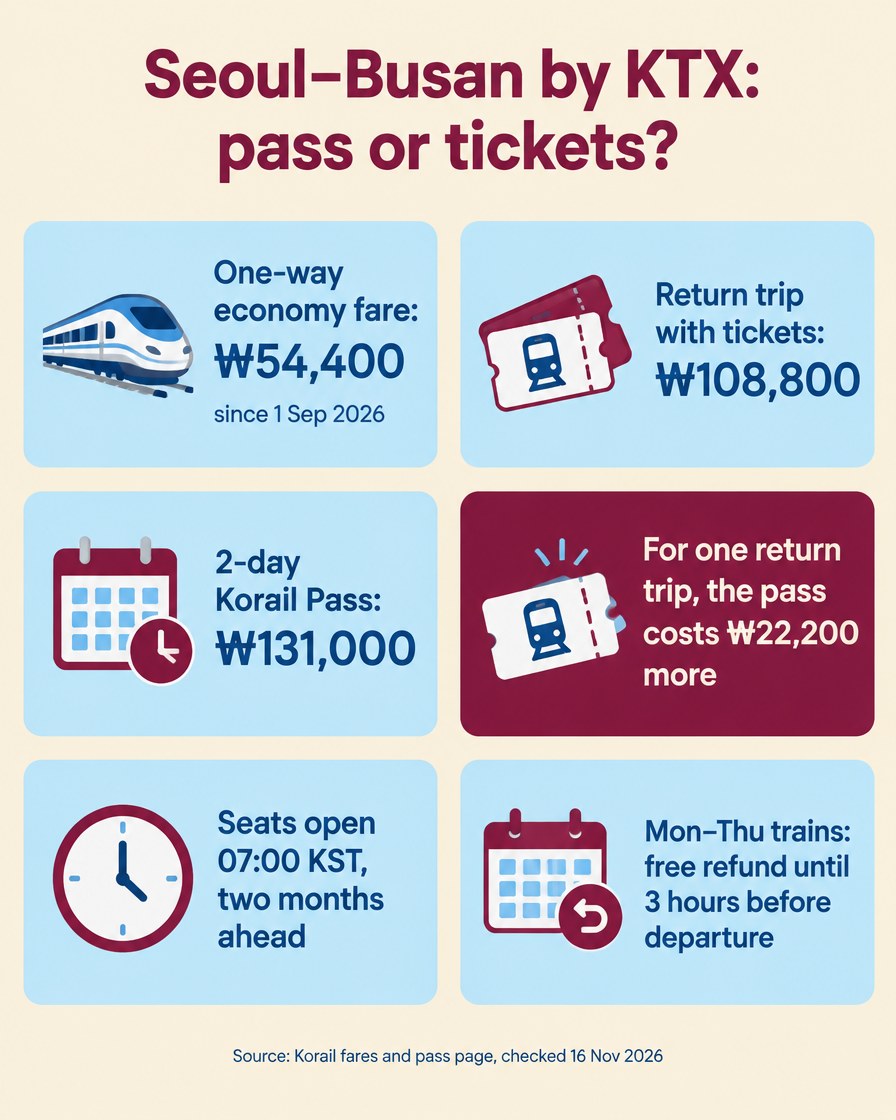
The pattern is simple: Seoul–Busan, one of the longest single KTX rides, now costs ₩54,400, which is less than the per-day price of every pass. So the pass only saves money if you take more than one long train ride on most of your pass days, for example Seoul to Busan in the morning and a second long ride later the same day. Korail lets pass holders reserve up to two seats per person per day, which caps how much you can ride with a guaranteed seat.
The pass still has real advantages: you can book seats for free up to two months ahead, you can board without a seat (standing) with your pass and passport if a train is sold out, and Korail says pass holders pay 50 percent of the First Class price for that route if they want a First Class seat. What it does not cover: the Seoul and Busan subways (use a T-money card for those), the metropolitan railway and temporary tourist trains. Korail’s older notices also excluded SRT trains; its current pass page does not mention the former SRT services now running as KTX-Sancheon from Suseo, so if you plan to use the pass from Suseo, ask Korail’s call centre (+82-1599-7777) first.
How to use a Korail Pass
- Buy the pass under BOOK KORAIL PASS on korail.com with a valid passport and a credit card. The name must match your passport; Korail says you cannot change the pass type, passenger type or personal details after purchase.
- Register your travel days in MY TICKET → DETAILS → Add (Departure Date).
- Reserve seats in MY TICKET → SEAT RESERVATION. The same journey cannot be reserved twice on one day; to switch trains, cancel the reserved seat first.
- Board with the pass, your passport and the seat ticket. A screenshot is not valid.
You can change the pass’s starting date once after buying. Korail warns that misuse of the pass (for example, letting someone else use it) can lead to the standard fare plus an extra charge of 10 to 30 times the fare.
Refunds and no-show fees
Tickets. You can cancel a ticket yourself under MY TICKET until the departure time. After departure, refunds are possible only at a station ticket office, and not at all once the train has reached your destination. The fee depends on the day of travel and how late you cancel. This is Korail’s English penalty table, rewritten as rows:
| When you cancel | Monday–Thursday trains | Friday–Sunday and public holiday trains |
|---|---|---|
| 2 months to 2 days before departure | Free | Minimum fee (₩400, as reported by Maeil Shinmun) |
| 1 day before departure | Free | 5% |
| 24 hours to 3 hours before departure | Free | 10% |
| 3 hours before until departure | 5% | 20% |
| Up to 20 minutes after departure (station only) | 15% | 30% |
| 20 to 60 minutes after departure (station only) | 40% | 40% |
| 60 minutes after departure until arrival (station only) | 70% | 70% |
Worked example (our calculation from the table): a ₩54,400 Seoul–Busan ticket for a Saturday cancelled the day before costs 5%, about ₩2,720, and you get about ₩51,680 back. A no-show on the same Saturday train that you report at the station 30 minutes after departure costs 40%, about ₩21,760. Korean holiday periods such as Seollal and Chuseok have their own stricter rules, so check the booking screen for those dates.
Korail Pass. There is no refund fee up to the day before the pass’s starting date (Korean time), and no refund at all from the starting date. You must cancel any seat reservations first, then refund under MY TICKET → DETAILS → REFUND. A pass bought from a travel agency or at a station must be refunded where you bought it, not online. Korail also says the pass does not pay compensation for delays or cancellations.
Common mistakes
- Using the wrong website. Search ads for “KTX tickets” often lead to resellers. Type korail.com yourself.
- Forgetting the guest password. Without the exact email and password, you cannot open or cancel a non-member ticket online.
- Showing a screenshot. Korail does not accept screenshots as tickets; open MY TICKET or print.
- Buying a pass for one return trip. At ₩54,400 each way, a single Seoul–Busan return is ₩22,200 cheaper on tickets.
- Waiting for “one month before”. Since 1 October the window is two months; holiday trains open much earlier than many older guides say.
- Booking a weekend train you might cancel. Friday–Sunday tickets carry fees from the first day; a Monday–Thursday train is free to cancel until three hours before.
If you are heading to the mountains rather than the coast, our guide to ski resorts near Seoul without a car covers the KTX to Jinbu for Yongpyong and the trains and shuttles to other resorts.
Heading to Busan after you book? See our 2-day Busan winter plan by KTX (Haeundae, Gamcheon, Jagalchi, Huinnyeoul, metro fares and December weather).
FAQ
Q. Can foreigners book KTX tickets online without a Korean phone number?
Yes. Korail’s English website, korail.com/global/eng, lets you book as a non-member with an email address and a password and pay with a credit card. Keep the email and password: you need both to view or cancel the ticket.
Q. How much is the KTX from Seoul to Busan in 2026?
Since 1 September 2026 the standard adult economy fare is ₩54,400, down from ₩59,800, after Korail cut KTX fares by about 10 percent when it merged with SR. First Class costs extra; the booking screen shows the amount.
Q. Is the Korail Pass worth it for Seoul to Busan?
Not for a single return trip. Two economy tickets cost ₩108,800, while the cheapest pass (2 days) costs ₩131,000. The pass pays off only if you take more than one long ride on most of your pass days.
Q. How far ahead can I book KTX tickets?
Two months. Since 1 October 2026 tickets go on sale at 07:00 Korea time two months before the departure date, and Korail Pass seat reservations also open two months ahead.
Q. What is the KTX cancellation fee?
For Monday–Thursday trains, cancelling is free until three hours before departure, then 5%. For Friday–Sunday and public-holiday trains, a minimum fee applies up to two days before, then 5% the day before, 10% from 24 to 3 hours before and 20% in the last three hours. After departure you can only get a refund at a station.
Q. Can I get a refund on a Korail Pass?
Yes, free of charge up to the day before the pass’s starting date, Korean time, after cancelling any seat reservations. From the starting date no refund is possible.
Sources
- Korail (English), Ticketing Guide: where and when to buy, refund penalty table: https://www.korail.com/global/eng/passengerGuide/ticketTypes/tickets
- Korail (English), About Korail Pass (prices, rules, seat reservation): https://www.korail.com/global/eng/passengerGuide/ticketTypes/korailpass
- Korail (English), Korail Pass FAQ (start-date change, refund): https://www.korail.com/global/eng/korailpass/faq
- Korail (English), Notice on Korail Pass types and prices from 11 December 2025: https://www.korail.com/global/eng/siteInfo/notice/22248
- Korail (English), Notice warning about unauthorized ticket websites: https://www.korail.com/global/eng/siteInfo/notice/21242
- Korail (English), Notice on foreign credit card maintenance, 24 August 2026: https://www.korail.com/global/eng/siteInfo/notice/25703
- Korail (English), Train fleet: https://www.korail.com/global/eng/passengerGuide/info/trainFleet
- Korail press release, integrated high-speed rail from September (5 August 2026, Korean): https://info.korail.com/info/selectBbsNttView.do?bbsNo=199&key=911&nttNo=27135
- Ministry of Land, Infrastructure and Transport via Korea.kr, booking window extended to two months from 1 October 2026 (Korean): https://www.korea.kr/news/policyNewsView.do?newsId=148972799
- Hankyung, Seoul–Busan KTX ₩54,400 from 1 September (31 August 2026, Korean): https://www.hankyung.com/article/2026083145861
- Yonhap News, KTX–SRT integrated service starts (1 September 2026, Korean): https://www.yna.co.kr/view/AKR20260901085551063
- Maeil Shinmun, two-month booking window, fares and cancellation fees (3 October 2026, Korean): https://www.imaeil.com/page/view/2026100307142647453
- CityFluent, KTX booking and Korail Pass guide (November 2026): https://cityfluent.com/korea/getting-around/ktx-booking-korail-pass
- Dari, How to book KTX as a foreigner (checked 12 October 2026): https://darikorea.app/en/guides/ktx-booking-foreigners
How we checked: We opened Korail’s English ticketing guide, pass page, pass FAQ and notices on 16 November 2026 and read the refund table from the page’s own HTML, then matched the fare cut, booking window and fee levels against Korail’s press release, the transport ministry and at least one independent news report. We could not run a live fare search (the site blocked automated lookups), so the First Class price is not quoted; all totals and per-day figures are our own arithmetic from the official fares and are labelled.
Researched and drafted with AI assistance; checked against the sources listed.





3 Comments