Mental Health Help in Korea for Foreigners: 109, 1577-0199, Local Centres and NHIS Costs
Haesul Health desk (AI-assisted). As of 15 November 2026 (KST). Based on the Ministry of Health and Welfare (MOHW) 109 and 1577-0199 pages and its 29 May 2026 release on the 109 hotline, the National Center for Mental Health’s 2026 directory of mental health institutions, the Gov24 service listing for mental health welfare centres, the Health Insurance Review and Assessment Service (HIRA) copayment tables, the GOV.KR foreigner portal, VISITKOREA and the Korea Astronomy and Space Science Institute (KASI), cross-checked with The Korea Herald (31 May 2026), The Korea Times (1 June 2026), Newsis (3 September 2025), the Central Mental Health Support Unit and two district health centre pages. General information, not medical advice.
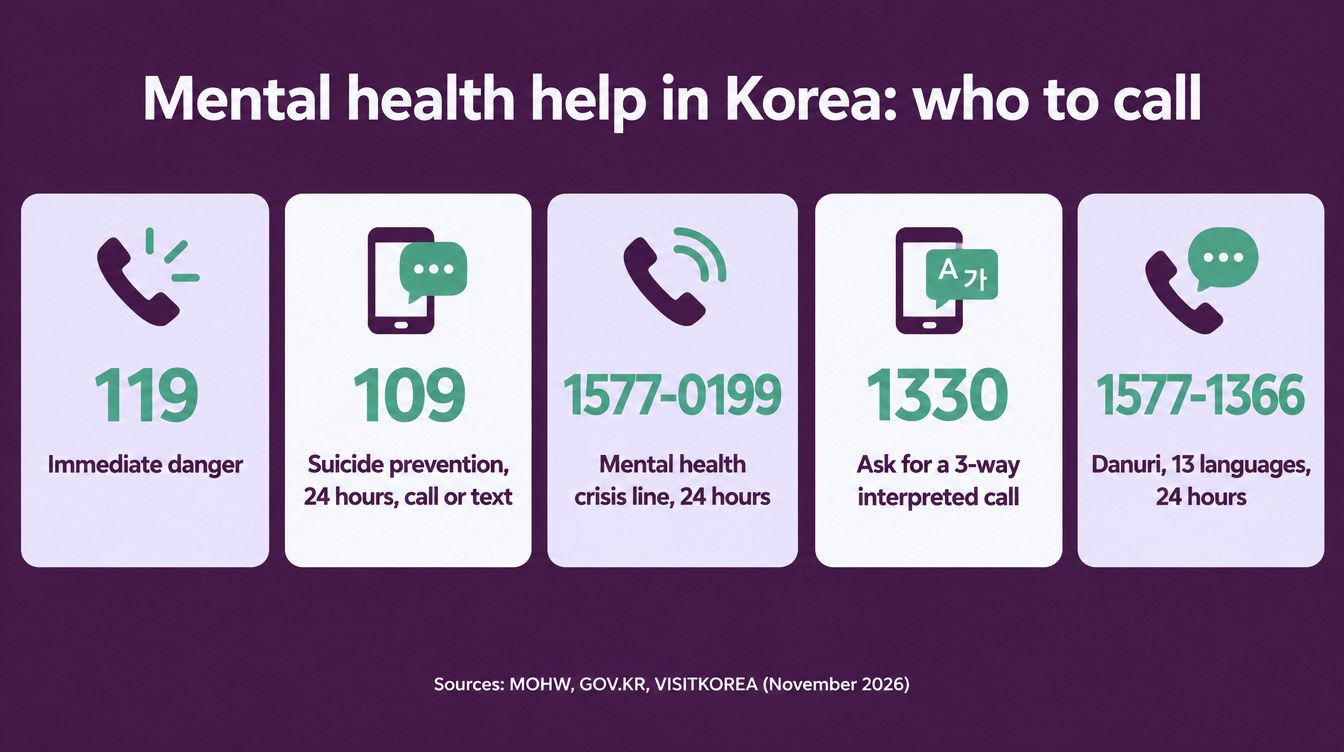
If you are thinking about suicide or self-harm right now: call 109 (24 hours) or text 109. If you or someone else is in immediate danger, call 119 (or 112 if there is violence). If you can’t speak Korean, ask for an interpreter, or call 1330 first and ask for a three-way interpreted call. Danuri (1577-1366) answers 24 hours a day in 13 languages, including English.
Quick answer: Korea has one free number for suicidal thoughts, 109, which since 1 January 2024 has taken over all suicide-prevention counselling. It also answers texts and runs a chat service called Madeullan (마들랜). For other mental health worries, 1577-0199 connects you to your local public mental health welfare centre (정신건강복지센터), day or night. There are 263 of these centres, and the government lists them as open to anyone living in the area. If you are enrolled in the National Health Insurance Service (NHIS), a psychiatrist visit costs you the normal outpatient share, and talk therapy with a psychiatrist is charged at a reduced rate: 10% at a clinic. The government’s voucher for private counselling is not open to foreign nationals unless they have naturalised.

This guide is for foreigners living in Korea, especially in the long, dark weeks between November and February, when isolation and homesickness can hit hardest. It covers which number to call, how to get through without much Korean, what the free public centres do, and what a psychiatrist or therapist costs on NHIS. It doesn’t diagnose anything or recommend treatments. That is for a doctor or mental health professional.
Which number for what
| Number | What it is | Hours | Language |
|---|---|---|---|
| 119 | Fire-service ambulance and emergency rescue | 24 hours | Say “English please” or “Interpreter please”; the operator links a professional interpreter (VISITKOREA) |
| 112 | Police, if there is violence or a threat to life or property | 24 hours | Same “English please” interpreter link (VISITKOREA) |
| 109 | MOHW suicide-prevention counselling line (자살예방상담전화) | 24 hours, 365 days | Korean; ask for an interpreter, or relay through 1330 or Danuri (see below) |
| Text 109 / Madeullan | Suicide-prevention chat by text message, KakaoTalk channel or app (마들랜) | 24 hours, 365 days | Korean-language service |
| 1577-0199 | Mental health crisis line (정신건강위기상담전화), routed to your local mental health welfare centre | 24 hours | Korean; ask for an interpreter or use a relay |
| 1588-9191 | Lifeline Korea (생명의전화), a civilian suicide-prevention line listed by MOHW | 24 hours | Korean |
| 1388 | Youth counselling line | 24 hours | Korean |
| 1577-1366 | Danuri Call Center: crisis counselling and three-way interpretation | 24 hours (central centre) | 13 languages, including English |
| 1330 | Korea Travel Hotline (+82-2-1330 from abroad) | 24 hours | Korean, English, Japanese, Chinese, Russian, Vietnamese, Thai, Malay |
Hours and services: MOHW 109 page and 1577-0199 page; GOV.KR foreigner portal (Danuri); VISITKOREA (1330, 112, 119). The 109 page lists Lifeline Korea, 1388 and 1577-0199 as 24-hour lines.
Why 109, and what happened to the other numbers
MOHW’s 109 page says that from 1 January 2024 all suicide-prevention counselling was merged into 109. The old suicide-prevention number 1393 is gone. The mental health line 1577-0199, the youth line 1388 and the women’s emergency line 1366 still work as before, each for its own purpose. (A 2024 Korea Policy Briefing reader article says 1577-0199 was folded into 109. MOHW’s own FAQ says it was not, and MOHW still lists 1577-0199 as a live 24-hour number, so we follow MOHW.)
MOHW says what you say to 109 or Madeullan is confidential. There is one exception: if a caller is in danger, the counsellor may ask other agencies for help. If a counsellor judges the risk to be high, and you agree, they can refer you to the mental health welfare centre or suicide prevention centre where you live for face-to-face counselling and follow-up.
Text instead of talk: Madeullan
If speaking is too hard, MOHW’s text service Madeullan (마들랜, short for “a friend online who listens to your heart”) is open 24 hours a day, every day. You can reach it by text message to 109, the “마들랜” KakaoTalk channel or the Madeullan app. MOHW and the Korea Foundation for Suicide Prevention describe it as anonymous chat with trained counsellors. Writing in Korean is the safe assumption. A translation app can help you type a short first message, such as “저는 외국인이에요. 한국어가 서툴러요” (“I’m a foreigner. My Korean isn’t good”).
Getting help when you don’t speak Korean
This is the hard part, so here is exactly what we could confirm.
- 109 and 1577-0199 run in Korean. Neither MOHW page lists foreign-language service. Korean news outlets end suicide reports with a notice telling English speakers to call 109 and “request a translator for English-language services” (quoted by The Korea Herald, 31 May 2026). Try saying “English interpreter, please” (영어 통역 부탁합니다) as soon as the call connects.
- 1330 can set up a three-way call. The Korea Times (1 June 2026) reports that you can dial 1330 and ask an English-speaking operator to set up a three-way interpreted call with an emergency line such as 109. VISITKOREA confirms 1330’s eight languages. We found this relay described only in that report, not on an official page, so treat it as a workable route rather than a guarantee.
- Danuri (1577-1366) interprets in 13 languages, 24 hours a day. The GOV.KR foreigner portal lists English, Chinese, Vietnamese, Tagalog, Khmer, Mongolian, Russian, Japanese, Thai, Lao, Uzbek and Nepali, plus Korean, with crisis counselling, emergency support and three-way calls. Its official target group is multicultural families and marriage migrants. In September 2025 the Korea Foundation for Suicide Prevention announced that Danuri would provide translated notices and three-way interpretation for marriage migrants and foreign nationals referred to suicide-prevention services (Newsis, 3 September 2025).
- In immediate danger, don’t wait for an interpreter. Call 119. Say “English please”, give your address or the nearest building or subway exit, and stay on the line.
If 109 is busy: what the 2026 numbers show
Be ready for a wait. In its 29 May 2026 release, MOHW said 109 received an average of 1,118 calls a day in the first quarter of 2026 and answered about 532, fewer than half. Calls rose from 219,650 in 2023 to 352,914 in 2025 after the three-digit number launched. The Korea Herald reported the same daily volume and also put the answer rate below half. (It printed 582 answered calls; we use MOHW’s own figure.) MOHW’s response:
| Measure (MOHW, 29 May 2026) | Timing |
|---|---|
| Counsellors increased from 103 to 200 | 110 by July, 145 by September, 200 by October 2026 |
| Option at night to be connected to Lifeline Korea while you wait | From June 2026 |
| A rapid-response team that checks waiting callers for emergencies | From July 2026 |
| AI tool to cut counsellors’ paperwork from 20 to 5 minutes | November 2026 |
MOHW hasn’t published an answer rate since the staff increase, so we can’t tell you how long waits are now. In practice: stay on the line if you can. If you can’t wait, text 109 or use Madeullan, call 1577-0199 or Lifeline Korea (1588-9191), and call 119 if anyone is in immediate danger.
Your local mental health welfare centre
Every city, county and district has a public mental health welfare centre (정신건강복지센터), with a metropolitan centre in each province or major city. The National Center for Mental Health counted 17 metropolitan and 246 local centres (263 in all) on 31 December 2025, along with 56 suicide prevention centres and 2,353 psychiatric medical institutions. The Gov24 service listing gives the same 17 and 246 for 2024.
- Who can use them: Gov24 says the centres serve “residents of the area, including people with severe mental illness”, and that “anyone who lives in the community can use them”. It sets no nationality rule. Call first and ask whether an interpreter can join.
- What they do: counselling, case management, rehabilitation and treatment support, and crisis response (Gov24). Korea Policy Briefing (29 March 2024) notes that most programmes are free and that some centres help low-income people and single-person households with psychiatric treatment costs.
- How to reach yours: call 1577-0199. MOHW says the call goes to the centre nearest your mobile phone’s location, and to the metropolitan centre at night and on public holidays. You can also search by district on the National Center for Mental Health’s portal (mentalhealth.go.kr, Korean) or ask your local public health centre (보건소).
Metropolitan mental health welfare centres (MOHW list updated 24 April 2025; every number also matches the National Center for Mental Health’s 2026 directory):
| Region | Phone | Region | Phone |
|---|---|---|---|
| Seoul | 02-3444-9934 | Gyeonggi | 031-212-0435 |
| Busan | 051-242-2575 | Gangwon | 033-251-1970 |
| Daegu | 053-256-0199 | North Chungcheong | 043-217-0597 |
| Incheon | 032-468-9911 | South Chungcheong | 041-633-9183 |
| Gwangju | 062-600-1930 | Jeonbuk | 063-251-0650 |
| Daejeon | 042-486-0005 | South Jeolla | 061-350-1700 |
| Ulsan | 052-716-7199 | North Gyeongsang | 054-748-6400 |
| Sejong | 044-865-4597 | South Gyeongsang | 055-239-1400 |
| Jeju | 064-717-3000 |
These are the centres’ main office lines. For a crisis at any hour, use 1577-0199 or 109.
Seeing a psychiatrist on NHIS
If you are enrolled in NHIS as a foreign resident (our health insurance guide for foreigners explains who must join and what it costs), a visit to a psychiatry clinic (정신건강의학과 의원) is billed like any other clinic visit. You pay a share of the covered cost, and the share depends on the type of hospital. HIRA’s current tables:
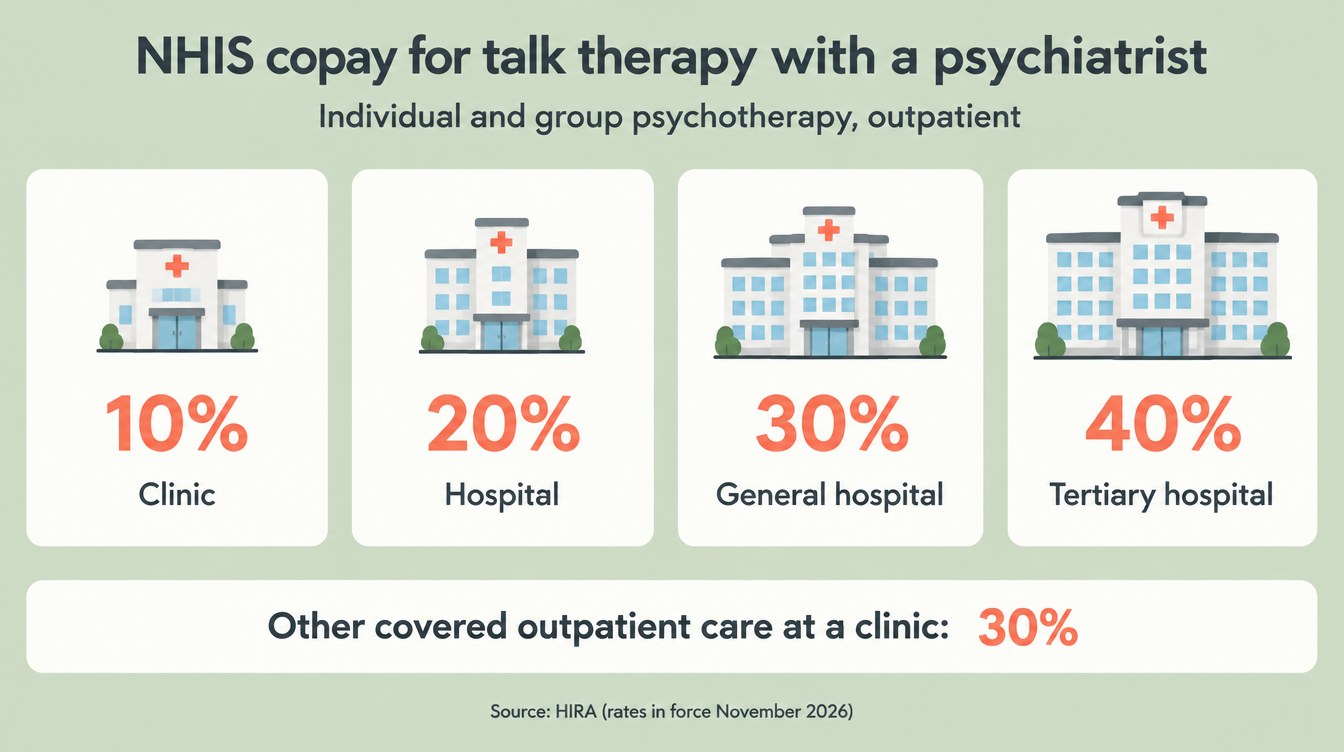
| Type of institution | Ordinary covered outpatient care (under 65, city area) | Individual or group psychotherapy (아-1, 아-2) |
|---|---|---|
| Clinic (의원) | 30% | 10% |
| Hospital (병원) | 40% | 20% |
| General hospital (종합병원) | 50% | 30% |
| Tertiary hospital (상급종합병원) | 100% of the consultation fee + 60% of the rest | 40% |
Source: HIRA outpatient copayment pages. The psychotherapy rates come from the 2018 change to the NHIS Enforcement Decree (Annex 2, item 3-파), in force since 1 July 2018 (HIRA notice). The Central Mental Health Support Unit confirms the 20-percentage-point cut at every tier. Lower rates apply to children under 6, and fixed amounts apply to people 65 and over for small clinic bills.
Worked example (our calculation, illustrative amounts): say a first clinic visit has ₩40,000 of covered costs, of which ₩30,000 is individual psychotherapy and ₩10,000 is everything else. At HIRA’s rates you would pay 10% of ₩30,000 (₩3,000) plus 30% of ₩10,000 (₩3,000), so ₩6,000, plus any medicine at the pharmacy. The same visit at a general hospital would come to ₩9,000 + ₩5,000 = ₩14,000. Real fees depend on how long the session lasts and which tests are done. Ask the reception desk for an estimate.
About your record: since 1 April 2013, MOHW has let psychiatrists bill a first visit that involves talk only, with no medication, under a general-counselling code (Z code) instead of a psychiatric diagnosis code (F code). This applies to first-time patients only, and the doctor decides. They may still bill an F code (MOHW release, 19 February 2013, also reported by Metro Seoul). If this matters to you, for example for a visa or an insurance application, ask before the consultation starts.
Without NHIS (tourists, or residents not yet enrolled), you pay the full price. Check whether your travel or private insurance covers mental health care, and ask for an itemised receipt and an English medical certificate if you plan to claim.
Counselling vouchers: why most foreigners can’t use them
Korea subsidises private one-to-one counselling through the mental health counselling voucher (정신건강 심리상담 바우처, formerly 전국민 마음투자 지원사업). In 2026 it covers 8 sessions of at least 50 minutes, priced at ₩80,000 (grade-1 counsellor) or ₩70,000 (grade-2) per session. Your share is 0% to 50%, depending on income. You need a referral, for example from a mental health welfare centre, a psychiatrist’s note, or a PHQ-9 score of 10 or more on the national checkup. However, both Songpa-gu and Wonju health centre pages state that foreign nationals are not eligible unless they have naturalised and hold a Korean resident registration number. If you hold an Alien Registration Card, you can still use the public centres and NHIS psychiatry described above.
The national checkup’s depression questionnaire, which NHIS-enrolled foreigners can also get at the checkup ages, is explained in our PHQ-9 checkup guide. If your sheet says “moderate depression suspected”, that guide covers the follow-up visit.
Winter blues or something more?
Korea’s winter days are short. On the winter solstice, Tuesday 22 December 2026, KASI lists sunrise at 07:43 and sunset at 17:18, about 9 hours 35 minutes of daylight. Timeanddate.com gives the same times to within a minute for Seoul. If you work office hours, you may leave home before sunrise and come back after dark for weeks.
The US National Institute of Mental Health (NIMH) separates the common “winter blues” from seasonal affective disorder (SAD), a type of depression that returns each autumn or winter and eases in spring. NIMH lists depression symptoms that last at least 2 weeks: low mood most of the day, loss of interest, low energy, changes in sleep or appetite, and thoughts of death or suicide. Winter-pattern SAD can add oversleeping, carbohydrate cravings and social withdrawal. NIMH also notes that SAD is tied to daylight, not to holiday stress. Only a health professional can tell the difference. If symptoms last two weeks or more, or get in the way of work or daily life, book a clinic visit or call 1577-0199. If you have any thoughts of suicide, call 109 now.
New arrivals often face extra pressures: distance from family, the language barrier and the first-winter routine. Our first 90 days in Korea guide covers registration, phones and banking, so those don’t add to the load.
A 5-minute plan to do today
- Save these numbers in your phone: 119, 109, 1577-0199, 1330 and 1577-1366.
- Find your local mental health welfare centre (call 1577-0199 or search mentalhealth.go.kr) and note its office number.
- Check your NHIS status if you are a resident, so a clinic visit is billed at the insured rate.
- Write two lines in Korean in your notes app: your address, and “영어 통역 부탁합니다” (English interpreter, please).
- Tell one person (a friend, colleague or family member at home) how to reach 109 or 119 for you if needed.
Common problems
- “109 rang and rang.” MOHW’s 2026 figures show waits are common. Hold if you can, or text 109, use Madeullan, or call 1577-0199 or 1588-9191. In immediate danger, call 119.
- “The counsellor only spoke Korean.” Hang up and call 1330 or Danuri (1577-1366) to set up an interpreted three-way call, or ask a Korean-speaking friend to sit with you.
- “I’m not sure I’m ‘ill enough’ to call.” 1577-0199 handles general mental health counselling, information and referrals as well as crises (MOHW). You don’t need a diagnosis to call.
- “I’m worried a psychiatry visit will show up on my record.” Ask about the Z-code rule for a talk-only first visit, and remember the doctor decides. NHIS data are protected by law, as MOHW’s 2013 release notes.
FAQ
Q. What number do I call in Korea if I’m feeling suicidal?
Call 109, Korea’s suicide-prevention line, 24 hours a day, or text 109. If you or someone else is in immediate danger, call 119. If you need English, ask for an interpreter, or call 1330 or Danuri (1577-1366) to set up an interpreted three-way call.
Q. Is there an English mental health hotline in Korea?
MOHW’s 109 and 1577-0199 lines run in Korean. Danuri (1577-1366) answers in 13 languages, including English, 24 hours a day, and can interpret three-way calls. The 1330 travel hotline also has English-speaking operators.
Q. Is 1577-0199 still working?
Yes. MOHW says suicide-prevention counselling moved to 109 on 1 January 2024, but the 1577-0199 mental health line still runs as before. It connects you to the nearest mental health welfare centre, or to the metropolitan centre at night and on public holidays.
Q. Can foreigners use community mental health welfare centres?
The government’s Gov24 listing says anyone who lives in the community can use them, with no nationality condition. Korea Policy Briefing says most programmes are free. Call ahead to ask about interpretation.
Q. Does NHIS cover therapy with a psychiatrist?
Yes, for NHIS enrollees. Individual and group psychotherapy is charged at a reduced share: 10% at a clinic, 20% at a hospital, 30% at a general hospital and 40% at a tertiary hospital (HIRA). Other covered outpatient care at a clinic is 30%.
Q. Can foreigners get the government counselling voucher?
Generally no. District health centre pages for the 2026 mental health counselling voucher (8 sessions) say foreign nationals are not eligible unless they have naturalised and hold a Korean resident registration number.
General information, not medical advice. If you are in crisis, call 109 (24 hours, call or text) or 119 for immediate danger. Diagnosis and treatment decisions are for a doctor or mental health professional. Services, hours and copayments are as published by MOHW, HIRA and the other sources below on the dates shown; NHIS (1577-1000) can confirm your own cover.
Sources
- MOHW 129/109 Health and Welfare Call Centre, suicide-prevention line page and FAQ (24-hour 109, Madeullan, consolidation from 1 January 2024, 1577-0199/1388/1366 continue, confidentiality and referral with consent; related lines 1588-9191, 1388, 1577-0199): https://www.129.go.kr/109/index.do
- MOHW, “Suicide prevention line 109 doubles counsellors to raise answer rate” (site visit and plan, 29 May 2026): https://www.mohw.go.kr/gallery.es?act=view&bid=0003&list_no=380102&mid=a10605040000
- MOHW, mental health crisis line 1577-0199 (routing to local and metropolitan centres; last updated 19 August 2025): https://www.mohw.go.kr/menu.es?mid=a10706040100
- MOHW, metropolitan mental health welfare centres list (updated 24 April 2025): https://www.mohw.go.kr/menu.es?mid=a10706040200
- National Center for Mental Health, 2026 H1 national directory of mental health institutions (as of 31 December 2025; PDF hosted by the Jeonbuk metropolitan centre): https://jbmhc.or.kr/inc/download.php?dataPath=stat_board1&filename=★_2026년_상반기_전국_정신건강관련_기관_현황집.pdf
- Gov24 service listing, mental health welfare centres (17 metropolitan, 246 local in 2024; anyone in the community; updated 28 November 2025): https://www.gov.kr/portal/rcvfvrSvc/dtlEx/GMW000000140
- Korea Policy Briefing, “When your mind hurts, there’s the mental health welfare centre” (29 March 2024): https://www.korea.kr/news/policyNewsView.do?newsId=148927242
- Korea Policy Briefing card, “Madeullan” text counselling: https://www.korea.kr/multi/visualNewsView.do?newsId=148974736
- Madeullan (Korea Foundation for Suicide Prevention), service guide: https://www.madeullan.or.kr/consult/guide
- National Center for Mental Health portal, facility search: https://mentalhealth.go.kr/portal/health/fac/PotalHealthFacListTab1.do
- HIRA, outpatient copayment rates by institution type: https://www.hira.or.kr/dummy.do?pgmid=HIRAA030056020110
- HIRA, notice on reduced outpatient psychotherapy copayments (from 1 July 2018, PDF): https://www.hira.or.kr/bbs/157/2018/07/BZ201807033915532.pdf
- MOHW press release, talk-only psychiatry visits may be billed under a Z code from 1 April 2013 (19 February 2013): https://www.mohw.go.kr/board.es?act=view&bid=0027&list_no=282387&mid=a10503010300
- Songpa-gu Public Health Center, mental health counselling voucher 2026 (eligibility, prices, foreigner rule): https://www.songpa.go.kr/ehealth/contents.do?key=6081
- Wonju Public Health Center, mental health counselling voucher (foreigner rule, prices): https://www.wonju.go.kr/health/contents.do?key=6231
- GOV.KR foreigner portal, Danuri Call Center 1577-1366: https://www.gov.kr/portal/foreigner/en/m030401
- VISITKOREA, “Disaster Safety Services for International Visitors in Korea” (112/119 interpreter, 2 October 2025): https://english.visitkorea.or.kr/svc/contents/contentsView.do?vcontsId=248145
- VISITKOREA, “Emergency Situations” (1330 languages, 119; updated 11 September 2026): https://english.visitkorea.or.kr/svc/contents/infoHtmlView.do?vcontsId=140042
- KASI, monthly astronomical calendar for December 2026 (sunrise and sunset, solstice): https://astro.kasi.re.kr/life/pageView/7?mm=12&yyyy=2026
- NIMH, “Seasonal Affective Disorder” (revised 2023): https://www.nimh.nih.gov/health/publications/seasonal-affective-disorder
- Central Mental Health Support Unit (NMHC), psychotherapy fee reform and copay cut: https://www.nmhc.or.kr/sub.php?id=news&idx=247&menukey=16&mode=view&page=8
- The Korea Herald, “Korea’s suicide fix starts with answering calls” (31 May 2026): https://www.koreaherald.com/article/10759801
- The Korea Times, “Korea increases hotline staff for suicide prevention calls, boosts multilingual support” (1 June 2026): https://www.koreatimes.co.kr/southkorea/health/20260601/korea-increases-hotline-staff-for-suicide-prevention-calls-boosts-multilingual-support
- Newsis, “Foundation adds multilingual support for foreign residents and marriage migrants” (3 September 2025): https://www.newsis.com/view/NISX20250903_0003313870
- Metro Seoul, “Talk-only psychiatry visits leave no claim record” (19 February 2013): https://www.metroseoul.co.kr/article/2013021900088
- Seoul Metropolitan Government, 1577-0199 crisis line page (365 days, 24 hours; updated 27 April 2026): https://news.seoul.go.kr/welfare/archives/561837
- Timeanddate.com, Seoul sunrise and sunset, December 2026: https://www.timeanddate.com/sun/south-korea/seoul?month=12&year=2026
How we checked: On 15 November 2026 we read the MOHW 109, 1577-0199 and centre-list pages, the MOHW 29 May 2026 release, the National Center for Mental Health’s 2026 directory (PDF), the Gov24 listing, both HIRA copay sources, the 2013 MOHW release, both district voucher pages, GOV.KR, VISITKOREA, KASI and NIMH. We matched each number and rule against the second source listed. The worked copay example is our own arithmetic on illustrative amounts. The 1330-to-109 relay comes from one news report only, and we found no official page confirming language support on 109 or 1577-0199. Both points are flagged in the text.
Researched and drafted with AI assistance; checked against the sources listed.