Stroke Warning Signs: What the CDC, NHS and Korea’s KDCA Say (and Which Number to Call)
By the Haesul Global health desk (AI-assisted). Information as of October 16, 2026 (KST). World Stroke Day is October 29.
Quick answer: The warning signs of stroke come on suddenly: weakness or numbness on one side of the face, arm or leg; trouble speaking or understanding; trouble seeing; dizziness or loss of balance; and a severe headache with no known cause. The CDC, NHS and KDCA all say to call an ambulance right away, even if the symptoms go away. (Each agency’s emergency number is in the table below.)
The World Stroke Organization’s focus for World Stroke Day 2026 (October 29) is knowing the signs of stroke. Here is how three national health agencies describe them, side by side.
1) The signs, agency by agency
| Sign | CDC (US) | NHS (UK) | KDCA (Korea) |
|---|---|---|---|
| One-sided weakness/numbness | Face, arm or leg, especially one side | Face droop, arm weakness; one side of body | Sudden one-sided paralysis or numbness of arm/leg |
| Speech | Trouble speaking or understanding; confusion | Slurred words, sounding confused, finding words | Slurred speech or not understanding others |
| Vision | Sudden trouble seeing | Blurred vision or loss of sight in 1 or both eyes | Loss of sight in one eye, double vision, or loss of half the visual field |
| Balance | Trouble walking, dizziness, loss of balance | Feeling dizzy or falling over | Dizziness, loss of balance, trouble controlling limbs |
| Headache | Sudden severe headache, no known cause | A severe headache | Very severe headache “like being struck by lightning or a hammer” |
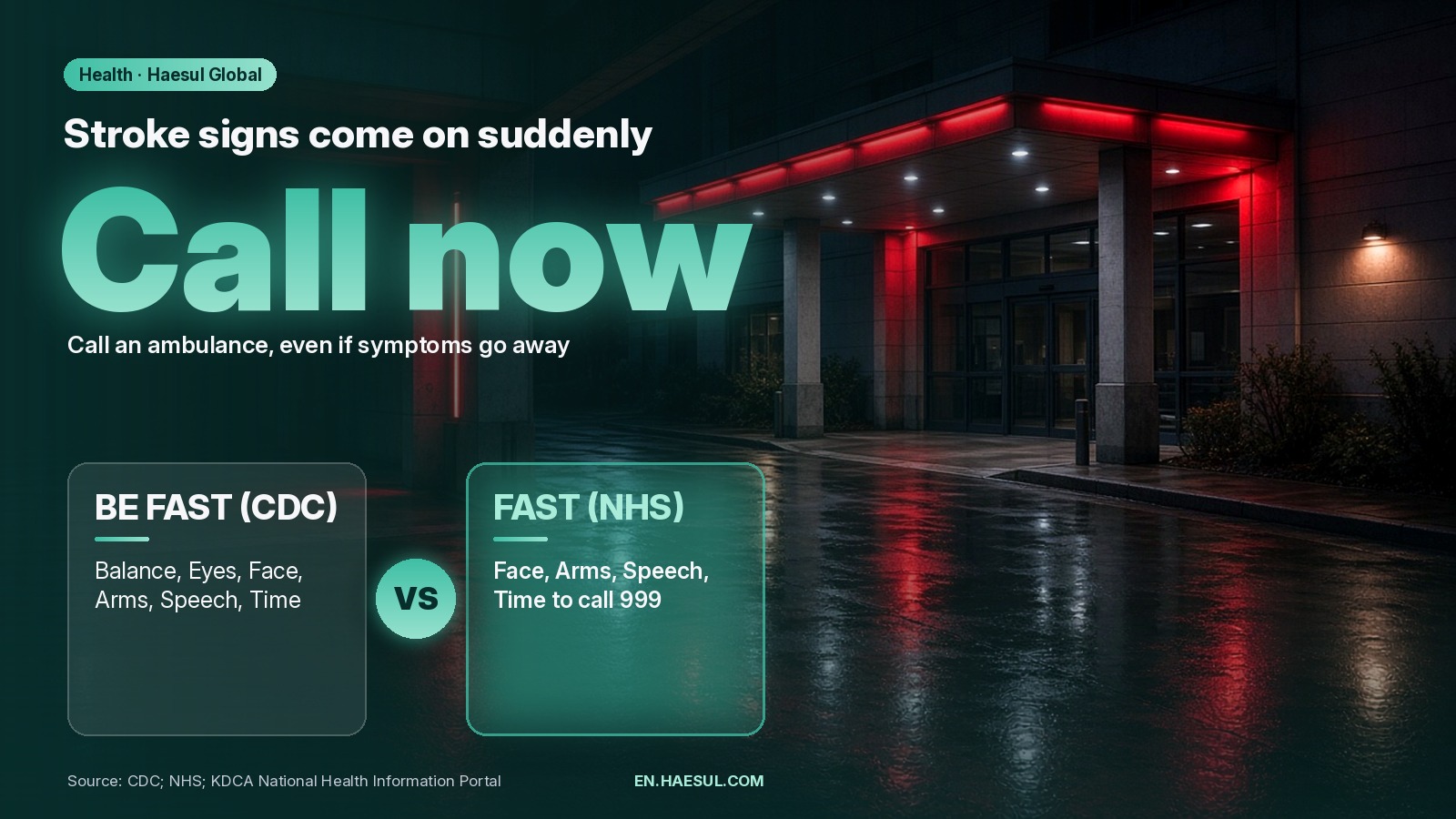
| Memory aid | BE FAST (Balance, Eyes, Face, Arms, Speech, Time) | FAST (Face, Arms, Speech, Time to call 999) | Five main signs (no acronym) |
| Emergency number | 911 | 999 | 119 |
Why the acronyms differ: The NHS’s FAST covers the three main signs (face, arms, speech). The CDC’s BE FAST adds Balance and Eyes, which KDCA also lists among its five main signs. The NHS lists dizziness and vision problems as “other symptoms.” KDCA notes that tingling alone, or both arms or both legs going weak at the same time, is not one-sided paralysis.
2) Why minutes matter
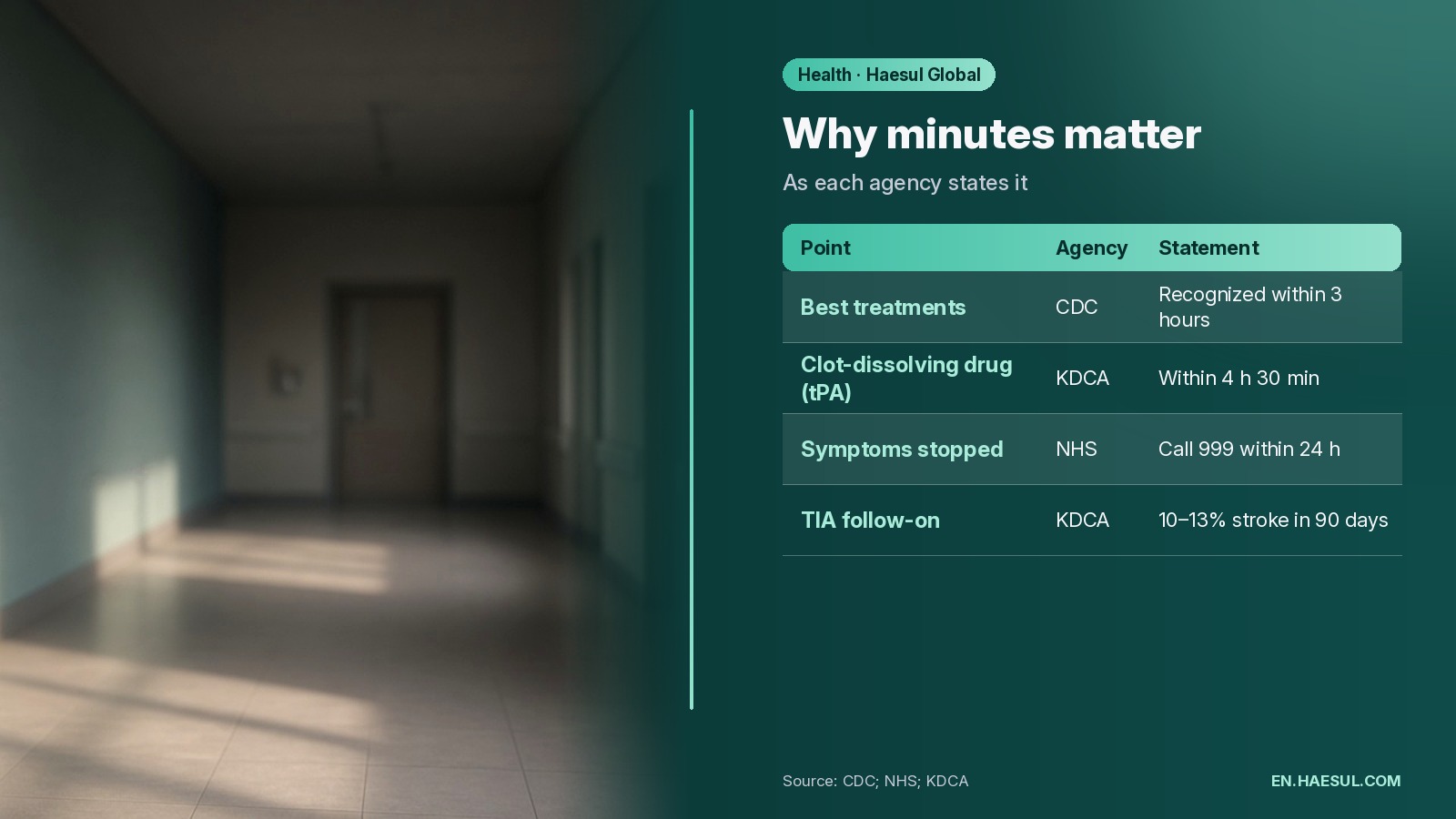
- CDC: the stroke treatments that work best are available only if the stroke is recognized and diagnosed within 3 hours of the first symptoms. Note the time symptoms started.
- KDCA: clot-dissolving medicine (tPA) can be tried within 4 hours 30 minutes of symptom onset; clot removal procedures may be tried later in some patients, so go to hospital even after 4.5 hours.
- These two time frames describe different things (CDC: the window for the best treatments to be recognized; KDCA: the tPA window). Neither changes the advice: call immediately.
- Don’t drive yourself. The CDC and NHS both say to call for an ambulance rather than drive.
3) If symptoms go away: TIA (“mini-stroke”)
- CDC: if symptoms go away after a few minutes, it may have been a transient ischemic attack (TIA) — a sign of a serious condition. Tell a health care team right away.
- NHS: call 999 if you’ve had signs of a stroke within the last 24 hours, even if they’ve stopped.
- KDCA: after a TIA, stroke recurs in about 10–13% within 90 days, about half of those within the first two days; it should be assessed like an acute stroke.
4) What not to do (KDCA)
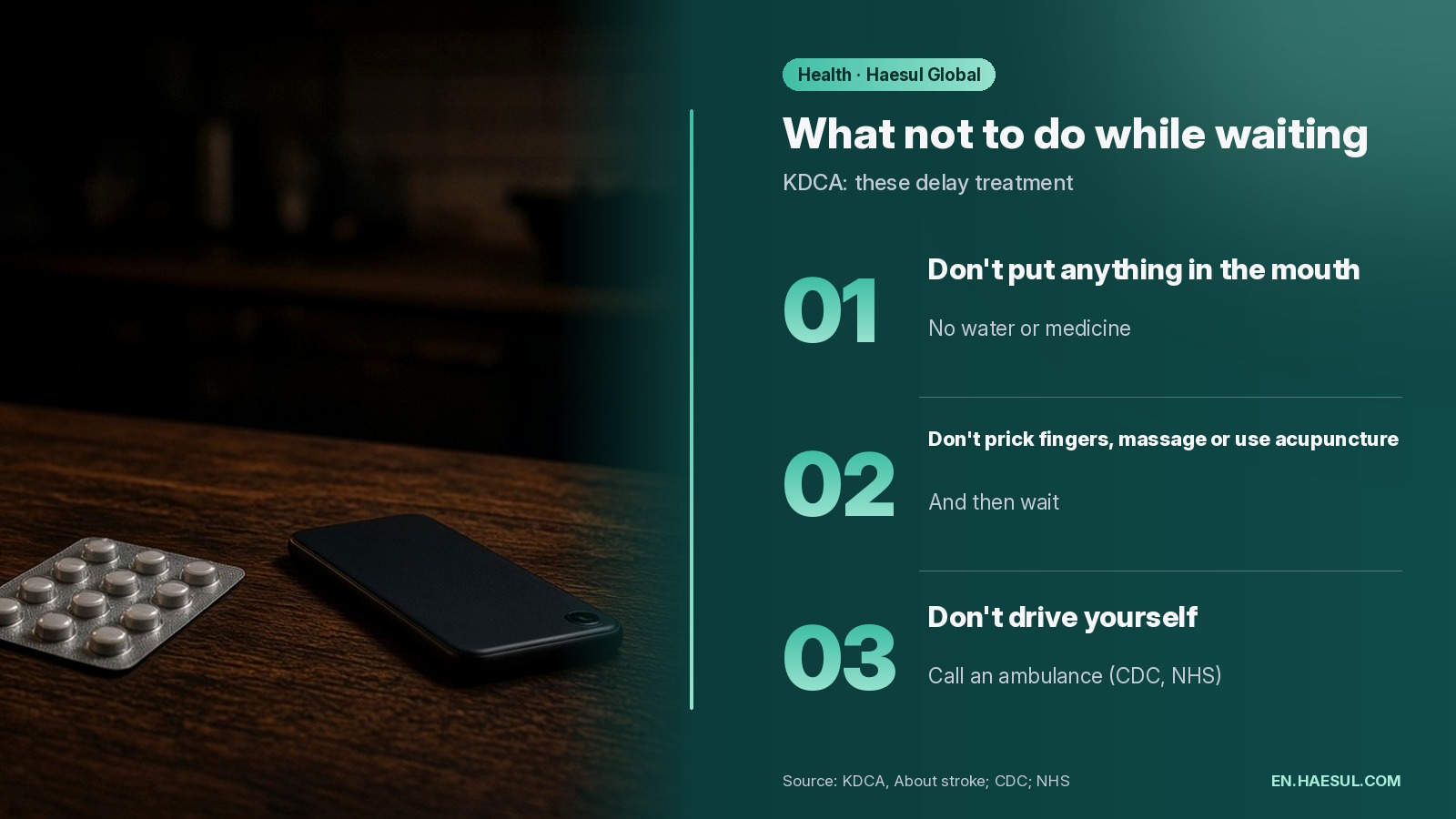
KDCA lists actions that delay treatment and put the person at more risk:
- Pricking the fingertips and waiting
- Putting water, medicine or anything else in the person’s mouth
- Massaging the arms and legs while waiting
- Having acupuncture and waiting
5) Korea context (KDCA)
- According to KDCA, there were about 110,000 strokes in 2022; men about 1.2 times more than women; rates rise with age, highest at 80+.
- KDCA says stroke is Korea’s fourth leading cause of death, after cancer, heart disease and pneumonia (KDCA health portal).
- Modifiable risk factors listed by KDCA include high blood pressure (3–5 times the risk), diabetes (2–3 times), smoking (1.5–3 times), abnormal cholesterol, atrial fibrillation, obesity and physical inactivity.
FAQ
Which number do I call in Korea?
119, according to KDCA. The NHS (999) and CDC (911) give their own countries’ numbers.
Can young people have a stroke?
The NHS says a stroke is more likely if you’re older but can happen at any age.
The symptoms lasted a few minutes and stopped. Is it over?
All three agencies say to get medical help right away; a TIA is a warning of higher stroke risk.
This article summarizes public information from the CDC, NHS and KDCA. It is not medical advice. If you think someone is having a stroke, call your local emergency number now.
Korean-language version: 뇌졸중 전조증상 (Naver blog).
Sources
- US CDC, “Signs and Symptoms of Stroke” (updated May 19, 2026; checked Oct 16, 2026) https://www.cdc.gov/stroke/signs-symptoms/index.html
- NHS, “Symptoms of a stroke” (checked Oct 16, 2026) https://www.nhs.uk/conditions/stroke/symptoms/
- KDCA National Health Information Portal, “뇌졸중” (updated Apr 29, 2026; checked Oct 16, 2026) https://health.kdca.go.kr/healthinfo/biz/health/gnrlzHealthInfo/gnrlzHealthInfo/gnrlzHealthInfoView.do?cntnts_sn=5495
- KDCA National Health Information Portal, “뇌졸중에 대해서” (checked Oct 16, 2026) https://health.kdca.go.kr/healthinfo/biz/health/ccvdInfo/ccvcdInfo/cbvcacdInfoMain.do
- World Stroke Organization, World Stroke Day campaign (checked Oct 16, 2026) https://www.world-stroke.org/world-stroke-day-campaign