Alaska LNG and the $54 Billion Figure: What Washington and Seoul Each Say
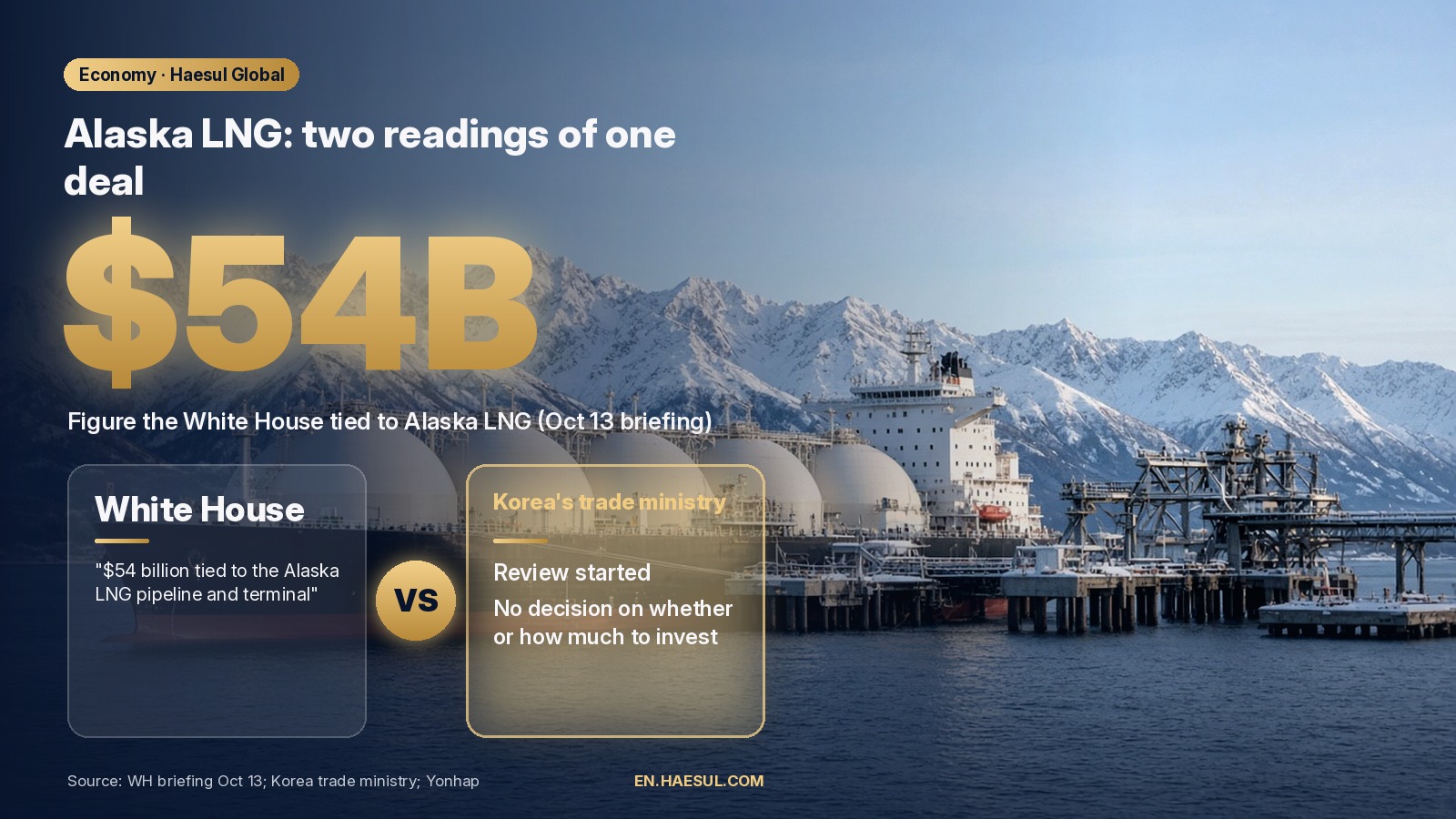
On October 13 (US time), new White House Press Secretary Katie Zacharia said $54 billion of a South Korean energy investment package is “tied to” the Alaska LNG project. South Korea’s trade ministry has said since October 1 that Seoul has only agreed to start reviewing the project, and that nothing has been decided about whether it will invest or how much. This explainer sets out what each government has said, in its own words, and what the two countries’ joint fact sheet says.
Key points
- White House (Oct 13): “there is $54 billion tied to the Alaska LNG pipeline and terminal.”
- Korea’s trade ministry (Oct 1): the two countries agreed to begin reviewing the project. Whether to proceed will be decided only if commercial-viability and domestic legal conditions are met. The ministry said “nothing has been decided” on whether to invest or how much.
- Joint fact sheet: the two countries “agreed to commence working on” Alaska LNG, subject to “commercial reasonableness” and domestic legal requirements. It gives no dollar figure for Alaska.
What the White House said
In her first briefing, Zacharia listed the Korean package among the administration’s investment wins. According to a transcript of the October 13 briefing, she said:
“President Trump also unveiled a South Korea energy investment package of up to $200 billion in the United States. This is an amazing deal. This includes as much as $120 billion to build eight large scale nuclear power plants…”
“…there is $54 billion tied to the Alaska LNG pipeline and terminal to service the Pacific Rim and sell fuel to our allies, as well as $22.3 billion for a six gigawatt natural gas power facility in Texas.”
The White House has posted video of the briefing but no written transcript. The same wording was reported by Yonhap via The Korea Herald.
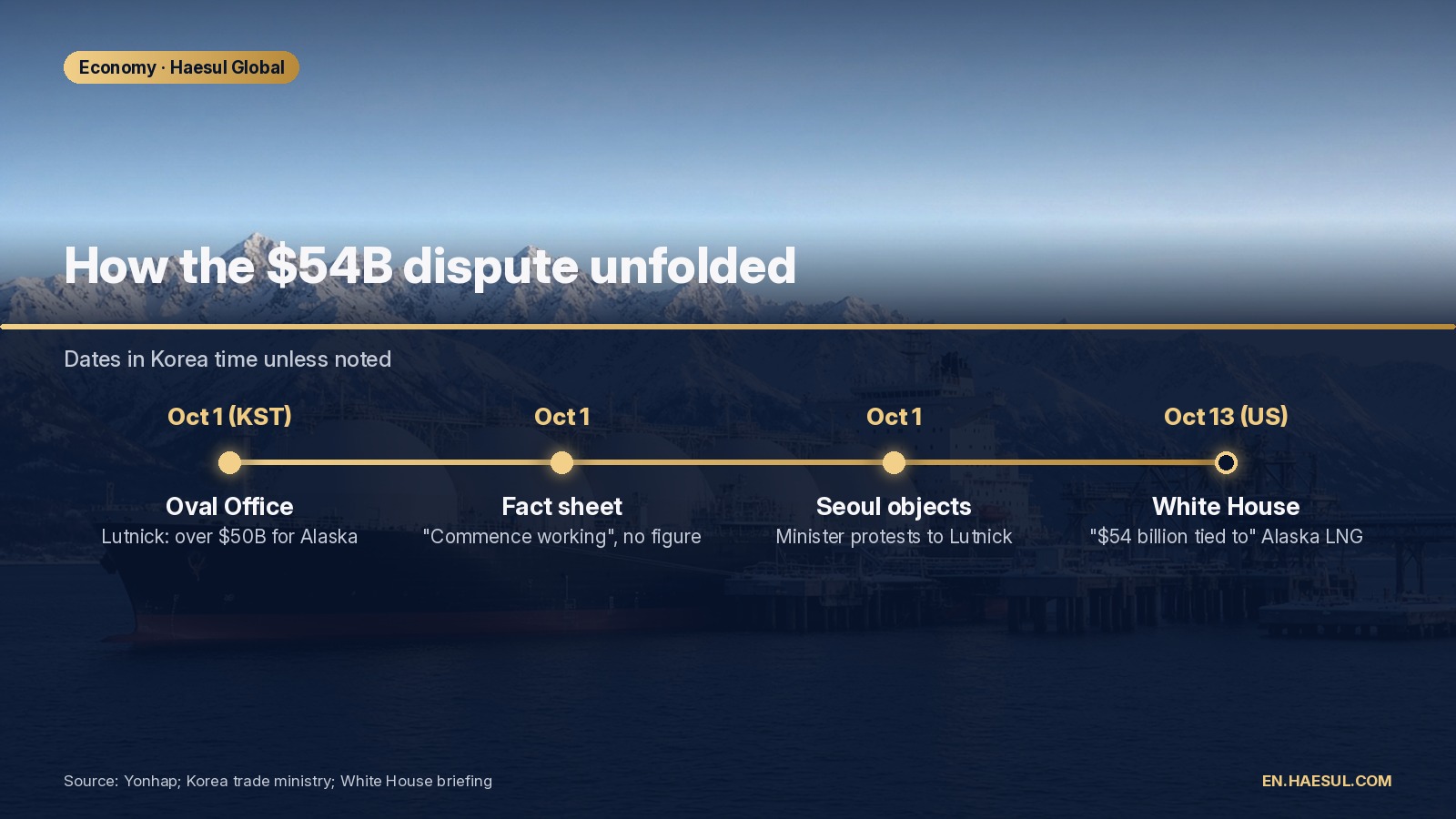
This was not the first time a figure came up. At the Oval Office announcement on September 30 (US time), Commerce Secretary Howard Lutnick said over $50 billion would be invested in the Alaska project, Yonhap reported.
What Korea’s trade ministry said
The Ministry of Trade, Industry and Resources (산업통상부) published its official release on October 1. It describes Alaska LNG (“Project North”) as a project to build a large pipeline carrying natural gas from northern Alaska to the south, plus an LNG export terminal. It then says (our translation):
“The two countries have decided to begin a review of the project.” … “If the commercial reasonableness requirement under the Korea-US Strategic Investment MOU and the conditions under relevant domestic law are met, [we] will decide whether to proceed with the project.”
The ministry also told reporters that the Alaska project “is about beginning a review, premised on commercial reasonableness under the MOU and relevant domestic legal procedures,” and that “nothing has been decided on whether to invest or on the size of any investment” (Yonhap, our translation).
At a briefing the same day, Trade Minister Kim Jung-kwan said he had “strongly objected” to Lutnick about the announcement. He added that “what the two countries agreed on Alaska is the three sentences in the fact sheet, and that is all.” Figures and definitive wording, he said, went “much further than what was agreed” (Yonhap, our translation). Kim said Lutnick replied that he understood Korea’s concern.
What the joint fact sheet says
The fact sheet released by the US Commerce Department says the “two countries have agreed to commence working on the Alaska LNG project, subject to meeting ‘commercial reasonableness’ under the Strategic Investment memorandum of understanding (MOU) and all applicable domestic legal requirements” (Yonhap). It gives a dollar figure for the Texas plant and the nuclear program, but not for Alaska LNG (Alaska News).
If the project does go ahead, Korea’s release says the US would create favourable conditions for Korean suppliers, including lower tariffs on materials such as steel, and would give Korea priority access to the LNG the project produces.
Context for global readers
Where this comes from. The projects fall under the 2025 Korea-US trade agreement. In that deal Korea committed to invest $350 billion in the United States ($150 billion for shipbuilding and the rest for strategic investments) in return for lower US tariffs, which went down to 15% from 25% (Yonhap). Korea’s release says strategic investment is capped at $20 billion a year and $200 billion in total. Returns are split 50:50 until the principal is recovered.
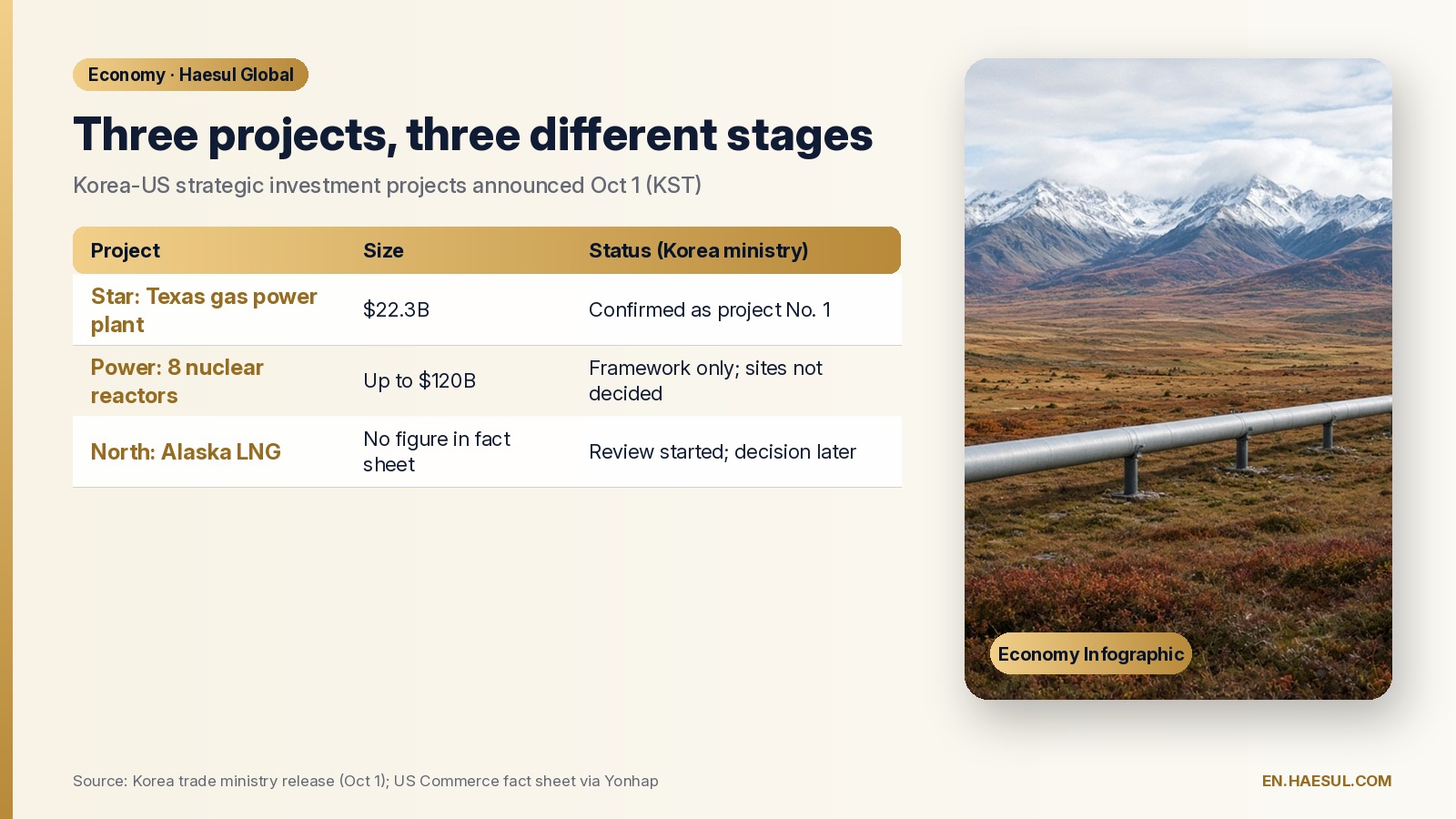
The three projects are at different stages. According to Korea’s release:
– Project Star, a $22.3 billion, 6,472MW gas-fired plant in Encinal, Texas, is the first official project. It has completed the commercial review and the domestic procedures.
– Project Power covers up to $120 billion for eight reactors (two APR1400 and six AP1000): $100 billion in construction costs plus $20 billion in contingency. Individual projects are still to be decided.
– Alaska LNG is at the review stage.
The project itself. Yonhap describes a 1,298-kilometer pipeline from the North Slope to southern Alaska, where the gas would be liquefied for shipment to Asia. Alaska News reports that developer Glenfarne owns 75% and the state owns 25%, and that the project has not reached a final investment decision.
Since then. At a National Assembly audit on October 6, Kim pointed to new strategic value for the project after the Middle East war. He said it had not gone ahead before because its commercial viability was low. He still said it remained at the review stage and that commercial reasonableness is the precondition. Opposition lawmaker Choi Su-jin argued that the mismatched announcements had damaged diplomatic trust (Yonhap).
What to watch
- Kim said Seoul is waiting for US material on steps to improve the project’s commercial viability, such as federal help with permits and labour.
- Any decision to proceed would, by the ministry’s own account, have to pass the MOU’s commercial-reasonableness test and Korea’s domestic legal procedures first.
FAQ
Has Korea committed $54 billion to Alaska LNG?
Korea’s trade ministry says no decision has been made on whether to invest or how much. The White House press secretary said $54 billion is “tied to” the project. The joint fact sheet contains no dollar figure for Alaska.
What did both governments actually sign off on?
The joint fact sheet says they agreed to “commence working on” Alaska LNG, subject to commercial reasonableness and domestic legal requirements. Korea’s minister says those sentences are the whole agreement on Alaska.
Which project is confirmed?
Korea’s ministry says Project Star, the $22.3 billion gas power plant in Texas, is the first official project.
This article is for information only and is not investment advice.
Sources
- White House, Press Secretary Katie Zacharia briefing video, Oct 13, 2026 — https://www.whitehouse.gov/videos/press-secretary-katie-zacharia-briefs-members-of-the-media-oct-13-2026/ (2026년 10월 14일 확인)
- Briefing transcript (Trump Archive), Oct 13, 2026 — https://trump-archive.com/item/f791f69f-ef04-48ed-be55-a6ea1c5c1bab (2026년 10월 14일 확인)
- The Korea Herald / Yonhap, “New White House spokesperson says $54b tied to Alaska gas project…” — https://www.koreaherald.com/article/10901822 (2026년 10월 14일 확인)
- 산업통상부, (참고자료) 한미 전략투자 프로젝트 추진 계획 발표, Oct 1, 2026 — https://www.motir.go.kr/kor/article/ATCL3f49a5a8c/172253/view?pageIndex=1 (2026년 10월 14일 확인)
- 연합뉴스, Oct 1, 2026 — https://www.yna.co.kr/view/AKR20261001082800003 (2026년 10월 14일 확인)
- 연합뉴스, 산업장관 “알래스카 발표 이의제기…”, Oct 1, 2026 — https://www.yna.co.kr/view/AKR20261001144600003 (2026년 10월 14일 확인)
- 연합뉴스, Oct 6, 2026 — https://www.yna.co.kr/view/AKR20261006104100003 (2026년 10월 14일 확인)
- Yonhap News Agency (English), Trump unveils S. Korea’s investment plans… — https://en.yna.co.kr/view/AEN20261001000854315 (2026년 10월 14일 확인)
- Alaska News, Seoul protested U.S. Alaska LNG announcement… — https://alaskanews.com/c/alaska-news/seoul-protested-us-alaska-lng-announcement-says-investment-remains-under-review (2026년 10월 14일 확인)